
Investing
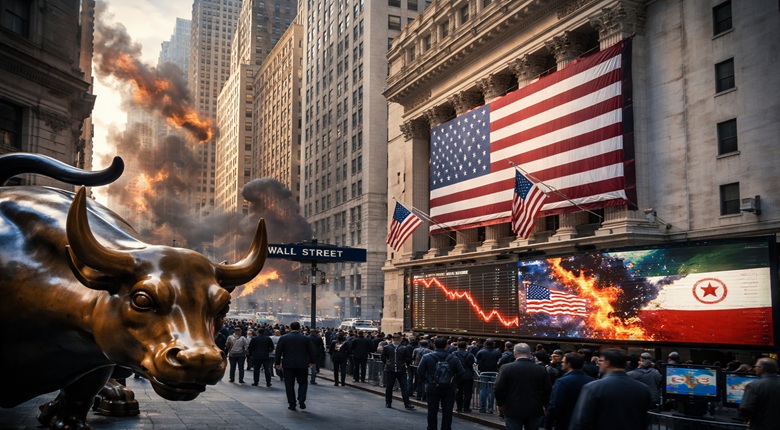
Wall Street Strategy: Navigating the US–Iran Conflict

Table of Contents
- War, Oil, and Record Highs
- How the Conflict Began and Where It Stands
- The Strait of Hormuz: Why It Moves Markets
- Wall Street’s Three Scenario Framework
- Goldman Sachs: Rebuild the 60/40 for Wartime
- Morgan Stanley: Rotate to Quality and Defense
- Charles Schwab: Watch the Hormuz Signposts
- The ‘TACO Trade’ and Market Psychology
- Sectors to Watch: Winners and Pressure Points
- What Long-Term Investors Should Actually Do
- Conclusion: Uncertainty Has a Price — and a Strategy
- Frequently Asked Questions
- External References and Further Reading
War, Oil, and Record Highs
In the final week of April 2026, the S&P 500 closed above 7,100 for the first time in history. The Nasdaq Composite was on its longest winning streak since 1992. The Dow Jones Industrial Average had recovered all its losses from the start of the year in a single session.All of this happened against the backdrop of an active military conflict between the United States and Iran — a conflict that had shut down traffic through the Strait of Hormuz, sent Brent crude oil surging past $100 per barrel, triggered food price warnings from global commodity analysts, and prompted the International Energy Agency to describe it as the “greatest global energy security challenge in history.”
The disconnect between Main Street and Wall Street has rarely been more visible. For strategists at the major Wall Street firms, navigating this environment has required an unusual blend of geopolitical scenario planning, energy market analysis, inflation forecasting, and a clear-eyed assessment of how investors have been conditioned to respond to Donald Trump’s pattern of rhetorical escalation followed by policy reversal. This blog post consolidates what the major firms are saying, what frameworks they are using, and what investors at every level of sophistication need to understand.
How the Conflict Began and Where It Stands
On February 28, 2026, the United States and Israel conducted joint military strikes against Iran in an operation dubbed “Operation Epic Fury” by the Trump administration. The strikes killed Iran’s Supreme Leader, Ali Khamenei, along with several other top Iranian officials and reportedly sank nine Iranian navy ships. Iran responded with retaliatory attacks across the Gulf, effectively shutting down traffic through the Strait of Hormuz, the narrow waterway that carries approximately 20% of global oil and LNG supply.Brent crude, trading at approximately $80 per barrel at the start of March, surged to over $102 per barrel by mid-April — a gain of more than 27% in six weeks. Some spot market cargoes traded at premiums approaching $150 per barrel as buyers scrambled to secure supply.
On April 7, the US and Iran announced a two-week ceasefire, conditional on the opening of the Strait. Markets rallied sharply. But the ceasefire proved tenuous, with both sides accusing the other of violations. Peace talks in Pakistan broke down after the Iranian delegation refused to agree to American demands that Iran abandon its nuclear weapons programme. By April 17, with Iran announcing the Strait was “completely open” during the ceasefire, Brent crude fell sharply and the S&P 500 hit new records. Whether those gains hold depends entirely on what happens next.
Current status: As of April 18, 2026, a tenuous ceasefire is in place. The US naval blockade of Iran remains. No permanent peace deal has been signed. The IEA has reported that Middle Eastern refineries have cut production by approximately 6 million barrels per day. Market conditions remain highly event-driven.
The Strait of Hormuz: Why It Moves Markets
To understand why Wall Street strategists are so focused on a narrow stretch of water between Iran and Oman, consider the numbers. The Strait of Hormuz is approximately 21 miles wide at its narrowest point. Through it passes roughly 20% of the world’s seaborne crude oil and a significant portion of global LNG supply. Asian economies — China, India, Japan, South Korea — receive 75% of the oil and 59% of the LNG exports that flow through it.Iran’s closure of the Strait has caused what the IEA has described as the largest supply disruption in the history of the global oil market. Its economic effects radiate outward rapidly: oil price spikes feed directly into gasoline prices for consumers, input costs for manufacturers, transport costs for retailers, and the inflation calculations that determine central bank policy. The US, buffered by domestic shale production, faces less direct exposure than Asian importers — but US gasoline prices rose approximately 5 to 10 cents per gallon daily in early March, reaching $4 per gallon by March 31.
The Morgan Stanley Research team noted that even if the Strait reopens in the near term, it could take months for oil and gas production to normalise, “creating a more prolonged supply shock and higher prices.” Their revised forecast of $80 to $90 per barrel for Brent for full-year 2026 — up from a prior forecast of $60 — reflects this assessment. Some scenarios price Brent at $100 to $110 per barrel if the conflict remains elevated, with tail-risk scenarios approaching $130 if the war extends into mid-year.
Wall Street’s Three Scenario Framework
Virtually every major Wall Street firm has organised its Iran conflict analysis around a scenario framework, typically involving a short-resolution case, a moderate-friction case, and a severe or prolonged case. The Morgan Stanley version is among the most detailed and widely cited.| Scenario | Oil Price Outlook | Market / Economic Implication |
| Resolution (short conflict) | $65–$80 by year-end | Risk-on rally; tech, consumer, airlines rebound; Fed cuts resume |
| Moderate (Hormuz disruptions persist) | $100–$110 average 2026 | Selective gains in high-quality equities; rate cut delays; elevated inflation |
| Severe (prolonged conflict) | $130+ / global recession risk | Defensive rotation; stagflation risk; sharp equity correction possible |
Charles Schwab has framed its analysis similarly, describing the Moderate and Severe scenarios as “currently most likely” as of early April, with uncertainty remaining high. “Market volatility is likely to remain high with headline risk driving short-term swings,” their strategists wrote, adding that key signposts include whether the ceasefire truce holds and how quickly energy infrastructure can normalise.
Invesco strategists made the same observation from a different angle: “Markets crave narrative closure more than calendar precision.” The market, they argued, has made a judgment call that this conflict will not spiral endlessly outward. That judgment could be revised if the evidence changes.
Goldman Sachs: Rebuild the 60/40 for Wartime
The most structurally ambitious response to the Iran conflict has come from Goldman Sachs Research, whose head of asset allocation Christian Mueller-Glissmann framed the challenge as a fundamental portfolio design problem, not just a tactical reallocation.Mueller-Glissmann noted that after 15 years in which US technology stocks drove the bulk of global equity returns, portfolios are “overweight innovation” and dangerously light on assets that protect against inflation. The traditional 60/40 portfolio of stocks and bonds — already under structural pressure — is ill-equipped for a wartime environment where both equities and bonds face simultaneous headwinds. “The losses to balanced portfolios have been relatively small so far, but the risk distribution is highly asymmetric,” he said.
Goldman’s recommended framework divides portfolio exposure into three equal buckets. First, an innovation bucket retains equity exposure to technology and AI, but with more selectivity. Second, an inflation bucket includes real assets, gold, inflation-protected Treasuries (TIPS), and shorter-duration value stocks with real cash-flow growth, such as infrastructure. Third, a risk-mitigation bucket holds bonds alongside low-volatility and quality equity factors, safe-haven currencies, and alternatives.
The key insight is that the goal is not to predict the conflict’s outcome but to build a portfolio that remains functional across a range of outcomes. As Mueller-Glissmann put it: “The idea is to get the balance right across those categories so it’s not necessarily dependent on just the traditional asset class splits.”
Goldman takeaway: Gold surged above $5,400 per ounce during the conflict’s peak volatility period. TIPS and inflation-linked bonds, medium-duration infrastructure equities, and selective safe-haven currencies are the inflation-bucket anchors Goldman recommends for wartime portfolio robustness.
Morgan Stanley: Rotate to Quality and Defense
Morgan Stanley’s strategists are more explicitly sector-directional in their conflict guidance. Their core recommendation is a rotation from cyclically sensitive equities toward quality-factor stocks — companies with stable earnings, strong balance sheets, and pricing power — alongside select defensive sectors.On the energy side, Morgan Stanley revised its oil price forecasts significantly upward. Their commodity research head, Martijn Rats, noted that “the disruption has moved beyond logistics to production,” meaning that even a quick resolution would leave supply tighter than pre-conflict conditions for an extended period. This structural tightness supports energy equities well beyond the immediate conflict phase.
For equity allocation, Morgan Stanley highlighted defense, security, aerospace, and industrial resilience as sectors where government spending can drive multiyear demand regardless of conflict duration. The Global X Defense Tech ETF returned 72.8% in the 11 months preceding the conflict’s start — but strategists argue the defence sector’s structural outperformance has much further to run given the Trump administration’s stated commitment to expanding Pentagon spending.
Morgan Stanley also warned about the lagged consumer impact of higher oil prices. Their analysis showed that real consumption typically begins to decline two to three months after an oil price shock and can remain depressed for another five to six months. This means the economic effects of the Strait of Hormuz disruption are still working their way through household balance sheets, even as the S&P 500 hits record highs.
Charles Schwab: Watch the Hormuz Signposts
Charles Schwab’s strategists Michelle Gibley and Chris Ferrarone offered the most operationally specific guidance: a set of concrete signposts that investors should monitor to determine whether the conflict is de-escalating toward the mild scenario or deteriorating toward the severe one.Their primary signpost is Strait of Hormuz traffic normalisation. Shipping flows through the Strait are a real-time indicator of whether the ceasefire is holding and whether oil infrastructure is recovering. Schwab noted that even under their “Moderate” scenario, only around 80% of tanker passage would resume within a month, with full normalisation taking a full quarter. Any data showing persistent restriction of tanker flows would signal that the energy supply shock is structural, not temporary.
The secondary signpost is energy infrastructure repair. The March 18 Iranian strike on Qatar’s Ras Laffan Industrial City LNG complex reduced Qatar’s LNG production capacity by 17% with damage estimated to require three to five years to fully repair. This infrastructure damage is independent of the conflict’s duration — it creates a permanent supply reduction that will affect global energy markets regardless of when a peace deal is signed.
The third signpost Schwab highlights is central bank communication. Rate cut expectations have swung dramatically throughout the conflict — from a 20% probability of a December 2026 Fed cut to 50% in a single session following the Strait opening announcement. This volatility in rate expectations reflects the fundamental tension between the Fed’s inflation mandate and the growth-dampening effects of higher oil prices. Any signal from the Fed that rate cuts are being further delayed would be a significant negative for equity valuations.
The ‘TACO Trade’ and Market Psychology
Perhaps the most unusual element of Wall Street’s approach to the Iran conflict has been the explicitly psychological framing adopted by multiple strategists. The “TACO trade” — shorthand for “Trump Always Chickens Out” — has become the dominant explanation for the market’s relative resilience.The logic is rooted in the Liberation Day tariff episode of April 2025, when the S&P 500 fell more than 12% in days after Trump announced sweeping tariffs on US trading partners, only to see one of the biggest single-day rallies in history when Trump reversed course with a 90-day pause. Investors were conditioned by that episode to interpret geopolitical shocks as temporary and to bet on Trump de-escalating before the economic pain became intolerable.
Steve Sosnick, chief strategist at Interactive Brokers, described the market mood in the immediate aftermath of the Strait ceasefire announcement bluntly: “At this point, it’s almost a feeding frenzy. No one wants to be left out. FOMO is a weird thing, because you know that the F is clearly ‘fear’, but it’s really ‘greed’.”
The TACO trade has a real limitation in the Iran context that analysts have been careful to note. As CNN’s reporting put it: “The war with Iran has complicated that strategy, as Trump can’t just walk away, or TACO, if the Iranians decide to hold their line and keep the strait closed.” Kristina Hooper, chief market strategist at Man Group, added a sharper concern: “Affordability is becoming a bigger issue every day that gas prices are higher for consumers. We’re just seeing that chasm widening between Main Street and Wall Street.”
Sectors to Watch: Winners and Pressure Points
Beneficiaries
Energy stocks have been among the clearest winners. ExxonMobil (XOM) and Chevron (CVX) both gained approximately 40% year-to-date, capturing windfall profits from elevated oil prices. BP reported “exceptional” oil trading performance in Q1 2026, with Brent crude averaging $81.13 per barrel in Q1 versus $63.73 in Q4 2025.Defense contractors have also outperformed, with Lockheed Martin (LMT), RTX Corporation, and others capitalising on surging Pentagon spending and the Trump administration’s commitment to expanding the defence budget. Gold surged above $5,400 per ounce, confirming its safe-haven role. Citigroup posted record Q1 2026 results, driven by volatility-driven trading revenue.
Under Pressure
Airlines have struggled significantly, with United Airlines down more than 18% year-to-date as higher jet fuel costs compressed margins. Mortgage companies have seen rate momentum reverse as inflation concerns pushed borrowing costs back up. Technology stocks — already under pressure from AI capex sustainability concerns — have faced additional headwinds from risk-off rotation.Consumer staples face an uncomfortable squeeze: higher energy costs raise input prices while simultaneously compressing consumer spending power, particularly for lower-income households. The Motley Fool noted that utility stocks and high-quality dividend payers have attracted safe-haven inflows from investors seeking shelter from volatility without abandoning equities entirely.
What Long-Term Investors Should Actually Do
Across all the institutional guidance reviewed in this article, one recommendation appears with remarkable consistency: do not make dramatic portfolio changes in response to geopolitical shock.Defiant Capital Group’s analysis of 40 major geopolitical events spanning 85 years found that the S&P 500 lost an average of just 0.9% in the first month following a conflict and recovered to gain 3.4% over the following six months. “In almost every historical case, selling into a geopolitical shock has proven to be the wrong decision,” their analysis concluded. “The investors most harmed by crises are typically those who exit during the downturn and miss the recovery.”
For investors who want to take action without abandoning their long-term plan, the consensus guidance from multiple strategists suggests incremental adjustments rather than wholesale restructuring:
- Add modest exposure to energy equities or broad commodity ETFs if you are underweight real assets.
- Consider TIPS or short-duration inflation-linked bonds if your fixed-income allocation is entirely nominal.
- Reduce overweight positions in the most rate-sensitive technology stocks if the portfolio was constructed for a low-inflation environment.
- Add to defensive equity factors — low-volatility, quality, and dividend-paying stocks — which tend to outperform in high-uncertainty environments.
- Do not trade headlines. The Iran conflict has produced multiple sharp reversals within single trading sessions. Reactive trading in this environment has consistently proven costly.
Conclusion
The US–Iran conflict of 2026 has placed Wall Street’s most experienced strategists in genuinely difficult analytical territory. The conflict has elements of a traditional geopolitical shock — elevated oil prices, defence sector outperformance, safe-haven flows to gold — but its scale, the involvement of the Strait of Hormuz, and the unprecedented market conditioning around the “TACO trade” create a more complex and potentially dangerous setup than most historical analogies suggest.The S&P 500 closing above 7,100 while a war with Iran persists is not evidence that markets are wrong. Markets are forward-looking instruments, and the record-high close reflects a collective bet that the conflict will resolve relatively quickly and that oil flows through the Strait will normalise. What it is evidence of is the extraordinary level of confidence investors have placed in a specific political outcome — and the magnitude of the correction that would follow if that confidence proved misplaced.
Goldman Sachs, Morgan Stanley, Charles Schwab, and other major strategists are not predicting that outcome either way. What they are doing — and what this blog post has attempted to convey — is building frameworks for navigating a wide range of possibilities: diversifying portfolios that were overbuilt for a low-inflation, high-growth world; adding real assets and defensive factors; watching concrete operational signposts like Strait of Hormuz traffic; and retaining the discipline to distinguish between genuinely new information and the noise of a headline-driven market.
The conflict is not over. The economic consequences, particularly the infrastructure damage in Qatar and the delayed pass-through of oil prices into consumer spending, will persist beyond any ceasefire. But the tools for managing this environment exist, they are well-understood, and for investors with the patience to use them consistently, they are working.
Frequently Asked Questions
How has the US–Iran conflict affected the stock market?
Since the conflict began on February 28, 2026, the S&P 500 has been highly volatile, falling nearly 6% from its January peak before recovering to new record highs above 7,100 in mid-April. The market’s resilience reflects investor expectations of a quick resolution rather than a prolonged conflict. Brent crude surged from approximately $80 to over $102 per barrel during the conflict’s most intense phase.Why did the S&P 500 hit record highs during an active war?
Markets are forward-looking. Investors are pricing in an expectation of relatively quick de-escalation, betting on what analysts call the ‘TACO trade’ — the pattern in which President Trump backs off geopolitical escalation before economic pain becomes severe. Technology and AI stocks, which account for nearly half of the S&P 500’s market capitalisation, have also provided a resilient floor.What is the Strait of Hormuz and why does it matter for markets?
The Strait of Hormuz is a 21-mile-wide waterway between Iran and Oman through which approximately 20% of global oil and LNG supply passes. Iran’s closure of the Strait created what the IEA called the ‘largest supply disruption in the history of the global oil market,’ driving oil prices sharply higher and contributing to inflation and growth concerns globally.What sectors are performing best during the Iran conflict?
Energy stocks (ExxonMobil, Chevron, BP), defense contractors (Lockheed Martin, RTX), gold and precious metals, and financial institutions with strong trading operations (Citigroup) have been the primary beneficiaries. Defensive equities with stable dividends and low-volatility factors have also outperformed on a relative basis.Which sectors are struggling most?
Airlines (higher jet fuel costs), mortgage companies (inflation-driven rate reversal), growth-oriented technology stocks (risk-off rotation), and consumer discretionary companies facing compressed spending power have all faced pressure. The impact is uneven, with lower-income consumers bearing a disproportionate burden of higher energy costs.What does Goldman Sachs recommend for portfolios during the Iran conflict?
Goldman Sachs recommends rebuilding portfolios into three equal buckets: an innovation bucket (selective tech/AI exposure), an inflation bucket (real assets, gold, TIPS, infrastructure stocks), and a risk-mitigation bucket (low-volatility equities, quality factors, safe-haven currencies, alternatives). The goal is robustness across a range of conflict outcomes rather than a directional bet.Should I sell my stocks during the US–Iran conflict?
Most major Wall Street strategists and historical data argue against it. Across 40 major geopolitical events since World War II, the S&P 500 fell an average of just 0.9% in the first month and recovered to gain 3.4% over the following six months. Investors who sold into the downturn typically missed the recovery. If your portfolio is appropriately diversified and sized to your time horizon, staying the course is the most consistently supported strategy.What is the TACO trade in relation to the Iran war?
The TACO trade (Trump Always Chickens Out) is a market thesis that President Trump will de-escalate economic or geopolitical crises before they cause severe economic damage, based on his pattern of reversing course during the Liberation Day tariff episode in April 2025. Investors conditioned by that experience have been more willing to buy the Iran war dip than they might otherwise have been.What oil price scenarios are Wall Street firms projecting?
Morgan Stanley projects Brent crude averaging $80 to $90 per barrel in 2026 even if tensions ease quickly. A moderate scenario of persistent Strait disruptions could push oil to $100 to $110 per barrel. A severe prolonged conflict scenario could approach $130 per barrel. A quick full resolution could see Brent return to the mid-$60s by year-end.What are the key risks if the market’s optimism is wrong?
If the conflict proves more prolonged than markets expect, stagflation — the combination of rising inflation and slowing growth — becomes the central risk. This is historically one of the most difficult environments for both stocks and bonds. Economist Mark Zandi estimated that if Trump does not quickly extricate the US from the war, markets could face a full correction (a decline of at least 10% from recent highs) or worse.External References and Further Reading
CNBC — Why the Stock Market Is Hitting Records Despite Iran War (April 16, 2026), CNN — Oil Drops 9%, Stock Futures Surge After Iran Says Strait of Hormuz is ‘Completely Open’ (April 17, 2026), Goldman Sachs — How the Iran War Is Impacting Investment Portfolios, Morgan Stanley — Iran Conflict: Three Market Scenarios Investors Should Consider, Morgan Stanley — Iran Conflict: Oil Price Impacts and Inflation, Charles Schwab — Iran War: Ceasefire Offers Relief, Not Resolution (April 10, 2026), Invesco — Iran War: What’s Driving Market Sentiment? (April 10, 2026), Defiant Capital Group — Iran War and Your Portfolio: What Investors Need to Know in 2026, Reuters / Investing.com — Wall Street Indexes Rally After Iran Says Strait of Hormuz ‘Completely Open’ (April 17, 2026), The Motley Fool — 6 Stocks to Buy to Hedge Against a Prolonged War in Iran (April 8, 2026), Wikipedia — Economic Impact of the 2026 Iran War
0 Comments
Be the first to share your thoughts on this article.