

Investing
What Is a Money Market Fund? The Basics Explained

Key Statistics: Global money market fund assets exceeded $7 trillion by 2026. US government money market funds must invest at least 99.5% in government securities (SEC). Maximum weighted average maturity (WAM): 60 days. Maximum weighted average life (WAL): 120 days. Typical yield: linked to central bank base rate (Bank of England at 3.75% / US Fed Funds rate as of April 2026). Typical NAV target: £1 or $1 per unit/share. Daily liquidity: available T+0 or T+1. AAA-rated funds: highest credit quality designation from major credit rating agencies. UK: money market funds can be held inside a Stocks and Shares ISA. FSCS protection: does not apply to fund investments; FSCS covers cash deposits up to £85,000.
Table of Contents
- The Low-Risk Corner of the Investment World
- What a Money Market Fund Actually Is
- How a Money Market Fund Works: Step by Step
- What Money Market Funds Invest In
- The Three Types of Money Market Fund
- How Returns Are Generated and Measured
- Money Market Fund vs. Money Market Account
- Money Market Fund vs. Cash in a Savings Account
- Money Market Fund vs. Bonds and Gilts
- Who Uses Money Market Funds and Why
- The Risks You Need to Know
- UK Specifics: ISAs, FCA Regulation, and FSCS
- How to Invest in a Money Market Fund
- Conclusion: A Useful Tool When Used Appropriately
- Frequently Asked Questions
- External References and Further Reading
The Low-Risk Corner of the Investment World
The investment world can feel like a choice between extremes: stock markets that generate strong long-term returns but can fall 30 percent in a crisis, and savings accounts that protect your capital but often pay below-inflation returns. Money market funds occupy a different position in this spectrum: lower risk than equities or bonds, potentially higher returns than many cash savings accounts, and a level of liquidity that makes them practical for both individuals and institutions.Global money market fund assets exceeded $7 trillion by 2026. They are among the most widely used financial instruments in the world, employed by governments, corporations, pension funds, and individual investors to manage short-term cash holdings. And yet most individual savers — particularly in the UK — have never heard of them, or conflate them with savings accounts or bonds.
This article explains money market funds from first principles: what they invest in, how the returns are generated, the different types available, the risks that genuinely apply, and whether they might be a suitable tool for your own financial situation.
What a Money Market Fund Actually Is
A money market fund is a type of mutual fund — a pooled investment vehicle — that invests exclusively in short-term, high-quality debt instruments. These instruments are chosen specifically for their combination of safety (very low default risk), short maturity (typically less than six months), and liquidity (easily bought and sold without significant price impact).The core purpose of a money market fund, as State Street's institutional guidance explains, is to provide stability and liquidity. Unlike equity funds, which aim to grow in value over time and accept significant volatility as the price of that growth, money market funds aim primarily to preserve the value of the money invested while generating modest income from the interest earned on the short-term instruments they hold.
In the UK, money market funds are sometimes described as being even lower risk than government bonds (gilts). As Rest Less's June 2026 guide explains, this is because UK gilts often come with much longer maturity dates of several years, during which interest rate changes and market conditions can significantly affect their price. Money market funds invest in instruments maturing in less than six months — typically weeks or days — which dramatically reduces price sensitivity.
Ramp.com, May 2026: Think of it like this: You and a group of people put money into a shared pot. A professional manager uses that pot to make a bunch of very safe, short-term loans — like lending to the government or big banks for 30–60 days. Every day, the interest from those loans is divided among everyone based on how much they have invested. When you want your money back, you just withdraw your share — usually available the next business day.
How a Money Market Fund Works: Step by Step
The mechanics of a money market fund are straightforward, which is one reason they are so widely used as cash management tools:- Investors pool their money: individuals or institutions invest by purchasing units or shares in the fund. There is typically no lock-in period — money can be withdrawn at any time, usually with same-day or next-business-day (T+1) settlement.
- The fund manager invests the pool: the fund's investment manager uses the pooled capital to purchase a diversified portfolio of short-term debt instruments, all meeting strict quality criteria set by the fund's mandate and applicable regulations.
- Interest accrues daily: as the underlying instruments earn interest, that interest is calculated and allocated to investors each day, proportionally to their holding.
- Interest is distributed or reinvested: depending on the fund structure, interest is either paid out to investors as income distributions or reinvested to purchase additional units in the fund.
- Instruments mature and are rolled over: the short-term nature of the underlying instruments means they mature continuously — sometimes daily. As each instrument matures, the fund manager reinvests the proceeds in new instruments at prevailing rates. This is why money market fund yields adjust quickly when interest rates change: the portfolio is constantly being refreshed at current market rates.
- Investors withdraw on demand: when an investor wants their money back, they redeem their units. Most money market funds maintain sufficient liquidity to process redemptions immediately or within one business day.
What Money Market Funds Invest In
The specific instruments in a money market fund's portfolio are constrained by regulatory requirements and credit quality standards. The most common holdings include:- Treasury bills (T-bills): short-term government debt issued by central governments. In the UK, these are HM Treasury bills; in the US, they are issued by the Department of the Treasury. T-bills are considered the lowest-risk debt instruments available, backed by the full faith and credit of the government.
- Commercial paper: short-term unsecured debt issued by large, creditworthy corporations. Commercial paper typically matures in a few weeks to months and is issued by companies with strong credit ratings.
- Certificates of deposit (CDs): time deposits issued by banks and financial institutions, similar to fixed-term savings accounts but in instrument form that can be traded.
- Repurchase agreements (repos): short-term arrangements where a seller agrees to buy back a security at a specified date and price; essentially a secured short-term loan.
- Short-term government bonds and agency securities: slightly longer-maturity government obligations that still fall within the fund's permitted maturity range.
The Three Types of Money Market Fund
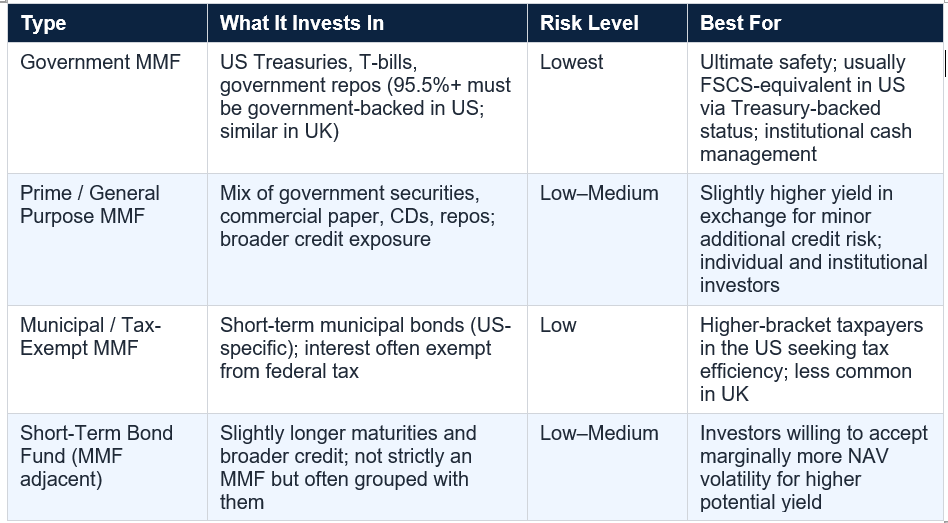
In the UK and Europe, money market funds are also classified by their NAV (Net Asset Value) stability: Constant NAV (CNAV) funds, which maintain a fixed price per unit (typically £1 per unit) and are primarily invested in government securities; Low Volatility NAV (LVNAV) funds, which target a stable NAV within a narrow band; and Variable NAV (VNAV) funds, where the price fluctuates with market value like a conventional fund. Most individual investor money market funds in the UK are LVNAV or CNAV products.
How Returns Are Generated and Measured
Money market fund returns come entirely from the interest earned on the fund's portfolio of short-term instruments. There is no capital growth element: a money market fund is not designed to increase in value over time. Its goal is to maintain approximately £1 (or $1) per unit while passing interest income through to investors.Returns are typically expressed as a 7-day SEC yield (in the US) or an annualised equivalent yield (in the UK). The 7-day SEC yield measures the net interest income the fund earned in the most recent 7-day period, annualised, minus fees. It is the most commonly used figure for comparing money market fund returns.
Because the portfolio is continuously rolling over at current market rates, money market fund yields track central bank interest rates closely. As Ramp's May 2026 analysis explains: when rates rise, new securities offer higher yields; when rates fall, reinvestment happens at lower yields. This makes money market funds more responsive than most savings accounts, where the bank's decision on pass-through rates is at the bank's discretion.
Rest Less, June 2026: The return you receive on a money market fund generally rises or falls in line with movements in the Bank of England’s base rate, similar to cash savings accounts. This makes money market funds particularly attractive when the base rate is high relative to normal savings account rates.
Fees are deducted from the yield before it reaches investors. These are disclosed in the fund's Key Investor Information Document (KIID). For institutional-grade money market funds, fees are typically very low — often 0.05 to 0.20 percent per year. For retail money market funds available within ISA or brokerage platforms, fees may be somewhat higher but are still generally lower than actively managed equity funds.
Money Market Fund vs. Money Market Account
These two products sound almost identical but are fundamentally different: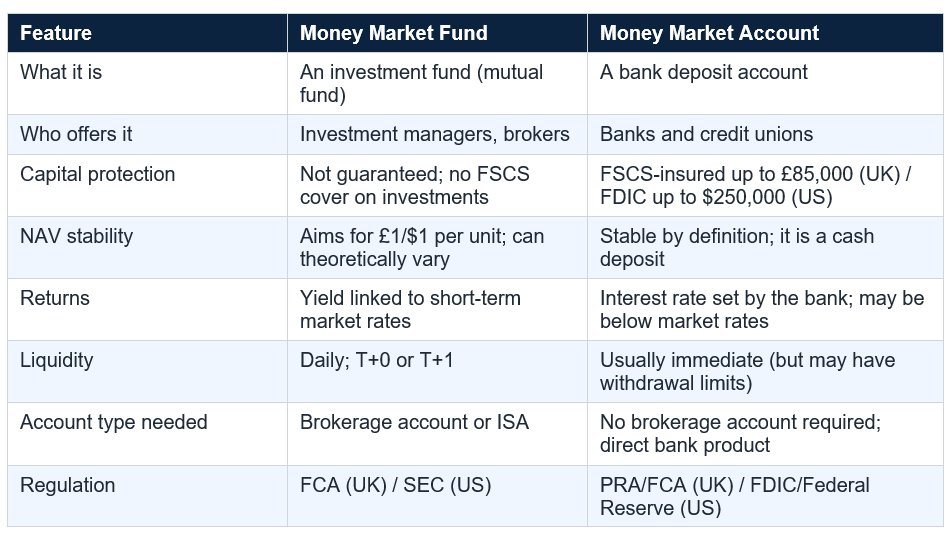
As Vanguard's guidance explains, the most critical difference for individual investors is the protection question. Money market accounts are bank deposits and benefit from FSCS protection in the UK (up to £85,000) or FDIC insurance in the US (up to $250,000). Money market funds are investments. They are not FSCS-insured in the UK, though they are regulated by the FCA and are designed with capital preservation as their primary objective. Losing money in a money market fund is extremely rare historically, but it is not impossible.
Money Market Fund vs. Cash in a Savings Account
For individual savers comparing money market funds to standard savings accounts, several practical differences matter:- Return potential: when central bank rates are elevated, money market fund yields can be more competitive than the rates offered by high-street bank savings accounts, because money market funds reflect wholesale market rates more directly, while banks adjust their savings rates at their own discretion and often do not fully pass through central bank rate increases.
- Liquidity: both are highly liquid, but money market funds typically settle in T+1 (next business day) rather than being immediately accessible at an ATM. For cash genuinely needed at a moment's notice, a savings account with instant access is more practical.
- Tax treatment: in the UK, interest on savings accounts is taxable above the Personal Savings Allowance (£1,000 for basic-rate, £500 for higher-rate taxpayers). Returns from a money market fund held inside a Stocks and Shares ISA are tax-free. This can make a material difference for higher-rate taxpayers with significant cash holdings.
- FSCS protection: savings accounts at FCA-regulated banks are FSCS-protected up to £85,000. Money market fund investments are not, though the risk of loss is very low in practice.
- Minimum investment: many money market funds available to retail investors have low or no minimum investment thresholds when held inside a brokerage ISA.
Money Market Fund vs. Bonds and Gilts
Money market funds and bonds both generate income from debt instruments, but they operate differently in practice:- Duration risk: bonds — particularly long-duration bonds (gilts) — can fall significantly in value when interest rates rise. As rates rise, existing bonds paying lower rates become less attractive, reducing their price. Money market funds avoid this because their maximum weighted average maturity is typically 60 days — instruments mature so quickly that they are re-priced at new market rates almost immediately, with minimal capital impact.
- Stability: money market funds aim for a stable NAV of £1 per unit. Bond funds can experience significant NAV fluctuations — in 2022, UK gilt funds fell 25 to 30 percent in value as the Bank of England raised rates aggressively. A money market fund's 2022 performance was, by contrast, essentially flat on capital with positive and rising income yield.
- Return potential: bonds offer potentially higher long-term returns than money market funds, especially when held to maturity. They are appropriate for investors with a longer time horizon and higher tolerance for interim price fluctuation.
Who Uses Money Market Funds and Why
Individual InvestorsIndividual investors use money market funds primarily as a place to park cash that they want to keep liquid but earning a return above a standard savings account. Common uses include: emergency fund holdings for investors who want their cash to work a little harder while remaining accessible; holding cash between investments (for example, after selling shares and before deciding where to redeploy the proceeds); and as a low-risk allocation within a diversified portfolio for investors who want some stability alongside equity holdings.
Corporations and Treasury Teams
Corporations use money market funds extensively for managing operational cash — the cash needed to pay suppliers, wages, and operating expenses in the near term. State Street's institutional guide explains that a money fund's stability and liquidity are essential for organisations performing critical functions such as meeting payroll, paying operating expenses, and making debt payments. For large organisations with significant cash balances, the ability to earn competitive short-term yields rather than leaving cash in low-rate bank accounts is genuinely significant.Institutional Investors
Pension funds, insurance companies, and other institutional investors use money market funds for cash management purposes: funding liquidity for near-term liabilities, meeting margin calls, or bridging between investment decisions. Institutional-grade money market funds often have high minimum investments but very low fees.The Risks You Need to Know
Money market funds are low-risk, but they are not risk-free. The specific risks relevant to investors are:- Credit risk: money market funds invest in debt issued by governments, banks, and corporations. In the rare scenario where an issuer defaults, the fund could suffer a capital loss. This is why quality criteria and diversification are so strictly enforced. The most famous instance of this risk materialising was the Reserve Primary Fund in the US, which broke the buck (fell below $1 NAV per share) in 2008 after Lehman Brothers paper in its portfolio became worthless overnight. Enhanced post-2008 regulations have significantly reduced this risk.
- Liquidity risk: in extreme market stress, money market funds could face simultaneous large redemptions that require selling assets in a distressed market. Regulators have imposed liquidity minimums and daily/weekly liquidity quotas to manage this risk.
- Interest rate risk: money market fund yields fall when central bank rates fall. If the Bank of England cuts rates significantly, money market fund returns will decline. This is not a capital loss but a reduction in income.
- No capital growth: money market funds are not intended to grow in value. An investor using a money market fund as a long-term investment is likely to see inflation erode purchasing power over time, because the yield — while positive in real terms when rates are high — may not always keep pace with inflation over longer periods.
- No FSCS protection: in the UK, money market fund investments are not covered by the FSCS. This distinguishes them from cash held in a regulated bank account.
UK Specifics: ISAs, FCA Regulation, and FSCS
For UK investors, several specific features of the money market fund landscape are worth understanding:- ISA wrapper: money market funds can be held inside a Stocks and Shares ISA, making the income generated tax-free. For higher-rate taxpayers with more than £500 in annual savings or investment income, this is a material benefit. The ISA allowance for 2026/27 is £20,000 per adult.
- FCA regulation: UK money market funds are regulated by the Financial Conduct Authority and must comply with the UK Money Market Fund Regulation. They are classified as Short-Term Money Market Funds (STMMFs) or Standard Money Market Funds (STMMFs) depending on their portfolio characteristics.
- FSCS: money market fund investments are not protected by the Financial Services Compensation Scheme. This is different from cash held in a savings account at a UK-regulated bank, which is protected up to £85,000. If a fund manager became insolvent, assets held in the fund would remain the property of investors (not the manager), but this does not eliminate the risk of capital loss if the underlying portfolio suffered defaults.
- Where to access: UK investors can access money market funds through most major investment platforms — Hargreaves Lansdown, AJ Bell, Interactive Investor, Fidelity UK, Vanguard UK — typically within an ISA wrapper.
How to Invest in a Money Market Fund
Investing in a money market fund is straightforward:- Step 1: Open a brokerage account or ISA. Most major UK investment platforms offer money market funds, either from their own fund range or from third-party fund managers. If you want tax-free returns, open a Stocks and Shares ISA.
- Step 2: Search for money market funds. On the platform's fund search, filter by asset class (money market) or fund type. Look for funds with a Constant or Low Volatility NAV designation, an AAA or equivalent credit rating from a major agency, and a low ongoing charges figure (OCF).
- Step 3: Read the KIID. Every regulated fund must publish a Key Investor Information Document. This summarises the fund's objectives, risk rating, costs, and past performance. Read it before investing.
- Step 4: Invest. Set the amount you want to invest. Most money market funds have no or very low minimum investment. Decide whether you want income (distributions paid out) or accumulation (returns reinvested).
- Step 5: Monitor and review. Money market fund yields change with central bank rates. If the Bank of England cuts rates significantly, compare whether the fund still offers competitive returns versus a high-yield savings account.
Conclusion
A money market fund is not the most exciting investment product available. It does not aim to double in value, outperform equity markets, or generate the kind of returns that make headlines. What it does is serve a specific and genuinely valuable purpose: preserving capital in the short term, maintaining high liquidity, and generating income closely linked to central bank interest rates.For individuals with cash they do not need immediately but want to keep accessible — an emergency fund, proceeds from a property sale waiting to be redeployed, or cash holdings within a diversified portfolio — money market funds offer a combination of characteristics that no other single product quite matches: better income potential than most savings accounts when rates are elevated, better stability than short-term bonds, and daily liquidity.
The conditions that make money market funds most attractive — elevated central bank rates, the ability to hold within an ISA for tax-free returns, and yields that genuinely exceed high-street savings account rates — are all present in 2026. For UK investors who have never considered money market funds as part of their financial toolkit, understanding them is a worthwhile investment of an hour.
Frequently Asked Questions
What is a money market fund?A money market fund is a type of mutual fund (pooled investment vehicle) that invests exclusively in short-term, high-quality debt instruments such as Treasury bills, commercial paper, certificates of deposit, and repurchase agreements. Its primary goals are to preserve capital and provide liquidity while generating modest income from the interest on the underlying instruments. Securities typically mature in less than six months, and most money market funds aim to maintain a stable price per unit of £1 or $1.
How does a money market fund make money?
A money market fund earns income from the interest paid on the short-term debt instruments it holds. This interest accrues daily and is allocated to investors proportionally to their holding. The fund manager continuously reinvests maturing instruments at current market rates, which is why money market fund yields respond quickly to changes in central bank interest rates. Returns are modest compared to equities but competitive with savings accounts, particularly when base rates are elevated.
Are money market funds safe?
Money market funds are among the lowest-risk investment products available, but they are not entirely risk-free and are not the same as cash savings. Unlike bank savings accounts, they are not covered by the FSCS in the UK or FDIC in the US. Capital loss, while historically rare, is theoretically possible if underlying issuers default. The 2008 Reserve Primary Fund case (which broke the buck after Lehman Brothers exposure) remains the most cited example. Post-2008 regulatory reforms significantly strengthened money market fund resilience.
What is the difference between a money market fund and a money market account?
A money market fund is an investment vehicle regulated as a mutual fund. A money market account is a bank deposit product similar to a savings account. Key differences: money market accounts are FSCS-insured (UK) or FDIC-insured (US); money market funds are not. Money market accounts offer instant access; money market funds typically settle in T+1. Money market fund yields often track central bank rates more closely; bank money market account rates are set by the bank at their discretion and may lag.
Can I hold a money market fund in an ISA?
Yes. In the UK, money market funds can be held inside a Stocks and Shares ISA. All income generated within an ISA is tax-free, regardless of whether it comes from a money market fund, equity funds, or bonds. For higher-rate taxpayers with significant cash holdings, the ISA wrapper can make a material difference: dividend tax on investment income above £500 would otherwise be 33.75% for higher-rate taxpayers.
How much can I earn from a money market fund?
Money market fund yields are closely linked to the central bank base rate. In an environment where the Bank of England base rate is 3.75% (as of April 2026), well-managed money market funds are yielding in the range of 3.5 to 4.5% per year after fees, depending on the specific fund and its portfolio. This can exceed rates offered by many high-street savings accounts. When base rates fall, money market fund yields will fall correspondingly. Always check the fund's current 7-day yield or annualised yield figure before investing.
Who should use a money market fund?
Money market funds suit: investors who need to park cash temporarily between investment decisions; people maintaining an emergency fund who want to earn more than a standard savings account while keeping the money accessible; higher-rate taxpayers who can benefit from the ISA wrapper's tax-free income; and corporates or institutions managing short-term cash holdings who need reliable liquidity and competitive market-rate returns. They are less suitable for long-term investors seeking capital growth, or anyone needing absolute certainty that their investment is covered by FSCS protection.
What is an AAA-rated money market fund?
AAA is the highest credit quality rating awarded by major credit rating agencies (Moody's Aaa, S&P AAA, Fitch AAA) to money market funds that meet their highest standards for portfolio quality, liquidity, and management. An AAA-rated money market fund invests in the safest short-term instruments, maintains strict diversification, and meets all regulatory requirements with margin to spare. Most institutional and many retail money market funds target AAA ratings as a signal of quality to investors.
External References and Further Reading
- Vanguard — What Is a Money Market Fund? (Updated 2026)
- State Street Global Advisors — Understanding Money Market Funds (Institutional Guide)
- Ramp.com — Money Market Funds (MMFs) Explained: A Business Guide (May 2026)
- Rest Less — What Is a Money Market Fund? (June 2026)
- Milltech — What Are Money Market Funds and How Do They Work? (June 2026)
- Bankrate — 6 Best Money Market Funds in 2026
- Raisin UK — Money Market Funds Explained (UK Guide)
- Minster Bank — How Money Market Funds Work (April 2025)
- SEC.gov (US) — Money Market Funds: What They Are and How They Work
0 Comments
Be the first to share your thoughts on this article.