

Retirement
What Is Pension Auto-Enrolment? UK Full Guide

Table of Contents
- The Law That Has Changed Retirement Saving for Millions
- What Is Pension Auto-Enrolment?
- How Pension Auto-Enrolment Works: The Step-by-Step Process
- Auto-Enrolment Rates and Thresholds 2026/27: Complete Reference
- What Auto-Enrolment Costs and Earns You: Worked Examples 2026/27
- How to Maximise Your Auto-Enrolment Pension in 2026
- Conclusion: The Policy That Reversed a Retirement Savings Crisis
- Frequently Asked Questions (FAQ)
The Law That Has Changed Retirement Saving for Millions
Before October 2012, workplace pension saving in the United Kingdom was voluntary. Employees who wanted a pension had to actively choose to join their employer's scheme. Most did not. Private sector pension participation was declining steadily as defined benefit schemes closed and workers either forgot, delayed, or simply never got around to signing up for the defined contribution alternatives that replaced them. The consequence was a generation of private sector workers heading toward retirement with inadequate savings.Pension auto-enrolment changed this by reversing the default. Instead of requiring workers to actively opt in to a pension, the law required employers to automatically enrol eligible workers and make it slightly harder to leave than to stay. The psychological mechanism -- inertia now working in favour of saving rather than against it -- produced a dramatic result. The House of Commons Library (January 2026): 'There was a tenfold increase in members contributing to defined contribution occupational pension schemes, from 0.9 million in 2011 to 10.6 million in 2019. Auto-enrolment is widely agreed to have been a success.'
In 2026, the system continues to operate under the rules established through a phased rollout that completed in 2018, with thresholds set annually by the government following a formal review. The most current official figures, from GOV.UK's December 2025 review for 2026/27: the earnings trigger remains at £10,000, the qualifying earnings band runs from £6,240 to £50,270, and the minimum total contribution rate remains at 8% -- with at least 3% from the employer and 5% from the employee (including tax relief). Total private sector pension saving in 2026/27 is estimated at £91 billion. This guide explains everything you need to know about how auto-enrolment works, who it applies to, exactly what it costs and earns you, and how to make the most of it.
What Is Pension Auto-Enrolment?
Pension auto-enrolment is a UK law, introduced under the Pensions Act 2008 and phased in from October 2012, that requires employers to automatically enrol eligible workers into a qualifying workplace pension scheme and make contributions on their behalf. The key word is automatically: eligible workers are enrolled without having to request it, fill in a form, or take any action at all. The pension begins, and both the employer and the employee start making contributions, unless the employee actively chooses to opt out.Wealthvieu (May 22, 2026): 'Auto-enrolment means that most UK employees are automatically signed up to a workplace pension by their employer -- and their employer must contribute too. Since its introduction in 2012, auto-enrolment has brought millions of UK workers into pension saving for the first time.' The employer's contribution is the financial feature that makes auto-enrolment so significant. In 2026/27, the employer must contribute a minimum of 3% of the employee's qualifying earnings. This is, in effect, additional pay that only exists if the employee remains enrolled. Wealthvieu: 'If you are auto-enrolled and opt out, you give up your employer's contributions -- which is the equivalent of refusing part of your pay.'
The scheme must be a qualifying pension scheme approved by The Pensions Regulator. Most employers use NEST (National Employment Savings Trust), the government-backed scheme established specifically for auto-enrolment, or an approved commercial provider such as Aviva, Legal & General, Scottish Widows, or The People's Pension. The type of scheme most workers are enrolled into is a defined contribution (DC) scheme, where contributions from employee, employer, and the government (through tax relief) are invested in a fund that grows over time and provides a pot of money at retirement.
How Pension Auto-Enrolment Works: The Step-by-Step Process
SECTION 1: ELIGIBILITY ASSESSMENT -- DOES IT APPLY TO YOU? | Three criteria: age, earnings, and UK employment
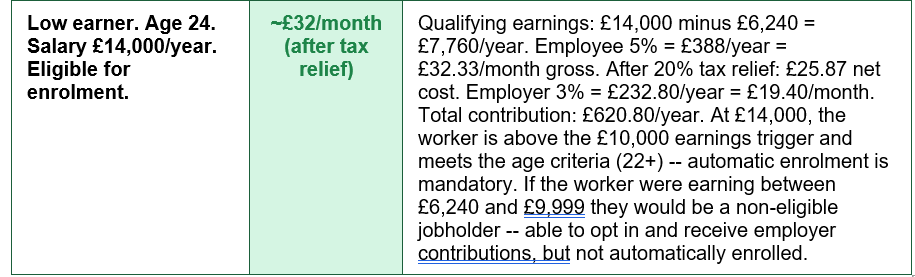
Your employer is required to assess all workers against three eligibility criteria on their 'duties start date' (the day when auto-enrolment obligations begin for that employer). LITRG (2026): 'You must automatically enrol all staff who are aged between 22 and state pension age (currently 66), earn above £10,000 per year (the earnings trigger), and are working in the UK under a contract of employment.' If you meet all three criteria, you are an 'eligible jobholder' and must be automatically enrolled. You do not need to request it. Note that part-time workers, those on zero-hours contracts, and agency workers can all qualify -- it is not restricted to full-time employment. The relevant earnings figure is not a fixed annual salary but actual earnings in any given pay reference period. If you are paid monthly and earn more than £833.33/month, the equivalent threshold applies.SECTION 2: NOTIFICATION -- WHAT YOUR EMPLOYER MUST TELL YOU | Written confirmation within 6 weeks of the duties start date
Once you have been enrolled, your employer must write to you within six weeks of your enrolment date explaining: that you have been enrolled into a workplace pension; the name of the scheme and a point of contact; how much you will contribute; how much your employer will contribute; how tax relief applies; your right to opt out and how to do so; and the fact that you will be re-enrolled every three years if you opt out. Commerce Bank: this written notification is a legal requirement, not optional. Checking this letter carefully is important -- it tells you the specific scheme details, the contribution rates (which may be above the legal minimum if your employer is more generous), and exactly how the opt-out process works. Your employer cannot enrol you in a scheme that does not meet the qualifying criteria for auto-enrolment.SECTION 3: CONTRIBUTIONS BEGIN -- HOW THE MONEY FLOWS | Employee, employer, and government all contribute simultaneously
Once enrolled, contributions begin in the next available pay period. Moorepay (March 2026): 'The minimum total contribution remains at 8% of qualifying earnings, with at least 3% contributed by the employer and the remaining 5% by the employee. These contributions apply to earnings between the lower and upper thresholds.' Wealthvieu (May 2026): 'Contributions are calculated on your qualifying earnings -- the band of salary between £6,240 and £50,270 per year (2026/27).' The employee contribution is typically deducted from gross pay before income tax is calculated, meaning the government effectively contributes through tax relief: a basic-rate taxpayer paying £50 of their own money into the pension actually receives £62.50 in the pot (£50 plus £12.50 in 20% tax relief). For higher-rate (40%) taxpayers, a £50 employee contribution produces £83.33 in the pot -- the tax relief is even more substantial. LITRG (2026): 'The employee contribution is typically 5% (or 4% plus 1% tax relief).' This depends on whether the scheme uses relief at source (tax relief added by provider) or net pay arrangement (deductions from gross pay before tax).SECTION 4: OPT-OUT -- YOUR RIGHT TO LEAVE (AND WHY MOST PEOPLE SHOULD NOT) | One month window. Employer cannot opt you out. You lose the employer contribution.
UKCalculator (verified April 2026): 'You have the right to opt out of your workplace pension, but the process must be initiated by you -- your employer cannot opt you out on your behalf. You must be given an opt-out notice by the pension provider (not your employer). You must complete and return the opt-out notice within the one-month opt-out window.' If you opt out within the first month, any contributions already deducted are refunded. If you opt out after the one-month window, contributions already made stay in the pension. LITRG (2026): 'Workers who are re-enrolled have the right to opt out again within one month, but they cannot permanently avoid re-enrolment as long as they remain an eligible worker.' The financial case against opting out is strong. The employer's minimum 3% contribution is the most immediately compelling reason: opting out means refusing this contribution, which is deferred pay you simply do not receive. Wealthvieu: 'Unless you have a very specific reason, staying enrolled is almost always the right financial choice.'SECTION 5: RE-ENROLMENT -- THE THREE-YEAR RESET | Cannot be permanently excluded. Every 3 years the clock resets.
UKCalculator (verified April 2026): 'Every three years, employers must re-enrol any eligible workers who previously opted out or ceased active membership of the scheme. This re-enrolment window is typically within three months of the third anniversary of the employer's staging date.' Re-enrolment is one of the most important design features of the system. Without it, a single opt-out decision in the twenties could permanently exclude a worker from pension saving for their entire career -- removing the employer contribution, tax relief, and compound growth from their retirement pot. With re-enrolment, the opt-out is reset every three years, and the worker must actively re-opt-out each time. This means inertia continues to work in favour of pension saving even for those who have previously chosen to leave.Auto-Enrolment Rates and Thresholds 2026/27: Complete Reference
The following table provides the complete, officially verified rates and thresholds for 2026/27 with sources: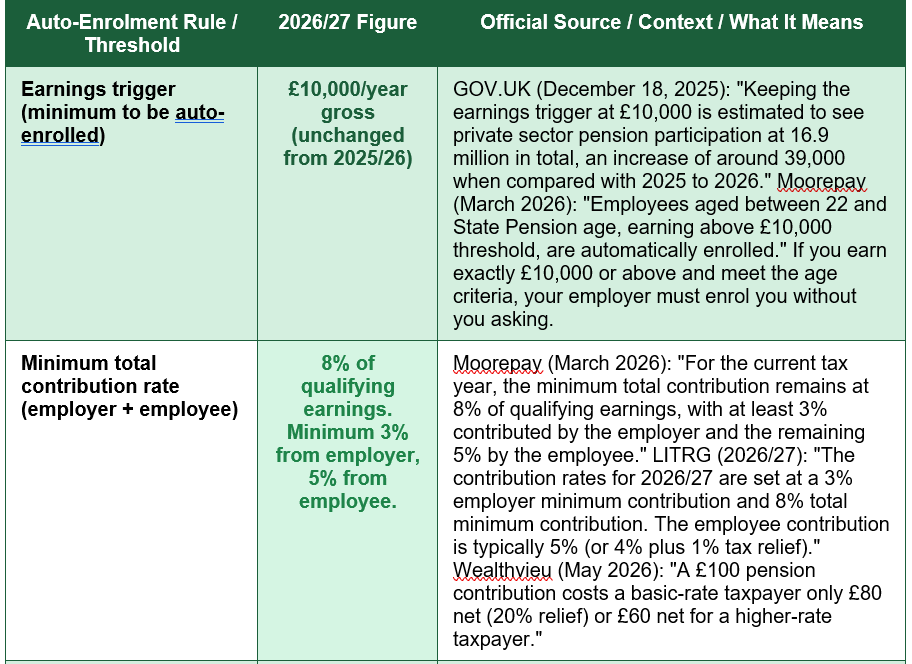
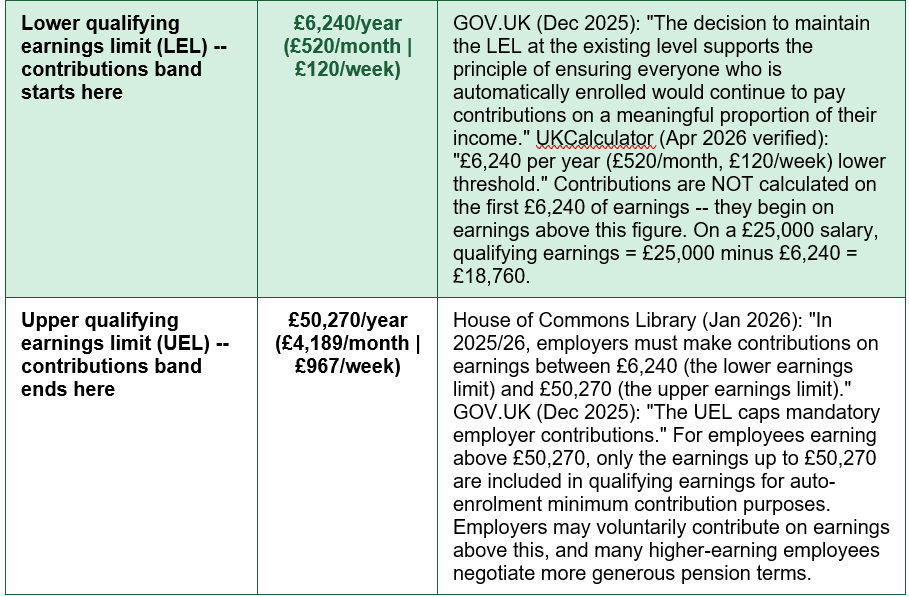
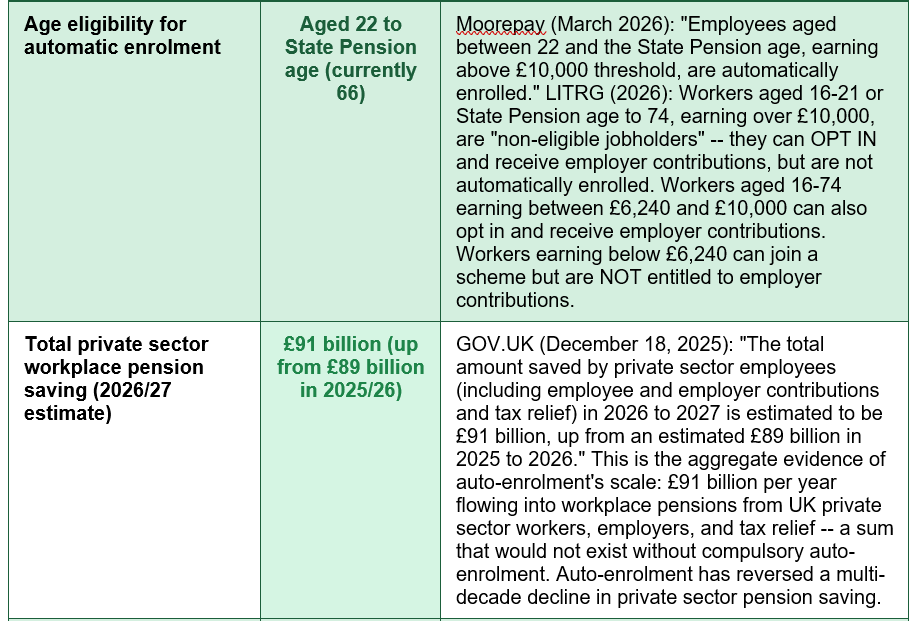
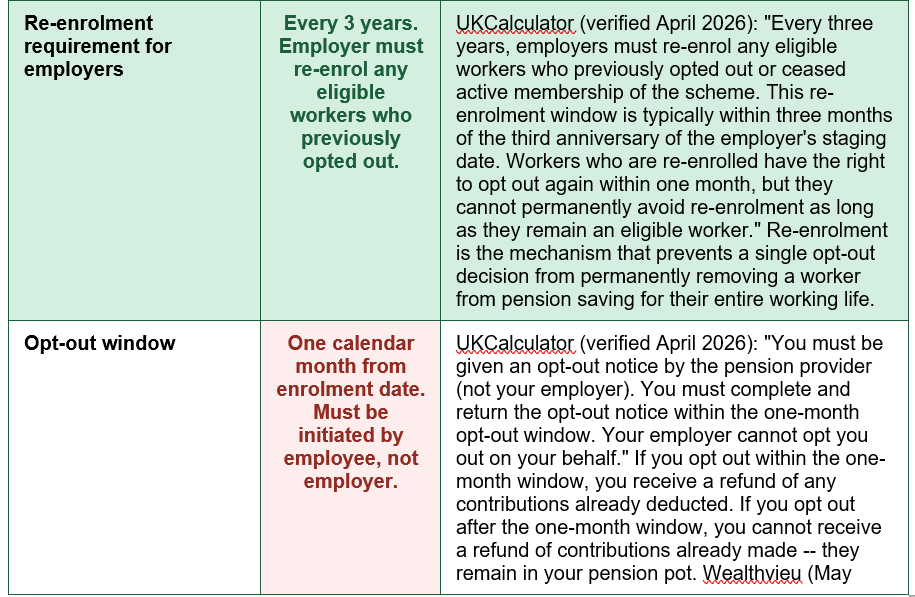

Auto-enrolment 2026/27 headline numbers: 8% total minimum contribution. 3% employer minimum. £10,000 trigger. £6,240-£50,270 qualifying band. £91bn saved. 16.9 million enrolled. — GOV.UK (December 18, 2025 -- official review): 'Total amount saved by private sector employees in 2026/27 estimated at £91 billion, up from £89 billion in 2025/26. Participation at 16.9 million in total.' Moorepay (March 2026): 'Minimum total contribution 8% of qualifying earnings. At least 3% employer, 5% employee.' GOV.UK: earnings trigger frozen at £10,000 for 2026/27. Qualifying band: £6,240 to £50,270. IFS (2 weeks ago -- most current): 'There is a great deal of variation in how much employers actually contribute, with some contributing well above the minimum.'
What Auto-Enrolment Costs and Earns You: Worked Examples 2026/27
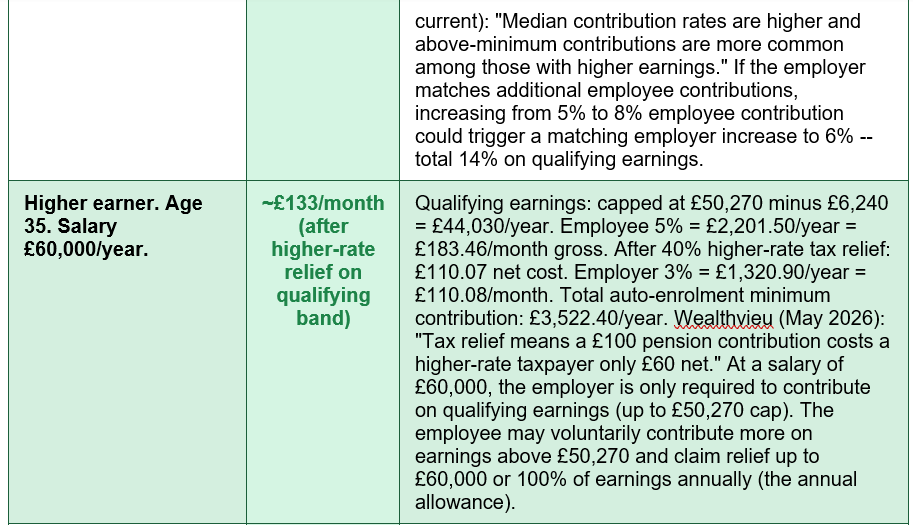
The following table shows exactly how contributions are calculated across four different worker profiles, with the real net cost to the employee after tax relief and the employer's contribution each month: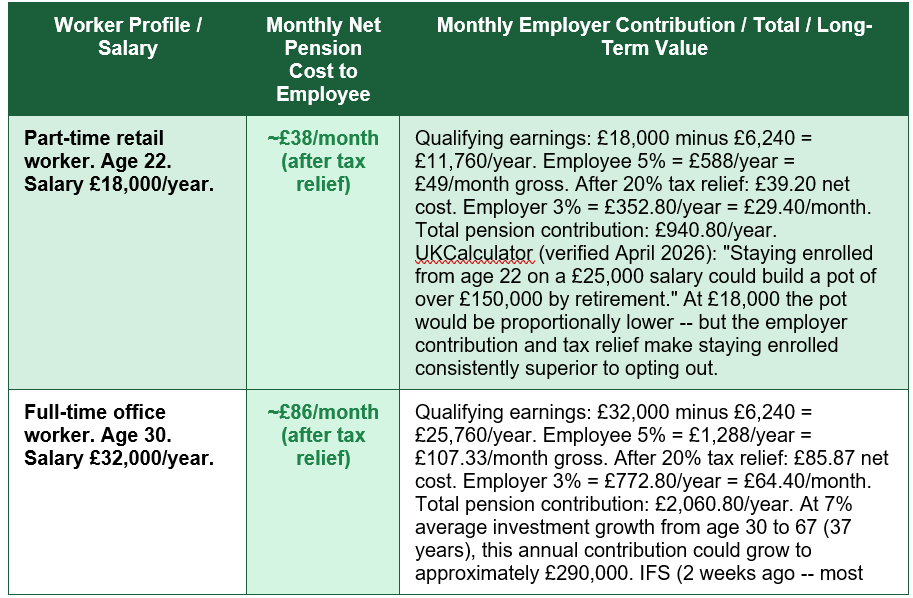
How to Maximise Your Auto-Enrolment Pension in 2026
Staying enrolled is the baseline. These are the additional steps that materially improve your retirement outcome:- Check whether your employer offers matched contributions above the minimum: Wealthvieu (May 2026): "Many employers offer to match additional employee contributions above the minimum. If this employee increases contributions from 5% to 8%, their employer matches to 6% -- total contribution becomes 14% of qualifying earnings instead of 8%. This is an immediate 100% return on the extra contribution (before investment returns)." IFS (two weeks ago -- most current research): "Median contribution rates are higher and above-minimum contributions are more common among those with higher earnings, those working for large employers and those working in finance and insurance." Always check whether your employer matches additional contributions. Increasing your employee contribution from 5% to 8% (an extra 3% of qualifying earnings) that triggers a matched employer increase from 3% to 6% doubles the employer's contribution -- the highest-return investment decision available to most employees.
- Use salary sacrifice if available: Wealthvieu (May 2026): "Salary sacrifice is typically most tax-efficient: if your employer offers it, you save your employee NI contributions (8% on earnings between £12,570 and £50,270 in 2026) on top of income tax relief." In a salary sacrifice arrangement, you agree to a formal reduction in your gross salary in exchange for the equivalent amount being paid directly as pension contribution. This reduces the income on which National Insurance is calculated -- saving 8% NI on the sacrificed amount. On a £5,000 salary sacrifice, you save approximately £400 in NI. Many employers also pass on their NI saving (13.8%) as an additional pension contribution, making the total benefit even greater. Not all employers offer salary sacrifice -- check with your HR or payroll department.
- Review your investment fund choices: Most auto-enrolment schemes place you in a default lifestyle fund that gradually shifts from higher-growth assets (equities) to lower-risk assets (bonds and cash) as you approach retirement. For younger workers, the default fund is typically appropriate. As you approach your 50s, review whether the lifestyle de-risking timeline matches your actual planned retirement date. If you intend to draw down flexibly rather than buy an annuity, the traditional lifestyle approach may not be optimal for your circumstances.
- Consolidate old pension pots: If you have worked for multiple employers, you may have multiple small pension pots from previous auto-enrolment. The Pensions Regulator and MoneyHelper both recommend consolidating small pots where appropriate -- multiple small pots with different providers can incur duplicated charges and make it harder to manage your overall retirement savings picture. The Pension Tracing Service (pensiontracing.com) helps locate lost or forgotten pots.
- Understand the difference between relief at source and net pay arrangements: There are two ways pension tax relief is administered. Relief at source: you contribute from take-home pay and the pension provider claims 20% basic-rate relief from HMRC, adding it to your pot. Higher-rate taxpayers must claim the additional relief through self-assessment. Net pay arrangement: contributions are deducted from gross pay before income tax, automatically giving full tax relief at the marginal rate. Understanding which your scheme uses is important for higher-rate taxpayers who may need to claim additional relief through self-assessment.
The most important number in auto-enrolment: the employer contribution is free money with a deadline. Wealthvieu (May 2026): 'If you are auto-enrolled and opt out, you give up your employer's contributions -- which is the equivalent of refusing part of your pay.' This framing is technically precise. The employer's minimum 3% contribution on qualifying earnings is not charity -- it is a condition of employment that the employer contributes to your pension while you remain enrolled. Opting out removes this entitlement permanently until re-enrolment. For a worker on £30,000: employer 3% of qualifying earnings (£30,000 minus £6,240 = £23,760 qualifying) = £712.80 per year. Over a 35-year career at 7% average investment growth, that annual £712.80 employer contribution alone -- without the employee contribution -- compounds to approximately £90,000. The employer contribution is not a small feature of the system. It is a substantial lifetime benefit that evaporates entirely when someone opts out. The Pensions Regulator and every major financial guidance body in the UK identifies remaining enrolled as the single most important pension decision for most workers.
FIVE AUTO-ENROLMENT MISTAKES THAT COST YOU IN THE LONG RUN: (1) OPTING OUT TO HAVE MORE TAKE-HOME PAY. Wealthvieu (May 2026): 'Unless you have a very specific reason, staying enrolled is almost always the right financial choice.' The employer contribution (minimum 3% of qualifying earnings) is money you lose permanently when you opt out. On a £28,000 salary, that is approximately £652/year of employer money you forfeit -- in addition to your own contributions and tax relief. The short-term take-home increase from opting out is real but modest (approximately £40-60/month on a typical salary). The long-term pension shortfall is measured in tens of thousands of pounds. (2) NEVER CHECKING WHETHER YOUR EMPLOYER MATCHES ADDITIONAL CONTRIBUTIONS. IFS (2 weeks ago): above-minimum employer contributions are common but not universal. Checking whether your employer matches employee contributions above 5% is one of the highest-return personal finance actions available. An employer match from 3% to 6% when you increase your contribution from 5% to 8% is an immediate 100% return on the extra contribution. (3) ASSUMING THE DEFAULT INVESTMENT FUND IS ALWAYS RIGHT FOR YOU. The auto-enrolment default fund is designed to suit the average worker's risk profile and timeline. It is not tailored to your specific retirement age, risk appetite, or planned drawdown method. Review your fund choices, particularly as you approach 50. (4) LOSING TRACK OF PENSION POTS FROM PREVIOUS EMPLOYERS. With auto-enrolment having been mandatory since 2018, most workers who have changed jobs have multiple pension pots. Unconsolidated small pots incur fees and are easily forgotten. Use the government's Pension Tracing Service (pensiontracing.com) to locate all pots and consider consolidation. (5) NOT CLAIMING HIGHER-RATE TAX RELIEF THROUGH SELF-ASSESSMENT. If your employer uses a relief-at-source scheme and you are a higher-rate (40%) or additional-rate (45%) taxpayer, you automatically receive only basic-rate (20%) tax relief through the pension provider. You must claim the additional 20% or 25% through a self-assessment tax return. For a higher-rate taxpayer contributing £2,000 to a relief-at-source scheme, the unclaimed additional relief is worth £400 per year.
AUTO-ENROLMENT ACTION CHECKLIST FOR 2026/27: IF YOU HAVE JUST BEEN ENROLLED: (1) Read the notification letter from your employer carefully. Confirm the scheme name, your contribution rate, your employer's contribution rate, and whether the scheme uses relief at source or net pay arrangement. (2) Do not opt out without understanding exactly what you are giving up: employer contribution + tax relief + compound growth. (3) If you are a higher-rate taxpayer and your scheme is relief at source, register for self-assessment to claim the additional tax relief each year. IF YOU ARE ALREADY ENROLLED: (4) Log into your pension provider's portal (NEST, Aviva, Aegon, Legal & General, Scottish Widows, The People's Pension -- whichever your employer uses) and check your current pot value, your investment fund selection, and whether it remains appropriate for your timeline. (5) Check whether your employer offers above-minimum matching. Ask your HR or payroll team: "If I increase my employee contribution above 5%, does the employer contribution also increase?" If yes, calculate the cost and benefit immediately. (6) Consider salary sacrifice if your employer offers it -- it reduces your NI liability in addition to income tax relief. IF YOU HAVE MULTIPLE JOBS OR HAVE CHANGED EMPLOYERS: (7) You may have auto-enrolment pots with multiple providers. Use pensiontracing.com or MoneyHelper to locate all pots. Consider consolidation (but take advice on whether consolidation is appropriate for your specific pots -- some have valuable guarantees that would be lost on transfer). FREE GUIDANCE: MoneyHelper 0800 138 7777 | Pension Wise (over 50s) 0800 138 3944 | The Pensions Regulator thepensionsregulator.gov.uk | Pension Tracing Service pensiontracing.com
Conclusion:
Pension auto-enrolment is the most effective pensions policy the UK government has introduced in decades. The House of Commons Library (January 2026) describes a tenfold increase in active defined contribution pension scheme members between 2011 and 2019 -- from 0.9 million to 10.6 million -- as the direct result of reversing the saving default from opt-in to opt-out. GOV.UK's December 2025 review projects £91 billion in total private sector pension saving in 2026/27, with 16.9 million private sector workers enrolled. These are not small numbers. They represent a genuine structural improvement in the UK's retirement saving position.For individual workers, the system's value is clear and quantifiable. In 2026/27: the minimum total contribution is 8% of qualifying earnings, with the employer contributing at least 3% and the employee contributing 5% (including tax relief at the marginal rate). For a worker on £32,000, this represents £2,061 per year flowing into a pension pot -- of which £773 is the employer's contribution and a further £215 is government tax relief. The employee's net cost from take-home pay is approximately £86 per month. The long-term compounding value of that annual contribution at 7% average return over 37 years is approximately £290,000. Wealthvieu (May 2026): 'If you are auto-enrolled and opt out, you give up your employer's contributions -- which is the equivalent of refusing part of your pay.'
The remaining challenges are real but tractable. The House of Commons Library: 'There are concerns that many are still under-saving for retirement.' The 8% minimum total contribution -- while transformative compared to what came before -- is not sufficient for most workers to achieve the retirement income they aspire to, particularly those who start working at the minimum contribution rate and never increase it. The IFS (two weeks ago): 'Median contribution rates are higher and above-minimum contributions are more common among those with higher earnings.' The policy has succeeded in getting most eligible workers into the system. Getting them to contribute enough to fund the retirement they need is the next challenge -- and one that each worker can address by checking their employer's matching policy, considering increasing contributions, and reviewing their investment fund choices. The system exists and works. The opportunity is there to make it work better.
Frequently Asked Questions (FAQ)
Who is eligible for pension auto-enrolment in 2026?Eligibility for automatic enrolment in 2026/27 requires meeting three criteria simultaneously. Moorepay (March 2026): 'Employees aged between 22 and the State Pension age, earning above £10,000 threshold, are automatically enrolled.' The three criteria are: (1) age -- you must be aged between 22 and the State Pension age (currently 66); (2) earnings -- your earnings must exceed the trigger of £10,000 per year (£833.33/month, £192.31/week); (3) UK employment -- you must be working in the UK under a contract of employment or a contract to perform work personally. If you meet all three, you are an 'eligible jobholder' and your employer must enrol you without you needing to ask. LITRG (2026): there are also two other worker categories who can opt in voluntarily. 'Non-eligible jobholders' are aged 16-21 or State Pension age to 74 earning above £10,000, or aged 16-74 earning between £6,240 and £10,000 -- these workers can opt in and receive employer contributions. 'Entitled workers' earn below £6,240 -- they can join a scheme but are not entitled to employer contributions. Agency workers, part-time workers, and zero-hours contract workers can all qualify for auto-enrolment if they meet the age and earnings criteria.
Can I opt out of my workplace pension?
Yes, you have the legal right to opt out of your workplace pension after being auto-enrolled. However, the opt-out process is strictly regulated to prevent employers from pressuring employees to leave. UKCalculator (verified April 2026): 'You have the right to opt out of your workplace pension, but the process must be initiated by you -- your employer cannot opt you out on your behalf. You must be given an opt-out notice by the pension provider (not your employer). You must complete and return the opt-out notice within the one-month opt-out window that starts from whichever is later: the date you were enrolled or the date you received your joiner information.' If you opt out within the one-month window, any contributions deducted from your pay are refunded in full. If you opt out after the one-month window, contributions already made stay in the pension pot and cannot be refunded. Critically, opting out does not mean you are permanently excluded. LITRG (2026): 'Every three years, employers must re-enrol any eligible workers who previously opted out or ceased active membership. Workers who are re-enrolled have the right to opt out again within one month, but they cannot permanently avoid re-enrolment as long as they remain an eligible worker.' The financial case against opting out is strong: you lose your employer's minimum 3% contribution -- which Wealthvieu (May 2026) describes as 'the equivalent of refusing part of your pay.'
How is my pension contribution calculated in 2026?
Pension contributions under auto-enrolment are calculated on your 'qualifying earnings' -- not on your total salary. Wealthvieu (May 2026): 'Contributions are calculated on your qualifying earnings -- the band of salary between £6,240 and £50,270 per year (2026/27). You don't contribute on every pound you earn.' The calculation: take your gross annual salary, subtract £6,240 (the lower earnings limit), and cap the result at £44,030 (which is £50,270 minus £6,240 -- the maximum qualifying earnings). This figure is your qualifying earnings. Minimum contributions of 8% apply to this figure: the employer pays at least 3% and the employee pays at least 5% (including tax relief). Example for a worker earning £30,000: qualifying earnings = £30,000 minus £6,240 = £23,760. Total annual contribution at 8% = £1,900.80. Employer minimum (3%) = £712.80. Employee gross contribution (5%) = £1,188. Employee net cost after 20% tax relief = £950.40 (approximately £79.20/month). Note that some employers use a more generous definition of 'pensionable pay' that includes total salary rather than just the qualifying band -- check your scheme rules. Moorepay (March 2026) confirms the 2026/27 rates: 'minimum total contribution remains at 8% of qualifying earnings, with at least 3% contributed by the employer and the remaining 5% by the employee.'
What happens if I have multiple jobs? Am I enrolled in each?
Yes -- auto-enrolment operates per employer, not per worker. If you have two jobs and meet the eligibility criteria in each (age 22-66 and earning above £10,000 from each employer individually), each employer must enrol you separately into their own qualifying scheme and make their own contributions. LITRG (2026): employers are required to automatically enrol all staff who meet the eligibility criteria on their duties start date, regardless of whether the worker has other employment. However, the earnings trigger applies to each employment separately: if you earn £8,000 from Job A and £8,000 from Job B (total £16,000), you are below the £10,000 trigger in each individual job and are not automatically enrolled by either employer -- though you may be able to opt in as a non-eligible jobholder and receive employer contributions if you ask. The House of Commons Library (January 2026) notes a review finding that 'removing the lower limit of the qualifying earnings band would increase incentives for people in multiple jobs to opt in. They would get an employer contribution for every pound they earn.' This expansion is under policy consideration but has not yet been implemented. If you have multiple jobs and multiple pension pots from different employers, MoneyHelper and the Pension Tracing Service (pensiontracing.com) can help you locate and manage them.
Is 8% enough to retire comfortably? Should I save more?
The honest answer from the research is that 8% is a significant improvement over no pension saving at all -- but is unlikely to be sufficient to fund most workers' retirement aspirations at a comfortable level. The House of Commons Library (January 2026): 'Auto-enrolment is widely agreed to have been a success. However, there are concerns that many are still under-saving for retirement.' The IFS (two weeks ago -- most current): the research models four different policy options for changing auto-enrolment parameters, reflecting a policy consensus that contribution rates may need to increase in future. The Pensions and Lifetime Savings Association (PLSA) Retirement Living Standards suggest that a moderate retirement (annual income of approximately £31,300 single, £43,100 couple in 2024-25 terms, outside London) requires a pension pot of approximately £490,000 (using an annuity assumption) or a larger pot for flexible drawdown. On a salary of £35,000 with 8% total minimum contributions from age 22 to 67, the projected pot (at 7% average annual return on qualifying earnings) is approximately £200,000-£250,000 -- below the PLSA moderate target. This means that for most workers, increasing contributions above the 8% minimum is advisable. Wealthvieu (May 2026) recommends: check whether your employer matches additional contributions; if increasing your contribution from 5% to 8% triggers an employer match from 3% to 6%, the total increases to 14% on qualifying earnings -- a substantially stronger foundation for retirement. If your employer does not match, increasing your own contribution independently still benefits from tax relief at your marginal rate.

0 Comments Comments