

Investing
What Is Share Capital? Types & Formula: Accountant Explains

The complete 2026 guide for investors, founders, and business students: authorised, issued, subscribed, called-up, and paid-up capital explained with worked examples and a full comparison table.
For investors, understanding share capital means understanding what you are actually buying when you purchase a share: a proportional ownership stake, defined by the share capital structure, that comes with specific rights and claims on the company’s assets and earnings. For founders and business owners, share capital determines how ownership is distributed, how future fundraising will work, and what appears on the company’s balance sheet as permanent funding. For accounting and finance students, the hierarchy of share capital types — authorised, issued, subscribed, called-up, paid-up — is one of the foundational concepts in financial reporting.
This guide explains what share capital is, the five types every investor and founder should understand, how it appears on the balance sheet, and what it means in practice through a complete worked example. The terminology used follows international corporate finance and accounting conventions; specific rules vary by jurisdiction.
EquityList’s March 2026 guide for founders summarises the concept precisely: share capital is the total amount a company raises by issuing shares to shareholders. It is recorded at the face value (nominal value) of those shares, not at the market or issue price. When you buy shares in a company, you are providing capital in exchange for partial ownership. The total of all such contributions — at face value — is the company’s share capital.
Two points are critical for understanding share capital from the outset:
A simplified shareholders’ equity section of a balance sheet might look like:
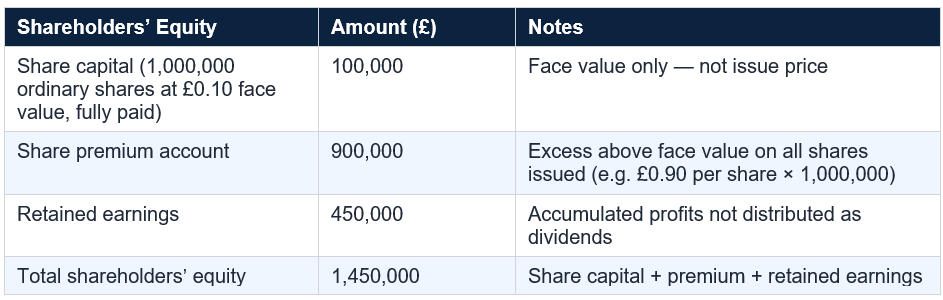
In this example, 1,000,000 shares with a face value of £0.10 were issued at £1.00 each. The company received £1,000,000 in total. Only £100,000 (the face value portion) is recorded as share capital. The remaining £900,000 is in the share premium account. Understanding this distinction is essential for reading any company’s annual report correctly.
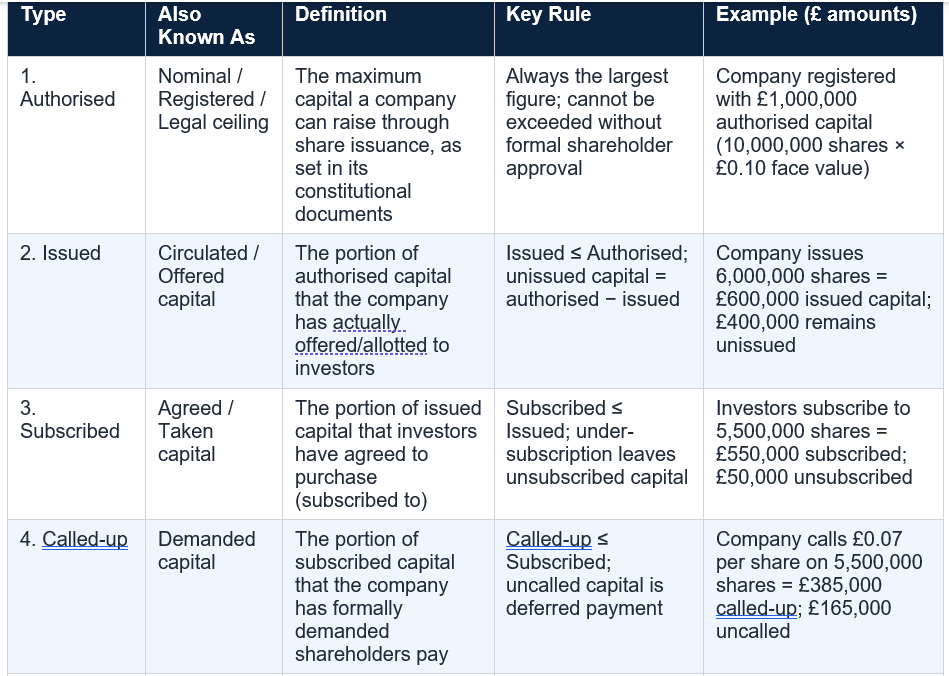

The Hierarchy Rule (EquityList, March 2026): Share capital has a defined hierarchy: authorized capital (the legal ceiling), issued capital (shares allotted), subscribed capital (shares agreed to be purchased), and paid-up capital (money actually received). Each is equal to or smaller than the one above it.
Authorised share capital is set at the time of company incorporation and acts as an absolute legal ceiling on the company’s ability to issue new shares. A company cannot issue shares whose total face value exceeds this ceiling without first obtaining shareholder approval to increase the authorised limit.
Key characteristics of authorised share capital:
Investor/Founder Note: For founders: set your authorised share capital higher than you currently need. Increasing it later requires formal resolutions and, in some jurisdictions, regulatory filings. Setting it too low at incorporation creates unnecessary administrative burden at the worst time — during a fundraising round. Many advisers suggest registering authorised capital of 10 to 100 times the initial issued capital.
Issued capital represents the shares that physically exist and have been distributed. It is always equal to or less than authorised capital. The difference between authorised and issued capital is the ‘unissued capital’ — the shares the company could still offer in the future without needing to increase its authorised limit.
How shares enter the issued category:
The distinction between issued and subscribed capital is most relevant in public share offerings where demand may not meet supply. When a company offers shares to the public — through an IPO or a rights issue — it may offer more shares than investors choose to subscribe for. The shares investors have committed to buying are the subscribed portion; the remainder is unsubscribed.
In modern practice:
Called-up capital is most relevant in contexts where shares are issued with deferred payment schedules, a common practice in certain types of share issuances particularly in the UK, India, and other Commonwealth jurisdictions. In modern practice, most shares in private companies are fully called-up at the time of issuance — meaning the entire face value (and any premium) is required immediately.
The terminology:
Key Point: In modern private company financing, shares are almost always fully called-up at the time of issuance — there is no instalment structure. The called-up vs uncalled distinction is most practically relevant for understanding legacy share structures, UK plc rights issues, and infrastructure or utility company financing models.
Paid-up capital is the most financially significant figure in the share capital hierarchy because it represents real cash received. It is the capital actually available to the company for operations, investment, and growth. All other categories above it in the hierarchy represent potential or committed capital that has not necessarily been received.
The formula: Paid-up Capital = Called-up Capital − Calls in Arrears
Calls in Arrears is the amount that shareholders owe but have not yet paid. It appears as a receivable on the company’s balance sheet, reducing the effective paid-up capital. Most company balance sheets present paid-up share capital, since this is the capital actually received.
Example — Paid-Up Capital: Continuing the InfraCo example: after both calls are made, called-up capital = £1,000,000. But 50,000 shareholders have not paid Call 2 (£0.40 per share), totalling £20,000 in Calls in Arrears. Paid-up capital = £1,000,000 − £20,000 = £980,000. The £20,000 in Calls in Arrears is shown as a deduction from subscribed capital in the balance sheet or as a receivable.
Reserve share capital is a specialised and relatively rare category most commonly encountered in the financial structures of banks, insurance companies, and utility companies where creditor protection is particularly important. 5paisa’s June 2026 share capital guide describes it as the portion of capital that a company decides to keep aside and utilise only in the event of winding up. Once a resolution creates reserve share capital, the company cannot call it for ordinary purposes — it is permanently reserved for liquidation scenarios.
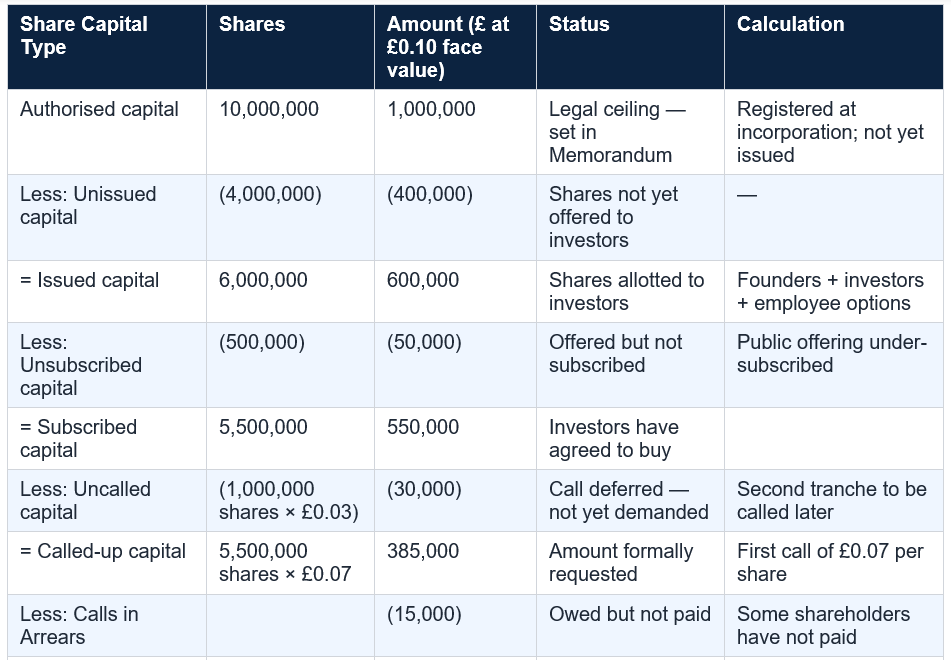

Reading this table from top to bottom shows the journey of share capital from its legal maximum to the actual cash in the company’s accounts. Most financial statement readers will only see the paid-up capital figure plus a note on authorised capital. The intermediate steps are rarely all simultaneously relevant, but understanding them is essential for anyone reading share capital notes in detail.
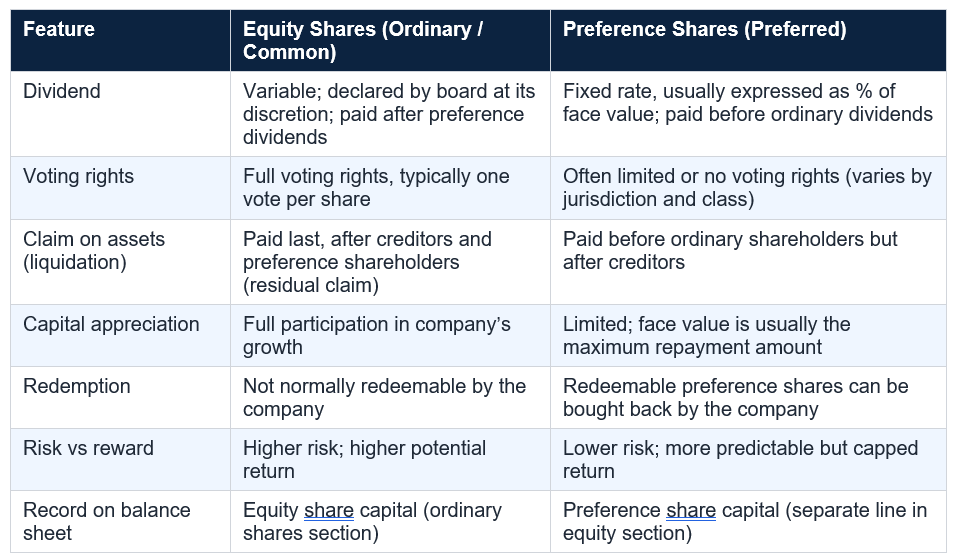
Most publicly listed company balance sheets show equity share capital and preference share capital as separate line items within shareholders’ equity. The distinction matters for investors because preference shares carry creditor-like characteristics (fixed dividend, priority claim) while equity shares reflect pure ownership.
The calculation:
Key Point: This distinction matters enormously for understanding a company’s actual share capital figure. A company that has raised £10 million at £5.00 per share with a £0.10 face value has share capital of only £200,000 (not £10 million) on its balance sheet. The £9.8 million difference is in the share premium account.
The five types of share capital — authorised, issued, subscribed, called-up, and paid-up — each represent a different stage in the process by which a company’s potential capital becomes actual, received capital. The distinction between share capital and share premium explains why a company that raised £10 million in an IPO might show only £200,000 in share capital. The difference between equity shares and preference shares explains why two shareholders in the same company can have entirely different rights and risk profiles.
The most important practical takeaway: when evaluating any company, look at paid-up capital to understand what has actually been raised, compare it to authorised capital to understand the potential for dilution, read the equity note for the full picture of share movements during the year, and never confuse a rising share price with a changing share capital. The market moves every day. Share capital changes only when the company issues or cancels shares.
Authorised share capital is the maximum amount a company can raise through share issuance, as set in its constitutional documents (Memorandum of Association). It is a legal ceiling, not an amount actually received. Paid-up share capital is the actual money received by the company from shareholders against issued shares. A company with £1,000,000 in authorised capital and £150,000 in paid-up capital has only actually received £150,000. The gap between the two represents unissued shares the company could offer in future fundraising without needing to change its constitutional documents. Always focus on paid-up capital to understand what a company has actually raised.
Why is share capital recorded at face value and not market price?
Share capital is recorded at face value (nominal value / par value) because this is the contractual value of each share as specified at incorporation. The excess above face value — the share premium — is recorded separately in the Share Premium Account (also called Securities Premium or Additional Paid-in Capital). This accounting treatment has its roots in company law, which historically required companies to maintain a minimum capital amount at face value as a form of creditor protection. The market price of shares reflects investor sentiment and company performance, changes constantly, and has no bearing on the company’s accounts. Only a new issuance of shares changes share capital.
Can a company issue shares below face value (below par)?
In most jurisdictions, including the UK, India, and most Commonwealth countries, a company cannot issue shares below face value. This rule exists to protect creditors: it ensures that the stated share capital in the accounts genuinely represents capital received by the company. In the United States, the concept of par value is often set at a nominal amount (e.g. US$0.001 per share) or companies may issue no-par-value shares, which eliminates this restriction in practice. If you are a founder or CFO considering unusual share issuance structures, always consult a qualified corporate lawyer in your jurisdiction.
What is the difference between equity shares and preference shares?
Equity shares (ordinary or common shares) carry full voting rights and an unrestricted claim on company earnings and assets, but they are paid last in liquidation and receive variable dividends at the board’s discretion. Preference shares typically carry a fixed dividend rate, priority over equity shares for both dividends and capital in a liquidation, but often limited or no voting rights. From an investor’s perspective, preference shares offer more certainty (similar to a bond) at the cost of upside participation; equity shares offer full participation in the company’s growth at the cost of greater risk. Both contribute to share capital but are reported separately in the equity section of the balance sheet.
Does a share price increase affect share capital?
No. Share capital in the financial accounts is fixed at the time of issuance and reflects the face value of shares issued. When a listed company’s share price rises from £1 to £10 on the stock exchange, share capital in the balance sheet does not change at all. The rise in market price benefits existing shareholders (their shares are worth more), but this is a market value gain, not an accounting change. Share capital only changes when new shares are issued (increasing it) or when the company buys back and cancels shares (decreasing it). This is why share capital on the balance sheet of a mature company is often a small fraction of its market capitalisation.
What is reserve share capital?
Reserve share capital is a specialised category of uncalled share capital that a company, by special resolution, declares can only be called upon in the event of the company being wound up (liquidated). Once this resolution is passed, the company cannot access this capital for ordinary business purposes. It exists primarily to provide creditors with confidence that there is a reserve of capital available specifically to meet the company’s obligations in a worst-case scenario. Reserve share capital is most commonly associated with banks, insurance companies, and utility providers rather than ordinary trading companies.
Table of Contents
- Why Share Capital Matters
- The Core Definition: What Share Capital Actually Is
- Share Capital and the Balance Sheet
- The Five Types of Share Capital Explained
- Type 1: Authorised Share Capital
- Type 2: Issued Share Capital
- Type 3: Subscribed Share Capital
- Type 4: Called-Up Share Capital
- Type 5: Paid-Up Share Capital
- Reserve Share Capital: The Special Sixth Category
- The Full Hierarchy in One Worked Example
- Equity Shares vs Preference Shares
- Share Capital vs Share Premium: A Critical Distinction
- How Share Capital Appears on the Balance Sheet
- How and Why Companies Change Their Share Capital
- What Share Capital Means for Investors
- Conclusion: The Architecture of Ownership
- Frequently Asked Questions
Why Share Capital Matters
When a company is formed or looks to expand, one of its first and most fundamental decisions is how to raise the money it needs. Share capital — the total funds a company raises by issuing shares to investors — is one of the oldest and most widely used mechanisms in corporate finance. It is the foundation of the ownership structure of every company that has shareholders, from a single-owner private limited company to the world’s largest publicly listed corporations.For investors, understanding share capital means understanding what you are actually buying when you purchase a share: a proportional ownership stake, defined by the share capital structure, that comes with specific rights and claims on the company’s assets and earnings. For founders and business owners, share capital determines how ownership is distributed, how future fundraising will work, and what appears on the company’s balance sheet as permanent funding. For accounting and finance students, the hierarchy of share capital types — authorised, issued, subscribed, called-up, paid-up — is one of the foundational concepts in financial reporting.
This guide explains what share capital is, the five types every investor and founder should understand, how it appears on the balance sheet, and what it means in practice through a complete worked example. The terminology used follows international corporate finance and accounting conventions; specific rules vary by jurisdiction.
2. The Core Definition: What Share Capital Actually Is
Definition — Share Capital: The total amount of money a company raises by issuing shares to shareholders. It represents the ownership contributions made by investors in exchange for equity shares and is recorded as permanent funding in the shareholders’ equity section of the balance sheet.EquityList’s March 2026 guide for founders summarises the concept precisely: share capital is the total amount a company raises by issuing shares to shareholders. It is recorded at the face value (nominal value) of those shares, not at the market or issue price. When you buy shares in a company, you are providing capital in exchange for partial ownership. The total of all such contributions — at face value — is the company’s share capital.
Two points are critical for understanding share capital from the outset:
- Share capital is recorded at face value (also called nominal value or par value), not the price the investor actually paid. If 1,000 shares with a face value of £0.10 are issued for £2.00 each, the share capital is £100 (1,000 × £0.10), not £2,000. The extra £1,900 (£1.90 per share × 1,000) is recorded separately as share premium.
- Share capital is not a debt. Unlike a bank loan, the company has no legal obligation to repay share capital to shareholders. This makes it a permanent source of funding, which is why it appears in equity on the balance sheet rather than in liabilities.
Share Capital and the Balance Sheet
Share capital appears in the shareholders’ equity section of the balance sheet, also described as the net worth or book value section. The balance sheet equation is: Assets = Liabilities + Equity. Share capital is a component of equity — the permanent, non-repayable funding provided by shareholders.A simplified shareholders’ equity section of a balance sheet might look like:
In this example, 1,000,000 shares with a face value of £0.10 were issued at £1.00 each. The company received £1,000,000 in total. Only £100,000 (the face value portion) is recorded as share capital. The remaining £900,000 is in the share premium account. Understanding this distinction is essential for reading any company’s annual report correctly.
The Five Types of Share Capital Explained
Share capital is not a single figure. It is structured in a hierarchy of five distinct categories, each representing a different stage in the process of issuing shares and receiving payment. The relationship between them follows one rule: each category is always equal to or less than the one above it in the hierarchy.The Hierarchy Rule (EquityList, March 2026): Share capital has a defined hierarchy: authorized capital (the legal ceiling), issued capital (shares allotted), subscribed capital (shares agreed to be purchased), and paid-up capital (money actually received). Each is equal to or smaller than the one above it.
Type 1: Authorised Share Capital
Definition — Authorised Share Capital: The maximum amount of share capital a company is legally permitted to issue to shareholders, as specified in its constitutional documents (Memorandum of Association / Articles of Incorporation). Also known as Nominal Capital or Registered Capital.Authorised share capital is set at the time of company incorporation and acts as an absolute legal ceiling on the company’s ability to issue new shares. A company cannot issue shares whose total face value exceeds this ceiling without first obtaining shareholder approval to increase the authorised limit.
Key characteristics of authorised share capital:
- It is the largest figure in the share capital hierarchy — all other categories are subsets of it.
- A company is not required to issue all of its authorised capital. Many companies register with significantly more authorised capital than they currently plan to issue, giving them flexibility to raise additional capital in the future without the formality of increasing the authorised limit.
- It can be increased (or decreased) by passing a resolution at a General Meeting of shareholders, subject to the procedures set out in the Companies Act of the relevant jurisdiction.
- The authorised share capital is disclosed in the company’s constitutional documents and in the notes to the financial statements.
Investor/Founder Note: For founders: set your authorised share capital higher than you currently need. Increasing it later requires formal resolutions and, in some jurisdictions, regulatory filings. Setting it too low at incorporation creates unnecessary administrative burden at the worst time — during a fundraising round. Many advisers suggest registering authorised capital of 10 to 100 times the initial issued capital.
Type 2: Issued Share Capital
Definition — Issued Share Capital: The portion of authorised share capital that the company has actually allotted and offered to investors — whether to founding shareholders, strategic investors, employees through share schemes, or the public through a rights issue or IPO. Also called circulated capital.Issued capital represents the shares that physically exist and have been distributed. It is always equal to or less than authorised capital. The difference between authorised and issued capital is the ‘unissued capital’ — the shares the company could still offer in the future without needing to increase its authorised limit.
How shares enter the issued category:
- At incorporation: founding shareholders subscribe for shares, bringing the company into existence.
- Private funding rounds: shares are issued to angel investors, venture capital firms, or strategic partners in exchange for capital.
- Initial Public Offering (IPO): a fresh issue of new shares to the public increases issued capital; an Offer for Sale (OFS) involves existing shareholders selling their shares and does not change the company’s issued capital.
- Employee Share Option Plans (ESOPs): options are exercised, new shares are issued, and issued capital increases.
- Rights issues: existing shareholders are offered additional shares, typically at a discount to market price, increasing issued capital.
Type 3: Subscribed Share Capital
Definition — Subscribed Share Capital: The portion of issued share capital that investors have agreed to purchase. In practice, for most modern private and public offerings where shares are fully allocated, subscribed capital equals issued capital. Under-subscription occurs when investors agree to purchase fewer shares than were offered.The distinction between issued and subscribed capital is most relevant in public share offerings where demand may not meet supply. When a company offers shares to the public — through an IPO or a rights issue — it may offer more shares than investors choose to subscribe for. The shares investors have committed to buying are the subscribed portion; the remainder is unsubscribed.
In modern practice:
- For most private company share allotments, where specific investors are offered and accept specific quantities, issued capital and subscribed capital are effectively simultaneous and equal.
- For public offerings that are oversubscribed (demand exceeds supply), the company allocates shares to successful applicants; the subscribed capital equals the issued capital, and excess applications are returned.
- For public offerings that are undersubscribed, the subscribed capital is less than the issued capital. Companies typically have minimum subscription requirements; if these are not met, the offering may be withdrawn or restructured.
Type 4: Called-Up Share Capital
Definition — Called-Up Share Capital: The portion of subscribed share capital that the company has formally demanded shareholders pay. Companies may issue shares but collect payment in instalments rather than in full at the time of subscription. The formal demand for payment of a tranche of the subscription price is called a ‘call.’Called-up capital is most relevant in contexts where shares are issued with deferred payment schedules, a common practice in certain types of share issuances particularly in the UK, India, and other Commonwealth jurisdictions. In modern practice, most shares in private companies are fully called-up at the time of issuance — meaning the entire face value (and any premium) is required immediately.
The terminology:
- Called-up capital: the total amount the company has asked shareholders to pay so far.
- Uncalled capital: the portion of subscribed capital not yet requested for payment. This is a future source of funds the company can access when needed.
- Calls in arrears: the portion of called-up capital that shareholders have not yet paid. This is a receivable for the company.
Key Point: In modern private company financing, shares are almost always fully called-up at the time of issuance — there is no instalment structure. The called-up vs uncalled distinction is most practically relevant for understanding legacy share structures, UK plc rights issues, and infrastructure or utility company financing models.
9. Type 5: Paid-Up Share Capital
Definition — Paid-Up Share Capital: The actual amount of money received by the company from shareholders against the shares they were allocated. It is the cash (or non-cash consideration) that has physically entered the company. Paid-up capital = Called-up capital − Calls in Arrears.Paid-up capital is the most financially significant figure in the share capital hierarchy because it represents real cash received. It is the capital actually available to the company for operations, investment, and growth. All other categories above it in the hierarchy represent potential or committed capital that has not necessarily been received.
The formula: Paid-up Capital = Called-up Capital − Calls in Arrears
Calls in Arrears is the amount that shareholders owe but have not yet paid. It appears as a receivable on the company’s balance sheet, reducing the effective paid-up capital. Most company balance sheets present paid-up share capital, since this is the capital actually received.
Example — Paid-Up Capital: Continuing the InfraCo example: after both calls are made, called-up capital = £1,000,000. But 50,000 shareholders have not paid Call 2 (£0.40 per share), totalling £20,000 in Calls in Arrears. Paid-up capital = £1,000,000 − £20,000 = £980,000. The £20,000 in Calls in Arrears is shown as a deduction from subscribed capital in the balance sheet or as a receivable.
10. Reserve Share Capital: The Special Sixth Category
Definition — Reserve Share Capital: A portion of uncalled share capital that a company, by special resolution, resolves will only be called in the event of the company being wound up (liquidated). This capital is ring-fenced for creditors in extreme circumstances and cannot be called for ordinary business purposes.Reserve share capital is a specialised and relatively rare category most commonly encountered in the financial structures of banks, insurance companies, and utility companies where creditor protection is particularly important. 5paisa’s June 2026 share capital guide describes it as the portion of capital that a company decides to keep aside and utilise only in the event of winding up. Once a resolution creates reserve share capital, the company cannot call it for ordinary purposes — it is permanently reserved for liquidation scenarios.
The Full Hierarchy in One Worked Example
The following example illustrates all five types of share capital in a single company, showing how each category is derived from the one above it:Reading this table from top to bottom shows the journey of share capital from its legal maximum to the actual cash in the company’s accounts. Most financial statement readers will only see the paid-up capital figure plus a note on authorised capital. The intermediate steps are rarely all simultaneously relevant, but understanding them is essential for anyone reading share capital notes in detail.
12. Equity Shares vs Preference Shares
Within any category of share capital, shares themselves fall into two broad types: equity (ordinary or common) shares and preference shares. Both contribute to share capital but carry different rights and obligations.Most publicly listed company balance sheets show equity share capital and preference share capital as separate line items within shareholders’ equity. The distinction matters for investors because preference shares carry creditor-like characteristics (fixed dividend, priority claim) while equity shares reflect pure ownership.
Share Capital vs Share Premium: A Critical Distinction
One of the most commonly misunderstood aspects of corporate accounting is the difference between share capital and share premium. EquityList’s March 2026 guide for founders is explicit: face value, issue price, and share premium are distinct concepts. When shares are issued above face value during a funding round, the excess is recorded as securities premium — not as share capital.The calculation:
- Face value (par value / nominal value): the value printed on the share certificate. This is what contributes to share capital.
- Issue price: the actual price the investor pays. This is almost always higher than face value for any viable company.
- Share premium: Issue price − Face value. This goes into the Share Premium Account (also called Securities Premium or Additional Paid-in Capital in US accounting).
Key Point: This distinction matters enormously for understanding a company’s actual share capital figure. A company that has raised £10 million at £5.00 per share with a £0.10 face value has share capital of only £200,000 (not £10 million) on its balance sheet. The £9.8 million difference is in the share premium account.
How Share Capital Appears on the Balance Sheet
In practice, company balance sheets typically present a simplified version of the share capital hierarchy, showing the figures most useful to readers. A standard UK or international presentation:- Share capital (paid-up): the face value of all issued and fully paid shares. This is the primary share capital figure.
- Share premium account: the aggregate excess above face value on all share issuances since the company’s founding.
- Other reserves: retained earnings, revaluation reserves, hedging reserves.
How and Why Companies Change Their Share Capital
Share capital is not static. Companies increase or decrease it through several mechanisms:Increases in share capital
- New share issuances: new equity rounds (Series A, B, C for startups), rights issues for listed companies, employee share option exercises, and IPO fresh issues all create new shares and increase paid-up capital.
- Increasing authorised capital: if a company needs to issue more shares than its current authorised limit permits, it must first pass a shareholder resolution to increase the authorised share capital, then proceed with the issuance.
- Bonus (scrip) shares: shares issued to existing shareholders in lieu of cash dividends, using retained earnings or share premium. This increases share capital without raising new cash.
Decreases in share capital
- Share buybacks (repurchases): a company buys its own shares in the market, reducing the number of shares in circulation. These may be cancelled (reducing issued and paid-up capital) or held as treasury stock.
- Capital reduction: companies may formally reduce their share capital through a court-approved process, for example to eliminate an accumulated deficit or return capital to shareholders.
- Share consolidation (reverse split): multiple existing shares are combined into fewer shares with a higher face value, leaving total share capital unchanged but reducing share count.
- Share splits: one share becomes multiple shares with a proportionally lower face value; total share capital is unchanged but the number of shares increases.
What Share Capital Means for Investors
Share capital is a foundational metric for equity investors because it defines the structure of ownership:- Dilution risk: every time a company issues new shares, existing shareholders’ percentage ownership is diluted. Understanding authorised capital vs issued capital reveals how much room remains for future dilution. A company with 10 million shares issued out of 100 million authorised has significant potential dilution remaining.
- Promoter commitment: the paid-up capital contributed by founders and major shareholders reflects their financial commitment to the business. Low promoter paid-up capital relative to total equity signals limited skin in the game.
- Capital adequacy: for banks and financial institutions, paid-up capital is a regulatory metric directly related to capital adequacy requirements. Regulators require banks to maintain minimum levels of paid-up capital relative to their risk-weighted assets.
- Evaluating buybacks: when a company repurchases its own shares, understanding the share capital structure helps determine whether this is value-accretive (buying below book value) or value-destructive.
- IPO analysis: in an IPO, the distinction between a fresh issue (new shares, proceeds to company, share capital increases) and an Offer for Sale (existing shares sold, proceeds to selling shareholders, share capital unchanged) is critical. Only a fresh issue actually provides new capital to the company.
Conclusion
Share capital is the architecture of corporate ownership. It determines who owns what, how much the company has raised from its shareholders, and what the relationship is between the company and its investors. For anyone who reads financial statements, makes investment decisions, or runs a company with shareholders, understanding the hierarchy from authorised to paid-up capital is not optional — it is foundational.The five types of share capital — authorised, issued, subscribed, called-up, and paid-up — each represent a different stage in the process by which a company’s potential capital becomes actual, received capital. The distinction between share capital and share premium explains why a company that raised £10 million in an IPO might show only £200,000 in share capital. The difference between equity shares and preference shares explains why two shareholders in the same company can have entirely different rights and risk profiles.
The most important practical takeaway: when evaluating any company, look at paid-up capital to understand what has actually been raised, compare it to authorised capital to understand the potential for dilution, read the equity note for the full picture of share movements during the year, and never confuse a rising share price with a changing share capital. The market moves every day. Share capital changes only when the company issues or cancels shares.
Frequently Asked Questions
What is the difference between authorised and paid-up share capital?Authorised share capital is the maximum amount a company can raise through share issuance, as set in its constitutional documents (Memorandum of Association). It is a legal ceiling, not an amount actually received. Paid-up share capital is the actual money received by the company from shareholders against issued shares. A company with £1,000,000 in authorised capital and £150,000 in paid-up capital has only actually received £150,000. The gap between the two represents unissued shares the company could offer in future fundraising without needing to change its constitutional documents. Always focus on paid-up capital to understand what a company has actually raised.
Why is share capital recorded at face value and not market price?
Share capital is recorded at face value (nominal value / par value) because this is the contractual value of each share as specified at incorporation. The excess above face value — the share premium — is recorded separately in the Share Premium Account (also called Securities Premium or Additional Paid-in Capital). This accounting treatment has its roots in company law, which historically required companies to maintain a minimum capital amount at face value as a form of creditor protection. The market price of shares reflects investor sentiment and company performance, changes constantly, and has no bearing on the company’s accounts. Only a new issuance of shares changes share capital.
Can a company issue shares below face value (below par)?
In most jurisdictions, including the UK, India, and most Commonwealth countries, a company cannot issue shares below face value. This rule exists to protect creditors: it ensures that the stated share capital in the accounts genuinely represents capital received by the company. In the United States, the concept of par value is often set at a nominal amount (e.g. US$0.001 per share) or companies may issue no-par-value shares, which eliminates this restriction in practice. If you are a founder or CFO considering unusual share issuance structures, always consult a qualified corporate lawyer in your jurisdiction.
What is the difference between equity shares and preference shares?
Equity shares (ordinary or common shares) carry full voting rights and an unrestricted claim on company earnings and assets, but they are paid last in liquidation and receive variable dividends at the board’s discretion. Preference shares typically carry a fixed dividend rate, priority over equity shares for both dividends and capital in a liquidation, but often limited or no voting rights. From an investor’s perspective, preference shares offer more certainty (similar to a bond) at the cost of upside participation; equity shares offer full participation in the company’s growth at the cost of greater risk. Both contribute to share capital but are reported separately in the equity section of the balance sheet.
Does a share price increase affect share capital?
No. Share capital in the financial accounts is fixed at the time of issuance and reflects the face value of shares issued. When a listed company’s share price rises from £1 to £10 on the stock exchange, share capital in the balance sheet does not change at all. The rise in market price benefits existing shareholders (their shares are worth more), but this is a market value gain, not an accounting change. Share capital only changes when new shares are issued (increasing it) or when the company buys back and cancels shares (decreasing it). This is why share capital on the balance sheet of a mature company is often a small fraction of its market capitalisation.
What is reserve share capital?
Reserve share capital is a specialised category of uncalled share capital that a company, by special resolution, declares can only be called upon in the event of the company being wound up (liquidated). Once this resolution is passed, the company cannot access this capital for ordinary business purposes. It exists primarily to provide creditors with confidence that there is a reserve of capital available specifically to meet the company’s obligations in a worst-case scenario. Reserve share capital is most commonly associated with banks, insurance companies, and utility providers rather than ordinary trading companies.
0 Comments
Be the first to share your thoughts on this article.