

Investing
What Is the 30/30/30 Investment Strategy? 2026

Key Statistics & Data (2026): The classic 60/40 portfolio (60% stocks, 40% bonds) has been the standard moderate portfolio for 50+ years. In 2022, the 60/40 portfolio fell approximately 16–17% — its worst year since 2008 — as stocks AND bonds fell simultaneously for the first time in decades. Candriam research (2025): a 40/30/30 portfolio (40% stocks, 30% bonds, 30% alternatives) showed a 40% improvement in Sharpe ratio vs the classic 60/40 (Funds Society, July 2025). S&P 500 historical average annual return (1957–2025): approximately 10.5% nominal. US bonds (Bloomberg US Aggregate): average annual return since 1976: approximately 5.3%. Gold 10-year average annual return (2016–2025): approximately 9.8%. Private markets total size: grew from a few hundred billion in 2000 to $13 trillion today (Wealth Management, February 2025).
That experience accelerated a conversation that institutional investors had already been having for years: is a two-asset portfolio sufficient for a world of volatile inflation, structurally higher interest rates, and investment opportunities that simply did not exist in mass-market form in the 1970s, when the 60/40 framework was codified? The emerging answer from both academic research and professional portfolio management is increasingly ‘no’ — and the direction of travel is toward three-way diversification.
The 30/30/30 investment strategy — sometimes called the equal-thirds approach — reflects this thinking. By allocating roughly equal portions of a portfolio across three distinct asset classes rather than two, investors aim to achieve a more robust form of diversification that performs better across a wider range of economic environments. This article explains exactly what the strategy is, where it came from, what the evidence says about whether it works, and who it is best suited for in 2026.
The 60/40 portfolio — 60 percent equities, 40 percent bonds — worked exceptionally well for most of the period between 1980 and 2020. Its logic was simple: stocks provide growth, bonds provide stability, and because the two asset classes tend to move in opposite directions during market stress (when stocks fall, investors typically buy bonds, pushing bond prices up), combining them reduced volatility without dramatically sacrificing returns.
But this relationship broke down in 2022. As inflation surged to 9.1 percent in the US and central banks raised interest rates at the fastest pace in 40 years, both stocks and bonds fell simultaneously. The 60/40 portfolio lost approximately 16 to 17 percent — its worst calendar year since 2008. As HeyGoTrade’s April 2026 analysis notes, critics have since pointed out that the positive stock-bond correlation of 2022 was not a one-off anomaly: prior to the 2000s, stocks and bonds moving in the same direction was the norm, not the exception. If inflation remains volatile, the diversification benefit of bonds cannot be guaranteed.
Candriam Research, as reported by Funds Society (July 2025): The 60/40 portfolio, a safe path to growth depended on for 50 years, is no longer enough. Global inflationary pressures, coupled with shifts in central bank monetary policies, are introducing challenges not seen since the 1980s. A three-way allocation including alternatives showed a 40% improvement in Sharpe ratio versus the classic 60/40.
There are two primary versions of the 30/30/30 framework in use in 2026:
Key Insight: The 30/30/30 strategy is not a single universally standardised framework with one definition. It is a broad philosophy of equal-thirds allocation that can be implemented in different ways depending on the investor’s access to asset classes, risk tolerance, and time horizon. What remains consistent across all versions is the principle of three genuinely distinct allocations.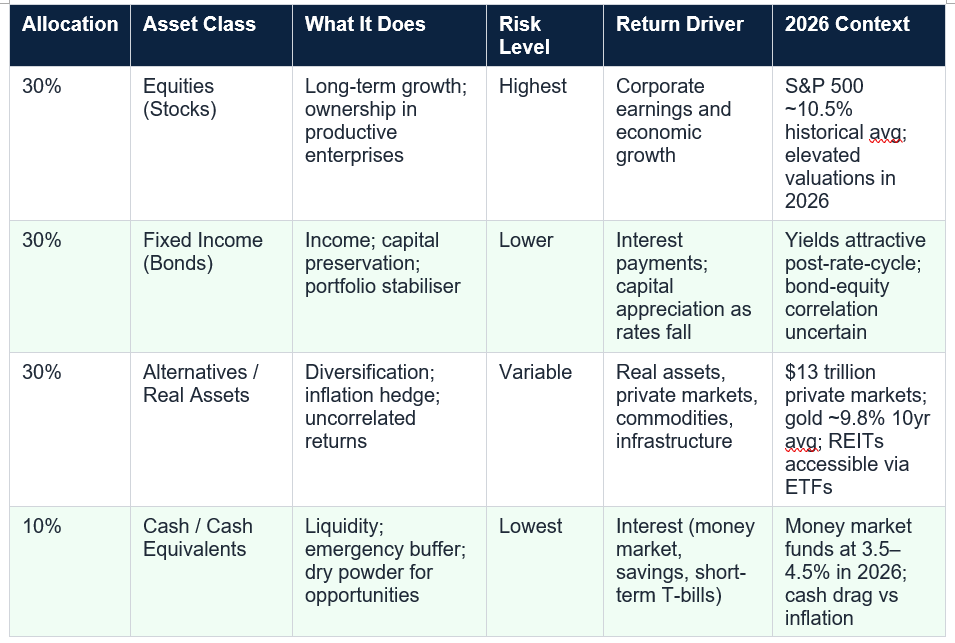
The four-bucket version above (30/30/30/10) reflects the practical reality of most real-world implementations: a pure three-thirds split leaves no liquidity buffer, whereas adding a 10 percent cash allocation provides the ‘dry powder’ that allows opportunistic rebalancing without selling long-term assets at inopportune moments.
Within the 30 percent equity allocation, further diversification is beneficial:
In 2026, the bond allocation is more attractive than it was during the near-zero interest rate environment of 2020 to 2022. The SmartAsset June 2026 analysis notes that the iShares 20-year-plus Treasury Bond ETF (TLT) has averaged approximately 4.86 percent annually since its 2002 launch. Following the rate cycle of 2022 to 2024, bond yields are now at levels that provide meaningfully higher income than the near-zero years, making the 30 percent fixed income allocation more productive as an income source.
Within the 30 percent bond allocation, diversification across bond types adds resilience: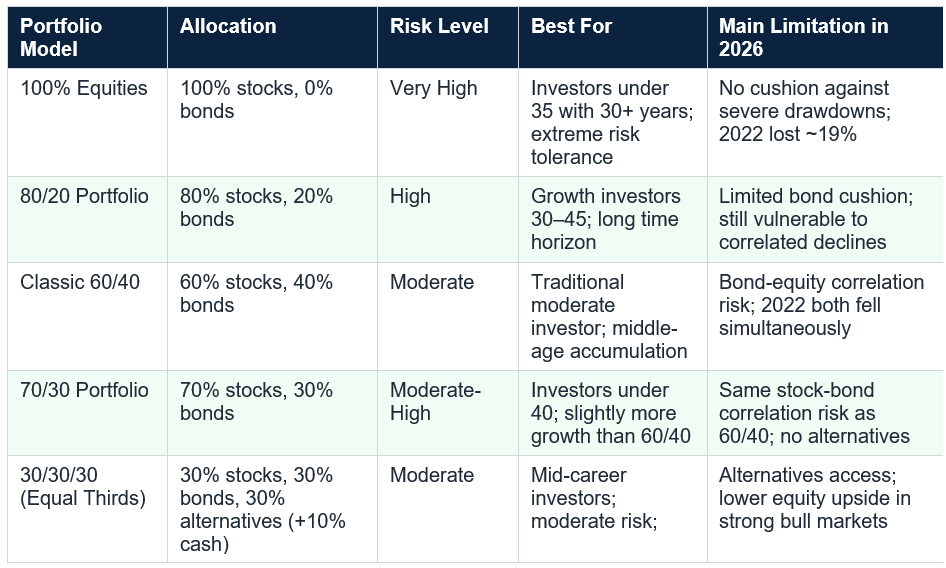
Critically, this improvement held even when the alternative assets were implemented through passive, index-based vehicles rather than expensive actively managed alternative funds. The diversification benefit was structural — a consequence of adding a genuinely uncorrelated third asset class — rather than dependent on manager skill.
The historical data on gold diversification supports a similar conclusion. HeyGoTrade’s May 2026 analysis found that a 5 to 15 percent gold allocation historically improved risk-adjusted returns and hedged long-horizon inflation across a range of portfolio compositions. Gold’s 10-year average annual return of approximately 9.8 percent (2016 to 2025) made it one of the stronger-performing alternative assets of the decade.
The 60/40 portfolio also recovered: HeyGoTrade’s April 2026 analysis notes it returned approximately 15 percent in 2024 and tracked near 14 percent in 2025 as the stock-bond correlation normalised. This recovery does not invalidate the case for three-way diversification; it illustrates that different portfolio structures perform differently in different economic environments, which is precisely the argument for building a portfolio that performs across more of those environments.
What happened in 2022:
The rebalancing rule recommended by the Legacy Investing Show’s February 2026 guide and HeyGoTrade’s May 2026 analysis: review quarterly and rebalance when any asset class has drifted more than 5 percentage points from its target allocation. An annual calendar review is an acceptable alternative for investors who prefer simplicity.
Rebalancing has two additional benefits beyond maintaining the target allocation:
The Candriam research showing a 40 percent improvement in Sharpe ratio for a three-way allocation versus the classic 60/40 is not an argument that the 60/40 portfolio is worthless. It recovered strongly in 2024 and 2025. It is an argument that adding a third genuinely uncorrelated asset class improves risk-adjusted returns across a wider range of economic environments — including environments where both stocks and bonds fall together.
For investors at or approaching the moderate-risk, mid-career stage of life, the 30/30/30 framework offers a coherent, evidence-backed alternative to both the traditional 60/40 and the complexity of individually managed alternative asset strategies. Built from low-cost index funds and ETFs, rebalanced annually or on a drift-based rule, held through market cycles with the patience that compounding demands, it is a portfolio that can grow, protect, and generate income across the unpredictable decades ahead.
The 30/30/30 investment strategy is a portfolio allocation framework that divides investments roughly equally across three distinct asset classes: equities (stocks) for growth, fixed income (bonds) for stability and income, and alternative assets (real estate, commodities, gold, infrastructure, or private markets) for genuine diversification. Many implementations also include a 10 percent cash allocation, making it a 30/30/30/10 portfolio in practice. The core principle is that three genuinely different asset classes provide more robust diversification than the traditional two-asset 60/40 stock-bond portfolio.
How does the 30/30/30 strategy differ from the 60/40 portfolio?
The classic 60/40 portfolio holds 60% stocks and 40% bonds. Its diversification depends on stocks and bonds moving in opposite directions — a relationship that failed in 2022 when both fell simultaneously, costing the 60/40 portfolio approximately 16 to 17%. The 30/30/30 strategy adds a third asset class (alternatives) that responds to different economic drivers from both stocks and bonds, reducing the portfolio’s dependence on the stock-bond correlation holding. Candriam research (2025) found that a three-way allocation showed a 40% improvement in Sharpe ratio versus the classic 60/40.
What does the ‘alternatives’ allocation include in a 30/30/30 portfolio?
The alternatives allocation in a 30/30/30 portfolio can include: real estate investment trusts (REITs), which provide exposure to property markets; commodity ETFs, which provide exposure to oil, agricultural products, and metals; gold (via gold ETFs such as GLD or iShares Physical Gold ETC); infrastructure funds; and, for institutional or sophisticated investors, private equity, private credit, and hedge funds. For most retail investors, a practical alternatives allocation uses REITs, a diversified commodity ETF, and gold, all accessible at low cost through standard brokerage accounts and ISAs.
Who is the 30/30/30 strategy best suited for?
The 30/30/30 strategy is best suited for mid-career investors aged 35 to 55 with a moderate risk tolerance and a time horizon of 10 to 25 years. It is particularly suitable for investors who want structural protection against periods when stocks and bonds fall simultaneously, and for those who want to add genuine diversification beyond the two-asset stock-bond model. It is generally less appropriate for very young investors (who should hold more equities for maximum long-run growth) or those approaching retirement (who may need a more conservative allocation).
What happened to the 30/30/30 portfolio in 2022 when the 60/40 failed?
A 30/30/30 portfolio with meaningful commodity and gold exposure would have performed materially better than the 60/40 in 2022. While the S&P 500 fell approximately 19.4% and the Bloomberg US Aggregate Bond Index fell approximately 13%, commodities (Bloomberg Commodity Index) rose approximately 16%, driven by energy price spikes. Gold was roughly flat, providing far better protection than either stocks or bonds. The REIT allocation fell in the second half of 2022 as rate rises weighed on valuations, but the overall three-asset portfolio would have experienced significantly lower drawdown than the two-asset 60/40.
How do I rebalance a 30/30/30 portfolio?
The Legacy Investing Show’s February 2026 guide and HeyGoTrade’s May 2026 analysis both recommend a drift-based rebalancing rule: review your portfolio quarterly and rebalance when any asset class has moved more than 5 percentage points from its target allocation. An annual calendar review is a simpler alternative. Inside tax-advantaged accounts (ISA, SIPP, 401k, Roth IRA), rebalance by directing new contributions toward the underweight allocation first, then by selling the overweight allocation if necessary. In taxable accounts, direct new contributions to underweight assets before triggering capital gains events.
What are the risks of the 30/30/30 strategy?
The main risks are: lower equity upside in strong bull markets (30% equities captures less growth than a 60%+ equity portfolio); alternative asset complexity (some alternatives are illiquid, expensive, or complex if not implemented via low-cost ETFs); correlation in crises (during severe market dislocations, all asset classes can fall simultaneously regardless of their normal correlation behaviour); and reduced long-run equity return for very young investors who would benefit from a higher equity allocation during their peak compounding years. No portfolio framework eliminates risk; the 30/30/30 strategy manages it differently from the traditional 60/40.
Table of Contents
- The Case for Equal Thirds
- Why the Traditional 60/40 Portfolio Is Under Pressure
- What Is the 30/30/30 Investment Strategy?
- The Three Asset Classes: What Each 30% Buys You
- The First 30%: Equities (Stocks)
- The Second 30%: Fixed Income (Bonds)
- The Third 30%: Alternative Assets
- The Fourth Slice: Where Does the Remaining 10% Go?
- The 30/30/30 vs. Other Major Portfolio Models
- What the Evidence Says: Does Three-Way Diversification Work?
- The 2022 Stress Test: Why the Classic 60/40 Failed
- Who Is the 30/30/30 Strategy Best Suited For?
- How to Build a 30/30/30 Portfolio in Practice
- Rebalancing: The One Discipline That Makes It Work
- The Risks and Limitations to Understand
- Conclusion: Equal Parts Discipline, Diversification, and Patience
- Frequently Asked Questions
The Case for Equal Thirds
Every investor, at some point, faces the same fundamental question: how do I split my money across different types of investment? The answer that has dominated personal finance for half a century — put 60 percent in stocks and 40 percent in bonds — was shaken to its foundations in 2022, when stocks and bonds fell simultaneously for the first time in decades and the 60/40 portfolio delivered its worst annual return since the 2008 financial crisis.That experience accelerated a conversation that institutional investors had already been having for years: is a two-asset portfolio sufficient for a world of volatile inflation, structurally higher interest rates, and investment opportunities that simply did not exist in mass-market form in the 1970s, when the 60/40 framework was codified? The emerging answer from both academic research and professional portfolio management is increasingly ‘no’ — and the direction of travel is toward three-way diversification.
The 30/30/30 investment strategy — sometimes called the equal-thirds approach — reflects this thinking. By allocating roughly equal portions of a portfolio across three distinct asset classes rather than two, investors aim to achieve a more robust form of diversification that performs better across a wider range of economic environments. This article explains exactly what the strategy is, where it came from, what the evidence says about whether it works, and who it is best suited for in 2026.
Why the Traditional 60/40 Portfolio Is Under Pressure
To understand the 30/30/30 strategy, it helps to understand why the two-asset 60/40 model it is partially replacing has come under scrutiny.The 60/40 portfolio — 60 percent equities, 40 percent bonds — worked exceptionally well for most of the period between 1980 and 2020. Its logic was simple: stocks provide growth, bonds provide stability, and because the two asset classes tend to move in opposite directions during market stress (when stocks fall, investors typically buy bonds, pushing bond prices up), combining them reduced volatility without dramatically sacrificing returns.
But this relationship broke down in 2022. As inflation surged to 9.1 percent in the US and central banks raised interest rates at the fastest pace in 40 years, both stocks and bonds fell simultaneously. The 60/40 portfolio lost approximately 16 to 17 percent — its worst calendar year since 2008. As HeyGoTrade’s April 2026 analysis notes, critics have since pointed out that the positive stock-bond correlation of 2022 was not a one-off anomaly: prior to the 2000s, stocks and bonds moving in the same direction was the norm, not the exception. If inflation remains volatile, the diversification benefit of bonds cannot be guaranteed.
Candriam Research, as reported by Funds Society (July 2025): The 60/40 portfolio, a safe path to growth depended on for 50 years, is no longer enough. Global inflationary pressures, coupled with shifts in central bank monetary policies, are introducing challenges not seen since the 1980s. A three-way allocation including alternatives showed a 40% improvement in Sharpe ratio versus the classic 60/40.
What Is the 30/30/30 Investment Strategy?
The 30/30/30 investment strategy is a portfolio allocation framework that divides investment capital roughly equally across three distinct asset categories: equities (stocks), fixed income (bonds), and a third category — typically alternative assets, real assets, or cash. The key principle is three-way diversification: rather than relying on the historically uncertain inverse relationship between just two asset classes, the strategy introduces a third leg that responds to different economic conditions from the other two.There are two primary versions of the 30/30/30 framework in use in 2026:
- 30% Equities / 30% Bonds / 30% Alternatives (+ 10% Cash): the institutional version, driven by research from asset managers including Candriam. This is effectively a modification of the emerging 40/30/30 portfolio (40% stocks, 30% bonds, 30% alternatives) tilted slightly more conservatively. The ‘alternatives’ bucket includes private equity, hedge funds, real estate, infrastructure, commodities, and other assets that do not behave like traditional stocks or bonds.
- 30% Domestic Equities / 30% International Equities / 30% Bonds (+ 10% Cash): a retail-focused variant that achieves three-way diversification by splitting the equity allocation between domestic and international markets rather than introducing a formal ‘alternatives’ category. This is more accessible for individual investors who may not have easy access to private markets.
Key Insight: The 30/30/30 strategy is not a single universally standardised framework with one definition. It is a broad philosophy of equal-thirds allocation that can be implemented in different ways depending on the investor’s access to asset classes, risk tolerance, and time horizon. What remains consistent across all versions is the principle of three genuinely distinct allocations.
The Three Asset Classes: What Each 30% Buys You
The four-bucket version above (30/30/30/10) reflects the practical reality of most real-world implementations: a pure three-thirds split leaves no liquidity buffer, whereas adding a 10 percent cash allocation provides the ‘dry powder’ that allows opportunistic rebalancing without selling long-term assets at inopportune moments.
The First 30%: Equities (Stocks)
The equity allocation in a 30/30/30 portfolio provides the growth engine. Historically, equities have delivered higher returns than any other major asset class over long periods: the S&P 500 has averaged approximately 10.5 percent per year in nominal terms from its inception in 1957 through 2025. This growth comes with volatility — single-year swings of 30 to 40 percent in either direction have occurred multiple times — but over periods of 10 years or more, the equity risk premium has consistently rewarded patient investors.Within the 30 percent equity allocation, further diversification is beneficial:
- Domestic equities: exposure to the home market through a low-cost total market index fund (such as Vanguard Total Stock Market Index Fund, VTI in the US, or Vanguard FTSE UK All Share Index in the UK). This provides the foundation of the equity allocation.
- International equities: the global economy is larger than any single domestic market. Adding international developed markets (Europe, Japan, Australia) and emerging markets (India, China, Brazil) reduces concentration in the home market and captures growth from a broader pool of productive enterprises.
- Sector diversification: within equities, broad index funds automatically provide exposure across technology, healthcare, financials, consumer goods, energy, industrials, and other sectors. Single-sector concentration increases risk without necessarily increasing expected return.
The Second 30%: Fixed Income (Bonds)
The bond allocation in a 30/30/30 portfolio serves multiple functions: it provides regular income through interest payments (coupons), it tends to preserve capital better than equities during market downturns when the stock-bond inverse relationship holds, and it provides a source of capital that can be redeployed into equities during market corrections without requiring the sale of equity positions at depressed prices.In 2026, the bond allocation is more attractive than it was during the near-zero interest rate environment of 2020 to 2022. The SmartAsset June 2026 analysis notes that the iShares 20-year-plus Treasury Bond ETF (TLT) has averaged approximately 4.86 percent annually since its 2002 launch. Following the rate cycle of 2022 to 2024, bond yields are now at levels that provide meaningfully higher income than the near-zero years, making the 30 percent fixed income allocation more productive as an income source.
Within the 30 percent bond allocation, diversification across bond types adds resilience:
- Government bonds (Gilts in the UK, Treasuries in the US): the safest bond category, backed by sovereign credit. Lower yield but maximum stability.
- Corporate bonds (investment grade): slightly higher yield than government bonds in exchange for slightly higher credit risk. Investment-grade corporate bonds (BBB or higher) have historically had low default rates.
- Short, intermediate, and long-duration mix: a bond ladder or a diversified bond fund spreads maturity risk across the yield curve, reducing the impact of interest rate movements on any single portion of the allocation.
The Third 30%: Alternative Assets
The alternative asset allocation is what distinguishes the 30/30/30 portfolio from its two-asset predecessors. Alternatives are investments that do not fit neatly into the equity or bond categories and that respond to different economic drivers — making them the genuine diversifiers that the portfolio’s third leg is designed to provide.Real Estate (REITs)
Real Estate Investment Trusts provide exposure to commercial, residential, industrial, and specialised property markets without requiring direct property ownership. REITs generate rental income and property appreciation, providing inflation protection (rents tend to rise with inflation) and income (REITs are required to distribute at least 90 percent of taxable income as dividends in the US). In the UK, listed property funds and REITs are accessible through standard ISA accounts.Commodities and Gold
Commodities — including oil, natural gas, agricultural products, metals, and gold — are real assets whose prices tend to rise during inflationary periods. Gold in particular has a long track record as an inflation hedge and a safe-haven asset during geopolitical stress. HeyGoTrade’s May 2026 analysis of stocks-bonds-gold diversification notes that a 5 to 15 percent gold allocation via GLD (the SPDR Gold Shares ETF) has historically improved risk-adjusted returns and hedged long-horizon inflation.Infrastructure
Infrastructure assets — toll roads, airports, utilities, renewable energy plants, and broadband networks — generate stable, long-term income streams that are often contractually linked to inflation indices. Institutional investors have dramatically increased infrastructure allocations in recent years as an alternative to bonds for income generation.Private Markets
Wealth Management’s February 2025 analysis notes that private markets have grown from a few hundred billion dollars in 2000 to $13 trillion today. Once limited to institutional portfolios, private equity, private credit, and private real estate are increasingly accessible to retail investors through listed funds, investment trusts, and new fund structures. Private markets offer potential for higher returns than public markets in exchange for lower liquidity.The Fourth Slice: Where Does the Remaining 10% Go?
In practice, most implementations of the 30/30/30 framework retain a 10 percent cash or cash-equivalent allocation rather than running a pure three-thirds split. This serves several specific functions:- Emergency and liquidity buffer: financial planning consistently recommends maintaining three to six months of living expenses in accessible cash before investing in any long-term portfolio. The 10 percent cash allocation within the portfolio is separate from this emergency fund and provides near-term liquidity within the investment structure.
- Rebalancing capital: when equity markets fall and the portfolio’s equity allocation drops below 30 percent, the cash allocation provides capital to buy additional equities without being forced to sell bonds or alternatives at potentially unfavourable prices.
- Dry powder for opportunities: market dislocations — periods of unusually low asset prices during panics or sell-offs — reward investors with available capital. A 10 percent cash sleeve ensures this capacity exists at all times.
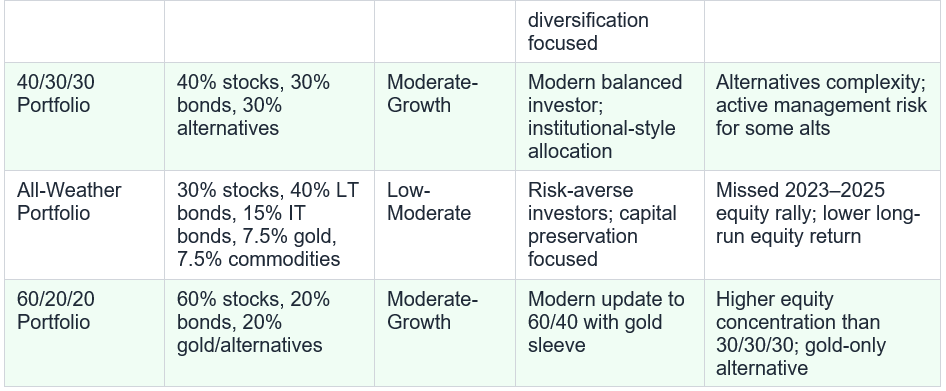
The 30/30/30 vs. Other Major Portfolio Models
What the Evidence Says: Does Three-Way Diversification Work?
The empirical case for adding a third asset class to the traditional stock-bond allocation has been growing for several years. The most rigorous recent study was published by Candriam in 2025 and covered extensively by Funds Society in July of that year. Its key finding: a portfolio of 40 percent public equities, 30 percent fixed income, and 30 percent alternative investments showed a 40 percent improvement in Sharpe ratio versus the classic 60/40 portfolio. The Sharpe ratio measures return per unit of risk — a 40 percent improvement means the three-way portfolio delivered meaningfully better risk-adjusted returns than the two-way portfolio.Critically, this improvement held even when the alternative assets were implemented through passive, index-based vehicles rather than expensive actively managed alternative funds. The diversification benefit was structural — a consequence of adding a genuinely uncorrelated third asset class — rather than dependent on manager skill.
The historical data on gold diversification supports a similar conclusion. HeyGoTrade’s May 2026 analysis found that a 5 to 15 percent gold allocation historically improved risk-adjusted returns and hedged long-horizon inflation across a range of portfolio compositions. Gold’s 10-year average annual return of approximately 9.8 percent (2016 to 2025) made it one of the stronger-performing alternative assets of the decade.
The 60/40 portfolio also recovered: HeyGoTrade’s April 2026 analysis notes it returned approximately 15 percent in 2024 and tracked near 14 percent in 2025 as the stock-bond correlation normalised. This recovery does not invalidate the case for three-way diversification; it illustrates that different portfolio structures perform differently in different economic environments, which is precisely the argument for building a portfolio that performs across more of those environments.
The 2022 Stress Test: Why the Classic 60/40 Failed
The 2022 market environment was the most significant test of the 60/40 portfolio since 2008, and it delivered a clear verdict: when both inflation and interest rates rise sharply and simultaneously, the two-asset stock-bond portfolio provides much less protection than its investors had come to expect.What happened in 2022:
- US CPI inflation peaked at 9.1 percent in June 2022 — the highest since 1981.
- The Federal Reserve raised interest rates from 0 percent to 4.25 to 4.50 percent over the course of the year — the fastest tightening cycle in 40 years.
- The S&P 500 fell approximately 19.4 percent over the year.
- The Bloomberg US Aggregate Bond Index fell approximately 13.0 percent over the year.
- The 60/40 portfolio fell approximately 16 to 17 percent — both legs of the traditional portfolio declined simultaneously.
Who Is the 30/30/30 Strategy Best Suited For?
The 30/30/30 strategy is not universally appropriate. It is best suited for specific investor profiles:- Mid-career investors aged 35 to 55: investors with 10 to 25 years until retirement who want a portfolio that balances growth (the equity allocation), income and stability (the bond allocation), and genuine diversification (the alternatives allocation). This group has enough time to ride out equity volatility but is near enough to retirement to care about downside protection.
- Moderate risk tolerance: the 30/30/30 portfolio accepts that the equity allocation of 30 percent is lower than many growth-oriented portfolios recommend. Investors who need maximum equity growth to catch up on retirement savings may find the three-way split too conservative.
- Investors who have experienced or fear correlated stock-bond declines: anyone who watched their 60/40 portfolio fall in 2022 and wants a framework that is structurally more robust against future periods when bonds fail to cushion equity declines.
- Investors with access to low-cost alternatives: the third bucket is only valuable if it can be accessed efficiently. If the alternatives available to you carry high fees (some actively managed alternative funds charge 2 percent or more annually), the diversification benefit may be offset by the cost. REITs, commodity ETFs, and gold ETFs are accessible to most investors at low cost and represent a practical implementation of the alternatives allocation.
How to Build a 30/30/30 Portfolio in Practice
For a UK investor with £10,000 to invest (scalable to any amount):- Equity allocation (30% = £3,000): Vanguard LifeStrategy 80% Equity fund or a combination of Vanguard FTSE UK All Share ETF and Vanguard FTSE All-World ETF. This provides global equity exposure at an annual cost of approximately 0.15 to 0.22 percent.
- Bond allocation (30% = £3,000): Vanguard UK Gilt ETF (for government bonds) combined with iShares Corporate Bond ETF. Target a mix of approximately 60 percent government and 40 percent corporate bonds within the allocation. Annual cost approximately 0.07 to 0.20 percent.
- Alternatives allocation (30% = £3,000): split across a UK REIT fund (e.g. iShares UK Property ETF), a commodity ETF (e.g. iShares Diversified Commodity Swap ETF), and a gold ETF (e.g. iShares Physical Gold ETC). This achieves real asset diversification within the alternatives allocation at low cost. Annual cost approximately 0.15 to 0.25 percent.
- Cash allocation (10% = £1,000): held in a money market fund within the ISA wrapper (where available) or in a high-interest easy-access account. In 2026, this portion can earn 3.5 to 4.5 percent.
Rebalancing: The One Discipline That Makes It Work
A portfolio that is built as 30/30/30 but never rebalanced will drift away from its target allocation as market movements cause some assets to grow faster than others. After a strong equity bull market, for example, the equity allocation may have grown from 30 percent to 40 or 45 percent — inadvertently increasing risk exposure above the investor’s intended level.The rebalancing rule recommended by the Legacy Investing Show’s February 2026 guide and HeyGoTrade’s May 2026 analysis: review quarterly and rebalance when any asset class has drifted more than 5 percentage points from its target allocation. An annual calendar review is an acceptable alternative for investors who prefer simplicity.
Rebalancing has two additional benefits beyond maintaining the target allocation:
- It enforces a buy-low-sell-high discipline: selling the asset that has risen most (selling high) and buying the asset that has fallen most (buying low) is counter-intuitive in the moment but structurally correct in a diversified portfolio. Rebalancing automates this behaviour.
- In tax-advantaged accounts (ISA, SIPP, 401k, Roth IRA): rebalancing inside a tax-advantaged account incurs no immediate tax cost, making it straightforward to execute. In taxable accounts, use new cash contributions to rebalance where possible before triggering capital gains events.
The Risks and Limitations to Understand
No portfolio framework eliminates risk, and the 30/30/30 strategy has specific limitations that every investor should understand before adopting it:- Lower equity upside in strong bull markets: the 30 percent equity allocation captures less of a strong equity bull market than a 60/40 or 80/20 portfolio. The three-way structure trades some upside for improved resilience. This is an explicit trade-off, not a flaw.
- Alternative asset complexity: not all alternatives are created equal. Private equity, hedge funds, and some infrastructure assets are complex, illiquid, and expensive if accessed through actively managed vehicles. The low-cost ETF implementation (REITs, commodity ETFs, gold ETFs) avoids these issues, but it also means the ‘alternatives’ bucket is not as fully diversifying as a true institutional alternatives allocation.
- Alternatives in a crisis: during severe market dislocations, correlations across all asset classes can rise sharply — the phenomenon known as ‘correlation to one’ in a crisis. Some alternatives that appear uncorrelated in normal markets can fall significantly during panics. This was observed with REITs in 2008 and in the March 2020 COVID sell-off.
- Not suitable for very young investors: a 25-year-old with a 40-year investment horizon has sufficient time to ride out equity volatility and should generally hold a higher equity allocation than 30 percent. The lower equity weighting of 30/30/30 reduces expected long-run returns in exchange for lower volatility — a trade-off that may not be optimal for investors with very long time horizons.
Conclusion
The 30/30/30 investment strategy is the practical application of a simple but powerful idea: that genuinely diversified portfolios need more than two asset classes to provide resilience across the full range of economic environments that investors will encounter over a working lifetime. The 2022 experience — when the 60/40 portfolio’s two-asset structure failed at precisely the moment investors needed it most — has given this idea a live demonstration that no amount of historical data alone could have provided.The Candriam research showing a 40 percent improvement in Sharpe ratio for a three-way allocation versus the classic 60/40 is not an argument that the 60/40 portfolio is worthless. It recovered strongly in 2024 and 2025. It is an argument that adding a third genuinely uncorrelated asset class improves risk-adjusted returns across a wider range of economic environments — including environments where both stocks and bonds fall together.
For investors at or approaching the moderate-risk, mid-career stage of life, the 30/30/30 framework offers a coherent, evidence-backed alternative to both the traditional 60/40 and the complexity of individually managed alternative asset strategies. Built from low-cost index funds and ETFs, rebalanced annually or on a drift-based rule, held through market cycles with the patience that compounding demands, it is a portfolio that can grow, protect, and generate income across the unpredictable decades ahead.
Frequently Asked Questions
What is the 30/30/30 investment strategy?The 30/30/30 investment strategy is a portfolio allocation framework that divides investments roughly equally across three distinct asset classes: equities (stocks) for growth, fixed income (bonds) for stability and income, and alternative assets (real estate, commodities, gold, infrastructure, or private markets) for genuine diversification. Many implementations also include a 10 percent cash allocation, making it a 30/30/30/10 portfolio in practice. The core principle is that three genuinely different asset classes provide more robust diversification than the traditional two-asset 60/40 stock-bond portfolio.
How does the 30/30/30 strategy differ from the 60/40 portfolio?
The classic 60/40 portfolio holds 60% stocks and 40% bonds. Its diversification depends on stocks and bonds moving in opposite directions — a relationship that failed in 2022 when both fell simultaneously, costing the 60/40 portfolio approximately 16 to 17%. The 30/30/30 strategy adds a third asset class (alternatives) that responds to different economic drivers from both stocks and bonds, reducing the portfolio’s dependence on the stock-bond correlation holding. Candriam research (2025) found that a three-way allocation showed a 40% improvement in Sharpe ratio versus the classic 60/40.
What does the ‘alternatives’ allocation include in a 30/30/30 portfolio?
The alternatives allocation in a 30/30/30 portfolio can include: real estate investment trusts (REITs), which provide exposure to property markets; commodity ETFs, which provide exposure to oil, agricultural products, and metals; gold (via gold ETFs such as GLD or iShares Physical Gold ETC); infrastructure funds; and, for institutional or sophisticated investors, private equity, private credit, and hedge funds. For most retail investors, a practical alternatives allocation uses REITs, a diversified commodity ETF, and gold, all accessible at low cost through standard brokerage accounts and ISAs.
Who is the 30/30/30 strategy best suited for?
The 30/30/30 strategy is best suited for mid-career investors aged 35 to 55 with a moderate risk tolerance and a time horizon of 10 to 25 years. It is particularly suitable for investors who want structural protection against periods when stocks and bonds fall simultaneously, and for those who want to add genuine diversification beyond the two-asset stock-bond model. It is generally less appropriate for very young investors (who should hold more equities for maximum long-run growth) or those approaching retirement (who may need a more conservative allocation).
What happened to the 30/30/30 portfolio in 2022 when the 60/40 failed?
A 30/30/30 portfolio with meaningful commodity and gold exposure would have performed materially better than the 60/40 in 2022. While the S&P 500 fell approximately 19.4% and the Bloomberg US Aggregate Bond Index fell approximately 13%, commodities (Bloomberg Commodity Index) rose approximately 16%, driven by energy price spikes. Gold was roughly flat, providing far better protection than either stocks or bonds. The REIT allocation fell in the second half of 2022 as rate rises weighed on valuations, but the overall three-asset portfolio would have experienced significantly lower drawdown than the two-asset 60/40.
How do I rebalance a 30/30/30 portfolio?
The Legacy Investing Show’s February 2026 guide and HeyGoTrade’s May 2026 analysis both recommend a drift-based rebalancing rule: review your portfolio quarterly and rebalance when any asset class has moved more than 5 percentage points from its target allocation. An annual calendar review is a simpler alternative. Inside tax-advantaged accounts (ISA, SIPP, 401k, Roth IRA), rebalance by directing new contributions toward the underweight allocation first, then by selling the overweight allocation if necessary. In taxable accounts, direct new contributions to underweight assets before triggering capital gains events.
What are the risks of the 30/30/30 strategy?
The main risks are: lower equity upside in strong bull markets (30% equities captures less growth than a 60%+ equity portfolio); alternative asset complexity (some alternatives are illiquid, expensive, or complex if not implemented via low-cost ETFs); correlation in crises (during severe market dislocations, all asset classes can fall simultaneously regardless of their normal correlation behaviour); and reduced long-run equity return for very young investors who would benefit from a higher equity allocation during their peak compounding years. No portfolio framework eliminates risk; the 30/30/30 strategy manages it differently from the traditional 60/40.
0 Comments
Be the first to share your thoughts on this article.