
Investing
What Is the Bond Market? Accountant Explains


Table of Contents
- The Market That Moves Governments, Economies, and Mortgages
- What Is the Bond Market?
- How a Bond Works: The Four Key Components
- Worked Example: How a UK Gilt Investment Works
- Types of Bonds: The Complete 2026 Reference
- The Inverse Relationship: How Bond Yields and Prices Move
- The Yield Curve: What It Tells Us About the Economy
- The Bond Market in 2026: The Current Environment
- The Role of Bonds in an Investment Portfolio
- Conclusion
- Frequently Asked Questions (FAQ)
The Market That Moves Governments, Economies, and Mortgages
When UK chancellor Jeremy Hunt delivered the September 2022 mini-budget, it was not the stock market that reacted first and most violently — it was the bond market. UK gilt yields surged to their highest levels in decades within hours. Mortgage rates followed within days. Pension funds faced margin calls that threatened their solvency within a week. The Bank of England was forced to intervene with emergency bond purchases to prevent a financial crisis. The mini-budget was reversed within weeks. The bond market — not Parliament, not regulators, not voters — had spoken, and governments listen when it does.The bond market is the largest financial market in the world. It dwarfs the global stock market in total value. It determines the interest rates at which governments fund their spending, companies finance their growth, and individuals pay for their mortgages. Yet for most ordinary investors, it remains far less understood than the stock market. Ask a retail investor about share prices and they will likely have an opinion. Ask the same investor about the relationship between bond yields and interest rates, and you will often get a blank stare. This guide fixes that.
This guide explains the bond market completely and practically for 2026: what a bond is and how the bond market works, the primary and secondary markets, the types of bonds from UK gilts to US Treasuries to corporate and high-yield bonds, the most critical concept in fixed income — the inverse relationship between bond yields and prices — the yield curve and what its shape signals about economic expectations, the 2026 bond market environment with live yield data, the role bonds play in a diversified investment portfolio, the specific UK tax advantages of gilts, and the practical options for retail investors wanting to access the bond market today.
What Is the Bond Market?
The bond market is the global marketplace where bonds — debt securities issued by governments, corporations, municipalities, and supranational organisations — are created, bought, and sold. Chase defines the essential purpose: 'The US bond market refers to the market for debt securities. Investors — including individuals, institutions, and even foreign governments — can buy and sell bonds, with the proceeds going to pay for government projects and activities.'When a government needs to fund its spending beyond what tax revenues cover, it does not go to a bank for a loan — it issues bonds. When a company needs capital for expansion that it does not want to raise through new shares, it issues corporate bonds. When either entity issues a bond, it is effectively borrowing money from investors in exchange for a promise to pay regular interest (the coupon) at defined intervals and to return the original sum (the principal or face value) at a specific future date (the maturity date). The bond itself is the legal contract encoding these promises. The bond market is where those contracts are created and subsequently traded.
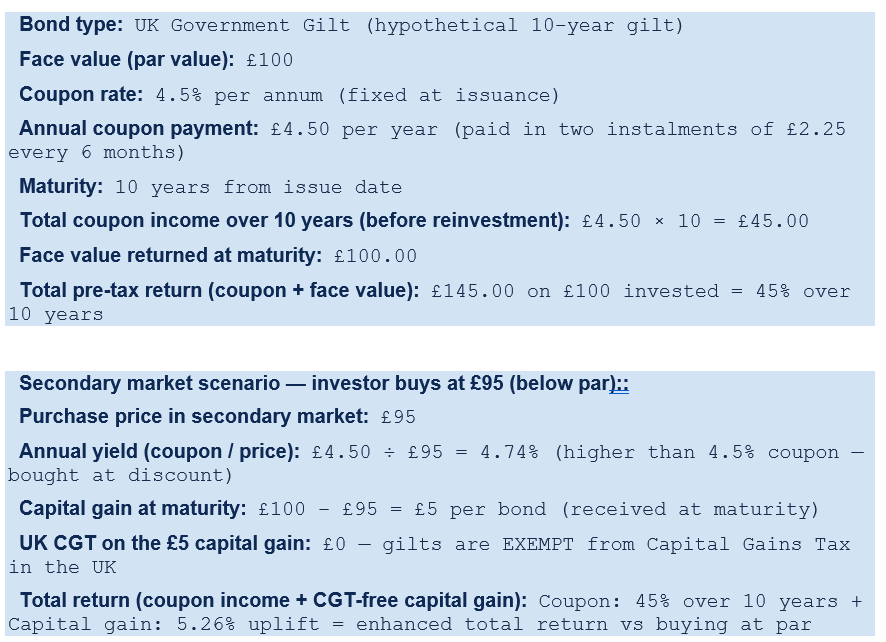
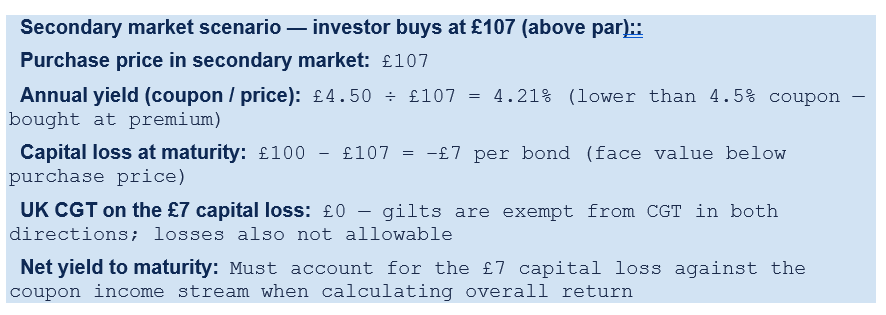
The bond market operates in two segments: the primary market, where new bonds are issued and sold to the first buyer (typically at a fixed price set by the issuer), and the secondary market, where existing bonds are traded between investors after issue. The secondary market price of a bond fluctuates continuously based on prevailing interest rates, the issuer's creditworthiness, time to maturity, and investor demand — which is why the bond you buy at £100 today may be worth £95 or £107 tomorrow, even though the government still owes you exactly £100 at maturity.
The bond market in 2026 — key benchmarks: UK 10-year gilt: ~4.82% (mid-June 2026). US 10-year Treasury: 4.48% (June 17, 2026). Bloomberg US Aggregate Bond Index: ~7% return in 2025. — IG UK (1 week ago): 'With the Bank of England Bank Rate at 3.75% and the 10-year gilt yield at approximately 4.82% as of mid-June 2026, bonds now offer income returns that were not available during the low-rate years of 2009-2021.' US Bank Asset Management (June 17, 2026): '10-year US Treasury yield stood at 4.48% at market close, near the high of the 4.00% to 4.50% range that has defined much of the past year.' Yahoo Finance (December 2025): Bloomberg US Aggregate Bond Index returned ~7% in 2025. Barclays Private Bank: yields both nominal and real above 20-year averages in 2026
How a Bond Works: The Four Key Components
Every bond — whether a UK gilt, a US Treasury, or a corporate bond — is defined by four fundamental terms that determine everything about its behaviour and the investor's return:- Face value (par value): The amount the issuer promises to repay the investor at maturity. In the UK, most gilts have a face value of £100. US Treasuries typically use $1,000 or $100 for T-bills. This is the amount returned at the end — regardless of what the bond traded at in the secondary market in the intervening period.
- Coupon rate: The fixed annual interest payment expressed as a percentage of the face value, paid at regular intervals (typically semi-annually for US Treasuries; typically twice yearly or annually for UK gilts). A gilt with a face value of £100 and a 4% coupon pays £4 per year in interest — £2 every six months. The coupon rate is fixed at issuance and does not change regardless of subsequent market interest rate movements. This fixed income stream is what makes bonds 'fixed income' instruments.
- Maturity date: The specific future date on which the issuer repays the face value to the holder. Bond maturities range from four weeks (US T-bills) to 50 years (some UK ultra-long gilts). The longer the maturity, the more sensitive the bond's price is to interest rate changes — because the investor is locked in to the fixed coupon for longer before receiving the face value back.
- Yield: The actual return an investor receives, calculated as the coupon payment relative to the current market price of the bond. If a bond with a £100 face value and £4 annual coupon is trading at £95 in the secondary market, its yield is £4 ÷ £95 = 4.21% — higher than the 4% coupon, because you are buying it below face value and will receive £100 at maturity. If the same bond trades at £107, the yield falls to £4 ÷ £107 = 3.74%. The yield moves inversely with the price — the most fundamental relationship in fixed income investing.
Worked Example: How a UK Gilt Investment Works
Types of Bonds: The Complete 2026 Reference
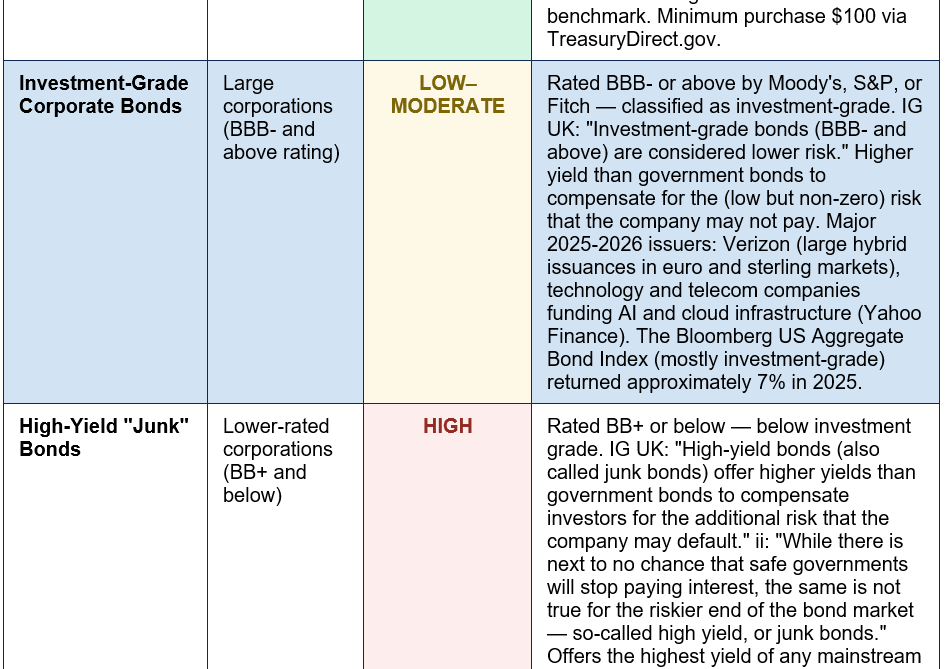
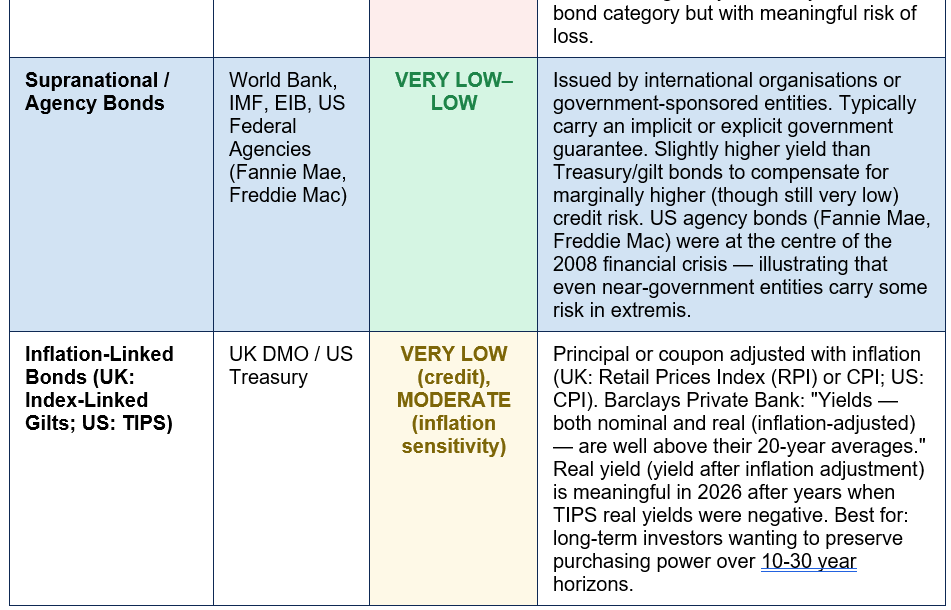
The bond market encompasses a wide range of instruments issued by different entities with different risk profiles, yields, and investor characteristics. The table below maps every major bond type with current 2026 context: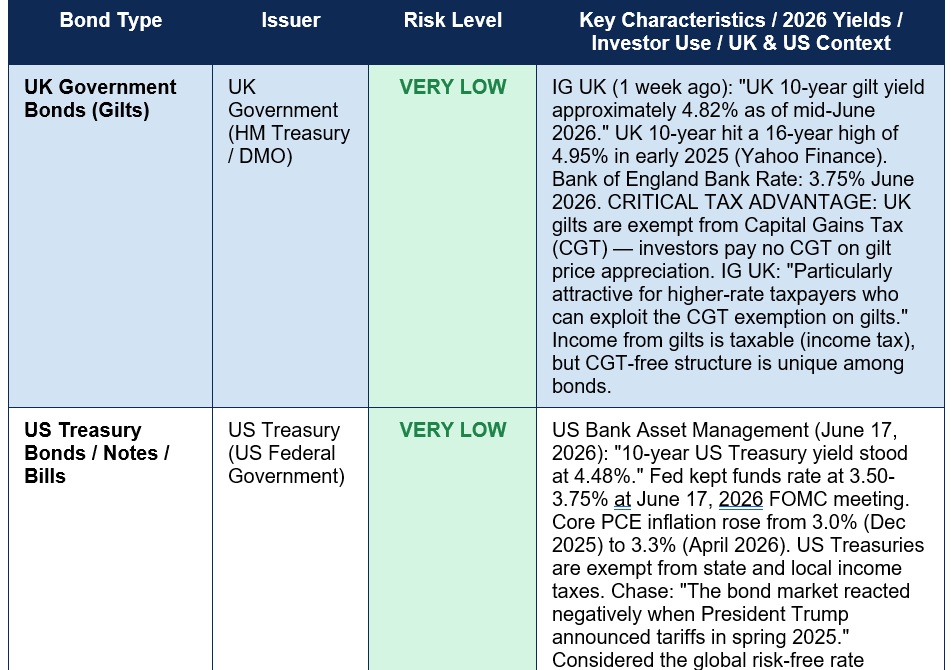
The Inverse Relationship: How Bond Yields and Prices Move
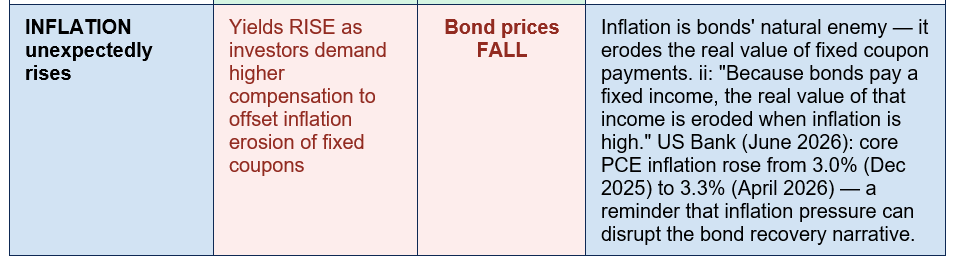
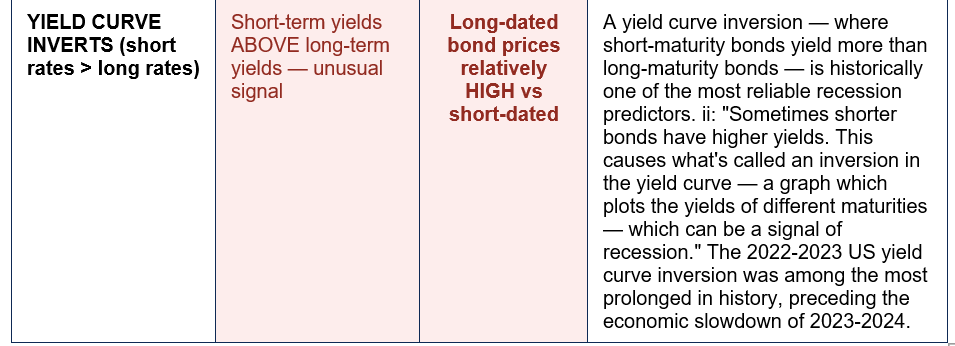
The most important concept in fixed income investing — and the one that trips up even experienced investors — is the inverse relationship between bond yields and bond prices. When yields go up, prices go down. When prices go up, yields go down. The following table maps the six most important scenarios in the bond market, showing what drives yield and price changes and giving real 2026 examples: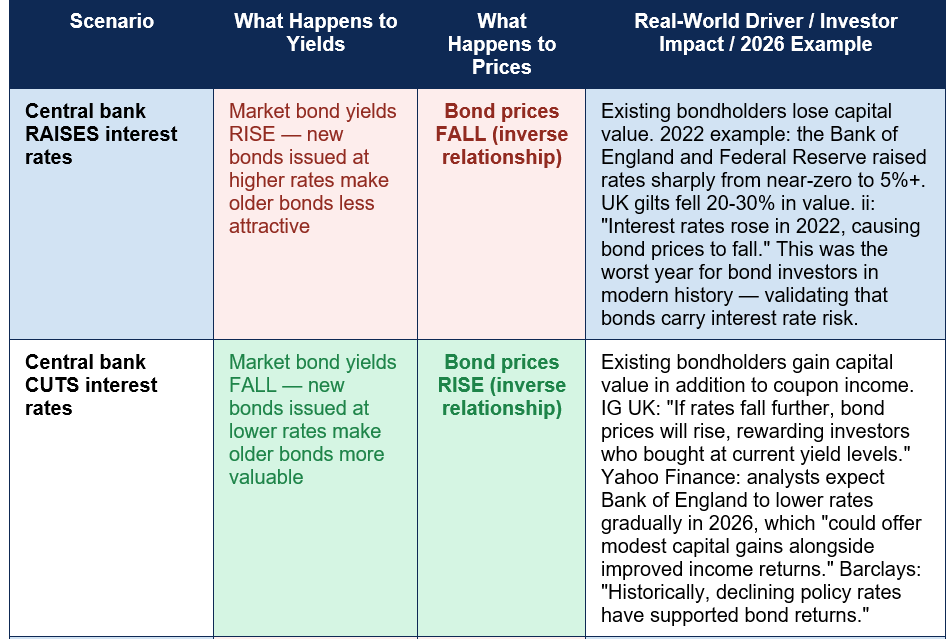
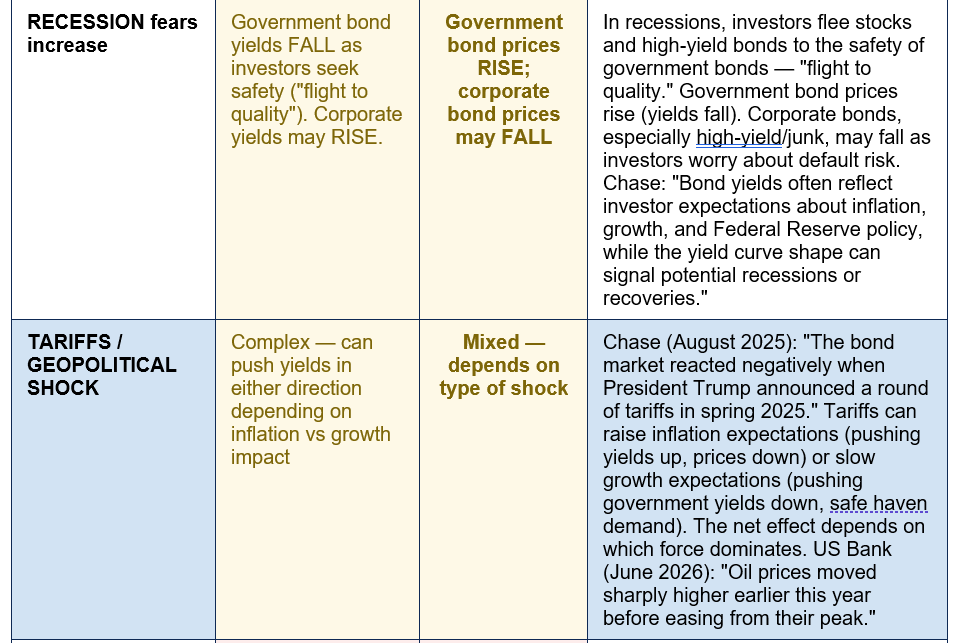
Why do bond prices fall when interest rates rise? The intuitive explanation: you hold a bond paying £45 per year on a £1,000 face value — a 4.5% yield. Now the Bank of England raises rates and new bonds are issued at 6%. Your 4.5% bond is now less attractive compared to new bonds at 6%. To sell your bond, you must lower the price until its yield matches the new market rate. If the new market rate is 6%, you need to price your bond so that £45 coupon on your asking price = 6%. That means asking price = £45 ÷ 0.06 = £750. Your bond's market price has fallen from £1,000 to £750 — a 25% decline — purely because interest rates rose. IG UK: 'Interest rates rose in 2022, causing bond prices to fall' — describing exactly this mechanism in action across the entire UK gilt market.
The Yield Curve: What It Tells Us About the Economy
The yield curve is a graph that plots the yields of bonds of the same issuer (typically government bonds) across different maturities — from the shortest (1-month T-bills or gilts) to the longest (30-year bonds). Its shape carries significant information about market expectations for interest rates, economic growth, and future inflation:- Normal (upward-sloping) yield curve: Long-term bonds yield more than short-term bonds — the most common configuration in a healthy economy. Investors demand higher compensation for lending money over longer periods, because more can go wrong over time (higher duration risk, inflation uncertainty). ii: 'Longer bonds tend to offer higher yields than shorter dated bonds to compensate investors for locking up their money for longer periods.'
- Flat yield curve: Short-term and long-term yields are approximately equal. Often a transitional state — the economy is at a turning point. Investors are uncertain whether rates will rise or fall. May indicate slowing economic growth as the premium for long-term lending disappears.
- Inverted yield curve: Short-term bonds yield MORE than long-term bonds — the configuration that historically precedes recessions with remarkable reliability. It signals that investors expect interest rates to fall significantly in the future (because of an anticipated economic slowdown or recession). Chase: 'The yield curve shape can signal potential recessions or recoveries.' The 2022-2023 US yield curve inversion was the most sustained in decades. ii: 'This causes what's called an inversion in the yield curve — a signal of recession.'
The Bond Market in 2026: The Current Environment
The 2026 bond market is operating in a historically unusual but increasingly normalised environment — one where yields are meaningfully positive in real terms after years of near-zero rates. Here is the key context:- Bonds are back: IG UK (1 week ago): 'With the Bank of England Bank Rate at 3.75% and the 10-year gilt yield at approximately 4.82% as of mid-June 2026, bonds now offer income returns that were not available during the low-rate years of 2009-2021. This has renewed retail investor interest in the asset class.' Barclays Private Bank: 'Yields — both nominal and real (inflation-adjusted) — are well above their 20-year averages, providing a strong starting point for performance.'
- 2025 bond market performance: Yahoo Finance (December 2025): 'The Bloomberg US Aggregate Bond Index returned about 7% for the year as of late November 2025.' ii confirms: 'Bonds generally delivered strong positive returns in 2025.' After the catastrophic 2022 year for bonds (the worst in modern history), the asset class has been recovering. The combination of high starting yields and gradual rate cuts created a constructive environment in 2025.
- Central bank direction: US Bank Asset Management (June 17, 2026): 'At its June 17 meeting, the Federal Open Market Committee kept the federal funds target range at 3.50 to 3.75%.' Barclays Private Bank: 'Forward pricing for UK, eurozone and US rates suggests that more easing will be seen in 2026.' The direction of central bank policy remains the dominant bond market driver. ii: 'Economists expect central banks to keep gradually cutting interest rates throughout 2025 and 2026, which should provide a boost to bond prices.'
- Inflation uncertainty remains: US Bank (June 2026): 'Core PCE rose from 3.0% year-over-year in December 2025 to 3.3% in April 2026.' This unexpected uptick in inflation in early 2026 demonstrates that the path to central bank 2% targets is not linear. Barclays: 'Slow progress on the disinflationary process, tariffs and the lack of government debt consolidation add complexity. Success in 2026 will depend on timely and correct interpretation of incoming data.'
- Corporate bond market: Yahoo Finance (December 2025): 'Technology and telecom companies are expected to remain prominent borrowers as spending on AI, cloud capacity, data centres and network infrastructure continues. Verizon executed several large bond transactions in 2025, including hybrid issuances in the euro and sterling markets.'
The Role of Bonds in an Investment Portfolio
Understanding the bond market is not just an academic exercise — bonds play three specific functional roles in a well-constructed investment portfolio that equities alone cannot fulfil:- Income generation: Bonds provide predictable, regular income through coupon payments — a characteristic particularly valuable to retirees and income-focused investors. At current 2026 yield levels of 4-5% on UK gilts and US Treasuries, bonds deliver meaningful income without the volatility or dividend uncertainty associated with equity income. IG UK: 'With the 10-year gilt yield at approximately 4.82%, bonds now offer income returns that were not available during the low-rate years of 2009-2021. This has renewed retail investor interest in the asset class.'
- Capital preservation and stability: Government bonds provide a near-certain return of principal at maturity (assuming no sovereign default, which is effectively impossible for UK gilts and US Treasuries in normal circumstances). In a volatile market environment, the predictability of bond cash flows provides stability that equity portfolios cannot. For investors approaching retirement or with short investment horizons, the capital preservation characteristic of investment-grade bonds is especially valuable.
- Diversification from equities: Bonds and equities do not always move in the same direction. In most recessions and risk-off episodes, government bonds rise in price (as investors seek safety) while equities fall — providing a natural hedge within a portfolio. The classic 60/40 portfolio (60% equities, 40% bonds) exploits this correlation to smooth portfolio returns. Note: this diversification relationship broke down in 2022, when both equities and bonds fell simultaneously — a reminder that the correlation is not constant and can invert when inflation is the primary market concern.
HOW TO ACCESS THE BOND MARKET AS A RETAIL INVESTOR IN 2026: UK investors have four main routes: (1) Direct gilt purchase — via HL, AJ Bell, or Interactive Brokers. Short-dated gilts below par offer CGT-free capital gains in addition to coupon income — particularly attractive for higher-rate taxpayers. (2) Gilt or bond fund — HSBC, Vanguard, iShares, and L&G all offer UK gilt ETFs and global government bond ETFs. Provides diversification across multiple bonds with one purchase. Best held in a Stocks and Shares ISA (gilt income exempt from income tax in ISA). (3) NS&I products — UK government-backed savings at retail-accessible minimums. Premium Bonds and fixed-rate savings bonds provide government-backed returns without bond market price risk. (4) US Treasuries via broker — Interactive Brokers, Saxo Bank, and some major UK platforms allow purchase of US Treasuries. Note GBP/USD currency risk unless hedged. US investors: TreasuryDirect.gov for direct government bond purchase; Fidelity, Schwab, or Vanguard for corporate and government bond funds. Bloomberg US Aggregate Bond ETFs track the full US investment-grade bond market at very low cost (0.03-0.05% TER).
Conclusion
The bond market is the world's largest financial marketplace — a global network where governments, corporations, and supranational organisations borrow money by issuing debt securities that investors buy for income and capital preservation. As of mid-2026, the UK 10-year gilt yield stands at approximately 4.82% and the US 10-year Treasury at 4.48% — yields that are above their 20-year averages and represent meaningful real returns after years of near-zero rates. The Bloomberg US Aggregate Bond Index returned approximately 7% in 2025, confirming that bonds are delivering again after the historically poor 2022.The two foundational concepts that every bond market investor must internalise are the inverse relationship between yields and prices — when interest rates rise, bond prices fall; when rates fall, prices rise — and the yield curve, which encodes market expectations about the future path of interest rates and economic growth. The 2022 mini-budget demonstrated that bond markets can move faster and with more force than any government policy correction, while the 2022-2023 yield curve inversion demonstrated their predictive power about recessions.
For investors in 2026, the bond market offers meaningful opportunities that were not available for most of the previous decade. UK gilts at ~4.82% with their unique CGT exemption are particularly attractive to higher-rate taxpayers. Investment-grade corporate bonds offer modestly higher yields for marginally more credit risk. The direction of central bank policy — and inflation's path toward the 2% target — will determine whether bond investors receive the capital gains that rate cuts historically deliver in addition to their coupon income. Understanding the bond market well enough to navigate these dynamics is one of the most valuable skills any investor can develop.
0 Comments
Be the first to share your thoughts on this article.