

Investing
What Is the Ex-Dividend Date? Accountant Explains


Table of Contents
- The Date That Determines Who Gets Paid
- What Is the Ex-Dividend Date?
- The Four Dividend Dates: A Complete Reference
- How the Four Dates Work Together: The Complete Timeline
- Real Worked Examples: March 2026 Dividend Dates (Investor.gov)
- Example 1 — Record Date Falls on a Weekday (Monday)
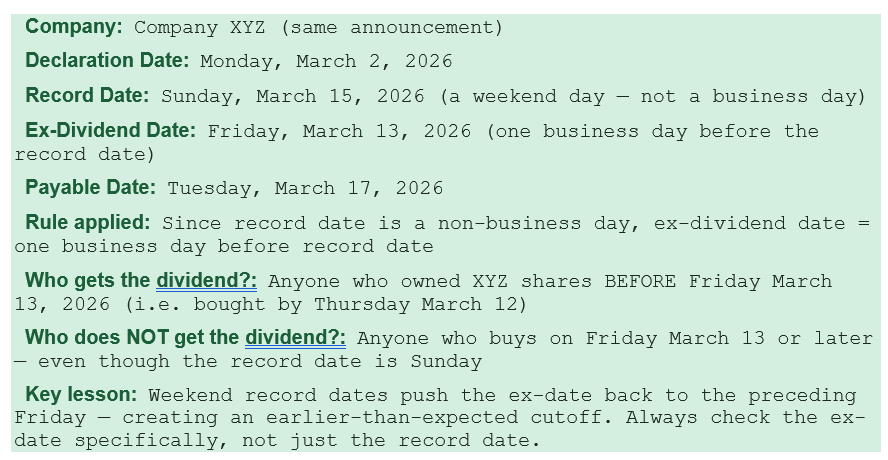
- Example 2 — Record Date Falls on a Weekend (Sunday)
- Why Does the Stock Price Drop on the Ex-Dividend Date?
- Who Gets the Dividend? Seven Scenarios Explained
- US T+1 vs UK T+2 Settlement: What Each Means for Ex-Dividend Timing
- United States: T+1 Settlement (Since May 28, 2024)
- United Kingdom: T+2 Settlement (Standard for UK-Listed Shares)
- Special Cases: Large Dividends, Stock Dividends, and Spin-Offs
- Special Rule for Large Dividends (25% or More of Stock Value)
- Stock Dividends and Company Spin-Offs
- Conclusion
- Frequently Asked Questions (FAQ)
The Date That Determines Who Gets Paid
You have found a stock with a generous dividend yield. The company has just announced its next quarterly payment. You check the dates and decide to buy — only to discover later that you missed the dividend by a single day. Or perhaps the opposite: you see a stock price drop sharply and worry that something has gone wrong with the business, only to realise the decline is perfectly explained by the ex-dividend date. Both experiences — missing a dividend by a day and misreading a routine price adjustment — are among the most common and most avoidable experiences in dividend investing. They both trace back to the same root: not fully understanding the ex-dividend date and how it fits into the four-date dividend timeline.The ex-dividend date is the single most important date in the dividend payment process for shareholders to understand. Robinhood's guide describes it as 'an inflection point in trading stocks: buying a stock before the ex-dividend date means investors can get the next dividends from that stock, while buying on or after the ex-dividend date means investors can't get the next dividend payment.' DividendCalculator.io is equally direct: 'Of all four dates, the ex-dividend date is the one investors need to pay the most attention to.'
This guide explains the ex-dividend date completely for 2026: the precise definition and why the date exists, its relationship to the other three dividend dates (declaration, record, and payment), how the US T+1 settlement change from May 2024 affects the timing rules every investor must now follow, what happens to the stock price on the ex-dividend date and why, the seven scenarios that determine who gets the dividend, worked examples using real March 2026 dates from Investor.gov, special rules for large dividends (25% or more of stock value), how the ex-dividend date works for stock dividends and spin-offs, the UK versus US settlement comparison, and the practical strategies income investors use to maximise their dividend collection consistently.
What Is the Ex-Dividend Date?
The ex-dividend date — commonly abbreviated as the ex-date or ex-div date — is the first day on which a stock trades without the entitlement to the next dividend payment. Any investor who purchases shares on this date or after it will not receive the upcoming dividend; that payment goes to the person who sold them the shares. To receive the dividend, an investor must own the shares before the ex-dividend date.The word 'ex' is Latin for 'without' — so 'ex-dividend' literally means 'without dividend.' From the ex-date onward, the stock trades ex-dividend: each transaction represents a share that carries no right to the upcoming payment. StockTitan (August 2025) defines it precisely: 'The ex-dividend date (or ex-date) is the first business day when the stock trades WITHOUT the dividend attached. If you buy the stock on or after this date, you won't receive the upcoming dividend — the seller gets it instead.'
The ex-dividend date exists because of the practical reality of stock settlement — the process through which a completed trade is officially recorded and ownership formally changes hands. A stock transaction does not transfer ownership instantaneously. Under the US T+1 settlement cycle (implemented May 28, 2024), a trade executed today officially settles and registers as a change of ownership in the company's books on the next business day. This settlement delay creates the need for an ex-dividend date: if the record date is the official cutoff for dividend eligibility, there must be a date before the record date after which new purchases cannot settle in time to appear on the register. That date is the ex-dividend date.
T+1 settlement change — May 28, 2024: US markets moved from T+2 to T+1 settlement on May 28, 2024 — meaning trades now settle in 1 business day, not 2. — StockTitan (August 27, 2025): 'Since May 28, 2024, the U.S. stock market operates on a T+1 settlement cycle, meaning trades settle one business day after the transaction date. This change from the previous T+2 cycle affects dividend timing: To receive the dividend, purchase the stock at least one business day before the ex-dividend date.' Dividend Channel (March 2026): 'In today's U.S. market (T+1 settlement), the ex-dividend date will typically fall on the same business day as the record date.' UK markets still operate on T+2 settlement — meaning UK investors must buy at least 2 business days before the record date to receive a dividend
The Four Dividend Dates: A Complete Reference
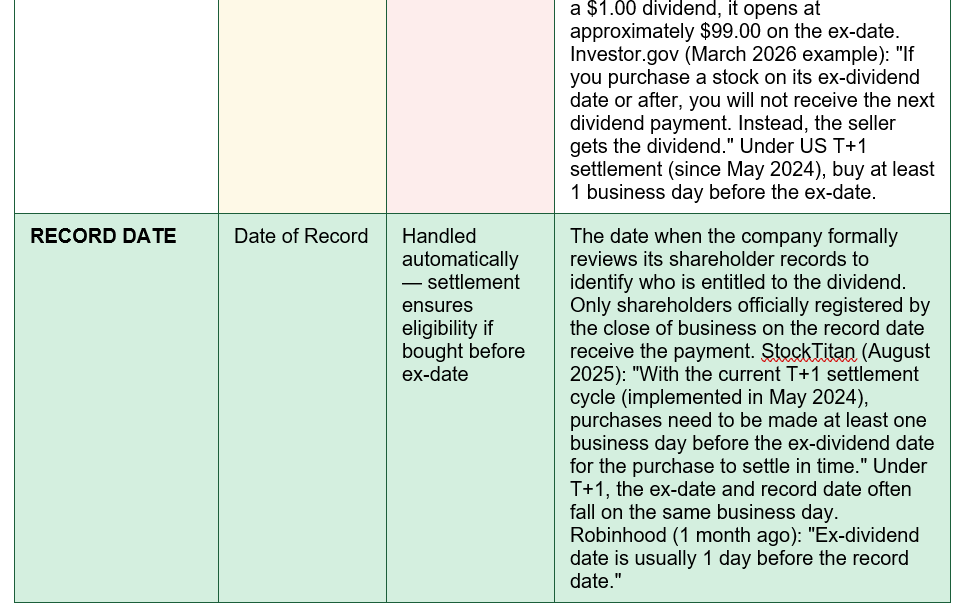
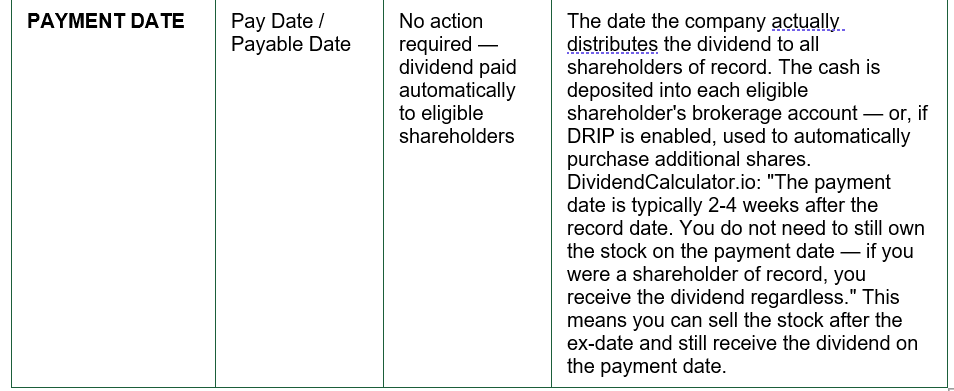
Every dividend payment involves four dates that work together in sequence. Understanding all four — and the specific role each plays — is the foundation of intelligent dividend investing. The table below maps each date with its purpose, investor obligation, and the practical implications for 2026: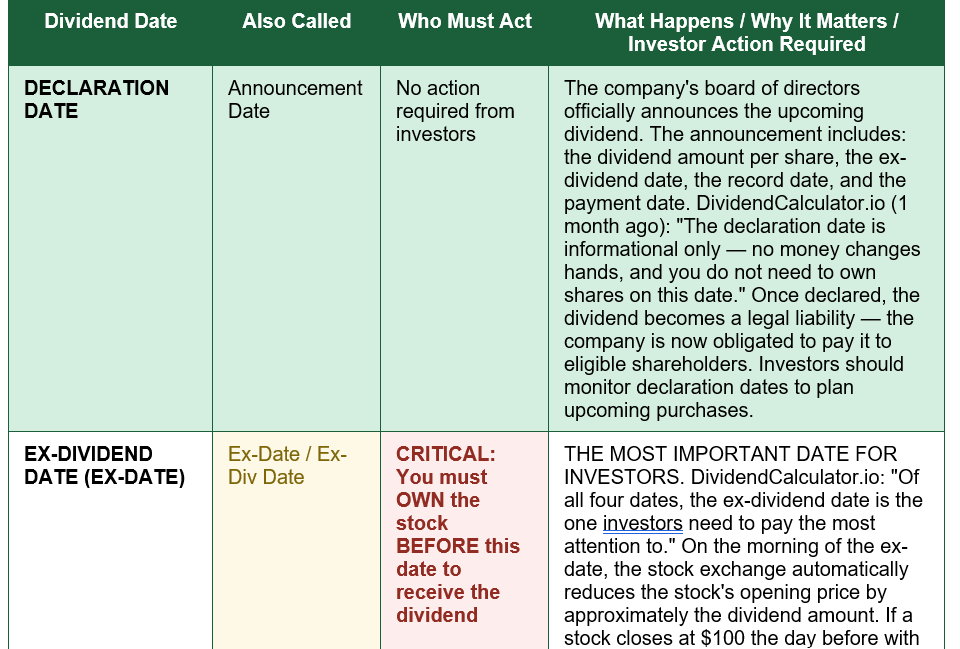
How the Four Dates Work Together: The Complete Timeline
The four dividend dates form a logical, sequential chain. Understanding how they connect resolves the most common points of confusion:Step 1 — Declaration Date: Board of directors meets and votes to pay a dividend. Public announcement made: dividend amount, ex-date, record date, and payment date all stated.
Step 2 — Ex-Dividend Date: The cutoff date. Shares purchased on this date or later do NOT come with the upcoming dividend. Shares purchased before this date DO. Stock price drops by approximately the dividend amount at the opening of trading on this date.
Step 3 — Record Date: Company formally reviews its shareholder register. Only investors who appear as registered shareholders on this date receive the dividend. Under T+1 (US), ex-date and record date often coincide. The record date is typically 1-2 business days after the ex-date in most structures.
Step 4 — Payment Date: Dividend cash deposited into eligible shareholders' brokerage accounts. Typically 2-4 weeks after the record date. No need to still own the shares — you qualify based on holding before the ex-date.
SureDividend (June 12, 2026) summarises the practical investor priority: 'What really matters for shareholders is receiving the dividend in question. And three important dates determine who receives the dividend (and who doesn't): your purchase (transaction) date, the ex-dividend date, and the record date.' The payment date is an administrative outcome of these three — once you are confirmed as a shareholder of record, you receive the payment automatically.
Real Worked Examples: March 2026 Dividend Dates (Investor.gov)
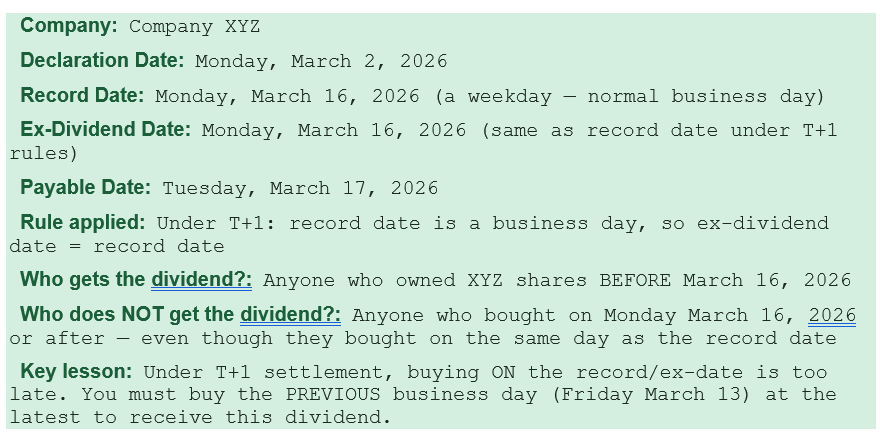
Investor.gov (the US SEC's official investor education website) published the following real examples using March 2026 dates, demonstrating exactly how the ex-dividend date is set under different record date scenarios:Example 1 — Record Date Falls on a Weekday (Monday)
Example 2 — Record Date Falls on a Weekend (Sunday)
Why Does the Stock Price Drop on the Ex-Dividend Date?
One of the most frequently misunderstood aspects of the ex-dividend date is the stock price decline that occurs on that morning. New investors often see their stock fall and assume something has gone wrong with the business. In fact, the price drop is a routine, predictable mechanical adjustment that reflects nothing negative about the company.DividendCalculator.io explains the mechanism: 'On the morning of the ex-dividend date, the stock exchange automatically reduces the stock's opening price by the amount of the dividend. If a stock closes at $100 on the day before the ex-date and the dividend is $1.00, the adjusted opening price on the ex-date will be $99.00. This happens because new buyers on or after the ex-date are not entitled to the dividend, so the stock price adjusts downward to reflect that. The dividend is essentially transferred from the company's value to the shareholders as cash.'
StockTitan explains the economic logic: 'If a stock closes at $100 the day before going ex-dividend with a $2 dividend, it will typically open around $98 on the ex-dividend date. The stock is now worth less because new buyers won't receive that $2 dividend. The market efficiently prices in this difference. The total value remains the same.' This is a zero-sum adjustment: the £100 you owned before the ex-date becomes £98 in stock plus £2 in cash dividend — identical total value, just in different forms. The dividend payment does not destroy wealth; it redistributes it from the company's balance sheet into shareholders' bank accounts.
Why there is no 'free money' in buying just before the ex-date to capture the dividend: A common misconception among new investors is that buying a stock just before the ex-dividend date and selling just after — sometimes called 'dividend capture' — is a reliable way to make extra income. SureDividend (June 12, 2026) addresses this directly: 'Investors wanting to lock in the gain of that dividend, but who do not purchase before the ex-dividend date, can still purchase shares on the ex-dividend date at a discount approximately equal to the dividend amount. Because of this, there is no advantage to waiting to purchase shares.' The stock price falls by approximately the dividend amount on the ex-date, meaning that buying the day before and selling the day after produces roughly zero net gain (dividend income offset by capital loss). In practice, dividend capture strategies also incur trading costs, potentially unfavourable tax treatment on short-term gains, and market timing risk that prevents them from being reliably profitable. SureDividend: 'Instead, focus on developing a long-term systematic investing plan that will be successful regardless of your timing of dividend payments.'
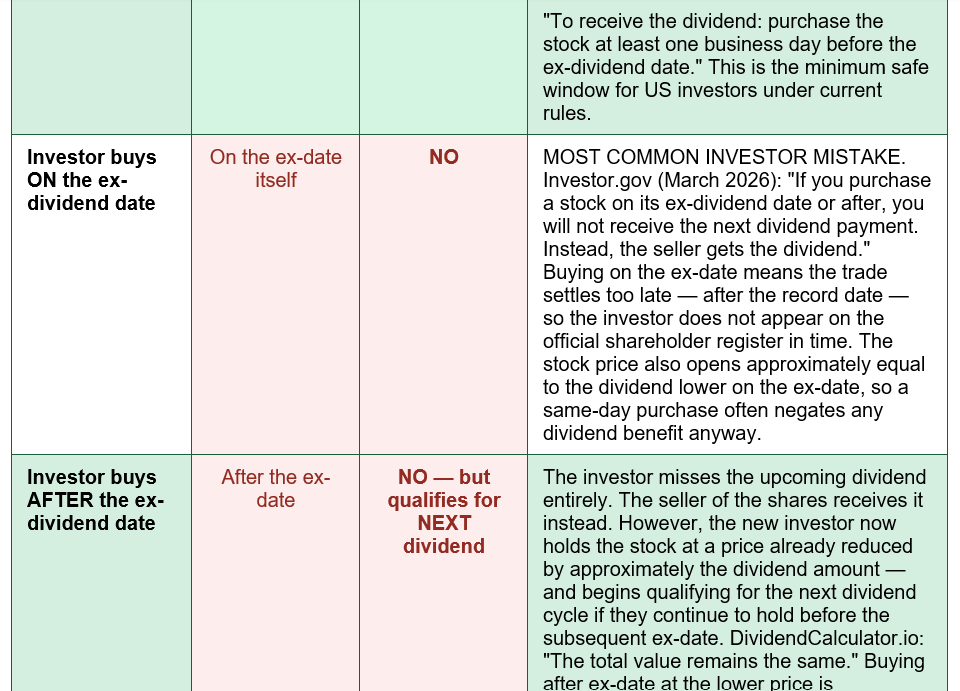
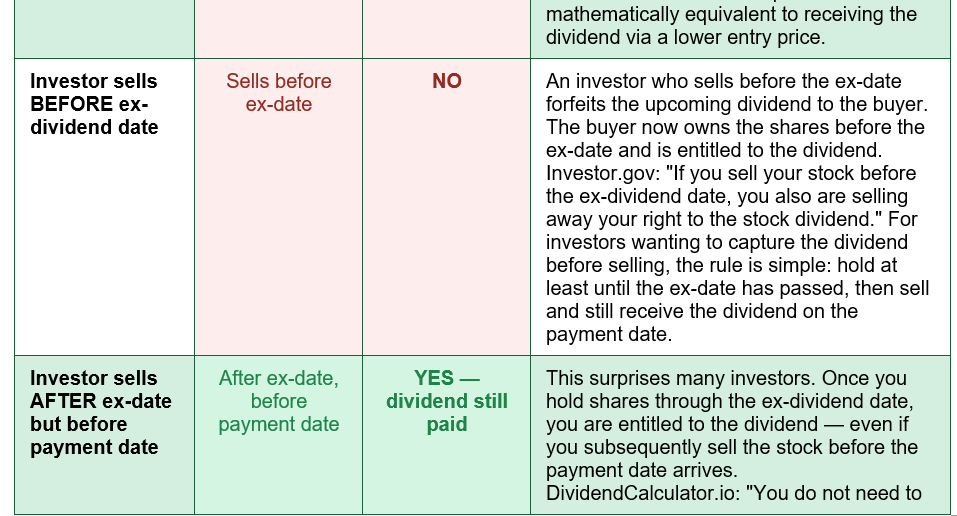
Who Gets the Dividend? Seven Scenarios Explained
The following table maps every investor scenario — from long-term holders to those who buy on or after the ex-date — to the clear dividend eligibility outcome. This table resolves the most common questions investors have about ex-dividend timing: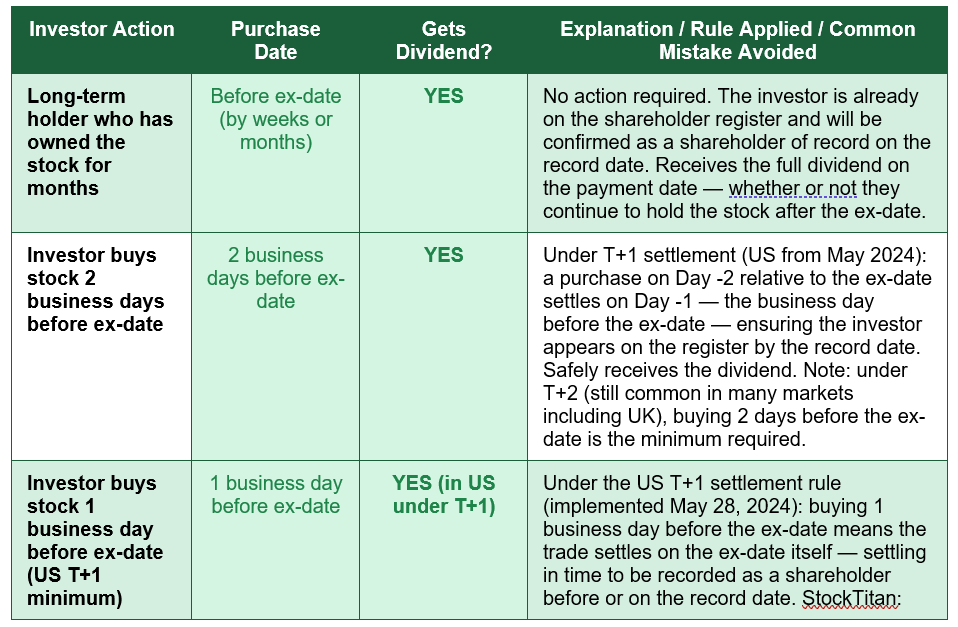

US T+1 vs UK T+2 Settlement: What Each Means for Ex-Dividend Timing
Settlement cycles are the backbone of ex-dividend timing — and the rules differ between the US and UK markets. Understanding which rules apply to the stocks you own is essential for correctly calculating the latest date you can buy and still receive a dividend:United States: T+1 Settlement (Since May 28, 2024)
The US moved from T+2 to T+1 settlement on May 28, 2024 — one of the most significant operational changes to US equity markets in decades. Under T+1, a trade executed today settles and officially registers in the company's books the next business day. The practical implication for dividend timing: you need to buy at least ONE business day before the ex-dividend date for the trade to settle in time to appear on the shareholder register by the record date.Dividend Channel (March 2026) confirms the post-T+1 landscape: 'In today's U.S. market (T+1 settlement), the ex-dividend date will typically fall on the same business day as the record date. Even so, the investor takeaway stays the same: if you want the next dividend, you generally need to buy before the ex-dividend date.' Robinhood (1 month ago): 'The ex-dividend date for stocks is usually 1 day before the record date, which gives a company time to update its books.' The day before the ex-date is the critical deadline for US investors.
United Kingdom: T+2 Settlement (Standard for UK-Listed Shares)
UK-listed shares on the London Stock Exchange typically still settle on a T+2 basis — meaning trades take two business days to settle and officially register. Under T+2, the ex-dividend date is typically set two business days before the record date, creating a wider gap between the last day to buy and the record date.For UK investors buying UK-listed shares, the practical rule is: purchase at least TWO business days before the record date (i.e., on or before the ex-dividend date minus one business day). However, the safest approach for all investors — UK or US — is simply to own the stock comfortably before the ex-dividend date rather than attempting to time the minimum possible purchase date. For investors holding US stocks through a UK brokerage, the US T+1 rules apply to those US-listed securities regardless of the UK platform used.
THE PRACTICAL EX-DIVIDEND DATE CHECKLIST FOR INCOME INVESTORS: Before each dividend payment, work through these five checks: (1) CHECK THE EX-DATE SPECIFICALLY — not the record date or payment date. The ex-date is your action deadline. Find it in the company's dividend announcement, your broker's dividend calendar, or financial data sites like Dividend.com, Dividend Channel, or Yahoo Finance. (2) CONFIRM YOUR PURCHASE TIMING — US stocks: buy at least 1 business day before the ex-date. UK stocks: buy at least 2 business days before the ex-date. When in doubt, buy earlier. (3) DO NOT PANIC ON EX-DATE PRICE DROPS — the stock opening lower on the ex-date is normal and expected. The dividend you receive compensates for the price reduction. Total value is unchanged. (4) IF YOU WANT TO SELL — hold through the ex-date at minimum to receive the dividend, then sell any time after. You will receive the payment on the payment date even after selling. (5) USE A DRIP FOR LONG-TERM COMPOUNDING — enable your broker's Dividend Reinvestment Plan to automatically reinvest dividends into additional shares on the payment date. Long-term income investors building dividend-focused portfolios should ideally not be tracking ex-dates at all — they should be holding quality dividend payers continuously, collecting every quarterly or semi-annual payment automatically.
Special Cases: Large Dividends, Stock Dividends, and Spin-Offs
Special Rule for Large Dividends (25% or More of Stock Value)
When a company declares an exceptionally large dividend — one equal to 25% or more of the stock's current market value — special rules apply to the ex-dividend date timing. Investor.gov explains: 'If the dividend is 25% or more of the stock value, special rules apply to the determination of the ex-dividend date. In these cases, the ex-dividend date will be deferred until one business day after the dividend is paid.' Using the March 2026 example dates: the payable date is March 17, so the ex-dividend date for a 25%+ dividend would be Wednesday, March 18, 2026 — one business day after payment. This deferral allows shareholders time to adjust their positions after receiving such an unusually large distribution, preventing distortions in the normal trading relationship between dividend eligibility and price.Stock Dividends and Company Spin-Offs
Sometimes companies pay dividends in additional shares rather than cash — called stock dividends. Spin-offs (where a subsidiary is distributed as shares to existing shareholders) follow similar mechanics. Investor.gov: 'The ex-dividend date is set the first business day after the stock dividend is paid (and is also after the record date). If you sell your stock before the ex-dividend date, you also are selling away your right to the stock dividend. Your sale includes an obligation to deliver any shares acquired as a result of the dividend to the buyer of your shares, since the seller will receive an I.O.U. or due bill from his or her broker for the additional shares.'The key practical implication: unlike cash dividends where the dividend and the price adjustment happen simultaneously on the ex-date, stock dividends involve actual share delivery and may involve 'due bills' — IOUs for shares that will be delivered once the dividend is processed. Selling around the ex-date of a stock dividend requires understanding these obligations, as you may be required to deliver additional shares to the buyer.
Conclusion
The ex-dividend date is the most important date in the dividend payment cycle for any investor who actively manages their portfolio around income. It is the cutoff — the precise moment after which buying a stock no longer entitles the new owner to the upcoming dividend. Buy before it: you receive the payment. Buy on it or after it: the seller receives the payment instead. The rule is that simple in principle, and that consequential in practice.The four-date dividend timeline — declaration, ex-dividend, record, and payment — provides the complete framework every income investor needs to understand. The declaration announces the dividend and sets the dates. The ex-dividend date is the action deadline for investors. The record date is when the company formally confirms eligibility. The payment date is when the cash (or shares) arrives in accounts. With the US moving to T+1 settlement from May 2024, US investors now need to purchase at least one business day before the ex-dividend date — a tighter window than the previous T+2 rule required. UK investors holding UK-listed shares still operate under T+2, requiring purchase at least two business days before the record date.
The stock price drop on the ex-dividend date — typically equal to the dividend amount — is not a negative event. It is a mechanical adjustment reflecting the transfer of value from the company's balance sheet to shareholders' accounts. Total investor wealth is unchanged: the price decline is offset by the dividend received. Long-term dividend investors who hold quality stocks continuously through multiple dividend cycles need not concern themselves with the mechanics of any individual ex-date. Their dividend income flows automatically, each quarterly or semi-annual payment being deposited or reinvested through a DRIP without any action required. Understanding the ex-dividend date is most critical precisely for those investors who are buying, selling, or building new positions — ensuring that timing decisions around this key date always produce the intended dividend outcome.
0 Comments
Be the first to share your thoughts on this article.