

Investing
What Is DRIP Investing? Your Complete Guide


Table of Contents
- The Simplest Compounding Machine in Investing
- What Is DRIP Investing?
- How Does a DRIP Work? The Mechanics Step by Step
- Company-Direct DRIP vs Broker DRIP: Which Should You Use?
- The Power of DRIP Compounding: Alex vs Ben Over 30 Years
- DRIP Investing in the UK and US: Account and Tax Considerations
- United Kingdom: ISAs, SIPPs, and the UK Dividend Allowance
- United States: IRAs, 401(k)s, and the 1099-DIV
- How to Set Up a DRIP: Step-by-Step for UK and US Investors
- Setting Up a Broker DRIP (Recommended)
- Who Should (and Should Not) Use a DRIP
- DRIP Is Ideal For:
- DRIP May Not Be Right If:
- Conclusion
- Frequently Asked Questions (FAQ)
The Simplest Compounding Machine in Investing
Most investors know that dividends are paid by companies to reward shareholders for owning their stock. What many do not fully appreciate is that how you handle those dividends — whether you spend them, save them in cash, or immediately reinvest them into more shares — makes one of the most significant long-run differences in portfolio outcomes available to any investor. The Dividend Reinvestment Plan, universally known as a DRIP, is the mechanism that automates that reinvestment: no manual action required, no temptation to spend the cash, no timing decisions. Every dividend payment automatically buys more shares of the same investment.The compounding mathematics behind this automation are remarkable. Investing.com's April 2026 worked comparison of two hypothetical investors — Alex, who uses a DRIP, and Ben, who takes his dividends in cash — both starting with $10,000 in a stock offering 6% annual price appreciation and a 3% dividend yield — produces a striking divergence over 30 years. Alex's DRIP generates an effective total return of approximately 9% (6% capital growth plus 3% yield continuously reinvested). After 30 years, her $10,000 has grown to approximately $132,677. Ben, taking the 3% dividend as cash each year, experiences only the 6% capital appreciation. After 30 years, his $10,000 becomes approximately $57,435. The same starting capital, the same investment, the same 30-year period — but Alex has 2.3 times more wealth. The only difference is automation.
This guide explains DRIP investing completely: the definition and mechanics, how dividends become shares step by step, the two main types of DRIP (company-direct and broker DRIP), the six key advantages including commission-free reinvestment, fractional shares, and built-in dollar-cost averaging, the critical disadvantages including the phantom income tax problem and concentration risk, the specific UK and US tax and account considerations, how to set up a DRIP in minutes through any major brokerage or investment platform, who should and should not use a DRIP, and the practical steps to get started today.
What Is DRIP Investing?
A Dividend Reinvestment Plan (DRIP) is a programme offered by companies or brokerages that allows investors to automatically reinvest their cash dividends into additional shares — including fractional shares — of the same investment, typically at no commission. Charles Schwab's definition is precise: 'A DRIP automatically reinvests dividends and capital gains distributions to purchase additional shares of the same security — typically at no charge.'The name describes both the mechanism and the effect perfectly: dividends drip steadily and continuously back into the investment, accumulating shares quietly over time without requiring any active management. Each reinvested dividend buys more shares. Those additional shares generate their own dividends at the next payment date. Those dividends buy more shares still. The cycle repeats indefinitely, automatically, on every dividend payment date — creating the compounding snowball that makes DRIP investing one of the most powerful long-term wealth-building strategies available to ordinary investors.
Firstcard's June 2026 guide articulates the compounding engine at work: 'Say you own 100 shares of a stock that pays a dividend. Normally that cash lands in your account. With a DRIP, it instead buys you, for example, 1.5 more shares automatically. Those new shares then earn their own dividends next time. That is the engine that drives long-term growth.' The individual amounts involved in any single dividend reinvestment are small. The compounding effect across years and decades is anything but.
The DRIP compounding advantage — 30-year comparison: $10,000 with DRIP: $132,677 after 30 years. Without DRIP: ~$57,435 — 2.3x MORE wealth from the same investment. — Investing.com (April 23, 2026): Alex and Ben both invest $10,000 in a stock offering 6% annual appreciation + 3% dividend yield. Alex uses a DRIP (total effective return ~9%/year), Ben takes cash dividends. After 30 years: Alex $132,677 vs Ben ~$57,435 — the reinvested dividend compounds Alex's growth rate from 6% to 9%, producing $75,242 more from the same initial investment. 'By simply automating the reinvestment of dividends, Alex ended up with more than double Ben's total. This is the power of compounding in action — a patient, relentless force that DRIPs put on autopilot.'
How Does a DRIP Work? The Mechanics Step by Step
Understanding the precise mechanics of a DRIP demystifies the process and reveals exactly where the compounding advantage comes from. The sequence of events that occurs every dividend payment cycle:- The dividend is declared: The company announces its dividend — the amount per share that will be paid to all shareholders on record as of the record date. For most established dividend-paying stocks, this occurs quarterly (four times per year). Some companies pay monthly dividends (common in UK investment trusts and some US REITs) or annual dividends.
- Your account is calculated: On the dividend payment date, the company's transfer agent (or your brokerage, for a broker DRIP) calculates your total dividend: the dividend per share multiplied by the number of shares you hold. If you hold 150 shares and the dividend is $0.40 per share, your total dividend is $60.
- Shares are purchased automatically: Instead of the $60 being deposited as cash in your account, it is immediately used to purchase additional shares at the prevailing market price on the payment date. PrimeWay's 2026 guide explains the McDonald's example: 'Every three months, McDonald's looks at how many shares you own. They multiply this by the dividend amount for each share. Instead of sending you a check, they take that money and buy you more McDonald's stock automatically.' With broker DRIPs in 2026, fractional shares are purchased — your $60 buys exactly $60 worth of shares at the current price, not just enough for whole shares with the remainder sitting as cash.
- Your share count grows: After the reinvestment, your account shows a slightly larger number of shares than before. If shares were trading at $50 on the payment date, your $60 buys 1.2 additional shares (including the 0.2 fractional share). Your position grows from 150 to 151.2 shares.
- The next dividend is larger: At the next quarterly payment date, the dividend per share remains the same — but it is now calculated on 151.2 shares rather than 150. The dividend for the new quarter is $60.48 rather than $60. Over time, this continuous share count increase causes the dividend amount to grow with each cycle, accelerating the compounding effect.
The cumulative effect of this cycle over a long period is not linear — it is exponential. The compounding accelerates over time because each new tranche of shares generates dividends that are reinvested to buy more shares, which generate more dividends. Schwab: 'This reinvestment potentially creates a snowball effect that can accelerate portfolio growth and also saves time. Over years or decades, DRIPs can encourage a disciplined, systematic approach to investing that can make a meaningful difference for investors looking to build wealth.'
Company-Direct DRIP vs Broker DRIP: Which Should You Use?
There are two distinct types of DRIP available to investors: the company-direct DRIP, operated through the company's own transfer agent, and the broker DRIP, operated through your existing investment account. Understanding the difference is essential for choosing the right approach: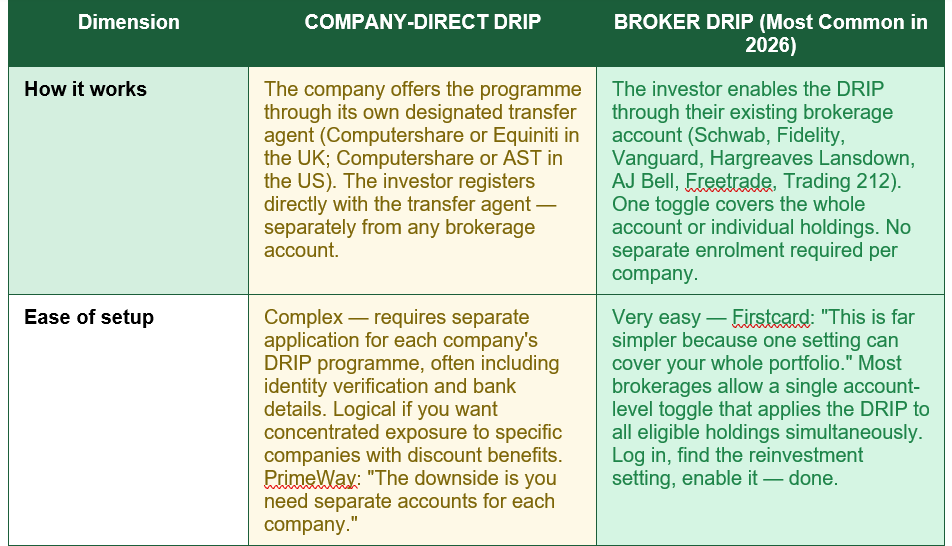
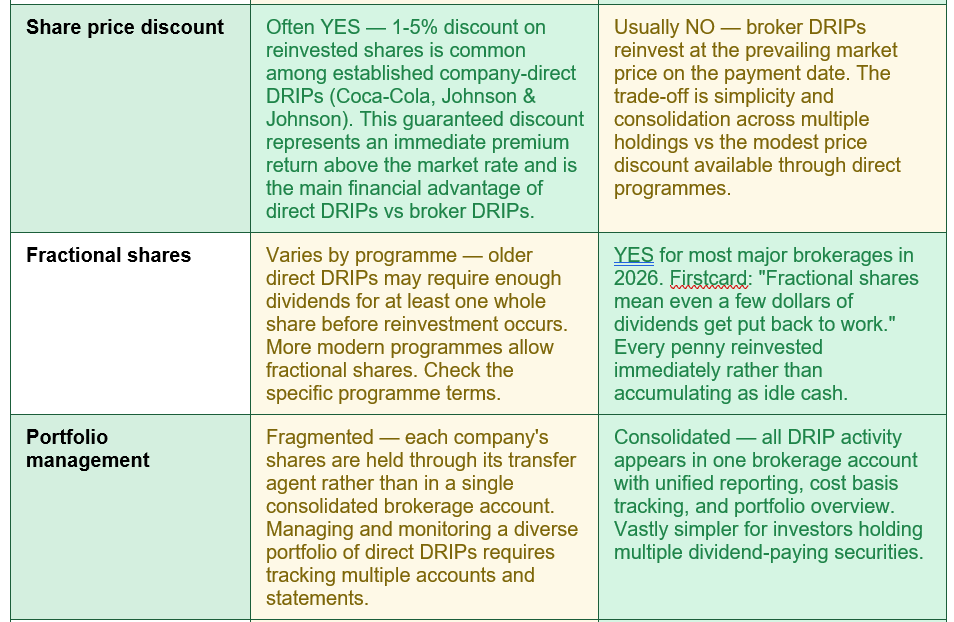
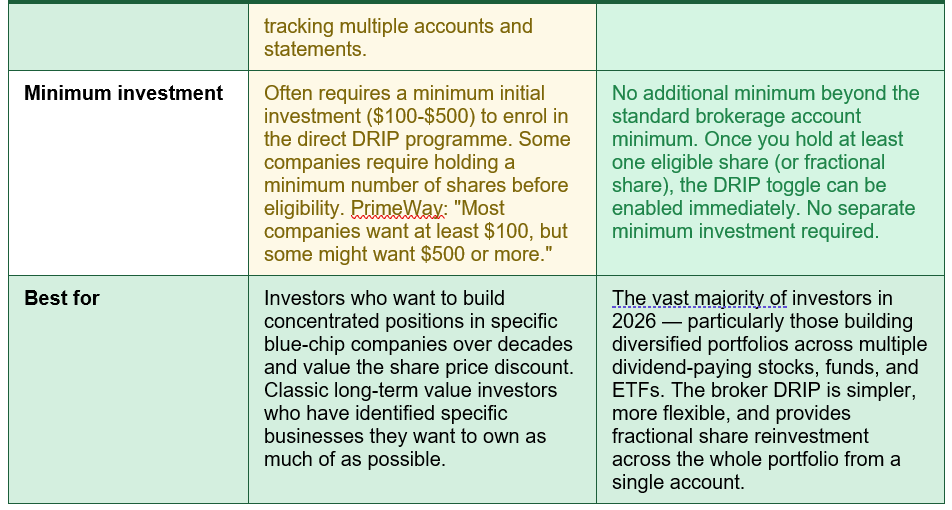
The 2026 trend: broker DRIPs are now the dominant method and rapidly improving. Aurora Training Advantage's 2026 market overview notes that 'Many investment apps and robo-advisors now offer DRIP features built directly into their platforms' and that 'brokerages are expanding DRIP functionality to include exchange-traded funds (ETFs), increasing diversification. Some platforms are exploring instant dividend reinvestment, allowing quicker compounding than traditional batch reinvestments.' The practical implication: for most investors in 2026, the broker DRIP is not merely more convenient than the company-direct alternative — it is also becoming more powerful, with faster reinvestment, broader ETF coverage, and better cost-basis tracking than was available even five years ago.
The Power of DRIP Compounding: Alex vs Ben Over 30 Years
The most compelling illustration of DRIP investing's long-term advantage comes from Investing.com's April 2026 comparison of two investors making identical choices except for what they do with their dividends: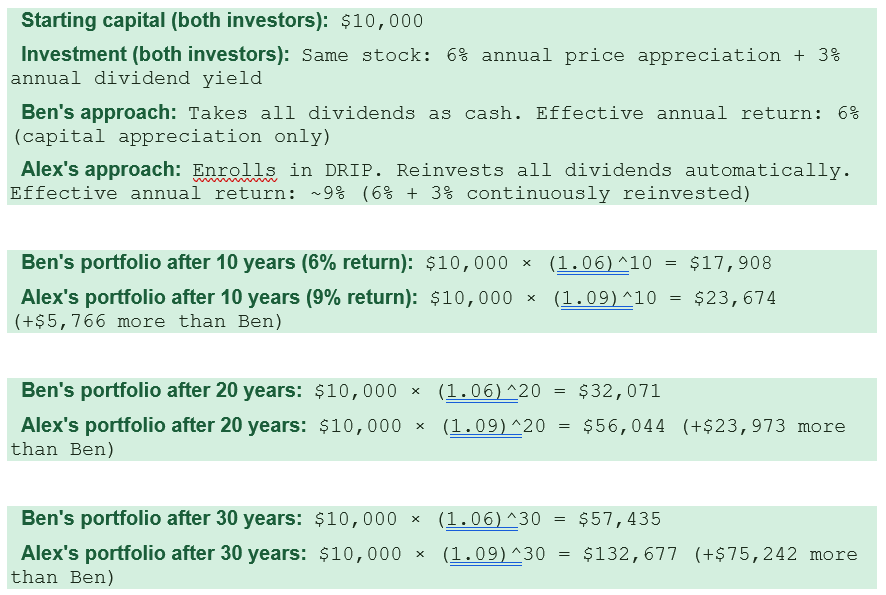

The divergence is not dramatic in early years — at year 10, Alex is ahead by $5,766. But the gap widens exponentially as time passes. By year 20, Alex is ahead by $24,000. By year 30, by over $75,000. This exponential widening is the essence of the compounding effect: time is the critical variable, and a DRIP maximises the compounding advantage by ensuring no dividend income ever sits idle as uninvested cash.
DRIP Investing in the UK and US: Account and Tax Considerations
United Kingdom: ISAs, SIPPs, and the UK Dividend Allowance
For UK investors, the single most important DRIP consideration is the account wrapper in which the DRIP is held. UK investors have access to powerful tax-advantaged wrappers that can shelter DRIP gains entirely from both income tax on dividends and capital gains tax on the growth in share value:- Stocks and Shares ISA: Dividends received within an ISA are completely exempt from UK income tax, and any capital gains are exempt from CGT. For a DRIP operating within a Stocks and Shares ISA, the phantom income tax problem that affects taxable accounts does not arise — reinvested dividends generate zero tax liability. The annual ISA allowance (£20,000 per person in the 2025/26 tax year) allows significant DRIP portfolio construction within this tax-free wrapper. This is the optimal environment for UK DRIP investors.
- Self-Invested Personal Pension (SIPP): Pension wrappers also provide complete income tax and CGT exemption on reinvested dividends, with the additional benefit of upfront tax relief on contributions (20% for basic-rate taxpayers, 40% for higher-rate). DRIP investing within a SIPP is particularly powerful because contributions attract tax relief on the way in and DRIP compounding operates tax-free throughout the accumulation phase.
- General Investment Account (taxable): Outside tax-advantaged wrappers, UK investors face taxation on dividends even when reinvested through a DRIP. The UK dividend allowance (reduced to £500 in 2024/25 and 2025/26) means that only the first £500 of dividend income is tax-free. Dividends above this threshold are taxed at 8.75% (basic rate), 33.75% (higher rate), or 39.35% (additional rate). Each DRIP reinvestment is a separate share purchase with its own cost basis date and price, creating complexity for CGT calculations when shares are eventually sold. Keep thorough records of every reinvestment.
United States: IRAs, 401(k)s, and the 1099-DIV
For US investors, the tax treatment of DRIP dividends mirrors the UK situation in its key distinction between tax-advantaged and taxable accounts. Charles Schwab's October 2025 guide is explicit: 'If a DRIP is active in a non-retirement account, the dividend income is a taxable event and will be reported on an investor's 1099-DIV as if it was received in cash. All dividend income is reported on a 1099-DIV for taxable accounts, regardless of whether or not it's reinvested.'For US investors, the optimal DRIP environments are tax-advantaged retirement accounts: the Roth IRA (contributions from after-tax income, all growth and withdrawals tax-free in retirement), the Traditional IRA (tax-deferred growth; dividends reinvested with no immediate tax), and the 401(k) (employer-sponsored; reinvested dividends grow tax-deferred). Aurora Training: 'Use DRIPs in tax-advantaged accounts like IRAs to avoid annual dividend taxes.' Qualified dividends in taxable US accounts are taxed at preferential rates (0%, 15%, or 20% depending on income), which is lower than ordinary income rates — but still represents a cash tax obligation on income that was never received as cash.
THE PHANTOM INCOME PROBLEM — THE CRITICAL TAX WARNING FOR DRIP INVESTORS IN TAXABLE ACCOUNTS: In a taxable brokerage account (not an ISA, SIPP, Roth IRA, or 401(k)), every dividend reinvestment is a taxable event in the year it occurs. If you receive £500 in dividends that are automatically reinvested through a DRIP, you still owe tax on that £500 — even though you never touched the money. Investing.com calls this "phantom income." For UK investors: use DRIPs inside a Stocks and Shares ISA (£20,000/year allowance) to avoid this entirely. For US investors: use DRIPs inside a Roth IRA ($7,000/year contribution limit) or 401(k). For portfolios that have outgrown tax-advantaged wrappers, keep meticulous records of every reinvestment date and price — most major brokerages now track this automatically, but verify your platform does before relying on it. The tax complexity is manageable; it is not a reason to avoid DRIPs — it is a reason to use them inside the right wrapper.
How to Set Up a DRIP: Step-by-Step for UK and US Investors
Setting Up a Broker DRIP (Recommended)
- Log in to your brokerage or investment platform: For UK investors: Hargreaves Lansdown, AJ Bell, Vanguard UK, Freetrade, Trading 212, and most major platforms support automatic dividend reinvestment. For US investors: Fidelity, Charles Schwab, Vanguard, TD Ameritrade, Robinhood, and others all offer broker DRIPs. The Investing.com guide confirms this is now standard: 'Log in to your brokerage account. Navigate to your account settings or positions page. You should find an option for Reinvest Dividends or a similar setting.'
- Find the dividend reinvestment setting: On Schwab: from the Accounts tab, select Positions, find a holding, and select Yes or No in the Reinvest? column. On Fidelity and Vanguard: similar account settings or position-level toggles. On most platforms, you can choose between enabling DRIP for all eligible holdings simultaneously (account-level setting) or selecting it for specific stocks and funds individually (position-level setting).
- Enable the DRIP toggle: Select Yes or enable the reinvestment option. Save your preference. The broker will apply DRIP to all future dividend payments from that point forward. For Schwab: 'A pop-up window will appear where investors can make their decision. Select Yes to start a DRIP, then hit Update.' Most platforms require only 30-60 seconds from login to activation.
- Verify on the next dividend payment date: Check your account on the next dividend payment date for your first DRIP reinvestment. You should see the dividend amount converted into additional shares (including fractional shares at most platforms) rather than appearing as cash. If cash appears instead, check whether the holding is eligible for DRIP reinvestment on your platform — some international stocks or specialist funds may not be eligible.
Who Should (and Should Not) Use a DRIP
DRIP Is Ideal For:
- Long-term investors with a multi-decade horizon: The compounding advantage is time-dependent. The Alex vs Ben comparison shows modest divergence at 10 years but a 2.3x multiple at 30. DRIP investing rewards patience above all other attributes. Firstcard: 'For long-term, hands-off investors, these benefits make DRIPs appealing.'
- Investors who do not need dividend income for living expenses: If your dividends are not needed to pay bills or supplement income, reinvesting them is almost always the highest-returning use of that cash. Robinhood: 'If you need your dividends in cash to pay your bills, you might not want to set up a DRIP.'
- Investors in tax-advantaged accounts: ISA, SIPP, Roth IRA, 401(k) holders who can compound completely tax-free get the maximum benefit from a DRIP. The tax wrapper eliminates the phantom income problem entirely.
- Passive and hands-off investors: Schwab: 'DRIPs help investors build discipline and practice consistency — two important ingredients for long-term success in the markets.' The automation removes the decision to reinvest (or not) each quarter, preventing cash from sitting idle because of inertia or the temptation to time the market.
DRIP May Not Be Right If:
- You rely on dividend income for living expenses: Retirees or income investors who use dividend payments to supplement living costs should not DRIP — they need the cash. A DRIP specifically removes the cash flow that income investors depend on.
- You are already overweight a specific stock: SoFi: 'You might not want a DRIP if your current investment in the company is already aligned with your financial goals, and risk being overweight in a certain company or sector.' Review portfolio concentration before enabling position-specific DRIPs.
- You frequently rebalance or switch between investments: Robinhood: 'DRIPs may not be the best idea if you shift your money from one stock to another fairly frequently.' The additional shares acquired through DRIP create more lots to track and more complexity when rebalancing or selling.
THE CONCENTRATION RISK WARNING — DRIP INTO A SINGLE FAILING COMPANY: The most dangerous scenario in DRIP investing is automatically reinvesting dividends into a company that is deteriorating — where the fundamental reason to own the stock has changed but the DRIP continues reinvesting regardless. A company can cut its dividend entirely without warning (as many UK and US companies did in 2020 during the COVID-19 crisis), eliminating the DRIP income and leaving the investor with an amplified position in a weakened business. The DRIP automation that removes temptation to spend dividends also removes the natural pause that manual reinvestment would provide for reassessing whether the investment thesis remains intact. Aurora Training: 'Continually reinvesting into one stock can concentrate risk if the company underperforms.' The solution: review every active DRIP quarterly. If the underlying company's dividend sustainability or competitive position has deteriorated, disable the DRIP for that specific holding.
Conclusion
DRIP investing is one of the most powerful and most accessible compounding tools in personal finance — a simple programme that transforms passive dividend income into active portfolio growth by automatically purchasing additional shares every time a dividend is paid. Investing.com's April 2026 comparison demonstrates the consequence of this automation at full scale: $10,000 invested over 30 years with a DRIP generates $132,677 versus $57,435 without one — 2.3 times more wealth from the same starting capital, the same investment, and the same 30-year period. The only difference is whether the 3% annual dividend was reinvested or taken as cash.The mechanics are straightforward: each quarterly dividend buys more shares; those shares generate dividends at the next payment date; those dividends buy more shares; and the cycle compounds indefinitely. The broker DRIP — the most common and most convenient method in 2026 — enables this across an entire portfolio from a single account toggle, with fractional shares ensuring every penny of dividend income is reinvested immediately at no commission. The company-direct DRIP offers the added benefit of share price discounts (typically 1-5%) from established blue-chip companies like Coca-Cola and Johnson & Johnson, at the cost of greater administrative complexity.
The critical considerations: use DRIPs inside tax-advantaged wrappers (UK Stocks and Shares ISA, SIPP; US Roth IRA, 401(k)) wherever possible to avoid the phantom income tax problem that makes DRIP dividends in taxable accounts a tax liability without a corresponding cash receipt. Review active DRIPs quarterly to ensure the investment thesis for each reinvested holding remains intact — DRIP automation is a feature for sound investments and a risk amplifier for deteriorating ones. And for investors who do not need dividend income for living expenses and have a long time horizon, the DRIP is arguably the single simplest, lowest-cost, highest-impact change available to maximise long-term portfolio compounding.
0 Comments
Be the first to share your thoughts on this article.