

Investing
What Are Long and Short Positions in Trading


Table of Contents
- Two Directions, Endless Opportunities
- What Is a Long Position?
- What Is a Short Position?
- Long vs Short: The Complete Side-by-Side Comparison
- How Short Selling Works: A Step-by-Step Mechanics Guide
- Long and Short Across Asset Classes in 2026
- Short Selling as a Hedging Tool
- Short Selling Regulations: UK and US Rules in 2026
- UK Short Selling Regulation (FCA)
- US Short Selling Regulation (SEC)
- When to Go Long vs When to Go Short
- Conclusion
- Frequently Asked Questions (FAQ)
- External References
Two Directions, Endless Opportunities
Most people learn about investing the same way: buy something at a low price, wait for it to rise, sell at a higher price, and pocket the difference. This is a long position, and it is the foundational concept that most investors encounter first. But financial markets offer a second and equally important direction: the ability to profit when prices fall. This is a short position, and understanding it transforms a one-directional participant in rising markets into a trader capable of generating returns in any market environment — up, down, or sideways.VT Markets' June 2026 trading guide captures the essential truth: 'Most new traders enter the market believing there is only one way to make money: buy low, sell high. Seasoned traders know the truth. Profit does not depend on markets going up. It depends on being on the right side of the move.' April 2025 illustrated this principle in real time: the S&P 500 posted its largest single-session point gain and its fifth-largest two-day decline in history within the same brief window. Traders who only understood long positions could profit from the up move — but needed to sit out the crash or suffer losses. Traders who understood both directions could navigate both.
This guide explains long and short positions comprehensively: what each means, how each works mechanically, the critical asymmetry in risk between them, how they operate across stocks, forex, indices, commodities, and crypto, the regulations that govern short selling in the UK and US, the key uses of each position including hedging, and the practical rules for managing both responsibly. Whether you are encountering these concepts for the first time or seeking a structured reference for how the mechanics work across asset classes, this guide provides the complete picture.
What Is a Long Position?
A long position is the most straightforward and most common position in any financial market. Going long simply means buying an asset in the expectation that its price will rise, so that it can later be sold at a higher price for a profit. The profit is the difference between the purchase price (entry) and the sale price (exit), minus any transaction costs.LiteFinance's April 2025 trading guide defines it precisely: 'A long position suggests buying an asset, hoping that the price will appreciate. This classic form of trading is common across various markets, including forex. When traders take a long position, they purchase an asset — such as a stock, cryptocurrency, commodity, or currency — expecting the price to climb over time. The main goal is to acquire an asset at a lower cost and lock in profits when the price soars.'
The key financial characteristic of a long position is its defined maximum loss. When you buy a share at £50, the worst possible outcome is that the company goes bankrupt and the share becomes worthless — you lose the £50 you invested. The price cannot fall below zero, so your maximum loss is always capped at the amount you paid. Conversely, the upside on a long position is theoretically unlimited: a share bought at £50 can, in principle, rise to any price. This asymmetric risk profile — limited downside, unlimited upside — is one of the reasons long positions are accessible and appropriate for the broadest range of investors.
Long positions are held across every timeframe, from seconds to decades. A day trader may open a long position on a stock at 9 AM and close it at 10 AM, having held for a single hour. A long-term investor buys shares and holds them for years or decades, never actively trading but always holding a long position. Both are long — the term describes the directional exposure, not the holding period.
CFD market 2026 context: CFD industry valued at USD 1.33 billion in 2026, forecast to reach USD 2.3 billion by 2035 — VT Markets (June 5, 2026) — the rapid growth of CFD trading reflects increasing retail access to both long and short positions across all asset classes from a single account. CFDs allow traders to express long or short views on stocks, indices, forex, and commodities without owning the underlying asset. 82% of retail CFD accounts lose money when trading with providers — risk management is critical
What Is a Short Position?
A short position is the mirror image of a long position — a bet that the price of an asset will fall, executed by first selling an asset you do not yet own and then buying it back later at a lower price. The profit is the difference between the initial selling price (higher) and the repurchase price (lower), minus any borrowing costs and transaction fees.Utrada's trading guide explains the mechanics precisely: 'Short selling involves borrowing assets to sell immediately, with the obligation to repurchase and return them later. Profits emerge when repurchase prices fall below initial sale prices. This mechanism allows traders to profit from declining prices while providing market liquidity. The short selling process typically works as follows: a trader borrows shares from a broker, immediately sells them at current market prices, and later repurchases shares at hopefully lower prices to return to the lender. The difference between sale and repurchase prices represents profit or loss.'
The mechanics can feel counterintuitive at first. You sell something before you own it — borrowed from your broker — then buy it back later. If the price has fallen between the sale and the repurchase, you buy back at a lower price than you sold at, and the difference is your profit. If the price has risen, you must buy back at a higher price than you sold at, and the difference is your loss. The short seller's profit and loss are the inverse of the long buyer's profit and loss on the same price move.
The critical risk distinction between long and short positions is the asymmetry of potential loss. Daily Price Action's trading education resource states the key principle: 'The main risk of taking a short stock position is that if the price of an asset suddenly starts to rally, the possible losses are unlimited.' A stock bought long at £50 cannot fall below zero — maximum loss is £50. A stock shorted at £50 can, in theory, rise to any price. If it rises to £200, the short seller loses £150 per share. If it rises to £500, they lose £450. There is no mathematical ceiling on how high a price can rise, which means there is no mathematical ceiling on a short seller's loss without active risk management.
Long vs Short: The Complete Side-by-Side Comparison
The table below maps every key dimension of long and short positions side by side, covering mechanics, risk, cost, regulatory requirements, and typical users: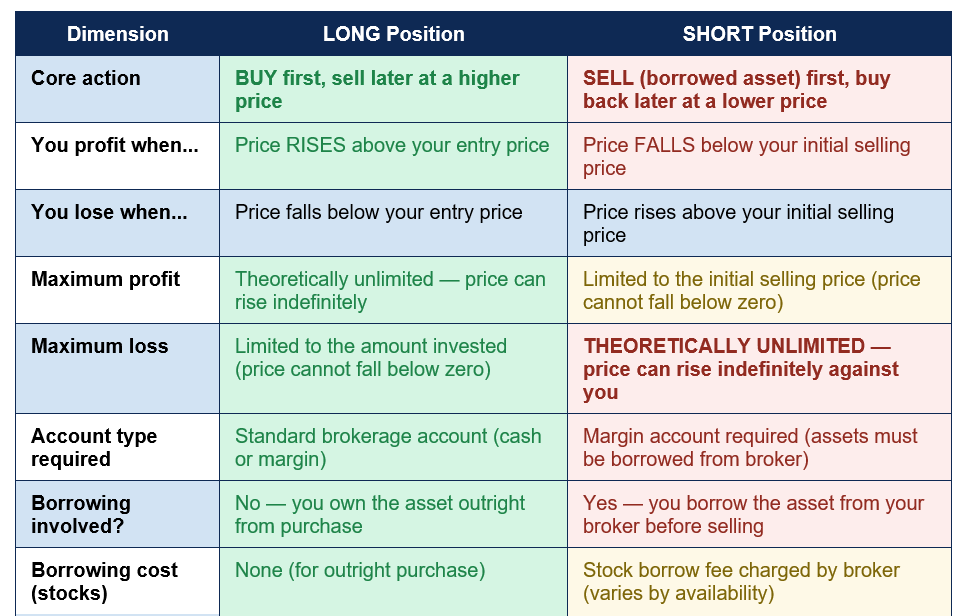
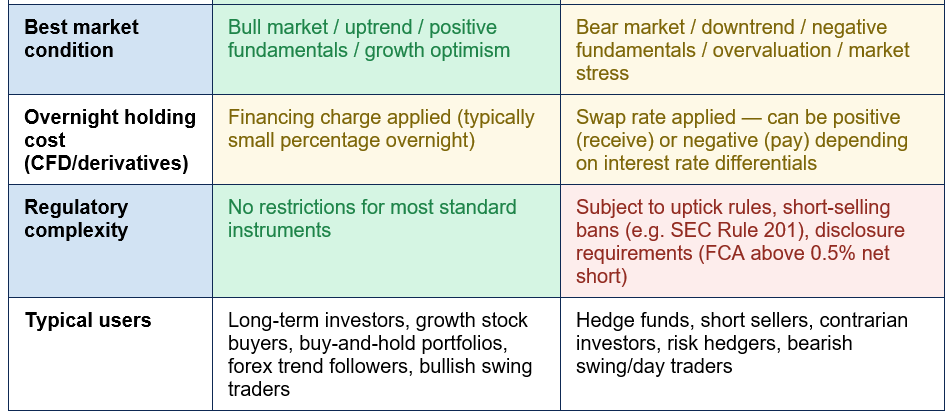
How Short Selling Works: A Step-by-Step Mechanics Guide
Understanding the exact mechanical sequence of a short sale removes the mystery from one of trading's most misunderstood concepts. In equity markets (stocks and shares), the process follows four steps:- Borrowing: The trader instructs their broker to borrow shares from another account holder (or from the broker's own inventory). The borrower pays a stock borrow fee — which varies from negligible for highly liquid large-cap stocks to significant for hard-to-borrow stocks where short interest is already high. The Forex Complex's June 2025 guide confirms: 'In forex markets, going short a currency pair means selling the base currency while buying the quote currency — no borrowing needed in the traditional sense, but trades are still margin-based.'
- Selling: The borrowed shares are immediately sold at the current market price. The trader receives the proceeds of this sale, which are held as collateral in the margin account. A margin account is required for short selling because the broker needs security against the obligation to return the shares.
- Waiting and monitoring: The trader monitors the position. If the price falls as expected, the position shows a profit. If the price rises, the position shows a loss. Margin requirements are recalculated daily — if losses accumulate and the margin balance falls below the required level, the broker issues a margin call requiring the trader to deposit additional funds.
- Closing (buying to cover): The trader repurchases the same number of shares at the current market price — a transaction called 'covering' the short or 'buying to cover.' These repurchased shares are returned to the lender. If the repurchase price is below the original selling price, the trader keeps the difference as profit minus costs. If above, the difference is a loss.
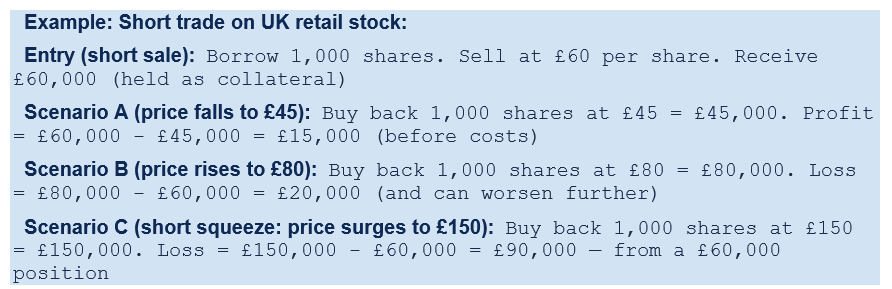
The short squeeze: the short seller's worst scenario. A short squeeze occurs when a heavily shorted stock rises sharply in price, forcing short sellers who cannot afford further losses to buy back shares to close their positions. But every short seller buying back shares drives the price higher still, triggering further margin calls and further forced buying in a self-reinforcing cascade. Short squeezes can move prices 100%, 300%, or more in days or even hours. The GameStop short squeeze of January 2021 remains the most famous recent example: hedge funds with massive short positions suffered billions in losses as retail traders coordinated to drive the price from around $20 to over $480 in weeks. No long position carries equivalent tail risk.
Long and Short Across Asset Classes in 2026
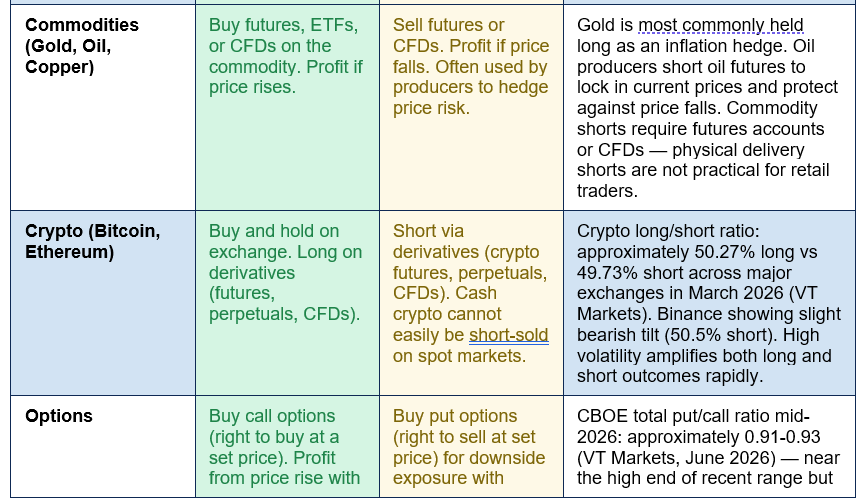
Long and short positions apply across every major tradable asset class, but the mechanics differ by market. The table below maps how each works, with 2026 data where relevant: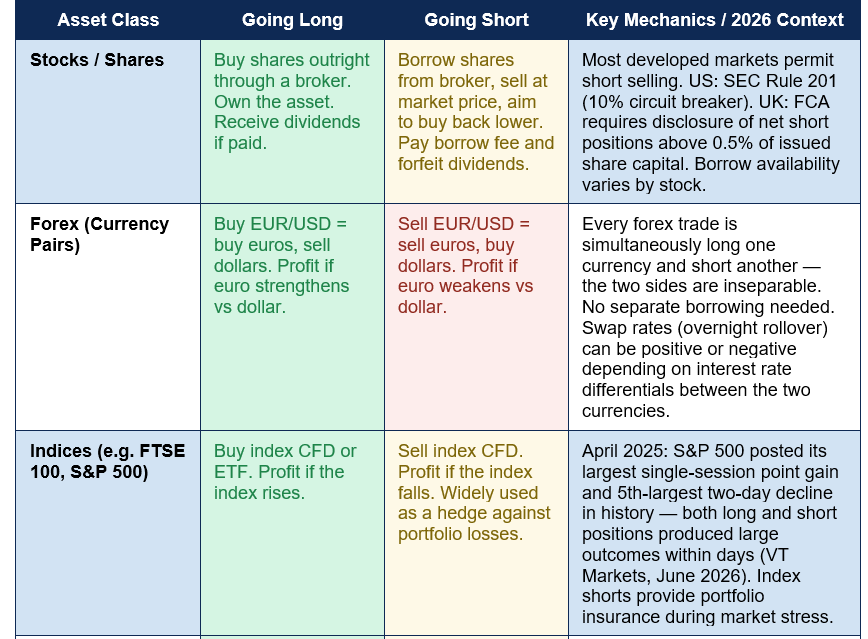

Short Selling as a Hedging Tool
Not every short position is a directional bet that a specific stock will fall. A significant proportion of short selling in professional markets serves a hedging function — using short positions to protect existing long portfolios against market declines rather than to generate outright profits from price falls.A portfolio manager who holds 50 FTSE 100 stocks and believes the market may fall 10% in the short term has two choices: sell some or all of the portfolio (incurring transaction costs and potentially capital gains tax on any profits) or open a short position on the FTSE 100 index. The index short provides a partial offset if the market falls — gains on the short hedge cushion losses on the long portfolio — without requiring the manager to liquidate holdings that may have strong long-term prospects.
ActivTrades' January 2026 trading guide confirms this dual role: 'Short positions can be used to hedge risk when investors aim to protect their portfolios from price drops.' This hedging function is why short selling, despite its controversial reputation, is considered by most market regulators to serve a legitimate economic purpose: providing insurance mechanisms for portfolios, facilitating price discovery by correcting overvalued securities, and providing liquidity to markets by creating willing sellers when everyone wants to buy.
LONG/SHORT RATIO AS A SENTIMENT INDICATOR: The ratio of long positions to short positions in any market is a widely tracked sentiment indicator. A long/short ratio above 1 indicates predominantly bullish sentiment among tracked traders; below 1 indicates bearish lean. For crypto derivatives in March 2026, the ratio across major exchanges was approximately 50.27% long vs 49.73% short — nearly perfectly balanced, suggesting neither strong bull nor bear conviction in the aggregate. For the CBOE options market in mid-2026, the put/call ratio of 0.91-0.93 is near the high end of its recent range, indicating moderate hedging demand and some elevated concern about downside risk (VT Markets, June 2026).
Short Selling Regulations: UK and US Rules in 2026
Short selling is legal in the UK and US but is subject to regulatory oversight designed to prevent abusive practices, maintain market stability, and ensure transparency. Understanding the key regulatory frameworks is important for any trader considering short positions.UK Short Selling Regulation (FCA)
In the UK, short selling is regulated under the UK Short Selling Regulation (UK SSR), retained from EU law after Brexit. The key requirements: net short positions above 0.1% of a company's issued share capital must be notified privately to the FCA; positions above 0.5% must be disclosed publicly. The FCA has emergency powers to temporarily ban or restrict short selling in specific securities during periods of market stress. During the 2008 financial crisis, UK regulators temporarily banned short selling in financial stocks. In March 2020 during the COVID-19 market crash, several EU regulators imposed temporary short-selling bans, though the FCA chose not to.US Short Selling Regulation (SEC)
In the US, the SEC's primary short-selling rule for public equity markets is Rule 201 — the Alternative Uptick Rule, adopted in 2010. It operates as a circuit breaker: when a stock declines 10% or more from its previous day's closing price, short sales are restricted to prices above the current national best bid for the remainder of that day and the following full trading day. Additionally, the SEC's Regulation SHO requires all short sales to be preceded by a 'locate' — the broker must confirm that shares are available to borrow before executing a short sale — and failed trades must be resolved within strict timeframes to prevent naked short selling (selling short without actually locating shares to borrow).THE UNLIMITED LOSS WARNING — SHORT POSITIONS REQUIRE ACTIVE MANAGEMENT: Short positions carry theoretically unlimited loss potential and require active, disciplined risk management at all times. Unlike a long position where you can hold and wait even through drawdowns with the mathematical assurance that the price cannot fall below zero, a short position can move against you without limit. Key requirements: always use a stop loss order on every short position; maintain adequate margin at all times; monitor positions actively for adverse news or sharp price movements; be acutely aware of short squeeze risk in heavily shorted securities; understand your broker's margin call procedures before you open a short. Never size a short position so large that a short squeeze could produce an unmanageable loss.
When to Go Long vs When to Go Short
Choosing between a long and short position is the most fundamental directional decision in any trade. The choice should be driven by analysis — of fundamentals, technicals, or macro environment — rather than by emotion, hope, or fear. ActivTrades' January 2026 guide identifies a critical common mistake: 'One common mistake in long vs short positions is choosing direction emotionally. Fear and excitement can lead traders to commit to a position without sufficient confirmation.'Going long is typically favoured when: the asset has positive fundamental momentum (growing earnings, improving economic data, positive industry trends); technical analysis indicates a clear uptrend (price making higher highs and higher lows, above key moving averages); market sentiment is broadly positive; or the broader economic environment supports rising asset prices.
Going short is typically favoured when: the asset shows deteriorating fundamentals (falling earnings, excessive valuation, competitive disruption); technical analysis indicates a clear downtrend with lower highs and lower lows; the broader market is in a downtrend or bear phase; the asset is widely recognised as overvalued; or the position is being used as a hedge against existing long exposure. Saxo Bank's March 2026 guide offers the most balanced perspective: 'In volatile markets, neither long nor short is inherently better. In uncertain or volatile conditions, directional decisions become far more complex. Traders often reduce position size or wait for clearer conditions before choosing long vs short positions.'
Conclusion
Long and short positions are the two fundamental building blocks of every active trading strategy in every financial market. Long means buying first and selling later — profiting from price rises with a defined maximum loss limited to the capital invested. Short means selling first and buying back later — profiting from price falls, but with a theoretically unlimited loss potential if the price moves against the position.The 2026 trading environment makes understanding both directions more important than ever. Elevated market volatility — illustrated by April 2025's simultaneous record session gain and fifth-largest two-day decline in S&P 500 history — means that traders who understand only one direction are exposed to significant idle periods or forced losses during contrary moves. The CFD industry's growth from USD 1.33 billion in 2026 to a projected USD 2.3 billion by 2035 reflects rising retail demand for tools that allow both long and short exposure across every asset class from a single account.
The fundamental disciplines apply regardless of direction: always use a stop loss; never size positions beyond what the account can sustainably support if the trade goes wrong; understand the specific mechanics of borrowing, margin, and overnight financing for short positions; and be acutely aware of the short squeeze risk that creates the most dangerous tail events in short selling. Trading in both directions requires more knowledge, more discipline, and more active risk management than long-only investing. It also offers the potential to generate returns in markets that are falling just as readily as in markets that are rising — the core competency that distinguishes active traders from passive investors.
Frequently Asked Questions (FAQ)
What is the difference between a long and short position?
A long position means you have bought an asset expecting its price to rise, so you can sell it later at a higher price for a profit. A short position means you have sold a borrowed asset expecting its price to fall, so you can buy it back later at a lower price, return the borrowed asset, and keep the difference as profit. Long positions profit from rising prices; short positions profit from falling prices. The key risk difference: a long position's maximum loss is the amount you invested (the price cannot fall below zero), while a short position carries theoretically unlimited loss potential because a price can rise to any level, forcing the short seller to buy back at a much higher price than they sold at.How does short selling work?
Short selling involves four steps: borrowing shares from a broker (you pay a borrow fee for this service), selling the borrowed shares immediately at the current market price, waiting for the price to fall, and then buying the same number of shares back at the lower price to return to the lender. The profit is the difference between the original selling price and the repurchase price, minus borrowing costs and transaction fees. Short selling requires a margin account because the broker needs collateral as security for the borrowed shares. If the price rises instead of falls, the short seller faces a loss — and because prices can rise without limit, so can the potential loss on a short position. Brokers issue margin calls requiring additional capital if losses accumulate beyond the account's margin buffer.Is short selling legal in the UK?
Yes, short selling is legal in the UK and is regulated by the Financial Conduct Authority (FCA) under the UK Short Selling Regulation (UK SSR). However, it is subject to disclosure requirements: traders must report net short positions above 0.1% of a company's issued share capital to the FCA privately, and must publicly disclose positions above 0.5%. The FCA also has emergency powers to temporarily ban short selling in specific securities during extreme market stress. Short selling is accepted as a legitimate market activity by UK regulators because it contributes to price discovery, provides liquidity, and offers hedging tools — though it is subject to robust oversight to prevent abusive practices such as naked short selling (selling short without locating borrowable shares) or coordinated bear raids.What is a short squeeze?
A short squeeze occurs when a heavily shorted stock or asset rises sharply in price, forcing short sellers to buy back shares to close their positions and limit further losses. But every short seller buying back shares adds more buying pressure, driving the price higher still — which triggers more margin calls, which forces more short sellers to buy, creating a self-reinforcing cycle of rising prices and forced closures. Short squeezes can produce extreme price moves far beyond what fundamentals would justify. The GameStop short squeeze of January 2021 — where the stock rose from approximately $20 to over $480 in a matter of weeks, causing billions in losses to hedge funds with large short positions — is the most cited modern example. Short squeeze risk is highest in stocks with very high short interest ratios (the percentage of the float that is sold short), where any sharp upward move could force a large proportion of short sellers to cover simultaneously.Can I hold a long and short position at the same time?
Yes, in several ways. In different securities: a portfolio manager or trader can simultaneously hold a long position in one stock and a short position in a different stock — this is the foundation of long/short equity hedge fund strategies, which aim to profit from the long side rising and the short side falling regardless of the market's overall direction. In the same security through derivatives: a trader can hold shares in a company (long) while simultaneously buying put options on the same company (which profit if the price falls), creating a hedged exposure. In forex: because every forex trade is simultaneously long one currency and short another, every forex position is inherently both long and short simultaneously (e.g. buying EUR/USD = long EUR, short USD). What you generally cannot do is hold direct long and short positions in the exact same stock in the same cash account, because they would simply cancel each other out.External References
1. VT Markets — Long vs Short: How to Profit When Markets Fall (June 5, 2026 — CFD market size, crypto long/short ratio, CBOE put/call ratio)
https://www.vtmarkets.com/en-asia/discover/long-vs-short-how-to-profit-when-markets-fall/
2. ActivTrades — What Is Long and Short in Trading? (January 30, 2026 — directional mechanics and common mistakes)
https://www.activtrades.com/en/news/long-vs-short-how-traders-choose-market-direction
3. Saxo Bank — What Is Long and Short Trading? (March 30, 2026)
https://www.home.saxo/learn/guides/cfds/what-is-long-and-short-trading
4. LiteFinance — Long vs Short Position Explained: Differences, Pros and Cons (April 24, 2025)
https://www.litefinance.org/blog/for-beginners/orders-market-limit-and-stop-buy-and-sell/long-vs-short-position/
5. Utrada — Short and Long in Trading: What Every Trader Needs to Know (mechanics of short selling)
https://www.utrada.com/en/learning-center/short-and-long-trading-what-every-trader-needs-know
6. The Forex Complex — Long Position vs Short Position in Forex Trading (June 3, 2025 — margin calls and forced liquidation)
https://theforexcomplex.com/long-position-vs-short-position-forex-trading/
7. Daily Price Action — What Are Long and Short in Trading? (September 2025 — stop loss orders and forex mechanics)
https://dailypriceaction.com/forex-beginners/long-or-short/
8. HDFC Sky — Long and Short Positions in Trading: Key Differences and Benefits (January 23, 2026 — long/short ratio as sentiment indicator)
https://hdfcsky.com/sky-learn/share-trading/long-and-short-positions-in-trading
0 Comments
Be the first to share your thoughts on this article.