
Investing
Accountant Explains What Is a Reverse Stock Split?


Table of Contents
- The Corporate Action That Changes Everything — and Nothing
- What Is a Reverse Stock Split?
- How Does a Reverse Stock Split Work? The Mechanics
- Fractional Shares: What Happens When the Maths Is Not Clean
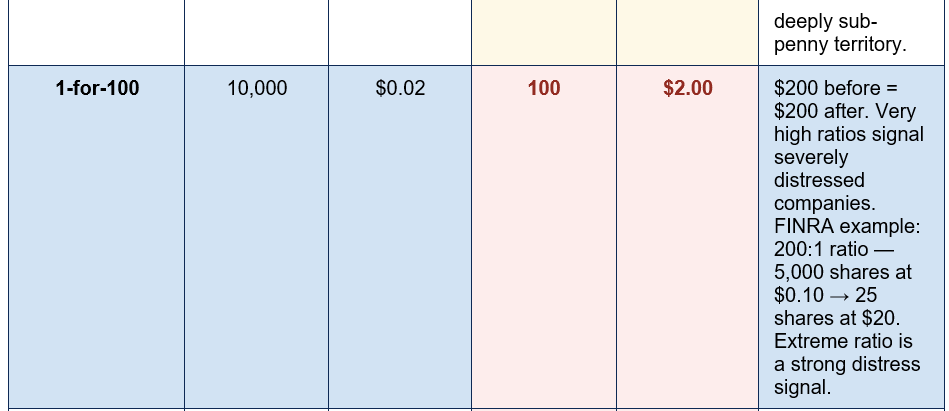
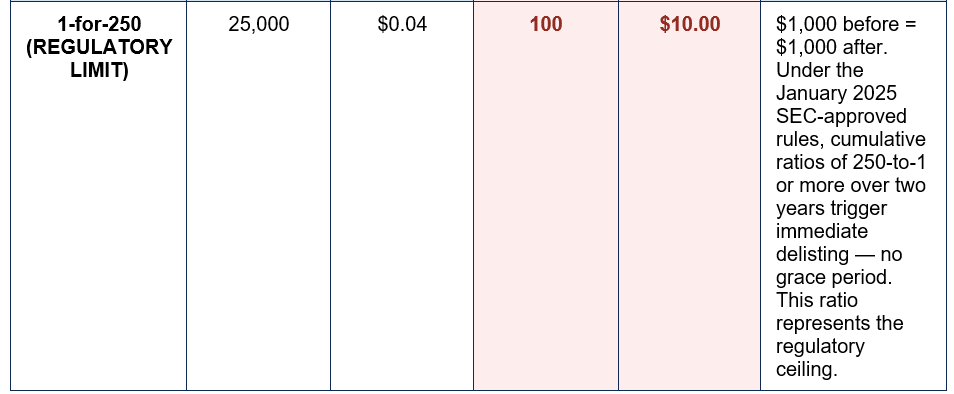
- Reverse Split Ratios: Before and After in Real Numbers
- Why Do Companies Execute Reverse Stock Splits?
- Reverse Split vs Forward Split: The Complete Comparison
- The January 2025 Rule Changes: The End of Serial Reverse Splitting
- What a Reverse Split Means for Investors: A Practical Framework
- Your Existing Holding: What Actually Happens
- The Underlying Signal: Why Context Matters More Than Mechanics
- Effect on Options and Derivatives
- Conclusion
- Frequently Asked Questions (FAQ)
- External References
The Corporate Action That Changes Everything — and Nothing
On Monday, July 6, 2026, thirteen reverse stock splits took effect at the market open on US exchanges. Zero forward splits occurred that same day. This asymmetry — thirteen to zero — is not an anomaly. It reflects the structural reality of the current market environment: in 2026, reverse stock splits overwhelmingly dominate the split landscape. Strasmore's analysis of real-time corporate action data confirms that 80% of all US stock splits executed in 2026 have run in reverse, with January 2026 alone recording 69 reverse splits against just 11 forward splits.Yet despite their prevalence, reverse stock splits remain one of the most misunderstood corporate actions in investing. Many retail investors are alarmed when they check their brokerage account and find their share count has dropped sharply overnight — only to discover the per-share price has risen by the same factor. Their total position value is unchanged. Others mistakenly believe that the higher post-split price means the company has become more valuable. Neither panic nor optimism is warranted by the mechanics of the split itself. What matters is understanding what a reverse split is, why companies execute them, what the data says about what typically follows them, and what the new regulatory rules effective from January 2025 mean for companies that rely on them as a survival tool.
This guide explains everything: the precise definition, the mathematics of how share counts and prices adjust, common ratios from 1-for-2 to 1-for-250, the reasons companies execute reverse splits, the effect on market capitalisation and investor holdings, what happens to fractional shares and options, the critical warning signals that experienced investors watch for, the new SEC/Nasdaq/NYSE rules that changed the regulatory landscape in January 2025, and the practical framework for understanding what a reverse split announcement means for your investment.
What Is a Reverse Stock Split?
A reverse stock split is a corporate action in which a company reduces the total number of its outstanding shares by consolidating multiple existing shares into a smaller number of new shares, with a proportional increase in the price per share. Strasmore's July 2026 corporate actions guide defines it precisely: 'A reverse stock split consolidates a company's existing shares into fewer shares at a higher price without changing the company's overall value: in a 1-for-10 reverse split, every 10 shares you own become 1, the price per share is multiplied by 10, and the total value of your position is unchanged. It is the mirror image of a forward split, where one share becomes several cheaper ones.'The essential mathematical principle is straightforward: the share price multiplies by the same factor that shares divide. In a 1-for-10 reverse split, every 10 shares are consolidated into 1 share, and the share price is multiplied by 10. In a 1-for-5 reverse split, every 5 shares become 1 share, and the price is multiplied by 5. FINRA's investor education guide articulates the invariance of total value: 'The amount of money you have invested doesn't change, just the number of shares you own. Remember that a stock split — or a reverse stock split — does nothing to change the value of a company.' The market capitalisation (total shares outstanding multiplied by the price per share) is mathematically identical before and after — because both the numerator (shares) and denominator (price) adjust by the same factor, and the product stays constant.
What does change is the per-share price, the share count, and — crucially for investor psychology and regulatory compliance — the price tier at which the stock trades. A stock trading at $0.50 is perceived very differently from one trading at $5.00 even when the underlying company is identical. That perception gap is precisely why companies execute reverse splits: not to change what the company is worth, but to change how it appears to the market, to regulators, and to institutional investors whose mandates exclude sub-$1 stocks.
Reverse splits in 2026 — the scale of the phenomenon: 80% of US stock splits in 2026 run in reverse. Q1 2025 hit a 10-year high: 93 reverse splits in just 3 months. — Strasmore (published 6 days ago, July 8, 2026): '80% of the US stock splits executed in 2026 ran in reverse — and every number below is measured from real corporate-action records.' Stoxcraft (June 2, 2026): 'Reverse splits hit a 10-year high in Q1 2025, with 93 executed in three months.' Prior peak period: 464 Nasdaq reverse splits in 2024 alone, 495 across listed companies in 2023 — driving the SEC and exchanges to tighten the rules in January 2025. Most common 2026 ratio: 1-for-10, executed 128 times
How Does a Reverse Stock Split Work? The Mechanics
The mechanics of a reverse stock split are standardised across exchanges. The company's board of directors approves the consolidation and announces the ratio (e.g. 1-for-10). A record date is set — the date on which shareholders of record are identified. An execution date is set — the date on which the new, consolidated shares take effect at the market open. On the execution date, the exchange and the company's transfer agent automatically convert all existing shares into the new consolidated shares at the announced ratio. There is no action required from shareholders — the adjustment is processed automatically in all brokerage accounts.The ratio tells you exactly how the mathematics work. Stoxcraft's June 2026 explanation is the clearest: 'The ratio tells you exactly how the math works. Say a company executes a 1-for-10 reverse split. If you owned 1,000 shares before, you now own 100. If those shares traded at $0.50 each before, they now trade at $5.00. Your total investment value stays the same. Only the packaging changed.'
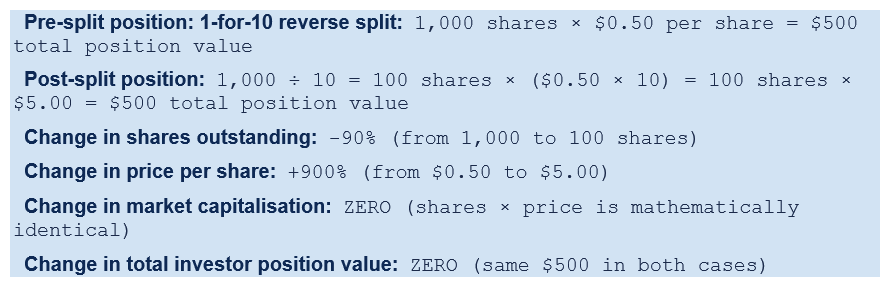
This mathematical invariance holds for every shareholder proportionally. If the company had 100 million shares outstanding before the 1-for-10 reverse split, it has 10 million shares outstanding after. If the price was $0.50 before, it is $5.00 after. Market cap = 100M × $0.50 = $50 million before. Market cap = 10M × $5.00 = $50 million after. The company has not created any new value through the reverse split — it has only repackaged the existing value into fewer, higher-priced containers.
Fractional Shares: What Happens When the Maths Is Not Clean
When the reverse split ratio does not divide evenly into a shareholder's total shares, the result is a fractional share. Options Education's June 2026 guide explains the standard treatment: 'In a 1-for-3 reverse split, 100 shares ÷ 3 = 33.333 shares; since fractional shares cannot be delivered, the terms of the reverse split typically round down to 33 shares with the remainder settled as cash in lieu.' The cash in lieu payment compensates the shareholder for the fractional portion at the post-split adjusted price, though in most cases the amounts involved are small. Shareholders with very small holdings can find their entire position converted to cash in lieu if they hold fewer shares than the split ratio requires to produce even one new share.Reverse Split Ratios: Before and After in Real Numbers
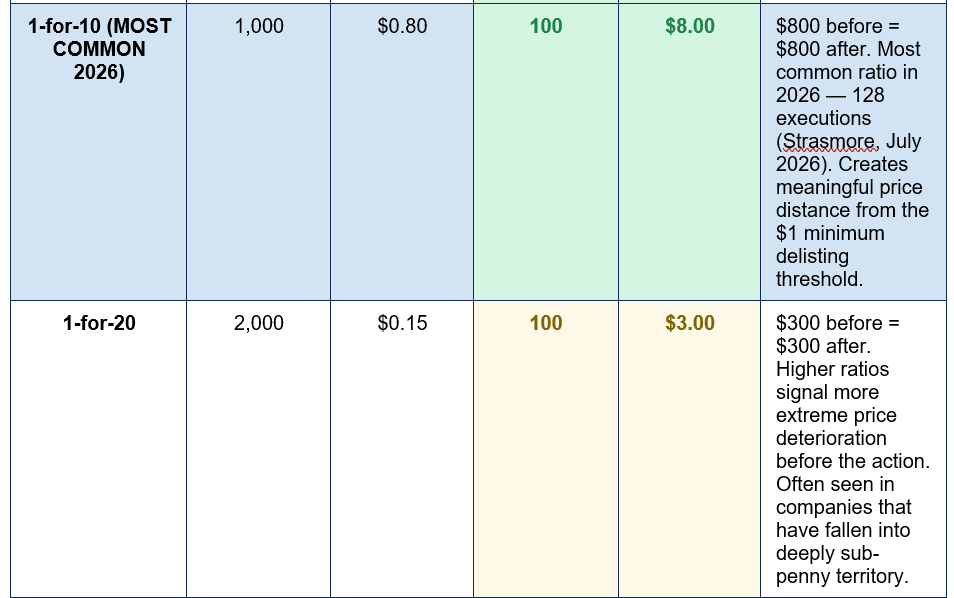
The table below maps every common reverse split ratio from 1-for-2 to the new 1-for-250 regulatory ceiling, showing the exact before-and-after position for a shareholder — and the signal that each ratio sends about the company's situation: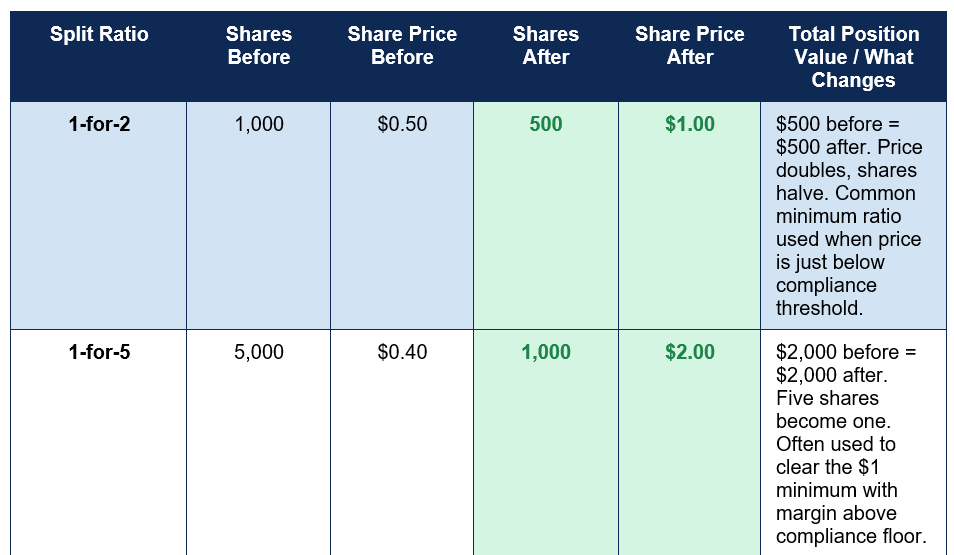
Why Do Companies Execute Reverse Stock Splits?
There are four primary reasons why companies choose to execute a reverse stock split. Understanding which reason applies in a specific case is one of the most useful analytical steps an investor can take when a reverse split is announced:- Exchange listing compliance — avoiding delisting: The most common reason by far, explicitly cited in most reverse split announcements. Both Nasdaq and the NYSE require listed companies to maintain a share price of at least $1.00 over an extended period. When a stock falls below this threshold and stays below it, the exchange issues a compliance notification and begins a deficiency process that can ultimately lead to delisting. Strasmore (July 2026): 'The most commonly stated reason is compliance with exchange minimum-price rules: Nasdaq and the NYSE both hold listed stocks to a $1.00 minimum price standard, and split announcements routinely cite regaining compliance as the purpose.' A reverse split is the fastest and most common mechanism to comply: a $0.40 stock that executes a 1-for-5 reverse split immediately trades at $2.00 — well above the $1.00 minimum. The new January 2025 rules, however, have dramatically changed what happens if the compliance is only temporary.
- Institutional investor eligibility: Many institutional investors — pension funds, mutual funds, ETFs, and professional asset managers — have internal policies that prohibit purchasing stocks priced below $1.00 (penny stocks) or below $5.00. The rationale is fiduciary risk management: very low-priced stocks are associated with higher volatility, lower liquidity, and greater risk. By lifting the share price above these thresholds through a reverse split, a company opens its shares to a broader universe of institutional buyers. FINRA confirms: 'Companies also might do reverse splits to maintain their listing on a stock market that has a minimum per-share price or to appeal to certain institutional investors who might not buy stock priced below a certain amount.'
- Index and ETF inclusion eligibility: Index providers and ETF managers apply minimum price filters when screening stocks for inclusion. A stock trading below $1.00 is typically excluded from major indices. By lifting the price through a reverse split, a company may become eligible for index inclusion — which can drive meaningful additional buying from index-tracking funds. Strasmore lists this among the 'other stated reasons' in its July 2026 analysis of corporate-action records.
- Share price optics and institutional perception: A stock quoted at $0.15 per share carries stigma — it is categorised as a penny stock, associated with fraud and pump-and-dump schemes in the minds of many investors, and generally treated with heightened scepticism regardless of the underlying company's actual fundamentals. A stock at $3.00 is perceived differently, even when the two prices represent identical companies before and after a reverse split. FINRA: 'A company with a very low-stock price might engage in the opposite behavior [to a forward split]: a reverse stock split, to increase its per-share price.' This perceptual benefit is real but limited — the market rapidly prices in the split and the underlying fundamentals reassert themselves.
Reverse Split vs Forward Split: The Complete Comparison
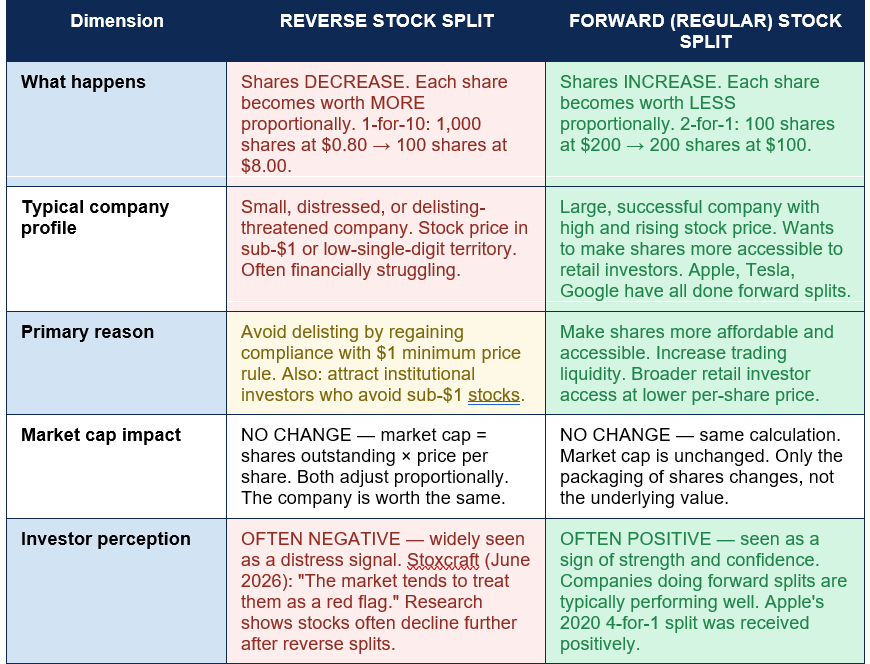
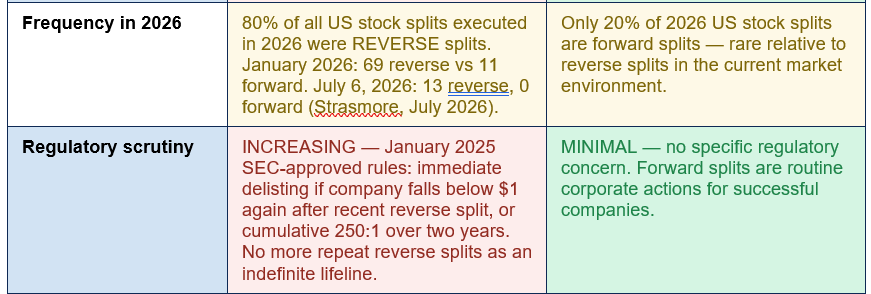
A reverse split and a forward (regular) split are mirror images of each other mechanically, but they carry completely different signals and are associated with completely different company profiles. The table below maps every key dimension of the comparison:
The January 2025 Rule Changes: The End of Serial Reverse Splitting
Prior to January 2025, a company could theoretically execute a reverse split every time its stock price collapsed below $1.00 — buying itself another grace period each time, repeating the cycle indefinitely. This serial reverse splitting became a documented pattern: companies would execute a reverse split, the stock would briefly comply, the underlying business would continue to deteriorate, the price would fall below $1.00 again, and the company would execute another reverse split. Some companies ran this cycle multiple times over several years.The regulators had seen enough. In January 2025, the SEC approved tighter delisting rules for both Nasdaq and the NYSE, fundamentally changing the consequences of a reverse split. Stoxcraft's June 2, 2026 analysis documents the new framework precisely: 'Under the new rules, if a company has already done a reverse split in the past year and falls below $1.00 again, it gets no grace period. Nasdaq will immediately begin delisting procedures. The same applies if a company has run multiple reverse splits with a cumulative ratio of 250-to-1 or more over two years. This eliminates the strategy of using repeat reverse splits every time the price collapses. These new rules followed a record 464 reverse splits by Nasdaq-listed companies in 2024 alone, and 495 reverse splits across listed companies in 2023. The exchanges had seen enough.'
The practical implications of this rule change are significant. For investors evaluating a reverse split announcement, the new rules mean that the action must be followed by genuine operational improvement — not just a temporarily higher price — because there is no longer a reliable safety net of another reverse split available if the price collapses again. Stoxcraft states this consequence directly: 'For companies now, the reverse split is no longer a reliable safety net. It must be followed by real operational improvement, not just an adjusted share count.'
The January 2025 cumulative 250-to-1 rule — what it means in practice: A company that executed a 1-for-10 reverse split in early 2024, followed by another 1-for-5 in late 2024, followed by a 1-for-5 in early 2025, would have a cumulative ratio of 10 × 5 × 5 = 250-to-1. Under the new SEC-approved rules, this triggers immediate delisting procedures regardless of whether the stock is currently above $1.00. The rule closes the serial-splitter loophole entirely: companies cannot use a sequence of reverse splits to survive indefinitely without fundamentally improving their business. For investors, this means that a third or fourth reverse split by a serial splitter is now an immediate delisting trigger — a critical red flag that goes beyond the warning signal that any single reverse split already represents.
What a Reverse Split Means for Investors: A Practical Framework
A reverse stock split announcement requires investors to assess multiple dimensions simultaneously — the immediate mechanics (which change nothing about total value), the signal it sends about company health (often negative), and the forward-looking question of whether the underlying business can genuinely improve. Here is a practical framework for each:Your Existing Holding: What Actually Happens
If you currently hold shares in a company that announces a reverse split, your brokerage account will automatically reflect the new share count and new price on the execution date. No action is required on your part. Your total position value in pounds or dollars remains the same. If you hold a number of shares that does not divide cleanly by the reverse split ratio, you will receive cash in lieu of the fractional share, typically credited to your account within a few days of the execution date. Your options contracts on the stock will adjust proportionally — the number of shares deliverable per contract changes, but the total exercise value remains the same.The Underlying Signal: Why Context Matters More Than Mechanics
The mechanics of a reverse split change nothing about the company's fundamental value. But the announcement itself carries substantial informational content — and that content is almost always negative. Stoxcraft's June 2026 analysis is frank: 'The market tends to treat [reverse splits] as a red flag. Research consistently shows that stocks doing reverse splits tend to underperform the broader market in the months that follow.' The reasons are intuitive: if a company's stock has fallen so far that it needs a reverse split to remain listed, the business is clearly struggling. The split does not fix the underlying problems — it temporarily changes their visible symptom.FINRA's investor alert reinforces this caution: 'If a reverse split is announced and actually occurs, proceed with caution. Reverse splits tend to go hand in hand with low-priced, high-risk stocks. This is especially true with reverse splits that result in a post-split share price that is many times the price of the stock's current price.' The higher the ratio (1-for-50, 1-for-100, 1-for-200), the more severe the price deterioration that preceded the action — and the more cautious an investor should be.
THE INVESTOR'S REVERSE SPLIT CHECKLIST: When a company in your portfolio or watchlist announces a reverse split, ask these five questions before making any decision: (1) What is the stated reason? If it is to regain exchange compliance, the stock has been trading below $1.00 — a severe deterioration. (2) Has this company done a reverse split before? Under the January 2025 rules, a second reverse split after a recent first one may already trigger immediate delisting. Check the company's split history. (3) What are the fundamentals? Has revenue grown? Is cash flow positive? Are losses narrowing or worsening? The split changes nothing about the business — only improvement in the fundamentals changes the investment case. (4) What is the post-split price relative to peers? A company with fundamentally weak financials trading at $5.00 post-split is not comparable to a genuine $5.00 company with strong earnings. (5) Are institutional holders increasing or selling? SEC 13F filings (filed quarterly, with a 45-day lag) show whether professional investors are building or reducing their positions.
Effect on Options and Derivatives
For investors who hold options on a stock that executes a reverse split, the mechanics require careful attention. Options Education's June 2026 guide (published approximately one month ago) provides the clearest available explanation: 'When a company does a standard even (whole-number) reverse split (like 1-for-2 or 1-for-10), the math is clean and options adjust proportionally.' The key principle: the aggregate exercise value of each options contract remains unchanged after the reverse split.In a 1-for-10 reverse split, before the split one standard options contract delivers 100 shares at a specific strike price. After the split, the same contract delivers 10 shares (100 ÷ 10) but the strike price and total exercise value are unchanged. If the pre-split strike was $0.50, the post-split contract still represents $50.00 in total exercise value — the same economics, repackaged into a smaller number of deliverable shares. The Options Clearing Corporation (OCC) publishes an Information Memo for each adjusted contract, identifying the exact terms of the adjustment and the effective date.
For odd ratios (1-for-3, 1-for-7, 1-for-15) that produce fractional shares: 'If cash is paid in lieu of fractional shares, the cash delivery obligation on an option is generally fixed at the time of adjustment, and the investor would lose the time value of the fractional share,' according to Options Education's June 2026 guide. This fractional share cash-in-lieu treatment in options can have small but meaningful effects for investors with large positions in affected contracts.
THE SERIAL SPLITTER WARNING — NEW 2025 RULES CHANGE THE CALCULUS: Before the January 2025 rule changes, an investor holding stock in a serial reverse-splitter had a worst case of continued losses but no immediate delisting trigger from the reverse split itself. Under the new rules, a second reverse split within one year of the first — or a cumulative 250-to-1 over two years — now triggers immediate delisting proceedings on Nasdaq and the NYSE. For investors in companies that have already done one reverse split in the past 12 months, the announcement of a second reverse split is now a signal that the company is at immediate risk of delisting — not just a sign of continued distress. Check the company's split history on the exchange's website, the SEC Edgar database, or financial data providers before deciding whether to hold through a second or third reverse split.
Conclusion
A reverse stock split is a corporate action that reduces the number of shares outstanding while proportionally increasing the price per share — leaving the company's total market capitalisation and every investor's total position value mathematically unchanged. The most common ratio in 2026 is 1-for-10, with 128 executions tracked by Strasmore in the first half of the year alone. In January 2026, 69 reverse splits occurred against just 11 forward splits. On July 6, 2026, 13 reverse splits took effect at the market open versus zero forward splits. Reverse splits now represent 80% of all US stock splits executed in 2026.The mechanics change nothing about company value. But the signal they send — and the context in which they appear — tells a very different and typically worrying story. A reverse split is almost always executed by a company that has experienced significant stock price decline, either approaching or already below the $1.00 exchange minimum price threshold. The underlying business problems that caused the price decline do not disappear because the share count has been consolidated. Research consistently shows stocks underperforming the broader market in the months following reverse splits, and the frequency of their occurrence among distressed companies means they are associated with elevated investment risk.
The January 2025 rule changes from the SEC, Nasdaq, and NYSE have added a new dimension of urgency: a company that falls below $1.00 again after a recent reverse split faces immediate delisting, and a cumulative 250-to-1 ratio over two years triggers the same outcome. These rules have closed the serial-splitting loophole that allowed struggling companies to survive indefinitely through repeated reverse splits without addressing their underlying problems. For investors, the practical conclusion is clear: treat a reverse split announcement as a red flag requiring careful fundamental analysis, not as a neutral corporate action. The packaging has changed. The underlying reality has not.
Frequently Asked Questions (FAQ)
What is a reverse stock split in simple terms?
A reverse stock split is when a company reduces its number of shares by consolidating multiple existing shares into fewer new ones, while simultaneously raising the price per share by the same factor — so the total value stays the same. For example, in a 1-for-10 reverse split, if you owned 1,000 shares at $0.80 each, you now own 100 shares at $8.00 each. Your investment is still worth $800 — nothing has changed except the number of shares and the price label. Companies typically do this to raise their share price above the $1.00 minimum required by major exchanges like Nasdaq and the NYSE, which can threaten a company with delisting if the price stays below that threshold.Does a reverse stock split change the value of my investment?
No — a reverse stock split does not change the total value of your investment or the company's market capitalisation. The mathematics ensure that the total position value (shares × price per share) is identical before and after the split. If you owned 500 shares at $0.40 (total value $200) and the company does a 1-for-5 reverse split, you now own 100 shares at $2.00 (still $200). FINRA is explicit: 'The amount of money you have invested doesn't change, just the number of shares you own. Remember that a stock split — or a reverse stock split — does nothing to change the value of a company.' What can change the value of your investment after a reverse split is the subsequent performance of the underlying business — which is why the reverse split announcement itself is a reason to reassess the investment fundamentals, not a cause of any immediate financial gain or loss.Why is a reverse stock split considered a red flag?
A reverse stock split is widely considered a red flag because it is almost always executed by a company whose stock price has declined so severely that it is at risk of — or already in breach of — the minimum $1.00 price required for continued listing on major exchanges. The split fixes the symptom (the low price) but not the underlying cause (the poor business performance). Stoxcraft (June 2026) states: 'The market tends to treat them as a red flag. Research consistently shows that stocks doing reverse splits tend to underperform the broader market in the months that follow.' FINRA adds: 'Reverse splits tend to go hand in hand with low-priced, high-risk stocks.' The higher the reverse split ratio (1-for-50, 1-for-100), the more severe the prior price deterioration and the stronger the distress signal. Under the January 2025 rule changes, a second reverse split within a year of the first now triggers immediate delisting on Nasdaq — adding another dimension of risk for companies and investors in serial-splitting situations.What are the new 2025 SEC rules about reverse stock splits?
In January 2025, the SEC approved tighter delisting rules for both Nasdaq and the NYSE that significantly changed the consequences of reverse stock splits. Under the new rules: first, if a company has already done a reverse split in the past year and its stock falls below $1.00 again, it receives no grace period — delisting procedures begin immediately. Previously, the company would have had another grace period to come back into compliance, allowing repeated reverse splits as an indefinite survival mechanism. Second, if a company has run multiple reverse splits with a cumulative ratio of 250-to-1 or more over two years, immediate delisting procedures also begin. These rules were driven by the record 464 reverse splits by Nasdaq-listed companies in 2024 and 495 across listed companies in 2023, which the exchanges determined was an abuse of the reverse split mechanism. The practical effect is that a reverse split must now be followed by genuine operational and financial improvement — it can no longer serve as a reliable, repeatable survival tool for chronically underperforming companies.What happens to fractional shares and options during a reverse split?
Fractional shares arise when the reverse split ratio does not divide evenly into a shareholder's total share count. For example, in a 1-for-3 reverse split, a holder of 100 shares receives 33 complete new shares, with the remaining 0.333 fractional share settled as cash in lieu — a cash payment equal to the fractional share at the post-split price, automatically credited to the brokerage account. For options contracts, the adjustment maintains the aggregate exercise value. In a 1-for-10 reverse split, a standard contract that previously delivered 100 shares now delivers 10 shares — but the same total exercise value is preserved because the price has been multiplied by 10. The Options Clearing Corporation (OCC) publishes a formal Information Memo for each adjusted contract specifying the exact new terms. For odd ratios (like 1-for-3 or 1-for-7), cash in lieu of fractional shares is the standard treatment and applies to both the underlying shares and to any fractional adjustments to options deliverables.External References
1. Strasmore — What Is a Reverse Stock Split? Real Examples (Published 6 days ago, July 8, 2026 — 80% of 2026 splits run in reverse, 1-for-10 most common with 128 executions, January 69 vs 11, July 6 13 vs 0)https://www.strasmore.com/blog/what-is-a-reverse-stock-split
2. Stoxcraft — Reverse Stock Split Explained: How It Works and What It Signals (June 2, 2026 — Q1 2025 10-year high 93 in 3 months, January 2025 new SEC rules, 464 Nasdaq splits 2024, 250-to-1 cumulative limit)
https://www.stoxcraft.com/blog/reverse-stock-split
3. Options Education — Splits Happen: How Reverse Splits Affect Options Contracts (June 2026 — 1-for-10 options adjustment mechanics, OCC Information Memo, fractional share cash in lieu)
https://www.optionseducation.org/news/splits-happen
4. FINRA — Stock Splits (200:1 reverse split example, 5,000 shares at $0.10 → 25 shares at $20, FINRA processing in OTC market, value unchanged)
https://www.finra.org/investors/investing/investment-products/stocks/stock-splits
5. US SEC Investor.gov — Reverse Stock Splits (official SEC investor education resource: 1-for-10 example, 10,000 shares → 1,000 shares)
https://www.investor.gov/introduction-investing/investing-basics/glossary/reverse-stock-splits
6. StockSplitHistory.com — Recent Reverse Stock Splits 2025-2026 (Database of actual reverse splits: ANGI 1-for-10, AZN 1-for-2, ATOS 1-for-15, ADV 1-for-250, AGL 1-for-250)
https://www.stocksplithistory.com/reverse-stock-splits/
7. Public.com — What Is a Reverse Stock Split? (April 17, 2025 — investor impact, why companies do it, institutional eligibility)
https://public.com/learn/reverse-stock-split
8. Robinhood — What Is a Reverse Stock Split? (exchange compliance, forward vs reverse split mechanics, market cap unchanged)
https://robinhood.com/us/en/learn/articles/1s3IKqLvRyOPLPSt9tlLz9/what-is-a-reverse-stock-split/
0 Comments
Be the first to share your thoughts on this article.