

Hustle
What to Consider Before Starting a Side Gig
Over 70 million Americans are part of the gig economy. The average side hustle now earns a record $1,242 per month. But 65% of active side hustlers report burnout, the median income is just $200 per month, and the self-employment tax bill catches most newcomers completely off guard. Starting a side gig can be one of the best financial decisions you make in 2026 — or one of the most draining. The difference usually comes down to what you considered before you started. This guide covers everything you should think through first.
The people leaving side gigs and the people staying are telling two different stories simultaneously. Those staying are earning more. Those leaving are burning out or finding the income insufficient for the time invested. The median side hustle income across surveys sits at just $200 per month (SideHustleNation August 2026) — a stark contrast to the $1,000-plus average figures that dominate headlines. The bottom 25% of side hustlers earn less than $300 per month; the top 10% earn over $4,000. The distribution is extremely wide, and where you land depends almost entirely on factors you can evaluate before you start.
This guide is not about whether side gigs are good or bad. It is about the seven considerations that determine whether a specific side gig will work for a specific person. The people who thrive in the gig economy tend to have thought through these questions before they started. The people who burn out or quit often discover them after the fact — when they file their first Schedule C and realise 35 cents of every dollar they earned is already committed to the IRS, or when they calculate their hourly rate and find it is less than minimum wage, or when their employment contract turns out to contain a clause they never read.
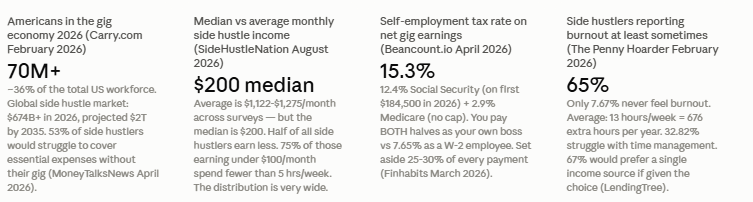
70+ million Americans in gig economy (36% of workforce) (Carry.com February 2026). Record average side hustle: $1,242/month (LiveNOW FOX April 2026). Median side hustle: $200/month (SideHustleNation August 2026). 65% of active side hustlers report burnout at least sometimes (The Penny Hoarder February 2026). 32.82% struggle with time management (Hostinger January 2026). Self-employment tax: 15.3% on net earnings (12.4% Social Security + 2.9% Medicare). Social Security wage base 2026: $184,500. Set aside 25-30% of every payment (Finhabits March 2026). QBI deduction: up to 20% of qualified business income (OBBBA permanent).
The Penny Hoarder's February 2026 survey of 1,000 active side hustlers found that 80% of American side hustlers name financial reasons as their primary motivation (Omnisend March 2026 via MakerStations). But within that financial category, the reasons divide sharply: 53% say they would struggle to cover essential expenses without the gig (MoneyTalksNews April 2026), while others are paying off debt (24%), covering discretionary spending (28%), or building savings. The 20% who are not primarily financially motivated are testing a business idea, building skills, maintaining professional networks, or trying to determine whether a passion can become a career (SideHustleNation August 2026).
The reason matters because it determines the right success metric. If your goal is to pay off a specific debt, the right question is: which side gig generates the most reliable income per hour with the least overhead? If your goal is to test whether you can build a business, the right question is: which side gig has the longest-term growth ceiling and the most defensible competitive position? A side hustle optimised for immediate cash — rideshare, delivery, hourly service work — is not the same as one optimised for long-term business building, and measuring a delivery driver's side gig by its business-building potential, or a freelance consulting business by its first-month income, leads to misaligned expectations and premature quitting.
The most common reason side gigs underperform expectations: the person chose a category based on what they heard others earning, not based on what matches their goal, skills, and available time. A side gig choice that aligns with your actual goal, leverages skills you already have, and fits genuinely available hours is dramatically more likely to succeed than one chosen because someone on social media claimed to earn $5,000 a month doing it. The question to answer first: what does success actually look like for you, in concrete terms, twelve months from now?
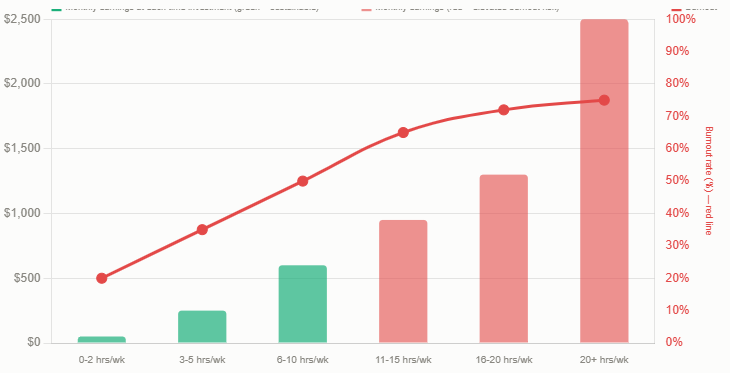
The average side hustler spends 11-16 hours per week on their business (SideHustleNation August 2026 survey); MoneyTalksNews's April 2026 survey of 1,000 active side hustlers found the average to be 13 hours per week, which over a year adds up to 676 hours — roughly 17 additional 40-hour work weeks. QuickBooks' 2026 survey found Americans dedicate an average of 19.5 hours per month (about 4.5 hours per week), which is on the lower end. The range is wide. But Hostinger's January 2026 analysis found a direct relationship: of the people making $500 or more every month, 81% are spending at least 5 hours per week on their side hustle.
The time consideration has three components that all need to be true simultaneously: the hours must be available in your existing schedule; you must be able to give those hours to productive work rather than administration, learning, and setup; and the hours must not compromise the rest of your life to a degree that causes the burnout that ends 65% of side gigs (The Penny Hoarder February 2026). Time for a side gig does not appear from nowhere — it comes from somewhere else. From sleep, from family time, from exercise, from hobbies, from recovery.
Time reality check. Most employed Americans have 4-6 discretionary hours on weekdays and 8-12 on weekends. After accounting for commute, cooking, childcare, and basic recovery: realistic weekly side gig hours for most people with full-time jobs: 5-15 hours. At the lower end (5 hours/week, 50 weeks): 250 hours per year. At a $25/hour effective hourly rate: $6,250/year gross. At the median side hustle hourly rate of $16-$23/hour (SideHustleNation): $4,000-$5,750/year from 250 hours. That is $333-$479/month — consistent with the median income data but very different from the average figures driven by high performers. Before starting, list specifically which hours you will redirect to the side gig and from which current activity. Not financial advice.
The setup time trap: the first three to six months of most side gigs involve significant non-billable time — building a website, learning a platform, onboarding the first clients, setting up business accounting, figuring out the tax system. This setup time often makes the first six months feel unrewarding and triggers early quitting. Budget explicitly for this setup phase: expect the first 3-6 months to generate less than 50% of the eventual steady-state hourly rate. Those who persist through the setup phase are the ones who reach the income levels that make side gigs genuinely worthwhile.
The core data point most often quoted is the 'average' side hustle income — which various surveys put between $530 and $1,275 per month depending on their methodology. But SideHustleNation's August 2026 analysis of 1,200 subscribers is more granular: the median income is $200 per month, and half of all respondents reported making less than $100 per month. Critically, 75% of those making under $100 per month reported spending 0-5 hours per week on their side hustle. The relationship between time invested and income earned is strong and consistent: 81% of those making $500 or more per month spent at least 5 hours per week; 36% of side hustlers overall earn $1,000 or more per month.
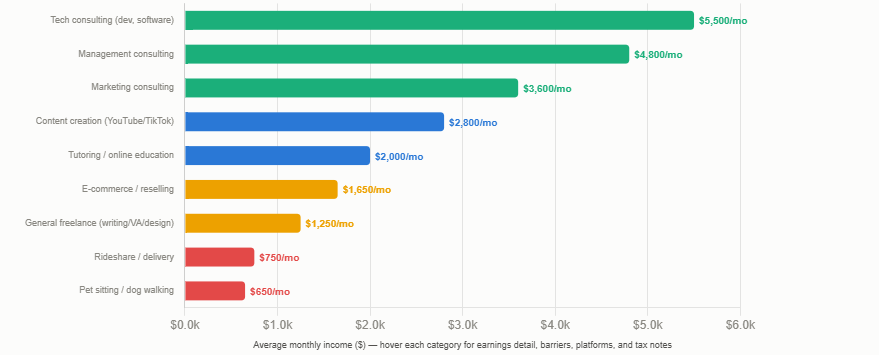
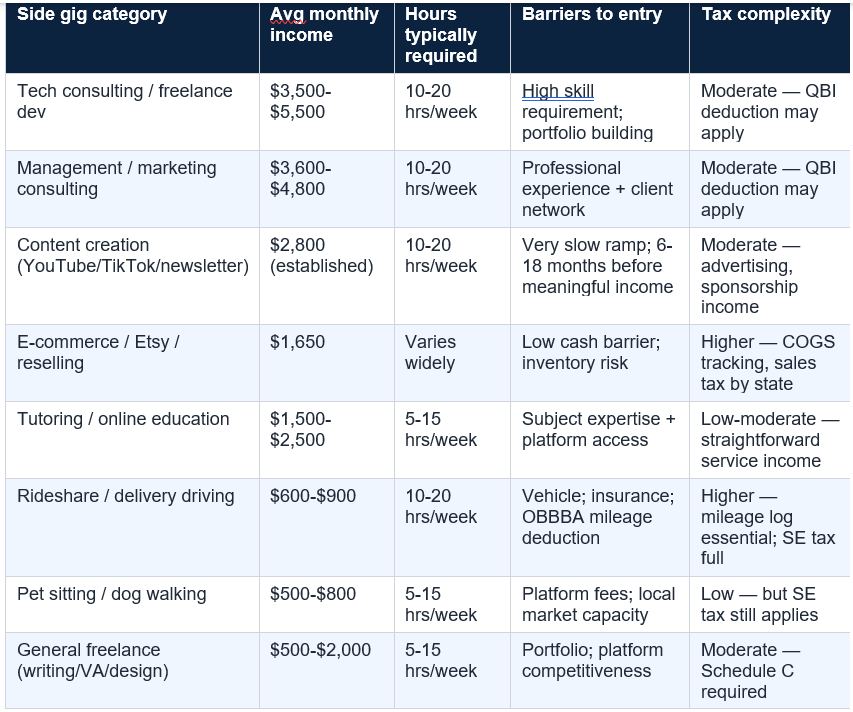
Earnings also vary dramatically by category. Skillademia's July 2026 analysis of side hustle earnings by type finds that freelancing and consulting generate the highest average at $4,200 per month (tech consulting $5,500/month, management consulting $4,800/month, marketing consulting $3,600/month). Content creation averages $2,800/month. E-commerce averages $1,650/month. Gig and delivery work — the highest-participation category — averages $600-$900 per month. This means two people who both 'have a side hustle' can have radically different income potential based purely on category choice, and the categories with the highest earnings require the most upfront investment in skills and client acquisition.
The headline number: self-employment tax is 15.3% of net earnings — 12.4% for Social Security on the first $184,500 of net earnings in 2026 (the Social Security wage base, which increased from $176,100 in 2025) plus 2.9% for Medicare on every dollar with no cap. Beancount.io's April 2026 self-employment tax guide describes the structural shock clearly: 'When you have a regular job, your employer quietly pays half of your Social Security and Medicare taxes — and you never see it on your pay stub. When you go independent, you pay both halves. That extra slice is what the IRS calls self-employment tax, and it catches new freelancers off guard every single year.'
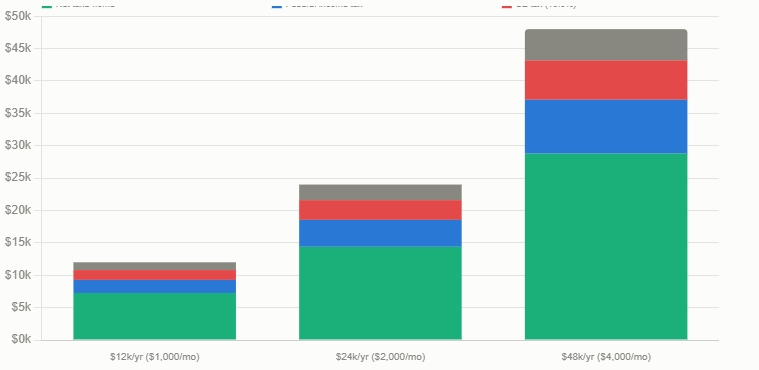
Self-employment tax is calculated on 92.35% of net earnings (not 100%), and you can deduct 50% of the SE tax paid from your gross income — effectively deducting the employer's share. But even with this deduction, the net impact is significant. Finhabits' March 2026 gig worker tax guide recommends setting aside 25-30% of every payment received to cover SE tax plus federal income tax. At 25-30%, a side hustler earning $1,000/month is setting aside $250-$300 in tax every month — before spending a dollar of it on business expenses or investing it in the business.
Self-employment tax worked example (2026). Side gig earns $24,000 gross in 2026. Business expenses: $2,400 (supplies, software, home office portion). Net profit (Schedule C): $21,600. SE tax base (92.35% of net profit): $19,948. SE tax (15.3%): $3,052. SE tax deduction (50% of SE tax, deducted from gross income): $1,526. Taxable income from SE before other deductions: $21,600 - $1,526 = $20,074 added to AGI. Federal income tax (at 22% marginal rate, assuming other income pushes into 22%): approximately $4,416. Total tax from side gig: $3,052 + $4,416 = $7,468. As % of gross side gig income: 31.1%. Recommended set-aside: 30% = $7,200 — very close to actual. If QBI deduction applies (20% of $21,600 = $4,320): reduces taxable income, saving approximately $950 in income tax. Net tax after QBI: approximately $6,518 (27.2% of gross). Not tax advice — individual outcomes depend on total income, deductions, and filing status. Consult a CPA.
Quarterly estimated tax payments: if you expect to owe $1,000 or more in federal taxes from self-employment income in 2026, you are required to make quarterly estimated tax payments. The 2026 due dates: April 15 (Q1), June 16 (Q2), September 15 (Q3), January 15, 2027 (Q4). Missing these payments can result in an underpayment penalty — typically 0.5% per month on the unpaid amount. The fix: as soon as you receive your first gig payment, open a separate savings account designated for taxes. Transfer 25-30% of every payment received into this account immediately. Do not spend it. This account funds your quarterly payments. Not tax advice.
Many employment contracts contain provisions that directly affect side gig activity. The most common are non-compete clauses (prohibiting you from working for or operating a business that competes with your employer, often for a specified period during and after employment), non-solicitation clauses (prohibiting you from soliciting your employer's clients or employees for your own business), and intellectual property assignment clauses (assigning ownership of work created using company resources — including your work computer, work time, or even ideas developed during employment — to your employer).
SideGigGuide's 2026 complete gig economy guide explicitly flags this: 'Yes — most gig workers start part-time alongside a day job. Check your employment contract for non-compete clauses, especially in tech, finance, and consulting.' The enforceability of non-compete clauses varies significantly by state — California, Minnesota, and several other states have near-total bans on non-competes, while others enforce them broadly. The FTC had proposed a national ban on non-competes, but its implementation has been legally contested.
Even if your contract has no non-compete, consider whether your side gig could create real or perceived conflicts of interest with your employer, whether it uses skills, contacts, or information developed during your employment that your employer might claim ownership of, and whether your employer has policies about outside employment that require disclosure. Many large employers have policies requiring employees to disclose outside employment above certain income thresholds. Disclosing proactively is almost always better than having a conflict surface later.
Employer contract review checklist before starting a side gig: (1) Read your full employment agreement — not just the sections about compensation. (2) Look specifically for non-compete, non-solicitation, and IP assignment clauses. (3) Check your employer's outside employment / moonlighting policy in the employee handbook. (4) Assess whether your planned side gig could be argued to compete with your employer's business. (5) If you find relevant clauses or policies, consult an employment attorney before proceeding — not after a dispute has started. (6) In states with strong non-compete enforcement (many states except CA, MN, ND, OK), take this step seriously even for seemingly unrelated gigs. Not legal advice.
The SEP IRA (Simplified Employee Pension) allows self-employed individuals to contribute up to 25% of net self-employment income or $72,000 in 2026 (whichever is less). Contributions are tax-deductible, reducing taxable income dollar-for-dollar, and the account grows tax-deferred. For a side hustler earning $24,000 in net profit, a SEP IRA contribution of up to $4,488 (approximately 25% of adjusted net SE income) would reduce taxable income by that amount — potentially saving over $1,000 in federal income tax.
The Solo 401(k) (also called the Individual 401(k) or Self-Employed 401(k)) is even more powerful for higher-income side gig workers. As both the employee and employer, you can contribute $24,500 as the employee (the standard 2026 401(k) limit, plus catch-up if 50+) plus up to 25% of net earnings as the employer contribution, for a total contribution cap of $72,000 in 2026. For someone with significant side gig income who is already maximising their W-2 employer's 401(k), a Solo 401(k) can shelter additional income from immediate taxation.
On the benefits side, the self-employed are responsible for their own health insurance. The health insurance premium deduction for the self-employed allows you to deduct 100% of health insurance premiums paid for yourself, your spouse, and your dependents as an above-the-line deduction — reducing AGI rather than just taxable income. This applies as long as your side gig generates net profit and you are not eligible for employer-sponsored health coverage through your or your spouse's employer. Carry.com's February 2026 gig economy guide specifically notes that 'each career path comes with its own earning potential, tax rules, and retirement planning strategies' — a recognition that the retirement and benefits planning for gig workers requires more deliberate action than for traditional W-2 employees.
The retirement and benefits gap: a W-2 employee earning $100,000 may have employer-matched retirement contributions, employer-sponsored health insurance, disability insurance, and paid leave — benefits that can be worth $15,000-$30,000 annually in total compensation above salary. A side gig that adds $24,000 in gross income but requires $7,000 in taxes, provides no benefits, and requires 13 hours per week of additional work is actually adding less value than the headline income suggests. Calculating the full economic value of a side gig — net of taxes, costs, and the cost of foregone benefits — is the only honest way to evaluate whether it is worth the trade-offs. Not financial advice.
The highest-earning categories in the gig economy in 2026 are concentrated in professional services: technology consulting ($5,500/month average), management consulting ($4,800/month), and marketing consulting ($3,600/month), according to Skillademia's July 2026 report. These categories are accessible only to people with existing professional expertise and established professional networks — but for those who have them, the hourly effective rate can be extraordinary. Content creation (YouTube, TikTok, newsletters, podcasting) averages $2,800 per month but has an extremely long ramp time — most content creators earn minimal income for 6-18 months before reaching meaningful monetisation.
The most accessible categories — rideshare, delivery, pet care, house cleaning — have the lowest barriers to entry and generate the most reliable near-term cash, but they have both a low ceiling on hourly rate and a time-for-money structure that does not scale. If you work more hours, you earn more money; if you stop, you earn nothing. The categories that scale — content, software tools, digital products, courses — have longer ramps but create income streams that eventually decouple from hourly input.
Carry.com's February 2026 gig economy overview describes the two tracks clearly: 'Freelance work in 2026 generally follows two tracks: local service-based jobs (low barriers to entry, strong consumer demand) and digital skills-based work (combining global reach with premium pricing, making them attractive for freelancers seeking higher earnings and Solo 401(k)-eligible income).' Knowing which track aligns with your goals, skills, and timeline is the most strategic pre-start decision you can make.
The gap between the side gigs that work and the ones that do not is almost entirely in the preparation. People who know why they are starting, how many hours they can realistically commit, what they will actually earn at that time level, what the tax system will take, which deductions they can legitimately claim, whether their employment contract permits the activity, and how to protect their retirement without an employer doing it for them — those people dramatically outperform those who start with enthusiasm and discover the complications later.
This guide has covered the seven considerations that most determine side gig success. None of them are reasons not to start. They are reasons to start informed. The best time to think through the self-employment tax is before you spend the first payment. The best time to read the employment contract is before you take the first client. The best time to open the tax savings account is before the first dollar of side gig income arrives. If you have done that thinking, and the numbers still work, and the time is genuinely available — start. Not financial, tax, or legal advice.
The earnings data for side gigs is extremely wide-ranging, and headline averages are misleading because a small number of very high earners pull the mean far above the typical experience. The most reliable picture comes from looking at multiple data points simultaneously. The median side hustle income is $200 per month, according to SideHustleNation's August 2026 analysis of 1,200 subscribers — meaning half of all side hustlers earn less than this. Of those earning under $100 per month, 75% spend fewer than 5 hours per week on their side hustle, which suggests a direct time-income relationship. At the higher end, 36% of side hustlers earn $1,000 or more per month, and the top 10% earn over $4,000 (Skillademia July 2026). The average across surveys ranges from $530/month (Hostinger) to $1,275/month (MoneyTalksNews). The record average for 2026 is $1,242/month (LiveNOW from FOX April 2026). Category matters enormously: tech consultants average $5,500/month, delivery drivers $600-$900/month. Not financial advice — individual earnings depend on skill, time invested, category, and market conditions.
What is the self-employment tax and how much will I owe?
The self-employment (SE) tax is 15.3% of your net self-employment earnings — 12.4% for Social Security on the first $184,500 in 2026 (the Social Security wage base, up from $176,100 in 2025) and 2.9% for Medicare on every dollar with no cap. When you work as an employee, your employer pays half of these taxes (7.65%) and you pay the other half through payroll withholding. As a self-employed person, you pay the full 15.3% yourself. SE tax is calculated on 92.35% of net profit (net profit after business expenses), and you can deduct 50% of the SE tax paid from your gross income. Adding income tax on top of SE tax, most gig workers in the 22% bracket effectively pay 30-35% of net gig income to combined federal taxes. The standard recommendation from Finhabits, SideGigGuide, and KeeperTax is to set aside 25-30% of every payment received to cover both taxes. If you expect to owe $1,000 or more in federal taxes from self-employment, you must also make quarterly estimated tax payments (April 15, June 16, September 15, January 15). Not tax advice — consult a qualified CPA.
Do I need to tell my employer about my side gig?
It depends on your employment contract and your employer's policies. Many employment agreements contain provisions that directly affect side gig activities: non-compete clauses (prohibiting work for competing businesses), non-solicitation clauses (prohibiting soliciting your employer's clients), and intellectual property assignment clauses (assigning to your employer the ownership of work created using company resources or time). Many employers also have outside employment or moonlighting policies that require disclosure of secondary income above certain thresholds. The critical step: read your full employment agreement before starting any side gig, paying particular attention to these clause types. SideGigGuide's 2026 gig economy guide flags this specifically for workers in tech, finance, and consulting. If your contract contains relevant clauses, consult an employment attorney before starting. If your employer has a disclosure policy, proactive disclosure is almost always better than discovery after a conflict arises. The enforceability of non-compete clauses varies significantly by state — California and several others ban them broadly. Not legal advice.
What tax deductions can I claim for my side gig?
As a self-employed individual, you can deduct legitimate business expenses from your gross side gig income on Schedule C, reducing the net profit on which both SE tax and income tax are calculated. Common deductions include: home office (proportional share of home costs for space used regularly and exclusively for the business); business vehicle use (IRS standard mileage rate for 2026 or actual expenses proportional to business use — requires a contemporaneous mileage log); equipment and technology (laptops, phones, cameras, software subscriptions, cloud storage in proportion to business use); platform and transaction fees (marketplace platform fees, payment processing fees); professional development (courses, books, subscriptions directly related to your gig); and health insurance premiums for self-employed individuals (deductible above the line, not requiring itemisation). Two significant 2026 deductions to know: the QBI deduction (Section 199A) allows up to 20% of qualified business income to be deducted from taxable income — made permanent by OBBBA; and the new tip income deduction (OBBBA) allows up to $25,000 in qualified tip income to be deducted. Record-keeping is essential for all deductions. Not tax advice — consult a qualified CPA.
What retirement account should I open for side gig income?
Self-employed individuals with side gig net profit have access to retirement accounts with significantly higher contribution limits than a standard IRA. The two most commonly used for side gig income are: SEP IRA — contribute up to 25% of net self-employment income or $72,000 in 2026 (whichever is less). Contributions are tax-deductible and reduce taxable income dollar-for-dollar. Simple to set up through any major brokerage. Contribution deadline: tax filing deadline including extensions. For a side gig generating $24,000 in net profit, maximum SEP contribution is approximately $4,488 — potentially saving over $1,000 in federal income tax. Solo 401(k) (also called Individual or Self-Employed 401(k)) — allows contributions as both employee ($24,500 in 2026, plus catch-up if 50+) and employer (up to 25% of net earnings), with a combined maximum of $72,000. Roth Solo 401(k) option available at most providers. Best for higher-income side gig workers who want to maximise tax-advantaged contributions beyond what a SEP IRA allows at their income level. Also note: if you already maximise a 401(k) through your W-2 employer, the employee contribution limit is shared across all 401(k) plans. You cannot contribute $24,500 to both your employer's plan and a Solo 401(k) in the same year. Carry.com's February 2026 gig economy guide notes Solo 401(k)-eligible income as a specific advantage of digital skills-based gig work. Not financial or tax advice — consult a qualified CPA or financial adviser.
Table of Contents
- The Real Picture Behind the Side Gig Economy in 2026
- Consideration #1 — Why Do You Actually Want to Start a Side Gig?
- Consideration #2 — How Much Time Can You Realistically Commit?
- Consideration #3 — What Will You Actually Earn? The Reality vs the Headline
- Consideration #4 — The Self-Employment Tax You Did Not See Coming
- Consideration #5 — The Deductions That Change the Tax Picture
- Consideration #6 — Your Employer Contract and Non-Compete Clauses
- Consideration #7 — Retirement, Benefits, and the Self-Employed Safety Net
- Side Gig Earnings by Category: Where the Money Actually Is
- Setting Up for Success: The First 90 Days
- Conclusion: Consider Everything Before You Start — Then Start
- Frequently Asked Questions
Earning By Category: Where The Money Actually is
The SE tax reality: what you keep after tax
Burnout and time: the cost you don't see
The Real Picture Behind the Side Gig Economy in 2026
The narrative around side gigs in 2026 is contradictory. On one side: more than 70 million Americans are estimated to be part of the gig economy (Carry.com February 2026), earnings have hit a record average of $1,242 per month for those who have side hustles (LiveNOW from FOX April 2026), and the global side hustle market has grown past $674 billion (Podbase May 2026). On the other side: side hustle participation is actually declining — Bankrate found the share of Americans with a side hustle fell from 36% in 2024 to 27% in 2026 — and 65% of active side hustlers report burnout at least sometimes (The Penny Hoarder February 2026).The people leaving side gigs and the people staying are telling two different stories simultaneously. Those staying are earning more. Those leaving are burning out or finding the income insufficient for the time invested. The median side hustle income across surveys sits at just $200 per month (SideHustleNation August 2026) — a stark contrast to the $1,000-plus average figures that dominate headlines. The bottom 25% of side hustlers earn less than $300 per month; the top 10% earn over $4,000. The distribution is extremely wide, and where you land depends almost entirely on factors you can evaluate before you start.
This guide is not about whether side gigs are good or bad. It is about the seven considerations that determine whether a specific side gig will work for a specific person. The people who thrive in the gig economy tend to have thought through these questions before they started. The people who burn out or quit often discover them after the fact — when they file their first Schedule C and realise 35 cents of every dollar they earned is already committed to the IRS, or when they calculate their hourly rate and find it is less than minimum wage, or when their employment contract turns out to contain a clause they never read.
70+ million Americans in gig economy (36% of workforce) (Carry.com February 2026). Record average side hustle: $1,242/month (LiveNOW FOX April 2026). Median side hustle: $200/month (SideHustleNation August 2026). 65% of active side hustlers report burnout at least sometimes (The Penny Hoarder February 2026). 32.82% struggle with time management (Hostinger January 2026). Self-employment tax: 15.3% on net earnings (12.4% Social Security + 2.9% Medicare). Social Security wage base 2026: $184,500. Set aside 25-30% of every payment (Finhabits March 2026). QBI deduction: up to 20% of qualified business income (OBBBA permanent).
Consideration #1 — Why Do You Actually Want to Start a Side Gig?
The motivation behind a side gig determines almost everything about how you should structure it, what trade-offs you should be willing to accept, and whether it is likely to satisfy you six months in. People start side gigs for fundamentally different reasons — and those reasons call for fundamentally different approaches.The Penny Hoarder's February 2026 survey of 1,000 active side hustlers found that 80% of American side hustlers name financial reasons as their primary motivation (Omnisend March 2026 via MakerStations). But within that financial category, the reasons divide sharply: 53% say they would struggle to cover essential expenses without the gig (MoneyTalksNews April 2026), while others are paying off debt (24%), covering discretionary spending (28%), or building savings. The 20% who are not primarily financially motivated are testing a business idea, building skills, maintaining professional networks, or trying to determine whether a passion can become a career (SideHustleNation August 2026).
The reason matters because it determines the right success metric. If your goal is to pay off a specific debt, the right question is: which side gig generates the most reliable income per hour with the least overhead? If your goal is to test whether you can build a business, the right question is: which side gig has the longest-term growth ceiling and the most defensible competitive position? A side hustle optimised for immediate cash — rideshare, delivery, hourly service work — is not the same as one optimised for long-term business building, and measuring a delivery driver's side gig by its business-building potential, or a freelance consulting business by its first-month income, leads to misaligned expectations and premature quitting.
The most common reason side gigs underperform expectations: the person chose a category based on what they heard others earning, not based on what matches their goal, skills, and available time. A side gig choice that aligns with your actual goal, leverages skills you already have, and fits genuinely available hours is dramatically more likely to succeed than one chosen because someone on social media claimed to earn $5,000 a month doing it. The question to answer first: what does success actually look like for you, in concrete terms, twelve months from now?
Consideration #2 — How Much Time Can You Realistically Commit?
The time investment required for a side gig is consistently underestimated at the planning stage and consistently overestimated in the ambition stage. Most people planning a side gig imagine they will find 'a few hours a week.' The data on what actually happens tells a different story.The average side hustler spends 11-16 hours per week on their business (SideHustleNation August 2026 survey); MoneyTalksNews's April 2026 survey of 1,000 active side hustlers found the average to be 13 hours per week, which over a year adds up to 676 hours — roughly 17 additional 40-hour work weeks. QuickBooks' 2026 survey found Americans dedicate an average of 19.5 hours per month (about 4.5 hours per week), which is on the lower end. The range is wide. But Hostinger's January 2026 analysis found a direct relationship: of the people making $500 or more every month, 81% are spending at least 5 hours per week on their side hustle.
The time consideration has three components that all need to be true simultaneously: the hours must be available in your existing schedule; you must be able to give those hours to productive work rather than administration, learning, and setup; and the hours must not compromise the rest of your life to a degree that causes the burnout that ends 65% of side gigs (The Penny Hoarder February 2026). Time for a side gig does not appear from nowhere — it comes from somewhere else. From sleep, from family time, from exercise, from hobbies, from recovery.
Time reality check. Most employed Americans have 4-6 discretionary hours on weekdays and 8-12 on weekends. After accounting for commute, cooking, childcare, and basic recovery: realistic weekly side gig hours for most people with full-time jobs: 5-15 hours. At the lower end (5 hours/week, 50 weeks): 250 hours per year. At a $25/hour effective hourly rate: $6,250/year gross. At the median side hustle hourly rate of $16-$23/hour (SideHustleNation): $4,000-$5,750/year from 250 hours. That is $333-$479/month — consistent with the median income data but very different from the average figures driven by high performers. Before starting, list specifically which hours you will redirect to the side gig and from which current activity. Not financial advice.
The setup time trap: the first three to six months of most side gigs involve significant non-billable time — building a website, learning a platform, onboarding the first clients, setting up business accounting, figuring out the tax system. This setup time often makes the first six months feel unrewarding and triggers early quitting. Budget explicitly for this setup phase: expect the first 3-6 months to generate less than 50% of the eventual steady-state hourly rate. Those who persist through the setup phase are the ones who reach the income levels that make side gigs genuinely worthwhile.
Consideration #3 — What Will You Actually Earn? The Reality vs the Headline
Side gig income statistics are among the most misleading in personal finance, not because the data is wrong, but because the distribution is so extreme that no single average number describes most people's experience. Understanding the earnings reality before you start prevents the disappointment that leads to burnout.The core data point most often quoted is the 'average' side hustle income — which various surveys put between $530 and $1,275 per month depending on their methodology. But SideHustleNation's August 2026 analysis of 1,200 subscribers is more granular: the median income is $200 per month, and half of all respondents reported making less than $100 per month. Critically, 75% of those making under $100 per month reported spending 0-5 hours per week on their side hustle. The relationship between time invested and income earned is strong and consistent: 81% of those making $500 or more per month spent at least 5 hours per week; 36% of side hustlers overall earn $1,000 or more per month.
Earnings also vary dramatically by category. Skillademia's July 2026 analysis of side hustle earnings by type finds that freelancing and consulting generate the highest average at $4,200 per month (tech consulting $5,500/month, management consulting $4,800/month, marketing consulting $3,600/month). Content creation averages $2,800/month. E-commerce averages $1,650/month. Gig and delivery work — the highest-participation category — averages $600-$900 per month. This means two people who both 'have a side hustle' can have radically different income potential based purely on category choice, and the categories with the highest earnings require the most upfront investment in skills and client acquisition.
Consideration #4 — The Self-Employment Tax You Did Not See Coming
For most new side gig workers, the tax bill is the single biggest surprise. When you work as an employee, your employer withholds federal income tax, pays half of your FICA (Social Security and Medicare taxes), and issues you a W-2 at year-end. When you work for yourself — as every independent contractor, freelancer, and gig worker is classified by the IRS, even for a part-time side job — none of that happens. You receive the full gross payment, nothing is withheld, and you are responsible for calculating and paying every dollar of tax yourself.The headline number: self-employment tax is 15.3% of net earnings — 12.4% for Social Security on the first $184,500 of net earnings in 2026 (the Social Security wage base, which increased from $176,100 in 2025) plus 2.9% for Medicare on every dollar with no cap. Beancount.io's April 2026 self-employment tax guide describes the structural shock clearly: 'When you have a regular job, your employer quietly pays half of your Social Security and Medicare taxes — and you never see it on your pay stub. When you go independent, you pay both halves. That extra slice is what the IRS calls self-employment tax, and it catches new freelancers off guard every single year.'
Self-employment tax is calculated on 92.35% of net earnings (not 100%), and you can deduct 50% of the SE tax paid from your gross income — effectively deducting the employer's share. But even with this deduction, the net impact is significant. Finhabits' March 2026 gig worker tax guide recommends setting aside 25-30% of every payment received to cover SE tax plus federal income tax. At 25-30%, a side hustler earning $1,000/month is setting aside $250-$300 in tax every month — before spending a dollar of it on business expenses or investing it in the business.
Self-employment tax worked example (2026). Side gig earns $24,000 gross in 2026. Business expenses: $2,400 (supplies, software, home office portion). Net profit (Schedule C): $21,600. SE tax base (92.35% of net profit): $19,948. SE tax (15.3%): $3,052. SE tax deduction (50% of SE tax, deducted from gross income): $1,526. Taxable income from SE before other deductions: $21,600 - $1,526 = $20,074 added to AGI. Federal income tax (at 22% marginal rate, assuming other income pushes into 22%): approximately $4,416. Total tax from side gig: $3,052 + $4,416 = $7,468. As % of gross side gig income: 31.1%. Recommended set-aside: 30% = $7,200 — very close to actual. If QBI deduction applies (20% of $21,600 = $4,320): reduces taxable income, saving approximately $950 in income tax. Net tax after QBI: approximately $6,518 (27.2% of gross). Not tax advice — individual outcomes depend on total income, deductions, and filing status. Consult a CPA.
Quarterly estimated tax payments: if you expect to owe $1,000 or more in federal taxes from self-employment income in 2026, you are required to make quarterly estimated tax payments. The 2026 due dates: April 15 (Q1), June 16 (Q2), September 15 (Q3), January 15, 2027 (Q4). Missing these payments can result in an underpayment penalty — typically 0.5% per month on the unpaid amount. The fix: as soon as you receive your first gig payment, open a separate savings account designated for taxes. Transfer 25-30% of every payment received into this account immediately. Do not spend it. This account funds your quarterly payments. Not tax advice.
Consideration #5 — The Deductions That Change the Tax Picture
The good news about side gig taxes is that reporting income and owing tax are not the same thing. Self-employed individuals can deduct legitimate business expenses from gross income, reducing the net profit on which SE tax and income tax are calculated. Understanding which deductions apply to your specific gig can meaningfully reduce the tax bill.- Home office deduction: if you regularly and exclusively use a portion of your home for the side gig, you can deduct a proportional share of rent or mortgage interest, utilities, and insurance as a business expense. The simplified method allows a deduction of $5 per square foot up to 300 square feet ($1,500 maximum). The actual expense method can generate a larger deduction but requires more record-keeping.
- Business use of vehicle: if you use your car for gig work (rideshare, delivery, client visits), you can deduct business mileage using the IRS standard mileage rate for 2026. Alternatively, deduct actual vehicle expenses proportional to business use. A detailed mileage log is essential — the IRS has denied mileage deductions for lack of substantiation. Apps like MileIQ and Everlance automate this tracking.
- Equipment and technology: laptop, phone, camera, microphone, and other equipment used for the side gig are deductible in proportion to business use. Software subscriptions (design tools, accounting software, project management platforms), internet service proportional to business use, and business-related cloud storage all qualify.
- Platform and transaction fees: fees paid to platforms (Upwork, Fiverr, Etsy, Rover) that operate as the marketplace for your services are deductible as a cost of doing business. Payment processing fees (Stripe, PayPal, Square) are also deductible.
- Professional development: courses, books, subscriptions to trade publications, and professional memberships directly related to your side gig are deductible business expenses.
- QBI deduction (Section 199A): if you operate as a sole proprietor or single-member LLC, you may be eligible to deduct up to 20% of your qualified business income from taxable income. The OBBBA made this deduction permanent (it was previously set to expire after 2025). This can be a significant reduction in income tax for profitable side gigs. Income and business-type limitations apply — consult a CPA.
- New: tip income deduction (OBBBA): freelancers and gig workers who earn tips can now deduct up to $25,000 in qualified tip income, effective for tax years beginning in 2025. This applies to tips received directly from customers or through a tip pool. This is a relatively new provision and worth discussing with a CPA.
Consideration #6 — Your Employer Contract and Non-Compete Clauses
Before you earn your first dollar from a side gig, read your employment contract. This is the step most people skip, and it is the one that can turn a successful side business into a legal dispute with your current employer.Many employment contracts contain provisions that directly affect side gig activity. The most common are non-compete clauses (prohibiting you from working for or operating a business that competes with your employer, often for a specified period during and after employment), non-solicitation clauses (prohibiting you from soliciting your employer's clients or employees for your own business), and intellectual property assignment clauses (assigning ownership of work created using company resources — including your work computer, work time, or even ideas developed during employment — to your employer).
SideGigGuide's 2026 complete gig economy guide explicitly flags this: 'Yes — most gig workers start part-time alongside a day job. Check your employment contract for non-compete clauses, especially in tech, finance, and consulting.' The enforceability of non-compete clauses varies significantly by state — California, Minnesota, and several other states have near-total bans on non-competes, while others enforce them broadly. The FTC had proposed a national ban on non-competes, but its implementation has been legally contested.
Even if your contract has no non-compete, consider whether your side gig could create real or perceived conflicts of interest with your employer, whether it uses skills, contacts, or information developed during your employment that your employer might claim ownership of, and whether your employer has policies about outside employment that require disclosure. Many large employers have policies requiring employees to disclose outside employment above certain income thresholds. Disclosing proactively is almost always better than having a conflict surface later.
Employer contract review checklist before starting a side gig: (1) Read your full employment agreement — not just the sections about compensation. (2) Look specifically for non-compete, non-solicitation, and IP assignment clauses. (3) Check your employer's outside employment / moonlighting policy in the employee handbook. (4) Assess whether your planned side gig could be argued to compete with your employer's business. (5) If you find relevant clauses or policies, consult an employment attorney before proceeding — not after a dispute has started. (6) In states with strong non-compete enforcement (many states except CA, MN, ND, OK), take this step seriously even for seemingly unrelated gigs. Not legal advice.
Consideration #7 — Retirement, Benefits, and the Self-Employed Safety Net
A side gig that generates meaningful income creates a parallel retirement savings opportunity that most gig workers overlook. As a self-employed individual with a net profit, you have access to retirement accounts that are not available to W-2 employees — and the contribution limits are substantially higher than the IRA limit.The SEP IRA (Simplified Employee Pension) allows self-employed individuals to contribute up to 25% of net self-employment income or $72,000 in 2026 (whichever is less). Contributions are tax-deductible, reducing taxable income dollar-for-dollar, and the account grows tax-deferred. For a side hustler earning $24,000 in net profit, a SEP IRA contribution of up to $4,488 (approximately 25% of adjusted net SE income) would reduce taxable income by that amount — potentially saving over $1,000 in federal income tax.
The Solo 401(k) (also called the Individual 401(k) or Self-Employed 401(k)) is even more powerful for higher-income side gig workers. As both the employee and employer, you can contribute $24,500 as the employee (the standard 2026 401(k) limit, plus catch-up if 50+) plus up to 25% of net earnings as the employer contribution, for a total contribution cap of $72,000 in 2026. For someone with significant side gig income who is already maximising their W-2 employer's 401(k), a Solo 401(k) can shelter additional income from immediate taxation.
On the benefits side, the self-employed are responsible for their own health insurance. The health insurance premium deduction for the self-employed allows you to deduct 100% of health insurance premiums paid for yourself, your spouse, and your dependents as an above-the-line deduction — reducing AGI rather than just taxable income. This applies as long as your side gig generates net profit and you are not eligible for employer-sponsored health coverage through your or your spouse's employer. Carry.com's February 2026 gig economy guide specifically notes that 'each career path comes with its own earning potential, tax rules, and retirement planning strategies' — a recognition that the retirement and benefits planning for gig workers requires more deliberate action than for traditional W-2 employees.
The retirement and benefits gap: a W-2 employee earning $100,000 may have employer-matched retirement contributions, employer-sponsored health insurance, disability insurance, and paid leave — benefits that can be worth $15,000-$30,000 annually in total compensation above salary. A side gig that adds $24,000 in gross income but requires $7,000 in taxes, provides no benefits, and requires 13 hours per week of additional work is actually adding less value than the headline income suggests. Calculating the full economic value of a side gig — net of taxes, costs, and the cost of foregone benefits — is the only honest way to evaluate whether it is worth the trade-offs. Not financial advice.
Side Gig Earnings by Category: Where the Money Actually Is
The most practical piece of pre-start analysis is matching your skills, available time, and income goal to the categories where those parameters actually produce the desired outcome. Not all side gigs are equivalent. The difference between a delivery driver and a tech consultant doing contract work can be a $4,600 monthly income gap — with similar time investment.The highest-earning categories in the gig economy in 2026 are concentrated in professional services: technology consulting ($5,500/month average), management consulting ($4,800/month), and marketing consulting ($3,600/month), according to Skillademia's July 2026 report. These categories are accessible only to people with existing professional expertise and established professional networks — but for those who have them, the hourly effective rate can be extraordinary. Content creation (YouTube, TikTok, newsletters, podcasting) averages $2,800 per month but has an extremely long ramp time — most content creators earn minimal income for 6-18 months before reaching meaningful monetisation.
The most accessible categories — rideshare, delivery, pet care, house cleaning — have the lowest barriers to entry and generate the most reliable near-term cash, but they have both a low ceiling on hourly rate and a time-for-money structure that does not scale. If you work more hours, you earn more money; if you stop, you earn nothing. The categories that scale — content, software tools, digital products, courses — have longer ramps but create income streams that eventually decouple from hourly input.
Carry.com's February 2026 gig economy overview describes the two tracks clearly: 'Freelance work in 2026 generally follows two tracks: local service-based jobs (low barriers to entry, strong consumer demand) and digital skills-based work (combining global reach with premium pricing, making them attractive for freelancers seeking higher earnings and Solo 401(k)-eligible income).' Knowing which track aligns with your goals, skills, and timeline is the most strategic pre-start decision you can make.
Setting Up for Success: The First 90 Days
The research on side gig success suggests that the first 90 days are decisive. Most people who quit their side gig do so within the first three to six months — often because they underestimated setup time, overestimated near-term income, or encountered a tax or legal complexity they had not prepared for. The following setup steps, done before or alongside the first income, significantly reduce the rate of early failure.- Open a dedicated business bank account: keep side gig income and expenses completely separate from personal finances from day one. This simplifies accounting, makes deduction tracking vastly easier, and protects you in the event of any business-related dispute or IRS inquiry.
- Set up a tax savings account immediately: on the day you receive your first payment, transfer 25-30% to a dedicated savings account labelled for taxes. Pay quarterly estimated taxes from this account. Never let the tax reserve become a spending account.
- Start tracking expenses from the first dollar: use a spreadsheet, a free tool like Wave, or a paid tool like QuickBooks Self-Employed from the beginning. Reconstruct records at tax time is painful and often results in missed deductions.
- Start a mileage log if your gig involves any driving: IRS mileage deductions require contemporaneous records. A mileage tracking app takes 10 seconds per trip and can generate hundreds of dollars in deductions per year for regular drivers.
- Understand your platform's terms and income reporting: know whether your platform issues 1099-NEC forms, at what threshold, and what their payment processing fee structure is. Your gross income is the full amount earned before platform fees; the fees are a deductible expense.
- Set a 90-day review date: at the 90-day mark, calculate your effective hourly rate (net income after taxes and expenses, divided by hours worked). If it is below your minimum acceptable rate, assess whether it is a ramp-phase issue (likely to improve) or a structural issue (unlikely to improve). This data-driven review prevents both premature quitting and continuing a gig that is genuinely not working.
Conclusion
The side gig economy in 2026 is real, large, and for many people genuinely life-changing. The record earnings, the 70 million participants, the 25% income boost that a median side hustle adds to a median household — these are real. So is the 65% burnout rate, the $200 median monthly income, and the quarterly tax bill that arrives without warning.The gap between the side gigs that work and the ones that do not is almost entirely in the preparation. People who know why they are starting, how many hours they can realistically commit, what they will actually earn at that time level, what the tax system will take, which deductions they can legitimately claim, whether their employment contract permits the activity, and how to protect their retirement without an employer doing it for them — those people dramatically outperform those who start with enthusiasm and discover the complications later.
This guide has covered the seven considerations that most determine side gig success. None of them are reasons not to start. They are reasons to start informed. The best time to think through the self-employment tax is before you spend the first payment. The best time to read the employment contract is before you take the first client. The best time to open the tax savings account is before the first dollar of side gig income arrives. If you have done that thinking, and the numbers still work, and the time is genuinely available — start. Not financial, tax, or legal advice.
Frequently Asked Questions
How much do most people actually earn from a side gig?The earnings data for side gigs is extremely wide-ranging, and headline averages are misleading because a small number of very high earners pull the mean far above the typical experience. The most reliable picture comes from looking at multiple data points simultaneously. The median side hustle income is $200 per month, according to SideHustleNation's August 2026 analysis of 1,200 subscribers — meaning half of all side hustlers earn less than this. Of those earning under $100 per month, 75% spend fewer than 5 hours per week on their side hustle, which suggests a direct time-income relationship. At the higher end, 36% of side hustlers earn $1,000 or more per month, and the top 10% earn over $4,000 (Skillademia July 2026). The average across surveys ranges from $530/month (Hostinger) to $1,275/month (MoneyTalksNews). The record average for 2026 is $1,242/month (LiveNOW from FOX April 2026). Category matters enormously: tech consultants average $5,500/month, delivery drivers $600-$900/month. Not financial advice — individual earnings depend on skill, time invested, category, and market conditions.
What is the self-employment tax and how much will I owe?
The self-employment (SE) tax is 15.3% of your net self-employment earnings — 12.4% for Social Security on the first $184,500 in 2026 (the Social Security wage base, up from $176,100 in 2025) and 2.9% for Medicare on every dollar with no cap. When you work as an employee, your employer pays half of these taxes (7.65%) and you pay the other half through payroll withholding. As a self-employed person, you pay the full 15.3% yourself. SE tax is calculated on 92.35% of net profit (net profit after business expenses), and you can deduct 50% of the SE tax paid from your gross income. Adding income tax on top of SE tax, most gig workers in the 22% bracket effectively pay 30-35% of net gig income to combined federal taxes. The standard recommendation from Finhabits, SideGigGuide, and KeeperTax is to set aside 25-30% of every payment received to cover both taxes. If you expect to owe $1,000 or more in federal taxes from self-employment, you must also make quarterly estimated tax payments (April 15, June 16, September 15, January 15). Not tax advice — consult a qualified CPA.
Do I need to tell my employer about my side gig?
It depends on your employment contract and your employer's policies. Many employment agreements contain provisions that directly affect side gig activities: non-compete clauses (prohibiting work for competing businesses), non-solicitation clauses (prohibiting soliciting your employer's clients), and intellectual property assignment clauses (assigning to your employer the ownership of work created using company resources or time). Many employers also have outside employment or moonlighting policies that require disclosure of secondary income above certain thresholds. The critical step: read your full employment agreement before starting any side gig, paying particular attention to these clause types. SideGigGuide's 2026 gig economy guide flags this specifically for workers in tech, finance, and consulting. If your contract contains relevant clauses, consult an employment attorney before starting. If your employer has a disclosure policy, proactive disclosure is almost always better than discovery after a conflict arises. The enforceability of non-compete clauses varies significantly by state — California and several others ban them broadly. Not legal advice.
What tax deductions can I claim for my side gig?
As a self-employed individual, you can deduct legitimate business expenses from your gross side gig income on Schedule C, reducing the net profit on which both SE tax and income tax are calculated. Common deductions include: home office (proportional share of home costs for space used regularly and exclusively for the business); business vehicle use (IRS standard mileage rate for 2026 or actual expenses proportional to business use — requires a contemporaneous mileage log); equipment and technology (laptops, phones, cameras, software subscriptions, cloud storage in proportion to business use); platform and transaction fees (marketplace platform fees, payment processing fees); professional development (courses, books, subscriptions directly related to your gig); and health insurance premiums for self-employed individuals (deductible above the line, not requiring itemisation). Two significant 2026 deductions to know: the QBI deduction (Section 199A) allows up to 20% of qualified business income to be deducted from taxable income — made permanent by OBBBA; and the new tip income deduction (OBBBA) allows up to $25,000 in qualified tip income to be deducted. Record-keeping is essential for all deductions. Not tax advice — consult a qualified CPA.
What retirement account should I open for side gig income?
Self-employed individuals with side gig net profit have access to retirement accounts with significantly higher contribution limits than a standard IRA. The two most commonly used for side gig income are: SEP IRA — contribute up to 25% of net self-employment income or $72,000 in 2026 (whichever is less). Contributions are tax-deductible and reduce taxable income dollar-for-dollar. Simple to set up through any major brokerage. Contribution deadline: tax filing deadline including extensions. For a side gig generating $24,000 in net profit, maximum SEP contribution is approximately $4,488 — potentially saving over $1,000 in federal income tax. Solo 401(k) (also called Individual or Self-Employed 401(k)) — allows contributions as both employee ($24,500 in 2026, plus catch-up if 50+) and employer (up to 25% of net earnings), with a combined maximum of $72,000. Roth Solo 401(k) option available at most providers. Best for higher-income side gig workers who want to maximise tax-advantaged contributions beyond what a SEP IRA allows at their income level. Also note: if you already maximise a 401(k) through your W-2 employer, the employee contribution limit is shared across all 401(k) plans. You cannot contribute $24,500 to both your employer's plan and a Solo 401(k) in the same year. Carry.com's February 2026 gig economy guide notes Solo 401(k)-eligible income as a specific advantage of digital skills-based gig work. Not financial or tax advice — consult a qualified CPA or financial adviser.

0 Comments Comments