

Self Development
When You're at Rock Bottom, the Only Way to Go Is Up

The psychology of hitting bottom is more nuanced than the phrase suggests. Research from the Journal of Personality and Social Psychology shows that profound adversity can lead to post-traumatic growth: increased resilience, deeper relationships, and a heightened sense of meaning. But it doesn’t happen automatically. Here is what the research actually says.
There is a sentence that gets handed to people in crisis, often with the best of intentions: ‘The only way from here is up.’ It is meant to comfort. It is also, in its blunt form, not entirely true — and the gap between the comfort it offers and the complicated reality it glosses over is part of why people at rock bottom sometimes feel more alone after hearing it, not less. Recovery is not a straight line. It is not a binary switch that flips from broken to fixed. It is a process, with setbacks, turning points, and long stretches of uncertainty that do not look or feel like progress. The research knows this. The research on resilience, post-traumatic growth, and recovery is both more honest about the difficulty and more genuinely hopeful than the simple upward-arc narrative. This article takes that research seriously — not to discourage hope, but to replace the simple version with something true. Because the true version is more useful, and because people at rock bottom deserve something that will actually hold under pressure. This article is not mental health or professional support. If you are in crisis, please reach out to a professional or a crisis line. But if you are trying to understand what rock bottom means and what the research says about moving through it, this is for you.
There are phrases that get handed to people in pain that mean well and land badly. ‘Everything happens for a reason.’ ‘What doesn’t kill you makes you stronger.’ ‘The only way from here is up.’ Each of these carries a fragment of something true. Each of them, when offered to someone in genuine crisis, can feel less like a bridge and more like a door closing. The problem is not the sentiment. The problem is the simplification. This article is about what the psychology of rock bottom and recovery actually looks like — the honest, research-backed version, with its nonlinear paths, its unexpected turning points, its neurological findings, and its clear evidence that genuine recovery and post-traumatic growth are real phenomena that happen to real people through identifiable processes. It is not a promise that everything will be fine. It is something more useful than that: a description of what the research says about how people actually move through the worst times of their lives, and what tends to work when they do.
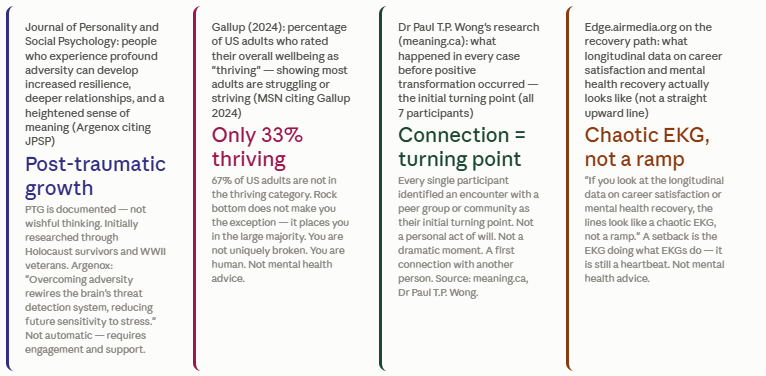
You are not alone: If you are currently in a place that feels like rock bottom, you are not reading this alone. Gallup's 2024 research found only 33% of US adults rated their wellbeing as 'thriving.' That means the majority — the large majority — are somewhere else on that spectrum. You are not the exception. You are not broken in a way that others are not. Not professional support. If you are in crisis, please call or text 988 (US) or 116 123 Samaritans (UK).
Dr Paul T.P. Wong (meaning.ca, Positive Living Newsletter): all seven research participants identified hitting bottom as an initial step. 'Hitting bottom alone was insufficient for personal transformation — turning points were required.' Initial turning point: always an encounter with peer group or community. Facilitating turning points: positive emotions — love and awe.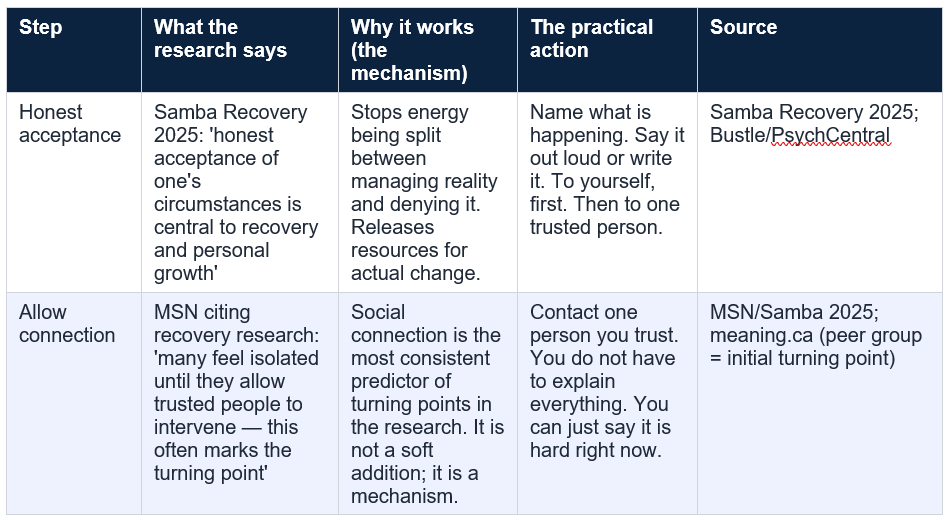
Edge.airmedia.org offers the most useful reframe for what going up actually looks like: ‘A turning point is just a change in direction, and you can change direction a thousand times in a single year.’ You do not need a single defining moment of strength. You need a change in direction. And then another. And then another. Each one counts. Newport Institute’s guidance is worth keeping: ‘Recognising that you’re at this point is the first, and arguably the most important, step towards recovery.’ If you are at the bottom and you know it, you have already taken the most important step. The research says the rest is possible. Not professional psychological, medical, or mental health advice. If you or someone you know is in crisis, please reach out to a crisis support line.
Sort of — but it is more complicated than the cultural shorthand suggests. A systematic review of the term 'hitting bottom' found no single operationalized definition in the research literature (Kirouac, Frohe, & Witkiewitz, 2015; cited at meaning.ca). What the research does consistently document is the experience of a critical threshold: a point at which previous coping strategies have stopped working and some form of change becomes unavoidable. PsychCentral, cited by Bustle, describes it as an 'epiphanic moment' of new self-realisation. Peg O'Connor, Ph.D., noted that rock bottom 'doesn't have to be evil; it also doesn't have to be necessary' — meaning that genuine change does not require reaching an absolute lowest point, and waiting for one can sometimes make recovery harder rather than easier. Modern neurobiological research, cited in m.fightcancer.org, suggests that waiting for total collapse before seeking help can cause cognitive declines that make recovery more difficult. The concept is psychologically real as an experience, but the research rejects the idea that it is a necessary prerequisite for change. Sources: meaning.ca; Bustle/PsychCentral; m.fightcancer.org.
What is post-traumatic growth and is it real?
Post-traumatic growth (PTG) is a well-documented psychological phenomenon — not wishful thinking or motivational framing but a measurable outcome that has been consistently identified in research. Research from the Journal of Personality and Social Psychology found that people who have experienced profound adversity develop post-traumatic growth: increased resilience, deeper relationships, and a heightened sense of meaning. Argenox's analysis notes the neurological component: overcoming adversity rewires the brain's threat detection system, reducing future sensitivity to stress. PTG research was initially catalysed by studies of Holocaust survivors and soldiers returning from WWII, and has been replicated across many different types of adversity since. The crucial qualification: PTG does not happen automatically to everyone who experiences adversity. It is associated with active engagement with the experience — processing it, making sense of it, and seeking connection and support. It is not a guarantee or a moral obligation for anyone who has suffered. Sources: Journal of Personality and Social Psychology; Argenox; meaning.ca.
Why does recovery feel like it goes backwards sometimes?
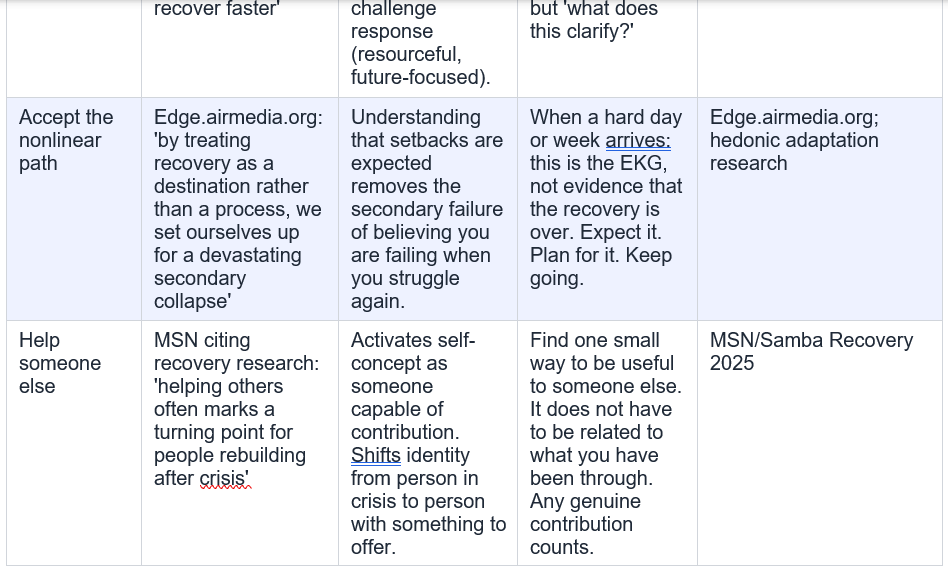
Because it does — and the psychology of hedonic adaptation explains why. Psychologists describe hedonic adaptation as the tendency of humans to return to a relatively stable level of happiness despite major positive or negative events. In recovery, this means that genuine progress is often followed by a pull back toward familiar patterns, difficulty, or lower energy states. Edge.airmedia.org describes this as the 'chaotic EKG, not a ramp' pattern of longitudinal recovery data: the line moves up over time, but not in a straight line. It fluctuates. If you believe recovery should be linear and it is not, you experience the natural fluctuation as evidence of failure. Understanding that setbacks are expected — not exceptions — removes the secondary suffering of believing the recovery has ended when a hard period returns. Edge.airmedia.org: 'By treating recovery as a destination rather than a process, we set ourselves up for a devastating secondary collapse when the inevitable dip returns.' A hard week is the EKG, not the end. Sources: edge.airmedia.org; hedonic adaptation research.
How do I actually start when everything feels impossible?
Newport Institute is direct about the starting point: 'Recognising that you're at this point is the first, and arguably the most important, step towards recovery.' After that: the research points to connection first. In Dr Paul T.P. Wong's research at meaning.ca, every single participant identified an encounter with a peer group or community as their initial turning point — not a personal act of will, but a connection with another person. MSN's synthesis of recovery research confirms: many people feel isolated until they allow trusted people to intervene, and this act of allowing intervention often marks the turning point. The practical starting point is genuinely small: contact one person. Tell them it is hard. You do not have to have a plan. You do not have to have a solution. Connection is not a step on the way to the turning point. Connection is the turning point, according to the research. If you are in crisis or need immediate support: 988 Suicide and Crisis Lifeline (US), 116 123 Samaritans (UK). Sources: meaning.ca; Newport Institute; MSN citing recovery research.
Does everyone come back from rock bottom?
The honest answer is: not automatically, and not without support. The research on recovery is consistent that it is not a passive process — it requires active engagement, connection, and often professional support. NCHS data cited at m.fightcancer.org shows that drug overdose deaths in the US exceeded 100,000 annually for the third consecutive year in 2023, which reflects the scale of cases where the hardest version of rock bottom does not automatically produce recovery. Miriam Delphin-Rittmon's 2024 departmental briefing on mental health stated that the goal of modern behavioral health is to provide 'on-ramps to support long before a total systemic collapse occurs' — recognising that early support produces better outcomes than waiting. Modern neurobiological research notes that some cognitive impacts of prolonged crisis can make recovery more difficult. The research on post-traumatic growth is genuinely hopeful — but it applies most reliably to those who receive support, make connections, and engage actively with the process. The most important thing this research implies for anyone at or near rock bottom: seek support now, rather than waiting for things to get worse. Sources: m.fightcancer.org citing NCHS; Argenox; meaning.ca.
This article is for general informational and educational purposes only. It touches on themes of adversity, mental health, and recovery. It is not a substitute for professional psychological, medical, or mental health support. If you are in crisis or experiencing thoughts of self-harm, please reach out to a crisis helpline immediately. In the UK: Samaritans 116 123. In the US: 988 Suicide and Crisis Lifeline (call or text 988). Help is available.
13. Crisis Resources and Further Support
If you or someone you know is in crisis or experiencing thoughts of self-harm, please reach out for professional support. These resources are available:
• UK: Samaritans — free, confidential support, 24 hours a day, 7 days a week. Call or text: 116 123. Email: jo@samaritans.org. Website: samaritans.org
• US: 988 Suicide and Crisis Lifeline — call or text 988, available 24/7. Chat at: 988lifeline.org
• US: Crisis Text Line — text HOME to 741741
• UK: Mind — mental health information and support: mind.org.uk. Infoline: 0300 123 3393
• US: NAMI (National Alliance on Mental Illness) Helpline: 1-800-950-6264. nami.org
• International: findahelpline.com — directory of crisis lines worldwide
There is a sentence that gets handed to people in crisis, often with the best of intentions: ‘The only way from here is up.’ It is meant to comfort. It is also, in its blunt form, not entirely true — and the gap between the comfort it offers and the complicated reality it glosses over is part of why people at rock bottom sometimes feel more alone after hearing it, not less. Recovery is not a straight line. It is not a binary switch that flips from broken to fixed. It is a process, with setbacks, turning points, and long stretches of uncertainty that do not look or feel like progress. The research knows this. The research on resilience, post-traumatic growth, and recovery is both more honest about the difficulty and more genuinely hopeful than the simple upward-arc narrative. This article takes that research seriously — not to discourage hope, but to replace the simple version with something true. Because the true version is more useful, and because people at rock bottom deserve something that will actually hold under pressure. This article is not mental health or professional support. If you are in crisis, please reach out to a professional or a crisis line. But if you are trying to understand what rock bottom means and what the research says about moving through it, this is for you.
Table of Contents
- More Than a Phrase
- 2. What Rock Bottom Actually Feels Like
- 3. The Myth of the Straight Line Up
- 4. What the Research Says About Turning Points
- 5. Post-Traumatic Growth: When the Research Surprises You
- 6. Why Acceptance Is the First Step (and the Hardest One)
- 7. The Role of Connection: You Were Not Designed for This Alone
- 8. Small Steps Forward: What Actually Works
- 9. Building Resilience After the Turning Point
- 10. The Road Forward: What the Research Actually Recommends
- 11. Conclusion: The Only Way to Go Is Up — What That Actually Means
- 12. Frequently Asked Questions
- 13. Crisis Resources and Further Support
More Than a Phrase
There are phrases that get handed to people in pain that mean well and land badly. ‘Everything happens for a reason.’ ‘What doesn’t kill you makes you stronger.’ ‘The only way from here is up.’ Each of these carries a fragment of something true. Each of them, when offered to someone in genuine crisis, can feel less like a bridge and more like a door closing. The problem is not the sentiment. The problem is the simplification. This article is about what the psychology of rock bottom and recovery actually looks like — the honest, research-backed version, with its nonlinear paths, its unexpected turning points, its neurological findings, and its clear evidence that genuine recovery and post-traumatic growth are real phenomena that happen to real people through identifiable processes. It is not a promise that everything will be fine. It is something more useful than that: a description of what the research says about how people actually move through the worst times of their lives, and what tends to work when they do.You are not alone: If you are currently in a place that feels like rock bottom, you are not reading this alone. Gallup's 2024 research found only 33% of US adults rated their wellbeing as 'thriving.' That means the majority — the large majority — are somewhere else on that spectrum. You are not the exception. You are not broken in a way that others are not. Not professional support. If you are in crisis, please call or text 988 (US) or 116 123 Samaritans (UK).
What Rock Bottom Actually Feels Like
Rock bottom is not one thing. That is the first truth about it that deserves saying out loud, because the culture tends to portray it as a single dramatic moment — the morning-after, the intervention, the call from the hospital. In reality, rock bottom arrives in as many forms as there are people who experience it. Newport Institute describes it as ‘a point when your life has come undone and you’ve lost any faith that things can improve.’ Argenox describes it as ‘the most isolated and the most connected place you’ll ever be.’ Both are right. What rock bottom shares across all its different forms is the internal experience: the complete exhaustion of the strategies you have been using to manage, the inability to pretend any longer that things are fine, and the terrifying clarity that something has to change. PsychCentral, cited by Bustle, describes this moment as an ‘epiphanic moment’ — a point of new self-realisation that arrives when the defences are fully down. What that clarity contains is the beginning of something rather than the end of everything. Not the end of the hard part. Just the beginning of a different kind of hard part. One that moves in a direction.The Myth of the Straight Line Up
The most damaging thing the culture tells people at rock bottom is that the journey back up is linear. That the breakthrough moment is the pivot, and from that pivot forward, the graph only goes in one direction. Edge.airmedia.org’s analysis of resilience narratives names this directly: ‘We’ve been sold a lie about the mechanics of human recovery. We adore the image of a person hitting a jagged rock bottom, finding a hidden well of strength, and then rocketing back toward the stratosphere in a straight, unbroken line. This cultural obsession suggests that resilience is a binary switch, a one-time pivot from failure to permanent success. By treating recovery as a destination rather than a process, we set ourselves up for a devastating secondary collapse when the inevitable dip returns.’ The psychological research on hedonic adaptation confirms this. Psychologists describe hedonic adaptation as the tendency of humans to return to a relatively stable level of happiness despite major positive or negative events. What this means practically is that even after genuine progress, people feel the pull back toward familiar patterns, low energy, or difficulty. If you believe the narrative of the straight line up, you will experience that pull as evidence that your recovery is failing. If you understand that recovery is not a destination but a process with fluctuations, a setback is information, not a verdict. Edge.airmedia.org puts it with precision: ‘If you look at the longitudinal data on career satisfaction or mental health recovery, the lines look like a chaotic EKG, not a ramp.’ The EKG is still a heartbeat.What the Research Says About Turning Points
Dr Paul T.P. Wong, a researcher whose work is published at meaning.ca, conducted research with seven men who self-reported personal transformation after recovering from drug and alcohol addiction. All seven identified hitting bottom as an initial step to engaging in self-reflection. But the research found something more specific and more useful: hitting bottom alone was insufficient for personal transformation. What the research identified were turning points — and two types of them. The initial turning point, which in every case in the study involved an encounter with a peer group or community, and facilitating turning points, which came after the initial ones and often involved positive emotions: love, awe, connection, gratitude. The research noted that ‘hitting bottom uniformly involved negative emotions and the frustration of cognitive, emotional, and relational processes.’ What the turning points added was something different in kind — not just the bottom of the negative trajectory, but a first encounter with a positive one. Edge.airmedia.org offers a useful reframe: ‘A turning point is just a change in direction, and you can change direction a thousand times in a single year.’ The turning point does not have to be dramatic. It does not have to feel like the beginning of permanent change. It just has to be a change in direction.Dr Paul T.P. Wong (meaning.ca, Positive Living Newsletter): all seven research participants identified hitting bottom as an initial step. 'Hitting bottom alone was insufficient for personal transformation — turning points were required.' Initial turning point: always an encounter with peer group or community. Facilitating turning points: positive emotions — love and awe.
Post-Traumatic Growth: When the Research Surprises You
One of the most significant findings in the psychology of adversity is the phenomenon of post-traumatic growth (PTG): the documented experience in which people who go through profound suffering do not merely return to their previous baseline but develop something they did not have before. Research from the Journal of Personality and Social Psychology found that people who have experienced profound adversity develop post-traumatic growth — a phenomenon where suffering leads to increased resilience, deeper relationships, and a heightened sense of meaning. Argenox.com’s analysis adds the neurological dimension: ‘Neurological resilience: overcoming adversity rewires the brain’s threat detection system, reducing future sensitivity to stress.’ The research on PTG was initially catalysed by studies of Holocaust survivors and soldiers returning from the Second World War — researchers trying to understand why some people emerged from extreme suffering not just intact but changed in ways that appeared to be genuinely positive: more compassionate, more purposeful, more connected to what actually matters. The crucial qualification in the research is important: growth doesn’t happen automatically. It requires active engagement, reflection, and often support. PTG is not something that happens to passive survivors. It is something that happens through the process of trying to make sense of what happened, which is itself one of the reasons that connection, community, and professional support are so consistently identified in the research as recovery accelerators.Why Acceptance Is the First Step (and the Hardest One)
Every credible recovery framework — whether it comes from addiction research, trauma psychology, or personal development — begins in the same place: honest acceptance of circumstances. A 2025 article from Samba Recovery, cited across multiple sources, confirms that honest acceptance of one’s circumstances is central to recovery and personal growth. This sounds straightforward until you sit with how hard it actually is. Acceptance is not resignation. It is not the same as agreeing that what happened was acceptable, or that you deserved what happened, or that things will always be this way. Acceptance, in the psychological sense used in recovery literature, is simply the act of no longer expending energy denying the current reality. The energy that was going into ‘this is not actually happening’ or ‘if I manage this carefully enough no one will notice how bad it is’ becomes available for something else. Bustle.com’s discussion of the psychology of rock bottom, citing PsychCentral, describes this shift as the moment when ‘you finally realise you’re in significant pain and have lost too much.’ The realisation is painful. It is also, for many people, the first moment in which energy is no longer split between the reality and the performance of managing the reality. Not all of that energy immediately becomes constructive. But it becomes available.The Role of Connection: You Were Not Designed for This Alone
The research on what actually produces turning points — rather than just the experience of hitting bottom — consistently points to connection. In Dr Paul T.P. Wong’s research, every single participant identified an encounter with a peer group or community as the initial turning point. MSN’s synthesis of recovery research notes that many people feel isolated until they allow trusted friends or family to intervene, and that this act of allowing intervention often marks the turning point in recovery. The difficulty is that rock bottom is, by design, isolating. The shame that accompanies serious difficulty tends to produce withdrawal from the people most likely to help. Argenox identifies the paradox clearly: ‘Rock bottom is the most isolated and the most connected place you’ll ever be.’ Connected, because the experience of profound difficulty is near-universal. Connected, because the people who have been through something like this and come out the other side often become the most effective source of support. Isolated, because the internal experience of rock bottom discourages reaching out. The research suggests that the first connection — the first honest conversation with another person about what is actually happening — is not merely helpful. It is frequently identified as the turning point itself. Gallup’s 2024 data found that only 33% of US adults rated their wellbeing as thriving. That number means you are not unusual. You are not the exception. You are in the large majority.Small Steps Forward: What Actually Works
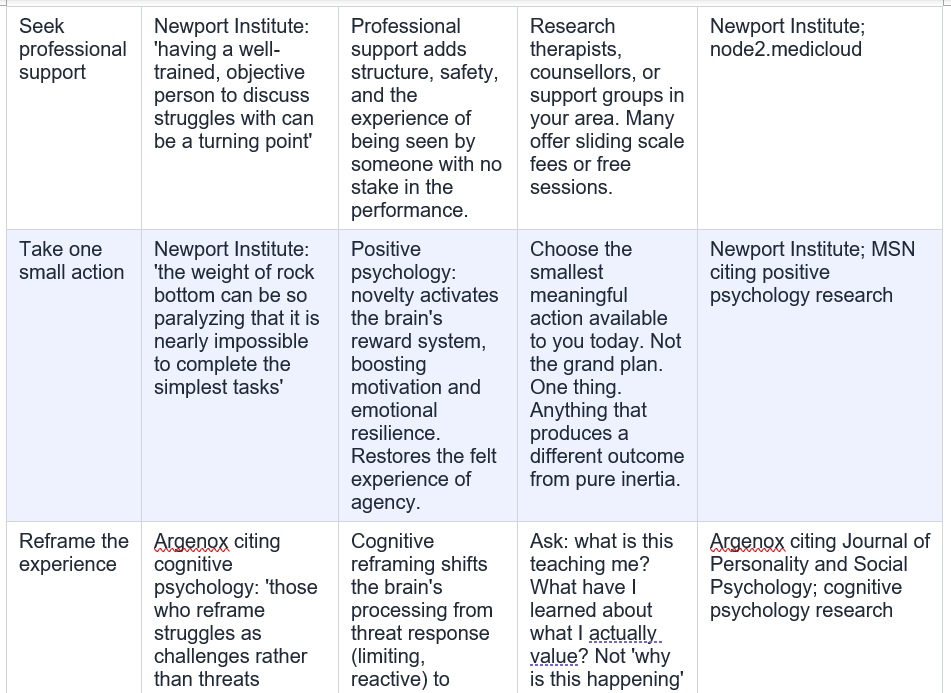
The weight of rock bottom is paralysing in a specific way: everything that needs to change feels like it needs to change at once, and the size of the gap between where you are and where you want to be is so large that no individual action seems meaningful against it. Newport Institute notes that ‘the weight of hitting rock bottom can be so paralyzing that it’s nearly impossible to complete the simplest tasks.’ The research on recovery consistently points in the opposite direction from the grand gesture: small, specific, achievable actions that rebuild a sense of agency rather than a complete overhaul that rebuilds nothing because it is never started. Positive psychology research cited in MSN’s recovery roundup notes that novelty activates the brain’s reward system, boosting motivation and enhancing emotional resilience in the face of adversity. This suggests a practical principle: the first steps do not have to be the right ones in some final, optimised sense. They have to be steps — actions that produce a small outcome different from the current one, that engage the reward system, that restore the felt experience of agency. MSN’s synthesis also notes that helping others often marks a turning point for people rebuilding after crisis — another counterintuitive finding that shows up repeatedly in the recovery literature. The act of contributing to someone else’s situation, however small, reactivates the self-concept of someone who is capable of making a positive difference.Building Resilience After the Turning Point
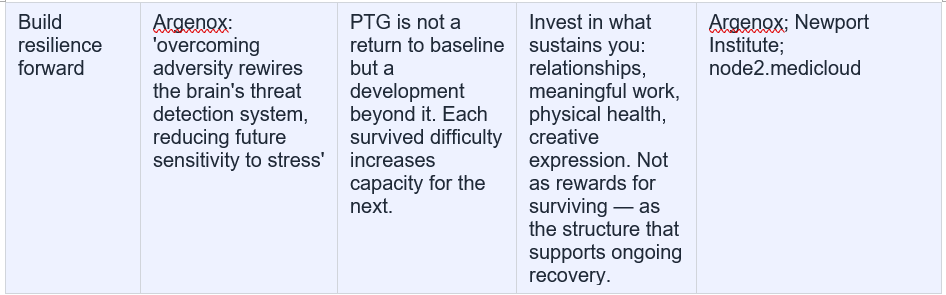
The popular image of resilience is someone who bounces back. The research suggests a more accurate image is someone who builds forward — not returning to the previous state but constructing a different one. Argenox’s analysis describes the neurological dimension: overcoming adversity rewires the brain’s threat detection system, reducing future sensitivity to stress. Resilience, in this frame, is not a personality trait you either have or lack. It is a capacity that develops through difficulty, through the experience of surviving things you thought you would not survive. The research on post-traumatic growth makes this concrete: the people who develop the most resilience after adversity are those who engage actively with what happened — who process it, make sense of it, and integrate it rather than bypassing it. Medicloud’s rock bottom guide recommends developing a growth mindset explicitly: viewing challenges as opportunities for learning and growth. Newport Institute identifies building strong relationships as another key component. MSN’s synthesis adds social connection research: social connection is linked to improved mental health and long-term resilience. The framework for what works is consistent across sources: connection, professional support where needed, small actions that restore agency, honest acceptance, and engagement with the meaning of what happened rather than pure avoidance of it. These are not ten steps. They are a direction.The Road Forward: What the Research Actually Recommends
Conclusion
The phrase is right, just not in the way it is usually meant. The only way to go is up — but not in a straight line, not without difficulty, not without periods where it feels like down again. Research from the Journal of Personality and Social Psychology shows that profound adversity can produce post-traumatic growth: genuine, measurable increases in resilience, relational depth, and sense of meaning. The neurological research shows that overcoming difficulty rewires the brain’s stress response, reducing future vulnerability. The turning point research shows that the pivot from hitting bottom to moving forward is not the dramatic single moment culture expects — it is usually a first connection with another person, a first encounter with a peer group, a first honest conversation.Edge.airmedia.org offers the most useful reframe for what going up actually looks like: ‘A turning point is just a change in direction, and you can change direction a thousand times in a single year.’ You do not need a single defining moment of strength. You need a change in direction. And then another. And then another. Each one counts. Newport Institute’s guidance is worth keeping: ‘Recognising that you’re at this point is the first, and arguably the most important, step towards recovery.’ If you are at the bottom and you know it, you have already taken the most important step. The research says the rest is possible. Not professional psychological, medical, or mental health advice. If you or someone you know is in crisis, please reach out to a crisis support line.
Frequently Asked Questions
Is 'hitting rock bottom' a real psychological concept?Sort of — but it is more complicated than the cultural shorthand suggests. A systematic review of the term 'hitting bottom' found no single operationalized definition in the research literature (Kirouac, Frohe, & Witkiewitz, 2015; cited at meaning.ca). What the research does consistently document is the experience of a critical threshold: a point at which previous coping strategies have stopped working and some form of change becomes unavoidable. PsychCentral, cited by Bustle, describes it as an 'epiphanic moment' of new self-realisation. Peg O'Connor, Ph.D., noted that rock bottom 'doesn't have to be evil; it also doesn't have to be necessary' — meaning that genuine change does not require reaching an absolute lowest point, and waiting for one can sometimes make recovery harder rather than easier. Modern neurobiological research, cited in m.fightcancer.org, suggests that waiting for total collapse before seeking help can cause cognitive declines that make recovery more difficult. The concept is psychologically real as an experience, but the research rejects the idea that it is a necessary prerequisite for change. Sources: meaning.ca; Bustle/PsychCentral; m.fightcancer.org.
What is post-traumatic growth and is it real?
Post-traumatic growth (PTG) is a well-documented psychological phenomenon — not wishful thinking or motivational framing but a measurable outcome that has been consistently identified in research. Research from the Journal of Personality and Social Psychology found that people who have experienced profound adversity develop post-traumatic growth: increased resilience, deeper relationships, and a heightened sense of meaning. Argenox's analysis notes the neurological component: overcoming adversity rewires the brain's threat detection system, reducing future sensitivity to stress. PTG research was initially catalysed by studies of Holocaust survivors and soldiers returning from WWII, and has been replicated across many different types of adversity since. The crucial qualification: PTG does not happen automatically to everyone who experiences adversity. It is associated with active engagement with the experience — processing it, making sense of it, and seeking connection and support. It is not a guarantee or a moral obligation for anyone who has suffered. Sources: Journal of Personality and Social Psychology; Argenox; meaning.ca.
Why does recovery feel like it goes backwards sometimes?
Because it does — and the psychology of hedonic adaptation explains why. Psychologists describe hedonic adaptation as the tendency of humans to return to a relatively stable level of happiness despite major positive or negative events. In recovery, this means that genuine progress is often followed by a pull back toward familiar patterns, difficulty, or lower energy states. Edge.airmedia.org describes this as the 'chaotic EKG, not a ramp' pattern of longitudinal recovery data: the line moves up over time, but not in a straight line. It fluctuates. If you believe recovery should be linear and it is not, you experience the natural fluctuation as evidence of failure. Understanding that setbacks are expected — not exceptions — removes the secondary suffering of believing the recovery has ended when a hard period returns. Edge.airmedia.org: 'By treating recovery as a destination rather than a process, we set ourselves up for a devastating secondary collapse when the inevitable dip returns.' A hard week is the EKG, not the end. Sources: edge.airmedia.org; hedonic adaptation research.
How do I actually start when everything feels impossible?
Newport Institute is direct about the starting point: 'Recognising that you're at this point is the first, and arguably the most important, step towards recovery.' After that: the research points to connection first. In Dr Paul T.P. Wong's research at meaning.ca, every single participant identified an encounter with a peer group or community as their initial turning point — not a personal act of will, but a connection with another person. MSN's synthesis of recovery research confirms: many people feel isolated until they allow trusted people to intervene, and this act of allowing intervention often marks the turning point. The practical starting point is genuinely small: contact one person. Tell them it is hard. You do not have to have a plan. You do not have to have a solution. Connection is not a step on the way to the turning point. Connection is the turning point, according to the research. If you are in crisis or need immediate support: 988 Suicide and Crisis Lifeline (US), 116 123 Samaritans (UK). Sources: meaning.ca; Newport Institute; MSN citing recovery research.
Does everyone come back from rock bottom?
The honest answer is: not automatically, and not without support. The research on recovery is consistent that it is not a passive process — it requires active engagement, connection, and often professional support. NCHS data cited at m.fightcancer.org shows that drug overdose deaths in the US exceeded 100,000 annually for the third consecutive year in 2023, which reflects the scale of cases where the hardest version of rock bottom does not automatically produce recovery. Miriam Delphin-Rittmon's 2024 departmental briefing on mental health stated that the goal of modern behavioral health is to provide 'on-ramps to support long before a total systemic collapse occurs' — recognising that early support produces better outcomes than waiting. Modern neurobiological research notes that some cognitive impacts of prolonged crisis can make recovery more difficult. The research on post-traumatic growth is genuinely hopeful — but it applies most reliably to those who receive support, make connections, and engage actively with the process. The most important thing this research implies for anyone at or near rock bottom: seek support now, rather than waiting for things to get worse. Sources: m.fightcancer.org citing NCHS; Argenox; meaning.ca.
This article is for general informational and educational purposes only. It touches on themes of adversity, mental health, and recovery. It is not a substitute for professional psychological, medical, or mental health support. If you are in crisis or experiencing thoughts of self-harm, please reach out to a crisis helpline immediately. In the UK: Samaritans 116 123. In the US: 988 Suicide and Crisis Lifeline (call or text 988). Help is available.
13. Crisis Resources and Further Support
If you or someone you know is in crisis or experiencing thoughts of self-harm, please reach out for professional support. These resources are available:
• UK: Samaritans — free, confidential support, 24 hours a day, 7 days a week. Call or text: 116 123. Email: jo@samaritans.org. Website: samaritans.org
• US: 988 Suicide and Crisis Lifeline — call or text 988, available 24/7. Chat at: 988lifeline.org
• US: Crisis Text Line — text HOME to 741741
• UK: Mind — mental health information and support: mind.org.uk. Infoline: 0300 123 3393
• US: NAMI (National Alliance on Mental Illness) Helpline: 1-800-950-6264. nami.org
• International: findahelpline.com — directory of crisis lines worldwide
0 Comments
Be the first to share your thoughts on this article.