
General
Why Are Mail Carriers Putting Dryer Sheets in Mailboxes Now?

The wasp problem behind a strange little mailbox mystery, and how much the trick can really do
This article explains why carriers do it, where the habit came from, what the Postal Service says, and the part most viral posts skip, which is how little proof there is that it works. You will also find a few practical steps, because a dryer sheet is not much use against an actual wasp nest.
His description of the problem is vivid. In that post, as reported by Fox 5 DC, he said he had opened boxes to find a small nest with three to five yellowjackets sitting inside. In the comments, a carrier says they leave a note on the customer’s door explaining that the nest has to be dealt with before mail can resume.
The habit is older than the post. A radio host in Rockford, Illinois, recalled his own carrier telling him years earlier to drop a couple of dryer sheets in his box. When the host joked about static cling, the carrier answered with a single word: wasps. Other postal workers have since backed this up on forums such as Quora, including one who has worked for the Postal Service since 1999.
What does the Postal Service itself say? A spokesperson told TODAY that dryer sheets are not a specific directive, and TODAY concluded that the trick is something carriers developed on their own. The agency does tell carriers to watch for nests and insects, and to report dangerous conditions, which can lead to delivery being suspended at that address.
Worth knowing: Nobody at the top ordered this. It spread the way a good workplace hack does: one carrier tried it, it seemed to help, and word travelled from route to route.
For the carrier, the danger is the way a mailbox is used. You push a hand, sometimes most of a forearm, into a dark space without being able to see what is in it. Do that hundreds of times a day through warm months and the odds of surprising a nest are not small. That is the real reason this matters to people who deliver the post.
Why the caution? Some research has found that scented dryer sheets can repel particular insects, such as fungus gnats. That finding does not carry over to wasps, because different species react differently to different smells. The scent also fades over time, so even a sheet that works for a week may stop working by the time it is needed.
There is a further problem that I would add myself. If a carrier places a sheet and then does not find a nest, it is natural to credit the sheet. But plenty of mailboxes never get a nest at all, so a quiet season proves very little. To know whether the trick works, you would need a proper comparison between boxes with sheets and boxes without. As far as I can find, nobody has done one.
Worth knowing: Think of it as an inexpensive, harmless gamble that some carriers like, not a pest control method. It may help. It may do nothing. It should never replace actually looking.
CDC figures reported by Newsweek in September 2026 show 788 deaths from hornet, wasp and bee stings in the United States between 2011 and 2021, an average of about 72 a year. Most of those deaths are believed to come from severe allergic reactions rather than the venom itself. The Merck Manual gives a similar figure of around 70 deaths a year.
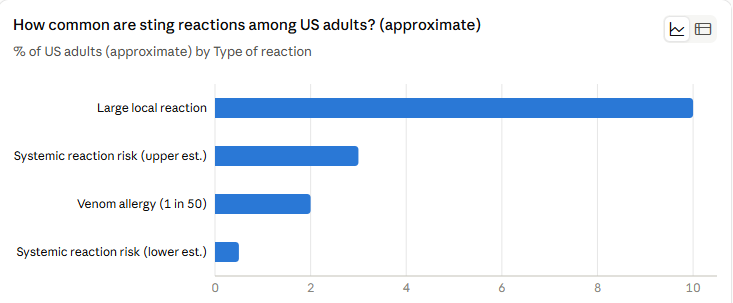
The same reporting says an estimated 0.5% to 3% of US adults are at risk of a systemic allergic reaction, the kind that can involve hives, breathing difficulty and anaphylaxis, and around 10% have a large local reaction with significant swelling. The American Bee Journal, drawing on medical references, puts venom allergy at about 2% of adults, or 1 in 50.
The Postal Service has taken the danger seriously for a long time. In a 2010 Postal Bulletin safety notice it warned that many stings happen near customers’ mailboxes and told carriers to look for nests, tell customers about hazards and report dangerous conditions to supervisors. A dryer sheet is a small, informal extension of that same instinct.
The data: About 72 sting deaths a year across the whole US is low in absolute terms. For someone who opens hundreds of boxes a day, the practical concern is a painful sting, and for the unlucky few, a dangerous one. Not medical advice.
You can also simply ask your carrier. Your carrier will know whether there have been insect problems on the route, and the Postal Service encourages that kind of communication when there is a hazard. A two-minute chat at the curb will tell you more than any article can.
While you are at it, check the box yourself from a sensible distance. Open the door carefully and look before you reach in. Wasp activity is highest in warmer months, so that is when a quick glance matters most.
If the nest is large, or you are not sure what you are looking at, leave it alone and call a qualified pest professional. If anyone in your household has a known sting allergy, take extra care and keep them away from the area. And tell your carrier or Post Office, because mail may be held until the box is safe again.
A word on money, since these small jobs can become annoying bills. According to the Postal Service, as summarised by SavingAdvice, homeowners are generally responsible for buying and maintaining their own mailboxes. A damaged door or hinge is yours to fix, and an established nest can mean paying for professional removal. Regular inspection is the cheap way to avoid both.
The method is another matter. Carriers say it helps, but the scientific backing is thin, and the smell fades. So treat the sheet as a friendly gesture and a harmless one, not as protection. The things that really work are dull: look inside your box now and then, keep the door closing properly, call a professional if you find a nest, and let your carrier know. That keeps both of you safer than any laundry product will. Not medical or pest-control advice.
Generally yes. Carriers who use the trick ask people to leave the sheet alone, since it may be protecting them from stings. If the scent bothers you or the sheet is getting in the way of your mail, call your local Post Office and ask about alternatives instead of quietly removing it.
Is this an official USPS policy?
No. A USPS spokesperson told TODAY in 2021 that it is not a specific directive, and TODAY described it as something carriers developed on their own. The Postal Service does tell carriers to watch for nests and report dangerous insect activity.
Do dryer sheets actually repel wasps?
Nobody has shown that they reliably do. Carriers swear by the method, but those are personal observations. Some research suggests scented sheets can repel certain small insects such as fungus gnats, and that does not tell us anything about wasps.
What should I do if I find a wasp nest in my mailbox?
Do not poke it or reach past it. Stinging insects defend their nests, so Penn State Extension advises matching your response to the species and the nest size, and recommends a qualified pest professional when the nest is substantial. Tell your carrier or Post Office too, because delivery may be paused.
Could someone be marking my house by leaving a dryer sheet?
No evidence supports that. It was a joke in a comment thread about the Reddit post. The documented explanation is the boring one: carriers trying to avoid stings.
Table of Contents
- The Mystery in Your Mailbox
- The Short Answer
- Where the Dryer Sheet Trick Came From
- Why Wasps Love Mailboxes
- Does It Actually Work?
- How Risky Are Stings, Really?
- What to Do If You Find a Dryer Sheet
- What to Do If You Find a Nest
- Claims Versus Facts: A Quick Table
- Conclusion
- Frequently Asked Questions
The Mystery in Your Mailbox
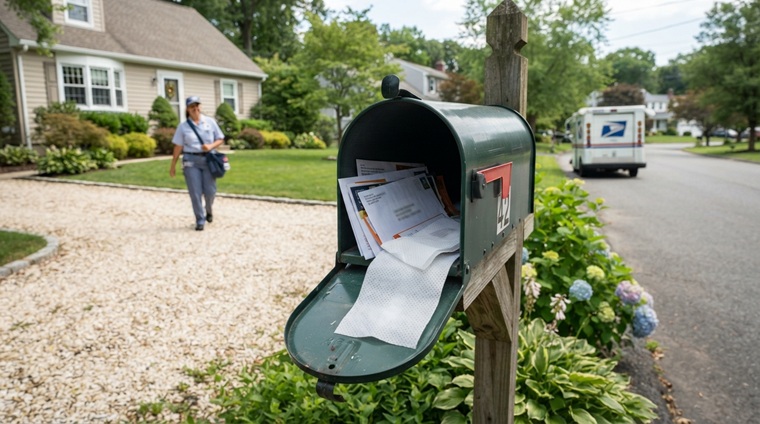
You open the mailbox expecting bills and a catalogue you never asked for. Instead there is a single dryer sheet lying at the back, smelling faintly of artificial meadow. You did not put it there. Nobody in your house did. For a moment it feels like a very tidy burglar has marked your front door. Take a breath. The real explanation is more ordinary, a little funny, and connected to something genuinely unpleasant: wasps.This article explains why carriers do it, where the habit came from, what the Postal Service says, and the part most viral posts skip, which is how little proof there is that it works. You will also find a few practical steps, because a dryer sheet is not much use against an actual wasp nest.
The Short Answer
Some letter carriers tuck scented dryer sheets into mailboxes hoping to stop wasps and other stinging insects from nesting inside. It is an informal trick that spread among carriers, not an official policy. Carriers who use it say wasps seem to dislike the smell. That is their experience, and as we will see, it is not the same thing as a proven result.Where the Dryer Sheet Trick Came From
The story went viral in April 2021, when a carrier named Chris Strickley, who posts on Reddit as u/istrx13, asked customers not to throw out a random dryer sheet they might spot at the back of their box. His reasoning was simple: it could save the carrier from being stung. He later told TODAY that he first noticed the sheets during his first spring on the job, and that he saw a box of them on his supervisor’s desk with other carriers grabbing handfuls.His description of the problem is vivid. In that post, as reported by Fox 5 DC, he said he had opened boxes to find a small nest with three to five yellowjackets sitting inside. In the comments, a carrier says they leave a note on the customer’s door explaining that the nest has to be dealt with before mail can resume.
The habit is older than the post. A radio host in Rockford, Illinois, recalled his own carrier telling him years earlier to drop a couple of dryer sheets in his box. When the host joked about static cling, the carrier answered with a single word: wasps. Other postal workers have since backed this up on forums such as Quora, including one who has worked for the Postal Service since 1999.
What does the Postal Service itself say? A spokesperson told TODAY that dryer sheets are not a specific directive, and TODAY concluded that the trick is something carriers developed on their own. The agency does tell carriers to watch for nests and insects, and to report dangerous conditions, which can lead to delivery being suspended at that address.
Worth knowing: Nobody at the top ordered this. It spread the way a good workplace hack does: one carrier tried it, it seemed to help, and word travelled from route to route.
Why Wasps Love Mailboxes
Put yourself in a wasp’s position. You want shelter from rain and wind, somewhere dry, and somewhere nobody disturbs you. A metal box on a post with a small gap around the door is nearly perfect. According to This Old House, as summarised by SavingAdvice, paper wasps and other stinging insects can nest in mailboxes, especially ones that sit undisturbed for long stretches.For the carrier, the danger is the way a mailbox is used. You push a hand, sometimes most of a forearm, into a dark space without being able to see what is in it. Do that hundreds of times a day through warm months and the odds of surprising a nest are not small. That is the real reason this matters to people who deliver the post.
Does It Actually Work?
Here is the honest part. Carriers believe it works, and a few of them are very confident. But a belief held by people who have tried something is not the same as evidence. SavingAdvice, in an October 2026 piece, states plainly that the trick is not scientifically established and that dryer sheets are not a dependable way to prevent infestations.Why the caution? Some research has found that scented dryer sheets can repel particular insects, such as fungus gnats. That finding does not carry over to wasps, because different species react differently to different smells. The scent also fades over time, so even a sheet that works for a week may stop working by the time it is needed.
There is a further problem that I would add myself. If a carrier places a sheet and then does not find a nest, it is natural to credit the sheet. But plenty of mailboxes never get a nest at all, so a quiet season proves very little. To know whether the trick works, you would need a proper comparison between boxes with sheets and boxes without. As far as I can find, nobody has done one.
Worth knowing: Think of it as an inexpensive, harmless gamble that some carriers like, not a pest control method. It may help. It may do nothing. It should never replace actually looking.
How Risky Are Stings, Really?
It is worth keeping the risk in proportion. Most stings are painful and nothing more. But a small share of people react badly, and carriers are exposed to far more opportunities than the rest of us.CDC figures reported by Newsweek in September 2026 show 788 deaths from hornet, wasp and bee stings in the United States between 2011 and 2021, an average of about 72 a year. Most of those deaths are believed to come from severe allergic reactions rather than the venom itself. The Merck Manual gives a similar figure of around 70 deaths a year.
The same reporting says an estimated 0.5% to 3% of US adults are at risk of a systemic allergic reaction, the kind that can involve hives, breathing difficulty and anaphylaxis, and around 10% have a large local reaction with significant swelling. The American Bee Journal, drawing on medical references, puts venom allergy at about 2% of adults, or 1 in 50.
The Postal Service has taken the danger seriously for a long time. In a 2010 Postal Bulletin safety notice it warned that many stings happen near customers’ mailboxes and told carriers to look for nests, tell customers about hazards and report dangerous conditions to supervisors. A dryer sheet is a small, informal extension of that same instinct.
The data: About 72 sting deaths a year across the whole US is low in absolute terms. For someone who opens hundreds of boxes a day, the practical concern is a painful sting, and for the unlucky few, a dangerous one. Not medical advice.
What to Do If You Find a Dryer Sheet
Leave it where it is, unless there is a good reason not to. If your carrier put it there, removing it undoes a precaution they chose to take for their own safety, and it costs you nothing to keep. If you genuinely do not like the smell, or you find it is getting stuck to your mail, contact your local Post Office and ask for a different approach.You can also simply ask your carrier. Your carrier will know whether there have been insect problems on the route, and the Postal Service encourages that kind of communication when there is a hazard. A two-minute chat at the curb will tell you more than any article can.
While you are at it, check the box yourself from a sensible distance. Open the door carefully and look before you reach in. Wasp activity is highest in warmer months, so that is when a quick glance matters most.
What to Do If You Find a Nest
Do not try to deal with it using a dryer sheet. Reaching past a nest to place one could put your hand exactly where you do not want it. Penn State Extension’s January 2026 guidance, summarised by SavingAdvice, notes that stinging insects can defend a nest aggressively and that the right response depends on the species, where the nest is and how big the colony has grown.If the nest is large, or you are not sure what you are looking at, leave it alone and call a qualified pest professional. If anyone in your household has a known sting allergy, take extra care and keep them away from the area. And tell your carrier or Post Office, because mail may be held until the box is safe again.
A word on money, since these small jobs can become annoying bills. According to the Postal Service, as summarised by SavingAdvice, homeowners are generally responsible for buying and maintaining their own mailboxes. A damaged door or hinge is yours to fix, and an established nest can mean paying for professional removal. Regular inspection is the cheap way to avoid both.
Claims Versus Facts: A Quick Table
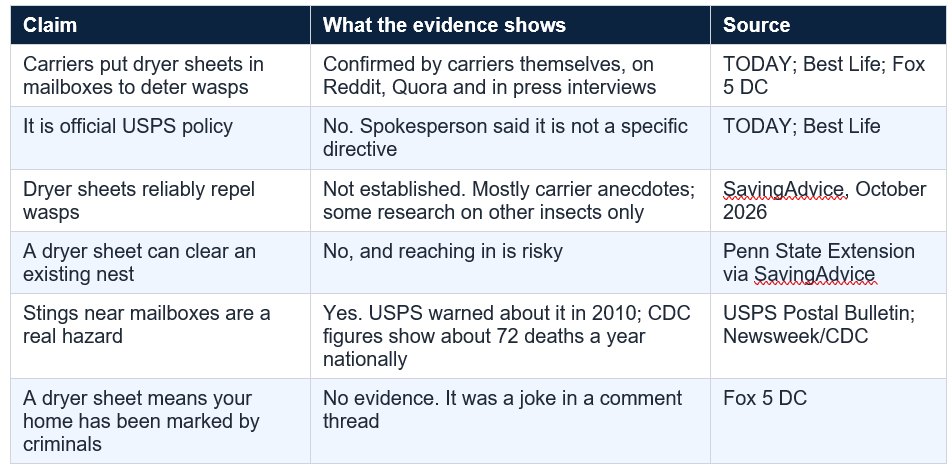
Here is the whole story in a snapshot, separating what is documented from what is only claimed.
Conclusion
The dryer sheet in your mailbox is not a prank, a message or a marketing stunt. It is most likely a carrier trying to avoid a nasty sting, using a trick that has passed from route to route for years. The motive is solid. Stings near mailboxes are a documented concern, and the Postal Service has said so for well over a decade.The method is another matter. Carriers say it helps, but the scientific backing is thin, and the smell fades. So treat the sheet as a friendly gesture and a harmless one, not as protection. The things that really work are dull: look inside your box now and then, keep the door closing properly, call a professional if you find a nest, and let your carrier know. That keeps both of you safer than any laundry product will. Not medical or pest-control advice.
Frequently Asked Questions
Is it safe to leave the dryer sheet in my mailbox?Generally yes. Carriers who use the trick ask people to leave the sheet alone, since it may be protecting them from stings. If the scent bothers you or the sheet is getting in the way of your mail, call your local Post Office and ask about alternatives instead of quietly removing it.
Is this an official USPS policy?
No. A USPS spokesperson told TODAY in 2021 that it is not a specific directive, and TODAY described it as something carriers developed on their own. The Postal Service does tell carriers to watch for nests and report dangerous insect activity.
Do dryer sheets actually repel wasps?
Nobody has shown that they reliably do. Carriers swear by the method, but those are personal observations. Some research suggests scented sheets can repel certain small insects such as fungus gnats, and that does not tell us anything about wasps.
What should I do if I find a wasp nest in my mailbox?
Do not poke it or reach past it. Stinging insects defend their nests, so Penn State Extension advises matching your response to the species and the nest size, and recommends a qualified pest professional when the nest is substantial. Tell your carrier or Post Office too, because delivery may be paused.
Could someone be marking my house by leaving a dryer sheet?
No evidence supports that. It was a joke in a comment thread about the Reddit post. The documented explanation is the boring one: carriers trying to avoid stings.
0 Comments
Be the first to share your thoughts on this article.