
Security
Why Scammers Call and Stay Silent — Act Fast


TABLE OF CONTENTS
- What Is a Silent Call — and Is It Really a Scam?
- How Automated Dialling Systems Work
- The Five Reasons Scammers Stay Silent
- The Voice Recording Threat: AI Cloning Explained
- The One-Ring Scam: Why You Should Never Call Back
- Caller ID Spoofing and Neighbour Spoofing
- Who Is Being Targeted Most
- What to Do the Moment You Get a Silent Call
- How to Reduce Silent Scam Calls Long-Term
- Conclusion
- Frequently Asked Questions
- References
What Is a Silent Call — and Is It Really a Scam?
You answer the phone, say hello, and hear nothing. No voice, no breathing, no background noise. Just a second or two of dead air before the line goes dead. Most people chalk it up to a dropped connection, a pocket dial, or a wrong number. That instinct is understandable — but in many cases it is exactly wrong.Silent calls are increasingly a deliberate first step in a structured phone fraud strategy. Scammers and the automated systems they use are not making a mistake when they call and stay quiet. They are gathering information. Specifically, they are finding out whether your number belongs to a real, live human being who answers their phone — information that is surprisingly valuable in the world of phone fraud.
That said, not every silent call is a scam. Legitimate businesses use automated dialling systems called predictive dialers, which sometimes create a brief gap of silence when a live call is connected before an agent picks up. Ofcom in the UK and the FTC in the US have regulations about this, and legitimate companies are required to play an automated message if no agent is available. The key difference is what happens next: a legitimate organisation will either leave a message, play a recorded identification, or have an agent come on the line within a few seconds. A scam call will disconnect — having collected the data it needed from your answer.
How Automated Dialling Systems Work
To understand why silent calls exist at such scale, you need to understand the technology behind them. Modern phone fraud operations do not involve a scammer sitting at a desk manually dialling phone numbers. They use sophisticated automated systems called robocallers or predictive dialers that can place thousands of calls simultaneously, around the clock, at minimal cost.A predictive dialer works by calling multiple numbers at once and connecting a live operator only when a human answers. The system uses algorithms to predict when an operator will become free and place calls accordingly. When the prediction is off — and the call connects before an operator is available — the person who answers hears silence for a few seconds before the system either connects them, plays a recording, or drops the call. This creates the characteristic brief silence that many people associate with robocalls.
In scam operations, the system is often designed to go further. Rather than just filling operator gaps, the automated dialer is specifically programmed to detect voice responses. When you say hello, the system's voice detection software logs your number as active and human-answered — a status that makes your number significantly more valuable. Your number may then be added to a verified database, sold to other fraud networks, or queued for a more targeted follow-up call. The cost of making these test calls is extremely low. A scammer can dial thousands of numbers an hour for very little money, and even a small percentage of confirmed active numbers generates a profitable list.
The Five Reasons Scammers Stay Silent
The silence on the other end of the line is never truly meaningless. Here are the five specific goals a scammer may be achieving during those few seconds of silence.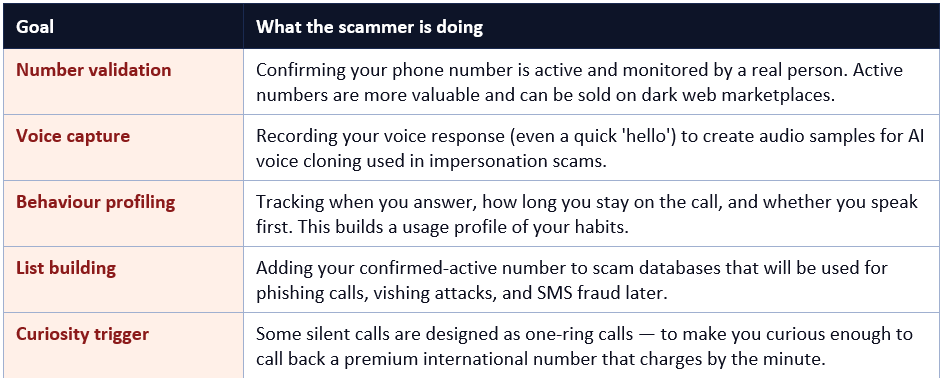
Silence is strategic. Even a few seconds of a silent call helps criminals identify which numbers are worth calling again — and your response matters far more than you think.
— AUTOMATE YOUR LIFE / CYBERSECURITY RESEARCHERS (2026)
The Voice Recording Threat: AI Cloning Explained
One of the most alarming developments in phone fraud in recent years is the use of artificial intelligence to clone human voices from very short audio samples. You may have seen news stories about voice cloning being used to impersonate celebrities or public figures. The same technology is now being used in targeted phone scams — and a silent call may be the first step in capturing the audio sample needed.Research has shown that modern AI voice synthesis tools can generate a convincing audio imitation of a person's voice from as little as three seconds of clear audio. That means a quick 'Hello? Hello? Is anyone there?' spoken into a silent call can, in the right circumstances, provide enough audio for a scammer to create a fake version of your voice.
That fake voice can then be used in impersonation scams. Scammers have used AI-cloned voices to call elderly relatives pretending to be a grandchild in distress, to call banks pretending to be an account holder authorising a transfer, or to call employers pretending to be a staff member requesting payroll changes. Some operations have used voice clones to call the victim's own family members with fake emergency scenarios designed to extract money quickly before anyone can verify the situation.
It is important to be accurate about the risk level here. The Identity Theft Resource Center (ITRC) has noted that saying a quick 'hello' is usually not enough for a scammer to fully clone your voice with professional results. But the threat is real, growing, and becoming more accessible as AI tools improve. Minimising how much of your voice you give away on unknown calls is always the wisest approach.
One practical defence used by families who are aware of this risk is to set up a family code word — a pre-agreed phrase that only trusted family members know. If you receive an urgent call from someone claiming to be a relative who needs help, ask for the code word before taking any action. A scammer with a voice clone will not know it.
The One-Ring Scam: Why You Should Never Call Back
A specific variant of the silent call scam is designed to exploit one of the most natural human instincts: the urge to return a missed call. In the one-ring scam, your phone rings once — sometimes twice — before the call drops, leaving a missed call notification. The number typically looks normal, often appearing to be from a local area code.When you call back, you may be unknowingly connecting to an international premium-rate number. These numbers — often with country codes from West Africa, the Caribbean, or Pacific island nations — charge extremely high per-minute rates, with a significant portion of the charge going directly to the scammer who controls the number. The call may be designed to keep you on the line as long as possible, playing hold music, fake operator recordings, or automated messages that never go anywhere.
Those charges appear on your phone bill, often weeks later, and many victims do not connect them to the original missed call. For this reason, the simple rule is: never call back an unknown number that gave you a missed call with no voicemail. If it was important, the caller will leave a message or call again from a number you can verify.
Country codes to be particularly wary of include +222 (Mauritania), +233 (Ghana), +269 (Comoros), +473 (Grenada), +664 (Montserrat), +268 (Swaziland), and numbers beginning with 809, 876, or 284 — all of which are Caribbean area codes that have been associated with premium-rate fraud, but which look similar to standard US domestic numbers because they follow the same 10-digit format.
Caller ID Spoofing and Neighbour Spoofing
A key reason silent calls — and phone scams in general — are so effective is that the number displayed on your caller ID is often not the real number calling you. Caller ID spoofing is the practice of disguising the true origin of a call by replacing it with a fake number. This technology is readily available and inexpensive, and it is widely used by scammers to make their calls appear more trustworthy.The most common form of spoofing used in silent call operations is neighbour spoofing, in which the incoming call appears to come from a number that shares your area code and sometimes even the first six digits of your phone number. People are significantly more likely to answer a call that appears local, so neighbour spoofing dramatically increases the answer rate — and therefore the effectiveness of the number-validation exercise.
Spoofing is also used to impersonate trusted organisations. A scammer's automated system can display the number of your bank, the IRS, Medicare, the Social Security Administration, or your local police department on your caller ID. Seeing a name you trust on your screen removes your natural caution and makes you far more likely to engage — and to share information.
The critical point here is that caller ID cannot be trusted as proof of identity. If you receive a call from what appears to be your bank and the caller asks for personal information, hang up and call your bank back using the number on the back of your card or on the bank's official website. A legitimate caller from your bank will understand and support this precaution. A scammer will not.
Who Is Being Targeted Most
Silent call scams and the more sophisticated fraud that follows from them are not random. Scammers use various methods to build and refine their call lists, and certain groups are disproportionately targeted.Older adults are the most frequently targeted demographic. Scammers know that many retirees rely heavily on phone communication for healthcare appointments, banking queries, government benefits, and family contact. This makes them more likely to answer unknown numbers and more likely to take a call seriously when a scammer impersonates a trusted institution. The FBI's Internet Crime Complaint Center (IC3) consistently reports that Americans over 60 lose more money to phone fraud than any other age group.
People who have recently had their phone number exposed in a data breach are also at significantly elevated risk. If your number appeared in one of the many large-scale data breaches of recent years — involving retailers, healthcare providers, social media platforms, or financial institutions — it is quite possible that it is already circulating on the fraud databases that feed automated dialling operations. Checking whether your information has been compromised using a service such as HaveIBeenPwned.com is a useful first step in understanding your exposure.
Small business owners and self-employed people who list their phone numbers publicly — on websites, directories, or social media — are also frequent targets, as those numbers are easily harvested by automated scraping tools. If you run a business, consider using a dedicated business number for public listings and keeping your personal number less visible.
What to Do the Moment You Get a Silent Call
Your response in the first few seconds of a silent call matters. Here is exactly what security experts and the ITRC recommend.Immediate action steps when you answer a silent call
- Step 1 — Do not speak. Resist the instinct to say 'hello' a second time. Every word you say confirms your number is active and provides audio for potential voice capture. Stay completely silent.
- Step 2 — Listen for clues. Wait two to three seconds. If you hear clicking sounds, mechanical 'blooping' tones, or a long silence, these are signs of an automated system trying to connect you to a live agent. Hang up.
- Step 3 — Hang up immediately. Do not press any buttons, do not follow automated instructions ('press 1 to be removed from our list'), and do not stay on the line waiting for someone to speak. These actions confirm engagement.
- Step 4 — Do not call the number back. Even if it appears local or familiar. If no voicemail was left, the call was almost certainly not important — and calling back may connect you to a premium-rate line.
- Step 5 — Block the number. Use your phone's built-in blocking feature. Scammers use many numbers, but every block reduces your exposure.
- Step 6 — Report it. Use your phone's 'Report Junk' or 'Report Spam' option if available. In the US, you can report unwanted calls to the FTC at reportfraud.ftc.gov. This data helps phone carriers identify and shut down fraud networks.
How to Reduce Silent Scam Calls Long-Term
Beyond reacting to individual calls, there are proactive steps you can take to reduce how often scammers reach you in the first place.Register with the National Do Not Call Registry
The Federal Trade Commission's National Do Not Call Registry (donotcall.gov) allows you to register your number for free. It does not stop all unwanted calls — scammers ignore it — but it can reduce the volume of calls from legitimate telemarketers, which reduces noise and makes it slightly easier to identify suspicious calls. Registration is permanent and only needs to be done once.Use your phone's built-in call screening tools
Both Android and iPhone have built-in tools to help manage unwanted calls. On iPhone, the 'Silence Unknown Callers' setting (found in Settings Phone) sends any call from a number not in your contacts directly to voicemail. On Android, the Google Phone app includes a 'Call Screen' feature that uses Google Assistant to answer suspected spam calls on your behalf and ask the caller to identify themselves before connecting you. These tools do not block all spam, but they significantly reduce direct engagement.Use a call-blocking app
Third-party apps such as Hiya, Nomorobo, and RoboKiller use crowdsourced databases of known spam and scam numbers to automatically identify and block incoming calls before they reach you. Most have free tiers that provide meaningful protection. Your mobile carrier may also offer free spam-blocking tools — Verizon, AT&T, and T-Mobile all provide call protection features at no charge.Freeze your credit
The ITRC strongly recommends that everyone — regardless of whether they have been targeted by a scam — place a free credit freeze with all three major credit bureaus (Equifax, Experian, and TransUnion). A credit freeze prevents anyone from opening new accounts in your name, even if a scammer has obtained your phone number and some personal details. It is free, can be done online in minutes, and does not affect your existing credit. It is one of the single most effective things you can do to protect your financial identity.Long-term protection checklist
- Register at donotcall.gov (free, takes 2 minutes)
- Enable 'Silence Unknown Callers' on iPhone or use Google Call Screen on Android
- Download a call-blocking app: Hiya, Nomorobo, or RoboKiller
- Check your carrier's free spam-blocking tools (Verizon, AT&T, T-Mobile all offer these)
- Freeze your credit with Equifax, Experian, and TransUnion (free at each bureau's website)
- Check HaveIBeenPwned.com to see if your number has been exposed in a data breach
- Set up a family code word to defend against AI voice cloning impersonation attempts
- Never list your personal mobile number publicly — use a separate business number if needed
CONCLUSION
That moment of silence on the other end of the line is not an accident. It is a deliberate, automated data-gathering exercise designed to confirm that your number belongs to a real person who answers their phone. In the space of a few seconds, a scam operation can add your number to high-value fraud lists, capture audio of your voice for potential cloning, and build a behavioural profile that will be used to target you more effectively in follow-up attacks.The good news is that your response to a silent call can significantly reduce your risk. Say nothing. Hang up immediately. Do not call back. Block and report. And over the longer term, use the free tools available to you — call-blocking apps, carrier spam filters, and a credit freeze — to make yourself a much harder target. In a world where phone fraud is increasingly sophisticated and AI-powered, awareness and a calm, deliberate response are your most effective defences.
Frequently Asked Questions
Why do scammers call and stay silent?
Silent calls are typically a deliberate number-validation technique. Automated dialling systems call thousands of numbers at once. When you answer, you confirm that your number is active and monitored by a real person — information that makes your number more valuable. It may be sold to other fraud networks or used for more targeted follow-up calls impersonating banks, government agencies, or Medicare. In some cases, the silence is also designed to capture your voice for AI cloning purposes.Should I say anything when I answer a silent call?
No. The safest response is to say nothing and hang up immediately. Every word you speak confirms your number is active and provides audio that could potentially be used in voice cloning scams. If you have already answered and said 'hello', do not panic — a quick word is generally not enough for a convincing voice clone — but hang up without saying anything further.Can scammers really clone my voice from a phone call?
Yes, in principle — though the risk is often overstated. Research suggests that some modern AI voice synthesis tools can generate a basic imitation of a person's voice from as little as three seconds of clear audio. However, the Identity Theft Resource Center notes that a quick 'hello' is usually not enough for a convincing clone. The risk is real and growing as AI tools improve, which is why minimising your voice exposure during unknown calls is always wise.What is the one-ring scam?
The one-ring scam involves calling your number once or twice before hanging up, leaving a missed call notification designed to make you curious enough to call back. When you do, you may connect to a premium-rate international number that charges high per-minute fees. These charges appear on your phone bill weeks later. The simple rule: never call back an unknown number that left no voicemail.Why does the number on my caller ID look like a local number if it is a scam?
Because of a technique called neighbour spoofing. Scammers can display any number they choose on your caller ID using readily available spoofing technology. By showing a number that shares your area code or the first digits of your own number, they make the call appear local and therefore more trustworthy. Caller ID can never be taken as proof of who is actually calling you.How do I stop silent scam calls?
You cannot stop all scam calls, but you can significantly reduce them. Register at donotcall.gov, enable 'Silence Unknown Callers' on iPhone or use Google Call Screen on Android, download a call-blocking app like Hiya or Nomorobo, and check your carrier's free spam-blocking tools. Over time, not answering unknown calls makes your number appear less valuable and can reduce the volume of scam attempts.Where should I report a silent scam call in the US?
You can report unwanted and scam calls to the FTC at reportfraud.ftc.gov, or by calling 1-877-382-4357. You can also file a complaint with the FCC at consumercomplaints.fcc.gov. If you believe you have been defrauded or are a victim of identity theft, you can contact the Identity Theft Resource Center (ITRC) for free advice at 888-400-5530 or via live chat at idtheftcenter.org.References
Saving Advice — Why Scammers Stay Silent When They Call https://www.savingadvice.com/articles/2026/04/22/10732176_why-scammers-stay-silent-when-they-call-and-what-you-should-do-immediately.htmlIdentity Theft Resource Center (ITRC) — Silent Call Scams Weekly Breakdown (March 2026) https://www.idtheftcenter.org/podcast/weekly-breach-breakdown-silent-call-scams/
Bitdefender — Got a Silent Call From an Unknown Number? It's a Scam https://www.bitdefender.com/en-us/blog/hotforsecurity/silent-call-unknown-number-its-a-scam
CISometric — Silent Calls and AI Voice Cloning https://www.cisometric.com/articles/silent-calls-and-ai-voice-cloning
Automate Your Life — What Scammers Are Really Doing When They Call and Stay Silent https://automatelife.net/what-scammers-are-really-doing-when-they-call-and-stay-silent/
Mid Oregon Blog — Silent Calls, Real Risks: What That Quiet Phone Call Could Mean https://blog.midoregon.com/whos-calling/
FTC — National Do Not Call Registry https://www.donotcall.gov
FTC — Report Fraud https://reportfraud.ftc.gov
HaveIBeenPwned — Check if Your Number Has Been Exposed in a Breach https://haveibeenpwned.com
FCC — Consumer Guide to Unwanted Calls https://www.fcc.gov/consumers/guides/stop-unwanted-robocalls-and-texts
0 Comments
Be the first to share your thoughts on this article.