

Financial Literacy
Your Best Money Tips: 10 Smart Moves for Your Money

47% can cover a $1,000 emergency; 46% three months; 27% six months. Average savings account 0.38% vs top accounts 4.34%–4.50% and 52-week T-bill 4.46%; inflation 3.7%. NY Fed Q2 2026: household debt $18.8 trillion; credit cards $1.263 trillion; average card APR about 21%. $10,000 at 20.9% costs about $2,090 a year in interest (author’s arithmetic). Vanguard 2026: average total savings rate 12.1% (12%–15% recommended); automatic enrollment 94% vs 64% participation. 2026 limits: 401(k) $24,500; IRA $7,500 ($8,600 at 50+). Costs and behavior: fund fees of 0.64% vs 0.04% cost about $66,900 over 30 years on $500 a month; DALBAR: investors earned about 6.8% vs 10.2% for the S&P 500. Housing and the long game: 30-year mortgage 7.40%; median home payment about $2,313 a month; Social Security 78%–83% payable after 2032–2034; retiree healthcare about $185,500.
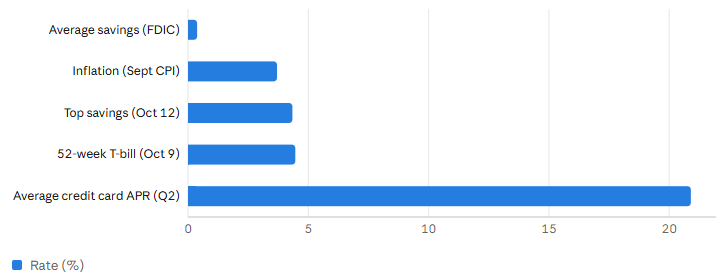
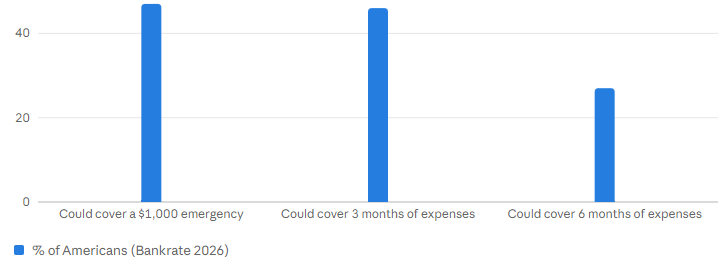
Table of Contents
1. Why These Ten
2. Tip 1: Know Your Two Numbers
3. Tip 2: Build the Cushion in Steps
4. Tip 3: Make Your Cash Earn Its Keep
5. Tip 4: Attack Expensive Debt
6. Tip 5: Capture the Match, Then Raise Your Rate
7. Tip 6: Use the Right Accounts
8. Tip 7: Buy Broad, Cheap and Boring
9. Tip 8: Automate and Ignore the Noise
10. Tip 9: Treat Housing as a Payment and Fight Inflation
11. Tip 10: Plan for the Long Game
12. Your 30-Day Action Plan
13. Conclusion
14. Frequently Asked Questions
The backdrop is not easy. Inflation was 3.7% in September, real hourly earnings are down 0.7% over the year and the 30-year mortgage rate has climbed to 7.40%. But savings accounts and Treasury bills now pay more than inflation, and the basic tools of wealth-building are still available to almost everyone.
Why six months? The average spell of unemployment lasts about 24.8 weeks, close to six months, according to a summary of September’s BLS report. Yet Bankrate’s 2026 survey found that only 46% of Americans could cover three months of expenses and just 27% could cover six. Most of us are not as prepared as we think.
Your move: Spend fifteen minutes listing your essential monthly costs. Multiply by three and by six. Keep both numbers somewhere visible.
On $10,000, the difference between 0.38% and 4.34% is about $396 a year for a ten-minute transfer. Check that any account is FDIC- or NCUA-insured, and remember that savings rates are variable and can fall.
The numbers: Average savings 0.38% vs top savings 4.34%–4.50% vs 52-week T-bill 4.46% vs inflation 3.7%. On $10,000: about $396 more a year at 4.34% than at 0.38% (author’s arithmetic). Move your emergency fund to an insured high-yield account today, and set an automatic transfer on payday.
How fast you pay it down matters, as the table shows: an extra few hundred dollars a month changes the outcome dramatically. Keep a $1,000 starter fund first so new emergencies do not go back on the card.

A note of perspective: the New York Fed reports that 12.9% of card balances are 90 or more days delinquent, but its researchers caution that figure reflects a backlog of old charged-off debts and that new delinquencies have been stable for almost two years. If you are struggling, call your issuer early, since many offer hardship programs.
Then raise your savings rate gradually. Vanguard’s 2026 report found an average total savings rate, employee plus employer, of 12.1%, an all-time high, and Vanguard recommends 12% to 15%. If you are below that, increase your contribution by one percentage point whenever you get a raise. On a $60,000 salary, an extra 1% is $600 a year. Invested at an assumed constant 7%, that grows to roughly $56,700 over 30 years, an illustration and not a promise. Your move: Log in to your retirement plan and check two things: whether you are getting the full match, and your current contribution rate.
Here is a sobering statistic from the Investment Company Institute: about 44% of US households own an IRA, but only 17% contributed to one in tax year 2024. Owning an account and funding it are different things. Pick the account that fits your tax situation and fund it regularly.
Boring wins partly because it protects you from yourself. DALBAR research, cited by MyETFJourney, found that over 30 years the average investor earned about 6.8% a year while the S&P 500 returned about 10.2%. The gap came from behavior: buying high and selling low. A broad fund held for decades avoids most of that.
79% of active large-cap funds trailed the S&P 500 in 2025 (SPIVA). $500 a month for 30 years at 7% before fees: about $605,193 at 0.04% vs about $538,276 at 0.64%. DALBAR: 6.8% for the average investor vs 10.2% for the index over 30 years.
Then ignore the noise. Headlines will always find something to alarm you; in October, stocks hit records and then slipped as oil and rate-hike worries returned. Decide your plan in calm moments, write it down and follow it. Before changing course because of a headline, ask whether it changes your plan or just your mood.
Fight inflation where it hurts most. Inflation was 3.7% in September. In a made-up family budget of $6,630 a month, my arithmetic suggests the same purchases cost about $235 more than a year earlier, with gasoline and housing the biggest drivers. Review your five biggest bills at each renewal, shop insurance, ask for a better rate before canceling and keep idle cash somewhere that pays more than inflation.
You cannot control Congress, but you can stress-test your plan. Multiply your expected Social Security benefit by 0.78 and 0.83 and see whether your plan still works, and build healthcare costs into your budget. The National Institute on Retirement Security found a median of just $955 saved for retirement among all workers and $40,000 among those with an account. The fix is not dramatic. It is regular saving, started sooner.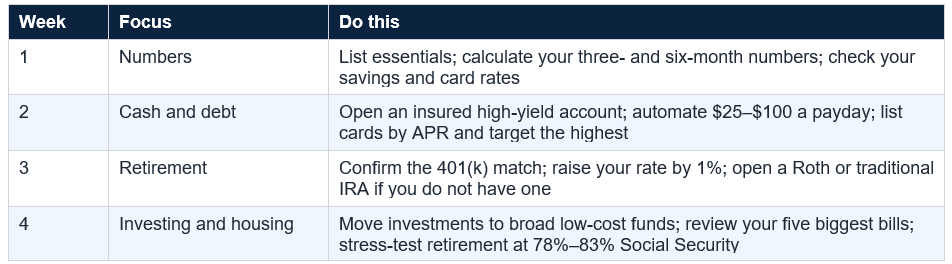
Repeat the cycle each quarter, and revisit your numbers when your income, family or housing changes. The goal is not perfection. It is steady progress.
The data in this article shows why the order matters. Only 47% of Americans can cover a $1,000 emergency, card debt near 21% outruns any savings rate, and fund fees of a few tenths of a percent can cost tens of thousands of dollars. Start with the first tip you have not yet done, and do one thing this week. This is general education, not personalized advice, and a qualified adviser can help you apply it to your situation.
Automate the basics. Set up automatic transfers to your savings, your 401(k) and your debt payments so good habits do not depend on willpower. Vanguard’s 2026 data shows automatic enrollment lifts plan participation to 94%, versus 64% when people must sign up themselves.
Should I pay off debt or save first?
Do both in order. Build a small starter fund of about $1,000 first so a surprise bill does not go on a card. Then pay down high-interest debt aggressively: with credit card rates near 21%, paying off a balance is like earning a guaranteed 21%, far above the roughly 4.4% a top savings account pays.
How much should I save for retirement each year?
Vanguard’s 2026 report put the average total savings rate at 12.1%, including employer contributions, and the company recommends 12% to 15%. If that feels out of reach, start by capturing your full employer match and raise your rate by one percentage point whenever you get a raise.
Where should I keep my emergency fund?
In an insured, separate savings account that pays a competitive rate. In mid-October 2026, top savings accounts paid about 4.34% to 4.50% and a 52-week Treasury bill about 4.46%, versus 0.38% for the average savings account. Check that the account is FDIC- or NCUA-insured.
Is now a good time to start investing?
No one can time markets reliably, and stocks were near records in October with Treasury yields near 5%. History shows that missing the market’s best days costs a lot, and regular investing on a schedule avoids the timing question. Match your stock exposure to your time horizon. This is general education, not personal advice.
Tips 3-4: What cash earns vs. what debt costs (%, 2026)
% per year by Experian/FDIC, BLS, MyMoneyBlog, Federal Reserve (APR via secondary source)
Tip 1-2: How many Americans have a cushion? (%)
% of Americans by Source: Bankrate 2026 Annual Emergency Savings ReportTable of Contents
1. Why These Ten
2. Tip 1: Know Your Two Numbers
3. Tip 2: Build the Cushion in Steps
4. Tip 3: Make Your Cash Earn Its Keep
5. Tip 4: Attack Expensive Debt
6. Tip 5: Capture the Match, Then Raise Your Rate
7. Tip 6: Use the Right Accounts
8. Tip 7: Buy Broad, Cheap and Boring
9. Tip 8: Automate and Ignore the Noise
10. Tip 9: Treat Housing as a Payment and Fight Inflation
11. Tip 10: Plan for the Long Game
12. Your 30-Day Action Plan
13. Conclusion
14. Frequently Asked Questions
Why These Ten
Money advice is everywhere, and most of it is either too vague to use or too clever to trust. “Spend less, save more” does not tell you what to do on Tuesday, and a thirty-step system with six apps does not survive a busy month. So I picked ten moves that are specific, ordered sensibly and backed by this year’s data. You do not need to do them all at once. Pick the first one you have not done and start there.The backdrop is not easy. Inflation was 3.7% in September, real hourly earnings are down 0.7% over the year and the 30-year mortgage rate has climbed to 7.40%. But savings accounts and Treasury bills now pay more than inflation, and the basic tools of wealth-building are still available to almost everyone.
Tip 1: Know Your Two Numbers
Before anything else, calculate two numbers. The first is your essentials: housing, utilities, groceries, transportation, insurance and minimum debt payments each month. The second is your six-month number, essentials multiplied by six. If essentials are $3,800 a month, that is $22,800. Writing the figures down turns a vague worry into a target.Why six months? The average spell of unemployment lasts about 24.8 weeks, close to six months, according to a summary of September’s BLS report. Yet Bankrate’s 2026 survey found that only 46% of Americans could cover three months of expenses and just 27% could cover six. Most of us are not as prepared as we think.
Your move: Spend fifteen minutes listing your essential monthly costs. Multiply by three and by six. Keep both numbers somewhere visible.
Tip 2: Build the Cushion in Steps
Do not try to save $22,800 in a month. Build in milestones: a $1,000 starter fund, then one month of essentials, then three months, then six. A $1,000 starter fund takes about six months at $167 a month, and reaching six months of the $3,800 example in 36 months takes about $633 a month. Bankrate found that only 47% of Americans can cover a $1,000 emergency, so even the first step puts you ahead of half the country. Keep this money separate from your spending account. The cushion is not an investment. It is what stops a surprise from turning into debt.Tip 3: Make Your Cash Earn Its Keep
Where you keep cash matters more than it has in years. The FDIC’s national average savings rate was 0.38% in mid-2026, according to Experian, and interest checking averaged 0.07%. MyMoneyBlog’s October 12 survey found top savings accounts at 4.34% to 4.50% and a 52-week Treasury bill at 4.46%. With inflation at 3.7%, the average account loses buying power every year, while the best accounts roughly keep up.On $10,000, the difference between 0.38% and 4.34% is about $396 a year for a ten-minute transfer. Check that any account is FDIC- or NCUA-insured, and remember that savings rates are variable and can fall.
The numbers: Average savings 0.38% vs top savings 4.34%–4.50% vs 52-week T-bill 4.46% vs inflation 3.7%. On $10,000: about $396 more a year at 4.34% than at 0.38% (author’s arithmetic). Move your emergency fund to an insured high-yield account today, and set an automatic transfer on payday.
Tip 4: Attack Expensive Debt
Nothing in your financial life guarantees a return like paying off a high-interest card. The New York Fed reported that Americans owed $1.263 trillion on credit cards at the end of June, and the average commercial bank card APR was about 21%, according to Federal Reserve data cited by a secondary source. By my arithmetic, a $10,000 balance at 20.9% costs about $2,090 a year in interest. The same $10,000 in a 4.34% savings account earns about $434. Paying off the card is the better trade by a wide margin.How fast you pay it down matters, as the table shows: an extra few hundred dollars a month changes the outcome dramatically. Keep a $1,000 starter fund first so new emergencies do not go back on the card.
A note of perspective: the New York Fed reports that 12.9% of card balances are 90 or more days delinquent, but its researchers caution that figure reflects a backlog of old charged-off debts and that new delinquencies have been stable for almost two years. If you are struggling, call your issuer early, since many offer hardship programs.
Tip 5: Capture the Match, Then Raise Your Rate
If your employer matches 401(k) contributions, contribute at least enough to get the full match. It is the closest thing to free money in personal finance. On a $60,000 salary, a 3% match is worth $1,800 a year. The 2026 employee contribution limit is $24,500, though most people will not approach it.Then raise your savings rate gradually. Vanguard’s 2026 report found an average total savings rate, employee plus employer, of 12.1%, an all-time high, and Vanguard recommends 12% to 15%. If you are below that, increase your contribution by one percentage point whenever you get a raise. On a $60,000 salary, an extra 1% is $600 a year. Invested at an assumed constant 7%, that grows to roughly $56,700 over 30 years, an illustration and not a promise. Your move: Log in to your retirement plan and check two things: whether you are getting the full match, and your current contribution rate.
Tip 6: Use the Right Accounts
Where you hold investments affects how much tax you pay. Use tax-advantaged accounts first: a 401(k) up to the match, then an IRA. For 2026 the IRA limit is $7,500, or $8,600 if you are 50 or older. A Roth IRA, funded with after-tax dollars, lets qualified withdrawals come out tax-free, and direct contributions phase out between $153,000 and $168,000 of income for single filers, or $242,000 to $252,000 for couples filing jointly.Here is a sobering statistic from the Investment Company Institute: about 44% of US households own an IRA, but only 17% contributed to one in tax year 2024. Owning an account and funding it are different things. Pick the account that fits your tax situation and fund it regularly.
Tip 7: Buy Broad, Cheap and Boring
For most people, the best investment is a diversified, low-cost index fund or target-date fund. The evidence is strong. S&P Dow Jones Indices found that 79% of active large-cap funds underperformed the S&P 500 in 2025. Top S&P 500 index funds charge 0.015% to 0.04% a year, according to Bankrate, versus much more for active funds. On $500 a month for 30 years at a 7% return before fees, a 0.04% fund ends at about $605,193 and a 0.64% fund at about $538,276, a gap of about $66,900 from fees alone.Boring wins partly because it protects you from yourself. DALBAR research, cited by MyETFJourney, found that over 30 years the average investor earned about 6.8% a year while the S&P 500 returned about 10.2%. The gap came from behavior: buying high and selling low. A broad fund held for decades avoids most of that.
79% of active large-cap funds trailed the S&P 500 in 2025 (SPIVA). $500 a month for 30 years at 7% before fees: about $605,193 at 0.04% vs about $538,276 at 0.64%. DALBAR: 6.8% for the average investor vs 10.2% for the index over 30 years.
Tip 8: Automate and Ignore the Noise
The best habit is the one you do not have to remember. Automate your savings, your retirement contributions and your debt payments so they happen on payday. Vanguard’s data shows how powerful automation is: employees who were automatically enrolled participated at 94%, compared with 64% when they had to opt in. If it requires a decision every month, it will eventually lose to something more urgent.Then ignore the noise. Headlines will always find something to alarm you; in October, stocks hit records and then slipped as oil and rate-hike worries returned. Decide your plan in calm moments, write it down and follow it. Before changing course because of a headline, ask whether it changes your plan or just your mood.
Tip 9: Treat Housing as a Payment and Fight Inflation
Your housing cost is probably your biggest bill, so judge it by the monthly payment, not the price tag. With the 30-year mortgage rate at 7.40% and a median home price of $417,500, principal and interest on a 20% down payment come to about $2,313 a month by my calculation, and each percentage point of rate adds about $223 a month. A common guideline is to keep housing near 28% of gross income. If you plan to buy, aim to stay at least five to seven years, and compare the payment, not just the price, when negotiating.Fight inflation where it hurts most. Inflation was 3.7% in September. In a made-up family budget of $6,630 a month, my arithmetic suggests the same purchases cost about $235 more than a year earlier, with gasoline and housing the biggest drivers. Review your five biggest bills at each renewal, shop insurance, ask for a better rate before canceling and keep idle cash somewhere that pays more than inflation.
Tip 10: Plan for the Long Game
Retirement is where small decisions today compound the most, and where uncertainty is greatest. The 2026 Social Security Trustees Report projects that without legislative action, benefits could be cut to about 83% of scheduled levels when the combined trust funds are depleted in 2034, and 78% for the retirement fund alone in late 2032. Fidelity estimates a 65-year-old retiring in 2026 will need about $185,500 for healthcare, excluding long-term care.You cannot control Congress, but you can stress-test your plan. Multiply your expected Social Security benefit by 0.78 and 0.83 and see whether your plan still works, and build healthcare costs into your budget. The National Institute on Retirement Security found a median of just $955 saved for retirement among all workers and $40,000 among those with an account. The fix is not dramatic. It is regular saving, started sooner.
Your 30-Day Action Plan
Repeat the cycle each quarter, and revisit your numbers when your income, family or housing changes. The goal is not perfection. It is steady progress.
Conclusion
The best money tips are rarely exciting. Know your numbers, build a cushion in steps, make cash earn something real, pay down expensive debt, capture the match, use the right accounts, buy broad cheap funds, automate, treat housing as a payment and plan for the long game. None of it requires a high income or a perfect market. It requires a plan and some patience.The data in this article shows why the order matters. Only 47% of Americans can cover a $1,000 emergency, card debt near 21% outruns any savings rate, and fund fees of a few tenths of a percent can cost tens of thousands of dollars. Start with the first tip you have not yet done, and do one thing this week. This is general education, not personalized advice, and a qualified adviser can help you apply it to your situation.
Frequently Asked Questions
What is the single best money tip?Automate the basics. Set up automatic transfers to your savings, your 401(k) and your debt payments so good habits do not depend on willpower. Vanguard’s 2026 data shows automatic enrollment lifts plan participation to 94%, versus 64% when people must sign up themselves.
Should I pay off debt or save first?
Do both in order. Build a small starter fund of about $1,000 first so a surprise bill does not go on a card. Then pay down high-interest debt aggressively: with credit card rates near 21%, paying off a balance is like earning a guaranteed 21%, far above the roughly 4.4% a top savings account pays.
How much should I save for retirement each year?
Vanguard’s 2026 report put the average total savings rate at 12.1%, including employer contributions, and the company recommends 12% to 15%. If that feels out of reach, start by capturing your full employer match and raise your rate by one percentage point whenever you get a raise.
Where should I keep my emergency fund?
In an insured, separate savings account that pays a competitive rate. In mid-October 2026, top savings accounts paid about 4.34% to 4.50% and a 52-week Treasury bill about 4.46%, versus 0.38% for the average savings account. Check that the account is FDIC- or NCUA-insured.
Is now a good time to start investing?
No one can time markets reliably, and stocks were near records in October with Treasury yields near 5%. History shows that missing the market’s best days costs a lot, and regular investing on a schedule avoids the timing question. Match your stock exposure to your time horizon. This is general education, not personal advice.
0 Comments
Be the first to share your thoughts on this article.