
Budgeting
10 Budget Tips to Help You Save More Money

95% of Americans say they plan to budget better in 2026. Only 17% succeed. The gap is not motivation — it’s method. Here are the ten techniques that the research says actually work.
The maths of saving money is straightforward. The behaviour is not. The WalletHub 2026 Budgeting Survey found that nearly 95% of Americans say they plan to budget better this year. Meanwhile, the US personal savings rate fell to just 3.6% in December 2025 — down from a 31.8% peak during the COVID savings surge in April 2020. US households added $50 billion in new credit card debt in 2025. The intention is almost universal. The execution is rare. The gap between these two facts is not a motivation problem — it is a method problem. Most people know they should spend less than they earn, save regularly, and avoid high-interest debt. What most people lack is the specific technique that converts that knowledge into automatic, repeatable behaviour. This article covers the ten budgeting techniques that financial experts, current research, and real-world data consistently identify as the ones that actually work — not the dramatic ones that make good content but fail in practice, but the boring, repeatable, sustainable ones that compound into real financial progress over time.
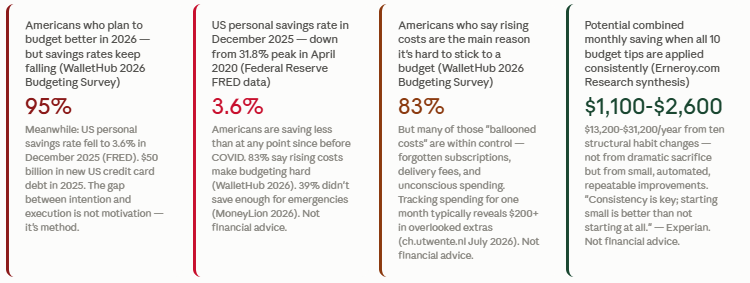
The gap between 95% planning to budget better and 3.6% savings rates is not explained by a lack of desire to save. It is explained by a lack of method. More than half of Americans say budgeting and tracking expenses is the most valuable way to manage their finances, according to an Empower 2023 study cited by InvestigateTV. The challenge is that knowing something is valuable and having a specific, repeatable system for doing it are entirely different things. The ten tips in this article are systems, not ideas. Each one converts good intentions into automatic or structured behaviour.
95% of Americans plan to budget better in 2026 (WalletHub Budgeting Survey). US personal savings rate: 3.6% (December 2025 FRED). $50 billion new US credit card debt in 2025 (WalletHub). 39% didn't save enough for emergencies. 44% spent too much on nonessentials (MoneyLion 2026). Sources cited.
Download a free budgeting app (YNAB, Mint, or your bank’s built-in tracker) and categorise every transaction for 30 days. Do not change your spending during this month. The goal is an accurate baseline, not immediate perfection. Review at the end of month one.
Calculate your after-tax monthly income. Multiply by 0.50, 0.30, and 0.20. Compare each target to your actual spending from Tip 1’s tracking. The category furthest above its target is where to start cutting first.
Set up a standing order to transfer 10-20% of your take-home pay to a separate savings account on the day your salary arrives. Use a different bank for savings to add an extra layer of separation from spending accounts. Review after 3 months.
Calculate three months of essential expenses (rent/mortgage, utilities, groceries, transport, minimum debt payments). Open a separate high-yield savings account. Automate a monthly transfer specifically labelled ‘Emergency Fund’ until the target is reached.
Open the last three months of bank and credit card statements. List every recurring charge. Cancel any service you have not actively used in the last 30 days. Set a calendar reminder for a quarterly repeat of this 20-minute audit.
Plan seven dinners at the start of each week. Shop from a specific list. Cook in batches where possible. Identify two meals per week that currently come from delivery or restaurants and replace them with home-cooked equivalents. Track the saving.
Open a high-yield savings account at an online bank or building society (US: check Bankrate or NerdWallet for current top rates; UK: check MoneySavingExpert or Moneyfacts for current easy-access rates). Transfer emergency fund and savings pot. Compare the interest earned after 90 days.
List your top three savings goals (emergency fund, holiday, deposit, retirement). Assign each a target amount. Divide by the number of months to your deadline. Open a named savings pot or account for each goal. Automate the monthly contribution.
List all debts with their interest rates. Make minimum payments on all. Direct every available additional payment to the highest-rate debt until cleared. Then redirect that payment to the next highest rate. Continue until all high-rate debt is gone.
Set four quarterly calendar events right now for budget reviews. At each review: compare actual spending to targets, update any income or fixed cost changes, check progress on savings and debt goals, and adjust contributions accordingly.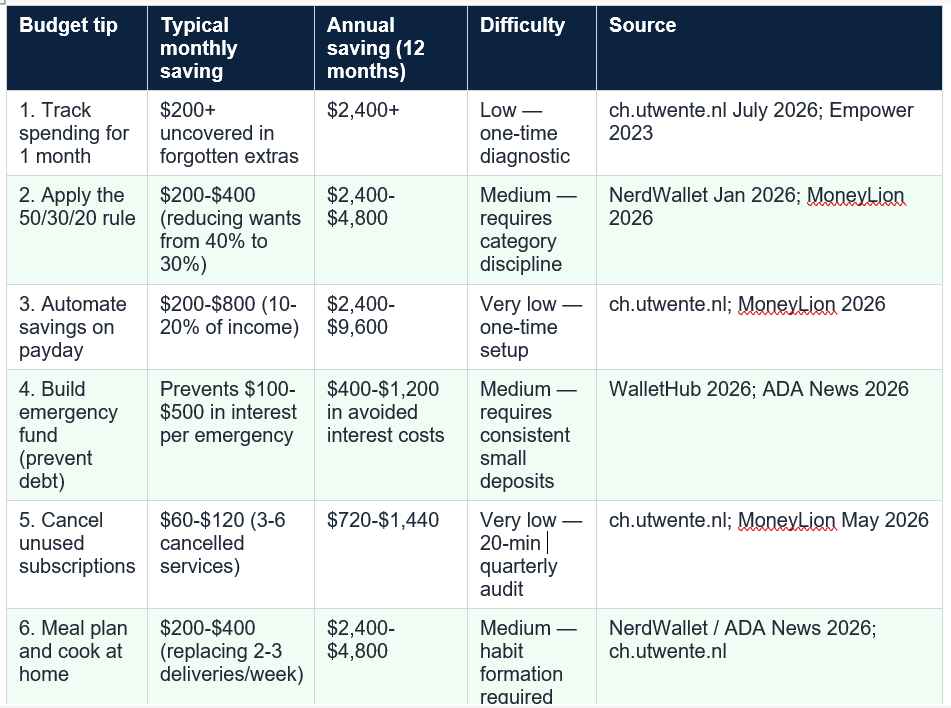
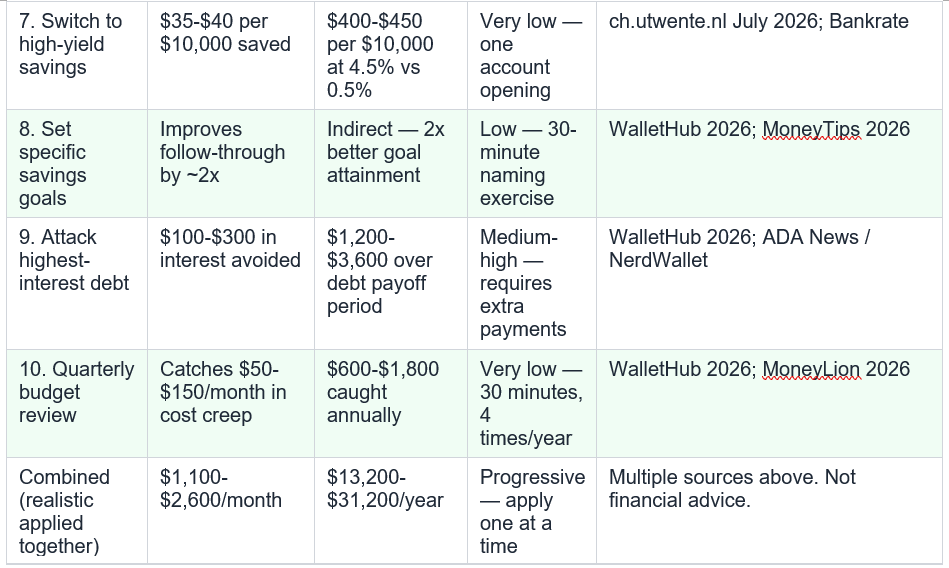
Note: savings estimates are illustrative ranges from cited research and expert guidance. Individual results vary significantly based on income, existing spending patterns, debt levels, and how consistently each tip is applied. Not financial, investment, or tax advice.
Every one of the ten tips in this article is small. Tracking spending for one month. Moving savings to an account that pays 4.5% instead of 0.5%. Setting up an automatic transfer. Cancelling two forgotten subscriptions. Planning four meals at home instead of three, none of these is dramatic. Each of them is sustainable. And the compound table above shows what happens when sustainable habits are applied consistently: the potential monthly saving from all ten tips applied together is £1,100 to £2,600 per month — not from a dramatic sacrifice, but from a dozen small structural improvements that each take less than an hour to implement. Not financial advice. Consult a qualified financial adviser for guidance specific to your circumstances.
Nathan Grant, senior finance industry analyst, MoneyTips (InvestigateTV January 2026): 'Set aside money each month — even if it's just $25, it will add up. There is no shame in speaking with a professional, whether it's a personal banker, a credit union or a financial advisor to help stay on track.' Experian (Dallas Express January 2026): 'Consistency is key to successful saving, and starting small is better than not starting at all.' MoneyLion 2026: 'Start small.' Sources cited.
The 50/30/20 rule is the most widely recommended budgeting framework for beginners in 2026, according to NerdWallet (updated January 1, 2026) and cited across multiple expert sources. It is simple: 50% of after-tax income to necessities (housing, food, utilities, transport), 30% to wants (dining out, entertainment, subscriptions), and 20% to savings or debt repayment. It provides a diagnostic framework that tells you immediately which category is out of balance without requiring complex spreadsheet work. For beginners specifically, the first step is one month of spending tracking (Tip 1) to establish an accurate baseline before applying any framework. Nathan Grant of MoneyTips told InvestigateTV: 'Identify specific, personal, financial goals' — this gives the 50/30/20 a destination to aim at. Sources: NerdWallet January 2026; WalletHub 2026; InvestigateTV January 2026.
How much should I save each month?
The most widely cited target is 20% of after-tax income, as recommended by the 50/30/20 rule (NerdWallet January 2026; Dallas Express January 2026). However, the US personal savings rate in December 2025 was 3.6% (Federal Reserve Economic Data), meaning most Americans are saving significantly less than this. For those starting from near zero, the guidance from multiple experts is consistent: start with any amount. Nathan Grant of MoneyTips: 'Set aside money each month — even if it's just $25, it will add up.' Experian's guidance: 'Consistency is key to successful saving, and starting small is better than not starting at all.' The immediate priority for those with no emergency fund is building three months of essential expenses before optimising the percentage. Once the emergency fund exists, the aspiration is working toward 20% of net income across all savings goals combined. Sources: NerdWallet; MoneyTips / InvestigateTV January 2026; Dallas Express January 2026.
What is the most effective way to stop overspending?
The research and expert consensus points to three structural interventions that are more effective than willpower alone. First, tracking spending for one month (the diagnostic step that makes overspending visible — research cited by ch.utwente.nl July 2026 found tracking reveals $200+ in forgotten extras). Second, automating savings before spending, so the discretionary spending pool is structurally smaller — ch.utwente.nl: 'Auto-transfers right after payday remove daily decisions.' Third, applying the 50/30/20 rule as a spending ceiling, particularly the 30% cap on wants. MoneyLion's 2026 survey found 44% of Americans spent too much on nonessentials — the 30% wants ceiling is the specific target for this problem. The WalletHub 2026 tips also include establishing realistic milestones as a way of measuring progress, because visible progress is one of the strongest reinforcers of continued good behaviour. Sources: WalletHub 2026; ch.utwente.nl July 2026; MoneyLion 2026.
How do I stick to a budget when prices keep rising?
83% of Americans say ballooned costs are one of the main reasons it's hard to stick to a budget, according to WalletHub's 2026 Budgeting Survey. The solution is a combination of adjusting the budget quarterly as prices change (Tip 10) and finding specific price-reduction strategies in the most inflation-sensitive categories. For food — identified by Ramsey Solutions as the top overspend category — MoneyLion's expert Cohen recommended combining strategies: 'Stacking coupons, opting for store brand options, using grocery store reward programs and price matching are all tried and true ways to save money on your grocery bill.' For utility costs, the Dallas Express January 2026 article cited Bankrate's guidance that simple changes (LED bulbs, sealing leaks) can yield noticeable savings. ADA News 2026 listed stacking errands to limit fuel costs and using free local events as entertainment alternatives. The key is that a budget is not a static document — it needs quarterly review to adjust for changed costs. Sources: WalletHub 2026; MoneyLion May 2026; Dallas Express January 2026.
Should I pay off debt or save first?
For high-interest debt — particularly credit card balances at 20-25% APR — WalletHub's 2026 budgeting guidance and most financial experts recommend a parallel approach: build a small emergency fund first (typically $1,000 as a starter buffer), then redirect all available extra income to the highest-rate debt. The logic: paying down 23% APR debt is a guaranteed 23% risk-free return, better than any savings account. Once high-rate debt is cleared, the monthly income previously used for debt payments redirects to savings. The caveat: a small emergency fund should be in place before aggressive debt repayment, because without it, every unexpected expense goes back on the credit card, undoing the debt repayment progress. WalletHub's 2026 advice: 'Getting out of debt won't do you much good if you incur an unaffordable, unexpected expense.' The recommended sequence: starter emergency fund ($1,000) → high-rate debt repayment → full emergency fund (3 months) → savings goals. Sources: WalletHub 2026 Budgeting Survey; ADA News / NerdWallet 2026.
The maths of saving money is straightforward. The behaviour is not. The WalletHub 2026 Budgeting Survey found that nearly 95% of Americans say they plan to budget better this year. Meanwhile, the US personal savings rate fell to just 3.6% in December 2025 — down from a 31.8% peak during the COVID savings surge in April 2020. US households added $50 billion in new credit card debt in 2025. The intention is almost universal. The execution is rare. The gap between these two facts is not a motivation problem — it is a method problem. Most people know they should spend less than they earn, save regularly, and avoid high-interest debt. What most people lack is the specific technique that converts that knowledge into automatic, repeatable behaviour. This article covers the ten budgeting techniques that financial experts, current research, and real-world data consistently identify as the ones that actually work — not the dramatic ones that make good content but fail in practice, but the boring, repeatable, sustainable ones that compound into real financial progress over time.
Table of Contents
- Why Budgeting Is a Method Problem, Not a Motivation Problem
- Tip 1: Track Every Pound and Dollar for One Month First
- Tip 2: Use the 50/30/20 Rule as Your Starting Framework
- Tip 3: Automate Your Savings Before You Spend
- Tip 4: Build a Three-Month Emergency Fund Before Anything Else
- Tip 5: Cut Subscriptions With a Quarterly Audit
- Tip 6: Meal Plan and Cook at Home to Slash Food Costs
- Tip 7: Move Your Savings to a High-Yield Account
- Tip 8: Use Clear Goals to Give Every Saving a Purpose
- Tip 9: Attack Your Highest-Interest Debt First
- Tip 10: Review and Rebalance Your Budget Every Three Months
- Your Monthly Savings Potential: The Compound Effect Table
- Conclusion: Small Systems Beat Big Resolutions Every Time
- Frequently Asked Questions
Why Budgeting Is a Method Problem, Not a Motivation Problem
Here is the paradox of personal finance in 2026: almost everyone wants to save more, and almost everyone is saving less than they should. The WalletHub 2026 Budgeting Survey found that 95% of Americans plan to budget better this year. In the same period, the US personal savings rate fell to 3.6% in December 2025 — one of the lowest levels in decades. US households added $50 billion in new credit card debt in 2025. The MoneyLion 2026 survey found that 39% of Americans didn’t save enough for emergencies, and 44% spent too much on nonessentials.The gap between 95% planning to budget better and 3.6% savings rates is not explained by a lack of desire to save. It is explained by a lack of method. More than half of Americans say budgeting and tracking expenses is the most valuable way to manage their finances, according to an Empower 2023 study cited by InvestigateTV. The challenge is that knowing something is valuable and having a specific, repeatable system for doing it are entirely different things. The ten tips in this article are systems, not ideas. Each one converts good intentions into automatic or structured behaviour.
95% of Americans plan to budget better in 2026 (WalletHub Budgeting Survey). US personal savings rate: 3.6% (December 2025 FRED). $50 billion new US credit card debt in 2025 (WalletHub). 39% didn't save enough for emergencies. 44% spent too much on nonessentials (MoneyLion 2026). Sources cited.
Tip 1: Track Every Pound and Dollar for One Month First
The single most revealing budgeting exercise available to anyone is also the one most consistently skipped: a full month of tracking every purchase, no matter how small. You cannot fix a problem you cannot see, and for most people, the problem is not where they think it is. Research cited by ch.utwente.nl’s July 2026 savings guide found that tracking spending for one month typically reveals more than $200 in forgotten or invisible extras — subscriptions renewed automatically, delivery fees absorbed without thought, small daily purchases whose cumulative cost is surprising. More than half of Americans say budgeting and tracking expenses is the most valuable way to manage their finances, according to an Empower 2023 study cited by InvestigateTV in January 2026. The WalletHub 2026 Budgeting Survey found that 83% of Americans say ballooned costs are one of the main reasons it’s challenging to stick to a budget. Tracking is the diagnostic that reveals exactly which costs have ballooned and which are within control. Nathan Grant, a senior finance industry analyst with MoneyTips, told InvestigateTV: ‘That can be things like your grocery habits, maybe you want to think about where you shop, what brands you’re buying — things like that you can kind of cut down.’ Tracking makes those things visible.Download a free budgeting app (YNAB, Mint, or your bank’s built-in tracker) and categorise every transaction for 30 days. Do not change your spending during this month. The goal is an accurate baseline, not immediate perfection. Review at the end of month one.
Tip 2: Use the 50/30/20 Rule as Your Starting Framework
Before you can reduce spending, you need a framework for deciding where your money should go. The 50/30/20 rule is the most widely cited budgeting framework in mainstream personal finance in 2026, recommended by NerdWallet (updated January 1, 2026) and cited across multiple expert sources in the Dallas Express’ January 2026 budget guide. The rule is simple: 50% of after-tax income goes to necessities (rent/mortgage, utilities, groceries, insurance, transport); 30% goes to wants (dining out, subscriptions, entertainment, travel); and 20% goes to savings or debt repayment. The 50/30/20 is not a rigid law — it is a diagnostic tool. If your necessities are consuming 70% of after-tax income (which is common in high-cost cities), the rule identifies the problem: your fixed cost base is too high relative to income, and the solution requires either reducing fixed costs or increasing income. If your wants are consuming 40%, the rule identifies discretionary overspending. MoneyLion’s 2026 budgeting survey found that 44% of Americans spent too much on nonessentials — the ‘wants’ category that the 50/30/20 framework specifically targets with a ceiling of 30%.Calculate your after-tax monthly income. Multiply by 0.50, 0.30, and 0.20. Compare each target to your actual spending from Tip 1’s tracking. The category furthest above its target is where to start cutting first.
Tip 3: Automate Your Savings Before You Spend
The most reliable budgeting trick available is not a technique at all — it is a structural intervention that removes the daily decision entirely. Automating a savings transfer immediately after every payday means the money moves before it enters the current account spending pool, before the temptation to spend it exists. Ch.utwente.nl’s July 2026 savings guide puts the principle directly: ‘Auto-transfers right after payday remove daily decisions.’ MoneyLion’s 2026 budgeting guidance advises: ‘Automate your savings — this means looking at all your personal financial accounts and making savings automatic.’ The pay-yourself-first principle behind this tip is one of the most robustly validated approaches in personal finance: when savings are treated as a non-negotiable fixed expense rather than whatever is left at the end of the month, savings rates systematically improve. The US personal savings rate fell to just 3.6% in December 2025 (down from a 31.8% peak in April 2020), which is partly a reflection of the opposite approach — spending first, saving whatever remains. Where an employer offers a 401(k) match, automating the contribution to at least the match level is the single highest-return financial move available: an immediate 50-100% return before any investment growth.Set up a standing order to transfer 10-20% of your take-home pay to a separate savings account on the day your salary arrives. Use a different bank for savings to add an extra layer of separation from spending accounts. Review after 3 months.
Tip 4: Build a Three-Month Emergency Fund Before Anything Else
The most counterproductive thing about the 13% of Americans who have no emergency fund is not the financial vulnerability itself — it is the cascade it creates. When an unexpected expense arrives with no buffer, the response is typically high-interest debt: a credit card, a personal loan, or a payday loan. US households added $50 billion in new credit card debt in 2025 (WalletHub 2026), and a significant portion of that debt is the direct result of emergency expenses arriving to households with no emergency savings to absorb them. WalletHub’s 2026 budgeting tips make the connection explicit: ‘Getting out of debt won’t do you much good if you incur an unaffordable, unexpected expense. Structure your initial budget around increased monthly savings to soon have at least three months’ worth of emergency savings.’ The ADA News 2026 survey found that 33% of Americans said they would not be able to financially tolerate a recession — which is, in part, a function of insufficient emergency reserves. The mechanism is circular: lack of emergency fund leads to debt, debt leads to interest payments, interest payments reduce income available for savings, and so the fund never gets built. Breaking this cycle requires treating emergency fund building as the highest-priority budget line item until three months of expenses are in place.Calculate three months of essential expenses (rent/mortgage, utilities, groceries, transport, minimum debt payments). Open a separate high-yield savings account. Automate a monthly transfer specifically labelled ‘Emergency Fund’ until the target is reached.
Tip 5: Cut Subscriptions With a Quarterly Audit
Subscription spending is the modern budget leak: small, recurrent, often forgotten, and collectively significant. Research cited by ch.utwente.nl’s July 2026 guide found that cancelling unused subscriptions saves approximately $20 per month per service, and that a quarterly review of bank statements consistently reveals subscriptions that the account holder either forgot about or stopped using. MoneyLion’s chief financial expert, quoted in their May 2026 paycheque-stretching guide, identified subscription cutting as one of the most effective frugal habits of 2026: ‘Cutting out unused streaming services or subscriptions is another effective way to save money.’ The WalletHub 2026 Budgeting Survey found that 83% of Americans say rising costs make it hard to budget — but many of those costs are partially self-inflicted through subscription accumulation. The average household now has six to eight active streaming and digital subscriptions, many of which overlap in content. A single family might have Netflix, Disney+, Apple TV+, Spotify, and several app subscriptions, adding £60-£100 per month for primarily leisure services. A quarterly audit involves opening three months of bank and credit card statements and listing every recurring charge. Any subscription that was not actively used in the previous month gets cancelled or paused.Open the last three months of bank and credit card statements. List every recurring charge. Cancel any service you have not actively used in the last 30 days. Set a calendar reminder for a quarterly repeat of this 20-minute audit.
Tip 6: Meal Plan and Cook at Home to Slash Food Costs
Food is the most flexible major budget category, and for most households it is the one where spending varies most dramatically from month to month. Grocery shopping was identified as the number one budget category where Americans are most likely to overspend, according to the Ramsey Solutions State of Personal Finance Q4 2024 report. Research cited by ch.utwente.nl’s July 2026 guide found that meal planning saves approximately $40 per month per takeout swap — approximately $500 per year per meal replaced with a home-cooked equivalent. The ADA News 2026 budgeting roundup, citing NerdWallet, listed cooking at home instead of eating out or ordering delivery as one of the most impactful ways to save money, noting it ‘can save hundreds of dollars each month.’ Nathan Grant of MoneyTips was direct in his InvestigateTV interview: ‘You really can free up more money in your new budget if you’re cutting out things like food delivery or rideshare services. They’re certainly helpful, but you’re always going to be paying for that convenience and those fees and tips and stuff like that can really add up.’ MoneyLion’s May 2026 frugal habits guide noted that stacking multiple grocery strategies amplifies savings: ‘Stacking coupons, opting for store brand options, using grocery store reward programs and price matching are all tried and true ways to save money on your grocery bill.Plan seven dinners at the start of each week. Shop from a specific list. Cook in batches where possible. Identify two meals per week that currently come from delivery or restaurants and replace them with home-cooked equivalents. Track the saving.
Tip 7: Move Your Savings to a High-Yield Account
One of the simplest and most underutilised improvements available to most savers is switching from a traditional bank savings account — which in 2025-2026 typically pays 0.5-0.6% APY — to a high-yield savings account that pays 4%+ APY. Ch.utwente.nl’s July 2026 savings guide identifies this as a structural improvement that takes minutes to implement: ‘High-yield savings: 4%+ rates (2025) — beat traditional near-zero — minutes to switch.’ On an emergency fund of $10,000, the difference between 0.5% and 4.5% APY is $400 per year in additional interest earned with zero additional effort or risk. Both account types are FDIC-insured up to $250,000 (US) or FSCS-protected up to £85,000 (UK). The only cost is the initial account opening and the setup of a transfer link between the new savings account and the current account. The ADA News 2026 budgeting survey found that 46% of Americans plan to save for emergencies in 2026. A high-yield savings account ensures those emergency savings are also working harder at no additional risk.Open a high-yield savings account at an online bank or building society (US: check Bankrate or NerdWallet for current top rates; UK: check MoneySavingExpert or Moneyfacts for current easy-access rates). Transfer emergency fund and savings pot. Compare the interest earned after 90 days.
Tip 8: Use Clear Goals to Give Every Saving a Purpose
Saving money in the abstract — ‘I should save more’ — is profoundly less effective than saving toward a named, specific goal with a defined target and a timeline. WalletHub’s 2026 budgeting tips list ‘have clear objectives’ as the first and most foundational budgeting step, ahead of all the tactical advice: ‘Once you improve your awareness of exactly where your money goes each month to avoid overspending, work on reducing credit card debt.’ Nathan Grant of MoneyTips identified goal specificity as essential in his InvestigateTV interview: ‘Identify specific, personal financial goals.’ The MoneyLion 2026 survey found 39% of Americans did not save enough for emergencies. This is not primarily a discipline problem — it is a goal-specificity problem. An emergency fund with a specific target (‘three months of essential expenses = $7,200’) and a monthly contribution (‘$300 per month for 24 months’) produces a fundamentally different relationship with the savings behaviour than a vague intention to save more. The Experian guidance cited by the Dallas Express summarises it: ‘Consistency is key to successful saving, and starting small is better than not starting at all.’ Name your savings goals. Give each one a target amount and a monthly contribution.List your top three savings goals (emergency fund, holiday, deposit, retirement). Assign each a target amount. Divide by the number of months to your deadline. Open a named savings pot or account for each goal. Automate the monthly contribution.
Tip 9: Attack Your Highest-Interest Debt First
If you carry high-interest debt — credit card balances at 20-25% APR are the most common example — no savings strategy produces a better guaranteed return than paying it down. The WalletHub 2026 budgeting survey noted that US households added $50 billion in new credit card debt in 2025. Paying down a balance that costs 23% APR produces a guaranteed 23% risk-free return — a return that no savings account or mainstream investment reliably matches. WalletHub’s budgeting tips explicitly address the debt repayment strategy: ‘Adjust your budget to continue making the minimum payments on all of your debts except the one with the highest interest rate — to which you’ll pay as much extra as you can afford.’ This is the debt avalanche method: minimum payments on all debts, all extra money to the highest-rate debt. It minimises total interest paid. The ADA News 2026 budgeting guide, citing NerdWallet, also recommends that home or car owners consider refinancing mortgages or auto loans if interest rates have fallen, as it can reduce monthly payments and total interest over the loan lifetime. Every pound or dollar freed from interest payments is a permanent improvement to the monthly budget.List all debts with their interest rates. Make minimum payments on all. Direct every available additional payment to the highest-rate debt until cleared. Then redirect that payment to the next highest rate. Continue until all high-rate debt is gone.
Tip 10: Review and Rebalance Your Budget Every Three Months
The most common reason budgets fail is not that they are built badly — it is that they are built once and never updated. Life changes, prices change, income changes, and a budget built in January for January’s circumstances may be significantly wrong by April. WalletHub’s 2026 budgeting tips include ‘establish realistic milestones for meeting your objectives’ as a distinct step: once you have set clear goals, choose metrics for evaluating your progress at defined intervals. MoneyLion’s 2026 budgeting guide found that the budgeting mindset is shifting in 2026: Gen Z is ‘most active in financial tracking and budgeting,’ and views budgeting as a form of experimentation. A quarterly review treats the budget as a living document: what has changed in income? What fixed costs have increased? Which discretionary categories are over or under? What progress has been made on debt or savings goals? The ADA News 2026 budgeting survey found 51% of Americans expected rising prices for goods and services in 2026 — which makes quarterly review particularly important as a defence against cost creep. Nathan Grant of MoneyTips advised InvestigateTV that even if you have a budget from last year, a fresh look is helpful. Set a quarterly calendar event — 30 minutes, four times a year — and treat it as a non-negotiable financial maintenance task.Set four quarterly calendar events right now for budget reviews. At each review: compare actual spending to targets, update any income or fixed cost changes, check progress on savings and debt goals, and adjust contributions accordingly.
12. Your Monthly Savings Potential: The Compound Effect Table
Note: savings estimates are illustrative ranges from cited research and expert guidance. Individual results vary significantly based on income, existing spending patterns, debt levels, and how consistently each tip is applied. Not financial, investment, or tax advice.
Conclusion
The WalletHub 2026 survey found that 95% of Americans are planning to budget better. The reason most of them won’t is not that they don’t want to. It is that they will treat budgeting as a one-time resolution rather than a system of small, automatic, repeatable habits. The MoneyLion 2026 budgeting guide’s most direct advice was also its most important: ‘Start small.’ And the Experian guidance cited in the Dallas Express put it with the brevity that the idea deserves: ‘Consistency is key to successful saving, and starting small is better than not starting at all.’Every one of the ten tips in this article is small. Tracking spending for one month. Moving savings to an account that pays 4.5% instead of 0.5%. Setting up an automatic transfer. Cancelling two forgotten subscriptions. Planning four meals at home instead of three, none of these is dramatic. Each of them is sustainable. And the compound table above shows what happens when sustainable habits are applied consistently: the potential monthly saving from all ten tips applied together is £1,100 to £2,600 per month — not from a dramatic sacrifice, but from a dozen small structural improvements that each take less than an hour to implement. Not financial advice. Consult a qualified financial adviser for guidance specific to your circumstances.
Nathan Grant, senior finance industry analyst, MoneyTips (InvestigateTV January 2026): 'Set aside money each month — even if it's just $25, it will add up. There is no shame in speaking with a professional, whether it's a personal banker, a credit union or a financial advisor to help stay on track.' Experian (Dallas Express January 2026): 'Consistency is key to successful saving, and starting small is better than not starting at all.' MoneyLion 2026: 'Start small.' Sources cited.
Frequently Asked Questions
What is the best budgeting method for beginners?The 50/30/20 rule is the most widely recommended budgeting framework for beginners in 2026, according to NerdWallet (updated January 1, 2026) and cited across multiple expert sources. It is simple: 50% of after-tax income to necessities (housing, food, utilities, transport), 30% to wants (dining out, entertainment, subscriptions), and 20% to savings or debt repayment. It provides a diagnostic framework that tells you immediately which category is out of balance without requiring complex spreadsheet work. For beginners specifically, the first step is one month of spending tracking (Tip 1) to establish an accurate baseline before applying any framework. Nathan Grant of MoneyTips told InvestigateTV: 'Identify specific, personal, financial goals' — this gives the 50/30/20 a destination to aim at. Sources: NerdWallet January 2026; WalletHub 2026; InvestigateTV January 2026.
How much should I save each month?
The most widely cited target is 20% of after-tax income, as recommended by the 50/30/20 rule (NerdWallet January 2026; Dallas Express January 2026). However, the US personal savings rate in December 2025 was 3.6% (Federal Reserve Economic Data), meaning most Americans are saving significantly less than this. For those starting from near zero, the guidance from multiple experts is consistent: start with any amount. Nathan Grant of MoneyTips: 'Set aside money each month — even if it's just $25, it will add up.' Experian's guidance: 'Consistency is key to successful saving, and starting small is better than not starting at all.' The immediate priority for those with no emergency fund is building three months of essential expenses before optimising the percentage. Once the emergency fund exists, the aspiration is working toward 20% of net income across all savings goals combined. Sources: NerdWallet; MoneyTips / InvestigateTV January 2026; Dallas Express January 2026.
What is the most effective way to stop overspending?
The research and expert consensus points to three structural interventions that are more effective than willpower alone. First, tracking spending for one month (the diagnostic step that makes overspending visible — research cited by ch.utwente.nl July 2026 found tracking reveals $200+ in forgotten extras). Second, automating savings before spending, so the discretionary spending pool is structurally smaller — ch.utwente.nl: 'Auto-transfers right after payday remove daily decisions.' Third, applying the 50/30/20 rule as a spending ceiling, particularly the 30% cap on wants. MoneyLion's 2026 survey found 44% of Americans spent too much on nonessentials — the 30% wants ceiling is the specific target for this problem. The WalletHub 2026 tips also include establishing realistic milestones as a way of measuring progress, because visible progress is one of the strongest reinforcers of continued good behaviour. Sources: WalletHub 2026; ch.utwente.nl July 2026; MoneyLion 2026.
How do I stick to a budget when prices keep rising?
83% of Americans say ballooned costs are one of the main reasons it's hard to stick to a budget, according to WalletHub's 2026 Budgeting Survey. The solution is a combination of adjusting the budget quarterly as prices change (Tip 10) and finding specific price-reduction strategies in the most inflation-sensitive categories. For food — identified by Ramsey Solutions as the top overspend category — MoneyLion's expert Cohen recommended combining strategies: 'Stacking coupons, opting for store brand options, using grocery store reward programs and price matching are all tried and true ways to save money on your grocery bill.' For utility costs, the Dallas Express January 2026 article cited Bankrate's guidance that simple changes (LED bulbs, sealing leaks) can yield noticeable savings. ADA News 2026 listed stacking errands to limit fuel costs and using free local events as entertainment alternatives. The key is that a budget is not a static document — it needs quarterly review to adjust for changed costs. Sources: WalletHub 2026; MoneyLion May 2026; Dallas Express January 2026.
Should I pay off debt or save first?
For high-interest debt — particularly credit card balances at 20-25% APR — WalletHub's 2026 budgeting guidance and most financial experts recommend a parallel approach: build a small emergency fund first (typically $1,000 as a starter buffer), then redirect all available extra income to the highest-rate debt. The logic: paying down 23% APR debt is a guaranteed 23% risk-free return, better than any savings account. Once high-rate debt is cleared, the monthly income previously used for debt payments redirects to savings. The caveat: a small emergency fund should be in place before aggressive debt repayment, because without it, every unexpected expense goes back on the credit card, undoing the debt repayment progress. WalletHub's 2026 advice: 'Getting out of debt won't do you much good if you incur an unaffordable, unexpected expense.' The recommended sequence: starter emergency fund ($1,000) → high-rate debt repayment → full emergency fund (3 months) → savings goals. Sources: WalletHub 2026 Budgeting Survey; ADA News / NerdWallet 2026.
0 Comments
Be the first to share your thoughts on this article.