

Taxes
3 Biggest Tax Mistakes Retirees Make in Their 60s
Most people in their 60s are enjoying their lowest tax bills in decades. Wages have stopped. Social Security hasn't started. RMDs are years away. Every low-tax year feels like a win. But according to a JPMorgan Chase study, 84% of retirees are making the same costly mistake: taking only the minimum required withdrawal instead of actively planning around a window that, once it closes at age 73, never reopens. One of those mistakes involves Roth conversions. One involves the two-year Medicare lookback. One involves a mechanism that can push a retiree in the 22% bracket into a 40%+ effective rate. This guide explains all three — with 2026 numbers.
This is the scenario Kiplinger describes in its feature on the three biggest tax mistakes retirees can make during what it calls the 'golden tax planning window.' Bob and Sue were actually enjoying tax season in the early part of retirement. Each low-tax year felt like a win. It was, instead, a missed opportunity — a chance to choose how much of their retirement income would be taxable, rather than having the IRS dictate mandatory taxable withdrawals when RMDs began at 73.
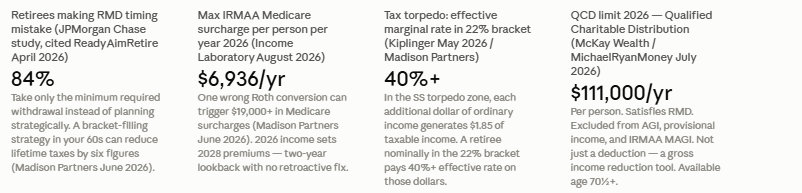
A JPMorgan Chase study, cited by ReadyAimRetire.com in April 2026, found that 84% of retirees make the mistake of only withdrawing the minimum required amount from their retirement accounts, rather than planning withdrawals strategically around the tax brackets available during the gap years. Madison Partners' June 2026 tax planning analysis states the consequence directly: a dynamic strategy that fills lower tax brackets with IRA withdrawals in your 60s before RMDs begin can reduce your lifetime tax bill by six figures. The three mistakes in this guide are the specific ways that opportunity gets squandered — and the specific 2026 rules and numbers behind each one.
84% of retirees make the mistake of only withdrawing the minimum required amount rather than planning strategically around available tax brackets (JPMorgan Chase study, cited ReadyAimRetire.com April 2026). A dynamic tax bracket-filling strategy in your 60s can reduce lifetime taxes by six figures (Madison Partners June 2026). In 2026, joint filers can convert IRA dollars at just 12% up to $100,800 — before RMDs stack that income higher. 2026 IRMAA surcharges: $1,148-$6,936 per person per year above base premium. The tax torpedo: a retiree in the 22% bracket can face 40%+ effective rates once SS and RMDs interact. QCD limit 2026: $111,000 per person per year, excluded from AGI and provisional income.
AOL's June 30, 2026 analysis describes this as the '11-year tax window most retirees miss' between ages 62 and 73. In 2026, under the IRS brackets from Revenue Procedure 2025-32, a married couple filing jointly can have up to $100,800 of taxable income in the 12% bracket. Above their $32,200 standard deduction, that means gross income up to approximately $133,000 before the 22% bracket starts. For most retirees who have stopped working, this bracket space is wide open — and it is space that IRA withdrawals or Roth conversions can fill at historically low rates.
The window closes when RMDs begin. Under SECURE 2.0, the RMD age is 73 for those born between 1951 and 1959, and will increase to 75 for those born in 1960 or later. Once RMDs begin, the withdrawal is no longer optional — the IRS requires a minimum distribution calculated annually from the account balance and a life expectancy factor from IRS tables. A $1 million traditional IRA at age 75 might generate a $48,780 mandatory withdrawal. Combined with a pension and Social Security, that can stack income into the 22% to 24% bracket while simultaneously pushing Social Security into 85% taxation and triggering IRMAA surcharges. The retiree is no longer choosing their taxable income. The formula is choosing it for them.
The critical insight: the gap years in your 60s are not a reward for saving well. They are an opportunity to restructure your retirement income — permanently — by converting traditional IRA balances to Roth, drawing down taxable accounts, and filling low brackets intentionally. Every year you do nothing in your 60s is a year those bracket slots go unused. They do not carry forward. The 12% bracket you did not use in 2025 cannot be applied to 2030 when RMDs are forcing income into 22% or 24% territory. Source: Kiplinger; AOL June 30, 2026; Madison Partners June 2026. Not tax advice.
The mathematics of why your 60s are the optimal time: in the gap years before RMDs and Social Security, your taxable income may be near zero or in the lowest brackets you have occupied since early in your career. Every dollar you convert now at 12% is a dollar you do not have to distribute later at 22% or 24% — forced out by an RMD calculation you cannot control. The conversion tax is higher today than doing nothing today; it is lower than the tax on the same dollar when mandatory distributions begin. Once RMDs start at 73, the lowest-tax conversion years are gone and the unconverted balance becomes a tax bill the retiree no longer controls, as AOL's June 2026 analysis states.
The SECURE 2.0 Act pushed the RMD start age to 73 for most current retirees, which is specifically what creates the modern conversion window, as Yahoo Finance's August 15, 2026 profile of optimal Roth conversion strategy explains. Anyone born between 1951 and 1959 has until 73 before the first mandatory distribution. If they retired at 62, that is eleven years of potential conversion time at below-working-income tax rates.
Roth conversion illustration. Starting balance: $500,000 traditional IRA. No conversions: IRA grows to approximately $800,000 at age 73 (assuming modest growth). RMD at 73 (27.4-year divisor): approximately $29,197. Add SS ($36,000), pension ($24,000): total income $89,197 — 85% of SS becomes taxable. Effective tax burden: meaningful and rising each year as the balance grows. With conversions: convert $50,000/year from age 65 to 72 (8 years) at 12-22% rates. IRA balance at 73 reduced by approximately $400,000 in pre-tax value. RMD at 73 drops correspondingly. SS tax impact reduced. IRMAA risk reduced. A couple who converts $50,000/year from 65 to 72 can drop their RMD at 73 from $100,000+ to $50,000 (Financial Advisors for RMD 2026). Not tax advice — individual results depend on account balance, growth rate, conversion amounts, and other income.
Five specific Roth conversion mistakes to avoid. First: paying conversion taxes from IRA funds. The conversion tax should be paid from a taxable brokerage account, not from the IRA itself — otherwise you are reducing the converted amount while triggering the same tax. Second: forgetting the 5-year rule. Each Roth conversion starts its own 5-year penalty-free withdrawal clock. If you are under 59½, converted money accessed within 5 years of conversion triggers the 10% early withdrawal penalty on that conversion amount. Third: not checking IRMAA two years out (see Mistake #2 below). Fourth: large lump-sum conversions that spike income in one year. Converting gradually over multiple years keeps each year's income in the target bracket. Fifth: forgetting the pro-rata rule if you have both pre-tax and after-tax (non-deductible) IRA contributions — this complicates conversion taxation. Source: ReadyAimRetire.com April 2026; Madison Partners 2026. Not tax advice.
This last point is the critical multiplier. Roth distributions are not just tax-free in the income sense. They are tax-invisible in every calculation that determines what else you owe. A $50,000 Roth distribution is not in your AGI. It does not push Social Security benefits into higher taxability tiers. It does not count toward IRMAA MAGI. It does not affect whether you qualify for certain credits or deductions. A $50,000 traditional IRA withdrawal, by contrast, raises your AGI by $50,000, potentially triggering all three of those effects simultaneously.
The optimal conversion strategy in 2026 for most retirees is 'bracket filling' — converting enough each year to bring taxable income up to (but not past) the top of the current bracket. For joint filers in 2026, the 12% bracket runs to $100,800 of taxable income, and the 22% bracket runs to $211,400. After the $32,200 standard deduction, the 12% bracket covers gross income up to $133,000. Retirees with Social Security not yet claimed and no RMDs may have significant room to fill before reaching those thresholds, and converting in that space permanently reduces future RMD exposure.
Four-step conversion planning checklist for retirees in their 60s. Step 1 — Estimate your taxable income for the year from all sources (pension, interest, capital gains, any Social Security already claimed). Step 2 — Identify how much bracket space remains before crossing the next bracket threshold or IRMAA tier. Step 3 — Convert up to that amount from your traditional IRA/401(k), paying the conversion tax from taxable brokerage funds, not from the IRA. Step 4 — Project 2 years forward: does this conversion push your MAGI above the IRMAA Tier 1 threshold ($109,000 single / $218,000 joint)? If yes, scale back the conversion to avoid the cliff surcharge. Repeat annually throughout the window years. Not tax advice — work with a qualified CPA.
The OBBBA senior deduction initially seems like a pure positive for retirees. But Madison Partners' May 29, 2026 analysis of 2026 Roth conversion traps identifies a subtle complication: once you turn 65, every Roth conversion dollar above $150,000 MAGI is operating in the senior deduction phase-out zone. This effectively increases the marginal cost of conversions above that threshold for taxpayers aged 65 and older. Converting in your early 60s — before you turn 65 and before Medicare IRMAA even applies — sidesteps this phase-out problem entirely.
AOL's June 2026 tax window analysis confirms this logic, noting that the OBBBA interaction means advisers are increasingly modelling conversion activity as 'pre-Medicare' (ages 60-64, no IRMAA, no senior deduction phase-out) and 'post-Medicare' (ages 65+, IRMAA applies, senior deduction phase-out above $150k) with very different sizing logic for each phase. Pre-Medicare conversions can often be larger. Post-Medicare conversions need to respect both the IRMAA cliffs and the senior deduction thresholds.
The OBBBA conclusion for Roth conversion timing: if you retire before 65, your early-60s years are actually the most conversion-friendly of the entire window. IRMAA does not apply. The senior deduction phase-out does not apply. Taxable income is often near its lowest. Conversions in these years carry the lowest combined immediate and future cost. The fix: if possible, front-load conversion activity in the years before Medicare begins. Work with a CPA to model the specific amounts each year. Not tax advice.
Madison Partners' June 24, 2026 analysis headline puts the stakes plainly: 'One Roth conversion in the wrong year can trigger $19,000+ in Medicare surcharges.' Yahoo Finance's August 15, 2026 profile confirms the specific IRMAA mechanics: 'A big 2026 conversion sets your 2028 Part B and Part D surcharges. The 2026 IRMAA brackets start biting joint filers above $218,000 in MAGI and hit the top surcharge at $750,000, adding as much as $487 per month on Part B alone.'
The lookback creates a planning opportunity most people miss, but also a trap for those who do not account for it. For someone who retires in their late 50s or early 60s, ages 59 to 63 are a window where Roth conversions have zero IRMAA consequences: no Medicare, no lookback applies. But the moment Medicare begins at 65, the two-year lookback means income at 63 sets premiums at 65. Income at 64 sets premiums at 66. Every year of the conversion window needs to be tracked against the IRMAA calendar, not just the income tax brackets.
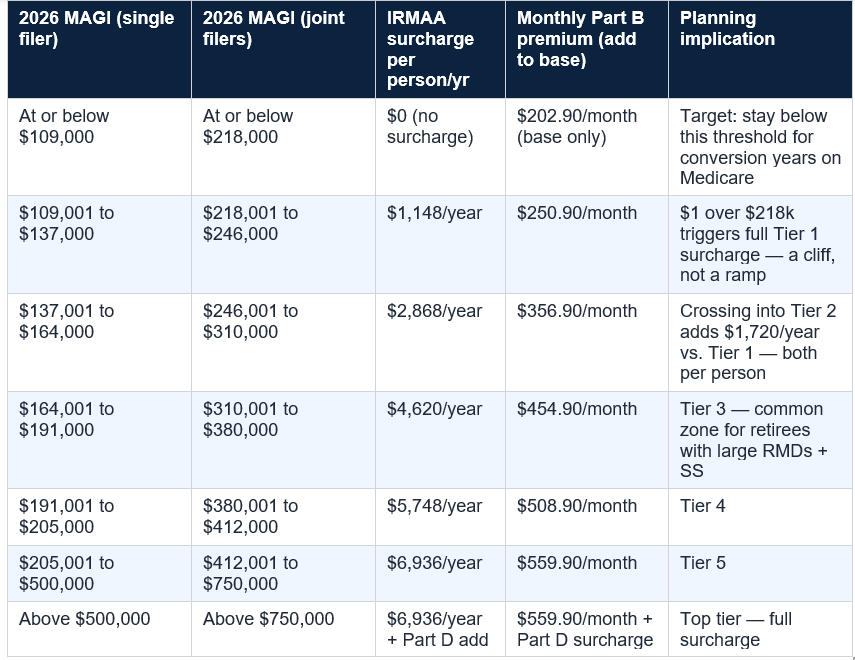
But a joint couple crossing the $218,001 MAGI threshold by just $1 triggers an additional $1,148 per person per year in IRMAA surcharges — $2,296 combined — on top of their standard premiums. Crossing into Tier 2 ($246,001) adds another $1,720 per person. At Tier 5 ($412,001 joint), the surcharge alone is $6,936 per person per year — $13,872 combined for a married couple — before even counting the standard base premium.
The Income Laboratory's August 2026 IRMAA advisor guide calculates that approximately 8% of Medicare beneficiaries — roughly 5.4 million people in 2026 — pay IRMAA surcharges. Many of them triggered the surcharge with a Roth conversion, a large capital gain, or a RMD that crossed a tier boundary without realising it. The IRMAA calculation also includes municipal bond interest, which surprises retirees who hold muni bonds expecting them to be fully tax-invisible. Tax-exempt interest counts in IRMAA MAGI even though it does not count in federal taxable income.
The surviving spouse IRMAA cliff is one of the most underappreciated risk factors in retirement tax planning. A married couple with $200,000 of combined income files jointly and stays below the $218,000 MFJ Tier 1 threshold — no IRMAA surcharge. When one spouse dies, the survivor now files as a single taxpayer. The same $200,000 of income (reduced somewhat but often not dramatically — pension and IRA distributions continue at similar levels) against the single-filer Tier 3 threshold ($164,001-$191,000) can push the survivor into paying $4,620/year in IRMAA surcharges per person — an additional $3,472/year triggered purely by the filing status change, not any actual increase in income (Income Laboratory August 2026). Pre-planning Roth conversions to reduce MAGI protects the surviving spouse from this cliff. Not tax advice.
A retired couple filing jointly with $200,000 MAGI in 2026 is below the MFJ Tier 1 threshold of $218,000. They pay no IRMAA surcharge. In 2027, one spouse dies. The survivor's income does not drop proportionally — the IRA still generates distributions, the surviving spouse's Social Security benefit continues (at the higher of the two benefits), and pension income continues in most structures. If the survivor's income remains around $175,000 and they now file as a Single taxpayer, that $175,000 against the single-filer Tier 3 threshold ($164,001-$191,000) triggers $4,620/year per person in IRMAA surcharges — up from $0 on the joint return.
The fix is to reduce MAGI proactively before either spouse reaches Medicare-enrollment age, using Roth conversions during the conversion window to bring the balance of traditional IRA assets down to a level where even Single-filing income stays below the IRMAA cliff. A surviving spouse with $100,000 in MAGI stays below the $109,000 Single Tier 1 threshold and avoids the surcharge entirely.
To understand the torpedo, you need to understand how Social Security benefits are taxed. The IRS uses a formula called 'provisional income' to determine what percentage of your Social Security benefit is taxable: your adjusted gross income, plus any tax-exempt interest, plus half of your gross Social Security benefit. For married couples filing jointly, up to 50% of Social Security benefits become taxable when provisional income exceeds $32,000, and up to 85% become taxable when provisional income exceeds $44,000. These thresholds have never been adjusted for inflation since they were set in the 1980s — which is why nearly 90% of higher-income retirees now have 85% of their Social Security in taxable income, according to financial advisors for retirees' 2026 analysis.
The torpedo effect: in the income zone where Social Security transitions from 50% taxable to 85% taxable, each additional dollar of ordinary income (an RMD, a pension payment, a capital gain) does not just add $1.00 to taxable income. It adds $1.85 — the dollar itself plus $0.85 of newly taxable Social Security income that was below the threshold a moment before. A retiree in the 22% ordinary income bracket who earns one additional dollar in the torpedo zone pays: 22% on the $1.00 of ordinary income plus 22% on $0.85 of newly taxable Social Security = $1.22 x 22% / $1.00 = effectively ~40% marginal rate on that dollar. Kiplinger's May 2026 analysis of the torpedo, cited by Madison Partners, states: 'In the 2026 tax torpedo zone, a couple with joint income of $253,000 sits in the 22-24% federal bracket, but the effective rate on certain dollars can exceed 40% once RMDs, Social Security taxation, and IRMAA are stacked together.'
Tax torpedo worked example — married couple, 2026 (approximate). Income: Pension $20,000. Social Security (gross) $42,000. RMD at age 75 from $1.2M IRA: $48,780 (based on IRS Uniform Lifetime Table). Step 1 — Provisional income for SS taxation: $20,000 + $48,780 + half of $42,000 ($21,000) = $89,780. Well above $44,000 MFJ threshold. 85% of $42,000 SS ($35,700) becomes taxable. Step 2 — Taxable income: Pension $20,000 + RMD $48,780 + Taxable SS $35,700 = $104,480 gross income. Minus standard deduction $32,200. Minus OBBBA senior add-on (MFJ, age 65+): $12,000. Taxable income: approximately $60,280. Step 3 — Federal income tax: approximately $6,420 (12% bracket covers most of this). Step 4 — MAGI: $104,480. Below 2026 IRMAA Tier 1 threshold ($218,000 MFJ). No IRMAA surcharge at this income level. NET: this couple pays approximately $6,420 in federal income tax on $110,780 in total cash received — an effective rate of 5.8%. The torpedo hit is when income rises above $44k provisional income. Not tax advice — calculated on simplified assumptions.
The torpedo bites hardest for couples in the $80,000 to $200,000 total income range where provisional income is above $44,000 (triggering 85% SS taxability) but taxable income is in the 22% to 24% bracket range. A single retiree in the 22% bracket whose additional $10,000 of RMD pushes 85% of their Social Security into taxable territory effectively pays 22% x (1 + 0.85) = approximately 40.7% on that additional dollar of RMD. No additional IRMAA surcharge needed — the torpedo alone creates the 40%+ rate.
The distinction is critical. A conventional charitable contribution requires itemising deductions (most retirees use the standard deduction and cannot itemise) and reduces only taxable income. A QCD excludes the distribution from gross income entirely — it never appears in AGI. That means it does not count toward provisional income for Social Security taxation, it does not count toward IRMAA MAGI, and it does not appear in any of the threshold calculations that trigger cascading tax effects.
Michael Ryan Money's July 2026 analysis explains the QCD advantage directly: compare the standard route (take a $10,000 RMD, pay tax at marginal rate, then donate $10,000 from checking and itemise the deduction) to the QCD route (transfer $10,000 directly from IRA to charity). At the 24% bracket, the conventional route nets zero tax benefit — you pay $2,400 in tax on the RMD and deduct $2,400. But the conventional route also inflated AGI by $10,000, potentially triggering IRMAA and additional Social Security taxation. The QCD route bypasses both. McKay Wealth Management's May 2026 analysis confirms: 'It's not just a tax deduction — it's a gross income reduction tool.'
The QCD tax form trap: your IRA custodian will issue a Form 1099-R that shows the full QCD amount as a taxable distribution — because the IRS does not require custodians to code QCDs separately. If you do not explicitly report the QCD to your CPA or flag it in your tax software, the IRS will assume the entire distribution is fully taxable income and tax it accordingly. The QCD election is made on your tax return, and you must maintain documentation of the direct transfer from IRA to charity. This is the single most common QCD filing error, per MichaelRyanMoney.com July 2026. Not tax advice — always work with a qualified CPA.
The three mistakes in this guide — missing the Roth conversion window, ignoring the IRMAA two-year lookback, and failing to plan around the tax torpedo before it fires — are all versions of the same underlying error: treating low-tax years as passive wins rather than active opportunities. The JPMorgan Chase study's finding that 84% of retirees only take their minimum required withdrawal is a finding about missed opportunities, not just missed withdrawals.
The corrective actions are not exotic: annual Roth conversions sized to bracket space and IRMAA thresholds, QCDs after age 70½ to eliminate charitable amounts from AGI, and deliberate bracket-filling IRA withdrawals before RMDs force the issue at 73. None of them require timing the market. All of them require working with a qualified CPA or tax-focused financial adviser who understands how these rules interact in 2026. The window is open. Not tax advice.
The golden tax window refers to the period between retiring and the start of Required Minimum Distributions at age 73 — typically ages 60 to 72 under SECURE 2.0 for most current retirees. During this window, taxable income often reaches its lowest point: wages have stopped, Social Security can be delayed, and RMDs have not yet begun. AOL's June 30, 2026 analysis calls it the '11-year tax window most retirees miss.' In 2026, married couples filing jointly can have up to $100,800 of taxable income in the 12% bracket (IRS Revenue Procedure 2025-32). Filling this bracket space with Roth conversions or voluntary IRA withdrawals permanently reduces future RMD exposure and the associated taxes that compound once mandatory distributions begin. Once RMDs start at 73, the flexibility to choose taxable income is replaced by a mandatory formula.
What is the IRMAA two-year lookback and why does it matter for Roth conversions?
IRMAA (Income-Related Monthly Adjustment Amount) is a Medicare Part B and Part D premium surcharge based on your MAGI from two years prior. Your 2026 income determines your 2028 Medicare premiums. A large Roth conversion in 2026 that pushes MAGI above $109,000 (single) or $218,000 (joint) in 2026 will trigger IRMAA surcharges in 2028 — even if your income in 2027 and 2028 is back below the threshold. The 2026 IRMAA surcharges range from $1,148 to $6,936 per person per year above the standard Part B premium of $202.90/month, according to Income Laboratory's August 2026 IRMAA advisor guide. Madison Partners' June 2026 analysis puts the worst-case impact at over $19,000 in Medicare surcharges from a single poorly timed conversion. The fix: before executing any Roth conversion, project your MAGI two years forward and check it against the IRMAA thresholds that will apply. Even splitting a large conversion across two to three years can keep you below a cliff threshold. Not tax advice.
What is the tax torpedo in retirement?
The tax torpedo is the interaction between Required Minimum Distributions and Social Security taxation that creates an effective marginal tax rate significantly higher than the nominal bracket rate. The IRS uses 'provisional income' to determine Social Security taxability: your AGI plus any tax-exempt interest plus half your gross Social Security benefit. For married couples, once provisional income exceeds $44,000, up to 85% of Social Security becomes taxable. Because these thresholds have never been adjusted for inflation, nearly 90% of higher-income retirees now have 85% of their benefits in taxable income. In the zone where Social Security transitions from 50% to 85% taxable, each additional dollar of ordinary income (like an RMD) generates $1.85 of taxable income — creating an effective marginal rate over 40% for a retiree nominally in the 22% bracket. Kiplinger's May 2026 analysis describes a couple with $253,000 joint income facing effective rates above 40% on certain dollars despite being in the 22-24% nominal bracket. Not tax advice.
What is a QCD and how does it reduce taxes in retirement?
A Qualified Charitable Distribution (QCD) is a direct transfer from a traditional IRA to a qualified charity made by an IRA owner aged 70½ or older. The 2026 limit is $111,000 per person per year, indexed annually. The crucial tax advantage: a QCD satisfies all or part of your RMD requirement while being excluded from gross income entirely. It does not appear in AGI, does not count toward Social Security provisional income, and does not count toward IRMAA MAGI. By contrast, taking the RMD as income and then donating to charity requires itemising deductions — which most retirees cannot do after the standard deduction exceeds their itemisable expenses. The QCD is not just a tax deduction; it is a gross income reduction tool that can reduce Social Security taxability and avoid IRMAA surcharges simultaneously. Critical: your IRA custodian will issue a Form 1099-R that shows the QCD as a taxable distribution. You must explicitly report it as a QCD on your tax return or the IRS will tax it as ordinary income. Work with a qualified CPA. Source: McKay Wealth May 2026; MichaelRyanMoney.com July 2026.
What changed about Roth conversions under the OBBBA in 2026?
The One Big Beautiful Bill Act (OBBBA), signed July 4, 2025, introduced a new $6,000 additional deduction for taxpayers aged 65 and older ($12,000 for qualifying joint filers where both are 65+), effective for tax years 2025 through 2028. This deduction phases out for joint filers above $150,000 MAGI. The OBBBA interaction with Roth conversions: once you turn 65, conversion dollars above $150,000 MAGI enter the phase-out zone, slightly increasing the effective marginal cost of conversion above that threshold. This is why Madison Partners' May 29, 2026 analysis notes that advisers are increasingly modelling conversions as 'pre-Medicare' (ages 60-64, no IRMAA, no senior deduction phase-out, potentially largest safe conversion amounts) and 'post-Medicare' (ages 65+, requires IRMAA management and senior deduction phase-out tracking). AOL's June 2026 analysis confirms: 'Converting in your early 60s sidesteps that problem entirely.' The OBBBA also kept TCJA brackets permanent at 37% top rate rather than allowing reversion to 39.6%, which slightly changes the long-term rate comparison for conversions. Not tax advice — consult a qualified CPA.
Table of Contents
- The Low-Tax Years That Most Retirees Waste
- The Golden Tax Window: Ages 60-73 and Why It Matters
- Mistake #1 — Missing the Roth Conversion Window
- How Roth Conversions Work and Why Your 60s Are the Optimal Time
- The OBBBA Senior Deduction and Its Surprising Impact on Roth Timing
- Mistake #2 — Triggering the IRMAA Two-Year Lookback Trap
- The 2026 IRMAA Brackets: How Much the Surcharges Actually Cost
- The Surviving Spouse Cliff: The IRMAA Risk Nobody Discusses
- Mistake #3 — The Tax Torpedo: When Social Security and RMDs Collide
- How the Tax Torpedo Creates a 40%+ Effective Rate in a 22% Bracket
- The QCD: The Fix for Both the Torpedo and the IRMAA Trap
- A Worked Example: Bob and Sue's Two Retirements
- Conclusion: Your 60s Are Not a Low-Tax Holiday — They Are the Last Chance
- Frequently Asked Questions
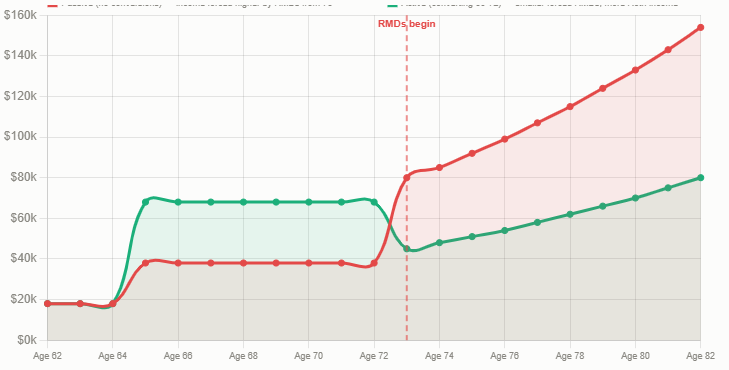
The golden tax window: taxable income from age 60 to 80+
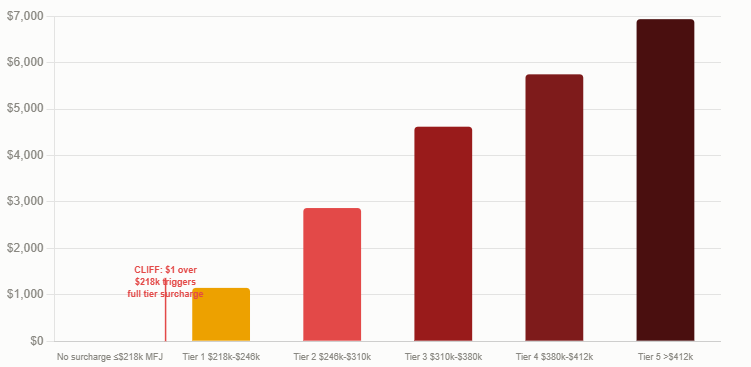
IRMAA cliff: 2026 Medicare surcharge brackets
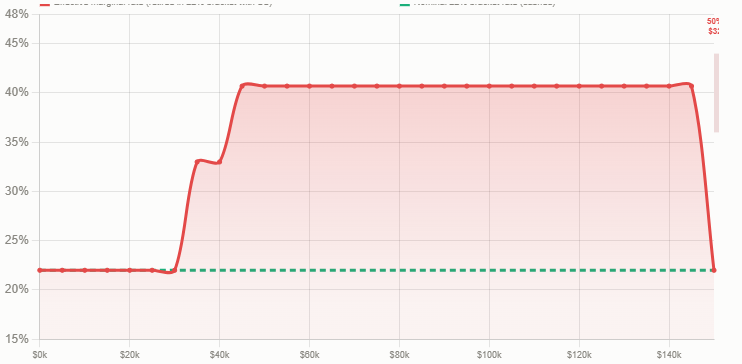
The tax torpedo: how SS + RMDs create 40%+ effective rates
The Low-Tax Years That Most Retirees Waste
Imagine two couples. Bob and Sue retire at 62. Their tax bill drops dramatically — no wages, Social Security not yet claimed, no Required Minimum Distributions. Each year they owe a fraction of what they paid during their working years. They feel good about their finances. They are in control. What they do not know is that they are sitting inside a tax planning window that will never reopen, and they are doing nothing with it.This is the scenario Kiplinger describes in its feature on the three biggest tax mistakes retirees can make during what it calls the 'golden tax planning window.' Bob and Sue were actually enjoying tax season in the early part of retirement. Each low-tax year felt like a win. It was, instead, a missed opportunity — a chance to choose how much of their retirement income would be taxable, rather than having the IRS dictate mandatory taxable withdrawals when RMDs began at 73.
A JPMorgan Chase study, cited by ReadyAimRetire.com in April 2026, found that 84% of retirees make the mistake of only withdrawing the minimum required amount from their retirement accounts, rather than planning withdrawals strategically around the tax brackets available during the gap years. Madison Partners' June 2026 tax planning analysis states the consequence directly: a dynamic strategy that fills lower tax brackets with IRA withdrawals in your 60s before RMDs begin can reduce your lifetime tax bill by six figures. The three mistakes in this guide are the specific ways that opportunity gets squandered — and the specific 2026 rules and numbers behind each one.
84% of retirees make the mistake of only withdrawing the minimum required amount rather than planning strategically around available tax brackets (JPMorgan Chase study, cited ReadyAimRetire.com April 2026). A dynamic tax bracket-filling strategy in your 60s can reduce lifetime taxes by six figures (Madison Partners June 2026). In 2026, joint filers can convert IRA dollars at just 12% up to $100,800 — before RMDs stack that income higher. 2026 IRMAA surcharges: $1,148-$6,936 per person per year above base premium. The tax torpedo: a retiree in the 22% bracket can face 40%+ effective rates once SS and RMDs interact. QCD limit 2026: $111,000 per person per year, excluded from AGI and provisional income.
The Golden Tax Window: Ages 60-73 and Why It Matters
Between the end of your working years and the start of Required Minimum Distributions at age 73, most retirees pass through an unusual valley in their lifetime income curve. Wages have stopped. Social Security can be delayed. RMDs from traditional IRAs and 401(k)s have not yet begun. For most retirees, this is the lowest-income, lowest-tax stretch of their adult lives — potentially lasting 10 to 13 years.AOL's June 30, 2026 analysis describes this as the '11-year tax window most retirees miss' between ages 62 and 73. In 2026, under the IRS brackets from Revenue Procedure 2025-32, a married couple filing jointly can have up to $100,800 of taxable income in the 12% bracket. Above their $32,200 standard deduction, that means gross income up to approximately $133,000 before the 22% bracket starts. For most retirees who have stopped working, this bracket space is wide open — and it is space that IRA withdrawals or Roth conversions can fill at historically low rates.
The window closes when RMDs begin. Under SECURE 2.0, the RMD age is 73 for those born between 1951 and 1959, and will increase to 75 for those born in 1960 or later. Once RMDs begin, the withdrawal is no longer optional — the IRS requires a minimum distribution calculated annually from the account balance and a life expectancy factor from IRS tables. A $1 million traditional IRA at age 75 might generate a $48,780 mandatory withdrawal. Combined with a pension and Social Security, that can stack income into the 22% to 24% bracket while simultaneously pushing Social Security into 85% taxation and triggering IRMAA surcharges. The retiree is no longer choosing their taxable income. The formula is choosing it for them.
The critical insight: the gap years in your 60s are not a reward for saving well. They are an opportunity to restructure your retirement income — permanently — by converting traditional IRA balances to Roth, drawing down taxable accounts, and filling low brackets intentionally. Every year you do nothing in your 60s is a year those bracket slots go unused. They do not carry forward. The 12% bracket you did not use in 2025 cannot be applied to 2030 when RMDs are forcing income into 22% or 24% territory. Source: Kiplinger; AOL June 30, 2026; Madison Partners June 2026. Not tax advice.
Mistake #1 — Missing the Roth Conversion Window
The first and most discussed mistake is failing to do Roth conversions during the low-income years before RMDs begin. A Roth conversion means taking money from a traditional IRA or 401(k) — which was contributed pre-tax and will be fully taxable when withdrawn — and moving it into a Roth IRA, paying the income tax now. In exchange, the converted money grows tax-free and Roth distributions in retirement do not count as taxable income for any purpose: not for federal income tax, not for Social Security provisional income, not for IRMAA MAGI.The mathematics of why your 60s are the optimal time: in the gap years before RMDs and Social Security, your taxable income may be near zero or in the lowest brackets you have occupied since early in your career. Every dollar you convert now at 12% is a dollar you do not have to distribute later at 22% or 24% — forced out by an RMD calculation you cannot control. The conversion tax is higher today than doing nothing today; it is lower than the tax on the same dollar when mandatory distributions begin. Once RMDs start at 73, the lowest-tax conversion years are gone and the unconverted balance becomes a tax bill the retiree no longer controls, as AOL's June 2026 analysis states.
The SECURE 2.0 Act pushed the RMD start age to 73 for most current retirees, which is specifically what creates the modern conversion window, as Yahoo Finance's August 15, 2026 profile of optimal Roth conversion strategy explains. Anyone born between 1951 and 1959 has until 73 before the first mandatory distribution. If they retired at 62, that is eleven years of potential conversion time at below-working-income tax rates.
Roth conversion illustration. Starting balance: $500,000 traditional IRA. No conversions: IRA grows to approximately $800,000 at age 73 (assuming modest growth). RMD at 73 (27.4-year divisor): approximately $29,197. Add SS ($36,000), pension ($24,000): total income $89,197 — 85% of SS becomes taxable. Effective tax burden: meaningful and rising each year as the balance grows. With conversions: convert $50,000/year from age 65 to 72 (8 years) at 12-22% rates. IRA balance at 73 reduced by approximately $400,000 in pre-tax value. RMD at 73 drops correspondingly. SS tax impact reduced. IRMAA risk reduced. A couple who converts $50,000/year from 65 to 72 can drop their RMD at 73 from $100,000+ to $50,000 (Financial Advisors for RMD 2026). Not tax advice — individual results depend on account balance, growth rate, conversion amounts, and other income.
Five specific Roth conversion mistakes to avoid. First: paying conversion taxes from IRA funds. The conversion tax should be paid from a taxable brokerage account, not from the IRA itself — otherwise you are reducing the converted amount while triggering the same tax. Second: forgetting the 5-year rule. Each Roth conversion starts its own 5-year penalty-free withdrawal clock. If you are under 59½, converted money accessed within 5 years of conversion triggers the 10% early withdrawal penalty on that conversion amount. Third: not checking IRMAA two years out (see Mistake #2 below). Fourth: large lump-sum conversions that spike income in one year. Converting gradually over multiple years keeps each year's income in the target bracket. Fifth: forgetting the pro-rata rule if you have both pre-tax and after-tax (non-deductible) IRA contributions — this complicates conversion taxation. Source: ReadyAimRetire.com April 2026; Madison Partners 2026. Not tax advice.
How Roth Conversions Work and Why Your 60s Are the Optimal Time
A Roth conversion is a taxable event in the year it occurs. The converted amount is added to your gross income for that year and taxed at your marginal rate. After conversion, the money sits in the Roth IRA and grows tax-free. Qualified distributions — generally those taken at least five years after the conversion and after age 59½ — come out completely tax-free, with no impact on AGI, no impact on Social Security provisional income calculations, and no impact on IRMAA Medicare premium determinations.This last point is the critical multiplier. Roth distributions are not just tax-free in the income sense. They are tax-invisible in every calculation that determines what else you owe. A $50,000 Roth distribution is not in your AGI. It does not push Social Security benefits into higher taxability tiers. It does not count toward IRMAA MAGI. It does not affect whether you qualify for certain credits or deductions. A $50,000 traditional IRA withdrawal, by contrast, raises your AGI by $50,000, potentially triggering all three of those effects simultaneously.
The optimal conversion strategy in 2026 for most retirees is 'bracket filling' — converting enough each year to bring taxable income up to (but not past) the top of the current bracket. For joint filers in 2026, the 12% bracket runs to $100,800 of taxable income, and the 22% bracket runs to $211,400. After the $32,200 standard deduction, the 12% bracket covers gross income up to $133,000. Retirees with Social Security not yet claimed and no RMDs may have significant room to fill before reaching those thresholds, and converting in that space permanently reduces future RMD exposure.
Four-step conversion planning checklist for retirees in their 60s. Step 1 — Estimate your taxable income for the year from all sources (pension, interest, capital gains, any Social Security already claimed). Step 2 — Identify how much bracket space remains before crossing the next bracket threshold or IRMAA tier. Step 3 — Convert up to that amount from your traditional IRA/401(k), paying the conversion tax from taxable brokerage funds, not from the IRA. Step 4 — Project 2 years forward: does this conversion push your MAGI above the IRMAA Tier 1 threshold ($109,000 single / $218,000 joint)? If yes, scale back the conversion to avoid the cliff surcharge. Repeat annually throughout the window years. Not tax advice — work with a qualified CPA.
The OBBBA Senior Deduction and Its Surprising Impact on Roth Timing
The One Big Beautiful Bill Act (OBBBA), signed July 4, 2025, introduced a new planning variable for retirees in their 60s: a $6,000 additional deduction for taxpayers aged 65 and older, or up to $12,000 for qualifying joint filers where both spouses are 65 or older. This deduction is effective for tax years 2025 through 2028 only, and it phases out for joint filers above $150,000 MAGI.The OBBBA senior deduction initially seems like a pure positive for retirees. But Madison Partners' May 29, 2026 analysis of 2026 Roth conversion traps identifies a subtle complication: once you turn 65, every Roth conversion dollar above $150,000 MAGI is operating in the senior deduction phase-out zone. This effectively increases the marginal cost of conversions above that threshold for taxpayers aged 65 and older. Converting in your early 60s — before you turn 65 and before Medicare IRMAA even applies — sidesteps this phase-out problem entirely.
AOL's June 2026 tax window analysis confirms this logic, noting that the OBBBA interaction means advisers are increasingly modelling conversion activity as 'pre-Medicare' (ages 60-64, no IRMAA, no senior deduction phase-out) and 'post-Medicare' (ages 65+, IRMAA applies, senior deduction phase-out above $150k) with very different sizing logic for each phase. Pre-Medicare conversions can often be larger. Post-Medicare conversions need to respect both the IRMAA cliffs and the senior deduction thresholds.
The OBBBA conclusion for Roth conversion timing: if you retire before 65, your early-60s years are actually the most conversion-friendly of the entire window. IRMAA does not apply. The senior deduction phase-out does not apply. Taxable income is often near its lowest. Conversions in these years carry the lowest combined immediate and future cost. The fix: if possible, front-load conversion activity in the years before Medicare begins. Work with a CPA to model the specific amounts each year. Not tax advice.
Mistake #2 — Triggering the IRMAA Two-Year Lookback Trap
The second major mistake is executing a large Roth conversion — or taking a large IRA withdrawal — without accounting for the effect on Medicare premiums two years later. IRMAA (Income-Related Monthly Adjustment Amount) is a Medicare premium surcharge that applies when your Modified Adjusted Gross Income (MAGI) from two years prior exceeds certain thresholds. Your 2026 income determines your 2028 Medicare Part B and Part D premiums. By the time the surcharge bill arrives, nothing can be changed retroactively.Madison Partners' June 24, 2026 analysis headline puts the stakes plainly: 'One Roth conversion in the wrong year can trigger $19,000+ in Medicare surcharges.' Yahoo Finance's August 15, 2026 profile confirms the specific IRMAA mechanics: 'A big 2026 conversion sets your 2028 Part B and Part D surcharges. The 2026 IRMAA brackets start biting joint filers above $218,000 in MAGI and hit the top surcharge at $750,000, adding as much as $487 per month on Part B alone.'
The lookback creates a planning opportunity most people miss, but also a trap for those who do not account for it. For someone who retires in their late 50s or early 60s, ages 59 to 63 are a window where Roth conversions have zero IRMAA consequences: no Medicare, no lookback applies. But the moment Medicare begins at 65, the two-year lookback means income at 63 sets premiums at 65. Income at 64 sets premiums at 66. Every year of the conversion window needs to be tracked against the IRMAA calendar, not just the income tax brackets.
The 2026 IRMAA Brackets: How Much the Surcharges Actually Cost
The dollar magnitude of IRMAA surcharges often surprises retirees who have not tracked them closely. At the standard 2026 Medicare Part B premium of $202.90 per month per person ($2,434.80 per year), two spouses together pay $4,869.60 annually with no IRMAA surcharge. Add the Part D premium on top and the total baseline is meaningful.But a joint couple crossing the $218,001 MAGI threshold by just $1 triggers an additional $1,148 per person per year in IRMAA surcharges — $2,296 combined — on top of their standard premiums. Crossing into Tier 2 ($246,001) adds another $1,720 per person. At Tier 5 ($412,001 joint), the surcharge alone is $6,936 per person per year — $13,872 combined for a married couple — before even counting the standard base premium.
The Income Laboratory's August 2026 IRMAA advisor guide calculates that approximately 8% of Medicare beneficiaries — roughly 5.4 million people in 2026 — pay IRMAA surcharges. Many of them triggered the surcharge with a Roth conversion, a large capital gain, or a RMD that crossed a tier boundary without realising it. The IRMAA calculation also includes municipal bond interest, which surprises retirees who hold muni bonds expecting them to be fully tax-invisible. Tax-exempt interest counts in IRMAA MAGI even though it does not count in federal taxable income.
The surviving spouse IRMAA cliff is one of the most underappreciated risk factors in retirement tax planning. A married couple with $200,000 of combined income files jointly and stays below the $218,000 MFJ Tier 1 threshold — no IRMAA surcharge. When one spouse dies, the survivor now files as a single taxpayer. The same $200,000 of income (reduced somewhat but often not dramatically — pension and IRA distributions continue at similar levels) against the single-filer Tier 3 threshold ($164,001-$191,000) can push the survivor into paying $4,620/year in IRMAA surcharges per person — an additional $3,472/year triggered purely by the filing status change, not any actual increase in income (Income Laboratory August 2026). Pre-planning Roth conversions to reduce MAGI protects the surviving spouse from this cliff. Not tax advice.
The Surviving Spouse Cliff: The IRMAA Risk Nobody Discusses
The surviving spouse IRMAA cliff deserves its own section because it is consistently underplanned for and the financial impact can be severe and immediate. Income Laboratory's August 2026 IRMAA advisor guide walks through the mathematics in detail.A retired couple filing jointly with $200,000 MAGI in 2026 is below the MFJ Tier 1 threshold of $218,000. They pay no IRMAA surcharge. In 2027, one spouse dies. The survivor's income does not drop proportionally — the IRA still generates distributions, the surviving spouse's Social Security benefit continues (at the higher of the two benefits), and pension income continues in most structures. If the survivor's income remains around $175,000 and they now file as a Single taxpayer, that $175,000 against the single-filer Tier 3 threshold ($164,001-$191,000) triggers $4,620/year per person in IRMAA surcharges — up from $0 on the joint return.
The fix is to reduce MAGI proactively before either spouse reaches Medicare-enrollment age, using Roth conversions during the conversion window to bring the balance of traditional IRA assets down to a level where even Single-filing income stays below the IRMAA cliff. A surviving spouse with $100,000 in MAGI stays below the $109,000 Single Tier 1 threshold and avoids the surcharge entirely.
Mistake #3 — The Tax Torpedo: When Social Security and RMDs Collide
The third mistake — and the one most likely to catch retirees completely off guard — is the tax torpedo. The torpedo describes a specific interaction between Required Minimum Distributions and Social Security benefits that can push a retiree in the 22% nominal bracket into effective marginal rates above 40% on certain dollars of income.To understand the torpedo, you need to understand how Social Security benefits are taxed. The IRS uses a formula called 'provisional income' to determine what percentage of your Social Security benefit is taxable: your adjusted gross income, plus any tax-exempt interest, plus half of your gross Social Security benefit. For married couples filing jointly, up to 50% of Social Security benefits become taxable when provisional income exceeds $32,000, and up to 85% become taxable when provisional income exceeds $44,000. These thresholds have never been adjusted for inflation since they were set in the 1980s — which is why nearly 90% of higher-income retirees now have 85% of their Social Security in taxable income, according to financial advisors for retirees' 2026 analysis.
The torpedo effect: in the income zone where Social Security transitions from 50% taxable to 85% taxable, each additional dollar of ordinary income (an RMD, a pension payment, a capital gain) does not just add $1.00 to taxable income. It adds $1.85 — the dollar itself plus $0.85 of newly taxable Social Security income that was below the threshold a moment before. A retiree in the 22% ordinary income bracket who earns one additional dollar in the torpedo zone pays: 22% on the $1.00 of ordinary income plus 22% on $0.85 of newly taxable Social Security = $1.22 x 22% / $1.00 = effectively ~40% marginal rate on that dollar. Kiplinger's May 2026 analysis of the torpedo, cited by Madison Partners, states: 'In the 2026 tax torpedo zone, a couple with joint income of $253,000 sits in the 22-24% federal bracket, but the effective rate on certain dollars can exceed 40% once RMDs, Social Security taxation, and IRMAA are stacked together.'
How the Tax Torpedo Creates a 40%+ Effective Rate in a 22% Bracket
The torpedo's damage is most severe for retirees who have large traditional IRA balances generating mandatory distributions on top of Social Security. The RMD itself is rarely the problem in isolation. The problem is what the RMD does to everything else on the return.Tax torpedo worked example — married couple, 2026 (approximate). Income: Pension $20,000. Social Security (gross) $42,000. RMD at age 75 from $1.2M IRA: $48,780 (based on IRS Uniform Lifetime Table). Step 1 — Provisional income for SS taxation: $20,000 + $48,780 + half of $42,000 ($21,000) = $89,780. Well above $44,000 MFJ threshold. 85% of $42,000 SS ($35,700) becomes taxable. Step 2 — Taxable income: Pension $20,000 + RMD $48,780 + Taxable SS $35,700 = $104,480 gross income. Minus standard deduction $32,200. Minus OBBBA senior add-on (MFJ, age 65+): $12,000. Taxable income: approximately $60,280. Step 3 — Federal income tax: approximately $6,420 (12% bracket covers most of this). Step 4 — MAGI: $104,480. Below 2026 IRMAA Tier 1 threshold ($218,000 MFJ). No IRMAA surcharge at this income level. NET: this couple pays approximately $6,420 in federal income tax on $110,780 in total cash received — an effective rate of 5.8%. The torpedo hit is when income rises above $44k provisional income. Not tax advice — calculated on simplified assumptions.
The torpedo bites hardest for couples in the $80,000 to $200,000 total income range where provisional income is above $44,000 (triggering 85% SS taxability) but taxable income is in the 22% to 24% bracket range. A single retiree in the 22% bracket whose additional $10,000 of RMD pushes 85% of their Social Security into taxable territory effectively pays 22% x (1 + 0.85) = approximately 40.7% on that additional dollar of RMD. No additional IRMAA surcharge needed — the torpedo alone creates the 40%+ rate.
The QCD: The Fix for Both the Torpedo and the IRMAA Trap
The Qualified Charitable Distribution (QCD) is one of the most powerful and underused tools in the retiree's tax toolkit. Available to IRA owners aged 70½ or older, a QCD allows a direct transfer from a traditional IRA to a qualified charity — up to $111,000 per person in 2026 (indexed annually). The QCD satisfies all or part of an RMD requirement while achieving something that a conventional charitable deduction cannot: it reduces gross income, not just taxable income.The distinction is critical. A conventional charitable contribution requires itemising deductions (most retirees use the standard deduction and cannot itemise) and reduces only taxable income. A QCD excludes the distribution from gross income entirely — it never appears in AGI. That means it does not count toward provisional income for Social Security taxation, it does not count toward IRMAA MAGI, and it does not appear in any of the threshold calculations that trigger cascading tax effects.
Michael Ryan Money's July 2026 analysis explains the QCD advantage directly: compare the standard route (take a $10,000 RMD, pay tax at marginal rate, then donate $10,000 from checking and itemise the deduction) to the QCD route (transfer $10,000 directly from IRA to charity). At the 24% bracket, the conventional route nets zero tax benefit — you pay $2,400 in tax on the RMD and deduct $2,400. But the conventional route also inflated AGI by $10,000, potentially triggering IRMAA and additional Social Security taxation. The QCD route bypasses both. McKay Wealth Management's May 2026 analysis confirms: 'It's not just a tax deduction — it's a gross income reduction tool.'
The QCD tax form trap: your IRA custodian will issue a Form 1099-R that shows the full QCD amount as a taxable distribution — because the IRS does not require custodians to code QCDs separately. If you do not explicitly report the QCD to your CPA or flag it in your tax software, the IRS will assume the entire distribution is fully taxable income and tax it accordingly. The QCD election is made on your tax return, and you must maintain documentation of the direct transfer from IRA to charity. This is the single most common QCD filing error, per MichaelRyanMoney.com July 2026. Not tax advice — always work with a qualified CPA.
A Worked Example: Bob and Sue's Two Retirements
Let us return to Bob and Sue from the introduction — the couple who was enjoying low tax bills in their 60s — and trace what happens to two versions of them: one who does nothing with the golden window, and one who uses the three strategies this guide describes.- Bob and Sue Version A (passive): Retire at 62. Take only RMDs starting at 73. Social Security claimed at 65. By age 73, traditional IRA has grown to $1.5 million. RMD at 73: approximately $54,745. Combined income with SS and small pension: $120,000+. Social Security: 85% taxable. Pushing toward IRMAA Tier 1 on joint filing. Each year of RMD growth increases future distributions. At 80, RMD from a still-growing account is larger still. The low-tax years of 62 to 72 were spent doing nothing. The tax bill in their 70s and 80s is larger than it needed to be by tens of thousands of dollars cumulatively.
- Bob and Sue Version B (active): Retire at 62. Convert $40,000-$50,000 per year from traditional IRA to Roth at 12% rates, paying taxes from taxable brokerage. Delay Social Security to age 70 (maximising the eventual benefit). By 73, the traditional IRA balance has been reduced by approximately $350,000-$400,000 in pre-tax value. RMD at 73 is correspondingly smaller — approximately $30,000-$35,000 vs. $54,745. Social Security taxability partially reduced. IRMAA risk meaningfully lower. Each future year, Roth balances provide tax-free income that does not count in any threshold calculation. Lifetime tax reduction: potentially $100,000+ over a 25-year retirement. Source: Madison Partners June 2026; AOL June 2026; Financial Advisors for RMD 2026. Not tax advice — individual outcomes depend on account balances, conversion amounts, return rates, and other income.
Conclusion
The low-tax years most retirees enjoy in their 60s are not a reward for careful saving. They are a closing window — the last time in a retiree's life when they can choose, rather than be forced, to determine how much of their traditional IRA will ever be taxed. Once RMDs begin at 73, that choice is made by a formula. Once Social Security and mandatory distributions stack together, the tax torpedo can push effective rates above 40% in a bracket that nominally says 22%. Once Medicare applies, a single large conversion in the wrong year can trigger two years of IRMAA surcharges worth thousands of dollars more than the immediate conversion tax appeared to cost.The three mistakes in this guide — missing the Roth conversion window, ignoring the IRMAA two-year lookback, and failing to plan around the tax torpedo before it fires — are all versions of the same underlying error: treating low-tax years as passive wins rather than active opportunities. The JPMorgan Chase study's finding that 84% of retirees only take their minimum required withdrawal is a finding about missed opportunities, not just missed withdrawals.
The corrective actions are not exotic: annual Roth conversions sized to bracket space and IRMAA thresholds, QCDs after age 70½ to eliminate charitable amounts from AGI, and deliberate bracket-filling IRA withdrawals before RMDs force the issue at 73. None of them require timing the market. All of them require working with a qualified CPA or tax-focused financial adviser who understands how these rules interact in 2026. The window is open. Not tax advice.
Frequently Asked Questions
What is the golden tax window for retirees in their 60s?The golden tax window refers to the period between retiring and the start of Required Minimum Distributions at age 73 — typically ages 60 to 72 under SECURE 2.0 for most current retirees. During this window, taxable income often reaches its lowest point: wages have stopped, Social Security can be delayed, and RMDs have not yet begun. AOL's June 30, 2026 analysis calls it the '11-year tax window most retirees miss.' In 2026, married couples filing jointly can have up to $100,800 of taxable income in the 12% bracket (IRS Revenue Procedure 2025-32). Filling this bracket space with Roth conversions or voluntary IRA withdrawals permanently reduces future RMD exposure and the associated taxes that compound once mandatory distributions begin. Once RMDs start at 73, the flexibility to choose taxable income is replaced by a mandatory formula.
What is the IRMAA two-year lookback and why does it matter for Roth conversions?
IRMAA (Income-Related Monthly Adjustment Amount) is a Medicare Part B and Part D premium surcharge based on your MAGI from two years prior. Your 2026 income determines your 2028 Medicare premiums. A large Roth conversion in 2026 that pushes MAGI above $109,000 (single) or $218,000 (joint) in 2026 will trigger IRMAA surcharges in 2028 — even if your income in 2027 and 2028 is back below the threshold. The 2026 IRMAA surcharges range from $1,148 to $6,936 per person per year above the standard Part B premium of $202.90/month, according to Income Laboratory's August 2026 IRMAA advisor guide. Madison Partners' June 2026 analysis puts the worst-case impact at over $19,000 in Medicare surcharges from a single poorly timed conversion. The fix: before executing any Roth conversion, project your MAGI two years forward and check it against the IRMAA thresholds that will apply. Even splitting a large conversion across two to three years can keep you below a cliff threshold. Not tax advice.
What is the tax torpedo in retirement?
The tax torpedo is the interaction between Required Minimum Distributions and Social Security taxation that creates an effective marginal tax rate significantly higher than the nominal bracket rate. The IRS uses 'provisional income' to determine Social Security taxability: your AGI plus any tax-exempt interest plus half your gross Social Security benefit. For married couples, once provisional income exceeds $44,000, up to 85% of Social Security becomes taxable. Because these thresholds have never been adjusted for inflation, nearly 90% of higher-income retirees now have 85% of their benefits in taxable income. In the zone where Social Security transitions from 50% to 85% taxable, each additional dollar of ordinary income (like an RMD) generates $1.85 of taxable income — creating an effective marginal rate over 40% for a retiree nominally in the 22% bracket. Kiplinger's May 2026 analysis describes a couple with $253,000 joint income facing effective rates above 40% on certain dollars despite being in the 22-24% nominal bracket. Not tax advice.
What is a QCD and how does it reduce taxes in retirement?
A Qualified Charitable Distribution (QCD) is a direct transfer from a traditional IRA to a qualified charity made by an IRA owner aged 70½ or older. The 2026 limit is $111,000 per person per year, indexed annually. The crucial tax advantage: a QCD satisfies all or part of your RMD requirement while being excluded from gross income entirely. It does not appear in AGI, does not count toward Social Security provisional income, and does not count toward IRMAA MAGI. By contrast, taking the RMD as income and then donating to charity requires itemising deductions — which most retirees cannot do after the standard deduction exceeds their itemisable expenses. The QCD is not just a tax deduction; it is a gross income reduction tool that can reduce Social Security taxability and avoid IRMAA surcharges simultaneously. Critical: your IRA custodian will issue a Form 1099-R that shows the QCD as a taxable distribution. You must explicitly report it as a QCD on your tax return or the IRS will tax it as ordinary income. Work with a qualified CPA. Source: McKay Wealth May 2026; MichaelRyanMoney.com July 2026.
What changed about Roth conversions under the OBBBA in 2026?
The One Big Beautiful Bill Act (OBBBA), signed July 4, 2025, introduced a new $6,000 additional deduction for taxpayers aged 65 and older ($12,000 for qualifying joint filers where both are 65+), effective for tax years 2025 through 2028. This deduction phases out for joint filers above $150,000 MAGI. The OBBBA interaction with Roth conversions: once you turn 65, conversion dollars above $150,000 MAGI enter the phase-out zone, slightly increasing the effective marginal cost of conversion above that threshold. This is why Madison Partners' May 29, 2026 analysis notes that advisers are increasingly modelling conversions as 'pre-Medicare' (ages 60-64, no IRMAA, no senior deduction phase-out, potentially largest safe conversion amounts) and 'post-Medicare' (ages 65+, requires IRMAA management and senior deduction phase-out tracking). AOL's June 2026 analysis confirms: 'Converting in your early 60s sidesteps that problem entirely.' The OBBBA also kept TCJA brackets permanent at 37% top rate rather than allowing reversion to 39.6%, which slightly changes the long-term rate comparison for conversions. Not tax advice — consult a qualified CPA.

0 Comments Comments