
Investing
3 Non-AI Stocks for Long-Term Dividends and Stability

ExxonMobil, McDonald's and Realty Income pay between roughly 2.5% and 5.6% and have limited exposure to artificial intelligence. XOM 44 years of dividend increases; MCD 50th straight raise, 2.69% yield; Realty Income AFFO payout 72.6%; SpaceX more than 40% below peak.
When the market worries about artificial intelligence valuations, investors often go looking for something boring. The three companies in this post are about as boring as large businesses get: an oil and gas giant, a burger chain and a monthly-dividend landlord. They are ExxonMobil, McDonald's and Realty Income.
The numbers are decent. ExxonMobil has raised its annual dividend for 44 straight years. McDonald's just raised its quarterly dividend 4% to $1.93, its 50th consecutive annual increase. Realty Income raised its monthly dividend to $0.274, its 137th increase since 1994. The yields, though, are not quite the 2.7% to 5.6% in the original headline. I found about 2.5% for ExxonMobil, 2.69% for McDonald's and roughly 5.5% to 5.6% for Realty Income. Yields move with the share price every day, so treat them as a snapshot.
Key takeaway: These are steady dividend payers with limited AI exposure, not risk-free ones. Each has its own pressure point: commodity prices, US traffic and interest rates.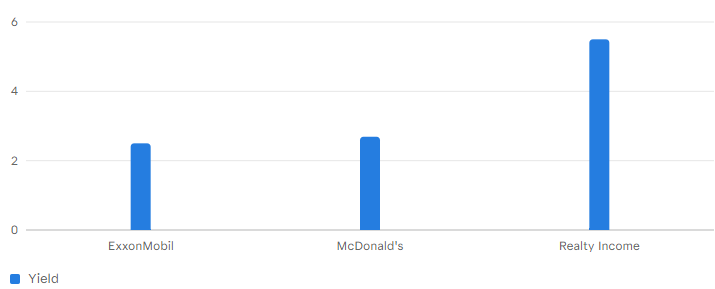
The quarterly dividend is moving to $1.07 from $1.03, payable on 10 December. That implies $4.28 a year (my calculation). Two sites show different yields: 2.51% trailing [5] and 2.30% on a $178.98 share price in mid-October. One of them lists the payment as rising for only five years, which conflicts with ExxonMobil's own claim of 44 years, likely because the data refers to a different corporate entity. The risk is the commodity cycle. Energy Products adjusted earnings were $9.05 billion in the third quarter against $4.10 billion in the second, a swing that shows how much results can move with margins (my reading). ExxonMobil's earnings can fall quickly when prices or margins weaken, which is why its yield is lower than a REIT's but its dividend growth depends on cash flow staying strong.
On the dividend, the new $1.93 quarterly payout equals $7.72 a year (my calculation). A Motley Fool page showed the stock near $280 on 24 November with a 2.69% yield, in a 52-week range of $229.20 to $341.75. At $280.14, the stock is about 18% below its 52-week high (my calculation). The same page notes that the stated yield does not exactly match the payout, which would imply about 2.76%. McDonald's strength is that most restaurants are independently operated, so it collects royalties and rent rather than carrying every store's costs. I did not verify that share in a source for this post, so treat it as general background. The pressure point is customers: if value-minded diners keep trading down, growth could stay modest (my reasoning).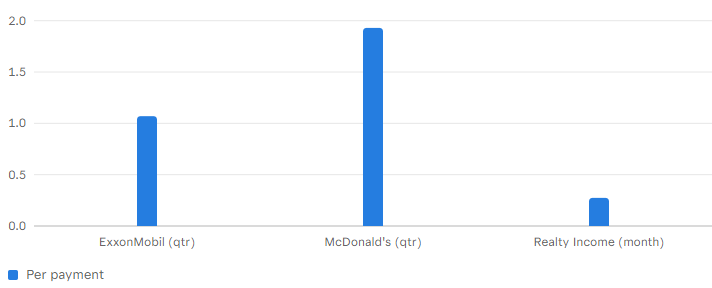
Note how small the raises are. The four 2026 increases were $0.0005 each, taking the monthly dividend from $0.2700 to $0.2715, and the latest lifts it to $0.2740. That is about 1.5% a year (my calculation). Same-store rental revenue grew only 1.1%, so growth relies on buying new properties. On price, the shares closed at $59.05 on 6 November, in a 52-week range of $53.15 to $67.94. At the new $3.288 annual dividend , the yield is about 5.6% (my calculation), and Zacks and the Fool cite 5.5% to 5.6%. The key risk is interest rates: a REIT's shares usually come under pressure when rates rise (my reasoning), and the Fed is expected to hike in December.
Yields are from different sites and dates and shift daily. Streak definitions differ: annual increases for XOM and MCD, monthly raises counted by Realty Income.
Notice the trade-off between yield and growth. Realty Income pays the most today but raises its payout by about 1.5% a year (my calculation from its dividend history). McDonald's raised 4% this year, and ExxonMobil's latest step is from $1.03 to $1.07, about 3.9% (my calculation). A lower starting yield with faster growth can catch up over a decade, while a higher yield with slow growth gives more income sooner (my reasoning, not a forecast). The three are diversified against each other. One depends on energy prices, one on consumer spending and one on rental income and rates. That does not remove risk, but it means a single event is less likely to hit all three at once (my reasoning).
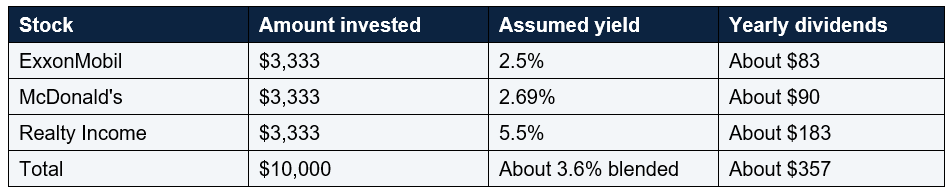
My calculation. Illustrative only, before taxes, assuming yields and dividends stay constant. Dividends can change. That is roughly $357 a year, or about $30 a month on average (my calculation). It is useful income, but not enough on its own to change anyone's finances, and share prices can move far more than that in a year. Reinvesting dividends can increase long-run results, but it also increases exposure to the same stocks.
Third, valuation. The Fool's quote page shows a price-to-earnings ratio of about 41 for Realty Income, though REITs are normally judged on AFFO rather than earnings, where the stock trades near 13 times 2026 guidance (my calculation: $59.05 divided by $4.455). Fourth, being non-AI does not mean being immune to markets. If an AI-driven sell-off drags the whole market, even defensive stocks can fall. And companies can adopt AI gradually, so "non-AI" is a matter of degree. Check the latest filings.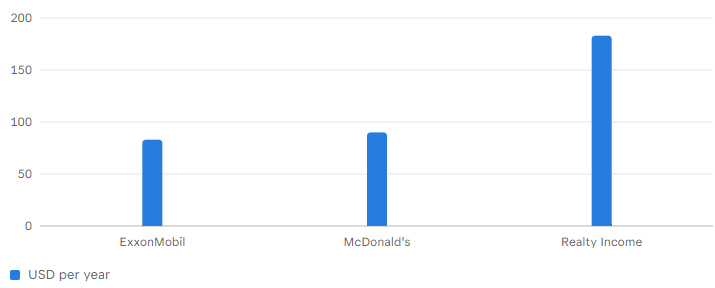
It also helps to picture a bad year. Suppose the market falls and all three shares drop 20%. Your dividends might stay the same, which would push the yield up, but the value of your holding would still be lower (my reasoning). Dividend investors need to be comfortable with that, because the income does not make the price swings go away. Writing down in advance how much of a fall you can tolerate is a simple way to avoid selling in a panic. And keep an eye on dates. ExxonMobil's next payment is on 10 December and Realty Income's on 15 December. Missing the record date means missing the payout.
Realty Income, at roughly 5.5% to 5.6%, versus about 2.5% for ExxonMobil and 2.69% for McDonald's.
How long has each raised its dividend?
ExxonMobil has raised its annual dividend 44 years in a row, McDonald's is on its 50th straight annual increase, and Realty Income has raised its dividend 137 times since 1994.
Are these stocks really free of AI exposure?
They have limited exposure based on my reading, but I did not verify each company's technology spending, so check current filings. The broader AI trade has been volatile.
Is Realty Income's dividend safe?
It paid 72.6% of AFFO as dividends in the third quarter, which leaves a cushion, but the company says it cannot guarantee future dividends .
What is the main risk for McDonald's?
US traffic. Comparable sales fell 0.2% in the US in the third quarter as guest counts declined.
Table of Contents
- Why investors are looking beyond AI
- ExxonMobil (XOM): the cash-flow dividend
- McDonald's (MCD): the franchise dividend
- Realty Income (O): the monthly dividend
- The three side by side
- What a $10,000 portfolio might earn
- The risks nobody should skip
- How to use this list
- Conclusion
- FAQ
When the market worries about artificial intelligence valuations, investors often go looking for something boring. The three companies in this post are about as boring as large businesses get: an oil and gas giant, a burger chain and a monthly-dividend landlord. They are ExxonMobil, McDonald's and Realty Income.
The numbers are decent. ExxonMobil has raised its annual dividend for 44 straight years. McDonald's just raised its quarterly dividend 4% to $1.93, its 50th consecutive annual increase. Realty Income raised its monthly dividend to $0.274, its 137th increase since 1994. The yields, though, are not quite the 2.7% to 5.6% in the original headline. I found about 2.5% for ExxonMobil, 2.69% for McDonald's and roughly 5.5% to 5.6% for Realty Income. Yields move with the share price every day, so treat them as a snapshot.
Key takeaway: These are steady dividend payers with limited AI exposure, not risk-free ones. Each has its own pressure point: commodity prices, US traffic and interest rates.
Approximate dividend yield, % (snapshot)
Why investors are looking beyond AI
The AI trade has been shaky lately. Anthropic debuted on 19 November, opening 34% above its offer price before sliding during the day . It priced at $83 and was quoted at $88.91 on 23 November, so it is still above its IPO price, but well off the opening spike. One quote page also shows a second price of $87.64, so I would treat the exact close with caution. SpaceX has had a rougher path. It traded below $124, about 8% below its $135 IPO price and more than 40% below its all-time intraday high of $225.64. Its slide has been tied to worries about heavy AI spending and valuation. The point is not that AI is finished. It is that concentrated bets feel riskier when valuations wobble. Dividend payers with mature businesses give a different kind of exposure, one built on cash returned rather than growth promised (my reasoning). I did not find any of the three heavily investing in AI in the materials I read, but I have not done a full review, so verify that yourself.ExxonMobil (XOM): the cash-flow dividend
ExxonMobil reported third-quarter earnings of $15.4 billion, or $3.72 per share, and adjusted earnings of $17.5 billion, or $4.23 per share. Year to date, adjusted earnings per share are $9.82 versus $5.19 a year earlier. Operating cash flow was $25.7 billion and free cash flow was $19.1 billion. The dividend is a small slice of that cash. Shareholder distributions were $9.4 billion in the quarter, including $4.3 billion of dividends and $5.1 billion of buybacks. Dividends were therefore about 23% of the quarter's free cash flow (my calculation). ExxonMobil also announced $20 billion of share repurchases for 2027, and net debt was $22.1 billion at 30 September.The quarterly dividend is moving to $1.07 from $1.03, payable on 10 December. That implies $4.28 a year (my calculation). Two sites show different yields: 2.51% trailing [5] and 2.30% on a $178.98 share price in mid-October. One of them lists the payment as rising for only five years, which conflicts with ExxonMobil's own claim of 44 years, likely because the data refers to a different corporate entity. The risk is the commodity cycle. Energy Products adjusted earnings were $9.05 billion in the third quarter against $4.10 billion in the second, a swing that shows how much results can move with margins (my reading). ExxonMobil's earnings can fall quickly when prices or margins weaken, which is why its yield is lower than a REIT's but its dividend growth depends on cash flow staying strong.
McDonald's (MCD): the franchise dividend
McDonald's third-quarter results were mixed. Global comparable sales rose 1.5%, but US comparable sales fell 0.2%. Revenue rose 1% to $7.16 billion, below expectations, while adjusted earnings per share rose 11% to $3.57. The US issue is traffic. Restaurant Business noted it was the first decline in US comparable sales since early last year. US comparable guest counts were negative, only partly offset by higher average checks [8]. US fast-food traffic fell 2.6% across the sector in the quarter. McDonald's says its value push helped as the quarter went on, with US comparable sales turning positive in September.On the dividend, the new $1.93 quarterly payout equals $7.72 a year (my calculation). A Motley Fool page showed the stock near $280 on 24 November with a 2.69% yield, in a 52-week range of $229.20 to $341.75. At $280.14, the stock is about 18% below its 52-week high (my calculation). The same page notes that the stated yield does not exactly match the payout, which would imply about 2.76%. McDonald's strength is that most restaurants are independently operated, so it collects royalties and rent rather than carrying every store's costs. I did not verify that share in a source for this post, so treat it as general background. The pressure point is customers: if value-minded diners keep trading down, growth could stay modest (my reasoning).
Latest quarterly or monthly dividend payout (USD)
Realty Income (O): the monthly dividend
Realty Income owns freestanding commercial properties and pays rent-based dividends monthly. Its third-quarter adjusted funds from operations, or AFFO, rose 3.7% to $1.12 per share, and it raised 2026 AFFO guidance to $4.45 to $4.46. The dividend paid in the quarter was 81.3 cents, or 72.6% of AFFO. The company invested $2.6 billion in the quarter at an initial cash yield of 6.8%, achieved a 103.5% rent recapture rate on re-leased properties, and had net debt of 5.4 times annualized adjusted EBITDAre. It has paid 116 consecutive quarterly dividend increases.Note how small the raises are. The four 2026 increases were $0.0005 each, taking the monthly dividend from $0.2700 to $0.2715, and the latest lifts it to $0.2740. That is about 1.5% a year (my calculation). Same-store rental revenue grew only 1.1%, so growth relies on buying new properties. On price, the shares closed at $59.05 on 6 November, in a 52-week range of $53.15 to $67.94. At the new $3.288 annual dividend , the yield is about 5.6% (my calculation), and Zacks and the Fool cite 5.5% to 5.6%. The key risk is interest rates: a REIT's shares usually come under pressure when rates rise (my reasoning), and the Fed is expected to hike in December.
The three side by side
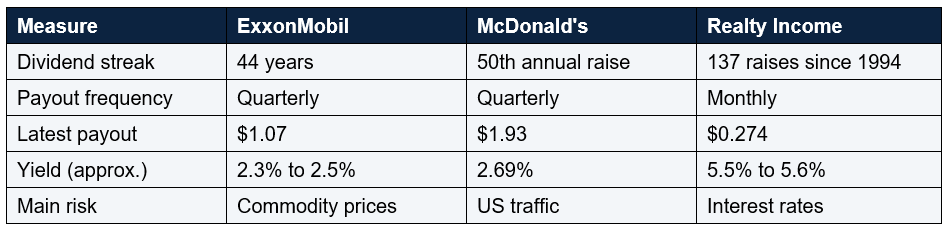
Here is how the three compare. The differences matter as much as the similarities, because they show what kind of income you would actually be buying.Yields are from different sites and dates and shift daily. Streak definitions differ: annual increases for XOM and MCD, monthly raises counted by Realty Income.
Notice the trade-off between yield and growth. Realty Income pays the most today but raises its payout by about 1.5% a year (my calculation from its dividend history). McDonald's raised 4% this year, and ExxonMobil's latest step is from $1.03 to $1.07, about 3.9% (my calculation). A lower starting yield with faster growth can catch up over a decade, while a higher yield with slow growth gives more income sooner (my reasoning, not a forecast). The three are diversified against each other. One depends on energy prices, one on consumer spending and one on rental income and rates. That does not remove risk, but it means a single event is less likely to hit all three at once (my reasoning).
What a $10,000 portfolio might earn
To make the yields concrete, imagine splitting $10,000 equally across the three. I used 2.5% for ExxonMobil, 2.69% for McDonald's and 5.5% for Realty Income.My calculation. Illustrative only, before taxes, assuming yields and dividends stay constant. Dividends can change. That is roughly $357 a year, or about $30 a month on average (my calculation). It is useful income, but not enough on its own to change anyone's finances, and share prices can move far more than that in a year. Reinvesting dividends can increase long-run results, but it also increases exposure to the same stocks.
The risks nobody should skip
First, dividends are not guaranteed. Realty Income itself says it cannot guarantee it will maintain its dividend level or its pattern of increases. The same logic applies to the others. Second, a high yield can reflect a falling price. Realty Income was down about 13% from the high of its 52-week range at $59.05 (my calculation), which is part of why its yield looks attractive.Third, valuation. The Fool's quote page shows a price-to-earnings ratio of about 41 for Realty Income, though REITs are normally judged on AFFO rather than earnings, where the stock trades near 13 times 2026 guidance (my calculation: $59.05 divided by $4.455). Fourth, being non-AI does not mean being immune to markets. If an AI-driven sell-off drags the whole market, even defensive stocks can fall. And companies can adopt AI gradually, so "non-AI" is a matter of degree. Check the latest filings.
Illustrative yearly dividends on $10,000 split equally (USD)
How to use this list
Dividend income is also taxable in most accounts, and the rules differ for REIT payouts versus ordinary company dividends. I am not giving tax advice here, so check how each would be treated in your own situation or ask a qualified professional. If you are researching these names, start with your goal. Are you after income now, growth in income over time, or lower volatility? Each stock leans differently. Realty Income offers the highest current yield, McDonald's and ExxonMobil offer longer streaks of annual increases and more room to raise. Next, look at the payout. A dividend that uses a modest share of cash flow, as ExxonMobil's does, or about 73% of AFFO, as Realty Income's does, has some cushion. Finally, think about where the three sit in your wider portfolio. If you already own lots of energy or real estate, adding more may increase overlap (my reasoning).It also helps to picture a bad year. Suppose the market falls and all three shares drop 20%. Your dividends might stay the same, which would push the yield up, but the value of your holding would still be lower (my reasoning). Dividend investors need to be comfortable with that, because the income does not make the price swings go away. Writing down in advance how much of a fall you can tolerate is a simple way to avoid selling in a panic. And keep an eye on dates. ExxonMobil's next payment is on 10 December and Realty Income's on 15 December. Missing the record date means missing the payout.
Conclusion
Three steady dividend payers, three different pressure points, and a range of yields from about 2.3% to 5.6%. ExxonMobil is lifting cash flow and buybacks. McDonald's is working through weak US traffic but still raised its payout. Realty Income is growing AFFO slowly and paying a high monthly dividend. With AI stocks wobbling, it is natural to look at dull, dependable businesses. Just remember that dull is not the same as safe. This is general education, not advice, and I am not a financial adviser. Check live prices, yields and filings before you decide.FAQ
Which of these three has the highest yield?Realty Income, at roughly 5.5% to 5.6%, versus about 2.5% for ExxonMobil and 2.69% for McDonald's.
How long has each raised its dividend?
ExxonMobil has raised its annual dividend 44 years in a row, McDonald's is on its 50th straight annual increase, and Realty Income has raised its dividend 137 times since 1994.
Are these stocks really free of AI exposure?
They have limited exposure based on my reading, but I did not verify each company's technology spending, so check current filings. The broader AI trade has been volatile.
Is Realty Income's dividend safe?
It paid 72.6% of AFFO as dividends in the third quarter, which leaves a cushion, but the company says it cannot guarantee future dividends .
What is the main risk for McDonald's?
US traffic. Comparable sales fell 0.2% in the US in the third quarter as guest counts declined.
0 Comments
Be the first to share your thoughts on this article.