

Retirement
3 Retirement Traps Even Executives Miss

The tapered annual allowance silently cuts your pension limit to £10,000. A single flexible drawdown payment permanently triggers the MPAA. A bad market in year one of retirement can damage a pot in ways three good years cannot fully repair. These are the retirement planning traps that cost experienced executives thousands — not because they are unintelligent, but because the rules are genuinely complex and the mistakes are irreversible.

The tapered annual allowance can reduce a senior executive’s pension contribution limit from £60,000 to £10,000, triggered not by deliberate pension decisions but by the incidental interaction of a bonus payment, a large employer contribution, and HMRC’s definition of adjusted income. The Money Purchase Annual Allowance (MPAA) trap closes the door on further tax-efficient pension saving — permanently — the moment a single pound of taxable drawdown income is taken, even at 55, even while still employed. And the sequence of returns risk can destroy the viability of a drawdown strategy in the first three years of retirement, leaving a pot that looks adequate on a spreadsheet unable to sustain the withdrawals its owner planned.
Each of these traps is well-documented in the technical pension literature. Each one is consistently described by specialist advisers as among the most common and most expensive mistakes made by sophisticated, well-informed, financially capable people. The reason they persist is not ignorance — it is complexity. The rules are layered, the interactions are non-obvious, and the consequences materialise years after the decision that caused them.
Tapered Annual Allowance 2026/27: reduces from £60,000 to as low as £10,000 for adjusted income above £260,000. MPAA: £10,000 per year — permanently triggered by a single taxable drawdown payment. Sequence of returns risk: Morningstar UK 2025 research puts the UK 'safe' withdrawal rate at 3.9% (90% confidence, 30-year horizon), down from the classic 4%.
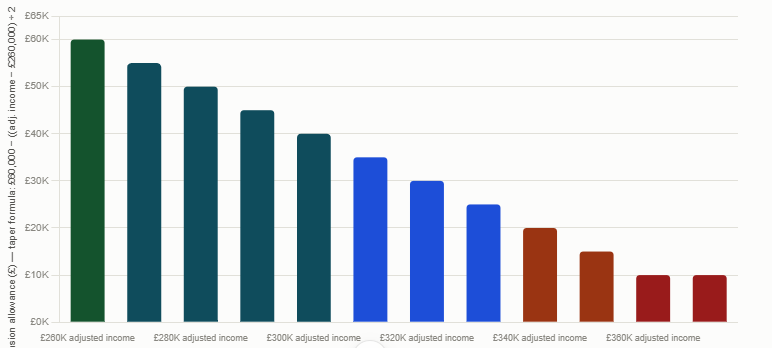
The Tapered Annual Allowance reduces the £60,000 standard allowance for high earners who meet two simultaneous income tests. For 2026/27, the taper applies when threshold income exceeds £200,000 AND adjusted income exceeds £260,000. When both conditions are met, the allowance reduces by £1 for every £2 of adjusted income above £260,000. The minimum allowance after taper is £10,000, reached when adjusted income hits £360,000 or above.
Standard Annual Allowance 2026/27: £60,000. Tapered Annual Allowance minimum: £10,000 (at adjusted income of £360,000+). Taper reduces by £1 for every £2 of adjusted income above £260,000. Threshold income trigger: >£200,000. Adjusted income trigger: >£260,000. Both conditions must be met for the taper to apply.
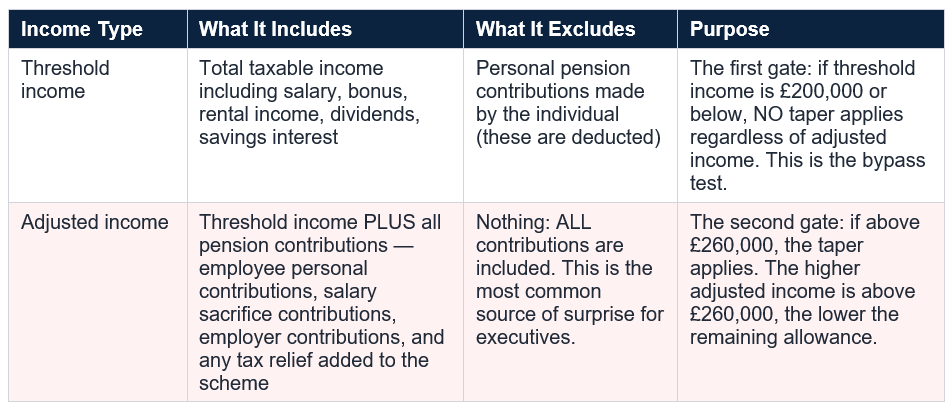
The trap is not that the taper exists — it is that it is calculated in a way that surprises people who believe they are well within the standard limit. The critical variable is adjusted income, which includes ALL pension contributions: the employee’s own personal contributions, employer contributions, salary sacrifice contributions, and the tax relief added by the pension scheme. A senior executive who believes they have a comfortable £60,000 allowance can find it has been reduced by their own employer’s contribution, which they did not make and cannot control.
Worked Example: David is a Chief Operating Officer earning £230,000 in salary and £40,000 in annual bonus. His employer contributes £40,000 to his pension annually (a standard executive benefit arrangement). His threshold income: £230,000 + £40,000 bonus = £270,000 (above the £200,000 threshold — test 1 passed). His adjusted income: £270,000 threshold income + £40,000 employer pension contribution = £310,000 (above the £260,000 trigger — test 2 passed). Taper reduction: (£310,000 − £260,000) ÷ 2 = £25,000 reduction. Tapered allowance: £60,000 − £25,000 = £35,000. If David also makes a personal pension contribution of £20,000 in the same year, his total contributions (£40,000 employer + £20,000 personal = £60,000) exceed his tapered allowance of £35,000 by £25,000. The annual allowance charge on this excess is £25,000 taxed at his marginal rate of 45% = £11,250 tax charge. The charge must be declared on Self Assessment and paid by 31 January following the tax year.
The critical planning lever: salary sacrifice reduces threshold income. Because personal pension contributions are deducted from threshold income, and salary sacrifice contributions are counted as employer contributions (therefore excluded from threshold income), a carefully structured salary sacrifice arrangement can keep an executive’s threshold income below £200,000 and bypass the taper entirely — even if their total remuneration substantially exceeds £200,000 (Cost Saver, May 2026; McCarthy Wealth, August 2026). This is not tax avoidance; it is the explicit design of the threshold income calculation, which HMRC confirmed in post-2016 guidance.
A second planning lever: if the adjusted income test is met and the taper applies, the allowance reduction is linear. Every £2,000 of reduction in adjusted income (for example, through additional salary sacrifice, Gift Aid donations, or pension contribution restructuring) adds back £1,000 of Annual Allowance. For a 45 percent taxpayer who would otherwise face an annual allowance charge on the excess, each £2,000 of adjusted income reduction saves both the allowance and the 45 percent charge on the excess contributions.
If your salary plus employer pension contributions approaches £200,000 in threshold income terms, or if your adjusted income approaches £260,000, model your precise position before any significant bonus or employer contribution is paid. The taper calculation must be run for each tax year individually. Variable bonuses, dividends, and employer contributions can change the position materially year to year. A qualified pension adviser can run the carry-forward and taper calculation together and identify whether restructuring contributions via salary sacrifice would save the allowance entirely. This is one of the highest-value planning exercises available for senior executives.
The rules and the catches:
The MPAA was introduced to prevent a ‘recycling’ of pension tax relief — taking pension income out and immediately contributing it back in, claiming tax relief on the way in while already having received tax relief on the way out. The principle is sound. The mechanism creates a trap for executives who access their pension while still employed or shortly before returning to employment, without fully understanding the permanent consequences.
MPAA 2026/27: £10,000 per year (down from the standard £60,000 Annual Allowance). Triggered by: any taxable income from flexi-access drawdown; any UFPLS payment; certain flexible annuities. NOT triggered by: taking the 25% tax-free PCLS alone. Once triggered: permanent, cannot be undone, applies to all DC pension contributions (employee + employer combined). Source: TaxFly May 2026; Wealthvieu May 2026; PensionHelper March 2026.
For a senior executive, the MPAA trap most commonly arises in two scenarios: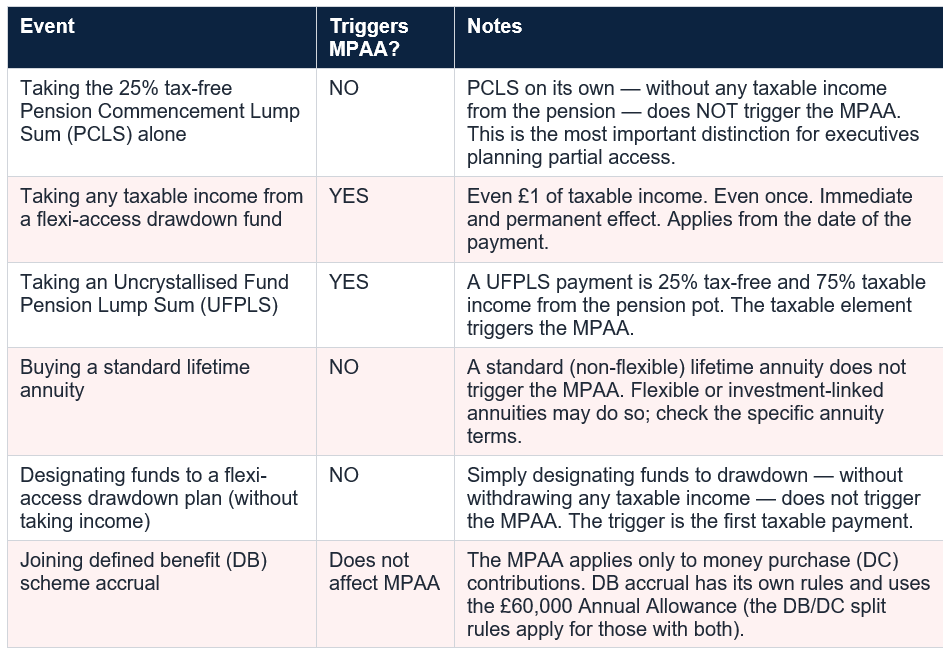
If you are considering accessing your pension while still employed or semi-employed, take your 25% tax-free lump sum (PCLS) first, without any taxable income drawdown. You can designate funds to a flexi-access drawdown plan and take the tax-free cash without triggering the MPAA. Defer any taxable income drawdown until you are certain you will not want or need to make significant further DC pension contributions. If you are uncertain whether you will return to high-earning employment, do not take any taxable drawdown income until you have taken specialist advice on the MPAA consequences in your specific circumstances.
The practical problem: employers are unaware of an employee’s pension status. A new employer offering a generous executive pension scheme will not know that the employee has already triggered the MPAA. When they begin making contributions that, combined with any employee contributions, exceed £10,000, an annual allowance charge arises. HMRC requires the individual to notify any new employer of the MPAA status — failure to do so appropriately can complicate the charge calculation and settlement.
The tax charge on an Annual Allowance excess is levied at the individual’s marginal rate and must be declared on Self Assessment. Where the charge exceeds £2,000, Mandatory Scheme Pays can be elected, allowing the charge to be settled from the pension pot rather than from other income. But using Scheme Pays effectively reduces the pension pot by the amount of the charge, compounding the financial impact.
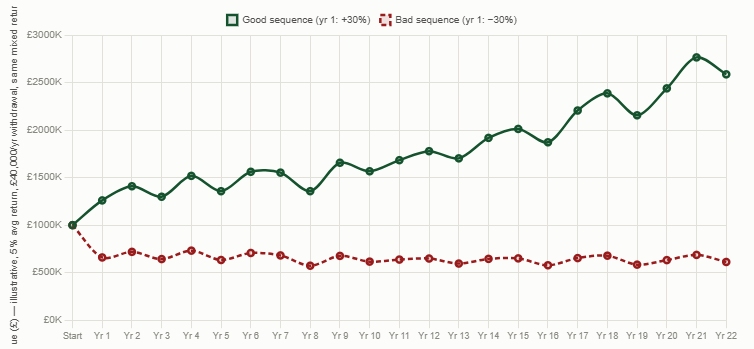
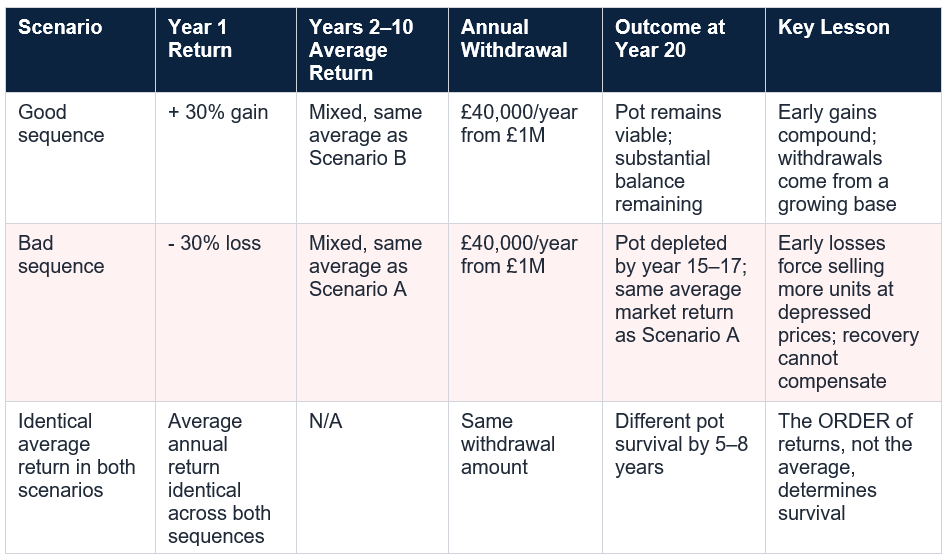
The mathematical intuition: during the accumulation phase (saving into a pension), a bad year is compensated over time because future contributions continue and the pound-cost averaging effect means more units are purchased at lower prices. During the drawdown phase, the relationship inverts. Each withdrawal in a bad year requires selling more units at depressed prices, leaving fewer units to benefit from the eventual recovery. The portfolio is permanently diminished by the forced sale at market lows, and this damage is not recoverable simply by waiting for the market to come back.
Morningstar UK’s 2025 research — cited by RetirementExpert.co.uk in May 2026 — put the safe starting withdrawal rate for UK retirees at 3.9 percent of the initial pot at 90 percent confidence over a 30-year horizon, down from the classic Bengen 4 percent rule, explicitly because of sequence-of-returns risk in current UK market conditions. This means a £1 million DC pension pot can sustainably generate approximately £39,000 per year in drawdown at a 90 percent probability of lasting 30 years — and only if withdrawals are managed flexibly.
Morningstar UK 2025 research: UK 'safe' withdrawal rate = 3.9% at 90% confidence over 30 years (down from the classic 4% Bengen rule). A 30% market fall in year one of drawdown with fixed withdrawals can deplete a pot 8–10 years earlier than an identical average return with gains in year one. Source: RetirementExpert.co.uk (May 2026), citing Morningstar UK 2025; SalaryTax.uk (June 2026).
The UK context adds a complication that the US-derived 4 percent rule does not fully address: the interaction with the State Pension. The full new State Pension in 2026/27 is £241.30 per week (£12,548 per year), typically starting at age 66 to 67. For a retiree who starts drawdown at 57 or 58, there is a 9 to 10-year period before the State Pension begins, during which the entire income burden falls on the drawdown pot. Sequencing risk is most acute during this early drawdown period, before the State Pension provides a guaranteed income floor that reduces the dependence on the investment portfolio.
The most important sequencing risk decision is made before retirement, not during it. Model your planned withdrawal rate against the 3.9% Morningstar UK guidance. If your required annual income exceeds 3.9% of your pot, consider partial annuitisation — using part of the pot to purchase a guaranteed lifetime income that covers essential expenses, then using the remaining pot in flexible drawdown for discretionary spending. The guaranteed annuity income floor reduces the dependence on drawdown and materially reduces sequencing risk by ensuring essential costs are covered regardless of what markets do.
Under current rules (to April 2027), most DC pension pots sit outside the estate entirely. An executive with a £2 million pension pot who dies before drawing it down can pass the entire pot to nominated beneficiaries free of Inheritance Tax — a significant estate planning advantage that has led many high earners to prioritise spending from ISAs and other savings while preserving the pension for inheritance. From April 2027, this advantage disappears: the pension pot will be included in the estate at 40 percent IHT above the nil-rate bands.
The planning implication: for executives whose total estate (including the pension) is likely to exceed the nil-rate band (£325,000 standard) and residence nil-rate band (£175,000 in qualifying cases, frozen to 2030), the optimal drawdown order changes. The longstanding advice to ‘spend the ISA first, preserve the pension’ is replaced by a more nuanced analysis of which assets to draw first based on IHT exposure, income tax on withdrawals, and the double-taxation risk for non-spouse beneficiaries who would pay both IHT on the estate and Income Tax on pension withdrawals.
The Mistake: If you have a large unspent pension pot and your estate is likely to exceed IHT thresholds, do not assume the pre-2027 strategy of 'preserve the pension for inheritance' remains optimal after April 2027. The change requires a fresh analysis of drawdown order, potential pension contributions before April 2027, and whether drawing the pension in retirement (and passing ISAs and other assets as inheritance instead) is more tax-efficient for your specific beneficiary situation. This is a specialist area requiring professional advice.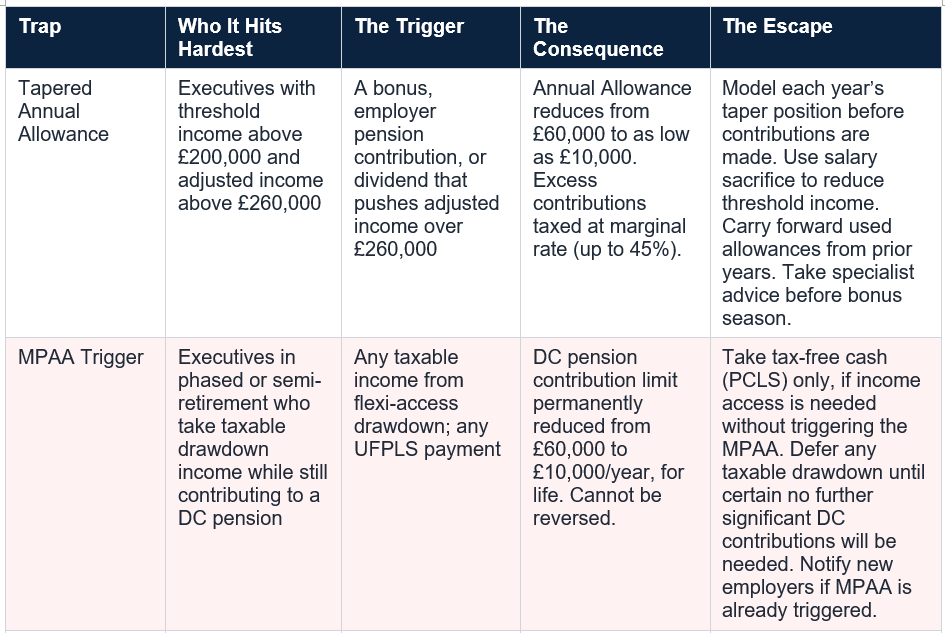
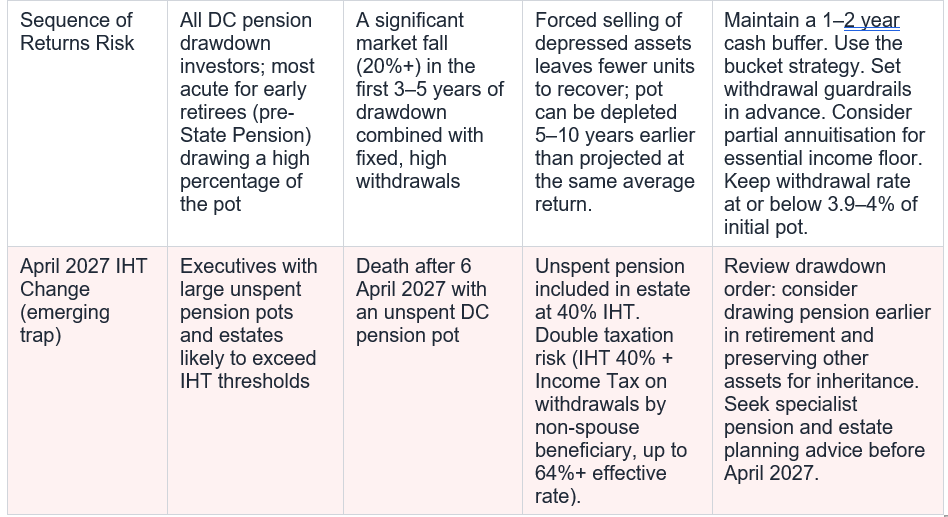
The tapered annual allowance is predictable once the adjusted income calculation is understood. The MPAA trigger is avoidable if the distinction between tax-free cash and taxable drawdown income is respected. Sequence of returns risk is manageable with a cash buffer, a bucket strategy, or guardrails — all of which are established, accessible strategies that require no specialist products. And the April 2027 IHT change is announced, dated, and actionable with adequate planning time remaining.
The common thread in all four is that the time to act is before the triggering event, not after. Before the bonus is paid, model the adjusted income. Before the first drawdown income is taken, confirm the MPAA consequences. Before retirement begins, design the withdrawal strategy and the sequencing defences. Before April 2027, review the drawdown order and the IHT position. Each of these actions requires specialist knowledge — but not extraordinary intelligence or access to esoteric financial products. They require the same analytical rigour that successful executives apply to their professional responsibilities, directed at their own retirement. That redirection, more than any product or strategy, is the escape from the traps described in this guide.
The tapered annual allowance is a reduction in the standard £60,000 pension Annual Allowance for high earners who meet two income tests in the same tax year. For 2026/27: your threshold income (total taxable income minus your personal pension contributions) must exceed £200,000; AND your adjusted income (threshold income plus ALL pension contributions — employee, employer, salary sacrifice, and tax relief) must exceed £260,000. If both conditions are met, the allowance reduces by £1 for every £2 of adjusted income above £260,000, to a minimum of £10,000 (reached at adjusted income of £360,000+). The trap for executives: large employer pension contributions — which the executive does not choose or control — count as part of adjusted income and can push the allowance well below £60,000 without the executive making any additional personal contribution. If contributions exceed the tapered allowance, an annual allowance charge applies at the marginal income tax rate on the excess.
What triggers the Money Purchase Annual Allowance (MPAA) and how does it affect me?
The MPAA of £10,000 per year is triggered the first time you take any taxable income from a flexi-access drawdown fund, take an Uncrystallised Fund Pension Lump Sum (UFPLS), or buy certain flexible annuities. It is NOT triggered by taking only the 25% tax-free Pension Commencement Lump Sum (PCLS). Once triggered, the MPAA is permanent — it cannot be reversed or reset. From that point, all defined contribution pension contributions (employee + employer combined) are limited to £10,000 per year rather than the standard £60,000. This is most significant for executives in phased retirement who take a first taxable drawdown payment and then return to high-earning employment with a generous employer pension scheme. The employer's contributions alone may exceed £10,000, creating an annual allowance charge on the excess.
What is sequence of returns risk and how does it affect pension drawdown?
Sequence of returns risk is the risk that the order of investment returns during pension drawdown — not just the average return — determines whether the pot lasts a full retirement. During drawdown, fixed withdrawals in a period of falling markets force the sale of more fund units (because each unit is worth less), leaving fewer units to benefit from the eventual recovery. The pot is permanently reduced by forced low-price selling, and this damage cannot be recovered simply by waiting for markets to rise. Morningstar UK's 2025 research (cited by RetirementExpert.co.uk May 2026) puts the UK 'safe' withdrawal rate at 3.9% at 90% confidence over 30 years — meaning a £1 million pot can sustainably generate approximately £39,000 per year in flexible drawdown with a 90% chance of lasting 30 years. A 30% market fall in year one can deplete a pot 5–10 years earlier than the same average return with year one gains.
How do I mitigate sequence of returns risk in practice?
Three practical defences are widely recommended: (1) Cash buffer — hold 1–2 years of planned spending in cash or money market funds. When markets fall, draw from cash rather than selling depressed equities; replenish cash when markets recover. (2) Bucket strategy — divide the pot into three segments: Bucket 1 (cash, 1–2 years of spending), Bucket 2 (short-duration bonds, years 3–5 of spending), Bucket 3 (equity growth, years 6+). Draw from Bucket 1, refill from Bucket 2 in normal markets, refill Bucket 2 from Bucket 3 in good years. This means equities are never sold at a market low. (3) Guardrails — set a pre-committed rule: if the pot falls more than 15–20% in a year, reduce withdrawals by 10% for the next year; reverse when the pot recovers. The key is committing to the rule before markets fall, not during the emotional stress of an actual downturn.
What is happening to pension Inheritance Tax from April 2027?
From 6 April 2027, unspent defined contribution pension pots will be included in the estate for Inheritance Tax purposes (Finance Act 2025 / Autumn Budget 2024; confirmed Davis LLP, August 2026). Currently (to April 2027), most DC pension pots sit outside the estate and can be passed to nominated beneficiaries free of IHT — a significant advantage that has made the pension the preferred inheritance vehicle for many high earners. After April 2027, unspent pensions will be included in the estate at 40% IHT above the nil-rate bands. For non-spouse beneficiaries who are higher-rate taxpayers, there is also a double taxation risk: IHT on the estate (40%) plus Income Tax on pension withdrawals (40%) can produce an effective tax rate of up to 64% on inherited pension funds. The optimal drawdown order for executives with taxable estates therefore changes materially after April 2027.
Should I take specialist advice on these retirement planning issues?
Yes. The three traps in this guide — the tapered annual allowance, the MPAA trigger, and sequence of returns risk — are all areas where the consequences of getting it wrong are large, often irreversible, and specific to individual circumstances that cannot be assessed from general guidance alone. The tapered annual allowance calculation requires modelling each year's adjusted income precisely, including all employer contributions and any variable income sources. The MPAA trigger requires understanding the exact structure of your planned pension access before any payment is made. Sequencing risk mitigation requires a withdrawal strategy tailored to your pot size, other income sources (State Pension, DB pensions, ISA), spending pattern, and risk tolerance. All three interact with the April 2027 IHT change. A qualified independent financial adviser (IFA) with specialist pension expertise is the appropriate source of advice for these decisions.
Table of Contents
- The Retirement Traps That Spare No One
- Trap #1: The Tapered Annual Allowance — How a Bonus Can Cost You £50,000
- How the Taper Is Calculated: Threshold vs Adjusted Income
- Carry Forward: The Partial Antidote (With Its Own Catch)
- Trap #2: The MPAA Trigger — One Drawdown Payment That Lasts Forever
- What Actually Triggers the MPAA (and What Does Not)
- The Semi-Retirement Trap: Working While Drawing
- Trap #3: Sequence of Returns Risk — The Market That Breaks Your Retirement
- Why Sequence Matters More Than Average Returns
- The Three Defences Against Sequence of Returns Risk
- The April 2027 IHT Change: A Fourth Trap on the Horizon
- Summary: The Traps Side by Side
- Conclusion: The Rules Are Complex, But the Mistakes Are Avoidable
- Frequently Asked Questions
Tapered Annual Allowance By Income
Sequence of Returns: Good vs Bad Sequence
The Retirement Traps That Spare No One
There is a widely held assumption that retirement planning complexity scales with wealth: that ordinary workers need to understand the basics, but high earners and experienced executives must have the details in hand. The reality, documented by specialist pension advisers and tax consultants across 2025 and 2026, is more uncomfortable. The three retirement traps described in this guide are more dangerous, not less, for high earners — because the financial consequences scale with income, the rules are genuinely counter-intuitive, and the mistakes are typically irreversible.The tapered annual allowance can reduce a senior executive’s pension contribution limit from £60,000 to £10,000, triggered not by deliberate pension decisions but by the incidental interaction of a bonus payment, a large employer contribution, and HMRC’s definition of adjusted income. The Money Purchase Annual Allowance (MPAA) trap closes the door on further tax-efficient pension saving — permanently — the moment a single pound of taxable drawdown income is taken, even at 55, even while still employed. And the sequence of returns risk can destroy the viability of a drawdown strategy in the first three years of retirement, leaving a pot that looks adequate on a spreadsheet unable to sustain the withdrawals its owner planned.
Each of these traps is well-documented in the technical pension literature. Each one is consistently described by specialist advisers as among the most common and most expensive mistakes made by sophisticated, well-informed, financially capable people. The reason they persist is not ignorance — it is complexity. The rules are layered, the interactions are non-obvious, and the consequences materialise years after the decision that caused them.
Tapered Annual Allowance 2026/27: reduces from £60,000 to as low as £10,000 for adjusted income above £260,000. MPAA: £10,000 per year — permanently triggered by a single taxable drawdown payment. Sequence of returns risk: Morningstar UK 2025 research puts the UK 'safe' withdrawal rate at 3.9% (90% confidence, 30-year horizon), down from the classic 4%.
Trap #1: The Tapered Annual Allowance — How a Bonus Can Cost You £50,000
The standard pension Annual Allowance for 2026/27 is £60,000 gross — covering employee contributions, employer contributions, and tax relief combined. For most UK workers, this limit is academic: the average employee contributing at auto-enrolment minimum rates will never approach it. For senior executives with significant employer pension contributions, substantial salaries, and year-end bonuses, the limit can become the central fact of their retirement planning.The Tapered Annual Allowance reduces the £60,000 standard allowance for high earners who meet two simultaneous income tests. For 2026/27, the taper applies when threshold income exceeds £200,000 AND adjusted income exceeds £260,000. When both conditions are met, the allowance reduces by £1 for every £2 of adjusted income above £260,000. The minimum allowance after taper is £10,000, reached when adjusted income hits £360,000 or above.
Standard Annual Allowance 2026/27: £60,000. Tapered Annual Allowance minimum: £10,000 (at adjusted income of £360,000+). Taper reduces by £1 for every £2 of adjusted income above £260,000. Threshold income trigger: >£200,000. Adjusted income trigger: >£260,000. Both conditions must be met for the taper to apply.
The trap is not that the taper exists — it is that it is calculated in a way that surprises people who believe they are well within the standard limit. The critical variable is adjusted income, which includes ALL pension contributions: the employee’s own personal contributions, employer contributions, salary sacrifice contributions, and the tax relief added by the pension scheme. A senior executive who believes they have a comfortable £60,000 allowance can find it has been reduced by their own employer’s contribution, which they did not make and cannot control.
Worked Example: David is a Chief Operating Officer earning £230,000 in salary and £40,000 in annual bonus. His employer contributes £40,000 to his pension annually (a standard executive benefit arrangement). His threshold income: £230,000 + £40,000 bonus = £270,000 (above the £200,000 threshold — test 1 passed). His adjusted income: £270,000 threshold income + £40,000 employer pension contribution = £310,000 (above the £260,000 trigger — test 2 passed). Taper reduction: (£310,000 − £260,000) ÷ 2 = £25,000 reduction. Tapered allowance: £60,000 − £25,000 = £35,000. If David also makes a personal pension contribution of £20,000 in the same year, his total contributions (£40,000 employer + £20,000 personal = £60,000) exceed his tapered allowance of £35,000 by £25,000. The annual allowance charge on this excess is £25,000 taxed at his marginal rate of 45% = £11,250 tax charge. The charge must be declared on Self Assessment and paid by 31 January following the tax year.
How the Taper Is Calculated: Threshold vs Adjusted Income
Understanding the two income definitions is essential for any executive approaching the taper threshold:The critical planning lever: salary sacrifice reduces threshold income. Because personal pension contributions are deducted from threshold income, and salary sacrifice contributions are counted as employer contributions (therefore excluded from threshold income), a carefully structured salary sacrifice arrangement can keep an executive’s threshold income below £200,000 and bypass the taper entirely — even if their total remuneration substantially exceeds £200,000 (Cost Saver, May 2026; McCarthy Wealth, August 2026). This is not tax avoidance; it is the explicit design of the threshold income calculation, which HMRC confirmed in post-2016 guidance.
A second planning lever: if the adjusted income test is met and the taper applies, the allowance reduction is linear. Every £2,000 of reduction in adjusted income (for example, through additional salary sacrifice, Gift Aid donations, or pension contribution restructuring) adds back £1,000 of Annual Allowance. For a 45 percent taxpayer who would otherwise face an annual allowance charge on the excess, each £2,000 of adjusted income reduction saves both the allowance and the 45 percent charge on the excess contributions.
If your salary plus employer pension contributions approaches £200,000 in threshold income terms, or if your adjusted income approaches £260,000, model your precise position before any significant bonus or employer contribution is paid. The taper calculation must be run for each tax year individually. Variable bonuses, dividends, and employer contributions can change the position materially year to year. A qualified pension adviser can run the carry-forward and taper calculation together and identify whether restructuring contributions via salary sacrifice would save the allowance entirely. This is one of the highest-value planning exercises available for senior executives.
Carry Forward: The Partial Antidote (With Its Own Catch)
Carry forward allows an individual to use unused Annual Allowance from the three preceding tax years, added to the current year’s allowance. For 2026/27, this means carry-forward from 2023/24, 2024/25, and 2025/26. In theory, at the full £60,000 allowance per year, carry-forward provides access to up to £240,000 of additional pension contribution capacity in a single year.The rules and the catches:
- You must have been a member of a UK-registered pension scheme during each year you carry forward from. If you were not a member in 2023/24, you cannot carry forward from that year, regardless of how much unused allowance there was.
- The current year’s allowance (including any taper reduction) must be fully used before carry-forward from previous years can begin.
- Carry-forward applies to the allowance you had in each prior year — which may have been a tapered allowance, not the full £60,000. If you had a £15,000 tapered allowance in 2024/25 and used £12,000, you can only carry forward £3,000 from that year.
- A practical trap for executives who did not open a pension early in their career: if they only joined a pension scheme in, say, January 2026, they cannot carry forward from 2023/24 or 2024/25 at all. The solution — open a pension with even a nominal £1 as soon as possible — is simple but must be done before the carry-forward years are needed (uktaxdrag.co.uk, May 2026).
Trap #2: The MPAA Trigger — One Drawdown Payment That Lasts Forever
The Money Purchase Annual Allowance (MPAA) is a £10,000 annual limit on contributions to defined contribution (money purchase) pensions that is triggered the moment a member takes any taxable income from a flexi-access drawdown fund. It is permanent. It cannot be undone. And it applies from the moment of the first taxable payment, regardless of how small that payment is.The MPAA was introduced to prevent a ‘recycling’ of pension tax relief — taking pension income out and immediately contributing it back in, claiming tax relief on the way in while already having received tax relief on the way out. The principle is sound. The mechanism creates a trap for executives who access their pension while still employed or shortly before returning to employment, without fully understanding the permanent consequences.
MPAA 2026/27: £10,000 per year (down from the standard £60,000 Annual Allowance). Triggered by: any taxable income from flexi-access drawdown; any UFPLS payment; certain flexible annuities. NOT triggered by: taking the 25% tax-free PCLS alone. Once triggered: permanent, cannot be undone, applies to all DC pension contributions (employee + employer combined). Source: TaxFly May 2026; Wealthvieu May 2026; PensionHelper March 2026.
For a senior executive, the MPAA trap most commonly arises in two scenarios:
- • Semi-retirement or phased retirement: an executive in their late 50s takes a smaller role or consulting position, decides to start drawing down their pension to supplement a reduced income, makes a single taxable drawdown payment, and permanently reduces their future pension contribution capacity from £60,000 to £10,000 per year. If they subsequently return to full-time employment at a high salary with a generous employer pension scheme, the employer’s contributions plus their own can easily exceed the £10,000 MPAA, creating an Annual Allowance charge.
- • Emergency or unplanned access: an executive draws on their pension during a period of financial difficulty, redundancy, or personal crisis, triggering the MPAA without specifically intending to begin pension drawdown. The trigger applies from the date of the payment, not from a later formal election.
What Actually Triggers the MPAA (and What Does Not)
If you are considering accessing your pension while still employed or semi-employed, take your 25% tax-free lump sum (PCLS) first, without any taxable income drawdown. You can designate funds to a flexi-access drawdown plan and take the tax-free cash without triggering the MPAA. Defer any taxable income drawdown until you are certain you will not want or need to make significant further DC pension contributions. If you are uncertain whether you will return to high-earning employment, do not take any taxable drawdown income until you have taken specialist advice on the MPAA consequences in your specific circumstances.
The Semi-Retirement Trap: Working While Drawing
The MPAA trap is most acute in the semi-retirement phase that many executives now navigate: working part-time, consulting, taking non-executive board roles, or moving into portfolio careers while simultaneously drawing on their pension to supplement reduced income. This combination — partially drawing the pension while still accumulating benefits — is exactly the scenario that pensions freedom (introduced in 2015) was designed to facilitate. It is also exactly the scenario in which the MPAA creates the greatest risk of an unintended and expensive outcome.The practical problem: employers are unaware of an employee’s pension status. A new employer offering a generous executive pension scheme will not know that the employee has already triggered the MPAA. When they begin making contributions that, combined with any employee contributions, exceed £10,000, an annual allowance charge arises. HMRC requires the individual to notify any new employer of the MPAA status — failure to do so appropriately can complicate the charge calculation and settlement.
The tax charge on an Annual Allowance excess is levied at the individual’s marginal rate and must be declared on Self Assessment. Where the charge exceeds £2,000, Mandatory Scheme Pays can be elected, allowing the charge to be settled from the pension pot rather than from other income. But using Scheme Pays effectively reduces the pension pot by the amount of the charge, compounding the financial impact.
Trap #3: Sequence of Returns Risk — The Market That Breaks Your Retirement
The third trap is the least obviously financial in character but arguably the most dangerous in practice. Sequence of returns risk — also called sequencing risk or sequence risk — is the phenomenon by which the order in which investment returns occur during the drawdown phase determines whether a retirement pot survives, even when the average return over the entire period is identical.The mathematical intuition: during the accumulation phase (saving into a pension), a bad year is compensated over time because future contributions continue and the pound-cost averaging effect means more units are purchased at lower prices. During the drawdown phase, the relationship inverts. Each withdrawal in a bad year requires selling more units at depressed prices, leaving fewer units to benefit from the eventual recovery. The portfolio is permanently diminished by the forced sale at market lows, and this damage is not recoverable simply by waiting for the market to come back.
Morningstar UK’s 2025 research — cited by RetirementExpert.co.uk in May 2026 — put the safe starting withdrawal rate for UK retirees at 3.9 percent of the initial pot at 90 percent confidence over a 30-year horizon, down from the classic Bengen 4 percent rule, explicitly because of sequence-of-returns risk in current UK market conditions. This means a £1 million DC pension pot can sustainably generate approximately £39,000 per year in drawdown at a 90 percent probability of lasting 30 years — and only if withdrawals are managed flexibly.
Morningstar UK 2025 research: UK 'safe' withdrawal rate = 3.9% at 90% confidence over 30 years (down from the classic 4% Bengen rule). A 30% market fall in year one of drawdown with fixed withdrawals can deplete a pot 8–10 years earlier than an identical average return with gains in year one. Source: RetirementExpert.co.uk (May 2026), citing Morningstar UK 2025; SalaryTax.uk (June 2026).
Why Sequence Matters More Than Average Returns
A concrete illustration of sequence risk (from CalcHub UK 2026 and SalaryTax.uk June 2026):The UK context adds a complication that the US-derived 4 percent rule does not fully address: the interaction with the State Pension. The full new State Pension in 2026/27 is £241.30 per week (£12,548 per year), typically starting at age 66 to 67. For a retiree who starts drawdown at 57 or 58, there is a 9 to 10-year period before the State Pension begins, during which the entire income burden falls on the drawdown pot. Sequencing risk is most acute during this early drawdown period, before the State Pension provides a guaranteed income floor that reduces the dependence on the investment portfolio.
The Three Defences Against Sequence of Returns Risk
The academic and professional consensus on managing sequencing risk identifies three practical defences, all applicable to UK retirees in drawdown:Defence 1: The Cash Buffer
Maintaining one to two years of planned annual spending in cash or money market funds provides a source of income that does not require selling equities in a market downturn. When the portfolio falls, withdrawals are taken from the cash buffer rather than from the equity allocation, allowing the equity portion to recover without forced sales at depressed prices. As the market recovers, the cash buffer is replenished by selling a portion of the equity recovery. Wealthvieu (May 2026), CalcHub UK (2026), and RetirementExpert (May 2026) all recommend this as the primary sequencing risk mitigation for UK drawdown portfolios.Defence 2: The Bucket Strategy
The bucket strategy extends the cash buffer concept into a structured three-tier allocation: Bucket 1 (cash and money market funds) holds one to two years of spending; Bucket 2 (short-duration bonds and gilt funds) holds years three to five of spending; Bucket 3 (global equity funds and multi-asset growth) holds the long-term capital. Income is drawn from Bucket 1. As Bucket 1 depletes, it is refilled from Bucket 2. Bucket 2 is replenished from Bucket 3 in good market years. The design means equities are never sold at market lows because five years of bond and cash runway exist before any equity needs to be liquidated (CalcHub UK, 2026; SalaryTax.uk, June 2026).Defence 3: Dynamic Withdrawal with Guardrails
The guardrails approach sets a rule in advance: if the portfolio falls by more than a defined threshold (typically 15 to 20 percent in a calendar year), withdrawals are reduced by a fixed percentage (typically 10 percent) for the following year. This automatic reduction in spending when markets fall reduces the forced selling of depressed assets and extends the portfolio’s survival significantly. The reduction is reversed when markets recover and the pot returns to its previous level. The pre-commitment aspect — deciding the rule before the market falls, not during the anxiety of an actual downturn — is essential for the strategy to work (SalaryTax.uk, June 2026).The most important sequencing risk decision is made before retirement, not during it. Model your planned withdrawal rate against the 3.9% Morningstar UK guidance. If your required annual income exceeds 3.9% of your pot, consider partial annuitisation — using part of the pot to purchase a guaranteed lifetime income that covers essential expenses, then using the remaining pot in flexible drawdown for discretionary spending. The guaranteed annuity income floor reduces the dependence on drawdown and materially reduces sequencing risk by ensuring essential costs are covered regardless of what markets do.
The April 2027 IHT Change: A Fourth Trap on the Horizon
A fourth trap is approaching that does not affect the retirement years directly but has material implications for executives with large pension pots who plan to pass wealth to the next generation. From 6 April 2027, unspent DC pension pots will be included in the estate for Inheritance Tax purposes (Finance Act 2025; Autumn Budget 2024; Davis LLP, August 2026).Under current rules (to April 2027), most DC pension pots sit outside the estate entirely. An executive with a £2 million pension pot who dies before drawing it down can pass the entire pot to nominated beneficiaries free of Inheritance Tax — a significant estate planning advantage that has led many high earners to prioritise spending from ISAs and other savings while preserving the pension for inheritance. From April 2027, this advantage disappears: the pension pot will be included in the estate at 40 percent IHT above the nil-rate bands.
The planning implication: for executives whose total estate (including the pension) is likely to exceed the nil-rate band (£325,000 standard) and residence nil-rate band (£175,000 in qualifying cases, frozen to 2030), the optimal drawdown order changes. The longstanding advice to ‘spend the ISA first, preserve the pension’ is replaced by a more nuanced analysis of which assets to draw first based on IHT exposure, income tax on withdrawals, and the double-taxation risk for non-spouse beneficiaries who would pay both IHT on the estate and Income Tax on pension withdrawals.
The Mistake: If you have a large unspent pension pot and your estate is likely to exceed IHT thresholds, do not assume the pre-2027 strategy of 'preserve the pension for inheritance' remains optimal after April 2027. The change requires a fresh analysis of drawdown order, potential pension contributions before April 2027, and whether drawing the pension in retirement (and passing ISAs and other assets as inheritance instead) is more tax-efficient for your specific beneficiary situation. This is a specialist area requiring professional advice.
Summary: The Traps Side by Side
Conclusion
The three retirement traps described in this guide share a common characteristic: they are not the result of bad luck or an unfair system. They are the predictable consequences of rules that are well-documented, publicly available, and entirely avoidable with appropriate planning. What makes them dangerous is the combination of their complexity, their irreversibility, and the confidence that many experienced professionals have in their own financial sophistication — a confidence that discourages them from seeking specialist advice until after the mistake has been made.The tapered annual allowance is predictable once the adjusted income calculation is understood. The MPAA trigger is avoidable if the distinction between tax-free cash and taxable drawdown income is respected. Sequence of returns risk is manageable with a cash buffer, a bucket strategy, or guardrails — all of which are established, accessible strategies that require no specialist products. And the April 2027 IHT change is announced, dated, and actionable with adequate planning time remaining.
The common thread in all four is that the time to act is before the triggering event, not after. Before the bonus is paid, model the adjusted income. Before the first drawdown income is taken, confirm the MPAA consequences. Before retirement begins, design the withdrawal strategy and the sequencing defences. Before April 2027, review the drawdown order and the IHT position. Each of these actions requires specialist knowledge — but not extraordinary intelligence or access to esoteric financial products. They require the same analytical rigour that successful executives apply to their professional responsibilities, directed at their own retirement. That redirection, more than any product or strategy, is the escape from the traps described in this guide.
Frequently Asked Questions
What is the tapered annual allowance and how does it work in 2026/27?The tapered annual allowance is a reduction in the standard £60,000 pension Annual Allowance for high earners who meet two income tests in the same tax year. For 2026/27: your threshold income (total taxable income minus your personal pension contributions) must exceed £200,000; AND your adjusted income (threshold income plus ALL pension contributions — employee, employer, salary sacrifice, and tax relief) must exceed £260,000. If both conditions are met, the allowance reduces by £1 for every £2 of adjusted income above £260,000, to a minimum of £10,000 (reached at adjusted income of £360,000+). The trap for executives: large employer pension contributions — which the executive does not choose or control — count as part of adjusted income and can push the allowance well below £60,000 without the executive making any additional personal contribution. If contributions exceed the tapered allowance, an annual allowance charge applies at the marginal income tax rate on the excess.
What triggers the Money Purchase Annual Allowance (MPAA) and how does it affect me?
The MPAA of £10,000 per year is triggered the first time you take any taxable income from a flexi-access drawdown fund, take an Uncrystallised Fund Pension Lump Sum (UFPLS), or buy certain flexible annuities. It is NOT triggered by taking only the 25% tax-free Pension Commencement Lump Sum (PCLS). Once triggered, the MPAA is permanent — it cannot be reversed or reset. From that point, all defined contribution pension contributions (employee + employer combined) are limited to £10,000 per year rather than the standard £60,000. This is most significant for executives in phased retirement who take a first taxable drawdown payment and then return to high-earning employment with a generous employer pension scheme. The employer's contributions alone may exceed £10,000, creating an annual allowance charge on the excess.
What is sequence of returns risk and how does it affect pension drawdown?
Sequence of returns risk is the risk that the order of investment returns during pension drawdown — not just the average return — determines whether the pot lasts a full retirement. During drawdown, fixed withdrawals in a period of falling markets force the sale of more fund units (because each unit is worth less), leaving fewer units to benefit from the eventual recovery. The pot is permanently reduced by forced low-price selling, and this damage cannot be recovered simply by waiting for markets to rise. Morningstar UK's 2025 research (cited by RetirementExpert.co.uk May 2026) puts the UK 'safe' withdrawal rate at 3.9% at 90% confidence over 30 years — meaning a £1 million pot can sustainably generate approximately £39,000 per year in flexible drawdown with a 90% chance of lasting 30 years. A 30% market fall in year one can deplete a pot 5–10 years earlier than the same average return with year one gains.
How do I mitigate sequence of returns risk in practice?
Three practical defences are widely recommended: (1) Cash buffer — hold 1–2 years of planned spending in cash or money market funds. When markets fall, draw from cash rather than selling depressed equities; replenish cash when markets recover. (2) Bucket strategy — divide the pot into three segments: Bucket 1 (cash, 1–2 years of spending), Bucket 2 (short-duration bonds, years 3–5 of spending), Bucket 3 (equity growth, years 6+). Draw from Bucket 1, refill from Bucket 2 in normal markets, refill Bucket 2 from Bucket 3 in good years. This means equities are never sold at a market low. (3) Guardrails — set a pre-committed rule: if the pot falls more than 15–20% in a year, reduce withdrawals by 10% for the next year; reverse when the pot recovers. The key is committing to the rule before markets fall, not during the emotional stress of an actual downturn.
What is happening to pension Inheritance Tax from April 2027?
From 6 April 2027, unspent defined contribution pension pots will be included in the estate for Inheritance Tax purposes (Finance Act 2025 / Autumn Budget 2024; confirmed Davis LLP, August 2026). Currently (to April 2027), most DC pension pots sit outside the estate and can be passed to nominated beneficiaries free of IHT — a significant advantage that has made the pension the preferred inheritance vehicle for many high earners. After April 2027, unspent pensions will be included in the estate at 40% IHT above the nil-rate bands. For non-spouse beneficiaries who are higher-rate taxpayers, there is also a double taxation risk: IHT on the estate (40%) plus Income Tax on pension withdrawals (40%) can produce an effective tax rate of up to 64% on inherited pension funds. The optimal drawdown order for executives with taxable estates therefore changes materially after April 2027.
Should I take specialist advice on these retirement planning issues?
Yes. The three traps in this guide — the tapered annual allowance, the MPAA trigger, and sequence of returns risk — are all areas where the consequences of getting it wrong are large, often irreversible, and specific to individual circumstances that cannot be assessed from general guidance alone. The tapered annual allowance calculation requires modelling each year's adjusted income precisely, including all employer contributions and any variable income sources. The MPAA trigger requires understanding the exact structure of your planned pension access before any payment is made. Sequencing risk mitigation requires a withdrawal strategy tailored to your pot size, other income sources (State Pension, DB pensions, ISA), spending pattern, and risk tolerance. All three interact with the April 2027 IHT change. A qualified independent financial adviser (IFA) with specialist pension expertise is the appropriate source of advice for these decisions.
0 Comments
Be the first to share your thoughts on this article.