

Retirement
4 Ways to Lower Your Retirement Healthcare Costs

A 65-year-old retiring in 2026 now needs an estimated $185,500 per person for healthcare costs alone — up 7.5% in one year. Healthcare inflation is running at 5.8% against a Social Security COLA projection of just 2.4%. You cannot eliminate this cost. But four specific strategies, used together, can meaningfully reduce it. Here is exactly what they are, how they work, and what they cost to implement.

The Milliman Retiree Health Cost Index 2026, published June 22, 2026, adds further precision: a 65-year-old couple retiring in 2026 will need approximately $30,000 more in savings than the 2025 cohort if they choose Original Medicare plus a Medigap supplement plan and Part D. HealthView Services projects healthcare inflation running at 5.8% per year against a Social Security COLA projection of just 2.4% — meaning the purchasing power gap between what healthcare costs and what retirees receive automatically widens every year. A healthy 65-year-old couple may need 84% of their lifetime Social Security income just to cover healthcare.
You cannot eliminate retirement healthcare costs. Medicare is not free, it has gaps, and the chronic conditions that accumulate with age create costs that no insurance plan fully eliminates. But this guide covers four specific, actionable strategies that together can meaningfully reduce what you pay — across the years before Medicare, through the Medicare decision, via income planning, and through the single most cost-effective long-term intervention available: your own health.
Fidelity 2026 individual retirement healthcare estimate: $185,500 per person (up from $172,500 in 2025; +7.5%). Milliman 2026: couple needs $30,000 MORE than 2025 estimate (Original Medicare + Medigap + Part D). Healthcare inflation projection: 5.8%/yr (HealthView Services 2026). Social Security projected COLA: 2.4%/yr average. A healthy 65-year-old couple may need 84% of their lifetime Social Security income to cover healthcare costs (HealthView Services 2026).
The maths of healthcare inflation is more punishing than general inflation because it compounds against a fixed or slowly growing income base. Social Security COLA at 2.4% does not keep pace with 5.8% healthcare inflation. The gap — 3.4 percentage points annually — means that healthcare becomes a progressively larger share of retirement income every year. This is not a problem that resolves itself; it requires active strategies to mitigate.
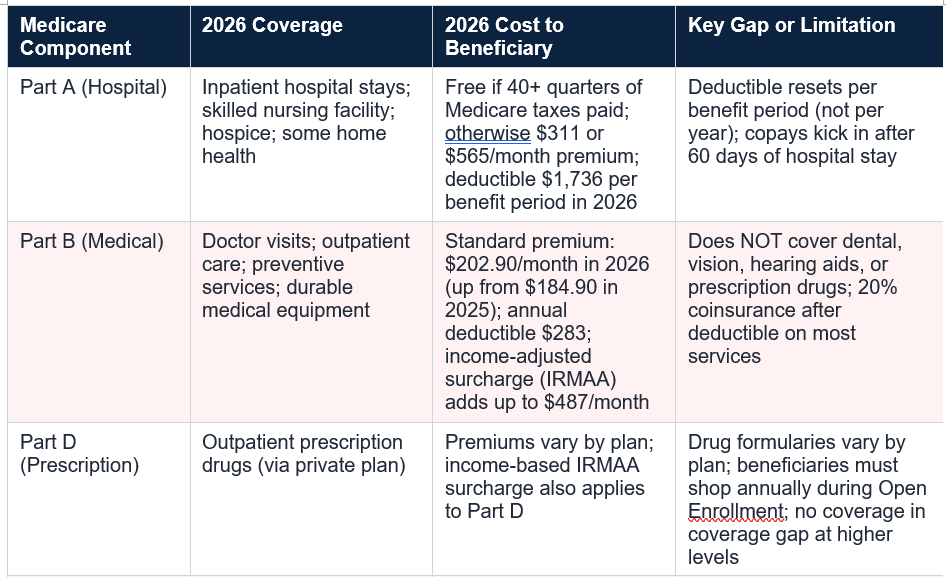
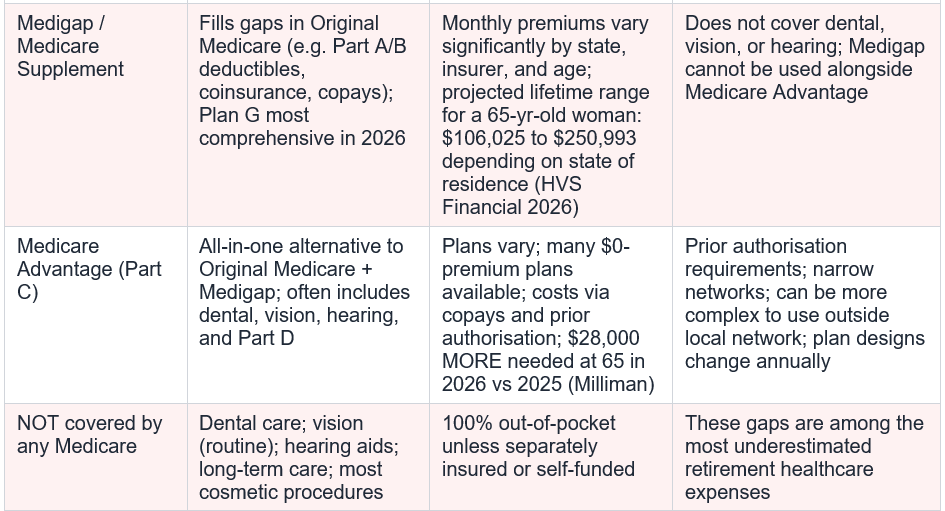
The most expensive Medicare mistake retirees make is assuming that standard Part B at $202.90/month is the cost they will pay. For higher-income retirees, IRMAA surcharges can push the effective Part B premium to $689.90/month — $487/month more than the standard rate. This is 2.4× the standard premium, adds $5,844/year per person to the Medicare bill, and is triggered by income from two years prior. Planning your income now — including Roth conversion timing and capital gains distribution — directly determines the IRMAA tier you fall into.
The 2026 HSA contribution limits (IRS):
The HSA’s power for retirement healthcare is in the compounding. Money contributed to an HSA and invested — rather than spent immediately on current medical costs — grows tax-free over the contribution period and can be withdrawn tax-free for any qualifying healthcare expense in retirement. Qualifying expenses include Medicare premiums (Parts B, C, D), Medicare Supplement premiums, dental and vision costs, long-term care insurance premiums (subject to limits), and prescription costs.
At age 55, contributing the maximum $5,400/year (catch-up eligible, self-only HDHP) and investing in a broad equity index fund at a hypothetical 7% annual growth rate: by age 65 (ten years), the HSA would grow to approximately $74,600 tax-free — available for qualified healthcare expenses in retirement with zero tax at withdrawal. At a 1% savings rate (cash), the same contributions produce approximately $57,000 at 65. The difference: $17,600 in additional tax-free healthcare funds purely from investment versus cash. This is before accounting for the tax deduction on contributions — at a 22% marginal rate, $5,400/year of pre-tax contributions saves approximately $1,188/year in current income taxes, or $11,880 over the decade. (Illustrative only; actual results vary. Not financial advice.)
If you are enrolled in an HDHP: contribute the maximum to your HSA this year, invest the balance immediately in your provider’s lowest-cost broad index fund option, and avoid spending HSA funds on current medical costs if you can afford to pay out of pocket. Every dollar that stays invested in the HSA is a dollar compounding tax-free toward the $185,500 target.
The feature that makes IRMAA both dangerous and plannable is the two-year lookback: 2026 Medicare Part B and D premiums are based on 2024 MAGI. This means decisions made in 2024 about income — IRA distributions, Roth conversions, capital gains realisations, business income timing — directly determine the IRMAA tier for 2026. By the time the 2026 IRMAA bill arrives, the 2024 tax year is closed and the lookback period is locked.
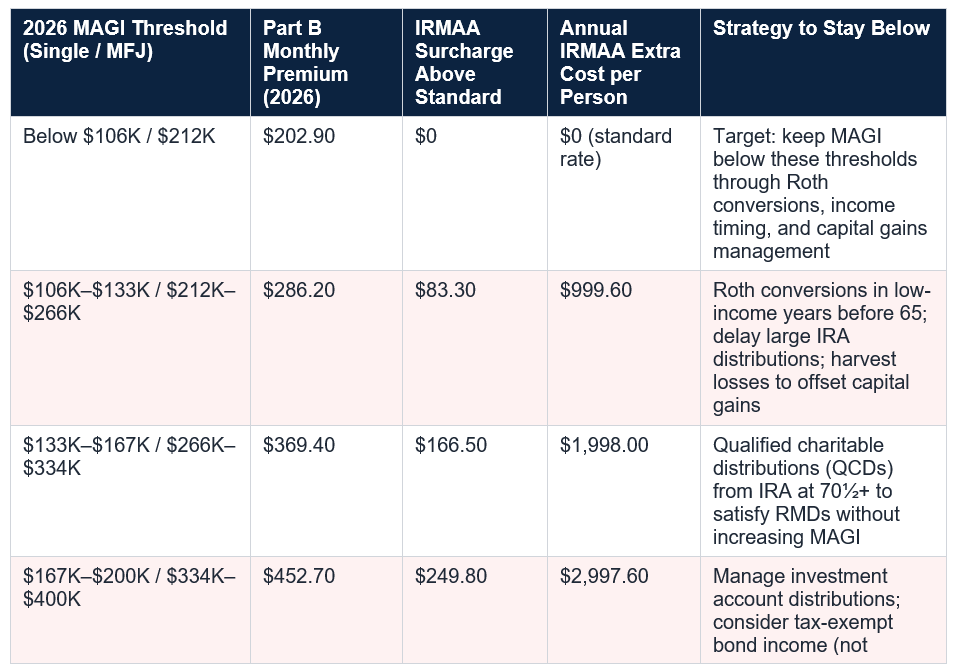
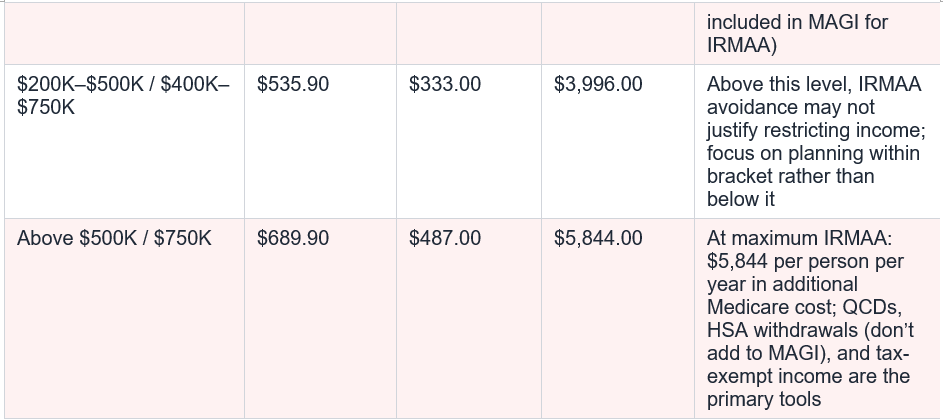
The most important IRMAA planning tool in the pre-Medicare years is the Roth conversion. Between retirement (often 62) and Medicare enrollment at 65, many retirees are in an unusually low-income year — no longer receiving employment income, not yet receiving Social Security (ideally delayed to 70 for maximum benefit), and with a temporarily reduced MAGI. This window is ideal for converting traditional IRA or 401(k) assets to Roth at a lower tax rate, which reduces future RMD-driven income and therefore reduces future IRMAA exposure. Charles Schwab (April 2026) and David Lerner Associates (March 2026) both identify Roth conversion in low-income years before Medicare as one of the highest-impact IRMAA strategies available.
Two years before your planned Medicare enrollment, run your projected MAGI through the IRMAA thresholds. If you are near a threshold, consider: (1) Roth conversions in the current year to reduce future RMDs; (2) delaying capital gains realisations; (3) accelerating deductible expenses; (4) filing an IRMAA appeal if you have had a qualifying life event (marriage, divorce, death of spouse, work stoppage) that changed your income since the lookback year. An IRMAA reduction of one tier saves $1,000 to $6,000 per person per year, every year of Medicare enrollment.
The fundamental trade-off between the two pathways:
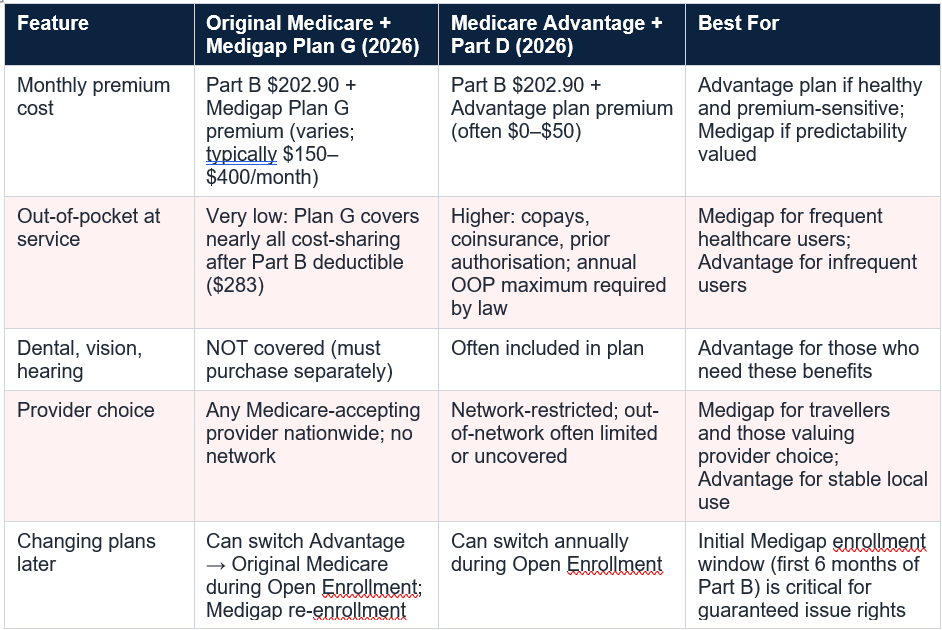
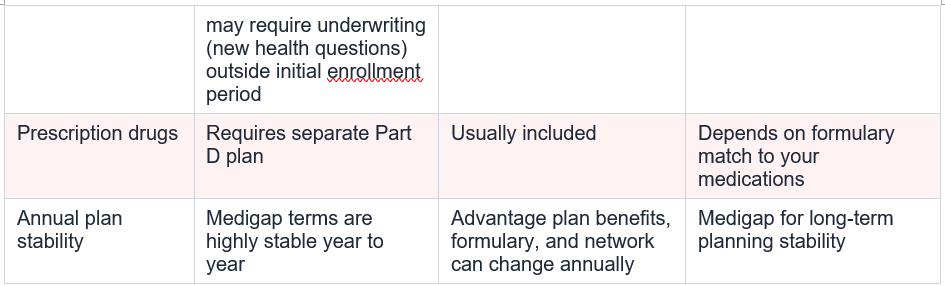
The single most critical timing rule in Medicare plan selection: the six-month Medicare Supplement Open Enrollment Period that begins when you turn 65 and enrol in Part B is the only time you have guaranteed issue rights for Medigap — insurers must accept you at standard rates regardless of pre-existing conditions. Miss this window and apply for Medigap later, and insurers in most states can reject you or charge higher premiums based on your health history. Getting this decision right at 65 can save tens of thousands of dollars over a 20-year retirement.
Before your 65th birthday: (1) research both pathways using the Medicare Plan Finder (medicare.gov/plan-compare); (2) list your current medications and check formulary coverage for both Part D and Medicare Advantage options; (3) list your current doctors and verify network participation; (4) if you have any existing health conditions, run the long-term cost comparison including out-of-pocket maximums; (5) if Medigap is right for you, enrol within your six-month guaranteed issue window — do not delay.
The mechanism is straightforward: your health status is one of the primary drivers of lifetime healthcare costs in retirement (Milliman 2026). A healthier retiree has fewer chronic conditions to manage, fewer hospitalisations, fewer prescription drugs, fewer specialist visits, and lower Medicare cost-sharing exposure. Every reduction in chronic disease risk is a reduction in the long-term healthcare bill. The Motley Fool’s retirement healthcare guide identifies healthy habits as the first strategy for reducing healthcare expenses: ‘If you make an effort to stay active and eat healthy, you’ll likely spend less on healthcare than someone who ignores diet and exercise.’
The financial value of specific healthy habits:
Coverage options during the pre-Medicare gap:
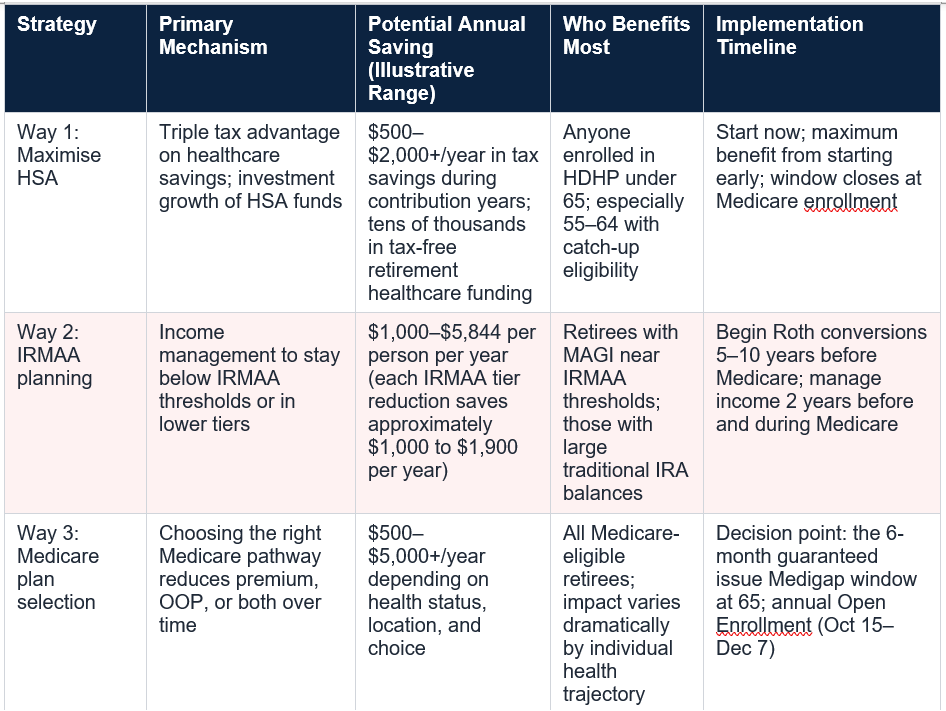
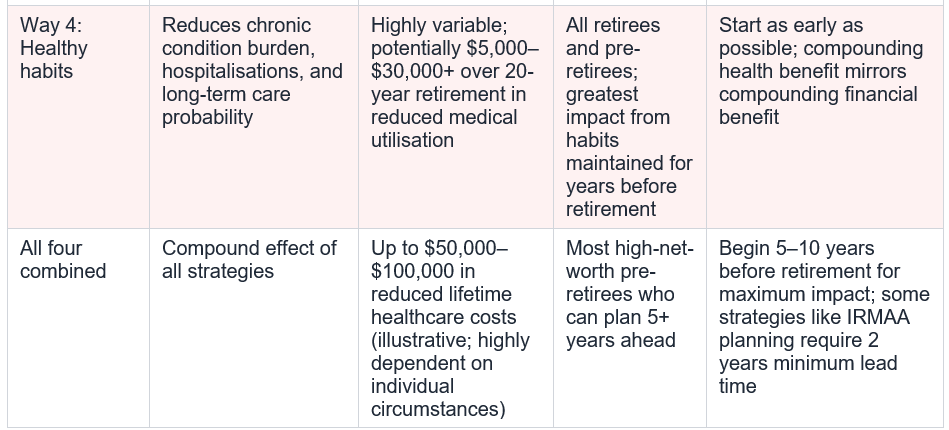
All figures in the table above are illustrative ranges for educational purposes. Individual outcomes will vary significantly based on health status, income, geographic location, Medicare plan choice, and the length of retirement. Not financial advice.
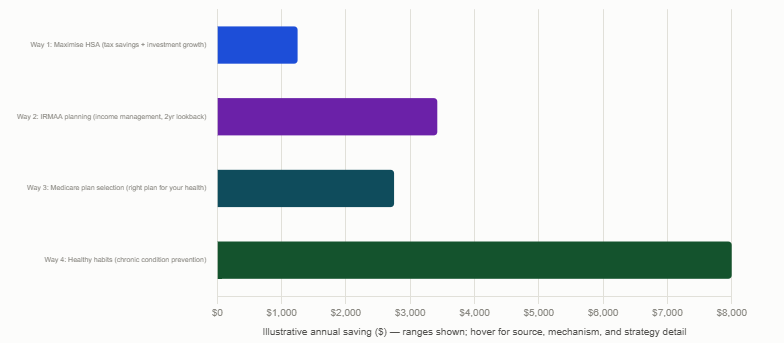
What the four strategies in this guide address is the significant margin of controllable cost within the larger total. HSA maximisation reduces the after-tax cost of every healthcare dollar spent in retirement. IRMAA income planning can save $1,000 to $5,844 per person per year in Medicare premiums. Medicare plan selection — made correctly during the six-month guaranteed issue window — determines the predictability and magnitude of healthcare cost exposure for the entire Medicare period. And healthy habits, maintained consistently before and through retirement, reduce the chronic condition burden that is one of the three forces driving the $185,500 figure higher every year.
None of these strategies requires exceptional income or exceptional luck. They require knowledge, planning, and time — ideally a decade or more before retirement. The investor who begins building the HSA at 55, manages income through Roth conversions in the years before Medicare, makes the Medicare plan decision with full information at 65, and arrives at retirement with a healthy lifestyle already established will face the same structural cost trajectory as everyone else — and will face it significantly better prepared.
According to Fidelity Investments' 2026 annual retirement healthcare estimate, a 65-year-old retiring in 2026 can expect to spend approximately $185,500 per person on healthcare costs over the course of retirement, excluding long-term care costs. This is up from $172,500 in 2025 — a 7.5% increase in one year. The Milliman Retiree Health Cost Index 2026 (published June 22, 2026) adds the couple-level estimate: a 65-year-old couple needs approximately $30,000 more in savings than the 2025 estimate under the Original Medicare + Medigap + Part D pathway. HealthView Services projects healthcare inflation running at 5.8% per year, meaning a healthy 65-year-old couple may need 84% of their lifetime Social Security income just to cover healthcare costs.
What is the best way to save for retirement healthcare costs?
The Health Savings Account (HSA) is widely considered the most tax-efficient vehicle for retirement healthcare savings, providing a triple tax advantage: pre-tax contributions, tax-free growth, and tax-free withdrawals for qualified healthcare expenses. In 2026, HSA contribution limits are $4,400 (self-only HDHP) or $8,750 (family), with an additional $1,000 catch-up for those 55 or older. The HSA requires enrollment in a High-Deductible Health Plan and cannot receive contributions once you enrol in Medicare. Fidelity research found that 40% of HSA owners have not invested their balance, leaving significant tax-free growth potential unused. Beyond the HSA, Roth IRA/401(k) contributions that have already been taxed can be a tax-efficient supplement, particularly because Roth withdrawals do not increase MAGI for IRMAA purposes.
What is IRMAA and how do I avoid it?
IRMAA (Income-Related Monthly Adjustment Amount) is a surcharge added to Medicare Part B and Part D premiums for higher-income beneficiaries. In 2026, IRMAA kicks in when MAGI exceeds $106,000 for single filers or $212,000 for married filing jointly. At the highest tier (MAGI above $500,000 single / $750,000 MFJ), the IRMAA surcharge adds up to $487 per month per person above the standard Part B premium, for an additional cost of $5,844 per person per year. IRMAA uses a two-year lookback: 2026 IRMAA is based on 2024 MAGI. The most effective strategies to reduce or avoid IRMAA include: Roth conversions in low-income years before Medicare enrollment (reducing future RMD-driven MAGI); timing capital gains realisations carefully; using Qualified Charitable Distributions (QCDs) from IRAs after age 70½ to satisfy RMDs without increasing MAGI; and using HSA withdrawals for Medicare premiums (HSA withdrawals are not included in MAGI). If you have a qualifying life event that reduced your income, you can appeal your IRMAA tier using Form SSA-44.
Should I choose Medicare Advantage or Original Medicare with Medigap?
This is one of the most consequential healthcare decisions in retirement, and the right answer varies significantly by individual health status, geographic location, income, and risk tolerance. Original Medicare with Medigap Plan G offers near-comprehensive coverage with minimal out-of-pocket at point of care, freedom to see any Medicare-accepting provider nationally, and highly stable year-to-year terms. The trade-off is higher monthly premiums. Medicare Advantage (Part C) typically offers lower premiums (many $0-premium plans) and often includes dental, vision, and hearing benefits, but has network restrictions, prior authorisation requirements, and higher potential out-of-pocket exposure if health deteriorates. For retirees with chronic conditions or complex health needs, the Original Medicare + Medigap pathway often provides better value despite higher premiums. For healthy retirees who use minimal healthcare, Medicare Advantage's lower premiums can be cost-effective. The critical timing rule: the six-month Medicare Supplement Open Enrollment Period beginning when you enrol in Part B at 65 is the only time insurers must accept you for Medigap at standard rates regardless of pre-existing conditions. This window cannot be replicated.
Can healthy habits really lower my retirement healthcare costs?
Yes, and the financial impact over a 20 to 30-year retirement is significant. Chronic conditions — type 2 diabetes, cardiovascular disease, hypertension, obesity-related conditions — are among the most expensive long-term healthcare expenses and are also among the most preventable. Milliman's 2026 Retiree Health Cost Index specifically identifies chronic condition management as one of the three forces behind the growing retirement healthcare cost burden. A retiree who arrives at 65 without multiple chronic conditions faces substantially lower Medicare cost-sharing, fewer prescription costs, lower probability of hospitalisation, and lower long-term care probability than a retiree managing several chronic diseases. The preventive care covered at zero cost under Medicare Part B — annual wellness visits, cancer screenings, cardiovascular risk assessments, diabetes screenings, vaccines — exists specifically to catch and address health risks before they become expensive chronic conditions. Using these services consistently is both the lowest-cost and one of the highest-value healthcare decisions available.
What happens if I retire before 65?
The average US retirement age is 62 (HVS Financial 2026 Data Report), creating a typical three-year gap between retirement and Medicare eligibility. During this gap, retirees must fund their own health insurance without the Medicare subsidy. Options include: COBRA continuation of employer coverage (typically expensive, as it includes both employer and employee premium portions); ACA marketplace plans (premium tax credits available based on income — carefully managing income during the pre-Medicare years can maximise subsidy eligibility); or coverage through a working spouse's employer plan. The pre-Medicare gap is one of the most expensive periods of the retirement healthcare timeline and should be budgeted separately from the Medicare years. Note that to preserve HSA contribution eligibility, you must not enrol in Medicare — even Part A if you delay Social Security. This is an important interaction between Social Security timing and HSA contributions that requires specific planning.
Table of Contents
- The $185,500 Problem
- Why Retirement Healthcare Costs Keep Rising
- Medicare 101: Understanding What You Are Working With in 2026
- Way 1: Maximise Your HSA Before You Retire
- Way 2: Plan Your Income to Avoid IRMAA Surcharges
- Way 3: Choose the Right Medicare Plan for Your Situation
- Way 4: Invest in Your Health Before Retirement
- Bridging the Pre-Medicare Gap: Ages 62 to 65
- The Four Ways Combined: What They Can Save You
- What Healthcare Costs Look Like Across a 25-Year Retirement
- Conclusion: The Costs You Can’t Avoid and the Ones You Can Reduce
- Frequently Asked Questions
The 4 Ways: Potential Annual Savings From Each Strategy
The $185,500 Problem
Fidelity Investments’ 2026 annual retirement healthcare estimate puts the average cost for a 65-year-old retiring in 2026 at $185,500 per person over the course of retirement — not including long-term care costs. That figure has risen from $172,500 in 2025, a 7.5% increase in a single year. When Fidelity published its inaugural estimate in 2002, the number was $80,000. In less than a quarter century, the figure has more than doubled.The Milliman Retiree Health Cost Index 2026, published June 22, 2026, adds further precision: a 65-year-old couple retiring in 2026 will need approximately $30,000 more in savings than the 2025 cohort if they choose Original Medicare plus a Medigap supplement plan and Part D. HealthView Services projects healthcare inflation running at 5.8% per year against a Social Security COLA projection of just 2.4% — meaning the purchasing power gap between what healthcare costs and what retirees receive automatically widens every year. A healthy 65-year-old couple may need 84% of their lifetime Social Security income just to cover healthcare.
You cannot eliminate retirement healthcare costs. Medicare is not free, it has gaps, and the chronic conditions that accumulate with age create costs that no insurance plan fully eliminates. But this guide covers four specific, actionable strategies that together can meaningfully reduce what you pay — across the years before Medicare, through the Medicare decision, via income planning, and through the single most cost-effective long-term intervention available: your own health.
Fidelity 2026 individual retirement healthcare estimate: $185,500 per person (up from $172,500 in 2025; +7.5%). Milliman 2026: couple needs $30,000 MORE than 2025 estimate (Original Medicare + Medigap + Part D). Healthcare inflation projection: 5.8%/yr (HealthView Services 2026). Social Security projected COLA: 2.4%/yr average. A healthy 65-year-old couple may need 84% of their lifetime Social Security income to cover healthcare costs (HealthView Services 2026).
Why Retirement Healthcare Costs Keep Rising
The $185,500 figure and its 7.5% year-over-year increase are not anomalies. They are the acceleration of a long-term structural trend. Fidelity identifies three specific forces behind the 2026 jump, and none of them are temporary:- Rising prices for care itself: healthcare inflation has outpaced general inflation for years. In 2026, Medicare Part B premiums rose by nearly 10% — against a CPI backdrop of 3.1% for food, 2.8% for energy, and 3.0% for general items (HVS Financial 2026 Data Report, February 2026). The Part B deductible also rose, from $257 to $283. These are administrative pricing decisions by the Centers for Medicare and Medicaid Services that reflect the underlying cost trajectory of the healthcare system.
- More frequent use of medical services: an aging population visits physicians, undergoes diagnostic testing, and fills prescriptions more often than younger cohorts. The average retirement age is 62 (HVS Financial 2026), creating a population of retirees who begin accumulating healthcare usage at 62 and continue for potentially 25 to 30+ years.
- The cost of managing chronic conditions: diabetes, hypertension, heart disease, arthritis, and other chronic conditions require ongoing medication, monitoring, and specialist care. As longevity increases, the duration and complexity of chronic condition management extends correspondingly.
The maths of healthcare inflation is more punishing than general inflation because it compounds against a fixed or slowly growing income base. Social Security COLA at 2.4% does not keep pace with 5.8% healthcare inflation. The gap — 3.4 percentage points annually — means that healthcare becomes a progressively larger share of retirement income every year. This is not a problem that resolves itself; it requires active strategies to mitigate.
Medicare 101: Understanding What You Are Working With in 2026
Any strategy to reduce retirement healthcare costs must start with a clear understanding of what Medicare covers, what it costs, and — critically — what it does not cover. Many retirees overestimate Medicare’s comprehensiveness and underestimate its costs.The most expensive Medicare mistake retirees make is assuming that standard Part B at $202.90/month is the cost they will pay. For higher-income retirees, IRMAA surcharges can push the effective Part B premium to $689.90/month — $487/month more than the standard rate. This is 2.4× the standard premium, adds $5,844/year per person to the Medicare bill, and is triggered by income from two years prior. Planning your income now — including Roth conversion timing and capital gains distribution — directly determines the IRMAA tier you fall into.
WAY 1: Maximise Your HSA Before You Retire
The Health Savings Account (HSA) is the single most tax-efficient vehicle available for funding retirement healthcare costs. It provides a triple tax advantage that no other retirement account matches: contributions are pre-tax or tax-deductible, growth inside the account is tax-free, and withdrawals for qualified healthcare expenses are tax-free. The combination of all three tax benefits, applied to what will be one of the largest line items in retirement spending, makes the HSA uniquely powerful.The 2026 HSA contribution limits (IRS):
- Self-only HDHP coverage: $4,400 per year (up from $4,300 in 2025).
- Family HDHP coverage: $8,750 per year (up from $8,550 in 2025).
- Catch-up contribution (age 55 or older, not yet enrolled in Medicare): additional $1,000, making the maximum $5,400 (self-only) or $9,750 (family) for those 55+.
The HSA’s power for retirement healthcare is in the compounding. Money contributed to an HSA and invested — rather than spent immediately on current medical costs — grows tax-free over the contribution period and can be withdrawn tax-free for any qualifying healthcare expense in retirement. Qualifying expenses include Medicare premiums (Parts B, C, D), Medicare Supplement premiums, dental and vision costs, long-term care insurance premiums (subject to limits), and prescription costs.
At age 55, contributing the maximum $5,400/year (catch-up eligible, self-only HDHP) and investing in a broad equity index fund at a hypothetical 7% annual growth rate: by age 65 (ten years), the HSA would grow to approximately $74,600 tax-free — available for qualified healthcare expenses in retirement with zero tax at withdrawal. At a 1% savings rate (cash), the same contributions produce approximately $57,000 at 65. The difference: $17,600 in additional tax-free healthcare funds purely from investment versus cash. This is before accounting for the tax deduction on contributions — at a 22% marginal rate, $5,400/year of pre-tax contributions saves approximately $1,188/year in current income taxes, or $11,880 over the decade. (Illustrative only; actual results vary. Not financial advice.)
If you are enrolled in an HDHP: contribute the maximum to your HSA this year, invest the balance immediately in your provider’s lowest-cost broad index fund option, and avoid spending HSA funds on current medical costs if you can afford to pay out of pocket. Every dollar that stays invested in the HSA is a dollar compounding tax-free toward the $185,500 target.
WAY 2: Plan Your Income to Avoid IRMAA Surcharges
IRMAA — the Income-Related Monthly Adjustment Amount — is the mechanism by which Medicare charges higher-income beneficiaries more for Parts B and D. For 2026, the IRMAA brackets are triggered when Modified Adjusted Gross Income (MAGI) exceeds $106,000 for single filers or $212,000 for married filing jointly. At the top tier, the combined IRMAA surcharge can add up to $487/month per person on top of the standard $202.90 Part B premium.The feature that makes IRMAA both dangerous and plannable is the two-year lookback: 2026 Medicare Part B and D premiums are based on 2024 MAGI. This means decisions made in 2024 about income — IRA distributions, Roth conversions, capital gains realisations, business income timing — directly determine the IRMAA tier for 2026. By the time the 2026 IRMAA bill arrives, the 2024 tax year is closed and the lookback period is locked.
The most important IRMAA planning tool in the pre-Medicare years is the Roth conversion. Between retirement (often 62) and Medicare enrollment at 65, many retirees are in an unusually low-income year — no longer receiving employment income, not yet receiving Social Security (ideally delayed to 70 for maximum benefit), and with a temporarily reduced MAGI. This window is ideal for converting traditional IRA or 401(k) assets to Roth at a lower tax rate, which reduces future RMD-driven income and therefore reduces future IRMAA exposure. Charles Schwab (April 2026) and David Lerner Associates (March 2026) both identify Roth conversion in low-income years before Medicare as one of the highest-impact IRMAA strategies available.
Two years before your planned Medicare enrollment, run your projected MAGI through the IRMAA thresholds. If you are near a threshold, consider: (1) Roth conversions in the current year to reduce future RMDs; (2) delaying capital gains realisations; (3) accelerating deductible expenses; (4) filing an IRMAA appeal if you have had a qualifying life event (marriage, divorce, death of spouse, work stoppage) that changed your income since the lookback year. An IRMAA reduction of one tier saves $1,000 to $6,000 per person per year, every year of Medicare enrollment.
WAY 3: Choose the Right Medicare Plan for Your Situation
The Medicare plan decision — Original Medicare + Medigap + Part D versus Medicare Advantage + Part D — is one of the most consequential financial choices retirees make, and it is one that most people make with inadequate information during the emotionally complex transition of retirement. The wrong choice can cost thousands of dollars per year and lock retirees into a coverage structure that becomes progressively harder to change.The fundamental trade-off between the two pathways:
- Original Medicare + Medigap (Plan G): higher upfront monthly premiums, but near-comprehensive coverage with minimal out-of-pocket exposure at point of care. Once enrolled in a Medigap plan, the cost of any covered service is predictable and nearly zero (after the Part B deductible). Particularly valuable for retirees with existing chronic conditions, those who travel frequently, or those who prioritise predictability over premium cost.
- Medicare Advantage (Part C): lower or zero monthly premiums, but higher out-of-pocket potential at point of service (copays, prior authorisation, network restrictions). Most plans include dental, vision, and hearing coverage that Original Medicare lacks. Best for healthy retirees who use healthcare infrequently, live in a stable geographic location with a good local network, and are comfortable managing the plan’s administrative requirements.
The single most critical timing rule in Medicare plan selection: the six-month Medicare Supplement Open Enrollment Period that begins when you turn 65 and enrol in Part B is the only time you have guaranteed issue rights for Medigap — insurers must accept you at standard rates regardless of pre-existing conditions. Miss this window and apply for Medigap later, and insurers in most states can reject you or charge higher premiums based on your health history. Getting this decision right at 65 can save tens of thousands of dollars over a 20-year retirement.
Before your 65th birthday: (1) research both pathways using the Medicare Plan Finder (medicare.gov/plan-compare); (2) list your current medications and check formulary coverage for both Part D and Medicare Advantage options; (3) list your current doctors and verify network participation; (4) if you have any existing health conditions, run the long-term cost comparison including out-of-pocket maximums; (5) if Medigap is right for you, enrol within your six-month guaranteed issue window — do not delay.
WAY 4: Invest in Your Health Before Retirement
The fourth strategy to lower retirement healthcare costs is the one least often discussed in financial planning contexts — because it requires no account opening, no tax election, and no plan comparison. It requires changing behaviour. It is also, across a 20 to 30-year retirement, potentially the highest-value strategy of the four.The mechanism is straightforward: your health status is one of the primary drivers of lifetime healthcare costs in retirement (Milliman 2026). A healthier retiree has fewer chronic conditions to manage, fewer hospitalisations, fewer prescription drugs, fewer specialist visits, and lower Medicare cost-sharing exposure. Every reduction in chronic disease risk is a reduction in the long-term healthcare bill. The Motley Fool’s retirement healthcare guide identifies healthy habits as the first strategy for reducing healthcare expenses: ‘If you make an effort to stay active and eat healthy, you’ll likely spend less on healthcare than someone who ignores diet and exercise.’
The financial value of specific healthy habits:
- Not smoking: smokers face significantly higher healthcare costs and mortality risk. The cost of tobacco-related illness, both in out-of-pocket medical expenses and in higher insurance premiums (some Medigap plans allow tobacco rating), adds substantially to lifetime healthcare spending.
- Maintaining a healthy weight: obesity is associated with higher rates of type 2 diabetes, cardiovascular disease, joint replacement, and sleep disorders — all of which are among the most expensive chronic conditions to manage in retirement. The incremental healthcare cost of obesity compounds over years of retirement at a healthcare inflation rate.
- Staying physically active: regular physical activity reduces the risk of heart disease, stroke, type 2 diabetes, and several cancers, as well as reducing falls — a leading cause of hospitalisation and long-term care entry in older adults. Medicare covers an annual wellness visit and preventive screenings; using these to manage health proactively reduces the downstream cost of untreated conditions.
- Managing blood pressure and cholesterol: hypertension and elevated cholesterol are modifiable risk factors for heart disease and stroke — two of the most expensive acute events in retirement. Generic medications for both conditions are inexpensive; the hospitalisation and ongoing care following a stroke or cardiac event is not.
- Using Medicare’s free preventive services: Medicare Part B covers an annual wellness visit (Medicare Wellness Visit), depression screening, cardiovascular risk assessments, diabetes screening, mammograms, colonoscopies, flu and pneumonia vaccines, and a Welcome to Medicare preventive visit in the first year. These services are fully covered at zero cost to the beneficiary and are the most cost-effective healthcare spending available. Using them consistently enables early detection of conditions that are less expensive to treat at earlier stages.
Bridging the Pre-Medicare Gap: Ages 62 to 65
The average retirement age in the US is 62 (HVS Financial 2026). Medicare eligibility begins at 65. The three-year gap between typical retirement and Medicare coverage is one of the most financially expensive periods in the retirement healthcare timeline — and one that surprises many early retirees who assume their employer coverage can simply be continued.Coverage options during the pre-Medicare gap:
- COBRA: continuation of employer group coverage for up to 18 months. The major limitation: COBRA premiums include both the employee and employer contribution portions, making them significantly more expensive than the employee-only premium paid during employment. For a single individual, COBRA coverage often costs $500 to $1,000+ per month in 2026.
- ACA Marketplace plans: available through healthcare.gov for individuals who are not eligible for employer coverage. Retirees who manage their income carefully may qualify for premium tax credits that reduce ACA marketplace premiums significantly. MAGI below 400% of the Federal Poverty Level qualifies for credits; retirees in the income gap between these levels can time Roth conversions and portfolio withdrawals to optimise ACA subsidy eligibility during the pre-Medicare years.
- Spouse’s employer plan: if a spouse continues working, joining their employer plan is typically the most cost-effective option during the pre-Medicare gap — because the employer subsidy remains in place.
- Short-term health plans: generally not recommended for most retirees due to benefit limitations, exclusions for pre-existing conditions, and coverage gaps. They carry the risk of large out-of-pocket exposure if a significant health event occurs.
9. The Four Ways Combined: What They Can Save You
The four strategies do not operate independently. They interact and reinforce each other. The HSA reduces the out-of-pocket cost of healthcare in retirement by providing tax-free funds. IRMAA planning reduces the annual Medicare premium bill. Medicare plan selection affects the predictability and magnitude of healthcare cost exposure. And healthy habits reduce the frequency and severity of healthcare utilisation across all coverage types.All figures in the table above are illustrative ranges for educational purposes. Individual outcomes will vary significantly based on health status, income, geographic location, Medicare plan choice, and the length of retirement. Not financial advice.
What Healthcare Costs Look Like Across a 25-Year Retirement
The $185,500 Fidelity figure represents a lifetime total, not an annual figure. Understanding how healthcare costs accumulate over a 25-year retirement — with the three-phase spending pattern of go-go, slow-go, and no-go years — helps illustrate where the spending is concentrated and where the strategies have the most impact.- Ages 65–75 (Go-Go years): routine Medicare costs dominate — Part B premiums, Medigap or Advantage premiums, Part D premiums, and moderate out-of-pocket costs. Average annual healthcare spending in this phase tends to be $7,000–10,000 per individual, varying by plan choice and health.
- Ages 75–85 (Slow-Go years): chronic condition management intensifies. Prescription costs, specialist visits, physical therapy, hearing aids, dental care, and vision care accumulate. Average annual spending rises to $10,000–15,000+ per individual in this phase.
- Ages 85+ (No-Go years): the most expensive healthcare decade. Long-term care costs (not covered by Medicare) emerge for a significant proportion of the population. The average annual cost of a private room in a nursing home exceeded $100,000 in 2025 and is rising at above-general-inflation rates. Healthcare costs in this phase can easily exceed $20,000–30,000+ per year before any long-term care costs are added.
Conclusion
A 65-year-old retiring in 2026 faces an estimated $185,500 in lifetime healthcare costs per person, rising at 7.5% in a single year against a healthcare inflation rate of 5.8% and a Social Security COLA of just 2.4%. These are structural forces that no individual strategy can eliminate. Medicare is not free. Chronic conditions accumulate with age. Healthcare inflation compounds over decades.What the four strategies in this guide address is the significant margin of controllable cost within the larger total. HSA maximisation reduces the after-tax cost of every healthcare dollar spent in retirement. IRMAA income planning can save $1,000 to $5,844 per person per year in Medicare premiums. Medicare plan selection — made correctly during the six-month guaranteed issue window — determines the predictability and magnitude of healthcare cost exposure for the entire Medicare period. And healthy habits, maintained consistently before and through retirement, reduce the chronic condition burden that is one of the three forces driving the $185,500 figure higher every year.
None of these strategies requires exceptional income or exceptional luck. They require knowledge, planning, and time — ideally a decade or more before retirement. The investor who begins building the HSA at 55, manages income through Roth conversions in the years before Medicare, makes the Medicare plan decision with full information at 65, and arrives at retirement with a healthy lifestyle already established will face the same structural cost trajectory as everyone else — and will face it significantly better prepared.
Frequently Asked Questions
How much does healthcare cost in retirement in 2026?According to Fidelity Investments' 2026 annual retirement healthcare estimate, a 65-year-old retiring in 2026 can expect to spend approximately $185,500 per person on healthcare costs over the course of retirement, excluding long-term care costs. This is up from $172,500 in 2025 — a 7.5% increase in one year. The Milliman Retiree Health Cost Index 2026 (published June 22, 2026) adds the couple-level estimate: a 65-year-old couple needs approximately $30,000 more in savings than the 2025 estimate under the Original Medicare + Medigap + Part D pathway. HealthView Services projects healthcare inflation running at 5.8% per year, meaning a healthy 65-year-old couple may need 84% of their lifetime Social Security income just to cover healthcare costs.
What is the best way to save for retirement healthcare costs?
The Health Savings Account (HSA) is widely considered the most tax-efficient vehicle for retirement healthcare savings, providing a triple tax advantage: pre-tax contributions, tax-free growth, and tax-free withdrawals for qualified healthcare expenses. In 2026, HSA contribution limits are $4,400 (self-only HDHP) or $8,750 (family), with an additional $1,000 catch-up for those 55 or older. The HSA requires enrollment in a High-Deductible Health Plan and cannot receive contributions once you enrol in Medicare. Fidelity research found that 40% of HSA owners have not invested their balance, leaving significant tax-free growth potential unused. Beyond the HSA, Roth IRA/401(k) contributions that have already been taxed can be a tax-efficient supplement, particularly because Roth withdrawals do not increase MAGI for IRMAA purposes.
What is IRMAA and how do I avoid it?
IRMAA (Income-Related Monthly Adjustment Amount) is a surcharge added to Medicare Part B and Part D premiums for higher-income beneficiaries. In 2026, IRMAA kicks in when MAGI exceeds $106,000 for single filers or $212,000 for married filing jointly. At the highest tier (MAGI above $500,000 single / $750,000 MFJ), the IRMAA surcharge adds up to $487 per month per person above the standard Part B premium, for an additional cost of $5,844 per person per year. IRMAA uses a two-year lookback: 2026 IRMAA is based on 2024 MAGI. The most effective strategies to reduce or avoid IRMAA include: Roth conversions in low-income years before Medicare enrollment (reducing future RMD-driven MAGI); timing capital gains realisations carefully; using Qualified Charitable Distributions (QCDs) from IRAs after age 70½ to satisfy RMDs without increasing MAGI; and using HSA withdrawals for Medicare premiums (HSA withdrawals are not included in MAGI). If you have a qualifying life event that reduced your income, you can appeal your IRMAA tier using Form SSA-44.
Should I choose Medicare Advantage or Original Medicare with Medigap?
This is one of the most consequential healthcare decisions in retirement, and the right answer varies significantly by individual health status, geographic location, income, and risk tolerance. Original Medicare with Medigap Plan G offers near-comprehensive coverage with minimal out-of-pocket at point of care, freedom to see any Medicare-accepting provider nationally, and highly stable year-to-year terms. The trade-off is higher monthly premiums. Medicare Advantage (Part C) typically offers lower premiums (many $0-premium plans) and often includes dental, vision, and hearing benefits, but has network restrictions, prior authorisation requirements, and higher potential out-of-pocket exposure if health deteriorates. For retirees with chronic conditions or complex health needs, the Original Medicare + Medigap pathway often provides better value despite higher premiums. For healthy retirees who use minimal healthcare, Medicare Advantage's lower premiums can be cost-effective. The critical timing rule: the six-month Medicare Supplement Open Enrollment Period beginning when you enrol in Part B at 65 is the only time insurers must accept you for Medigap at standard rates regardless of pre-existing conditions. This window cannot be replicated.
Can healthy habits really lower my retirement healthcare costs?
Yes, and the financial impact over a 20 to 30-year retirement is significant. Chronic conditions — type 2 diabetes, cardiovascular disease, hypertension, obesity-related conditions — are among the most expensive long-term healthcare expenses and are also among the most preventable. Milliman's 2026 Retiree Health Cost Index specifically identifies chronic condition management as one of the three forces behind the growing retirement healthcare cost burden. A retiree who arrives at 65 without multiple chronic conditions faces substantially lower Medicare cost-sharing, fewer prescription costs, lower probability of hospitalisation, and lower long-term care probability than a retiree managing several chronic diseases. The preventive care covered at zero cost under Medicare Part B — annual wellness visits, cancer screenings, cardiovascular risk assessments, diabetes screenings, vaccines — exists specifically to catch and address health risks before they become expensive chronic conditions. Using these services consistently is both the lowest-cost and one of the highest-value healthcare decisions available.
What happens if I retire before 65?
The average US retirement age is 62 (HVS Financial 2026 Data Report), creating a typical three-year gap between retirement and Medicare eligibility. During this gap, retirees must fund their own health insurance without the Medicare subsidy. Options include: COBRA continuation of employer coverage (typically expensive, as it includes both employer and employee premium portions); ACA marketplace plans (premium tax credits available based on income — carefully managing income during the pre-Medicare years can maximise subsidy eligibility); or coverage through a working spouse's employer plan. The pre-Medicare gap is one of the most expensive periods of the retirement healthcare timeline and should be budgeted separately from the Medicare years. Note that to preserve HSA contribution eligibility, you must not enrol in Medicare — even Part A if you delay Social Security. This is an important interaction between Social Security timing and HSA contributions that requires specific planning.
0 Comments
Be the first to share your thoughts on this article.