
Savings
5 Dollar Store Deals That Save You The Most Money

The specific categories — backed by real price comparisons — where dollar stores beat every other retailer, and the ones you should never buy there

US grocery prices rose approximately 25 percent between 2020 and 2025. Household essentials that once cost $3 cost $4 or more. The weekly grocery run that consumed $200 now consumes $250. And in that environment, the dollar store has gone from budget stigma to budget strategy. According to a 2024 Mintel report, 89 percent of US adults shopped at dollar stores in the last year. That includes, perhaps surprisingly, millennials with incomes above $100,000, who according to Checkout Tracking data compiled by Kiplinger visit dollar stores nearly 13 times per year and spend more than $135. NPD Group’s Andy Mantis put it plainly: nearly one in five dollars spent at dollar stores is contributed by affluent shoppers. The value proposition clearly resonates across economic segments.
But not everything at a dollar store is a deal. Some items are spectacular value. Others are disappointing in ways that cost you money rather than saving it. This guide identifies the five specific categories where dollar stores — principally Dollar Tree, Dollar General, and Family Dollar — deliver the largest, most consistent, and most reliably verified savings relative to mainstream retailers in 2026. Every price comparison is sourced and specific.
Mintel’s 2024 survey finding — that 89 percent of US adults shop at dollar stores — is a near-universal adoption number. This is not a niche. It is mainstream American shopping behaviour. The specific profile of the 2026 dollar store shopper:
Dollar store manufacturers deliberately engineer their products to fit the dollar store price point. As Kiplinger notes: ‘manufacturers do this deliberately — brands and package sizes vary between products stocked by Dollar Tree and those carried by other retailers.’ The 20-count bag of balloons at Dollar General for $1.50 versus the 20-count bag at Michaels for $3.55 is a legitimate apples-to-apples comparison. The single-dose laundry pod pack versus the 100-pack at Costco is not.
The five deals in this article have been selected specifically because they pass the per-unit test. These are categories where the dollar store price is lower per unit or per use, not just per item, than the mainstream retail alternative.
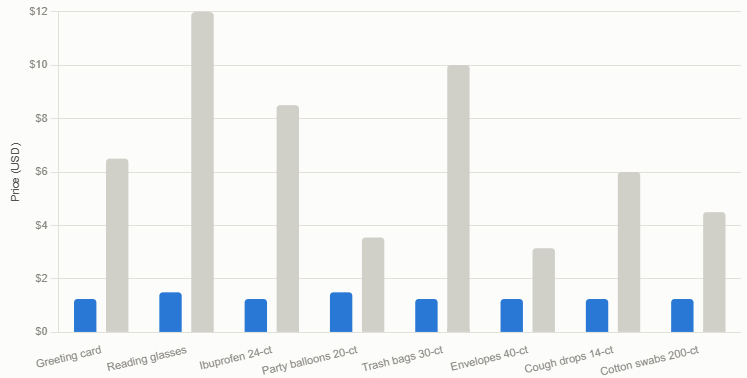
Greeting Cards: Dollar store: $1.25 (Dollar Tree) | Comparison retailer: $6.50+ (Hallmark / bookstore average) | You save: up to $5.25 per card (81% saving)
U.S. News identified greeting cards as the most obvious dollar store deal. Dollar Tree sells greeting cards for $1.25 each. A comparable card at Hallmark, a bookstore, or a supermarket card aisle costs $5 to $8. There is no material difference between a $1.25 birthday card and a $6.50 birthday card except the retailer’s margin. Both are made of paper. Both express the same sentiment. The more expensive card is not inherently more heartfelt or more appreciated by the recipient.
The AARP November 2025 analysis makes the same point with characteristic directness: ‘Loyal dollar store shoppers know that deals abound when it comes to greeting cards. Sure, the selection of seasonal, birthday, or get-well-soon cards may not be as robust as at a Hallmark store, but the cards won’t set you back several dollars.’
The practical maths: if your household sends 40 cards a year (birthday, holiday, thank-you, get-well), purchasing them at Dollar Tree rather than a mainstream card retailer saves approximately $200 annually. This is a straightforward, permanent saving with zero sacrifice in quality or sentiment.
The AARP November 2025 analysis is explicit: whether you need balloons, decorative bags, tissue paper, wrapping paper, or streamers, stocking up on party supplies at dollar stores is one of the most reliably good decisions in budget shopping. Shopping expert Chatman describes ‘a whole wall of party supplies, organised by colour’ at dollar stores, noting the breadth of selection.
The range of dollar store party savings extends well beyond balloons:
Watch Out: Be mindful of wrapping paper roll quality. As savings expert Bodge notes: ‘If the wrapping paper roll looks really thin, it probably is. Yes, it’s $1, but you can wrap two gifts.’ Always check the sheet count and yardage, not just the price.
Ibuprofen (ValuHealth 24-count caplets): Dollar store: $1.25 (Dollar Tree) | Comparison retailer: $7–$10 (Walgreens, CVS, big-box retailers) | You save: $5.75–$8.75 (80–87% saving).
GOBankingRates’ May 2026 guide highlighted the Dollar Tree ValuHealth ibuprofen as one of the clearest value comparisons in the store, noting that the product has been compared to Motrin in terms of effectiveness in customer reviews. The per-unit saving at a dollar store for generic ibuprofen, acetaminophen (paracetamol equivalent), antihistamines, and antacids is consistently in the 70 to 87 percent range versus drugstore pricing.
Other OTC health products that represent strong dollar store value:
The strongest specific value in this category:
Multi-surface cleaning spray: Dollar store: $1.25 (Dollar Tree, often name brand) | Comparison retailer: $3–$5 (Target, Walmart, same product) | You save: $1.75–$3.75 (50–75% saving).
Dollar stores frequently stock recognisable cleaning brands — Arm & Hammer, Pine-Sol, Lysol wipes, and similar — as overstock or in smaller sizes that maintain a per-unit advantage. GOBankingRates’ 2026 coverage highlighted Arm & Hammer Clean Burst liquid laundry detergent as a Dollar Tree offering, providing significantly cheaper per-load cost than the same brand at a supermarket.
Additional high-value cleaning and household buys:
Name-brand shampoo / conditioner (travel-to-regular size): Dollar store: $1.25–$2.50 (Dollar Tree) | Comparison retailer: $5–$15 (drugstore / supermarket) | You save: $2.50–$12.50 (50–83% saving).
FinanceBuzz’s August 2026 updated guide notes that Dollar Tree frequently carries name-brand personal care products, including established shampoo, conditioner, soap, and skin care brands, particularly in smaller-size formats that nonetheless represent better per-unit pricing than the equivalent at a supermarket or pharmacy.
The most specific and striking personal care deal documented in 2025–2026 research: teeth whitening strips. GOBankingRates noted that Dollar Tree sells teeth whitening strips for $1.25 — a product that retails for $25 to $50 at a pharmacy. While the Dollar Tree version may be a less powerful formulation, customer reviews indicate they do effectively remove surface stains at a fraction of the pharmacy cost.
Additional personal care deals worth buying:
10. The Full Savings Comparison Table
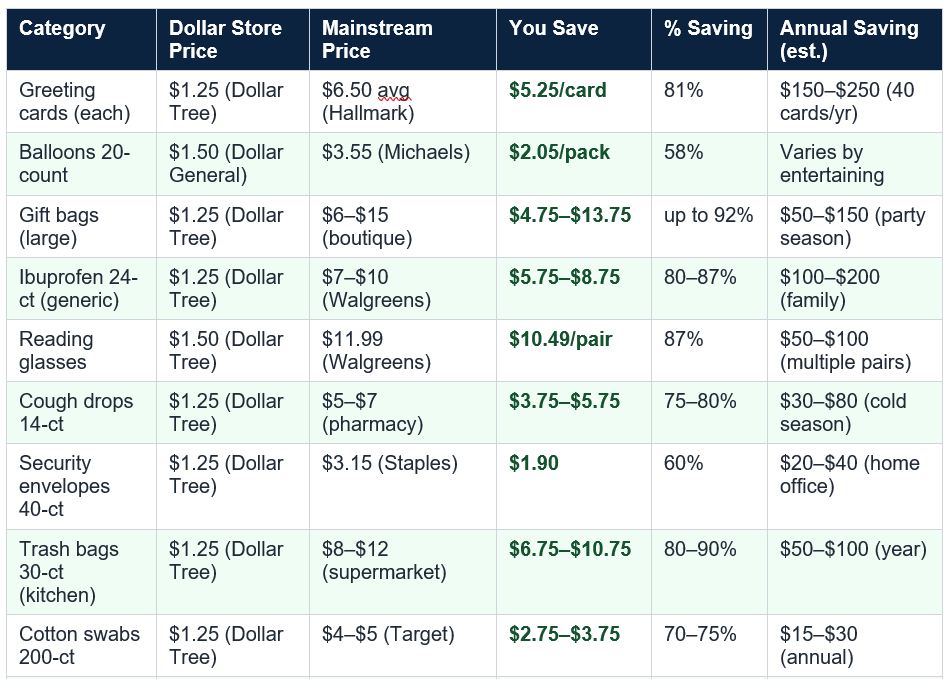
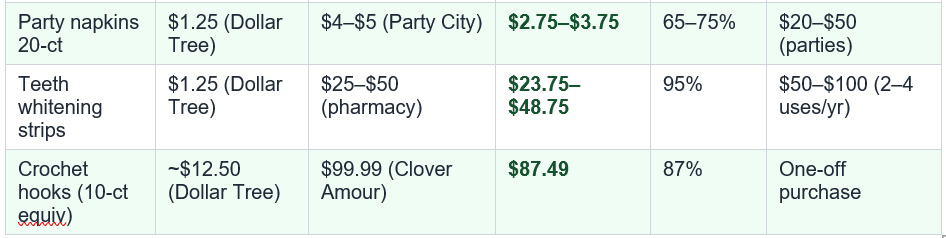
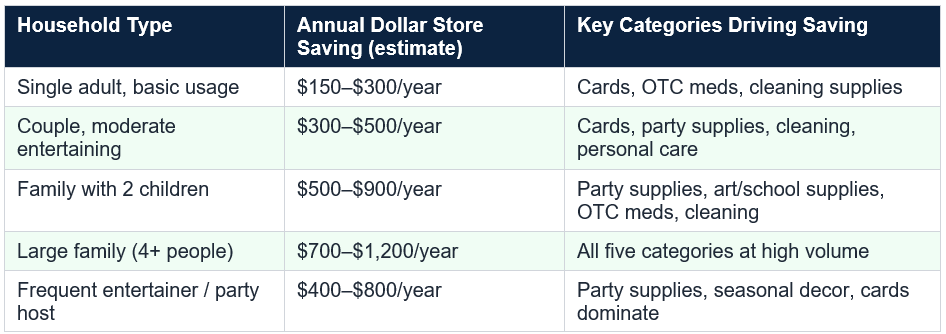
These estimates are based on price differentials sourced from publicly available 2025–2026 research and assume typical household consumption in each category. Individual results will vary based on consumption patterns, local availability, and current prices. The key principle: the saving from one year of strategic dollar store shopping for these five categories consistently exceeds the cost of a membership to a premium warehouse club.
The five deals in this article — greeting cards, party and celebration supplies, over-the-counter medications and health basics, cleaning and household supplies, and personal care basics — are not compromises. They are categories where the dollar store product is equivalent in function and radically lower in price. A $1.25 birthday card delivers the same birthday message as a $7.50 one. Generic ibuprofen at $1.25 relieves the same headache as Advil at $9. A Dollar Tree trash bag holds the same garbage as a Glad bag at three times the price.
The skill is not finding the dollar store. The skill is knowing exactly what to buy when you get there — and having the price-per-unit discipline to verify that the deal is real before you load your basket. These five categories pass that test every time.
It depends on the product category. Generic over-the-counter medications (ibuprofen, acetaminophen, antihistamines) are FDA-regulated to contain the same active ingredients as branded equivalents — they are chemically identical. Basic commodities like cotton swabs, envelopes, and cleaning tools are functionally equivalent regardless of brand. However, electronics, batteries, complex skincare formulations, and perishable food require more scrutiny at dollar stores. The safest strategy is to buy name-brand products when you spot them at dollar store prices, and to apply the per-unit price test before buying any store-brand alternative.
How much can I realistically save at a dollar store per year?
Based on publicly available 2025–2026 price comparison research, strategic dollar store shopping across the five categories covered in this article can save a single adult $150 to $300 per year, a couple $300 to $500, and a family with children $500 to $900 or more. These estimates assume consistently buying greeting cards, party supplies, OTC medications, cleaning products, and personal care basics at dollar stores rather than supermarkets or pharmacies. Individual results depend on consumption levels and local availability.
What is the difference between Dollar Tree, Dollar General, and Family Dollar?
Dollar Tree primarily sells items at $1.25 (standard items) or up to $5 (Dollar Tree Plus), with a focus on branded overstock, seasonal decor, and household basics. Dollar General operates a broader store format closer to a small discount grocery store, with items ranging from $1 to $20+, including groceries and clothing. Family Dollar is positioned between the two, with a wider food offering than Dollar Tree and a similar breadth to Dollar General. For the five deal categories in this article, Dollar Tree typically offers the strongest value per unit.
Is it safe to buy OTC medications at dollar stores?
Generic OTC medications at dollar stores — ibuprofen, acetaminophen, antihistamines, and antacids — are FDA-regulated and required to contain the same active ingredients in the same doses as branded equivalents. The ValuHealth brand at Dollar Tree, for example, has been compared favourably to Motrin in consumer reviews. Always check the active ingredients and dosage on the label to verify equivalence, and check the expiry date before purchasing. For complex medications, supplements, or any medication prescribed by a doctor, always consult a pharmacist or physician rather than self-medicating with a store-brand alternative.
What should I never buy at a dollar store?
Consumer research consistently advises against: electronics, phone chargers, and power strips (quality and safety concerns); batteries (short life means higher per-use cost); pet food and baby supplies (quality and safety risks); perishable food without careful expiry date checking; and complex skincare formulations where ingredient quality matters. Holiday lights and electrical items should only be purchased if they carry a UL (Underwriters Laboratories) safety certification label.
Do affluent shoppers actually use dollar stores?
Yes — emphatically. A 2024 Mintel survey found that 89% of US adults shop at dollar stores. Checkout Tracking data compiled by Kiplinger found that millennials with annual incomes above $100,000 visit dollar stores nearly 13 times per year and spend more than $135 annually. NPD Group’s Andy Mantis noted that nearly one in five dollars spent at dollar stores comes from affluent shoppers. Strategic dollar store shopping is not a sign of financial difficulty. It is a sign of rational consumer behaviour.
Dollar Store Price
Table of Contents
- The Dollar Store Is Having a Moment
- Who Actually Shops at Dollar Stores? (The Answer Might Surprise You)
- How Dollar Stores Work — and Why Prices Can Be So Low
- The Golden Rule: Price Per Unit, Not Price Per Item
- Deal #1: Greeting Cards — The Single Biggest Rip-Off at Any Other Store
- Deal #2: Party and Celebration Supplies
- Deal #3: Over-the-Counter Medications and Health Basics
- Deal #4: Cleaning and Household Supplies
- Deal #5: Personal Care and Beauty Basics
- The Full Savings Comparison Table
- Bonus Deals Worth Knowing
- What to Never Buy at a Dollar Store
- How to Shop Dollar Stores Like a Pro
- How Much Can You Actually Save in a Year?
- Conclusion: The Smartest Dollar You Can Spend
- Frequently Asked Questions
The Dollar Store Is Having a Moment
There used to be a stigma attached to dollar store shopping. It was perceived as the domain of people who had no other choice — a last resort for those on the tightest of budgets, a place where quality was always suspect and savings were largely illusory. That perception has not survived contact with five years of cumulative inflation.US grocery prices rose approximately 25 percent between 2020 and 2025. Household essentials that once cost $3 cost $4 or more. The weekly grocery run that consumed $200 now consumes $250. And in that environment, the dollar store has gone from budget stigma to budget strategy. According to a 2024 Mintel report, 89 percent of US adults shopped at dollar stores in the last year. That includes, perhaps surprisingly, millennials with incomes above $100,000, who according to Checkout Tracking data compiled by Kiplinger visit dollar stores nearly 13 times per year and spend more than $135. NPD Group’s Andy Mantis put it plainly: nearly one in five dollars spent at dollar stores is contributed by affluent shoppers. The value proposition clearly resonates across economic segments.
But not everything at a dollar store is a deal. Some items are spectacular value. Others are disappointing in ways that cost you money rather than saving it. This guide identifies the five specific categories where dollar stores — principally Dollar Tree, Dollar General, and Family Dollar — deliver the largest, most consistent, and most reliably verified savings relative to mainstream retailers in 2026. Every price comparison is sourced and specific.
Who Actually Shops at Dollar Stores? (The Answer Might Surprise You)
The demographic picture of the dollar store shopper in 2026 is significantly different from the stereotype. Dollar stores were once understood primarily as retailers serving lower-income communities in areas underserved by full-size supermarkets and discount chains. That picture remains partly accurate: Dollar General and Family Dollar do serve many food-desert communities across rural America and urban neighbourhoods where other grocery access is limited. But it is no longer the complete picture.Mintel’s 2024 survey finding — that 89 percent of US adults shop at dollar stores — is a near-universal adoption number. This is not a niche. It is mainstream American shopping behaviour. The specific profile of the 2026 dollar store shopper:
- Millennials (aged 30–44): the most frequent visitors among all demographics, according to Checkout Tracking data. High-income millennials shop dollar stores for specific categories where the value is obvious — party supplies, greeting cards, cleaning products — while doing primary grocery shopping elsewhere.
- Families with children: dollar stores index particularly strongly among households with young children, where the consumption of low-stakes items like art supplies, party favours, and household cleaning products is high and the willingness to pay premium prices is correspondingly low.
- Budget-conscious shoppers across income levels: as Kiplinger’s March 2026 analysis noted, the intelligence of dollar store shopping is not correlated with income. The affluent shopper who buys greeting cards at Dollar Tree instead of Hallmark is making a rational, well-informed decision. The person who buys over-the-counter ibuprofen at Dollar Tree instead of CVS is doing the same.
How Dollar Stores Work — and Why Prices Can Be So Low
Understanding how dollar stores achieve their low prices helps you use them more intelligently. There are four primary mechanisms:Stripped-down retail model
Dollar stores operate on minimal store footprint, low payroll, minimal visual merchandising, and tight assortment. A Dollar Tree store typically carries a fraction of the SKUs (individual product lines) that a Walmart or Target carries. This operational simplicity reduces overhead and allows lower margins to remain viable.Manufacturer closeouts and overstock
Dollar stores buy manufacturer overstock, end-of-season inventory, and discontinued product lines at below-wholesale prices. This is why you sometimes find name-brand products — Halls cough drops, Betty Crocker mixes, JIF peanut butter individual sizes — at dollar stores at prices that appear genuinely remarkable.Smaller package sizes
This is the critical caveat to dollar store shopping: some products appear cheap because they come in smaller quantities. A cleaning spray that costs $1.25 at Dollar Tree and $4 at Target may be cheaper at Dollar Tree per item — but if the Dollar Tree version contains half the fluid ounces, the saving evaporates. This is the foundation of the price-per-unit rule that every smart dollar store shopper applies.Private label and alternative brands
Many dollar store products are store-brand or lesser-known alternatives to major brands. Some are genuinely equivalent in quality (generic ibuprofen is chemically identical to Advil). Others are meaningfully inferior. The skill of dollar store shopping is knowing which category each product falls into.The Golden Rule: Price Per Unit, Not Price Per Item
Consumer savings expert Andrea Woroch, quoted in Kiplinger’s March 2026 guide, offers the most important single principle of dollar store shopping: compare price per unit, not price per item. A dollar store product that is unambiguously $1.25 versus $4.00 at a supermarket sounds like a 69 percent saving. If the supermarket version contains three times the quantity, the saving is actually zero.Dollar store manufacturers deliberately engineer their products to fit the dollar store price point. As Kiplinger notes: ‘manufacturers do this deliberately — brands and package sizes vary between products stocked by Dollar Tree and those carried by other retailers.’ The 20-count bag of balloons at Dollar General for $1.50 versus the 20-count bag at Michaels for $3.55 is a legitimate apples-to-apples comparison. The single-dose laundry pod pack versus the 100-pack at Costco is not.
The five deals in this article have been selected specifically because they pass the per-unit test. These are categories where the dollar store price is lower per unit or per use, not just per item, than the mainstream retail alternative.
Deal #1: Greeting Cards — The Single Biggest Rip-Off at Any Other Store
If there is one category where the dollar store saving is most universally dramatic and most reliably documented, it is greeting cards. This is the example every frugality expert reaches for first, and for good reason: the price differential is extraordinary and the product is essentially identical.Greeting Cards: Dollar store: $1.25 (Dollar Tree) | Comparison retailer: $6.50+ (Hallmark / bookstore average) | You save: up to $5.25 per card (81% saving)
U.S. News identified greeting cards as the most obvious dollar store deal. Dollar Tree sells greeting cards for $1.25 each. A comparable card at Hallmark, a bookstore, or a supermarket card aisle costs $5 to $8. There is no material difference between a $1.25 birthday card and a $6.50 birthday card except the retailer’s margin. Both are made of paper. Both express the same sentiment. The more expensive card is not inherently more heartfelt or more appreciated by the recipient.
The AARP November 2025 analysis makes the same point with characteristic directness: ‘Loyal dollar store shoppers know that deals abound when it comes to greeting cards. Sure, the selection of seasonal, birthday, or get-well-soon cards may not be as robust as at a Hallmark store, but the cards won’t set you back several dollars.’
The practical maths: if your household sends 40 cards a year (birthday, holiday, thank-you, get-well), purchasing them at Dollar Tree rather than a mainstream card retailer saves approximately $200 annually. This is a straightforward, permanent saving with zero sacrifice in quality or sentiment.
Deal #2: Party and Celebration Supplies
Party supplies are the second category where dollar store value is unambiguous, per-unit comparable, and consistently documented. The reason is structural: party supplies are use-once-and-discard items. The economic argument for premium quality in a disposable product is fundamentally weak.The AARP November 2025 analysis is explicit: whether you need balloons, decorative bags, tissue paper, wrapping paper, or streamers, stocking up on party supplies at dollar stores is one of the most reliably good decisions in budget shopping. Shopping expert Chatman describes ‘a whole wall of party supplies, organised by colour’ at dollar stores, noting the breadth of selection.
The range of dollar store party savings extends well beyond balloons:
- Gift bags and wrapping supplies: premium gift bags at boutique card shops and department stores cost $6 to $15. At Dollar Tree, large holographic gift bags cost $1.25. The recipient does not keep the bag. The sentiment travels in what’s inside it, not the packaging.
- Tableware and plates: plastic or paper tableware for parties — plates, cups, napkins, cutlery — costs a fraction of the supermarket or party store equivalent at dollar stores. A 20-count pack of birthday napkins that costs $4.50 at Party City costs $1.25 at Dollar Tree.
- Tissue paper, ribbons, and confetti: single-use decorative items where dollar store quality is entirely adequate and the savings are consistent.
- Seasonal and holiday decor: Dollar Tree offers particularly strong value in seasonal decor — ornaments, garlands, candles, and tabletop decorations for every major holiday. GOBankingRates’ 2026 New Year coverage highlighted seasonal items as among the strongest value propositions in the store.
Watch Out: Be mindful of wrapping paper roll quality. As savings expert Bodge notes: ‘If the wrapping paper roll looks really thin, it probably is. Yes, it’s $1, but you can wrap two gifts.’ Always check the sheet count and yardage, not just the price.
Deal #3: Over-the-Counter Medications and Health Basics
Generic over-the-counter medications are one of the most significant dollar store deals that many shoppers overlook. The reason they are such strong value is a pharmacological fact: generic OTC medications are required by the FDA to contain the same active ingredients in the same doses as their branded counterparts. A generic ibuprofen tablet is chemically identical to an Advil tablet. The active ingredient — ibuprofen 200mg — is the same. The price is not.Ibuprofen (ValuHealth 24-count caplets): Dollar store: $1.25 (Dollar Tree) | Comparison retailer: $7–$10 (Walgreens, CVS, big-box retailers) | You save: $5.75–$8.75 (80–87% saving).
GOBankingRates’ May 2026 guide highlighted the Dollar Tree ValuHealth ibuprofen as one of the clearest value comparisons in the store, noting that the product has been compared to Motrin in terms of effectiveness in customer reviews. The per-unit saving at a dollar store for generic ibuprofen, acetaminophen (paracetamol equivalent), antihistamines, and antacids is consistently in the 70 to 87 percent range versus drugstore pricing.
Other OTC health products that represent strong dollar store value:
- • Cough drops: Halls honey lemon cough drops are available at Dollar Tree for $1.25 for a 14-count pack. At a pharmacy, a 30-count bag costs $5 to $7 — making the per-unit price at the pharmacy higher even for a larger quantity.
- • Reading glasses: Dollar Tree’s reading glasses at $1.50 per pair versus Walgreens’ starting price of $11.99 represent an 87 percent per-unit saving. For anyone who uses multiple pairs around the house or frequently misplaces them, this is a genuinely significant recurring saving.
- • Bandages and first aid basics: basic bandage assortments and first aid supplies at dollar stores run $1.25 to $2.50 versus $5 to $10 at a pharmacy for equivalent products.
Deal #4: Cleaning and Household Supplies
Cleaning and household supplies are a category where dollar stores offer a mixed but often genuinely compelling picture. The key distinction is between branded cleaning products appearing at dollar stores (excellent value) and unbranded alternatives (more variable quality).The strongest specific value in this category:
Multi-surface cleaning spray: Dollar store: $1.25 (Dollar Tree, often name brand) | Comparison retailer: $3–$5 (Target, Walmart, same product) | You save: $1.75–$3.75 (50–75% saving).
Dollar stores frequently stock recognisable cleaning brands — Arm & Hammer, Pine-Sol, Lysol wipes, and similar — as overstock or in smaller sizes that maintain a per-unit advantage. GOBankingRates’ 2026 coverage highlighted Arm & Hammer Clean Burst liquid laundry detergent as a Dollar Tree offering, providing significantly cheaper per-load cost than the same brand at a supermarket.
Additional high-value cleaning and household buys:
- Sponges, scrub brushes, and cleaning cloths: disposable or replaceable cleaning tools that cost $3 to $6 at hardware stores cost $1.25 at dollar stores. The quality is entirely adequate for standard household cleaning.
- Dish soap: generic or off-brand dish soap at dollar stores performs equivalently to branded versions for standard dishwashing. The per-ounce price is typically 40 to 60 percent lower than supermarket alternatives.
- Trash bags: Dollar Tree trash bags are consistently cited by frugality blogs as one of the best cleaning-aisle buys. A 30-count bag of kitchen-sized trash bags costs $1.25 versus $8 to $12 for a comparable Glad or Hefty pack at a supermarket. Quality is adequate for standard household use (not construction or heavy debris).
- Storage containers and organisers: basic plastic storage bins, food containers, and organisers are among the highest per-dollar-value items at dollar stores. A container that performs identically to a $12 Target storage bin costs $1.25 or $2.50 at Dollar Tree.
Deal #5: Personal Care and Beauty Basics
Personal care is the category that most frequently surprises new dollar store shoppers. The image of dollar store personal care products as low-quality alternatives to trusted brands has been substantially revised by the entry of recognisable brands into dollar store distribution.Name-brand shampoo / conditioner (travel-to-regular size): Dollar store: $1.25–$2.50 (Dollar Tree) | Comparison retailer: $5–$15 (drugstore / supermarket) | You save: $2.50–$12.50 (50–83% saving).
FinanceBuzz’s August 2026 updated guide notes that Dollar Tree frequently carries name-brand personal care products, including established shampoo, conditioner, soap, and skin care brands, particularly in smaller-size formats that nonetheless represent better per-unit pricing than the equivalent at a supermarket or pharmacy.
The most specific and striking personal care deal documented in 2025–2026 research: teeth whitening strips. GOBankingRates noted that Dollar Tree sells teeth whitening strips for $1.25 — a product that retails for $25 to $50 at a pharmacy. While the Dollar Tree version may be a less powerful formulation, customer reviews indicate they do effectively remove surface stains at a fraction of the pharmacy cost.
Additional personal care deals worth buying:
- Soap and body wash: name-brand bars of soap and small bottles of name-brand body wash appear regularly at Dollar Tree and Dollar General. Verified name-brand products at $1.25 versus $4 to $6 at a supermarket represent savings of 75 percent or more.
- Cotton balls, swabs, and makeup removal pads: these are commodities. There is no meaningful difference between a $1.25 bag of 200 cotton swabs and a $4.50 bag of the same product at Target. This is one of the clearest unit-equivalent savings in the store.
- Hair accessories: hair ties, bobby pins, clips, and headbands at dollar stores are typically equivalent in quality to department store versions at a fraction of the price. Hair ties in particular are frequently lost or broken, making the dollar store price point entirely rational.
10. The Full Savings Comparison Table
Bonus Deals Worth Knowing
Beyond the five primary categories, several specific dollar store finds have attracted attention in 2025–2026 research for their exceptional per-unit value:- Office supplies — envelopes and stationery: a 40-count box of Mead Security envelopes costs $1.25 at Dollar Tree and $3.15 at Staples — a 60 percent saving on a product where quality is identical and brand matters not at all.
- Craft paints and art supplies: the Kiplinger March 2026 guide notes that unless you need a very specific design, there is no reason to pay 13 times the price for something at a specialty craft store. Basic acrylic and tempera paints, brushes, and craft supplies at dollar stores cost $1.25 to $2.50 versus $4 to $8 at Michaels.
- Cleaning tools — sponges and scrubbers: a 3-pack of kitchen sponges at Dollar Tree for $1.25 versus $4 to $6 for equivalent products at a hardware store. These are disposable items where quality threshold is minimal.
- Candles: Dollar Tree candles, which start at $1.25 for basic pillar and jar varieties, represent savings of 70 to 80 percent versus specialty candle retailers. GOBankingRates’ 2026 analysis noted quality comparable to significantly more expensive versions.
- Pens and pencils: a 5-count bag of name-brand ballpoint pens at Dollar Tree for $1.25 versus $5 to $8 for the same product at an office supply store.
What to Never Buy at a Dollar Store
A complete guide to dollar store deals requires equal attention to what not to buy. The categories where dollar store products consistently disappoint or present genuine risk:- Electronics: the most universally consistent advice across all consumer research is to avoid dollar store electronics, chargers, and power strips. The Washington Post has specifically flagged off-brand electronics as risky: ‘Power strips and chargers are likely to be cheaply made and could damage your devices.’ The supply chain quality is not consistent.
- Tools and batteries: small tools may appear tempting but frequently perform poorly and have short lifespans. Batteries at dollar stores are typically lower-quality with shorter life than branded alternatives. The per-use cost is often higher despite the lower sticker price.
- Perishable food in general: while some canned and dry food goods are excellent dollar store buys, perishable food — particularly meat, dairy, and fresh produce — should be purchased with caution. Check expiry dates on everything.
- Pet and baby items: U.S. News explicitly advises against dollar store purchases of pet food and baby supplies, noting that these categories present potential safety or quality risks that are not worth the saving.
- Skincare with complex formulations: basic soap and cotton products are fine. Specialist skincare products — sunscreen, anti-aging creams, acne treatments — have more variable quality at dollar stores and should be purchased with caution.
How to Shop Dollar Stores Like a Pro
The strategies that separate effective dollar store shoppers from those who leave disappointed:- Compare unit prices before every visit: use your phone to check the per-ounce, per-count, or per-unit price of the items you plan to buy at the dollar store against what you currently pay. This takes two minutes and instantly tells you whether the dollar store price is actually the deal it appears.
- Shop online before going in-store: many dollar stores, particularly Dollar Tree, have online shopping with store pickup or delivery. Shopping online first allows you to verify exactly what is available and at what price before visiting the store.
- Know your categories: the five deals in this article represent the most reliably strong savings. Go to dollar stores specifically for cards, party supplies, OTC health basics, cleaning essentials, and personal care commodities. Do not browse hoping to find deals — buy what you know is a deal.
- Check expiry dates on everything: food, medication, and personal care products at dollar stores may be close to or past their best-by date. This is not a reason to avoid buying these items, but it is a reason to check before buying more than you will use quickly.
- Visit regularly for seasonal buys: dollar store seasonal sections change frequently and often offer the best seasonal decor value available anywhere. Visiting in the weeks before major holidays to stock up on decorations, cards, and party supplies maximises the seasonal savings opportunity.
- Bring your own bags: this is a two-second action that prevents the minor indignity of paying for bags at the checkout when you have already made the effort of choosing a budget retailer.
How Much Can You Actually Save in a Year?
Putting the five deals together into a realistic annual savings estimate for a typical US household:These estimates are based on price differentials sourced from publicly available 2025–2026 research and assume typical household consumption in each category. Individual results will vary based on consumption patterns, local availability, and current prices. The key principle: the saving from one year of strategic dollar store shopping for these five categories consistently exceeds the cost of a membership to a premium warehouse club.
Conclusion
The dollar store’s moment is not a trend. It is a rational response to a cost-of-living environment that has permanently repriced everyday essentials above where most household budgets are comfortable. Eighty-nine percent of US adults already shop there. The affluent among them are not doing so out of necessity. They are doing so because they have identified the specific categories where the dollar store beats every alternative and have made the sensible decision to act on that knowledge.The five deals in this article — greeting cards, party and celebration supplies, over-the-counter medications and health basics, cleaning and household supplies, and personal care basics — are not compromises. They are categories where the dollar store product is equivalent in function and radically lower in price. A $1.25 birthday card delivers the same birthday message as a $7.50 one. Generic ibuprofen at $1.25 relieves the same headache as Advil at $9. A Dollar Tree trash bag holds the same garbage as a Glad bag at three times the price.
The skill is not finding the dollar store. The skill is knowing exactly what to buy when you get there — and having the price-per-unit discipline to verify that the deal is real before you load your basket. These five categories pass that test every time.
Frequently Asked Questions
Are dollar store products the same quality as name brands?It depends on the product category. Generic over-the-counter medications (ibuprofen, acetaminophen, antihistamines) are FDA-regulated to contain the same active ingredients as branded equivalents — they are chemically identical. Basic commodities like cotton swabs, envelopes, and cleaning tools are functionally equivalent regardless of brand. However, electronics, batteries, complex skincare formulations, and perishable food require more scrutiny at dollar stores. The safest strategy is to buy name-brand products when you spot them at dollar store prices, and to apply the per-unit price test before buying any store-brand alternative.
How much can I realistically save at a dollar store per year?
Based on publicly available 2025–2026 price comparison research, strategic dollar store shopping across the five categories covered in this article can save a single adult $150 to $300 per year, a couple $300 to $500, and a family with children $500 to $900 or more. These estimates assume consistently buying greeting cards, party supplies, OTC medications, cleaning products, and personal care basics at dollar stores rather than supermarkets or pharmacies. Individual results depend on consumption levels and local availability.
What is the difference between Dollar Tree, Dollar General, and Family Dollar?
Dollar Tree primarily sells items at $1.25 (standard items) or up to $5 (Dollar Tree Plus), with a focus on branded overstock, seasonal decor, and household basics. Dollar General operates a broader store format closer to a small discount grocery store, with items ranging from $1 to $20+, including groceries and clothing. Family Dollar is positioned between the two, with a wider food offering than Dollar Tree and a similar breadth to Dollar General. For the five deal categories in this article, Dollar Tree typically offers the strongest value per unit.
Is it safe to buy OTC medications at dollar stores?
Generic OTC medications at dollar stores — ibuprofen, acetaminophen, antihistamines, and antacids — are FDA-regulated and required to contain the same active ingredients in the same doses as branded equivalents. The ValuHealth brand at Dollar Tree, for example, has been compared favourably to Motrin in consumer reviews. Always check the active ingredients and dosage on the label to verify equivalence, and check the expiry date before purchasing. For complex medications, supplements, or any medication prescribed by a doctor, always consult a pharmacist or physician rather than self-medicating with a store-brand alternative.
What should I never buy at a dollar store?
Consumer research consistently advises against: electronics, phone chargers, and power strips (quality and safety concerns); batteries (short life means higher per-use cost); pet food and baby supplies (quality and safety risks); perishable food without careful expiry date checking; and complex skincare formulations where ingredient quality matters. Holiday lights and electrical items should only be purchased if they carry a UL (Underwriters Laboratories) safety certification label.
Do affluent shoppers actually use dollar stores?
Yes — emphatically. A 2024 Mintel survey found that 89% of US adults shop at dollar stores. Checkout Tracking data compiled by Kiplinger found that millennials with annual incomes above $100,000 visit dollar stores nearly 13 times per year and spend more than $135 annually. NPD Group’s Andy Mantis noted that nearly one in five dollars spent at dollar stores comes from affluent shoppers. Strategic dollar store shopping is not a sign of financial difficulty. It is a sign of rational consumer behaviour.
0 Comments
Be the first to share your thoughts on this article.