

Real Estate
5 Signs Your Mortgage Payment Is Taking Up Too Much Budget

1 in 4 new US mortgage borrowers spend 30%+ of income on their mortgage. In the UK, repayments are eating nearly half of gross earnings. Here are the 5 signs it’s happening to you — and what to do about each one.
The mortgage payment is the largest single line item in most households’ budgets, and in 2025-2026 it has become larger than the research says is healthy for an extraordinary proportion of homeowners. Harvard’s Joint Center for Housing Studies reported in July 2025 that nearly one-third of all US households are now officially ‘cost burdened’ — spending more than 30% of income on housing and utilities. In the UK, Moneyfacts found that mortgage repayments are eating up almost half of gross earnings for typical buyers, the toughest burden since the 2008 financial crisis. LendingTree’s 2025 analysis found that one in four new borrowers is spending 30% or more of income just on the principal and interest portion of their mortgage. And NAHB’s Q2 2026 data found the US median-income family needed 34% of income for a median-priced new home. The affordability crisis is real and documented. But individual households experiencing it often do not recognise the symptoms until the financial stress has been compounding for months. This article covers the five signs that your mortgage is taking too much, the research behind each one, and what to do if you recognise yourself in any of them.
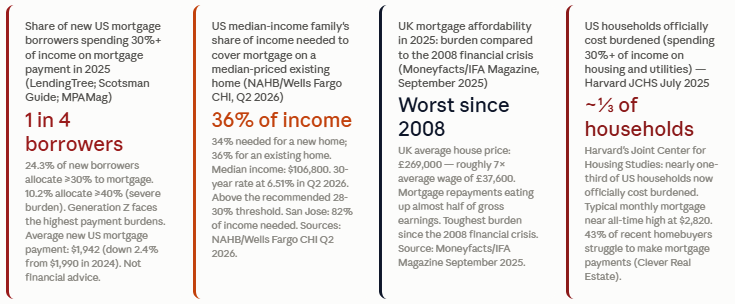
LendingTree’s 2025 analysis found that the average monthly payment on a new US mortgage fell slightly to $1,942 from $1,990 in 2024 — a 2.4% decline. But 24.3% of new borrowers are still allocating 30% or more of their income to the mortgage payment alone, before property taxes, insurance, or maintenance. In the UK, Moneyfacts’ September 2025 analysis found that mortgage repayments are eating up almost half of gross earnings for typical buyers — the toughest burden since the 2008 financial crisis. Average UK house prices of £269,000 represent approximately seven times the average wage of £37,600. The NAHB/Wells Fargo Cost of Housing Index for Q2 2026 found that a family earning the US median income of $106,800 needed 34% of income to cover a new home mortgage payment. This is a systemic problem. But it is also, within those numbers, a personal problem experienced one household at a time.
Harvard JCHS July 2025: nearly one-third of US households officially cost burdened (30%+ of income on housing). LendingTree 2025: 24.3% of new US borrowers spend 30%+ of income on mortgage; 10.2% spend 40%+. NAHB/Wells Fargo CHI Q2 2026: median income family needs 34% for new home, 36% for existing home. UK: mortgage repayments eating up almost half of gross earnings — toughest burden since 2008 (Moneyfacts September 2025).
The rule matters because housing costs are fixed and largely immovable in the short term. Unlike food spending, which can flex down in a difficult month, or discretionary spending, which can be cut immediately, the mortgage payment arrives every month regardless of what else is happening. When it is proportionate to income, that predictability is a strength: the largest bill is stable and manageable. When it is disproportionate, that same predictability is a trap: the largest bill is stable and unmanageable, and every other line item in the budget must flex around it indefinitely. The National Housing Conference’s analysis of 225 US metros found that only 8% had mortgage payments under 28% of median household income. For the vast majority of markets, the standard of affordability is not being met for median-income households. The five signs that follow describe what this looks like in practice. Not financial advice.
Matt Schulz, Chief Consumer Finance Analyst, LendingTree (MPAMag 2025): 'Homebuyers need to work with brokers to really crunch the numbers and understand not just the maximum they can get approved for, but what actually lets them live the kind of life they want to live without being completely pushed to the maximum limit of their budget.
Your monthly housing costs (mortgage payment + taxes + insurance) exceed 28-30% of gross monthly income. This is the HUD definition of 'cost burdened' and the threshold where financial stress typically compounds.
Calculate: total monthly housing costs ÷ gross monthly income. If above 28%: review whether the excess can be addressed through overpayments that reduce the balance, remortgaging if rates have improved, or whether a longer-term plan to increase income or reduce the property exposure is needed. Consult a mortgage adviser.
Since buying the property, your regular savings — pension contributions, emergency top-ups, investment contributions — have dropped to near zero or stopped completely. The mortgage payment and associated costs absorb all discretionary income. Sources: Harvard JCHS July 2025; Redfin analysis.
Audit your pre-purchase savings rate versus current rate. If the gap is more than 10-15% of income, the mortgage is structurally consuming what should be building your financial future. Options: review for overpayment if mortgage rate is variable or approaching expiry; consider whether income needs to increase to match the asset; consult a financial adviser.
Your credit card balance increases most months because the mortgage payment leaves insufficient income for regular expenses. You do not fully clear the balance each month. Consumer debt is filling the gap between what the mortgage costs and what the income covers.
Track which expenses are being covered by credit card that are not fully clearing monthly. If the pattern is consistent, the mortgage is structurally too large for current income. Immediate action: list all debts. Calculate the effective monthly cash deficit. Explore remortgaging options, income supplement strategies, and consult a debt adviser if high-interest balances are accumulating.
Since buying the property: your emergency fund has decreased, stalled at zero, or does not exist. You would need to borrow (credit card, personal loan) to cover a significant unexpected expense like a boiler, roof, or income disruption.
Assess your current emergency fund vs. three months of essential expenses (mortgage, utilities, food, transport). If the gap is large and the mortgage is the reason you cannot build it: this is a structural problem requiring a financial plan, not a savings habit fix. Consult a financial adviser about options including remortgaging, extending term to reduce monthly payment, or debt restructuring.
You feel financially constrained in ways you did not before buying: unable to change jobs, unwilling to take any income risk, spending on everything except the mortgage compressed to a minimum. Financial decisions are dominated by mortgage payment maintenance. Housing Conference October 2026.
If financial trap is the primary feeling associated with homeownership, rather than security: review the full financial picture with an independent mortgage adviser. Options may include: remortgaging to reduce monthly payment (potentially via term extension); renting out a room to supplement income; assessing equity position and whether downsizing is viable; government assistance schemes available in your country.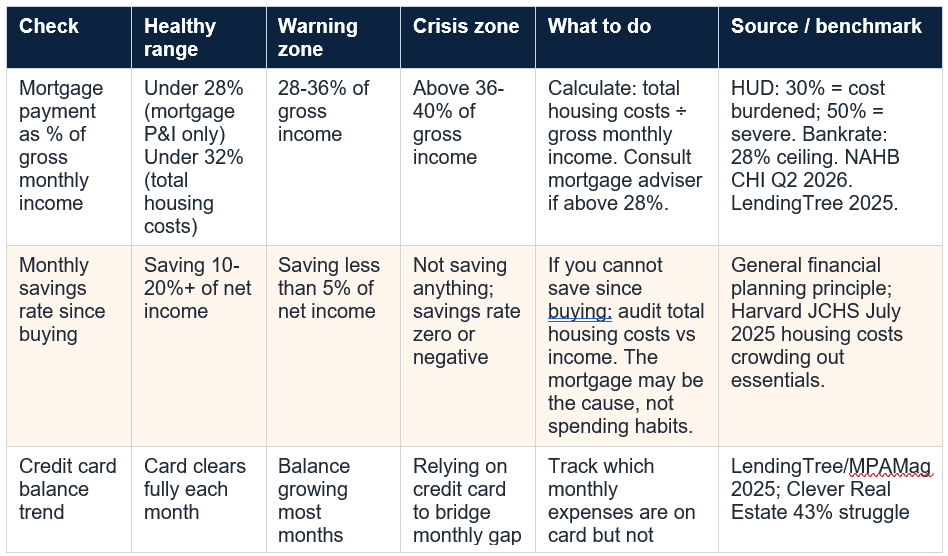
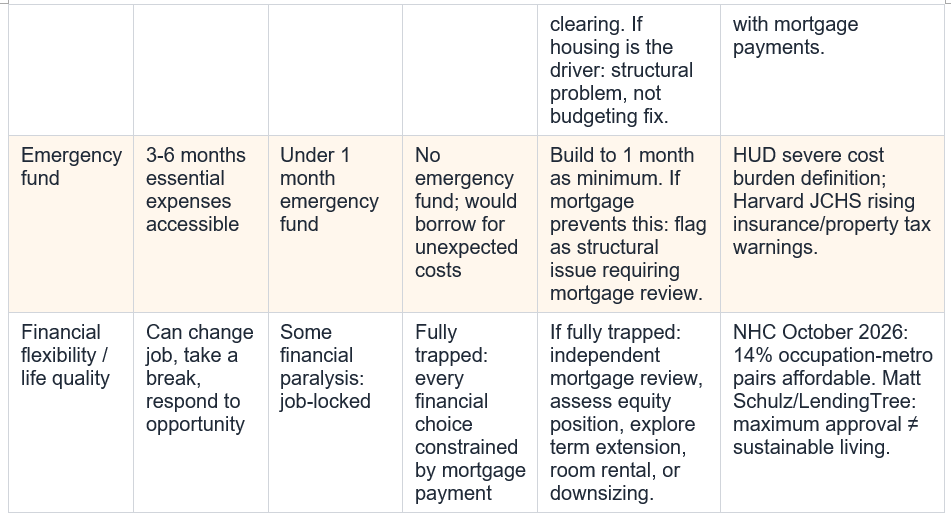
Options depend on how many signs apply and how acute the position is. For those in the early stages of sign one (ratio above 28% but savings still possible): explore overpayment when rates allow, and review when the mortgage is due to remortgage. For those recognising signs two and three simultaneously (savings have stopped and credit cards are accumulating): independent mortgage advice and a full debt review are the priority. For those recognising all five signs: the conversation with a qualified mortgage adviser should include all options including term extension to reduce monthly payments, equity review, potential rental income, and government assistance schemes. The Harvard JCHS report warned that rising climate-related insurance costs and growing property taxes are going to add further pressure to already-stretched homeowners. A plan made now, before those additional pressures arrive, is significantly more effective than one made in response to them.
Matt Schulz of LendingTree framed it with precision: the question is not what you can get approved for. The question is what lets you live the life you want to live without being pushed to the maximum limit of your budget. The five signs in this article are the points at which that maximum limit has been reached or exceeded. None of them is a permanent condition. Each of them is addressable with the right professional guidance and a clear-eyed assessment of the options. This is not a financial or mortgage advice. For personalised guidance, consult an independent mortgage adviser and financial planner.
The most widely cited guideline is 28% of gross monthly income for total housing costs (mortgage principal and interest, property taxes, and insurance). This is sometimes called the '28% rule' and is referenced in Bankrate's guidance cited in the National Housing Conference's October 2026 analysis. HUD defines a household as 'cost burdened' when housing costs exceed 30% of income, and 'severely cost burdened' when they exceed 50%. NAHB/Wells Fargo's Cost of Housing Index for Q2 2026 found that the median-income US family needed 34% of income to cover a median-priced new home mortgage — above the recommended threshold. The practical implication: 28% is the target; 30% is the defined stress threshold; anything above 36-40% represents significant financial strain. Sources: Bankrate guidance; HUD; NAHB/Wells Fargo CHI Q2 2026; LendingTree 2025.
How many people spend too much of their income on their mortgage?
Significantly more than most people realise. LendingTree's 2025 analysis found that 24.3% of new US mortgage borrowers — one in four — are spending 30% or more of their income on their mortgage payment alone, before property taxes, insurance, or maintenance costs. A more severe 10.2% are allocating 40% or more. Harvard's Joint Center for Housing Studies reported in July 2025 that nearly one-third of all US households are 'cost burdened' (spending 30%+ on housing and utilities). Clever Real Estate found that 43% of recent homebuyers struggle to make their payments. In the UK, Moneyfacts reported in September 2025 that mortgage repayments are eating up almost half of gross earnings — the toughest burden since 2008. Sources: LendingTree 2025 (Scotsman Guide); Harvard JCHS July 2025; Clever Real Estate; Moneyfacts/IFA Magazine September 2025.
What can I do if my mortgage is taking up too much of my budget?
Several options exist depending on the severity of the situation and the type of mortgage. First: calculate your accurate housing cost ratio and confirm the scope of the problem. Second: check your current mortgage rate against available rates — if your current rate is significantly above market, remortgaging may reduce the monthly payment. Third: consider extending the mortgage term, which reduces the monthly payment at the cost of paying more interest overall over the life of the loan. Fourth: explore whether rental income — a lodger, an Airbnb arrangement subject to local regulations — can supplement household income. Fifth: review all other budget lines to identify whether reallocation from elsewhere can restore savings capacity. Sixth: consult an independent mortgage adviser (FCA-authorised in the UK, HUD-approved housing counsellor in the US) for a full assessment of options. Sources: LendingTree/MPAMag guidance; NAHB; Moneyfacts. Not financial or mortgage advice. Consult a qualified professional.
Is it normal to feel financially trapped by a mortgage?
More common than publicly acknowledged. Matt Schulz, LendingTree's Chief Consumer Finance Analyst, identified the framing directly in 2025: the question is not what borrowers can get approved for, but what 'actually lets them live the kind of life they want to live without being completely pushed to the maximum limit of their budget.' The National Housing Conference's October 2026 analysis found that one earner could afford a typical home in just 14% of occupation-metro pairings — meaning for the vast majority of households in the majority of markets, homeownership involves accepting financial constraint as a permanent condition. Redfin found roughly half of Americans are struggling to afford housing payments. If financial trap is the dominant experience of homeownership rather than security, it is worth speaking to an independent mortgage adviser about whether refinancing, term extension, or other structural options could restore financial flexibility. Sources: LendingTree/MPAMag 2025; NHC/Inman October 2026; Redfin.
What is the difference between being 'cost burdened' and 'severely cost burdened' on housing?
These terms come from HUD (US Department of Housing and Urban Development). Cost burdened means spending more than 30% of household income on housing. Severely cost burdened means spending more than 50% of income on housing. NAHB's Cost of Housing Index quantifies the real-world scale: in Q2 2026, low-income families in the US needed 65-71% of their earnings to cover a median-income family's mortgage payment. In San Jose-Sunnyvale-Santa Clara, even a typical family needed 82% of income for a median-priced existing home. Zoocasa's analysis found that only 8% of 225 US metros had mortgage payments under 28% of median household income. The distinction matters practically: at cost-burdened levels (30-50%), the household may be managing but with significant financial stress and limited resilience. At severely cost-burdened levels (50%+), the household is in acute financial risk and any income disruption or unexpected expense is likely to create a crisis requiring intervention. Sources: HUD definition; NAHB/Wells Fargo CHI Q2 2026; Zoocasa/Inman October 2026.
The mortgage payment is the largest single line item in most households’ budgets, and in 2025-2026 it has become larger than the research says is healthy for an extraordinary proportion of homeowners. Harvard’s Joint Center for Housing Studies reported in July 2025 that nearly one-third of all US households are now officially ‘cost burdened’ — spending more than 30% of income on housing and utilities. In the UK, Moneyfacts found that mortgage repayments are eating up almost half of gross earnings for typical buyers, the toughest burden since the 2008 financial crisis. LendingTree’s 2025 analysis found that one in four new borrowers is spending 30% or more of income just on the principal and interest portion of their mortgage. And NAHB’s Q2 2026 data found the US median-income family needed 34% of income for a median-priced new home. The affordability crisis is real and documented. But individual households experiencing it often do not recognise the symptoms until the financial stress has been compounding for months. This article covers the five signs that your mortgage is taking too much, the research behind each one, and what to do if you recognise yourself in any of them.
Table of Contents
- The Housing Affordability Crisis in Numbers
- What the 28-30% Rule Actually Means
- Sign 1 Your Mortgage Exceeds 28-30% of Your Gross Monthly Income
- Sign 2 You Have Stopped Saving — or Cannot Save Anything — Since Buying
- Sign 3 You Are Using Credit Cards or Short-Term Debt to Cover Monthly Gaps
- Sign 4 You Have No Emergency Fund — or Depleted the One You Had
- Sign 5 Every Other Budget Line Is Compressed or You Feel Financially Trapped
- The Mortgage Affordability Self-Assessment Table
- What to Do If You Recognise Multiple Signs
- Conclusion: Being Approved Is Not the Same as Being Able to Afford It
- Frequently Asked Questions
The Housing Affordability Crisis in Numbers
The housing affordability crisis of 2025-2026 is not a headline or a political talking point. It is a documented, measurable shift in how much of household income is being consumed by the cost of putting a roof over your head. Harvard’s Joint Center for Housing Studies reported in July 2025 that nearly one-third of all US households are now officially cost burdened — spending more than 30% of their income on housing and utilities. That 30% threshold is not arbitrary: it is the point at which financial stress consistently begins to crowd out spending on other essentials.LendingTree’s 2025 analysis found that the average monthly payment on a new US mortgage fell slightly to $1,942 from $1,990 in 2024 — a 2.4% decline. But 24.3% of new borrowers are still allocating 30% or more of their income to the mortgage payment alone, before property taxes, insurance, or maintenance. In the UK, Moneyfacts’ September 2025 analysis found that mortgage repayments are eating up almost half of gross earnings for typical buyers — the toughest burden since the 2008 financial crisis. Average UK house prices of £269,000 represent approximately seven times the average wage of £37,600. The NAHB/Wells Fargo Cost of Housing Index for Q2 2026 found that a family earning the US median income of $106,800 needed 34% of income to cover a new home mortgage payment. This is a systemic problem. But it is also, within those numbers, a personal problem experienced one household at a time.
Harvard JCHS July 2025: nearly one-third of US households officially cost burdened (30%+ of income on housing). LendingTree 2025: 24.3% of new US borrowers spend 30%+ of income on mortgage; 10.2% spend 40%+. NAHB/Wells Fargo CHI Q2 2026: median income family needs 34% for new home, 36% for existing home. UK: mortgage repayments eating up almost half of gross earnings — toughest burden since 2008 (Moneyfacts September 2025).
What the 28-30% Rule Actually Means
The 28% rule is the most widely cited benchmark for mortgage affordability. It states that total monthly housing costs — mortgage principal and interest, property taxes, insurance, and in some frameworks HOA fees — should not exceed 28% of gross monthly income. Bankrate’s guidance, cited in the National Housing Conference’s October 2026 analysis, recommends 28% as the ceiling. HUD defines cost burden at 30%, and severe cost burden at 50%.The rule matters because housing costs are fixed and largely immovable in the short term. Unlike food spending, which can flex down in a difficult month, or discretionary spending, which can be cut immediately, the mortgage payment arrives every month regardless of what else is happening. When it is proportionate to income, that predictability is a strength: the largest bill is stable and manageable. When it is disproportionate, that same predictability is a trap: the largest bill is stable and unmanageable, and every other line item in the budget must flex around it indefinitely. The National Housing Conference’s analysis of 225 US metros found that only 8% had mortgage payments under 28% of median household income. For the vast majority of markets, the standard of affordability is not being met for median-income households. The five signs that follow describe what this looks like in practice. Not financial advice.
Matt Schulz, Chief Consumer Finance Analyst, LendingTree (MPAMag 2025): 'Homebuyers need to work with brokers to really crunch the numbers and understand not just the maximum they can get approved for, but what actually lets them live the kind of life they want to live without being completely pushed to the maximum limit of their budget.
Sign 1 Your Mortgage Exceeds 28-30% of Your Gross Monthly Income
The most widely recognised benchmark for mortgage affordability is the 28% rule: your total monthly housing costs (mortgage principal and interest, property taxes, and insurance) should not exceed 28% of your gross monthly income. At a maximum, the 30% threshold is the official US federal definition of a ‘cost-burdened’ household, as defined by HUD. Beyond 30%, the research consistently shows financial stress begins to compound into other areas of household finances. LendingTree’s 2025 analysis found that 24.3% of new US mortgage borrowers — one in four — are allocating at least 30% of their monthly income to their mortgage payment. More concerningly, 10.2% are dedicating 40% or more, a level that the research identifies as a severe cost burden. The NAHB/Wells Fargo Cost of Housing Index for Q2 2026 found that a family earning the US median income of $106,800 needed 34% of income to cover a median-priced new home’s mortgage — and 36% for a median-priced existing home. These figures are above the recommended threshold. In the UK, Moneyfacts’ September 2025 analysis found that mortgage repayments are eating up almost half of gross earnings for typical buyers — the toughest burden since the 2008 financial crisis. The straightforward calculation: divide your total monthly housing costs by your gross monthly income. If the result is above 28-30%, you are in cost-burdened territory, whether or not it feels acute right now.Your monthly housing costs (mortgage payment + taxes + insurance) exceed 28-30% of gross monthly income. This is the HUD definition of 'cost burdened' and the threshold where financial stress typically compounds.
Calculate: total monthly housing costs ÷ gross monthly income. If above 28%: review whether the excess can be addressed through overpayments that reduce the balance, remortgaging if rates have improved, or whether a longer-term plan to increase income or reduce the property exposure is needed. Consult a mortgage adviser.
Sign 2 You Have Stopped Saving — or Cannot Save Anything — Since Buying
One of the clearest signals that a mortgage is consuming more than its sustainable share of household income is the disappearance of saving. Before the house purchase, there was money going somewhere — a savings account, a pension contribution, even an informal buffer. After the purchase, that money is gone. The mortgage, the rates, the council tax or property tax, the maintenance costs, the insurance: collectively, they absorb everything that used to accumulate. This is not an unusual experience in 2025-2026. Harvard’s Joint Center for Housing Studies reported in July 2025 that nearly one-third of all US households are officially cost burdened, spending more than 30% of income on housing and utilities. The same report notes that this burden crowds out spending on essentials such as food, transportation, and utilities — and, critically, saving. When saving stops, the compounding effects are serious. Emergency funds that existed before the purchase are not topped up and gradually erode. Pension contributions that were being made before the purchase are cut or stopped entirely. The long-term financial plan — the retirement, the children’s education, the financial independence — effectively pauses from the month the mortgage payment becomes the dominant line item. Redfin’s analysis found that roughly half of Americans are struggling to afford housing payments, with one in five making significant sacrifices including skipping meals, working extra hours, and delaying medical care. The inability to save is not a budget management failure. It is a structural signal that the fixed cost of the mortgage is incompatible with the income available.Since buying the property, your regular savings — pension contributions, emergency top-ups, investment contributions — have dropped to near zero or stopped completely. The mortgage payment and associated costs absorb all discretionary income. Sources: Harvard JCHS July 2025; Redfin analysis.
Audit your pre-purchase savings rate versus current rate. If the gap is more than 10-15% of income, the mortgage is structurally consuming what should be building your financial future. Options: review for overpayment if mortgage rate is variable or approaching expiry; consider whether income needs to increase to match the asset; consult a financial adviser.
Sign 3 You Are Using Credit Cards or Short-Term Debt to Cover Monthly Gaps
The most financially dangerous sign that a mortgage is too large for the income supporting it is the use of revolving consumer debt to fill monthly shortfalls. If the mortgage payment leaves the current account short before payday, and the gap is being covered by a credit card balance that does not fully clear each month, the mortgage has effectively become too large for the income. The household is not just spending 30-40% of income on housing. It is spending 30-40% on housing plus growing consumer debt interest, which compounds the problem with every passing month. Matt Schulz, LendingTree’s Chief Consumer Finance Analyst, made the systemic point to MPAMag in 2025: ‘It’s not just home costs that are getting more expensive, but everyday items as well. If mortgage payments continue to make up a larger portion of the household budget, it’s going to leave homeowners in a difficult situation.’ The Redfin analysis found that one in five Americans struggling with housing costs is skipping meals and delaying medical care — but an equally significant and less visible group is quietly running credit card balances to bridge the gap between housing costs and income. The credit card balance is the financial system’s way of deferring a housing affordability problem that has not yet been acknowledged. It does not solve the problem. It extends it at 20-25% annual interest while the underlying gap continues. Clever Real Estate found that more than two in five recent homebuyers (43%) struggle to make their mortgage payments — suggesting that the credit card fill pattern is widespread, not unusual.Your credit card balance increases most months because the mortgage payment leaves insufficient income for regular expenses. You do not fully clear the balance each month. Consumer debt is filling the gap between what the mortgage costs and what the income covers.
Track which expenses are being covered by credit card that are not fully clearing monthly. If the pattern is consistent, the mortgage is structurally too large for current income. Immediate action: list all debts. Calculate the effective monthly cash deficit. Explore remortgaging options, income supplement strategies, and consult a debt adviser if high-interest balances are accumulating.
Sign 4 You Have No Emergency Fund — or Depleted the One You Had
A mortgage payment that is proportionate to income does not prevent saving for emergencies — it coexists with it. A mortgage payment that is disproportionate to income consumes the income that should have been building an emergency reserve, and then, when emergencies arrive, forces the use of whatever buffer existed before the purchase. The emergency fund is the canary in the coal mine of housing affordability. When the boiler breaks, the roof needs repair, a car needs replacement, or an income disruption occurs, the household with adequate emergency savings absorbs the hit. The household without emergency savings either takes on debt (see Sign 3) or falls into genuine financial crisis. HUD defines a ‘severe cost burden’ as paying more than 50% of income on housing — but the practical crisis often begins well before that threshold, when the absence of emergency savings means any shock becomes a financial emergency. Harvard’s JCHS report specifically warned of rising climate-related insurance costs, growing property taxes, and other cost increases that fall disproportionately on already-stretched homeowners. These costs are not predictable in timing but are predictable in their arrival. An emergency fund of three to six months of essential expenses is not a luxury item in household financial planning — it is the minimum structural protection for any significant asset that requires ongoing maintenance, insurance, and cost. If the mortgage has eliminated the capacity to build or maintain this fund, the mortgage is consuming more than it should.Since buying the property: your emergency fund has decreased, stalled at zero, or does not exist. You would need to borrow (credit card, personal loan) to cover a significant unexpected expense like a boiler, roof, or income disruption.
Assess your current emergency fund vs. three months of essential expenses (mortgage, utilities, food, transport). If the gap is large and the mortgage is the reason you cannot build it: this is a structural problem requiring a financial plan, not a savings habit fix. Consult a financial adviser about options including remortgaging, extending term to reduce monthly payment, or debt restructuring.
Sign 5 Every Other Budget Line Is Compressed or You Feel Financially Trapped
The fifth sign is less arithmetical and more experiential — but it is also the most diagnostic. If every conversation about money circles back to the mortgage, if every other financial goal has been indefinitely postponed because the mortgage takes first priority, if spending on health, relationships, personal development, and leisure has been compressed to the point where the house is being maintained at the cost of the life being lived inside it — the mortgage is taking too much. Matt Schulz of LendingTree identified the frame precisely in his 2025 interview with MPAMag: ‘Homebuyers need to work with brokers to really crunch the numbers and understand not just the maximum they can get approved for, but what actually lets them live the kind of life they want to live without being completely pushed to the maximum limit of their budget.’ Being approved for a mortgage is not the same as being able to afford it in a sustainable, whole-life sense. The approval process assesses repayment capacity. It does not assess whether the repayment leaves adequate income for every other financial need. The National Housing Conference’s October 2026 analysis found that one earner could afford a typical home in just 14% of occupation-metro pairings — confirming that for the majority of households in the majority of markets, the house-to-income ratio has become structurally misaligned. Feeling financially trapped — unable to change jobs for fear of income disruption, unable to reduce hours, unable to take risks, unable to respond to any unexpected cost without crisis — is not a mindset to work through. It is a structural signal worth taking seriously.You feel financially constrained in ways you did not before buying: unable to change jobs, unwilling to take any income risk, spending on everything except the mortgage compressed to a minimum. Financial decisions are dominated by mortgage payment maintenance. Housing Conference October 2026.
If financial trap is the primary feeling associated with homeownership, rather than security: review the full financial picture with an independent mortgage adviser. Options may include: remortgaging to reduce monthly payment (potentially via term extension); renting out a room to supplement income; assessing equity position and whether downsizing is viable; government assistance schemes available in your country.
The Mortgage Affordability Self-Assessment Table
What to Do If You Recognise Multiple Signs
If two or more of the five signs describe your current situation, the most important first step is to get an accurate picture of the full housing cost-to-income ratio. Not the mortgage payment alone, but the total: principal and interest, property tax, insurance, ground rent or service charges if applicable, and average monthly maintenance. Divide that total by gross monthly income. If the result is above 30%, you are in cost-burdened territory as defined by HUD.Options depend on how many signs apply and how acute the position is. For those in the early stages of sign one (ratio above 28% but savings still possible): explore overpayment when rates allow, and review when the mortgage is due to remortgage. For those recognising signs two and three simultaneously (savings have stopped and credit cards are accumulating): independent mortgage advice and a full debt review are the priority. For those recognising all five signs: the conversation with a qualified mortgage adviser should include all options including term extension to reduce monthly payments, equity review, potential rental income, and government assistance schemes. The Harvard JCHS report warned that rising climate-related insurance costs and growing property taxes are going to add further pressure to already-stretched homeowners. A plan made now, before those additional pressures arrive, is significantly more effective than one made in response to them.
Conclusion
The housing affordability data from 2025-2026 tells a consistent and concerning story. One in four new US mortgage borrowers is spending 30% or more of their income on their mortgage payment. The median-income family needs 34% of income for a new home’s mortgage. In the UK, repayments are eating up nearly half of gross earnings. The 43% of recent homebuyers who are struggling to make payments are not struggling because of poor financial discipline — they are struggling because the system approved them for mortgages that left insufficient income for everything else a household needs.Matt Schulz of LendingTree framed it with precision: the question is not what you can get approved for. The question is what lets you live the life you want to live without being pushed to the maximum limit of your budget. The five signs in this article are the points at which that maximum limit has been reached or exceeded. None of them is a permanent condition. Each of them is addressable with the right professional guidance and a clear-eyed assessment of the options. This is not a financial or mortgage advice. For personalised guidance, consult an independent mortgage adviser and financial planner.
Frequently Asked Questions
What percentage of income should go to a mortgage?The most widely cited guideline is 28% of gross monthly income for total housing costs (mortgage principal and interest, property taxes, and insurance). This is sometimes called the '28% rule' and is referenced in Bankrate's guidance cited in the National Housing Conference's October 2026 analysis. HUD defines a household as 'cost burdened' when housing costs exceed 30% of income, and 'severely cost burdened' when they exceed 50%. NAHB/Wells Fargo's Cost of Housing Index for Q2 2026 found that the median-income US family needed 34% of income to cover a median-priced new home mortgage — above the recommended threshold. The practical implication: 28% is the target; 30% is the defined stress threshold; anything above 36-40% represents significant financial strain. Sources: Bankrate guidance; HUD; NAHB/Wells Fargo CHI Q2 2026; LendingTree 2025.
How many people spend too much of their income on their mortgage?
Significantly more than most people realise. LendingTree's 2025 analysis found that 24.3% of new US mortgage borrowers — one in four — are spending 30% or more of their income on their mortgage payment alone, before property taxes, insurance, or maintenance costs. A more severe 10.2% are allocating 40% or more. Harvard's Joint Center for Housing Studies reported in July 2025 that nearly one-third of all US households are 'cost burdened' (spending 30%+ on housing and utilities). Clever Real Estate found that 43% of recent homebuyers struggle to make their payments. In the UK, Moneyfacts reported in September 2025 that mortgage repayments are eating up almost half of gross earnings — the toughest burden since 2008. Sources: LendingTree 2025 (Scotsman Guide); Harvard JCHS July 2025; Clever Real Estate; Moneyfacts/IFA Magazine September 2025.
What can I do if my mortgage is taking up too much of my budget?
Several options exist depending on the severity of the situation and the type of mortgage. First: calculate your accurate housing cost ratio and confirm the scope of the problem. Second: check your current mortgage rate against available rates — if your current rate is significantly above market, remortgaging may reduce the monthly payment. Third: consider extending the mortgage term, which reduces the monthly payment at the cost of paying more interest overall over the life of the loan. Fourth: explore whether rental income — a lodger, an Airbnb arrangement subject to local regulations — can supplement household income. Fifth: review all other budget lines to identify whether reallocation from elsewhere can restore savings capacity. Sixth: consult an independent mortgage adviser (FCA-authorised in the UK, HUD-approved housing counsellor in the US) for a full assessment of options. Sources: LendingTree/MPAMag guidance; NAHB; Moneyfacts. Not financial or mortgage advice. Consult a qualified professional.
Is it normal to feel financially trapped by a mortgage?
More common than publicly acknowledged. Matt Schulz, LendingTree's Chief Consumer Finance Analyst, identified the framing directly in 2025: the question is not what borrowers can get approved for, but what 'actually lets them live the kind of life they want to live without being completely pushed to the maximum limit of their budget.' The National Housing Conference's October 2026 analysis found that one earner could afford a typical home in just 14% of occupation-metro pairings — meaning for the vast majority of households in the majority of markets, homeownership involves accepting financial constraint as a permanent condition. Redfin found roughly half of Americans are struggling to afford housing payments. If financial trap is the dominant experience of homeownership rather than security, it is worth speaking to an independent mortgage adviser about whether refinancing, term extension, or other structural options could restore financial flexibility. Sources: LendingTree/MPAMag 2025; NHC/Inman October 2026; Redfin.
What is the difference between being 'cost burdened' and 'severely cost burdened' on housing?
These terms come from HUD (US Department of Housing and Urban Development). Cost burdened means spending more than 30% of household income on housing. Severely cost burdened means spending more than 50% of income on housing. NAHB's Cost of Housing Index quantifies the real-world scale: in Q2 2026, low-income families in the US needed 65-71% of their earnings to cover a median-income family's mortgage payment. In San Jose-Sunnyvale-Santa Clara, even a typical family needed 82% of income for a median-priced existing home. Zoocasa's analysis found that only 8% of 225 US metros had mortgage payments under 28% of median household income. The distinction matters practically: at cost-burdened levels (30-50%), the household may be managing but with significant financial stress and limited resilience. At severely cost-burdened levels (50%+), the household is in acute financial risk and any income disruption or unexpected expense is likely to create a crisis requiring intervention. Sources: HUD definition; NAHB/Wells Fargo CHI Q2 2026; Zoocasa/Inman October 2026.
0 Comments
Be the first to share your thoughts on this article.