

Real Estate
5 Ways Older Homeowners Can Break Free of the Mortgage Trap

41% of US homeowners aged 65–69 still carry a mortgage. Among the over-80s, the share has risen from 3% in 1989 to 31% today — a tenfold increase in one generation. In the UK, 88% of over-50s homeowners are still paying off their mortgage, and 36% have more than ten years left. The mortgage trap — being locked into debt on a fixed income in retirement — is not a niche problem. It is the retirement reality for millions of older homeowners who ran out of runway before they ran out of mortgage. This article covers five concrete strategies to break free — before or after retirement arrives. Not financial advice.
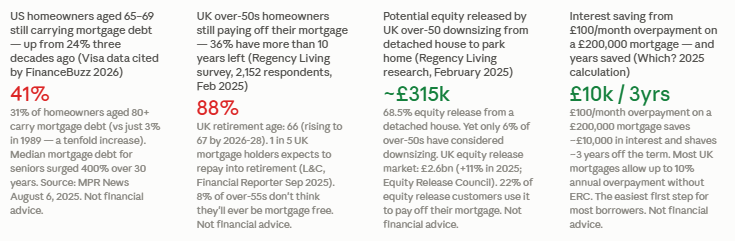
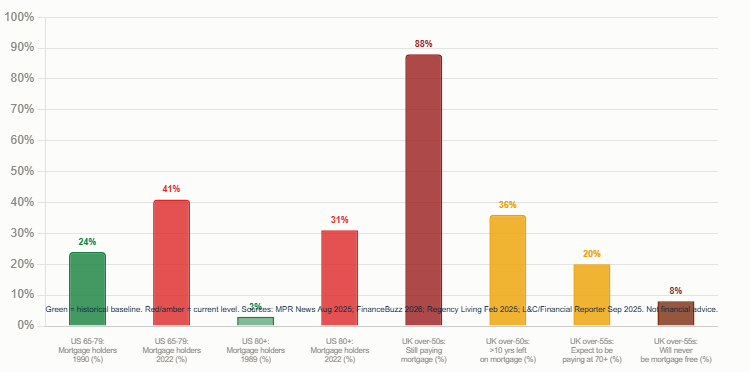
The numbers are startling. In the United States, 41% of homeowners aged 65–69 still carry mortgage debt — up from 24% three decades ago. Among homeowners aged 80 and over, the share has risen from 3% in 1989 to 31% in 2022, as Visa data cited by FinanceBuzz (2026) shows. A tenfold increase in a single generation. In the United Kingdom, a February 2025 survey of 2,152 over-50s homeowners by Regency Living found that 88% are still paying off their mortgage, and 36% have more than ten years of repayments remaining. With UK retirement age standing at 66 and set to rise to 67 between 2026 and 2028, a large proportion of those 36% will be paying well into their retirement years.
Researcher Linna Zhu, quoted by MPR News (August 6, 2025), identifies what makes this different from a simple debt problem: ‘For wealthier homeowners, maybe carrying a mortgage debt might be a strategic choice, but for many, most of the senior or older adults who are living on fixed incomes, it’s not a strategy.’ The mortgage trap is not a problem of financial recklessness. It is a structural collision between longer mortgage terms, higher house prices, later life events (divorce, remarriage, equity release followed by new purchase), and retirements that arrive before the debts are cleared. Not financial advice.
US: 41% of homeowners aged 65-69 still carry mortgage debt (2022 data; Visa, cited by FinanceBuzz 2026). 31% of homeowners aged 80+ still carry mortgage debt (vs 3% in 1989). Median mortgage debt for seniors surged 400% over past three decades. UK: 88% of over-50s homeowners are still paying off their mortgage; 36% have >10 years left (Regency Living survey of 2,152 over-50s, February 3, 2025). UK: 1 in 5 mortgage holders expects to repay into retirement; 8% of over-55s don't think they'll ever be mortgage free (L&C Mortgages survey, Financial Reporter September 2025). Sources: FinanceBuzz 2026; MPR News August 6, 2025; Regency Living/The Intermediary February 2025; L&C/Financial Reporter September 2025. Not financial advice.
The first cause is price inflation. Over the past three decades, house prices in the UK, US, Canada, and Australia have risen dramatically faster than wages, meaning that first-time buyers and subsequent movers have had to take on larger loans relative to income to access the same level of housing. Larger loans mean longer terms and larger outstanding balances closer to retirement. The MPR News report (August 2025) specifically notes that ‘median mortgage debt surged by 400%’ among older homeowners over thirty years — not because people are buying bigger houses, but because the debt required to buy a comparable house is larger.
The second cause is life events. Divorce, separation, and remarriage typically involve a property transaction in mid-life that can restart or extend the mortgage clock. An individual who was on track to be mortgage-free at 60 but separated at 48 and re-entered the housing market at 50 may be on a new 20-year mortgage that now runs to age 70. The L&C survey (September 2025) identifies this: ‘even those who buy relatively young, with a shorter mortgage, can run into all kinds of trouble along the way, which pushes their mortgage repayment back.’
The third cause is the normalisation of longer mortgage terms. As monthly affordability has tightened, lenders and borrowers have pushed mortgage terms from 25 years to 30, 35, and even 40 years to reduce the monthly payment. A 35-year mortgage taken out at age 35 runs to age 70. Not financial advice.
The income dimension: retirement income from pension, Social Security, or State Pension is typically 40–60% of pre-retirement earnings. A mortgage payment sized for a working income becomes a proportionally far larger burden on a retirement income. A £1,200/month mortgage payment that represented 18% of a £8,000/month working income becomes 34% of a £3,500/month retirement income. The same number; a fundamentally different affordability picture.
The flexibility dimension: carrying a mortgage reduces the options available to a retiree. Downsizing to release equity and reduce running costs is only effective if there is a surplus after clearing the mortgage. Travelling, covering care costs, or making family gifts all require discretionary income that the mortgage payment consumes. Chris Farrell (MPR News, August 2025) notes: ‘Older cost-burdened homeowners are at financial risk.’ Not financial advice.
The income squeeze illustrated: UK mortgage payment £1,200/month. Pre-retirement gross income: £55,000/yr (£4,583/month). Mortgage as % of income: 26%. State Pension 2026/27: £12,548/yr (£1,046/month). Private pension income (modest): £1,600/month. Total retirement income: £2,646/month. Mortgage as % of retirement income: 45%. The same mortgage, now nearly half of all retirement income. This is the mortgage trap's income dimension. Not a forecast. Illustrative. Not financial advice.
Which? (2025) ran the numbers on a £200,000 UK mortgage: an overpayment of just £100 per month enables the homeowner to shave three years off the mortgage term and save approximately £10,000 in interest over the life of the loan. Not £1,200 extra per year in a savings account — but £10,000 in guaranteed interest savings and three fewer years of payments. The return on overpayment is the mortgage interest rate itself, which in 2026 (UK 2-year fixed rates at approximately 4.8–5.7%) represents a guaranteed post-tax return that most savings accounts cannot match.
Most UK mortgage products allow overpayments of up to 10% of the outstanding balance per year without triggering early repayment charges (ERCs). On a £180,000 outstanding balance, that is up to £18,000 per year in additional overpayments — sufficient to clear many mortgages substantially ahead of schedule if applied consistently. In the US, most fixed-rate mortgages allow additional principal payments at any time without penalty. A biweekly payment plan (paying half the monthly payment every two weeks) results in 26 half-payments per year, equivalent to 13 full monthly payments rather than 12 — one extra payment per year that shaves approximately 4–5 years off a 30-year term.
Overpayment action: (1) Check your mortgage statement for the current outstanding balance and remaining term. (2) Use a free mortgage overpayment calculator (MoneySavingExpert, NerdWallet, or your lender's website) to model the impact of £50/month, £100/month, or £200/month extra. (3) Check your mortgage product for the annual overpayment limit (typically 10% of outstanding balance in the UK without ERC). (4) Set up a standing order for the overpayment amount on the same day as your regular mortgage payment. (5) Direct any windfall income (bonus, inheritance, tax refund) as a lump sum overpayment. Not financial advice.
ERC (Early Repayment Charge) risk: overpaying above your lender's annual threshold triggers an ERC, typically 1-5% of the overpaid amount. Check your mortgage terms before making large overpayments. Switching to a different mortgage product (remortgage) to reduce the rate can also trigger an ERC on the existing deal if done before the fixed period ends. Time overpayments and remortgaging to the end of your fixed period. Not financial advice.
The headline figures are significant. Regency Living’s analysis shows that downsizing from an average detached house to a park home in England could release approximately 68.5% of the property’s equity — approximately £314,928 at average house prices. Even a more modest downsize — from a four-bedroom family home to a two-bedroom flat or terrace — in most parts of the UK and US can release £50,000–£200,000 (or the dollar equivalent), more than enough to eliminate most outstanding mortgages.
Tim Simmons, Sales and Marketing Director at Regency Living, explains the dual benefit: ‘Downsizing is a great way of ridding yourself of mortgage debt before you enter retirement, freeing yourself of any concerns about being able to afford repayments once the reassurance of a regular salary is gone. And by downsizing, the amount of cash you’re going to release will not only cover any outstanding mortgage loans and buy your new home, but could also leave you with a handsome lump sum to put towards living your retirement to its fullest.’ Not financial advice.
UK downsizing calculation (illustrative): Sell current home £460,000 (detached house average). Purchase new home £200,000 (flat or smaller property). Estate agent fees (~1.5%) + legal costs (~£2,000) + Stamp Duty (on purchase): approximately £12,000 total transaction costs. Outstanding mortgage remaining: £85,000. Net equity released after transaction costs and mortgage clearance: approximately £163,000. This eliminates the mortgage entirely AND provides £163,000 in capital for retirement income, ISA contributions, care planning, or family gifts. Not a forecast. Figures illustrative. Transaction costs vary. Not financial advice.
Downsizing timing: the UK has a Stamp Duty exemption for first-time buyers (not applicable when downsizing) but significantly lower Stamp Duty bands for properties under £250,000 (0% on first £250,000 for non-first-time buyers from 31 March 2025 changes). Downsizing to a property under £250,000 eliminates Stamp Duty on the purchase entirely. US equivalent: capital gains tax on the sale may be relevant if profit exceeds $250,000 (single filers) or $500,000 (married joint filers) -- consult a tax professional. Not tax advice.
However, as Hargreaves Lansdown’s Sarah Coles (Mortgage Solutions, September 2025) warns: ‘Some people will use their pension tax-free lump sum to pay the mortgage off, but this needs to be considered carefully. You may need the pot to generate an income you can live off, so dipping into it could leave you struggling throughout retirement.’ The calculation is specific to each person’s circumstances: the interest rate on the mortgage (what you save), the income the pension pot generates if left invested (what you give up), and the remaining balance of the mortgage (how large the lump sum needs to be).
In the US, using 401(k) or IRA assets to clear a mortgage at or near retirement involves tax consequences that must be modelled carefully. Pre-tax 401(k) withdrawals are taxed as ordinary income at the marginal rate. A $60,000 withdrawal to clear a mortgage could generate $14,000–20,000 in federal income tax depending on the bracket, meaning the net benefit requires that the mortgage interest saved exceeds the tax cost. Roth IRA qualified distributions (after age 59.5 and after the account has been open 5 years) are tax-free and may be a more efficient route. Not tax advice; consult a qualified tax professional.
Pension lump sum action: (1) Get a current pension forecast from your provider showing both the available tax-free lump sum and the projected annual income if the lump sum is not taken. (2) Compare the annual interest saving from clearing the mortgage vs the annual income lost by taking the lump sum. (3) If the mortgage interest rate is above the expected safe withdrawal rate from the pension (commonly modelled at 3-4%/year), taking the lump sum to clear the mortgage may be financially optimal. (4) In the UK: use MoneyHelper (moneyhelper.org.uk) for impartial pension guidance. In the US: consult a CFP or CPA. Not financial or tax advice.
In the UK, the equity release market lent £2.6 billion in 2025, up 11% year-on-year (Equity Release Council, cited by Which? 2025). The most popular product is the lifetime mortgage, where a lump sum is secured against the property. No monthly capital payments are required; the loan (plus rolled-up interest) is repaid from the property sale when the homeowner dies or enters long-term care. Equity Release Council member providers offer a ‘no negative equity’ guarantee — the homeowner (or estate) will never owe more than the value of the property. 22% of equity release customers use the money specifically to pay off their existing mortgage (Which?/Key Retirement data).
In the US, the FHA-insured HECM (Home Equity Conversion Mortgage) is available from age 62. It is regulated by the US Department of Housing and Urban Development (HUD) and requires mandatory independent counselling from a HUD-approved counsellor before the loan is completed. The HECM can be structured as a lump sum, a line of credit (which grows if unused), or regular monthly income payments. No monthly mortgage payments are required; the loan is repaid when the homeowner sells, permanently moves out, or passes away. For eligible homeowners using a HECM to clear an existing mortgage, the result can be the elimination of all monthly mortgage payments. Not financial advice.
Equity release and reverse mortgage risks: (1) The loan balance grows over time as interest accrues, reducing the equity available to the estate or for future housing moves. (2) Early repayment charges if circumstances change (illness, care needs, moving abroad). (3) Impact on means-tested benefits (UK: Pension Credit, Local Authority care funding). (4) Reduces inheritance. (5) Not all properties qualify (leasehold with short term; non-standard construction; very high-value or very low-value). (6) Equity release is a lifetime commitment -- exiting early is costly. ALWAYS obtain independent advice from an FCA-registered equity release specialist (UK) or a HUD-approved counsellor (US) before proceeding. Not financial advice.
Shortening the term: if a homeowner has a £120,000 mortgage with 15 years remaining on a 5% rate, the monthly payment is approximately £949. Switching to a 10-year term at the same rate increases the monthly payment to approximately £1,273 — but guarantees the mortgage is cleared five years earlier, potentially aligning with the planned retirement date. The total interest saving over the life of the loan is approximately £12,000. Requires sufficient income to pass affordability checks on the higher payment.
The Retirement Interest-Only (RIO) mortgage (UK) is a regulated mortgage product available to older borrowers, typically from age 55. Unlike a standard repayment mortgage, only interest is paid monthly — the capital balance is repaid when the property is sold (typically on death or entry into long-term care). The FCA regulated RIOs from 2018, and they are available from a growing number of UK lenders. Monthly payments are substantially lower than on a repayment mortgage (paying only interest rather than interest plus capital), which can make carrying housing debt in retirement significantly more manageable. Not financial advice.
RIO vs repayment comparison (UK, illustrative): Outstanding mortgage £120,000 at 5.5% rate. Repayment mortgage (10 yr remaining): monthly payment ~£1,300. RIO mortgage at same rate: monthly payment ~£550 (interest only on £120,000). Monthly saving: ~£750. Annual saving: ~£9,000. Trade-off: the capital (£120,000) is still owed at the end -- but is repaid from the property sale, not from monthly income. For homeowners on fixed retirement income where cash flow is the primary pressure, the RIO can transform affordability. Must obtain independent mortgage advice. Not financial advice.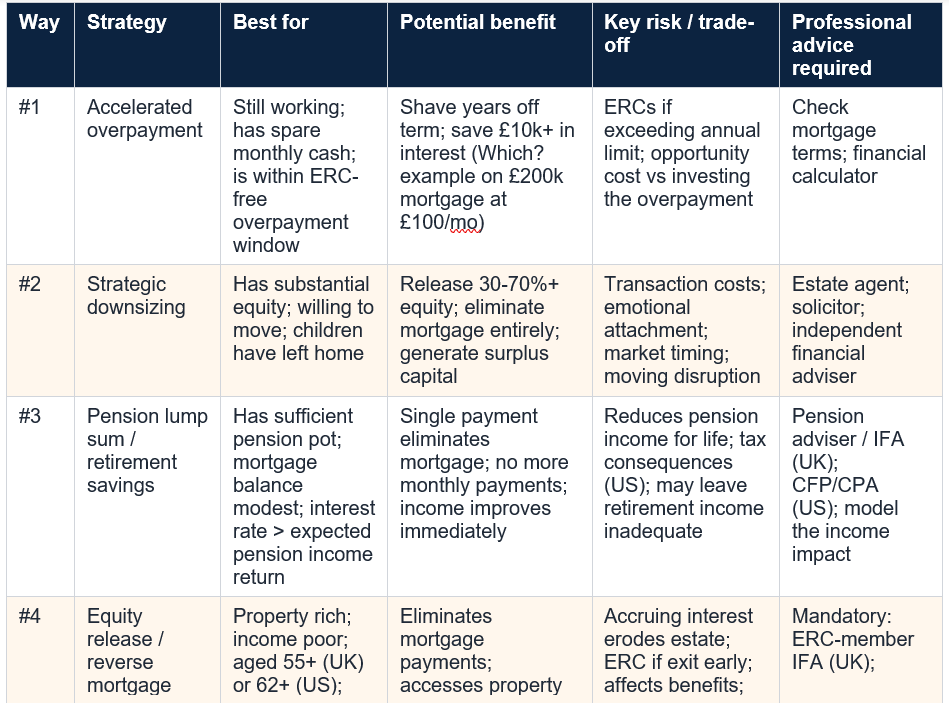
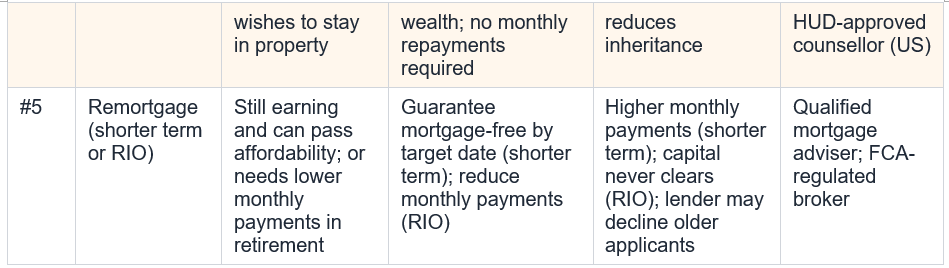
For UK homeowners: a qualified independent financial adviser (IFA) regulated by the FCA can advise on all five strategies and model the specific numbers for your pension, mortgage, and property equity. For equity release specifically: look for an adviser holding the Certificate in Equity Release (CER) awarded by the Chartered Insurance Institute (CII), or the ERMAPC (Equity Release Mortgage Advice & Practice Certificate) from the Chartered Institute of Bankers in Scotland. Equity Release Council member providers offer the ‘no negative equity’ guarantee. Use the MoneyHelper service (moneyhelper.org.uk) for free, impartial initial guidance.
For US homeowners: a CERTIFIED FINANCIAL PLANNER® (CFP) can model the tax implications of pension/401(k) distributions alongside the mortgage payoff calculation. For HECM (reverse mortgage): HUD-approved counselling is legally mandatory before the loan is completed; for a list of HUD-approved counsellors visit hud.gov. For any remortgage, use a licensed mortgage broker who can compare products across multiple lenders. Not financial or mortgage advice.
The five strategies in this article — accelerated overpayment, strategic downsizing, pension lump sum, equity release or reverse mortgage, and remortgaging — are not presented as universal solutions, because there is no universal solution. Each strategy works for a specific combination of remaining mortgage balance, home equity, retirement income, pension size, and personal preference for remaining in the property. The right answer for a homeowner with £30,000 left on a mortgage and a £400,000 property is different from the right answer for one with £150,000 left and £600,000 in equity.
What is universal: the cost of not planning. FinanceBuzz (2026) states it clearly: ‘Failure to make a plan for your mortgage is one of the biggest financial mistakes you could make when preparing for retirement.’ The mortgage trap is not inevitable. It is a planning problem, and planning problems have solutions. Not financial, mortgage, tax, legal, or property advice. Obtain independent professional advice specific to your circumstances.
More than you might expect. In the US: 41% of homeowners aged 65-69 still have mortgage debt; 31% of those aged 80+ carry mortgage debt (vs just 3% in 1989) -- a tenfold increase in one generation (Visa data cited by FinanceBuzz, 2026). The share of homeowners aged 65-79 with a mortgage rose from 24% to 41% over three decades, while median mortgage debt surged by 400% (MPR News, August 6, 2025). In the UK: 88% of over-50s homeowners are still paying off their mortgage; 36% have more than 10 years of repayments left (Regency Living survey, February 3, 2025). 1 in 5 UK mortgage holders expects to repay into retirement (L&C Mortgages survey, Financial Reporter September 2025). 8% of over-55s say they will never be mortgage free. The mortgage trap is not a marginal problem. Not financial advice.
Is it always bad to carry a mortgage into retirement?
Not necessarily, but it depends heavily on circumstances. Linna Zhu (researcher, MPR News August 2025): 'For wealthier homeowners, maybe carrying a mortgage debt might be a strategic choice, but for many, most of the senior or older adults who are living on fixed incomes, it's not a strategy.' Carrying a mortgage can be rational when: the mortgage interest rate is low (below the expected return on invested assets); the assets that would clear the mortgage are generating higher returns; the tax deductibility of mortgage interest applies (US, subject to limits); or the mortgage enables investment in other income-generating assets. For those on fixed incomes where the mortgage payment represents more than 20-25% of retirement income, the impact on financial resilience is significant. FinanceBuzz (2026): 'Failure to make a plan for your mortgage is one of the biggest financial mistakes you could make when preparing for retirement.' Not financial advice.
What is the easiest first step to take if I'm worried about my mortgage in retirement?
The single lowest-barrier first step is to run an overpayment calculation: find your current outstanding balance and remaining term, then use a free online overpayment calculator (MoneySavingExpert.com/mortgages, NerdWallet, or your lender's website) to see what a £50, £100, or £200 per month overpayment would do to your remaining term and total interest. Which? (2025) found that a £100/month overpayment on a £200,000 UK mortgage could cut the term by three years and save £10,000 in interest. This costs nothing to calculate and nothing to action except checking your mortgage terms for the annual overpayment limit (typically 10% of outstanding balance without ERC). Not financial advice.
What is a Retirement Interest-Only (RIO) mortgage and is it right for me?
A Retirement Interest-Only (RIO) mortgage is a FCA-regulated mortgage product available in the UK, typically from age 55. Unlike a standard repayment mortgage, monthly payments cover only the interest on the loan -- the capital balance is not reduced during the mortgage term and is repaid from the property sale on death or entry into long-term care. Monthly payments are substantially lower than on a repayment mortgage at the same rate (e.g. ~£550/month on £120,000 at 5.5% vs ~£1,300/month on a 10-year repayment). RIOs were regulated by the FCA from 2018 and are available from a growing number of UK lenders. They are appropriate for homeowners whose primary concern is managing monthly cash flow in retirement rather than clearing the capital debt. They are not appropriate if you want to leave the property to beneficiaries free of mortgage debt, as the capital remains outstanding. Always obtain independent mortgage advice from an FCA-registered adviser. Not financial advice.
Does equity release affect state benefits or pension credit?
Potentially yes -- and this is one of the most important reasons to take independent advice before proceeding. In the UK, releasing equity increases your capital assets, which can affect means-tested benefits including Pension Credit, Council Tax Reduction, and potentially local authority means-testing for care funding. If the equity released is kept as cash, it is treated as savings and assessed against the capital thresholds for these benefits (£10,000 savings threshold for Pension Credit as of 2025/26). If the equity is spent on home improvements, care costs, or specific qualifying purposes, the impact may be different. In the US, HECM proceeds are generally not considered taxable income and do not affect Social Security or Medicare, but may affect Medicaid eligibility if loan proceeds are held in a bank account and not spent in the month received. Always consult an independent financial adviser (UK: IFA regulated by FCA; US: HUD-approved counsellor and CFP) before proceeding. Not financial, benefits, or legal advice.
Table of Contents
- The Mortgage Trap: A Retirement Crisis Hidden in Plain Sight
- Why This Generation Is Stuck: The Structural Causes
- The Cost of Carrying a Mortgage Into Retirement
- Way #1 — Accelerated Overpayment: Shave Years Off Your Term Right Now
- Way #2 — Strategic Downsizing: Convert Your Home’s Equity Into Freedom
- Way #3 — Use Your Pension Lump Sum or Retirement Savings Strategically
- Way #4 — Equity Release or Reverse Mortgage: Access Your Home’s Value
- Way #5 — Remortgage to Retire the Debt on Your Terms
- The Full Comparison: All Five Ways Side by Side
- The Advice You Need Before Making Any Decision
- Conclusion: The Mortgage Does Not Have to Follow You Into Retirement
- Frequently Asked Questions
The mortgage trap — scale of the problem US and UK
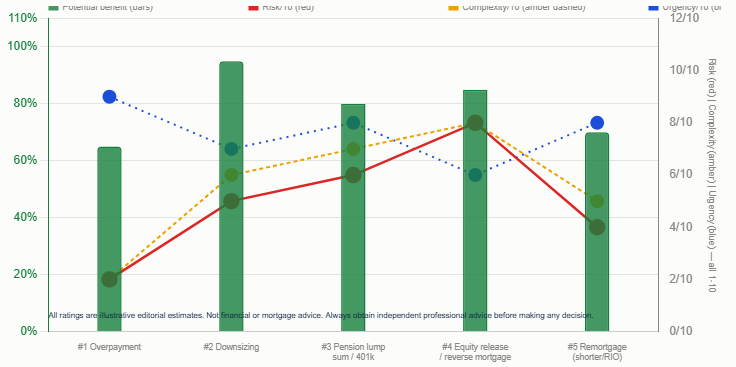
5 ways compared — benefit, risk and difficulty
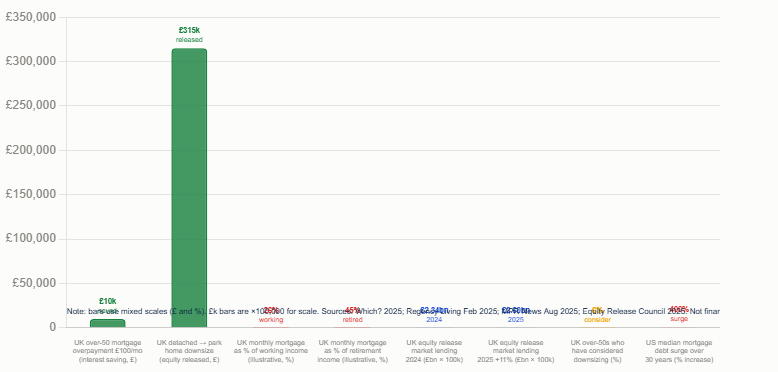
The numbers — overpayment, downsizing, and income squeeze
The Mortgage Trap: A Retirement Crisis Hidden in Plain Sight
The word ‘mortgage’ comes from the Old French mort gage — ‘death pledge.’ For most of the twentieth century, that name reflected the demographic reality: a mortgage was taken out in your 20s or 30s and paid off by your early 60s, before retirement began. The death referred to in the name was the death of the debt, not the death of the borrower. For a growing share of today’s older homeowners, the sequence has reversed. The retirement has arrived, and the mortgage has not died.The numbers are startling. In the United States, 41% of homeowners aged 65–69 still carry mortgage debt — up from 24% three decades ago. Among homeowners aged 80 and over, the share has risen from 3% in 1989 to 31% in 2022, as Visa data cited by FinanceBuzz (2026) shows. A tenfold increase in a single generation. In the United Kingdom, a February 2025 survey of 2,152 over-50s homeowners by Regency Living found that 88% are still paying off their mortgage, and 36% have more than ten years of repayments remaining. With UK retirement age standing at 66 and set to rise to 67 between 2026 and 2028, a large proportion of those 36% will be paying well into their retirement years.
Researcher Linna Zhu, quoted by MPR News (August 6, 2025), identifies what makes this different from a simple debt problem: ‘For wealthier homeowners, maybe carrying a mortgage debt might be a strategic choice, but for many, most of the senior or older adults who are living on fixed incomes, it’s not a strategy.’ The mortgage trap is not a problem of financial recklessness. It is a structural collision between longer mortgage terms, higher house prices, later life events (divorce, remarriage, equity release followed by new purchase), and retirements that arrive before the debts are cleared. Not financial advice.
US: 41% of homeowners aged 65-69 still carry mortgage debt (2022 data; Visa, cited by FinanceBuzz 2026). 31% of homeowners aged 80+ still carry mortgage debt (vs 3% in 1989). Median mortgage debt for seniors surged 400% over past three decades. UK: 88% of over-50s homeowners are still paying off their mortgage; 36% have >10 years left (Regency Living survey of 2,152 over-50s, February 3, 2025). UK: 1 in 5 mortgage holders expects to repay into retirement; 8% of over-55s don't think they'll ever be mortgage free (L&C Mortgages survey, Financial Reporter September 2025). Sources: FinanceBuzz 2026; MPR News August 6, 2025; Regency Living/The Intermediary February 2025; L&C/Financial Reporter September 2025. Not financial advice.
Why This Generation Is Stuck: The Structural Causes
The mortgage trap is not primarily a story of individual financial failure. It is a story of structural change in housing markets, family patterns, and financial products that has collided with the fixed timelines of retirement. Understanding the causes helps identify which of the five strategies is most relevant to any individual situation.The first cause is price inflation. Over the past three decades, house prices in the UK, US, Canada, and Australia have risen dramatically faster than wages, meaning that first-time buyers and subsequent movers have had to take on larger loans relative to income to access the same level of housing. Larger loans mean longer terms and larger outstanding balances closer to retirement. The MPR News report (August 2025) specifically notes that ‘median mortgage debt surged by 400%’ among older homeowners over thirty years — not because people are buying bigger houses, but because the debt required to buy a comparable house is larger.
The second cause is life events. Divorce, separation, and remarriage typically involve a property transaction in mid-life that can restart or extend the mortgage clock. An individual who was on track to be mortgage-free at 60 but separated at 48 and re-entered the housing market at 50 may be on a new 20-year mortgage that now runs to age 70. The L&C survey (September 2025) identifies this: ‘even those who buy relatively young, with a shorter mortgage, can run into all kinds of trouble along the way, which pushes their mortgage repayment back.’
The third cause is the normalisation of longer mortgage terms. As monthly affordability has tightened, lenders and borrowers have pushed mortgage terms from 25 years to 30, 35, and even 40 years to reduce the monthly payment. A 35-year mortgage taken out at age 35 runs to age 70. Not financial advice.
The Cost of Carrying a Mortgage Into Retirement
FinanceBuzz (2026) is direct: ‘Failure to make a plan for your mortgage is one of the biggest financial mistakes you could make when preparing for retirement.’ The cost of the mortgage trap is not limited to the monthly payment. It operates across several dimensions simultaneously.The income dimension: retirement income from pension, Social Security, or State Pension is typically 40–60% of pre-retirement earnings. A mortgage payment sized for a working income becomes a proportionally far larger burden on a retirement income. A £1,200/month mortgage payment that represented 18% of a £8,000/month working income becomes 34% of a £3,500/month retirement income. The same number; a fundamentally different affordability picture.
The flexibility dimension: carrying a mortgage reduces the options available to a retiree. Downsizing to release equity and reduce running costs is only effective if there is a surplus after clearing the mortgage. Travelling, covering care costs, or making family gifts all require discretionary income that the mortgage payment consumes. Chris Farrell (MPR News, August 2025) notes: ‘Older cost-burdened homeowners are at financial risk.’ Not financial advice.
The income squeeze illustrated: UK mortgage payment £1,200/month. Pre-retirement gross income: £55,000/yr (£4,583/month). Mortgage as % of income: 26%. State Pension 2026/27: £12,548/yr (£1,046/month). Private pension income (modest): £1,600/month. Total retirement income: £2,646/month. Mortgage as % of retirement income: 45%. The same mortgage, now nearly half of all retirement income. This is the mortgage trap's income dimension. Not a forecast. Illustrative. Not financial advice.
Way #1: Accelerated Overpayment: Shave Years Off Your Term Right Now
The most straightforward route out of the mortgage trap is also the most often overlooked: overpaying the mortgage while still working, before retirement income compresses the available cash. Overpayments directly reduce the outstanding capital balance, which reduces both the remaining term and the total interest paid. The compound interest savings from early overpayment can be substantial.Which? (2025) ran the numbers on a £200,000 UK mortgage: an overpayment of just £100 per month enables the homeowner to shave three years off the mortgage term and save approximately £10,000 in interest over the life of the loan. Not £1,200 extra per year in a savings account — but £10,000 in guaranteed interest savings and three fewer years of payments. The return on overpayment is the mortgage interest rate itself, which in 2026 (UK 2-year fixed rates at approximately 4.8–5.7%) represents a guaranteed post-tax return that most savings accounts cannot match.
Most UK mortgage products allow overpayments of up to 10% of the outstanding balance per year without triggering early repayment charges (ERCs). On a £180,000 outstanding balance, that is up to £18,000 per year in additional overpayments — sufficient to clear many mortgages substantially ahead of schedule if applied consistently. In the US, most fixed-rate mortgages allow additional principal payments at any time without penalty. A biweekly payment plan (paying half the monthly payment every two weeks) results in 26 half-payments per year, equivalent to 13 full monthly payments rather than 12 — one extra payment per year that shaves approximately 4–5 years off a 30-year term.
Overpayment action: (1) Check your mortgage statement for the current outstanding balance and remaining term. (2) Use a free mortgage overpayment calculator (MoneySavingExpert, NerdWallet, or your lender's website) to model the impact of £50/month, £100/month, or £200/month extra. (3) Check your mortgage product for the annual overpayment limit (typically 10% of outstanding balance in the UK without ERC). (4) Set up a standing order for the overpayment amount on the same day as your regular mortgage payment. (5) Direct any windfall income (bonus, inheritance, tax refund) as a lump sum overpayment. Not financial advice.
ERC (Early Repayment Charge) risk: overpaying above your lender's annual threshold triggers an ERC, typically 1-5% of the overpaid amount. Check your mortgage terms before making large overpayments. Switching to a different mortgage product (remortgage) to reduce the rate can also trigger an ERC on the existing deal if done before the fixed period ends. Time overpayments and remortgaging to the end of your fixed period. Not financial advice.
Way #2: Strategic Downsizing: Convert Your Home’s Equity Into Freedom
Downsizing — selling the current home and buying a smaller, less expensive property — is the most powerful tool available to homeowners with substantial equity. It converts the paper wealth of property ownership into actual cash that can eliminate the mortgage entirely and potentially leave a significant surplus for retirement income, care costs, or family gifts. Yet the Regency Living survey (February 2025) found that only 6% of over-50s homeowners have considered downsizing to pay off their mortgage — despite the fact that the equity release available can be transformative.The headline figures are significant. Regency Living’s analysis shows that downsizing from an average detached house to a park home in England could release approximately 68.5% of the property’s equity — approximately £314,928 at average house prices. Even a more modest downsize — from a four-bedroom family home to a two-bedroom flat or terrace — in most parts of the UK and US can release £50,000–£200,000 (or the dollar equivalent), more than enough to eliminate most outstanding mortgages.
Tim Simmons, Sales and Marketing Director at Regency Living, explains the dual benefit: ‘Downsizing is a great way of ridding yourself of mortgage debt before you enter retirement, freeing yourself of any concerns about being able to afford repayments once the reassurance of a regular salary is gone. And by downsizing, the amount of cash you’re going to release will not only cover any outstanding mortgage loans and buy your new home, but could also leave you with a handsome lump sum to put towards living your retirement to its fullest.’ Not financial advice.
UK downsizing calculation (illustrative): Sell current home £460,000 (detached house average). Purchase new home £200,000 (flat or smaller property). Estate agent fees (~1.5%) + legal costs (~£2,000) + Stamp Duty (on purchase): approximately £12,000 total transaction costs. Outstanding mortgage remaining: £85,000. Net equity released after transaction costs and mortgage clearance: approximately £163,000. This eliminates the mortgage entirely AND provides £163,000 in capital for retirement income, ISA contributions, care planning, or family gifts. Not a forecast. Figures illustrative. Transaction costs vary. Not financial advice.
Downsizing timing: the UK has a Stamp Duty exemption for first-time buyers (not applicable when downsizing) but significantly lower Stamp Duty bands for properties under £250,000 (0% on first £250,000 for non-first-time buyers from 31 March 2025 changes). Downsizing to a property under £250,000 eliminates Stamp Duty on the purchase entirely. US equivalent: capital gains tax on the sale may be relevant if profit exceeds $250,000 (single filers) or $500,000 (married joint filers) -- consult a tax professional. Not tax advice.
Way #3: Use Your Pension Lump Sum or Retirement Savings Strategically
For homeowners approaching retirement with a modest remaining mortgage balance, the most direct route may be to use a portion of their pension or retirement savings to clear the debt in a single payment. In the UK, most defined contribution pension schemes allow a tax-free lump sum of up to 25% of the fund on retirement (capped at £268,275 for 2025/26 under the lump sum allowance). This tax-free cash can be used for any purpose, including paying off a mortgage, and many homeowners specifically accumulate their pension with this goal in mind.However, as Hargreaves Lansdown’s Sarah Coles (Mortgage Solutions, September 2025) warns: ‘Some people will use their pension tax-free lump sum to pay the mortgage off, but this needs to be considered carefully. You may need the pot to generate an income you can live off, so dipping into it could leave you struggling throughout retirement.’ The calculation is specific to each person’s circumstances: the interest rate on the mortgage (what you save), the income the pension pot generates if left invested (what you give up), and the remaining balance of the mortgage (how large the lump sum needs to be).
In the US, using 401(k) or IRA assets to clear a mortgage at or near retirement involves tax consequences that must be modelled carefully. Pre-tax 401(k) withdrawals are taxed as ordinary income at the marginal rate. A $60,000 withdrawal to clear a mortgage could generate $14,000–20,000 in federal income tax depending on the bracket, meaning the net benefit requires that the mortgage interest saved exceeds the tax cost. Roth IRA qualified distributions (after age 59.5 and after the account has been open 5 years) are tax-free and may be a more efficient route. Not tax advice; consult a qualified tax professional.
Pension lump sum action: (1) Get a current pension forecast from your provider showing both the available tax-free lump sum and the projected annual income if the lump sum is not taken. (2) Compare the annual interest saving from clearing the mortgage vs the annual income lost by taking the lump sum. (3) If the mortgage interest rate is above the expected safe withdrawal rate from the pension (commonly modelled at 3-4%/year), taking the lump sum to clear the mortgage may be financially optimal. (4) In the UK: use MoneyHelper (moneyhelper.org.uk) for impartial pension guidance. In the US: consult a CFP or CPA. Not financial or tax advice.
Way #4: Equity Release or Reverse Mortgage: Access Your Home’s Value
Equity release (UK) and reverse mortgages (US/Home Equity Conversion Mortgage, HECM) allow older homeowners to access the value locked in their property without selling or making monthly capital repayments. For homeowners with substantial equity and a mortgage they cannot otherwise clear, these products can transform the retirement picture — but they require careful, independent professional advice before proceeding.In the UK, the equity release market lent £2.6 billion in 2025, up 11% year-on-year (Equity Release Council, cited by Which? 2025). The most popular product is the lifetime mortgage, where a lump sum is secured against the property. No monthly capital payments are required; the loan (plus rolled-up interest) is repaid from the property sale when the homeowner dies or enters long-term care. Equity Release Council member providers offer a ‘no negative equity’ guarantee — the homeowner (or estate) will never owe more than the value of the property. 22% of equity release customers use the money specifically to pay off their existing mortgage (Which?/Key Retirement data).
In the US, the FHA-insured HECM (Home Equity Conversion Mortgage) is available from age 62. It is regulated by the US Department of Housing and Urban Development (HUD) and requires mandatory independent counselling from a HUD-approved counsellor before the loan is completed. The HECM can be structured as a lump sum, a line of credit (which grows if unused), or regular monthly income payments. No monthly mortgage payments are required; the loan is repaid when the homeowner sells, permanently moves out, or passes away. For eligible homeowners using a HECM to clear an existing mortgage, the result can be the elimination of all monthly mortgage payments. Not financial advice.
Equity release and reverse mortgage risks: (1) The loan balance grows over time as interest accrues, reducing the equity available to the estate or for future housing moves. (2) Early repayment charges if circumstances change (illness, care needs, moving abroad). (3) Impact on means-tested benefits (UK: Pension Credit, Local Authority care funding). (4) Reduces inheritance. (5) Not all properties qualify (leasehold with short term; non-standard construction; very high-value or very low-value). (6) Equity release is a lifetime commitment -- exiting early is costly. ALWAYS obtain independent advice from an FCA-registered equity release specialist (UK) or a HUD-approved counsellor (US) before proceeding. Not financial advice.
Way #5: Remortgage to Retire the Debt on Your Terms
For homeowners with several years remaining before retirement and sufficient income to qualify, remortgaging — switching the existing mortgage to a new product, term, or lender — can fundamentally change the trajectory of when the debt will be cleared. There are three specific remortgage strategies relevant to the mortgage trap: shortening the remaining term to guarantee mortgage-free status by a target retirement date; switching to a Retirement Interest-Only (RIO) mortgage to reduce monthly payments; and switching lenders to a more flexible or lower-rate product.Shortening the term: if a homeowner has a £120,000 mortgage with 15 years remaining on a 5% rate, the monthly payment is approximately £949. Switching to a 10-year term at the same rate increases the monthly payment to approximately £1,273 — but guarantees the mortgage is cleared five years earlier, potentially aligning with the planned retirement date. The total interest saving over the life of the loan is approximately £12,000. Requires sufficient income to pass affordability checks on the higher payment.
The Retirement Interest-Only (RIO) mortgage (UK) is a regulated mortgage product available to older borrowers, typically from age 55. Unlike a standard repayment mortgage, only interest is paid monthly — the capital balance is repaid when the property is sold (typically on death or entry into long-term care). The FCA regulated RIOs from 2018, and they are available from a growing number of UK lenders. Monthly payments are substantially lower than on a repayment mortgage (paying only interest rather than interest plus capital), which can make carrying housing debt in retirement significantly more manageable. Not financial advice.
RIO vs repayment comparison (UK, illustrative): Outstanding mortgage £120,000 at 5.5% rate. Repayment mortgage (10 yr remaining): monthly payment ~£1,300. RIO mortgage at same rate: monthly payment ~£550 (interest only on £120,000). Monthly saving: ~£750. Annual saving: ~£9,000. Trade-off: the capital (£120,000) is still owed at the end -- but is repaid from the property sale, not from monthly income. For homeowners on fixed retirement income where cash flow is the primary pressure, the RIO can transform affordability. Must obtain independent mortgage advice. Not financial advice.
The Full Comparison: All Five Ways Side by Side
The Advice You Need Before Making Any Decision
Of the five strategies covered in this article, four (downsizing, pension lump sum, equity release/reverse mortgage, and remortgaging) involve transactions with significant, permanent financial and housing consequences. The L&C’s David Hollingworth (Financial Reporter, September 2025) acknowledges: ‘Older borrowers have more choice than ever, as the industry continues to innovate and cater for an ageing population.’ But having more choice makes independent advice more important, not less.For UK homeowners: a qualified independent financial adviser (IFA) regulated by the FCA can advise on all five strategies and model the specific numbers for your pension, mortgage, and property equity. For equity release specifically: look for an adviser holding the Certificate in Equity Release (CER) awarded by the Chartered Insurance Institute (CII), or the ERMAPC (Equity Release Mortgage Advice & Practice Certificate) from the Chartered Institute of Bankers in Scotland. Equity Release Council member providers offer the ‘no negative equity’ guarantee. Use the MoneyHelper service (moneyhelper.org.uk) for free, impartial initial guidance.
For US homeowners: a CERTIFIED FINANCIAL PLANNER® (CFP) can model the tax implications of pension/401(k) distributions alongside the mortgage payoff calculation. For HECM (reverse mortgage): HUD-approved counselling is legally mandatory before the loan is completed; for a list of HUD-approved counsellors visit hud.gov. For any remortgage, use a licensed mortgage broker who can compare products across multiple lenders. Not financial or mortgage advice.
Conclusion
The mortgage trap is real, it is growing, and it is affecting millions of older homeowners who expected to retire debt-free but find themselves still bound by a monthly obligation that their working income used to absorb comfortably and their retirement income cannot. 41% of US homeowners aged 65–69 are there now. In the UK, 88% of over-50s are still paying off their mortgage and 36% have over a decade left.The five strategies in this article — accelerated overpayment, strategic downsizing, pension lump sum, equity release or reverse mortgage, and remortgaging — are not presented as universal solutions, because there is no universal solution. Each strategy works for a specific combination of remaining mortgage balance, home equity, retirement income, pension size, and personal preference for remaining in the property. The right answer for a homeowner with £30,000 left on a mortgage and a £400,000 property is different from the right answer for one with £150,000 left and £600,000 in equity.
What is universal: the cost of not planning. FinanceBuzz (2026) states it clearly: ‘Failure to make a plan for your mortgage is one of the biggest financial mistakes you could make when preparing for retirement.’ The mortgage trap is not inevitable. It is a planning problem, and planning problems have solutions. Not financial, mortgage, tax, legal, or property advice. Obtain independent professional advice specific to your circumstances.
Frequently Asked Questions
How many older homeowners are still carrying a mortgage in retirement?More than you might expect. In the US: 41% of homeowners aged 65-69 still have mortgage debt; 31% of those aged 80+ carry mortgage debt (vs just 3% in 1989) -- a tenfold increase in one generation (Visa data cited by FinanceBuzz, 2026). The share of homeowners aged 65-79 with a mortgage rose from 24% to 41% over three decades, while median mortgage debt surged by 400% (MPR News, August 6, 2025). In the UK: 88% of over-50s homeowners are still paying off their mortgage; 36% have more than 10 years of repayments left (Regency Living survey, February 3, 2025). 1 in 5 UK mortgage holders expects to repay into retirement (L&C Mortgages survey, Financial Reporter September 2025). 8% of over-55s say they will never be mortgage free. The mortgage trap is not a marginal problem. Not financial advice.
Is it always bad to carry a mortgage into retirement?
Not necessarily, but it depends heavily on circumstances. Linna Zhu (researcher, MPR News August 2025): 'For wealthier homeowners, maybe carrying a mortgage debt might be a strategic choice, but for many, most of the senior or older adults who are living on fixed incomes, it's not a strategy.' Carrying a mortgage can be rational when: the mortgage interest rate is low (below the expected return on invested assets); the assets that would clear the mortgage are generating higher returns; the tax deductibility of mortgage interest applies (US, subject to limits); or the mortgage enables investment in other income-generating assets. For those on fixed incomes where the mortgage payment represents more than 20-25% of retirement income, the impact on financial resilience is significant. FinanceBuzz (2026): 'Failure to make a plan for your mortgage is one of the biggest financial mistakes you could make when preparing for retirement.' Not financial advice.
What is the easiest first step to take if I'm worried about my mortgage in retirement?
The single lowest-barrier first step is to run an overpayment calculation: find your current outstanding balance and remaining term, then use a free online overpayment calculator (MoneySavingExpert.com/mortgages, NerdWallet, or your lender's website) to see what a £50, £100, or £200 per month overpayment would do to your remaining term and total interest. Which? (2025) found that a £100/month overpayment on a £200,000 UK mortgage could cut the term by three years and save £10,000 in interest. This costs nothing to calculate and nothing to action except checking your mortgage terms for the annual overpayment limit (typically 10% of outstanding balance without ERC). Not financial advice.
What is a Retirement Interest-Only (RIO) mortgage and is it right for me?
A Retirement Interest-Only (RIO) mortgage is a FCA-regulated mortgage product available in the UK, typically from age 55. Unlike a standard repayment mortgage, monthly payments cover only the interest on the loan -- the capital balance is not reduced during the mortgage term and is repaid from the property sale on death or entry into long-term care. Monthly payments are substantially lower than on a repayment mortgage at the same rate (e.g. ~£550/month on £120,000 at 5.5% vs ~£1,300/month on a 10-year repayment). RIOs were regulated by the FCA from 2018 and are available from a growing number of UK lenders. They are appropriate for homeowners whose primary concern is managing monthly cash flow in retirement rather than clearing the capital debt. They are not appropriate if you want to leave the property to beneficiaries free of mortgage debt, as the capital remains outstanding. Always obtain independent mortgage advice from an FCA-registered adviser. Not financial advice.
Does equity release affect state benefits or pension credit?
Potentially yes -- and this is one of the most important reasons to take independent advice before proceeding. In the UK, releasing equity increases your capital assets, which can affect means-tested benefits including Pension Credit, Council Tax Reduction, and potentially local authority means-testing for care funding. If the equity released is kept as cash, it is treated as savings and assessed against the capital thresholds for these benefits (£10,000 savings threshold for Pension Credit as of 2025/26). If the equity is spent on home improvements, care costs, or specific qualifying purposes, the impact may be different. In the US, HECM proceeds are generally not considered taxable income and do not affect Social Security or Medicare, but may affect Medicaid eligibility if loan proceeds are held in a bank account and not spent in the month received. Always consult an independent financial adviser (UK: IFA regulated by FCA; US: HUD-approved counsellor and CFP) before proceeding. Not financial, benefits, or legal advice.
0 Comments
Be the first to share your thoughts on this article.