

Taxes
7 New Tax Brackets for High Earners: Who Pays More?
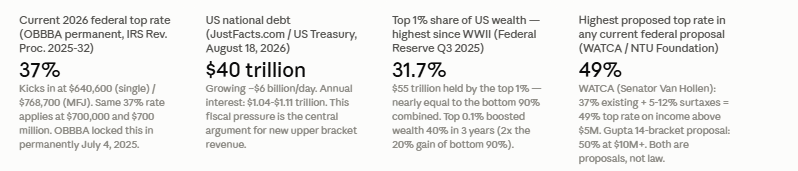
The US national debt hit $40 trillion in August 2026. The top 1% controls 31.7% of all American wealth — $55 trillion, nearly as much as the bottom 90% combined. And the federal tax code still applies the same 37% marginal rate to every dollar earned above $640,600, whether the earner makes $700,000 or $700 million. An academic proposal to double the number of federal tax brackets from 7 to 14 — adding seven new upper brackets ranging from 38% to 50% — is drawing fresh attention. So are Senate proposals for surtaxes up to 49%, and a wave of state-level millionaire taxes. This guide explains what is actually being proposed, who would pay more under each scenario, and what is or is not law today.
A single earner making $700,000 and a hedge fund manager making $70 million pay the same marginal rate on every dollar above that threshold. That flat rate above the top bracket is the central argument for the wave of proposals now circulating at the federal and state level. Kiplinger's Kelley R. Taylor put it directly in coverage published September 18-19, 2026: 'As income rises beyond the current 37% threshold, the tax rate doesn't increase. That's what spurs the argument for adding more brackets at the top.'
The fiscal backdrop makes the debate more urgent. As of August 18, 2026, the US national debt stands at $40.0 trillion, according to JustFacts.com citing Treasury data. The government now pays approximately $1.04 to $1.11 trillion per year in interest on that debt — more than the entire annual defence budget. The debt is growing by approximately $6 billion per day. Against this backdrop, an academic proposal to add seven new federal tax brackets above the current top rate, Senate bills for surtaxes that would create a 49% top rate, and a spreading wave of state-level millionaire taxes are all drawing more serious attention than they might have in a more fiscally comfortable environment.
US national debt: $40.0 trillion as of August 18, 2026 (JustFacts.com; US Treasury). Annual interest on debt: ~$1.04-$1.11 trillion per year (PrimeRates May 2026). Debt growing ~$6 billion per day. Top 37% federal rate in 2026 kicks in at $640,600 (single) / $768,700 (MFJ). Applies at the same 37% marginal rate whether you earn $700,000 or $700 million. Top 1% controls 31.7% of US wealth ($55 trillion) as of Q3 2025 — highest since WWII (Federal Reserve; Bloomberg January 21, 2026). 14-bracket proposal: seven new brackets from 38% to 50% above $900,000. WATCA Senate proposal: 49% potential top rate. Washington State: 9.9% tax on income above $1 million signed March 2026. All federal bracket reform proposals: NOT current law.
The US uses a progressive marginal rate system. Tax rates apply only to the income within each bracket, not to all income. A single filer earning $200,000 in 2026 does not pay 32% on their entire $200,000. They pay: 10% on the first $11,925; 12% on income from $11,925 to $50,400; 22% on income from $50,400 to $105,700; 24% on income from $105,700 to $201,775; and would cross into the 32% bracket only on income above $201,775. Their effective rate — total tax divided by total income — is significantly lower than 32%.
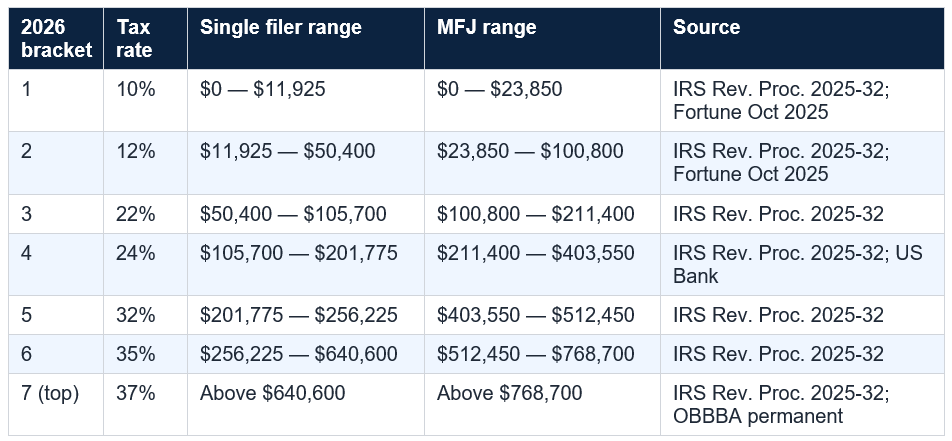
For 2026, the seven brackets for single filers start at: 10% ($0-$11,925), 12% ($11,925-$50,400), 22% ($50,400-$105,700), 24% ($105,700-$201,775), 32% ($201,775-$256,225), 35% ($256,225-$640,600), and 37% above $640,600. For married filing jointly: 10% ($0-$23,850), 12% ($23,850-$100,800), 22% ($100,800-$211,400), 24% ($211,400-$403,550), 32% ($403,550-$512,450), 35% ($512,450-$768,700), and 37% above $768,700. The standard deduction in 2026 is $16,100 for single filers and $32,200 for MFJ, which reduces taxable income before these brackets apply.
The OBBBA permanently locked these brackets in place. The top rate staying at 37% — rather than reverting to 39.6% as pre-OBBBA law had scheduled — is the most significant tax law development for high earners in 2026. Bloomberg Tax projects the IRS will announce a 3.2% inflation adjustment to the 2027 bracket thresholds, consistent with the current inflation environment, according to The Hill's September 2026 reporting published three days ago.
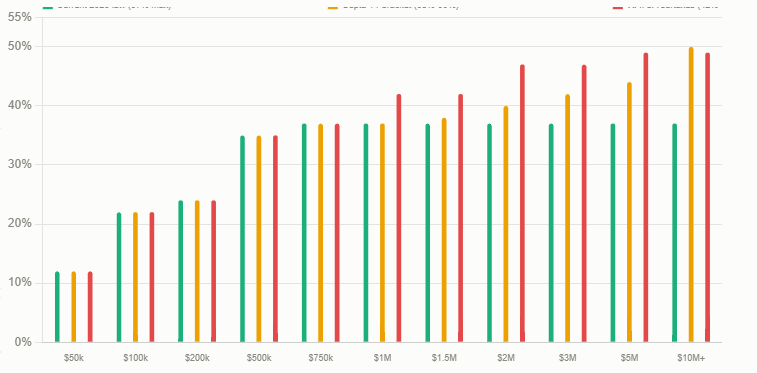
In one version of the proposal, the new upper brackets would raise the marginal rate gradually: 38% beginning at $900,000 of taxable income; 40% at $1.4 million; 42% at $2 million; 44% at $3 million; continuing with higher rates up to 50% at $10 million. These are the figures cited in the Kiplinger and MSN coverage of the Gupta paper. The paper notes it builds its 14-bracket model off the base 2024/2025 tax bracket thresholds — so the income thresholds in any implemented version would need to be adjusted for the 2026 or 2027 inflation-adjusted baselines.
The argument behind the proposal is fiscal and distributional. With the US national debt at $40 trillion and interest costs exceeding $1 trillion per year, Gupta argues that adding targeted tax-rate steps at the top of the income distribution could raise revenue without increasing taxes on middle-income taxpayers. A single earner at $900,000 would see only the portion of income between $900,000 and $1.4 million taxed at the new 38% rate — not a 38% tax on their entire income. Each new bracket only applies to the specific slice of income it covers.
It's true that none of this changes anyone's tax bill. The proposal is a policy recommendation, not a legislative proposal.' No revenue estimate is offered in the Gupta paper, because the total depends on the final rates chosen, income thresholds set, and — critically — how top earners would respond through changed behaviour, income timing, or relocation. These behavioural responses are addressed in Section 10.
Who the 14-bracket proposal would affect. Under Gupta's graduated schedule (38% at $900k to 50% at $10M+): Single earner at $900,000: the 37% rate applies to income from $640,600 to $900,000. The new 38% bracket would apply to income above $900,000. For a $900,001 earner: the new bracket adds 1 percentage point on just $1 of income. Negligible. Single earner at $2,000,000: income above $900k taxed at 38%; above $1.4M at 40%; above $2M at 42% (if that bracket applied). The incremental additional tax relative to the all-37% current system: approximately $10,000-$30,000 depending on exact thresholds. Single earner at $10,000,000: would reach the 50% top bracket on income above that threshold. Relative to current 37% flat rate above $640,600: substantially higher additional tax on the top-bracket income slice. IMPORTANT: these are illustrative, based on the proposal's described rate schedule. No official legislative text exists. Not tax advice.
14-bracket proposal: academic recommendation, not a bill. Proposes seven new brackets (38% to 50%) above current $900,000-level thresholds. Would affect only taxpayers with taxable income above approximately $900,000. No revenue estimate provided. Not law in 2026. Status: policy discussion and academic analysis. Would require Congressional legislation to take effect. Source: Kiplinger September 18-19, 2026; MSN coverage of same.
The Wealth Annual Tax and Contribution Act (WATCA), introduced by Senator Van Hollen, would create new income surtaxes at three income tiers: an additional 5% on income over $1 million for single filers ($1.5 million for married couples); an additional 10% on income over $2 million ($3 million for MFJ); and an additional 12% on income over $5 million ($7.5 million for MFJ). The surtax structure is additive to the existing 37% top rate. Applied together, the National Taxpayers Union Foundation's April 29, 2026 analysis calculates that WATCA would result in a 49% top individual income tax rate.
The Millionaires Surtax Act, revived and covered by ThinkAdvisor on April 16, 2026, takes a simpler approach: an additional flat 10% tax on incomes above $1 million per person. This would bring the top combined federal rate to 47% on earned income above $1 million (37% existing + 10% surtax), or effectively higher when combined with the existing 3.8% NIIT and 0.9% Additional Medicare Tax on high earned income.
Both proposals are legislative proposals, meaning they have been formally introduced in the Senate. Neither has passed. Both face the same political dynamic: they are purely Democratic proposals in a current Congressional environment where Republican opposition makes passage unlikely without a significant shift in Congressional composition. The NTU Foundation's analysis frames them as proposals that 'would exclusively target the highest income earners' — a description that supporters would characterise as precisely the point, and opponents would use as a reason for concern about investment and economic incentives.
WATCA surtax impact — illustrative examples. Current system (2026): single earner at $3 million. Existing 37% applies to income above $640,600. Additional Medicare Tax 0.9% applies. NIIT 3.8% on investment income. Under WATCA: income $1M-$2M: additional 5% surtax = 37% + 5% = 42% marginal rate on that slice. Income $2M-$3M: additional 10% surtax = 37% + 10% = 47% marginal rate on that slice. Income above $3M: 47% rate continues (next threshold at $5M). For the full $3M income: additional WATCA tax relative to current law: approximately $60,000-$100,000 depending on income composition. For $10M+ earner: additional WATCA tax in the hundreds of thousands. Combined 49% top rate applies to the highest slice under the full WATCA structure. Source: NTU Foundation April 29, 2026. Not tax advice. WATCA is not law.
The UMTA 2026, as analysed by the NTU Foundation in its April 29, 2026 report, would impose a 2% annual tax on household net worth between $50 million and $1 billion, and a 3% annual tax on net worth above $1 billion. The structure is a revision of Warren's 2020 proposal, which had a 6% top rate on billionaire wealth — the 2026 version reduces the billionaire rate to 3% while maintaining the same threshold structure.
A 2% annual wealth tax on $100 million of net worth means $2 million owed every year — not on income generated by that wealth, but on the wealth itself, even in years where the assets produce no liquid return. This creates distinct practical challenges: an individual with $60 million in net worth held primarily in illiquid assets (a private business, real estate, art, or undistributed equity in a startup) might not have the liquid cash to pay a $1.2 million annual wealth tax without selling assets. This valuation and liquidity problem — how do you annually value and tax private company stakes, real estate portfolios, or collectibles — is the central practical challenge that has led most tax law scholars to view a federal wealth tax as constitutionally and administratively complex.
Senator Sanders has introduced parallel wealth tax legislation in the same period. The NTU Foundation's April 2026 analysis covers both Warren's and Sanders' proposals together, noting that both 'drastically overestimate the potential revenue to be raised, handwave difficult questions of administrability, and portend significant economic consequences.'
Warren UMTA 2026: wealth tax, not income tax. 2% on net worth $50M-$1B; 3% above $1 billion. Targets accumulated wealth, not annual income. Practical challenges: annual valuation of illiquid assets; liquidity to pay without forced asset sales. Constitutional questions remain unresolved. Not law. Faces steep political hurdles. Source: NTU Foundation April 29, 2026; Nutax.com April 29, 2026.
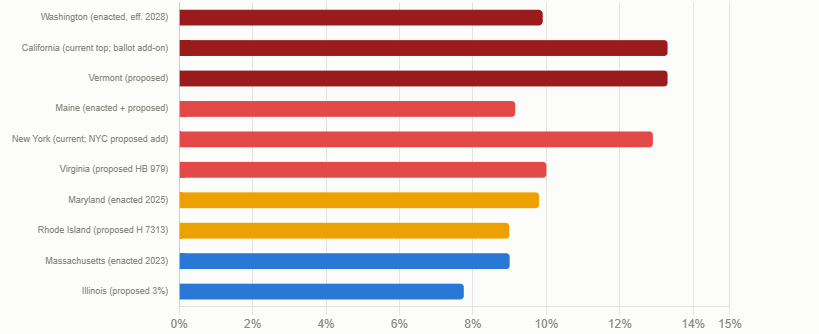
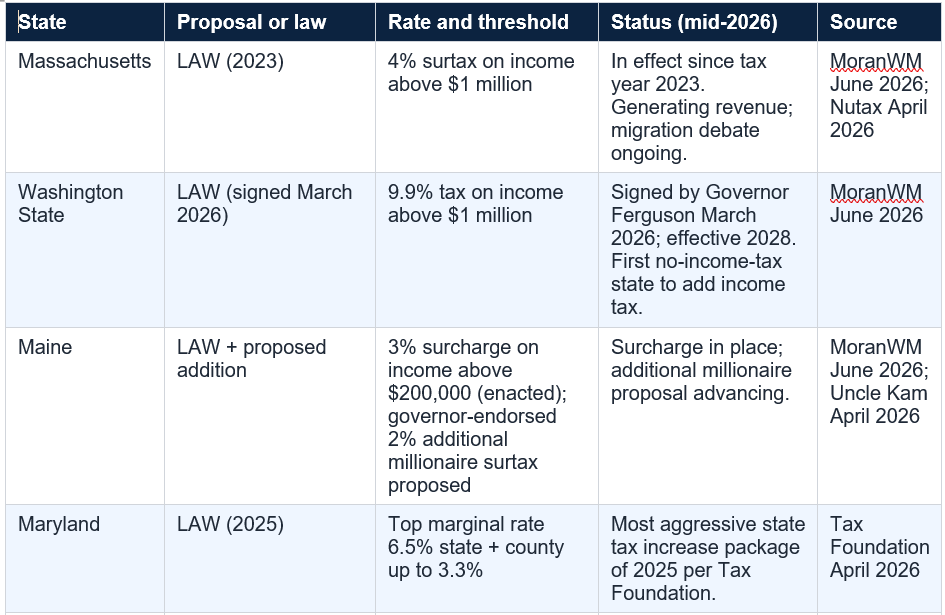
Three states already have enacted millionaire or high-earner surtaxes. Massachusetts imposed a 4% surtax on income above $1 million effective 2023; it has generated significant revenue and is now in its fourth year, with the debate having shifted to whether it is affecting migration patterns of high earners. Washington State made history in March 2026 by becoming the first traditionally no-income-tax state to enact a high-earner income tax: a 9.9% tax on earnings above $1 million, signed into law by Governor Ferguson and effective 2028. Maine has enacted a 3% surcharge on income above $200,000 (with a governor-endorsed 2% additional millionaire surtax also proposed), and Maryland implemented what the Tax Foundation called the nation's most aggressive state tax increase package in 2025, pushing combined state-and-county rates toward 9.8%.
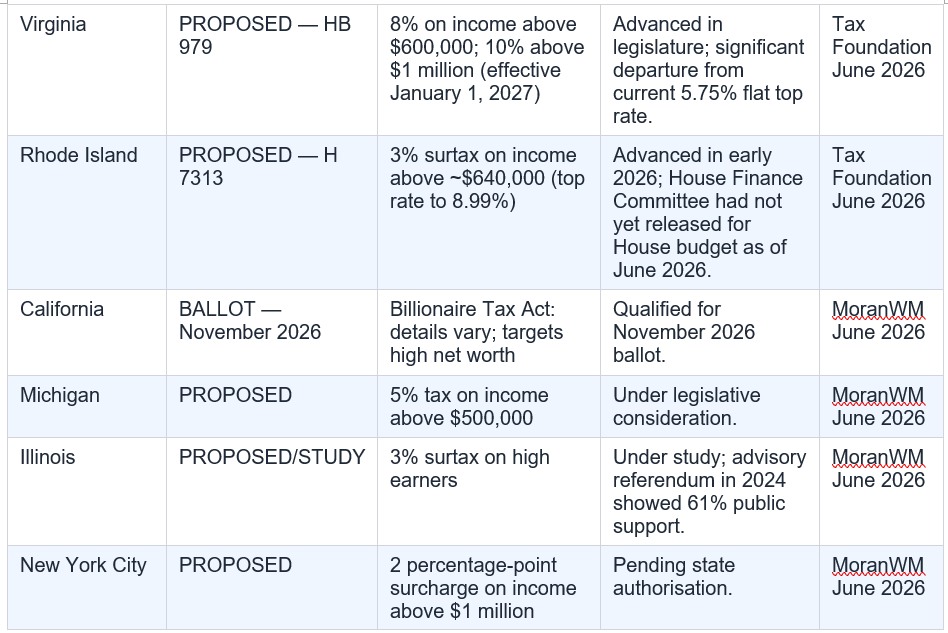
In the active proposal pipeline: Virginia's House Bill 979 would create two new upper brackets — 8% above $600,000 and 10% above $1 million — dramatically departing from the current 5.75% flat top rate; Rhode Island's H 7313 would add a 3% surtax above approximately $640,000; California's Billionaire Tax Act has qualified for the November 2026 ballot; Michigan is considering a 5% tax above $500,000; Illinois has a 3% surtax under study following a 61% advisory referendum in 2024; and New York City is pursuing a 2-point surcharge above $1 million pending state authorisation.
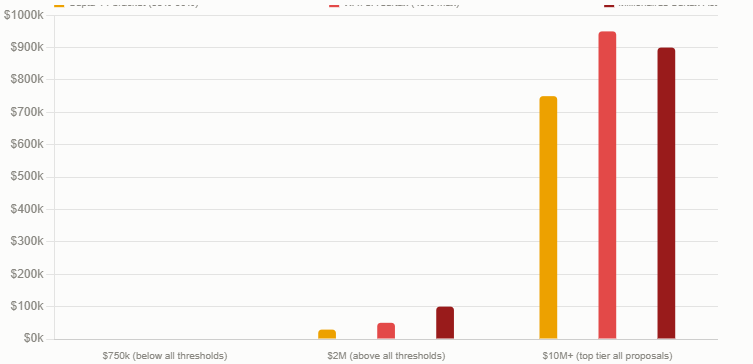
Example 1: Single earner with $750,000 taxable income. Current 2026 law: 10% on first $11,925 = $1,193; 12% on $11,925-$50,400 = $4,617; 22% on $50,400-$105,700 = $12,166; 24% on $105,700-$201,775 = $23,058; 32% on $201,775-$256,225 = $17,424; 35% on $256,225-$640,600 = $134,524; 37% on $640,600-$750,000 = $40,478. Total: approximately $233,460. Effective rate: ~31.1%. Under 14-bracket proposal (if $900,000 threshold applies): $750,000 is below the new $900,000 bottom threshold. ZERO additional tax. Under WATCA: $750,000 is below the $1 million threshold. ZERO additional surtax. Under Millionaires Surtax Act: below $1 million. ZERO additional. At this income level: NO additional tax under any current proposal.
Example 2: Single earner with $2,000,000 taxable income. Current 2026 law: 37% on income above $640,600. Federal income tax approximately $619,000. Effective rate: ~31%. Under 14-bracket proposal: Income $900k-$1.4M (additional 1% above 37% = 38%): $5,000 more. Income $1.4M-$2M (40% bracket): approximately $24,000 more. Total additional vs current law: ~$29,000. New total: approximately $648,000. Under WATCA: 5% surtax on $1M-$2M = $50,000 additional. Total additional vs current law: $50,000. New total: approximately $669,000. Under Millionaires Surtax Act: 10% on income above $1M: $100,000 additional. New total: approximately $719,000. NOTE: These are illustrative federal income tax estimates only. NIIT, Additional Medicare Tax, and state taxes would add to each scenario. Not tax advice. None of these proposals are law.
Example 3: Single earner with $10,000,000 taxable income. Current 2026 law: 37% on income above $640,600 = very large federal tax bill. Approximate federal tax: ~$3.5-$3.6 million. Under 14-bracket proposal (50% top rate at $10M+): significant additional tax on income above each new threshold. Approximate additional tax vs current law: $500,000-$1,000,000+ depending on exact bracket thresholds. Under WATCA (49% top effective rate): 5% on $1M-$2M = $50,000; 10% on $2M-$5M = $300,000; 12% on $5M-$10M = $600,000. Total additional WATCA surtax: approximately $950,000. Under Millionaires Surtax Act (10% on income above $1M): $900,000 additional surtax. Source: Rate schedules from NTU Foundation April 2026; Kiplinger September 2026. All figures illustrative; individual tax calculations vary widely based on deductions, income type, filing status, and other factors. Not tax advice.
The top 1% of US households controlled 31.7% of all national wealth in the third quarter of 2025, according to Federal Reserve data — $55 trillion in assets, roughly equal to the wealth held by the bottom 90% of Americans combined. Bloomberg's January 21, 2026 reporting on the data described it as the highest wealth concentration since World War II. Within the top 1%, the concentration is even more extreme: the top 0.1% — a subset of approximately 130,000 households — holds 14.4% of all national wealth, up from 8.6% in 1989 according to Federal Reserve data compiled in the Wikipedia wealth inequality article drawing on 2026 Q1 figures.
The top 0.1% boosted their wealth by 40% in just three years — twice the 20% gain achieved by the bottom 90% over the same period, according to Yahoo Finance's January 21, 2026 reporting on Fed data. Billionaire wealth in 2025 increased three times faster than the average annual rate over the prior five years, according to Oxfam International's 2026 report cited by CBS News. The top 10% of income earners accounted for nearly half of all US consumer spending in Q2 2025, according to Moody's chief economist Mark Zandi's analysis of Federal Reserve data.
These statistics form the distributional argument for new upper tax brackets: if wealth is increasingly concentrated among a small number of households, and the current tax system applies the same marginal rate to income earned by those at $640,601 as to those earning $64 million, a structural case can be made that the tax system is not capturing the full progressive intent of higher rates on higher incomes. Whether that argument should translate into new legislation — and what the economic consequences would be — is the substance of Section 9.
The historical context: the top US federal marginal income tax rate was 91% in the 1950s and 70% in the 1970s. After the Reagan-era reductions in the 1980s, it settled in the 28-39.6% range for the next four decades. The OBBBA's permanent 37% top rate is the lowest statutory top bracket in American history except for the period immediately following the 2017 Tax Cuts and Jobs Act (before its scheduled sunset). The 14-bracket proposal's top rate of 50% at $10 million+ would be the highest marginal rate in four decades — but still far below the 70-91% rates of the mid-20th century. Source: Tax Policy Center; IRS historical data.
At the state level, the Massachusetts experience with its 4% millionaire surtax (effective 2023) has been watched closely as the most recent large-scale US experiment with a high-earner surtax. The debate continues over whether the surtax is affecting migration among high earners, as the Nutax April 2026 analysis notes. Proponents of the surtax point to the fact that revenue collections have been 'significant.' Opponents point to migration data showing net outflows of high earners from Massachusetts following the surtax's introduction.
Washington State's 9.9% tax on income above $1 million, signed in March 2026 and effective in 2028, is attracting particular attention because it represents a departure from a no-income-tax state that had long used its zero income tax as a competitive advantage for attracting technology executives and entrepreneurs from California and New York. The Uncle Kam April 2026 analysis notes that both Maine and Washington's new taxes 'require immediate residency and income-timing strategies for affected earners' — meaning the primary impact may be on timing and structure of income recognition rather than on net revenue from earners who remain in the state.
The MoranWM June 23, 2026 state millionaire tax analysis characterises the broader pattern explicitly: 'Some have already passed into law. Others are weeks away from a ballot or a governor's signature. And a few are quietly building the legal architecture to tax you even after you leave.' The reference to extended residency rules is significant: several states have implemented or proposed rules that maintain state income tax jurisdiction over high earners for a period after they formally change residency — attempting to capture income that might otherwise be shifted to a departure year.
But for the average reader assessing how these proposals affect their finances today, the most important conclusion is this: none of the federal proposals discussed in this guide are law. Your 2026 taxes are governed by the seven-bracket, 10%-37% structure confirmed in IRS Revenue Procedure 2025-32 and made permanent by OBBBA. The 14-bracket proposal is an academic paper. The Senate surtax bills face significant political hurdles. The wealth tax has faced those same hurdles for six years.
At the state level, the story is different. Massachusetts, Washington, Maryland, and Maine have enacted real changes that affect real high earners now or imminently. Virginia, Rhode Island, California, and others have proposals moving through legislative or ballot channels that could affect the 2027 or 2028 tax environment. For high earners in those states, the timeline is shorter and the planning implications are more immediate.
The proposals on the table suggest the direction of pressure on the tax code. Whether any of them cross the line from proposal to law will depend on the next election cycle, the trajectory of the national debt, and the political appetite for restructuring a tax system that has been broadly stable at the federal level since 2017. The debate is worth following — and worth discussing with a qualified tax adviser who can translate its implications to your specific financial situation.
No — not at the federal level. For 2026, the federal tax code still has seven brackets (10%, 12%, 22%, 24%, 32%, 35%, and 37%), as confirmed in IRS Revenue Procedure 2025-32. The OBBBA, signed July 4, 2025, made these rates permanent, keeping the top rate at 37% rather than allowing it to revert to 39.6% as had been scheduled. What exists in 2026 are proposals for new upper brackets, not enacted law. The most-discussed federal proposal is an academic paper suggesting a 14-bracket system (doubling the current seven to fourteen) with new marginal rates from 38% to 50% above approximately $900,000. Senate bills proposing surtaxes of 5% to 12% on incomes above $1 million have been introduced but not passed. At the state level, Massachusetts, Washington State, Maryland, and Maine have enacted high-earner tax increases that are law. Source: Kiplinger September 2026; IRS Rev. Proc. 2025-32; OBBBA.
Who would the proposed new brackets affect?
All of the federal proposals discussed in this guide are targeted exclusively at the highest-income earners. The 14-bracket Gupta proposal would add new brackets only above approximately $900,000 of taxable income — a threshold that excludes the overwhelming majority of American taxpayers. The WATCA Senate surtax begins at $1 million for single filers. The Millionaires Surtax Act starts at $1 million. Senator Warren's wealth tax targets households with net worth above $50 million. Under none of these federal proposals would taxes increase on anyone with taxable income below approximately $640,000 to $900,000 — making them targeted at roughly the top 0.5% to 1% of earners. State-level proposals vary: Virginia's proposed 8% bracket begins at $600,000; Rhode Island's proposed surtax begins at approximately $640,000; Massachusetts' enacted surtax applies above $1 million. Source: Kiplinger September 2026; NTU Foundation April 29, 2026; Tax Foundation June 2026.
What is the highest proposed federal income tax rate in any current proposal?
The WATCA (Wealth Annual Tax and Contribution Act), introduced by Senator Van Hollen, would create a combined top effective income tax rate of 49% when its proposed surtaxes (5% on income above $1M, 10% above $2M, 12% above $5M) are added to the existing 37% top rate, according to the NTU Foundation's April 29, 2026 analysis. The 14-bracket academic proposal by Gupta would reach a 50% marginal rate on income above $10 million. The Millionaires Surtax Act would produce a 47% combined federal rate on income above $1 million (37% + 10%). None of these are law. The current enacted top federal marginal income tax rate is 37%, permanently set by OBBBA. Adding the 3.8% NIIT brings the maximum federal rate on investment income to 40.8%, and the 0.9% Additional Medicare Tax on wages above $200,000 brings the maximum on earned income to 37.9%. Source: NTU Foundation April 29, 2026; Kiplinger September 2026; High Earner Playbook June 2026.
Has Washington State really passed an income tax on millionaires?
Yes. Washington State, which had previously been one of nine states with no income tax, signed into law in March 2026 a 9.9% tax on earnings above $1 million, signed by Governor Ferguson. The law is effective in 2028, not immediately. This is significant because Washington had long used its zero income tax as a competitive advantage for attracting technology executives and entrepreneurs from California and New York. The Washington tax is the highest of any newly enacted state high-earner tax in the current wave. It is currently law, not a proposal. For high earners who live or work in Washington, planning should begin immediately even though the effective date is 2028. Source: MoranWM June 23, 2026; Uncle Kam April 2026.
What is the argument for adding more tax brackets above 37%?
The core argument is that a flat 37% rate above $640,600 applies the same marginal rate to someone earning $700,000 as to someone earning $70 million. As income rises above the top threshold, the effective rate does not increase. Proponents argue that adding graduated brackets above the current threshold — as the Gupta 14-bracket proposal suggests — would create a more genuinely progressive structure at the top without affecting middle-income taxpayers at all. The fiscal argument notes that the US national debt is $40 trillion as of August 2026 and growing at approximately $6 billion per day, with interest costs exceeding $1 trillion per year. Proponents argue that new upper brackets could raise revenue in a targeted way while leaving middle-class taxes unchanged. Opponents counter that high earners have more flexibility to respond behaviourally (through income timing, compensation structure, and relocation), and that the economic consequences could reduce the actual revenue collected versus the static estimate. Source: Kiplinger September 2026; NTU Foundation April 2026; Tax Foundation June 2026.
Table of Contents
- Why the 37% Rate and a $40 Trillion Debt Are Driving This Debate
- How the Current 2026 Federal Tax Brackets Actually Work
- The 14-Bracket Proposal: Seven New Rates from 38% to 50%
- The Senate Proposals: WATCA's 49% Top Rate and the Millionaires Surtax Act
- Senator Warren's Ultra-Millionaire Wealth Tax Act (UMTA) 2026
- State-Level Action: What Has Already Passed and What Is Coming
- Worked Examples: Who Would Actually Pay More Under Each Scenario
- The Inequality Data Behind These Proposals
- The Arguments For and Against New Upper Brackets
- The Behavioural Question: Would High Earners Pay More or Move?
- What Is Actually Law in 2026 vs What Is Just a Proposal
- Conclusion: The Proposals Are Real, the Timeline Is Not
- Frequently Asked Questions
Current 2026 brackets vs proposed new upper brackets
Who pays more: additional tax at $750k, $2M, $10M
State millionaire tax wave: enacted and proposed
Why the 37% Rate and a $40 Trillion Debt Are Driving This Debate
The United States federal tax code has seven income tax brackets, with marginal rates ranging from 10% to 37%. The top rate of 37% was locked in permanently by the One Big Beautiful Bill Act (OBBBA) signed on July 4, 2025, preventing the reversion to 39.6% that had been scheduled. But the OBBBA left unchanged one structural feature of the current system that is generating growing attention among economists, senators, and policy researchers: above the 37% threshold, which begins at $640,600 for single filers in 2026, every additional dollar is taxed at the same 37% rate — whether the earner makes $700,000 or $700 million.A single earner making $700,000 and a hedge fund manager making $70 million pay the same marginal rate on every dollar above that threshold. That flat rate above the top bracket is the central argument for the wave of proposals now circulating at the federal and state level. Kiplinger's Kelley R. Taylor put it directly in coverage published September 18-19, 2026: 'As income rises beyond the current 37% threshold, the tax rate doesn't increase. That's what spurs the argument for adding more brackets at the top.'
The fiscal backdrop makes the debate more urgent. As of August 18, 2026, the US national debt stands at $40.0 trillion, according to JustFacts.com citing Treasury data. The government now pays approximately $1.04 to $1.11 trillion per year in interest on that debt — more than the entire annual defence budget. The debt is growing by approximately $6 billion per day. Against this backdrop, an academic proposal to add seven new federal tax brackets above the current top rate, Senate bills for surtaxes that would create a 49% top rate, and a spreading wave of state-level millionaire taxes are all drawing more serious attention than they might have in a more fiscally comfortable environment.
US national debt: $40.0 trillion as of August 18, 2026 (JustFacts.com; US Treasury). Annual interest on debt: ~$1.04-$1.11 trillion per year (PrimeRates May 2026). Debt growing ~$6 billion per day. Top 37% federal rate in 2026 kicks in at $640,600 (single) / $768,700 (MFJ). Applies at the same 37% marginal rate whether you earn $700,000 or $700 million. Top 1% controls 31.7% of US wealth ($55 trillion) as of Q3 2025 — highest since WWII (Federal Reserve; Bloomberg January 21, 2026). 14-bracket proposal: seven new brackets from 38% to 50% above $900,000. WATCA Senate proposal: 49% potential top rate. Washington State: 9.9% tax on income above $1 million signed March 2026. All federal bracket reform proposals: NOT current law.
How the Current 2026 Federal Tax Brackets Actually Work
Before evaluating what a new set of brackets would change, it is important to understand precisely how the existing seven brackets operate — because the most common misconception about tax brackets (that moving into a higher bracket taxes all your income at the higher rate) is exactly the misconception that distorts the public debate about proposed bracket changes.The US uses a progressive marginal rate system. Tax rates apply only to the income within each bracket, not to all income. A single filer earning $200,000 in 2026 does not pay 32% on their entire $200,000. They pay: 10% on the first $11,925; 12% on income from $11,925 to $50,400; 22% on income from $50,400 to $105,700; 24% on income from $105,700 to $201,775; and would cross into the 32% bracket only on income above $201,775. Their effective rate — total tax divided by total income — is significantly lower than 32%.
For 2026, the seven brackets for single filers start at: 10% ($0-$11,925), 12% ($11,925-$50,400), 22% ($50,400-$105,700), 24% ($105,700-$201,775), 32% ($201,775-$256,225), 35% ($256,225-$640,600), and 37% above $640,600. For married filing jointly: 10% ($0-$23,850), 12% ($23,850-$100,800), 22% ($100,800-$211,400), 24% ($211,400-$403,550), 32% ($403,550-$512,450), 35% ($512,450-$768,700), and 37% above $768,700. The standard deduction in 2026 is $16,100 for single filers and $32,200 for MFJ, which reduces taxable income before these brackets apply.
The OBBBA permanently locked these brackets in place. The top rate staying at 37% — rather than reverting to 39.6% as pre-OBBBA law had scheduled — is the most significant tax law development for high earners in 2026. Bloomberg Tax projects the IRS will announce a 3.2% inflation adjustment to the 2027 bracket thresholds, consistent with the current inflation environment, according to The Hill's September 2026 reporting published three days ago.
The 14-Bracket Proposal: Seven New Rates from 38% to 50%
The proposal generating the most immediate attention — featured in Kiplinger's September 18-19, 2026 analysis and covered across major news outlets in the 72 hours preceding publication of this guide — comes from an academic economist (identified in Kiplinger as Gupta) and proposes doubling the number of federal tax brackets from the current seven to fourteen. The seven additional brackets would all fall above the existing 37% top rate.In one version of the proposal, the new upper brackets would raise the marginal rate gradually: 38% beginning at $900,000 of taxable income; 40% at $1.4 million; 42% at $2 million; 44% at $3 million; continuing with higher rates up to 50% at $10 million. These are the figures cited in the Kiplinger and MSN coverage of the Gupta paper. The paper notes it builds its 14-bracket model off the base 2024/2025 tax bracket thresholds — so the income thresholds in any implemented version would need to be adjusted for the 2026 or 2027 inflation-adjusted baselines.
The argument behind the proposal is fiscal and distributional. With the US national debt at $40 trillion and interest costs exceeding $1 trillion per year, Gupta argues that adding targeted tax-rate steps at the top of the income distribution could raise revenue without increasing taxes on middle-income taxpayers. A single earner at $900,000 would see only the portion of income between $900,000 and $1.4 million taxed at the new 38% rate — not a 38% tax on their entire income. Each new bracket only applies to the specific slice of income it covers.
It's true that none of this changes anyone's tax bill. The proposal is a policy recommendation, not a legislative proposal.' No revenue estimate is offered in the Gupta paper, because the total depends on the final rates chosen, income thresholds set, and — critically — how top earners would respond through changed behaviour, income timing, or relocation. These behavioural responses are addressed in Section 10.
Who the 14-bracket proposal would affect. Under Gupta's graduated schedule (38% at $900k to 50% at $10M+): Single earner at $900,000: the 37% rate applies to income from $640,600 to $900,000. The new 38% bracket would apply to income above $900,000. For a $900,001 earner: the new bracket adds 1 percentage point on just $1 of income. Negligible. Single earner at $2,000,000: income above $900k taxed at 38%; above $1.4M at 40%; above $2M at 42% (if that bracket applied). The incremental additional tax relative to the all-37% current system: approximately $10,000-$30,000 depending on exact thresholds. Single earner at $10,000,000: would reach the 50% top bracket on income above that threshold. Relative to current 37% flat rate above $640,600: substantially higher additional tax on the top-bracket income slice. IMPORTANT: these are illustrative, based on the proposal's described rate schedule. No official legislative text exists. Not tax advice.
14-bracket proposal: academic recommendation, not a bill. Proposes seven new brackets (38% to 50%) above current $900,000-level thresholds. Would affect only taxpayers with taxable income above approximately $900,000. No revenue estimate provided. Not law in 2026. Status: policy discussion and academic analysis. Would require Congressional legislation to take effect. Source: Kiplinger September 18-19, 2026; MSN coverage of same.
The Senate Proposals: WATCA's 49% Top Rate and the Millionaires Surtax Act
Two distinct legislative proposals have emerged from Democratic senators in 2026 that would create new high-income tax obligations through a different mechanism: surtaxes applied on top of existing rates, rather than restructuring the bracket system itself.The Wealth Annual Tax and Contribution Act (WATCA), introduced by Senator Van Hollen, would create new income surtaxes at three income tiers: an additional 5% on income over $1 million for single filers ($1.5 million for married couples); an additional 10% on income over $2 million ($3 million for MFJ); and an additional 12% on income over $5 million ($7.5 million for MFJ). The surtax structure is additive to the existing 37% top rate. Applied together, the National Taxpayers Union Foundation's April 29, 2026 analysis calculates that WATCA would result in a 49% top individual income tax rate.
The Millionaires Surtax Act, revived and covered by ThinkAdvisor on April 16, 2026, takes a simpler approach: an additional flat 10% tax on incomes above $1 million per person. This would bring the top combined federal rate to 47% on earned income above $1 million (37% existing + 10% surtax), or effectively higher when combined with the existing 3.8% NIIT and 0.9% Additional Medicare Tax on high earned income.
Both proposals are legislative proposals, meaning they have been formally introduced in the Senate. Neither has passed. Both face the same political dynamic: they are purely Democratic proposals in a current Congressional environment where Republican opposition makes passage unlikely without a significant shift in Congressional composition. The NTU Foundation's analysis frames them as proposals that 'would exclusively target the highest income earners' — a description that supporters would characterise as precisely the point, and opponents would use as a reason for concern about investment and economic incentives.
WATCA surtax impact — illustrative examples. Current system (2026): single earner at $3 million. Existing 37% applies to income above $640,600. Additional Medicare Tax 0.9% applies. NIIT 3.8% on investment income. Under WATCA: income $1M-$2M: additional 5% surtax = 37% + 5% = 42% marginal rate on that slice. Income $2M-$3M: additional 10% surtax = 37% + 10% = 47% marginal rate on that slice. Income above $3M: 47% rate continues (next threshold at $5M). For the full $3M income: additional WATCA tax relative to current law: approximately $60,000-$100,000 depending on income composition. For $10M+ earner: additional WATCA tax in the hundreds of thousands. Combined 49% top rate applies to the highest slice under the full WATCA structure. Source: NTU Foundation April 29, 2026. Not tax advice. WATCA is not law.
Senator Warren's Ultra-Millionaire Wealth Tax Act (UMTA) 2026
Senator Elizabeth Warren's latest iteration of her wealth tax proposal, the Ultra-Millionaire Tax Act (UMTA) 2026, takes a fundamentally different approach from all of the income tax proposals discussed so far. While income tax brackets and surtaxes tax what you earn in a given year, a wealth tax targets what you own — the accumulated net worth, regardless of whether it generates taxable income in that year.The UMTA 2026, as analysed by the NTU Foundation in its April 29, 2026 report, would impose a 2% annual tax on household net worth between $50 million and $1 billion, and a 3% annual tax on net worth above $1 billion. The structure is a revision of Warren's 2020 proposal, which had a 6% top rate on billionaire wealth — the 2026 version reduces the billionaire rate to 3% while maintaining the same threshold structure.
A 2% annual wealth tax on $100 million of net worth means $2 million owed every year — not on income generated by that wealth, but on the wealth itself, even in years where the assets produce no liquid return. This creates distinct practical challenges: an individual with $60 million in net worth held primarily in illiquid assets (a private business, real estate, art, or undistributed equity in a startup) might not have the liquid cash to pay a $1.2 million annual wealth tax without selling assets. This valuation and liquidity problem — how do you annually value and tax private company stakes, real estate portfolios, or collectibles — is the central practical challenge that has led most tax law scholars to view a federal wealth tax as constitutionally and administratively complex.
Senator Sanders has introduced parallel wealth tax legislation in the same period. The NTU Foundation's April 2026 analysis covers both Warren's and Sanders' proposals together, noting that both 'drastically overestimate the potential revenue to be raised, handwave difficult questions of administrability, and portend significant economic consequences.'
Warren UMTA 2026: wealth tax, not income tax. 2% on net worth $50M-$1B; 3% above $1 billion. Targets accumulated wealth, not annual income. Practical challenges: annual valuation of illiquid assets; liquidity to pay without forced asset sales. Constitutional questions remain unresolved. Not law. Faces steep political hurdles. Source: NTU Foundation April 29, 2026; Nutax.com April 29, 2026.
State-Level Action: What Has Already Passed and What Is Coming
While federal proposals remain in the proposal stage, state-level action on high-earner taxation is proceeding significantly faster and in some cases has already become law. The emerging picture, as documented by Tax Foundation's June 2026 analysis and MoranWM's June 23, 2026 state millionaire tax guide, is a growing patchwork of enacted and proposed high-earner taxes that collectively constitute a material shift in the state tax environment for Americans with incomes above $500,000 to $1 million.Three states already have enacted millionaire or high-earner surtaxes. Massachusetts imposed a 4% surtax on income above $1 million effective 2023; it has generated significant revenue and is now in its fourth year, with the debate having shifted to whether it is affecting migration patterns of high earners. Washington State made history in March 2026 by becoming the first traditionally no-income-tax state to enact a high-earner income tax: a 9.9% tax on earnings above $1 million, signed into law by Governor Ferguson and effective 2028. Maine has enacted a 3% surcharge on income above $200,000 (with a governor-endorsed 2% additional millionaire surtax also proposed), and Maryland implemented what the Tax Foundation called the nation's most aggressive state tax increase package in 2025, pushing combined state-and-county rates toward 9.8%.
In the active proposal pipeline: Virginia's House Bill 979 would create two new upper brackets — 8% above $600,000 and 10% above $1 million — dramatically departing from the current 5.75% flat top rate; Rhode Island's H 7313 would add a 3% surtax above approximately $640,000; California's Billionaire Tax Act has qualified for the November 2026 ballot; Michigan is considering a 5% tax above $500,000; Illinois has a 3% surtax under study following a 61% advisory referendum in 2024; and New York City is pursuing a 2-point surcharge above $1 million pending state authorisation.
Worked Examples: Who Would Actually Pay More Under Each Scenario
Abstract rate percentages mean little without dollar illustrations. The following worked examples show the federal tax calculation at specific income levels under current 2026 law, and what each major proposal would add. All examples use single filer status. All are illustrative, using simplified calculations without itemised deductions, investment income treatments, or state tax. Not tax advice — individual calculations depend on filing status, deductions, income type, and many other factors.Example 1: Single earner with $750,000 taxable income. Current 2026 law: 10% on first $11,925 = $1,193; 12% on $11,925-$50,400 = $4,617; 22% on $50,400-$105,700 = $12,166; 24% on $105,700-$201,775 = $23,058; 32% on $201,775-$256,225 = $17,424; 35% on $256,225-$640,600 = $134,524; 37% on $640,600-$750,000 = $40,478. Total: approximately $233,460. Effective rate: ~31.1%. Under 14-bracket proposal (if $900,000 threshold applies): $750,000 is below the new $900,000 bottom threshold. ZERO additional tax. Under WATCA: $750,000 is below the $1 million threshold. ZERO additional surtax. Under Millionaires Surtax Act: below $1 million. ZERO additional. At this income level: NO additional tax under any current proposal.
Example 2: Single earner with $2,000,000 taxable income. Current 2026 law: 37% on income above $640,600. Federal income tax approximately $619,000. Effective rate: ~31%. Under 14-bracket proposal: Income $900k-$1.4M (additional 1% above 37% = 38%): $5,000 more. Income $1.4M-$2M (40% bracket): approximately $24,000 more. Total additional vs current law: ~$29,000. New total: approximately $648,000. Under WATCA: 5% surtax on $1M-$2M = $50,000 additional. Total additional vs current law: $50,000. New total: approximately $669,000. Under Millionaires Surtax Act: 10% on income above $1M: $100,000 additional. New total: approximately $719,000. NOTE: These are illustrative federal income tax estimates only. NIIT, Additional Medicare Tax, and state taxes would add to each scenario. Not tax advice. None of these proposals are law.
Example 3: Single earner with $10,000,000 taxable income. Current 2026 law: 37% on income above $640,600 = very large federal tax bill. Approximate federal tax: ~$3.5-$3.6 million. Under 14-bracket proposal (50% top rate at $10M+): significant additional tax on income above each new threshold. Approximate additional tax vs current law: $500,000-$1,000,000+ depending on exact bracket thresholds. Under WATCA (49% top effective rate): 5% on $1M-$2M = $50,000; 10% on $2M-$5M = $300,000; 12% on $5M-$10M = $600,000. Total additional WATCA surtax: approximately $950,000. Under Millionaires Surtax Act (10% on income above $1M): $900,000 additional surtax. Source: Rate schedules from NTU Foundation April 2026; Kiplinger September 2026. All figures illustrative; individual tax calculations vary widely based on deductions, income type, filing status, and other factors. Not tax advice.
The Inequality Data Behind These Proposals
Understanding why these proposals are being made requires understanding the wealth and income concentration data that their proponents cite. The statistics are striking by historical standards.The top 1% of US households controlled 31.7% of all national wealth in the third quarter of 2025, according to Federal Reserve data — $55 trillion in assets, roughly equal to the wealth held by the bottom 90% of Americans combined. Bloomberg's January 21, 2026 reporting on the data described it as the highest wealth concentration since World War II. Within the top 1%, the concentration is even more extreme: the top 0.1% — a subset of approximately 130,000 households — holds 14.4% of all national wealth, up from 8.6% in 1989 according to Federal Reserve data compiled in the Wikipedia wealth inequality article drawing on 2026 Q1 figures.
The top 0.1% boosted their wealth by 40% in just three years — twice the 20% gain achieved by the bottom 90% over the same period, according to Yahoo Finance's January 21, 2026 reporting on Fed data. Billionaire wealth in 2025 increased three times faster than the average annual rate over the prior five years, according to Oxfam International's 2026 report cited by CBS News. The top 10% of income earners accounted for nearly half of all US consumer spending in Q2 2025, according to Moody's chief economist Mark Zandi's analysis of Federal Reserve data.
These statistics form the distributional argument for new upper tax brackets: if wealth is increasingly concentrated among a small number of households, and the current tax system applies the same marginal rate to income earned by those at $640,601 as to those earning $64 million, a structural case can be made that the tax system is not capturing the full progressive intent of higher rates on higher incomes. Whether that argument should translate into new legislation — and what the economic consequences would be — is the substance of Section 9.
The historical context: the top US federal marginal income tax rate was 91% in the 1950s and 70% in the 1970s. After the Reagan-era reductions in the 1980s, it settled in the 28-39.6% range for the next four decades. The OBBBA's permanent 37% top rate is the lowest statutory top bracket in American history except for the period immediately following the 2017 Tax Cuts and Jobs Act (before its scheduled sunset). The 14-bracket proposal's top rate of 50% at $10 million+ would be the highest marginal rate in four decades — but still far below the 70-91% rates of the mid-20th century. Source: Tax Policy Center; IRS historical data.
The Arguments For and Against New Upper Brackets
The debate over new upper tax brackets and millionaire surtaxes breaks along both fiscal and economic lines. The arguments on each side are substantive and should be understood independently of their political associations.- For new brackets — the fiscal argument: the US national debt is $40 trillion and growing at $6 billion per day. Interest costs exceed $1 trillion annually. New revenue without raising taxes on middle-income households requires either broadening the tax base or raising rates on the highest earners. Proponents like Gupta argue that seven additional brackets between $900,000 and $10 million represent a targeted, fiscally justified response.
- For new brackets — the distributional argument: the existing 37% flat rate above $640,600 produces identical marginal rates for a $700,000 earner and a $70 million earner. As the NTU Foundation's April 2026 analysis frames the proponents' position: the 14-bracket structure would 'raise revenue without increasing taxes on middle-income taxpayers.' This framing is broadly accurate — none of the proposals discussed here would raise taxes on anyone earning below approximately $640,000 to $1 million.
- Against new brackets — the behavioural response argument: the relationship between top marginal tax rates and actual revenue collected is not linear. High earners have more flexibility than typical wage earners to defer income, shift income between categories, change the timing of capital gains realisations, or alter compensation structures. Academic research on behavioural responses to top rate increases is mixed, with estimated elasticities ranging from modest to substantial. The NTU Foundation's analysis warns of 'significant economic consequences' from the Warren and Sanders proposals.
- Against new brackets — the competitiveness argument: the Tax Foundation's June 2026 analysis of state-level high-earner taxes argues directly that 'targeting high earners is misguided and will worsen states' fiscal positions,' citing concerns about the interstate migration of high-earning taxpayers from high-tax to low-tax states. The same argument is made at the federal level, with opponents noting that the US competes globally for investment, capital, and talent.
- Against new brackets — the OBBBA argument: the legislative rationale for making TCJA brackets permanent under OBBBA was explicitly to provide tax certainty and economic stability. New upper brackets introduced shortly after that permanent structure would undermine the certainty the legislation was intended to provide.
The Behavioural Question: Would High Earners Pay More or Move?
The most important empirical question in any evaluation of new upper brackets is not what the statutory rate would be, but how much revenue the change would actually raise after accounting for the behavioural responses of the affected taxpayers. This is the question every revenue estimate must answer, and it is the source of most disagreement about the fiscal impact of high-earner tax changes.At the state level, the Massachusetts experience with its 4% millionaire surtax (effective 2023) has been watched closely as the most recent large-scale US experiment with a high-earner surtax. The debate continues over whether the surtax is affecting migration among high earners, as the Nutax April 2026 analysis notes. Proponents of the surtax point to the fact that revenue collections have been 'significant.' Opponents point to migration data showing net outflows of high earners from Massachusetts following the surtax's introduction.
Washington State's 9.9% tax on income above $1 million, signed in March 2026 and effective in 2028, is attracting particular attention because it represents a departure from a no-income-tax state that had long used its zero income tax as a competitive advantage for attracting technology executives and entrepreneurs from California and New York. The Uncle Kam April 2026 analysis notes that both Maine and Washington's new taxes 'require immediate residency and income-timing strategies for affected earners' — meaning the primary impact may be on timing and structure of income recognition rather than on net revenue from earners who remain in the state.
The MoranWM June 23, 2026 state millionaire tax analysis characterises the broader pattern explicitly: 'Some have already passed into law. Others are weeks away from a ballot or a governor's signature. And a few are quietly building the legal architecture to tax you even after you leave.' The reference to extended residency rules is significant: several states have implemented or proposed rules that maintain state income tax jurisdiction over high earners for a period after they formally change residency — attempting to capture income that might otherwise be shifted to a departure year.
What Is Actually Law in 2026 vs What Is Just a Proposal
The most important practical point for readers evaluating how these proposals affect their own finances is distinguishing between what is actually law governing 2026 taxes and what is at various stages of the legislative or ballot process.- CURRENT FEDERAL LAW (2026): Seven brackets, 10%-37%, as described in Section 2. Rates confirmed in IRS Revenue Procedure 2025-32. Top rate at 37% made permanent by OBBBA (July 4, 2025). Standard deduction $16,100 single / $32,200 MFJ. NIIT 3.8% above $200,000/$250,000 MAGI. Additional Medicare Tax 0.9% on wages above $200,000/$250,000. This is what applies to your 2026 tax return filed in 2027.
- PROPOSALS ONLY — NOT CURRENT LAW: The 14-bracket Gupta proposal is an academic paper, not legislation. WATCA (Van Hollen) is a Senate bill, not passed. Millionaires Surtax Act is a Senate bill, not passed. Warren UMTA 2026 wealth tax is a Senate bill with limited political path. None of these affect your 2026 or 2027 taxes unless legislation passes, which would require both chambers of Congress and a presidential signature.
- ENACTED STATE LAW: Massachusetts 4% surtax on income above $1M (since 2023). Maryland top rate increases (2025). Washington State 9.9% on income above $1M (signed March 2026, effective 2028). Maine surcharges (various). If you are a high earner in one of these states, these laws affect your current or near-term tax situation.
- STATE PROPOSALS TO MONITOR: Virginia HB 979 (8% / 10% effective Jan 1, 2027, if passed). Rhode Island H 7313. California Billionaire Tax Act (November 2026 ballot). Michigan, Illinois proposals under consideration. These could affect your state tax bill if passed — consult a tax adviser if you are in one of these states at relevant income levels.
12. Conclusion: The Proposals Are Real, the Timeline Is Not
The debate over new upper federal tax brackets and millionaire surtaxes is substantive, timely, and backed by serious academic and legislative activity. The fiscal context — a $40 trillion national debt growing at $6 billion per day — makes some form of revenue discussion at the high end of the income distribution increasingly difficult to avoid. The inequality data — with the top 1% controlling 31.7% of all US wealth at a post-WWII high — provides the distributional argument.But for the average reader assessing how these proposals affect their finances today, the most important conclusion is this: none of the federal proposals discussed in this guide are law. Your 2026 taxes are governed by the seven-bracket, 10%-37% structure confirmed in IRS Revenue Procedure 2025-32 and made permanent by OBBBA. The 14-bracket proposal is an academic paper. The Senate surtax bills face significant political hurdles. The wealth tax has faced those same hurdles for six years.
At the state level, the story is different. Massachusetts, Washington, Maryland, and Maine have enacted real changes that affect real high earners now or imminently. Virginia, Rhode Island, California, and others have proposals moving through legislative or ballot channels that could affect the 2027 or 2028 tax environment. For high earners in those states, the timeline is shorter and the planning implications are more immediate.
The proposals on the table suggest the direction of pressure on the tax code. Whether any of them cross the line from proposal to law will depend on the next election cycle, the trajectory of the national debt, and the political appetite for restructuring a tax system that has been broadly stable at the federal level since 2017. The debate is worth following — and worth discussing with a qualified tax adviser who can translate its implications to your specific financial situation.
Frequently Asked Questions
Are there actually new tax brackets for high earners in 2026?No — not at the federal level. For 2026, the federal tax code still has seven brackets (10%, 12%, 22%, 24%, 32%, 35%, and 37%), as confirmed in IRS Revenue Procedure 2025-32. The OBBBA, signed July 4, 2025, made these rates permanent, keeping the top rate at 37% rather than allowing it to revert to 39.6% as had been scheduled. What exists in 2026 are proposals for new upper brackets, not enacted law. The most-discussed federal proposal is an academic paper suggesting a 14-bracket system (doubling the current seven to fourteen) with new marginal rates from 38% to 50% above approximately $900,000. Senate bills proposing surtaxes of 5% to 12% on incomes above $1 million have been introduced but not passed. At the state level, Massachusetts, Washington State, Maryland, and Maine have enacted high-earner tax increases that are law. Source: Kiplinger September 2026; IRS Rev. Proc. 2025-32; OBBBA.
Who would the proposed new brackets affect?
All of the federal proposals discussed in this guide are targeted exclusively at the highest-income earners. The 14-bracket Gupta proposal would add new brackets only above approximately $900,000 of taxable income — a threshold that excludes the overwhelming majority of American taxpayers. The WATCA Senate surtax begins at $1 million for single filers. The Millionaires Surtax Act starts at $1 million. Senator Warren's wealth tax targets households with net worth above $50 million. Under none of these federal proposals would taxes increase on anyone with taxable income below approximately $640,000 to $900,000 — making them targeted at roughly the top 0.5% to 1% of earners. State-level proposals vary: Virginia's proposed 8% bracket begins at $600,000; Rhode Island's proposed surtax begins at approximately $640,000; Massachusetts' enacted surtax applies above $1 million. Source: Kiplinger September 2026; NTU Foundation April 29, 2026; Tax Foundation June 2026.
What is the highest proposed federal income tax rate in any current proposal?
The WATCA (Wealth Annual Tax and Contribution Act), introduced by Senator Van Hollen, would create a combined top effective income tax rate of 49% when its proposed surtaxes (5% on income above $1M, 10% above $2M, 12% above $5M) are added to the existing 37% top rate, according to the NTU Foundation's April 29, 2026 analysis. The 14-bracket academic proposal by Gupta would reach a 50% marginal rate on income above $10 million. The Millionaires Surtax Act would produce a 47% combined federal rate on income above $1 million (37% + 10%). None of these are law. The current enacted top federal marginal income tax rate is 37%, permanently set by OBBBA. Adding the 3.8% NIIT brings the maximum federal rate on investment income to 40.8%, and the 0.9% Additional Medicare Tax on wages above $200,000 brings the maximum on earned income to 37.9%. Source: NTU Foundation April 29, 2026; Kiplinger September 2026; High Earner Playbook June 2026.
Has Washington State really passed an income tax on millionaires?
Yes. Washington State, which had previously been one of nine states with no income tax, signed into law in March 2026 a 9.9% tax on earnings above $1 million, signed by Governor Ferguson. The law is effective in 2028, not immediately. This is significant because Washington had long used its zero income tax as a competitive advantage for attracting technology executives and entrepreneurs from California and New York. The Washington tax is the highest of any newly enacted state high-earner tax in the current wave. It is currently law, not a proposal. For high earners who live or work in Washington, planning should begin immediately even though the effective date is 2028. Source: MoranWM June 23, 2026; Uncle Kam April 2026.
What is the argument for adding more tax brackets above 37%?
The core argument is that a flat 37% rate above $640,600 applies the same marginal rate to someone earning $700,000 as to someone earning $70 million. As income rises above the top threshold, the effective rate does not increase. Proponents argue that adding graduated brackets above the current threshold — as the Gupta 14-bracket proposal suggests — would create a more genuinely progressive structure at the top without affecting middle-income taxpayers at all. The fiscal argument notes that the US national debt is $40 trillion as of August 2026 and growing at approximately $6 billion per day, with interest costs exceeding $1 trillion per year. Proponents argue that new upper brackets could raise revenue in a targeted way while leaving middle-class taxes unchanged. Opponents counter that high earners have more flexibility to respond behaviourally (through income timing, compensation structure, and relocation), and that the economic consequences could reduce the actual revenue collected versus the static estimate. Source: Kiplinger September 2026; NTU Foundation April 2026; Tax Foundation June 2026.

0 Comments Comments