
Knowledge
Andy Burnham PM: Will He Scrap the Triple Lock?

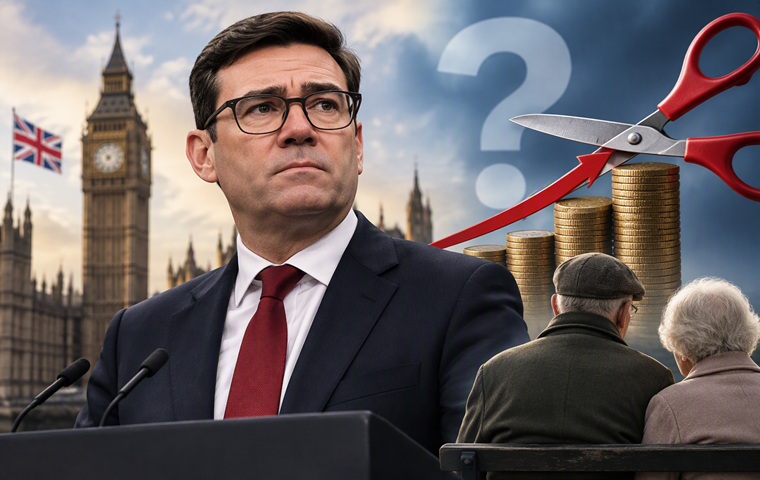
Andy Burnham became UK Prime Minister on 20 July 2026. Within days, the biggest question facing his government was the one he had been trying to avoid: the triple lock. His own economic advisers — Andy Haldane, Richard Hughes, and Jim O’Neill — have urged him to scrap it. Labour MPs are pressing for reform to free up funds for defence and younger generations. The OBR projects it will cost £15.5 billion more per year by 2030 than earnings-only uprating. Burnham has publicly said it stays. But he has not committed beyond 2029. This is the full picture of what is happening, what it costs, and what it means for your pension.
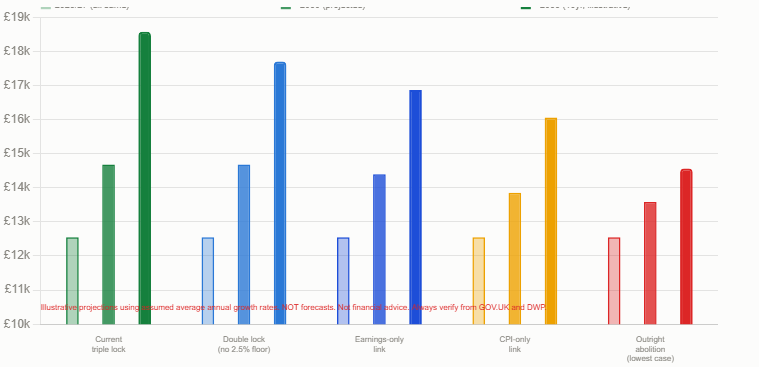
The biggest immediate question was not new. The triple lock — the mechanism that guarantees the State Pension rises each year by the highest of inflation, average earnings, or 2.5% — had been under sustained pressure throughout 2026. Andy Burnham had, before taking office and in the weeks immediately following, publicly committed to retaining the triple lock until the next general election, honouring Labour’s 2024 manifesto. But the pressure from within and outside his government was already significant, and the economic arithmetic was unambiguous.
As of September 2026, the government’s position remains that the triple lock is safe for this Parliament. Emma Reynolds, Chief Secretary to the Treasury, told LBC in September 2026: ‘The Prime Minister has made clear that we’re not getting rid of the Triple Lock.’ Yet Burnham has not committed to the policy beyond 2029 — and the OBR, his own advisers, and a growing number of Labour MPs are telling him the numbers do not add up. Not political or financial advice.
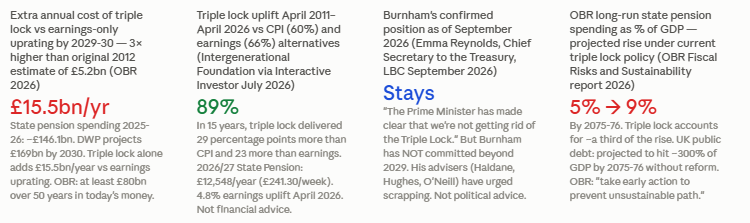
Andy Burnham became UK Prime Minister approximately 20 July 2026 (replacing Keir Starmer). John Healey: Chancellor. Torsten Bell: Pensions Minister. Triple lock 2026/27 uprating: 4.8% (earnings triggered). State Pension 2026/27: £12,548/year (£241.30/week). State pension spending 2025-26: ~£146.1bn (more than twice UK defence budget of ~£62.2bn in 2024-25). DWP projects state pension spending to hit £169bn by 2030. OBR: triple lock will cost £15.5bn/year more by 2029-30 vs earnings-only — ~3x higher than original 2012 estimate (£5.2bn). Sources: PensionBee July 2026; Corporate Adviser July 2026; LBC September 2026; This is the Coast/Sky Money July 2026. Not financial advice.
The policy was introduced by the Conservative-Liberal Democrat Coalition government in 2011 and first applied in 2012. It was designed to reverse the long trend of the State Pension falling behind average earnings, following the Thatcher government’s 1980 decision to link the pension to prices rather than earnings. By 2010, the full Basic State Pension had fallen to approximately 16% of average earnings. The triple lock was the mechanism to restore its relative value.
The New State Pension, which replaced the Basic State Pension in 2016, is the vehicle that carries the triple lock today. To receive the full New State Pension, a person needs 35 qualifying National Insurance years. A minimum of 10 qualifying years is needed for any pension at all. The current rate in 2026/27 is £12,548 per year (£241.30 per week), following the 4.8% earnings-triggered uplift in April 2026. Not financial advice. Verify current figures from GOV.UK.
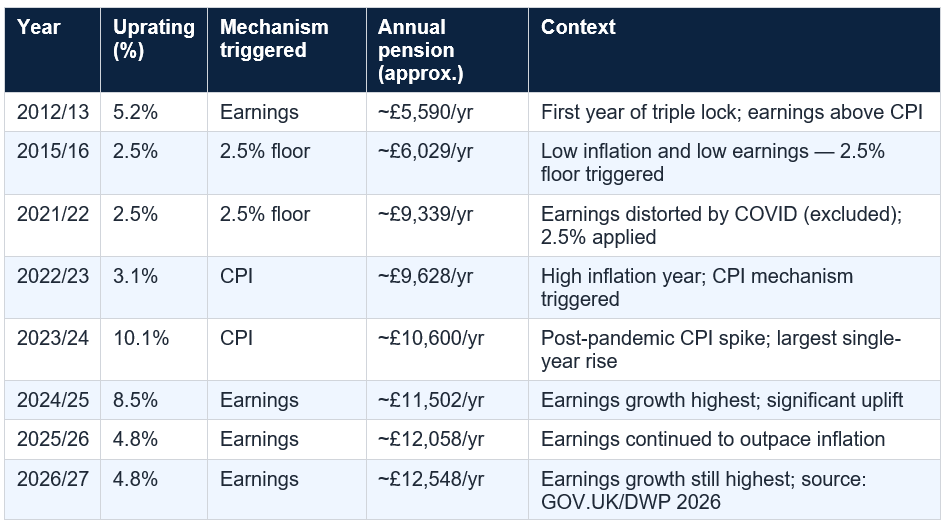
Note: figures are approximate. 2021 earnings distortion (COVID furlough scheme creating artificially high measured earnings growth) led the government to override the earnings element for 2022/23, applying only the 2.5% floor and CPI. This ‘double lock’ episode is often cited as precedent for how the mechanism can be adjusted without formal abolition. Not financial advice. Verify from GOV.UK and DWP.
In cash terms, the full New State Pension has risen from approximately £7,500 per year in 2016 (when the New State Pension replaced the Basic State Pension) to £12,548 per year in 2026/27 — a 67% increase in a decade. The cost of this generosity has been substantial. As Craig Rickman notes: ‘Over this period, the cost of the state pension has increased by almost 70% in real terms.’ The triple lock mechanism, combined with an ageing population, has driven state pension expenditure from a large but manageable programme to one of the largest single items of UK public expenditure.
For the current generation of pensioners, the triple lock has been transformative. For those who reached State Pension age in the mid-2000s on the old Basic State Pension and subsequently had it uprated under the triple lock, the cumulative gain over twenty years is tens of thousands of pounds. The mechanism has genuinely protected the living standards of pensioners through multiple periods of high inflation. Not financial advice.
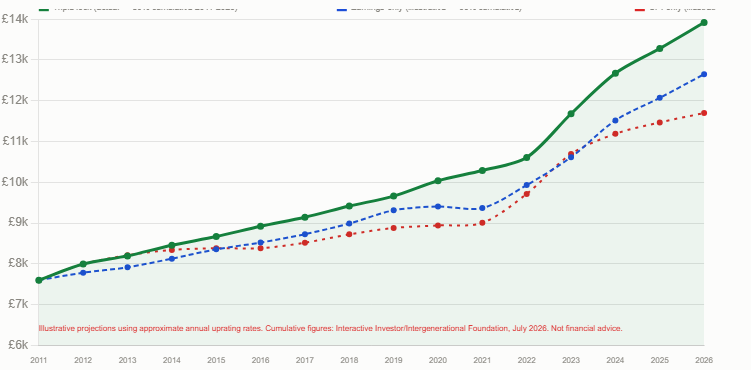
Craig Rickman, Interactive Investor (9 July 2026): 'Between April 2011 and April 2026, the triple lock shunted the state pension 89% higher. If it had been anchored to the consumer prices index (CPI) or average earnings, the increases would have been 60% and 66%, respectively.' And: 'Over this period, the cost of the state pension has increased by almost 70% in real terms.' Source: Interactive Investor, citing Intergenerational Foundation data.
When the triple lock was introduced in 2012, the estimate was that it would cost approximately £5.2 billion per year more than earnings-only uprating by 2029–30. That was always an optimistic forecast, built on assumptions of moderate and broadly stable inflation. The reality: the volatile post-COVID inflation and the sustained above-average earnings growth of the mid-2020s have driven the actual projected cost to approximately £15.5 billion per year by 2029–30 — approximately three times the original estimate. This is the central data point in every economic argument against the triple lock.
The longer-term picture is even more stark. Under the OBR’s baseline scenario, state pension spending is projected to rise from 5% of GDP to approximately 9% of GDP by 2075–76, with the triple lock mechanism itself estimated to account for approximately a third of this rise. UK public debt, without reform of current spending commitments, is projected to rise from approximately 95% of GDP in 2030–31 to approximately 300% of GDP by 2075–76 — a trajectory the OBR explicitly describes as ‘unsustainable and ever-rising.’ Not political or financial advice.
The OBR's 50-year projection: state pension spending rising from 5% of GDP (2026) to 9% of GDP (2075-76). The triple lock accounts for ~a third of this rise. UK public debt: projected to reach ~300% of GDP by 2075-76 under current policies. Tom Josephs (OBR) July 2026: 'It is certainly a substantial pressure on public spending over the longer term and is making a very significant contribution to that upward pressure on spending.' The OBR: 'take early action to prevent debt from moving on to an unsustainable and ever-rising path.' Not financial or political advice.
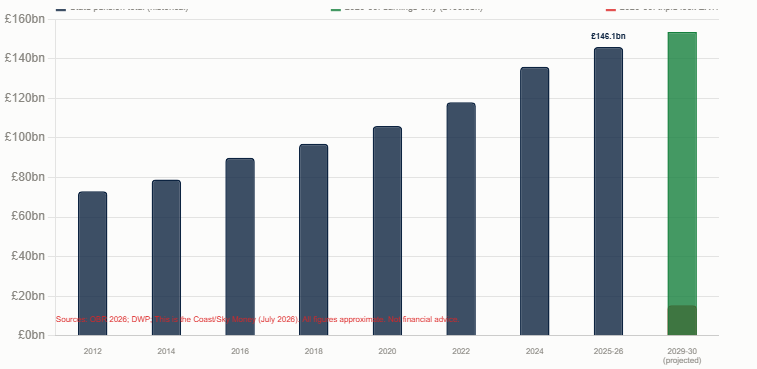
State pension payments totalled approximately £146.1 billion in 2025–26. By comparison, the entire UK defence budget was approximately £62.2 billion in 2024–25. The State Pension programme is already more than twice the size of the defence budget, and the DWP projects it will reach £169 billion by 2030. To put this in further context: the original estimate in 2012 was that the triple lock would add approximately £5.2 billion per year to state pension costs by 2029–30. The actual projected premium is approximately £15.5 billion — roughly three times higher than anticipated.
If the triple lock were replaced with an earnings-only link, the OBR estimates the saving would be approximately 2% of GDP in long-term spending pressure. That is a significant fiscal improvement that would materially affect the sustainability of UK public finances over the fifty-year horizon. The OBR’s language throughout is clear: this is a major and growing fiscal risk that requires early action. Not political or financial advice.
According to reporting in The Times (cited by Ground News, June 2026), all three have apparently suggested Burnham scrap the triple lock. O’Neill went further publicly, telling reporters he was ‘trying to convince’ Burnham that scrapping could boost national finances. The Spectator (Matthew Lynn, 25 June 2026) characterised the advisory position as clearly correct on the economics: ‘They are certainly right. The long-term projections for the triple lock are catastrophic.’ The same piece concluded, however, that it was ‘no way that “Our Andy” is going to do anything that bold’ — and so far, that prediction has proven accurate.
The significance of this advisory consensus is that it is not coming from political opponents or from the right-leaning think-tanks that have long advocated pension reform. It is coming from former senior officials at the Bank of England and the OBR — the institutional guardians of UK economic credibility — and from advisers within Burnham’s own inner circle. The economic case is being made by his own team. Not political or financial advice.
Burnham has been equally explicit about one important nuance: he has not committed to the triple lock beyond 2029. When pressed on the policy’s future, he has suggested the government should ‘look at’ tax breaks for older people drawn into income tax through frozen thresholds as a potential middle-way approach (Ground News, June 2026). PensionBee (23 July 2026) captured the central uncertainty: ‘Andy Burnham has repeatedly recommitted to the State Pension triple lock, but reports suggest his own economic advisers view scrapping it as a straightforward way to repair the public finances. The question is not whether reform is on the table, but whether the government reaches for one of the “middle way” options already proposed by industry figures rather than an outright manifesto U-turn.’
The current political reality, as of September 2026: the triple lock is formally safe for this Parliament. The question that will define the next election is whether Burnham can construct a politically viable reform package that addresses the fiscal sustainability problem without triggering the same kind of pensioner backlash that contributed to Keir Starmer’s downfall. Not political or financial advice.
Emma Reynolds, Chief Secretary to the Treasury (LBC, September 2026): 'The Prime Minister has made clear that we're not getting rid of the Triple Lock.' Andy Burnham (Reddit AMA, June 2026): 'I appreciate there's a lot of debate about this but it is important that the commitment in the manifesto stands.' Jim O'Neill (Burnham adviser, cited by The Times/Ground News, June 2026): 'trying to convince' Burnham that scrapping could boost national finances. PensionBee assessment (23 July 2026): 'The question is not whether reform is on the table, but whether the government reaches for one of the middle way options.'
The lesson the political system has drawn is stark: taking away something pensioners already have is one of the most dangerous acts available to a UK government. Older voters turn out at disproportionately high rates in UK elections — consistently higher than younger cohorts — and they have a demonstrated willingness to punish governments that reduce their benefits. The triple lock is not merely a pension policy; it is a signal of political intent toward the pensioner demographic that represents Labour’s most electorally sensitive constituency after the 2024 general election.
The Spectator (27 June 2026) articulated the psychological mechanism with precision: ‘Loss avoidance is one of the strongest forces in the world. It’s a fundamental of human nature — and therefore politics — that once we’ve been given something, we don’t easily give it up.’ The triple lock, introduced in 2012, has now been in place for fourteen years. Pensioners have built their financial planning around it. Removing or significantly modifying it is not merely a fiscal policy change; it is a breach of expectation that has the political profile of a tax rise on the most reliable voters in the electorate. Not political or financial advice.
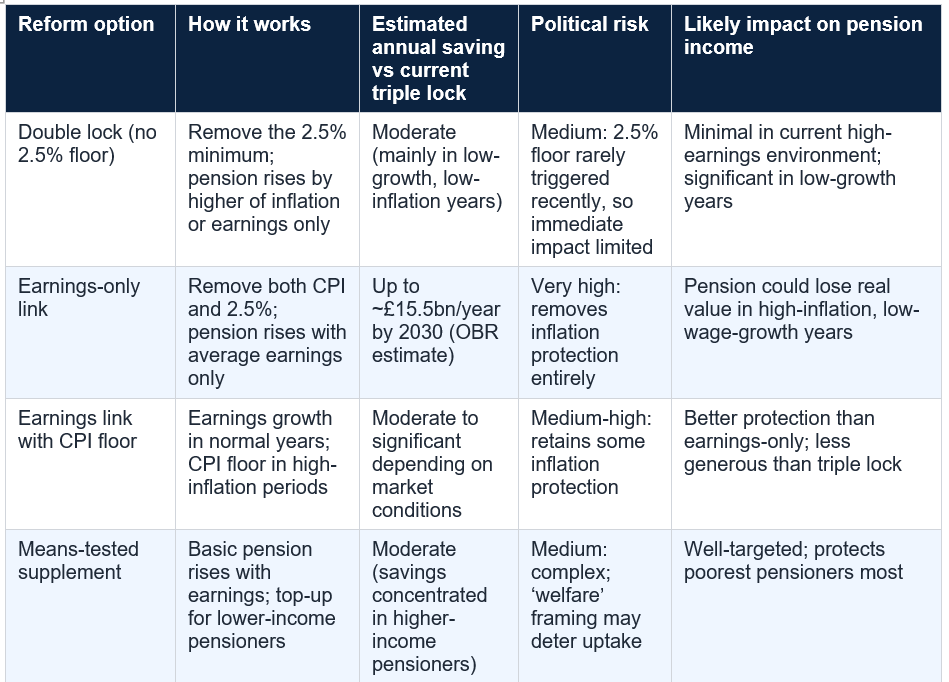
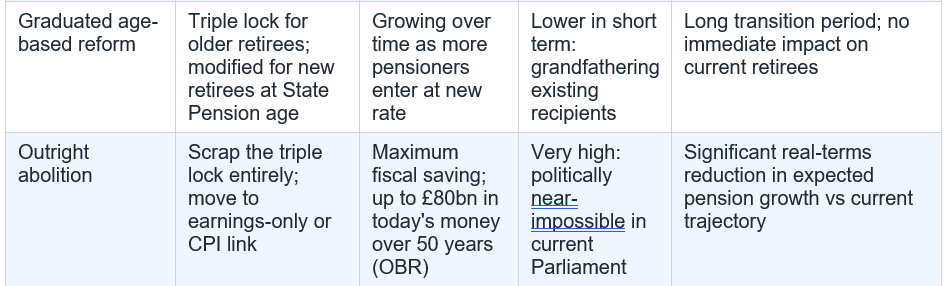
Sources: This is the Coast/Sky Money (July 2026); PensionBee Press (July 2026); Interactive Investor (July 2026); OBR Fiscal Risks and Sustainability report (2026). All savings estimates are approximate. Political risk assessments are editorial judgements based on media and expert commentary. Not financial or political advice.
The cumulative effect over fifteen years, using the Intergenerational Foundation’s analysis: between 2011 and 2026, triple lock recipients received pension uprating of 89%, against 60% for CPI and 66% for earnings. On a £12,548 annual pension in 2026, a CPI-only link from 2011 would have produced a pension approximately 15% lower — approximately £1,882 per year less. That is £157 per month in pension income that the triple lock has delivered above CPI uprating. An earnings-only link from 2011 would have produced approximately 13% less — approximately £1,631 per year less, or £136 per month.
For future pensioners: the triple lock projects a higher trajectory. Its removal would mean a lower State Pension at the point of retirement and compounding below the current trajectory in every year thereafter. The planning implication is significant: future pensioners who were counting on the triple lock to deliver a State Pension substantially above its current level would need to compensate through higher private pension contributions. Not financial advice. Consult a qualified independent financial adviser.
The 15-year compound difference (2011-2026): triple lock delivered 89% pension growth vs 60% (CPI) and 66% (earnings). On 2026/27 State Pension of £12,548: CPI-linked equivalent ~£10,666 (roughly £1,882/year or £157/month less). Earnings-linked equivalent ~£10,917 (roughly £1,631/year or £136/month less). Forward projection: if triple lock continues, State Pension expected to continue rising above CPI and earnings. If replaced: slower trajectory with lower purchasing power over time, particularly in high-inflation years. Source: Interactive Investor/Craig Rickman, 9 July 2026, citing Intergenerational Foundation data. Not financial advice.
Labour MPs urging Burnham to reform the triple lock have explicitly framed this as a generational fairness argument: freeing up funds for ‘defence and young people’ (The I Paper, reported by Newsquawk, 12 June 2026). The OBR itself has issued a call for early action to prevent the debt trajectory becoming unsustainable. PensionBee’s July 2026 assessment acknowledged directly: ‘with the current economic difficulties faced by younger workers and those seeking work, the intergenerational impact arguments surrounding both keeping and dispensing with the triple lock will keep this issue at the forefront of policy debate.’
The counter-argument from pensioners’ advocates is equally legitimate: the current generation of pensioners built their retirement expectations on the triple lock and adjusted their private saving and retirement age decisions accordingly. Removing it now would be a retrospective change to the terms on which they planned their retirement — an argument structurally identical to the objections raised against raising the State Pension age. Both are true. The genuine difficulty of the triple lock debate is that the competing claims of fairness point in opposite directions depending on which generation’s position you are occupying. Not political or financial advice.
The political lesson of the winter fuel allowance — that removing benefits from pensioners is one of the most dangerous acts available to a government — is the constraint that explains the gap between the economic consensus (reform is needed) and the political reality (reform is not happening in this Parliament). But it cannot constrain any prime minister indefinitely. The OBR’s projections are not a matter of political opinion. At 300% of GDP by 2075 — if that trajectory were permitted — there would be no State Pension to lock or unlock.
The question Burnham cannot avoid is not whether to reform the triple lock. It is whether to reform it in this Parliament, against manifesto commitments, with the winter fuel allowance precedent still fresh; or to defer reform, allow the fiscal position to deteriorate further, and hand his successor an even harder political choice with even more expensive numbers. For pension savers watching this unfold: the uncertainty is real, the planning implications are significant, and the time to build private pension resilience is now, regardless of what the triple lock does. Not financial or political advice. Always consult a qualified independent financial adviser.
As of September 2026: no. Andy Burnham has publicly committed to retaining the triple lock until the next general election, in line with Labour's 2024 manifesto. Emma Reynolds, Chief Secretary to the Treasury, confirmed this on LBC in September 2026: 'The Prime Minister has made clear that we're not getting rid of the Triple Lock.' However, Burnham has NOT committed to the triple lock beyond 2029, and his own economic advisers (Andy Haldane, Richard Hughes, Jim O'Neill) have reportedly urged him to scrap it. Jim O'Neill told reporters he was 'trying to convince' Burnham that scrapping would boost national finances. The tension between the economic case for reform and the political commitment to the manifesto is the defining issue. The triple lock is safe for this Parliament; its future post-2029 is genuinely uncertain. Not political or financial advice.
What is the triple lock and why is it controversial?
The triple lock is a guarantee that the State Pension rises each April by whichever is highest of: inflation (CPI), average earnings growth, or 2.5%. Introduced in 2012, it was designed to protect pensioners' living standards. It is controversial because: (1) it has cost far more than expected -- the OBR says it will cost £15.5bn/year more by 2029-30 than earnings-only uprating, against an original estimate of £5.2bn (approximately 3× over-budget); (2) it projects state pension spending to rise from 5% to 9% of GDP by 2075-76; (3) UK public debt is projected to reach approximately 300% of GDP by 2075-76 if current policies continue; (4) it is seen as intergenerationally regressive, transferring resources from working-age taxpayers to current pensioners at a time of fiscal pressure; and (5) it creates a structural incentive to uprate pensions beyond what wages can sustainably fund. Sources: OBR Fiscal Risks and Sustainability report 2026; Interactive Investor July 2026; The Spectator June 2026. Not financial or political advice.
How much does the triple lock cost?
In 2025-26, state pension spending totalled approximately £146.1bn (This is the Coast/Sky Money, July 2026). The DWP projects this will reach £169bn by 2030. The specific cost PREMIUM of the triple lock over earnings-only uprating: the OBR estimates approximately £15.5bn/year by 2029-30 (up from an original 2012 estimate of £5.2bn -- approximately 3× higher than projected). Over 50 years, the OBR estimates the triple lock will add at least £80bn (in today's money) to the cost of the state pension; the actual figure 'may be optimistic.' If replaced with an earnings-only link: would reduce long-term spending pressure by approximately 2% of GDP (OBR modelling). Sources: OBR; This is the Coast/Sky Money (July 2026); The Spectator (June 2026). Not financial advice.
What is the State Pension amount in 2026?
The full New State Pension for 2026/27 is £12,548 per year (£241.30 per week), following a 4.8% earnings-triggered increase in April 2026. To receive the full amount, you need 35 qualifying National Insurance years. You need at least 10 qualifying years to receive any State Pension. You can check your State Pension forecast and NI record at GOV.UK/check-state-pension. The State Pension age is currently 67 for those born after April 1960 (from April 2026). The PLSA comfortable retirement benchmark for a single person is £45,400/year (2026) -- the State Pension provides approximately 27.6% of this. Always verify current figures from GOV.UK and DWP. Not financial advice.
What should I do about my pension if the triple lock changes?
General information only -- not financial or pension advice. Consult a qualified IFA. Key steps to consider regardless of triple lock outcome: (1) Check your State Pension forecast at GOV.UK/check-state-pension. Know what you're projected to receive and when. (2) Check your National Insurance record for gaps. Class 3 voluntary NI contributions can fill gaps cost-effectively for many people; check the cost-effectiveness with HMRC or an IFA before paying. (3) Maximise private pension contributions -- capture your full employer match; use carry-forward allowance if applicable. (4) Model two scenarios for retirement planning: current triple lock trajectory and earnings-only (approximately 13% lower State Pension); ensure your private pension target bridges both gaps. (5) The Second Pensions Commission's findings (expected in Burnham's first Parliament) may clarify the policy direction. Monitor announcements via GOV.UK, DWP, and the Pensions Advisory Service (0800 011 3797, free). Not financial, pension, or legal advice. Always consult a qualified IFA (check register.fca.org.uk).
Table of Contents
- Andy Burnham: New Prime Minister, Familiar Dilemma
- What Is the Triple Lock? A Plain-English Explainer
- How Much Has the Triple Lock Delivered for Pensioners?
- Why the Economists Are Sounding the Alarm
- The OBR Verdict: £15.5 Billion and Rising
- The Advisers Pushing for Change: Haldane, Hughes, O’Neill
- Burnham’s Public Position: ‘The Manifesto Stands’
- The Political Trap: The Lesson of Winter Fuel Allowance
- The Middle-Way Options: Reform Without Abolition
- What Happens to Pensioners If the Triple Lock Is Scrapped?
- The Intergenerational Argument: Who Pays the Bill?
- What Should You Do With Your Pension Planning Now?
- Conclusion: The Question Burnham Cannot Avoid
- Frequently Asked Questions
Triple lock cost — what it spends vs the alternatives
State pension growth — triple lock vs alternatives since 2011
Impact on you — what each scenario means for your pension
Andy Burnham: New Prime Minister, Familiar Dilemma
Andy Burnham, the Labour MP for Makerfield and former Greater Manchester Mayor, formally became UK Prime Minister on approximately 20 July 2026, replacing Keir Starmer following Labour’s internal leadership contest. John Healey was confirmed as Chancellor of the Exchequer, and Torsten Bell remained as Pensions Minister (PensionBee, 23 July 2026; Corporate Adviser, July 2026). Burnham’s ascent to Downing Street brought with it a set of expensive spending commitments — defence, public ownership of utilities, ‘reindustrialisation,’ tax cuts for pubs and restaurants — and a fiscal hole that his own advisers were already working to explain.The biggest immediate question was not new. The triple lock — the mechanism that guarantees the State Pension rises each year by the highest of inflation, average earnings, or 2.5% — had been under sustained pressure throughout 2026. Andy Burnham had, before taking office and in the weeks immediately following, publicly committed to retaining the triple lock until the next general election, honouring Labour’s 2024 manifesto. But the pressure from within and outside his government was already significant, and the economic arithmetic was unambiguous.
As of September 2026, the government’s position remains that the triple lock is safe for this Parliament. Emma Reynolds, Chief Secretary to the Treasury, told LBC in September 2026: ‘The Prime Minister has made clear that we’re not getting rid of the Triple Lock.’ Yet Burnham has not committed to the policy beyond 2029 — and the OBR, his own advisers, and a growing number of Labour MPs are telling him the numbers do not add up. Not political or financial advice.
Andy Burnham became UK Prime Minister approximately 20 July 2026 (replacing Keir Starmer). John Healey: Chancellor. Torsten Bell: Pensions Minister. Triple lock 2026/27 uprating: 4.8% (earnings triggered). State Pension 2026/27: £12,548/year (£241.30/week). State pension spending 2025-26: ~£146.1bn (more than twice UK defence budget of ~£62.2bn in 2024-25). DWP projects state pension spending to hit £169bn by 2030. OBR: triple lock will cost £15.5bn/year more by 2029-30 vs earnings-only — ~3x higher than original 2012 estimate (£5.2bn). Sources: PensionBee July 2026; Corporate Adviser July 2026; LBC September 2026; This is the Coast/Sky Money July 2026. Not financial advice.
What Is the Triple Lock? A Plain-English Explainer
The triple lock is a commitment to increase the State Pension each April by whichever is the highest of three measures: inflation (Consumer Prices Index, or CPI), average earnings growth, or 2.5%. The 2.5% floor was intended to ensure the pension never fell behind living standards even in years of very low inflation and stagnant wages. The earnings measure links pension income to the rising cost of living in a working economy. The CPI measure protects against price rises.The policy was introduced by the Conservative-Liberal Democrat Coalition government in 2011 and first applied in 2012. It was designed to reverse the long trend of the State Pension falling behind average earnings, following the Thatcher government’s 1980 decision to link the pension to prices rather than earnings. By 2010, the full Basic State Pension had fallen to approximately 16% of average earnings. The triple lock was the mechanism to restore its relative value.
The New State Pension, which replaced the Basic State Pension in 2016, is the vehicle that carries the triple lock today. To receive the full New State Pension, a person needs 35 qualifying National Insurance years. A minimum of 10 qualifying years is needed for any pension at all. The current rate in 2026/27 is £12,548 per year (£241.30 per week), following the 4.8% earnings-triggered uplift in April 2026. Not financial advice. Verify current figures from GOV.UK.
Note: figures are approximate. 2021 earnings distortion (COVID furlough scheme creating artificially high measured earnings growth) led the government to override the earnings element for 2022/23, applying only the 2.5% floor and CPI. This ‘double lock’ episode is often cited as precedent for how the mechanism can be adjusted without formal abolition. Not financial advice. Verify from GOV.UK and DWP.
How Much Has the Triple Lock Delivered for Pensioners?
Between April 2011 and April 2026, the triple lock increased the State Pension by 89%, according to data cited by the Intergenerational Foundation and reported by Interactive Investor (Craig Rickman, 9 July 2026). Had the pension been linked to CPI alone over the same period, it would have risen by 60%. Linked to earnings alone: 66%. The triple lock delivered an additional 23 percentage points of increase over CPI and 23 points over earnings, compounding into significant cumulative gains for pensioners over fifteen years.In cash terms, the full New State Pension has risen from approximately £7,500 per year in 2016 (when the New State Pension replaced the Basic State Pension) to £12,548 per year in 2026/27 — a 67% increase in a decade. The cost of this generosity has been substantial. As Craig Rickman notes: ‘Over this period, the cost of the state pension has increased by almost 70% in real terms.’ The triple lock mechanism, combined with an ageing population, has driven state pension expenditure from a large but manageable programme to one of the largest single items of UK public expenditure.
For the current generation of pensioners, the triple lock has been transformative. For those who reached State Pension age in the mid-2000s on the old Basic State Pension and subsequently had it uprated under the triple lock, the cumulative gain over twenty years is tens of thousands of pounds. The mechanism has genuinely protected the living standards of pensioners through multiple periods of high inflation. Not financial advice.
Craig Rickman, Interactive Investor (9 July 2026): 'Between April 2011 and April 2026, the triple lock shunted the state pension 89% higher. If it had been anchored to the consumer prices index (CPI) or average earnings, the increases would have been 60% and 66%, respectively.' And: 'Over this period, the cost of the state pension has increased by almost 70% in real terms.' Source: Interactive Investor, citing Intergenerational Foundation data.
Why the Economists Are Sounding the Alarm
The concern among economists is not primarily about what the triple lock has done historically. It is about what it will cost in a future where the UK has an ageing population, a high public debt burden, and pressing competing demands on government expenditure. The mechanism was designed for a specific set of assumptions about future inflation and wage growth. Those assumptions have been comprehensively wrong.When the triple lock was introduced in 2012, the estimate was that it would cost approximately £5.2 billion per year more than earnings-only uprating by 2029–30. That was always an optimistic forecast, built on assumptions of moderate and broadly stable inflation. The reality: the volatile post-COVID inflation and the sustained above-average earnings growth of the mid-2020s have driven the actual projected cost to approximately £15.5 billion per year by 2029–30 — approximately three times the original estimate. This is the central data point in every economic argument against the triple lock.
The longer-term picture is even more stark. Under the OBR’s baseline scenario, state pension spending is projected to rise from 5% of GDP to approximately 9% of GDP by 2075–76, with the triple lock mechanism itself estimated to account for approximately a third of this rise. UK public debt, without reform of current spending commitments, is projected to rise from approximately 95% of GDP in 2030–31 to approximately 300% of GDP by 2075–76 — a trajectory the OBR explicitly describes as ‘unsustainable and ever-rising.’ Not political or financial advice.
The OBR's 50-year projection: state pension spending rising from 5% of GDP (2026) to 9% of GDP (2075-76). The triple lock accounts for ~a third of this rise. UK public debt: projected to reach ~300% of GDP by 2075-76 under current policies. Tom Josephs (OBR) July 2026: 'It is certainly a substantial pressure on public spending over the longer term and is making a very significant contribution to that upward pressure on spending.' The OBR: 'take early action to prevent debt from moving on to an unsustainable and ever-rising path.' Not financial or political advice.
The OBR Verdict: £15.5 Billion and Rising
The Office for Budget Responsibility’s Fiscal Risks and Sustainability report, published in the summer of 2026, provides the most authoritative independent assessment of the triple lock’s costs. Its central finding: the triple lock will cost approximately £15.5 billion per year more by 2029–30 than if the State Pension were linked to earnings alone. This is not a projected saving from scrapping it; it is the annual cost premium of the current policy over the simplest alternative.State pension payments totalled approximately £146.1 billion in 2025–26. By comparison, the entire UK defence budget was approximately £62.2 billion in 2024–25. The State Pension programme is already more than twice the size of the defence budget, and the DWP projects it will reach £169 billion by 2030. To put this in further context: the original estimate in 2012 was that the triple lock would add approximately £5.2 billion per year to state pension costs by 2029–30. The actual projected premium is approximately £15.5 billion — roughly three times higher than anticipated.
If the triple lock were replaced with an earnings-only link, the OBR estimates the saving would be approximately 2% of GDP in long-term spending pressure. That is a significant fiscal improvement that would materially affect the sustainability of UK public finances over the fifty-year horizon. The OBR’s language throughout is clear: this is a major and growing fiscal risk that requires early action. Not political or financial advice.
The Advisers Pushing for Change: Haldane, Hughes, and O’Neill
The three economists reported to be advising Andy Burnham are not minor figures. Andy Haldane was the Bank of England’s chief economist from 2014 to 2021 and is one of the most prominent economic voices in the UK. Richard Hughes was the founding chair of the OBR from 2020 to 2023 — the very institution whose fiscal projections are driving the case for triple lock reform. Jim O’Neill is the former Goldman Sachs economist and former commercial secretary to the Treasury who coined the term BRIC (Brazil, Russia, India, China) and has remained one of the UK’s most prominent economic commentators.According to reporting in The Times (cited by Ground News, June 2026), all three have apparently suggested Burnham scrap the triple lock. O’Neill went further publicly, telling reporters he was ‘trying to convince’ Burnham that scrapping could boost national finances. The Spectator (Matthew Lynn, 25 June 2026) characterised the advisory position as clearly correct on the economics: ‘They are certainly right. The long-term projections for the triple lock are catastrophic.’ The same piece concluded, however, that it was ‘no way that “Our Andy” is going to do anything that bold’ — and so far, that prediction has proven accurate.
The significance of this advisory consensus is that it is not coming from political opponents or from the right-leaning think-tanks that have long advocated pension reform. It is coming from former senior officials at the Bank of England and the OBR — the institutional guardians of UK economic credibility — and from advisers within Burnham’s own inner circle. The economic case is being made by his own team. Not political or financial advice.
Burnham’s Public Position: ‘The Manifesto Stands’
Andy Burnham’s public position throughout his leadership campaign and into his premiership has been consistent: the triple lock will remain for the duration of this Parliament, in line with Labour’s 2024 manifesto commitment. In an Ask Me Anything session on Reddit before taking office, Burnham stated: ‘I appreciate there’s a lot of debate about this but it is important that the commitment in the manifesto stands.’ After taking office, the Chief Secretary to the Treasury, Emma Reynolds, told LBC in September 2026: ‘The Prime Minister has made clear that we’re not getting rid of the Triple Lock.’Burnham has been equally explicit about one important nuance: he has not committed to the triple lock beyond 2029. When pressed on the policy’s future, he has suggested the government should ‘look at’ tax breaks for older people drawn into income tax through frozen thresholds as a potential middle-way approach (Ground News, June 2026). PensionBee (23 July 2026) captured the central uncertainty: ‘Andy Burnham has repeatedly recommitted to the State Pension triple lock, but reports suggest his own economic advisers view scrapping it as a straightforward way to repair the public finances. The question is not whether reform is on the table, but whether the government reaches for one of the “middle way” options already proposed by industry figures rather than an outright manifesto U-turn.’
The current political reality, as of September 2026: the triple lock is formally safe for this Parliament. The question that will define the next election is whether Burnham can construct a politically viable reform package that addresses the fiscal sustainability problem without triggering the same kind of pensioner backlash that contributed to Keir Starmer’s downfall. Not political or financial advice.
Emma Reynolds, Chief Secretary to the Treasury (LBC, September 2026): 'The Prime Minister has made clear that we're not getting rid of the Triple Lock.' Andy Burnham (Reddit AMA, June 2026): 'I appreciate there's a lot of debate about this but it is important that the commitment in the manifesto stands.' Jim O'Neill (Burnham adviser, cited by The Times/Ground News, June 2026): 'trying to convince' Burnham that scrapping could boost national finances. PensionBee assessment (23 July 2026): 'The question is not whether reform is on the table, but whether the government reaches for one of the middle way options.'
The Political Trap: The Lesson of Winter Fuel Allowance
The political context for Burnham’s caution is provided by the fate of his predecessor. Keir Starmer’s government removed a portion of the winter fuel allowance — a relatively modest benefit compared to the State Pension triple lock — from most pensioners, limiting it to Pension Credit recipients. The resulting public and media reaction was severe. The Spectator (27 June 2026) described it directly: the winter fuel allowance change ‘helped doom Starmer.’The lesson the political system has drawn is stark: taking away something pensioners already have is one of the most dangerous acts available to a UK government. Older voters turn out at disproportionately high rates in UK elections — consistently higher than younger cohorts — and they have a demonstrated willingness to punish governments that reduce their benefits. The triple lock is not merely a pension policy; it is a signal of political intent toward the pensioner demographic that represents Labour’s most electorally sensitive constituency after the 2024 general election.
The Spectator (27 June 2026) articulated the psychological mechanism with precision: ‘Loss avoidance is one of the strongest forces in the world. It’s a fundamental of human nature — and therefore politics — that once we’ve been given something, we don’t easily give it up.’ The triple lock, introduced in 2012, has now been in place for fourteen years. Pensioners have built their financial planning around it. Removing or significantly modifying it is not merely a fiscal policy change; it is a breach of expectation that has the political profile of a tax rise on the most reliable voters in the electorate. Not political or financial advice.
The Middle-Way Options: Reform Without Abolition
The political constraints on outright abolition of the triple lock have led pension industry figures and commentators to propose a range of ‘middle-way’ reforms that would address the fiscal sustainability concern without triggering the full political backlash. PensionBee (July 2026) and Interactive Investor (July 2026) both highlighted these options as the more likely policy direction than outright abolition.Sources: This is the Coast/Sky Money (July 2026); PensionBee Press (July 2026); Interactive Investor (July 2026); OBR Fiscal Risks and Sustainability report (2026). All savings estimates are approximate. Political risk assessments are editorial judgements based on media and expert commentary. Not financial or political advice.
What Happens to Pensioners If the Triple Lock Is Scrapped?
The financial impact of abolishing the triple lock depends entirely on what replaces it. If the State Pension is linked to earnings alone, the impact would be zero in years when earnings growth outpaces inflation and 2.5%. It would be negative in years when inflation significantly exceeds earnings growth (as occurred in 2022–23, when CPI reached 10.1%). In such a year, an earnings-only link would have produced a smaller increase than the current triple lock delivered under its CPI mechanism.The cumulative effect over fifteen years, using the Intergenerational Foundation’s analysis: between 2011 and 2026, triple lock recipients received pension uprating of 89%, against 60% for CPI and 66% for earnings. On a £12,548 annual pension in 2026, a CPI-only link from 2011 would have produced a pension approximately 15% lower — approximately £1,882 per year less. That is £157 per month in pension income that the triple lock has delivered above CPI uprating. An earnings-only link from 2011 would have produced approximately 13% less — approximately £1,631 per year less, or £136 per month.
For future pensioners: the triple lock projects a higher trajectory. Its removal would mean a lower State Pension at the point of retirement and compounding below the current trajectory in every year thereafter. The planning implication is significant: future pensioners who were counting on the triple lock to deliver a State Pension substantially above its current level would need to compensate through higher private pension contributions. Not financial advice. Consult a qualified independent financial adviser.
The 15-year compound difference (2011-2026): triple lock delivered 89% pension growth vs 60% (CPI) and 66% (earnings). On 2026/27 State Pension of £12,548: CPI-linked equivalent ~£10,666 (roughly £1,882/year or £157/month less). Earnings-linked equivalent ~£10,917 (roughly £1,631/year or £136/month less). Forward projection: if triple lock continues, State Pension expected to continue rising above CPI and earnings. If replaced: slower trajectory with lower purchasing power over time, particularly in high-inflation years. Source: Interactive Investor/Craig Rickman, 9 July 2026, citing Intergenerational Foundation data. Not financial advice.
The Intergenerational Argument: Who Pays the Bill?
The debate around the triple lock has an intergenerational dimension that is increasingly impossible to ignore. The triple lock transfers resources from working-age taxpayers and future generations to current and imminent pensioners. The £15.5 billion annual cost premium of the triple lock over earnings-only uprating by 2030 is funded through general taxation, which falls disproportionately on working-age adults. The OBR’s long-run debt trajectory — to 300% of GDP by 2075–76 without reform — is a debt that falls on people who are currently in primary school.Labour MPs urging Burnham to reform the triple lock have explicitly framed this as a generational fairness argument: freeing up funds for ‘defence and young people’ (The I Paper, reported by Newsquawk, 12 June 2026). The OBR itself has issued a call for early action to prevent the debt trajectory becoming unsustainable. PensionBee’s July 2026 assessment acknowledged directly: ‘with the current economic difficulties faced by younger workers and those seeking work, the intergenerational impact arguments surrounding both keeping and dispensing with the triple lock will keep this issue at the forefront of policy debate.’
The counter-argument from pensioners’ advocates is equally legitimate: the current generation of pensioners built their retirement expectations on the triple lock and adjusted their private saving and retirement age decisions accordingly. Removing it now would be a retrospective change to the terms on which they planned their retirement — an argument structurally identical to the objections raised against raising the State Pension age. Both are true. The genuine difficulty of the triple lock debate is that the competing claims of fairness point in opposite directions depending on which generation’s position you are occupying. Not political or financial advice.
What Should You Do With Your Pension Planning Now?
The political uncertainty around the triple lock makes one thing clear for individuals of all ages: planning that is entirely dependent on the State Pension continuing to be uprated as generously as it has been under the triple lock is planning built on an assumption that is now genuinely in question. Not financial advice. The following is general information — consult a qualified independent financial adviser for guidance specific to your circumstances.- If you are currently retired and receiving the State Pension: the triple lock is explicitly confirmed as safe for this Parliament (until 2029 at the latest). Your current income and the expected uprating for 2027/28 and 2028/29 are as secure as government policy can make them for now. Longer-term, a reform post-2029 is a genuine risk to the rate of State Pension growth. Not financial advice.
- If you are within 10 years of State Pension age (born approximately 1957-1967): the most immediately affected generation by any post-2029 reform. Maximising private pension contributions now — particularly if you have unused carry-forward allowance from the three prior tax years — would reduce dependence on the State Pension's uprating trajectory. Not financial advice. Consult a qualified IFA.
- If you are more than 10 years from State Pension age: the planning assumption that cannot safely be made is that the triple lock will still exist in its current form at your retirement date. Model two scenarios: triple lock maintained (current trajectory) and earnings-only uprating (approximately 13% lower State Pension at retirement, compounding). The difference in private pension requirement is significant. Not financial advice.
- For all ages: check your State Pension forecast. The GOV.UK website allows you to check your current National Insurance record, your projected State Pension, and the number of qualifying years you need. Topping up missing NI years (Class 3 voluntary contributions) may be cost-effective for those with gaps. Deadlines for topping up historical gaps have been extended in recent years; verify current rules from HMRC. Not financial advice.
Conclusion
Andy Burnham took office in July 2026 saying the triple lock would remain. His own economic advisers disagree. The OBR says the cost is £15.5 billion per year more than earnings-only uprating by 2030, and rising to approximately 9% of GDP by 2075. Labour MPs are arguing for reform to fund defence and support younger people. The Second Pensions Commission is ongoing, with its findings expected to add further pressure. Burnham has not committed to the triple lock beyond 2029.The political lesson of the winter fuel allowance — that removing benefits from pensioners is one of the most dangerous acts available to a government — is the constraint that explains the gap between the economic consensus (reform is needed) and the political reality (reform is not happening in this Parliament). But it cannot constrain any prime minister indefinitely. The OBR’s projections are not a matter of political opinion. At 300% of GDP by 2075 — if that trajectory were permitted — there would be no State Pension to lock or unlock.
The question Burnham cannot avoid is not whether to reform the triple lock. It is whether to reform it in this Parliament, against manifesto commitments, with the winter fuel allowance precedent still fresh; or to defer reform, allow the fiscal position to deteriorate further, and hand his successor an even harder political choice with even more expensive numbers. For pension savers watching this unfold: the uncertainty is real, the planning implications are significant, and the time to build private pension resilience is now, regardless of what the triple lock does. Not financial or political advice. Always consult a qualified independent financial adviser.
Frequently Asked Questions
Is Andy Burnham scrapping the triple lock?As of September 2026: no. Andy Burnham has publicly committed to retaining the triple lock until the next general election, in line with Labour's 2024 manifesto. Emma Reynolds, Chief Secretary to the Treasury, confirmed this on LBC in September 2026: 'The Prime Minister has made clear that we're not getting rid of the Triple Lock.' However, Burnham has NOT committed to the triple lock beyond 2029, and his own economic advisers (Andy Haldane, Richard Hughes, Jim O'Neill) have reportedly urged him to scrap it. Jim O'Neill told reporters he was 'trying to convince' Burnham that scrapping would boost national finances. The tension between the economic case for reform and the political commitment to the manifesto is the defining issue. The triple lock is safe for this Parliament; its future post-2029 is genuinely uncertain. Not political or financial advice.
What is the triple lock and why is it controversial?
The triple lock is a guarantee that the State Pension rises each April by whichever is highest of: inflation (CPI), average earnings growth, or 2.5%. Introduced in 2012, it was designed to protect pensioners' living standards. It is controversial because: (1) it has cost far more than expected -- the OBR says it will cost £15.5bn/year more by 2029-30 than earnings-only uprating, against an original estimate of £5.2bn (approximately 3× over-budget); (2) it projects state pension spending to rise from 5% to 9% of GDP by 2075-76; (3) UK public debt is projected to reach approximately 300% of GDP by 2075-76 if current policies continue; (4) it is seen as intergenerationally regressive, transferring resources from working-age taxpayers to current pensioners at a time of fiscal pressure; and (5) it creates a structural incentive to uprate pensions beyond what wages can sustainably fund. Sources: OBR Fiscal Risks and Sustainability report 2026; Interactive Investor July 2026; The Spectator June 2026. Not financial or political advice.
How much does the triple lock cost?
In 2025-26, state pension spending totalled approximately £146.1bn (This is the Coast/Sky Money, July 2026). The DWP projects this will reach £169bn by 2030. The specific cost PREMIUM of the triple lock over earnings-only uprating: the OBR estimates approximately £15.5bn/year by 2029-30 (up from an original 2012 estimate of £5.2bn -- approximately 3× higher than projected). Over 50 years, the OBR estimates the triple lock will add at least £80bn (in today's money) to the cost of the state pension; the actual figure 'may be optimistic.' If replaced with an earnings-only link: would reduce long-term spending pressure by approximately 2% of GDP (OBR modelling). Sources: OBR; This is the Coast/Sky Money (July 2026); The Spectator (June 2026). Not financial advice.
What is the State Pension amount in 2026?
The full New State Pension for 2026/27 is £12,548 per year (£241.30 per week), following a 4.8% earnings-triggered increase in April 2026. To receive the full amount, you need 35 qualifying National Insurance years. You need at least 10 qualifying years to receive any State Pension. You can check your State Pension forecast and NI record at GOV.UK/check-state-pension. The State Pension age is currently 67 for those born after April 1960 (from April 2026). The PLSA comfortable retirement benchmark for a single person is £45,400/year (2026) -- the State Pension provides approximately 27.6% of this. Always verify current figures from GOV.UK and DWP. Not financial advice.
What should I do about my pension if the triple lock changes?
General information only -- not financial or pension advice. Consult a qualified IFA. Key steps to consider regardless of triple lock outcome: (1) Check your State Pension forecast at GOV.UK/check-state-pension. Know what you're projected to receive and when. (2) Check your National Insurance record for gaps. Class 3 voluntary NI contributions can fill gaps cost-effectively for many people; check the cost-effectiveness with HMRC or an IFA before paying. (3) Maximise private pension contributions -- capture your full employer match; use carry-forward allowance if applicable. (4) Model two scenarios for retirement planning: current triple lock trajectory and earnings-only (approximately 13% lower State Pension); ensure your private pension target bridges both gaps. (5) The Second Pensions Commission's findings (expected in Burnham's first Parliament) may clarify the policy direction. Monitor announcements via GOV.UK, DWP, and the Pensions Advisory Service (0800 011 3797, free). Not financial, pension, or legal advice. Always consult a qualified IFA (check register.fca.org.uk).
0 Comments
Be the first to share your thoughts on this article.