

Investing
Best Bank Stocks to Buy for Your Portfolio

The US banking sector expects earnings to rise 17.8% in 2026. JPMorgan is hitting five-year highs. Wells Fargo’s asset cap was removed in 2025. Here are the five best bank stocks to consider for your portfolio — with the bull case, the bear case, and the metrics that matter.
Bank stocks are one of the oldest and most debated categories in equity investing. They are the engine of the economy — when banks do well, it usually means the economy is doing well. When banks struggle, the trouble ripples outward. For investors who want exposure to the financial sector’s earnings power, dividend income, and long-run compounding, bank stocks have historically delivered. In 2026, the setup is broadly constructive: Zacks’ July 2026 data shows US banking sector earnings expected to rise 17.8% in 2026 and another 11.4% in 2027. JPMorgan Chase is hitting five-year highs. Bank of America’s Q1 2026 EPS grew 24.7%. Wells Fargo’s asset cap — the regulatory punishment that held it back for seven years — was removed in June 2025. And CFRA’s analysts have flagged supportive policy conditions for capital market activity. This guide covers five of the best bank stocks to consider for your portfolio in 2026: what each one does, the key metrics, the bull case, the bear case, and the context you need to evaluate them honestly.
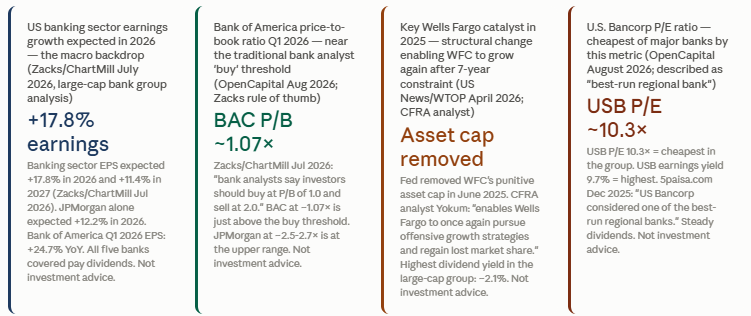
US banking sector: earnings expected to rise 17.8% in 2026 and 11.4% in 2027 (Zacks/ChartMill July 2026). JPMorgan 1-year performance: +20.98% (Boerse Stuttgart Aug 2026). Bank of America Q1 2026: EPS +24.7%; net income +16.6%; revenue +7.2% YoY. All five large-cap banks covered in this article pay dividends (Zacks July 2026).
Beyond P/B, the key metrics include: return on equity (ROE) — how effectively the bank converts shareholders’ capital into profit; net interest margin (NIM) — the spread between what the bank earns on loans and pays on deposits; loan loss provision trends — a leading indicator of credit quality; and dividend coverage — whether earnings support the dividend at current levels and under stress scenarios. MarketBeat consistently identifies interest rates, loan quality, economic conditions, and financial regulations as the four primary variables that drive bank-stock performance (multiple 2026 watchlist citations). Understanding these four variables for each bank in your portfolio is the foundation of managing bank stock exposure responsibly.
The risks are real. Bank performance is directly tied to interest rates, credit quality, and regulatory conditions — all three of which can shift. A recession, a credit cycle turn, or an unexpected tightening of capital requirements can rapidly reprice bank stocks. MarketBeat’s standard caveat across all its bank stock watchlists captures it precisely: ‘bank-stock performance can be influenced by interest rates, loan quality, economic conditions, and financial regulations.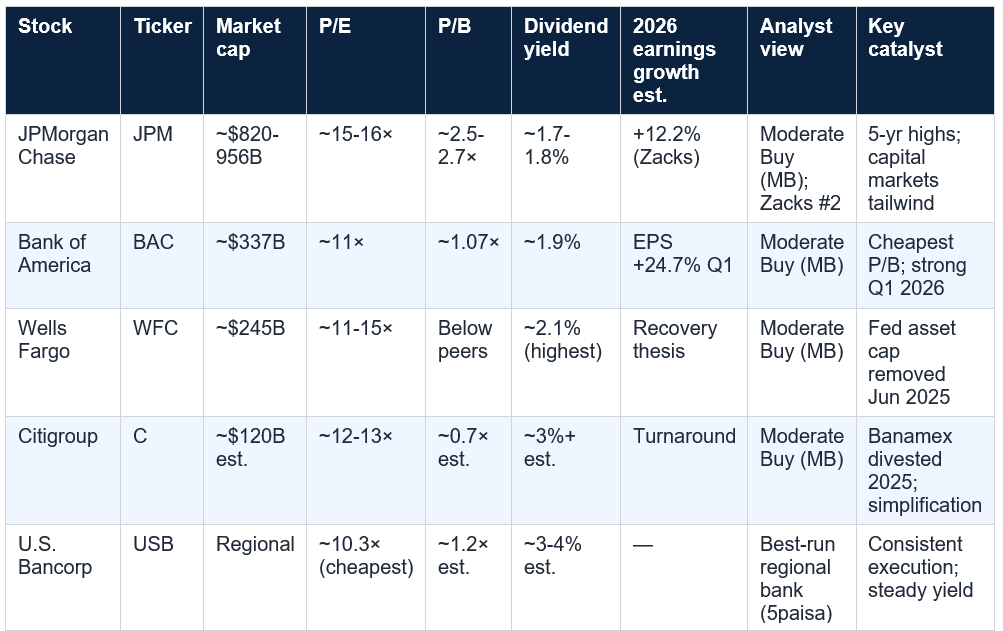
Ticker: JPM | NYSE | Market cap: ~$820-956B (2026) | P/E: ~15-16× | Dividend yield: ~1.68-1.80% | 1-year performance: +20.98% | 2026 earnings growth est: +12.2% (Zacks) | Analyst consensus: Moderate Buy. Sources: Boerse Stuttgart Aug 2026; US News/WTOP Apr 2026; Zacks/ChartMill Jul 2026.
Largest US bank by assets; unmatched revenue diversification; 12.2% earnings growth expected 2026; hitting five-year highs; Trump admin policy tailwinds for capital markets; Zacks Rank #2 Buy; CFRA 'another year of strong results.' Sources: Zacks/ChartMill Jul 2026; CFRA/US News Apr 2026.
Premium valuation (P/B ~2.5-2.7) — Zacks/ChartMill note analysts say 'buy at P/B 1.0, sell at 2.0.' Large, complex institution is harder to analyse for retail investors. CEO Jamie Dimon succession question is a long-term concern.
Key metric to watch: P/B ratio (price-to-book): currently ~2.5-2.7×. Zacks/ChartMill July 2026 note that bank analysts traditionally 'buy at P/B 1.0 and sell at 2.0.' JPMorgan trades at a premium to book, reflecting quality but limiting the upside from a value perspective.
Ticker: BAC | NYSE | Market cap: ~$337B (2026) | P/E: ~11× (Q1 2026) | P/B: ~1.07 | Dividend yield: ~1.9% | Q1 2026 EPS growth: +24.7% | Revenue Q1 2026: $30.3B (+7.2% YoY) | Earnings yield: 9.1%. Sources: OpenCapital (SEC 10-Q May 2026); US News/WTOP Apr 2026; Zacks Jul 2026. Not investment advice.
Cheapest large-cap bank by P/B at ~1.07× (near the traditional 'buy' level); earnings growing strongly (EPS +24.7% Q1 2026); CFRA 'well diversified, no credit problems'; consumer spending tailwind; consistently among highest-volume bank stocks.
Historically more sensitive to interest rate environments than JPMorgan. Large retail banking exposure. P/E has been compressed for years despite earnings growth. Long history of legacy legal liabilities. Not investment advice.
Key metric to watch: Price-to-book ratio: ~1.07× (OpenCapital Aug 2026) — the closest to the traditional 'buy at P/B 1.0' rule of thumb of any large-cap bank in this group. Zacks/ChartMill: 'bank analysts say buy at P/B of 1.0 and sell at 2.0.' BAC is near the buy threshold.
Ticker: WFC | NYSE | Market cap: ~$245B (2026) | P/E: ~11-15× | Dividend yield: ~2.1% (highest in large-cap group) | Revenue: $73.79B | Key catalyst: Fed removed asset cap Jun 2025. Sources: US News/WTOP Apr 2026; Zacks/ChartMill Jul 2026; OpenCapital Aug 2026.
Asset cap removed Jun 2025 — growth constraints lifted after 7 years; CFRA 'can now pursue offensive growth strategies and regain market share'; highest dividend yield in large-cap group (2.1%); cheaper valuation vs JPMorgan; potential multi-year earnings recovery.
Reputational damage from 2016 scandal is not fully resolved. The asset cap removal does not automatically mean trust is fully restored with regulators or customers. Trading lower YTD in 2026 at some data points — the market is not yet fully pricing in the recovery thesis. .
Key metric to watch: Dividend yield: 2.1% (Zacks July 2026) — highest in the large-cap bank group. Wells Fargo's dividend reflects both its commitment to returning capital to shareholders and its relatively depressed share price, which makes the yield appear higher. For income-focused investors, WFC offers the best yield among the megabanks.
Ticker: C | NYSE | P/E: ~12-13× (peer comparison) | Strategy: turnaround/simplification | Key 2025 event: Banamex Mexico consumer bank divested | International exposure: Asia, Latin America, Europe | Dividend: yes. Sources: US News/WTOP Apr 2026; 5paisa.com Dec 2025; MarketBeat 2026.
Turnaround executing — Banamex divestiture complete (2025); CFRA 'executed turnaround effectively'; meaningful discount to peers; genuine international diversification in Asia/LatAm/Europe; consistently high institutional trading interest.
Complex global operations; turnaround has been promised before; regulatory complexity of operating in many jurisdictions; historically lower returns on equity than JPMorgan or Bank of America.
Key metric to watch: Discount to book vs peers: Citigroup has historically traded at or below book value, reflecting market scepticism about the turnaround. As the turnaround narrative becomes performance-backed, a re-rating toward book value (1.0×+) is a key element of the bull thesis.
Ticker: USB | NYSE | P/E: ~10.3× (OpenCapital Aug 2026, lowest in peer group) | Earnings yield: 9.7% (OpenCapital Aug 2026) | Description: 'one of the best-run regional banks' (5paisa.com Dec 2025) | Steady dividends. Sources: OpenCapital Aug 2026; 5paisa.com Dec 2025; Zacks.
Cheapest by P/E at 10.3× among the major banks; 9.7% earnings yield; consistently described as well-run; steady dividends; operational efficiency advantage vs megabanks; less regulatory complexity than global banks.
Smaller scale limits fee diversification vs JPMorgan or Bank of America. More exposed to regional economic conditions. Less international growth potential. Less dramatic catalyst to drive near-term re-rating.
Key metric to watch: P/E of 10.3× (OpenCapital Aug 2026) — cheapest of the five major banks on this metric. 9.7% earnings yield means USB generates $9.70 in annual earnings for every $100 of market cap, compared to JPMorgan's 7.4%.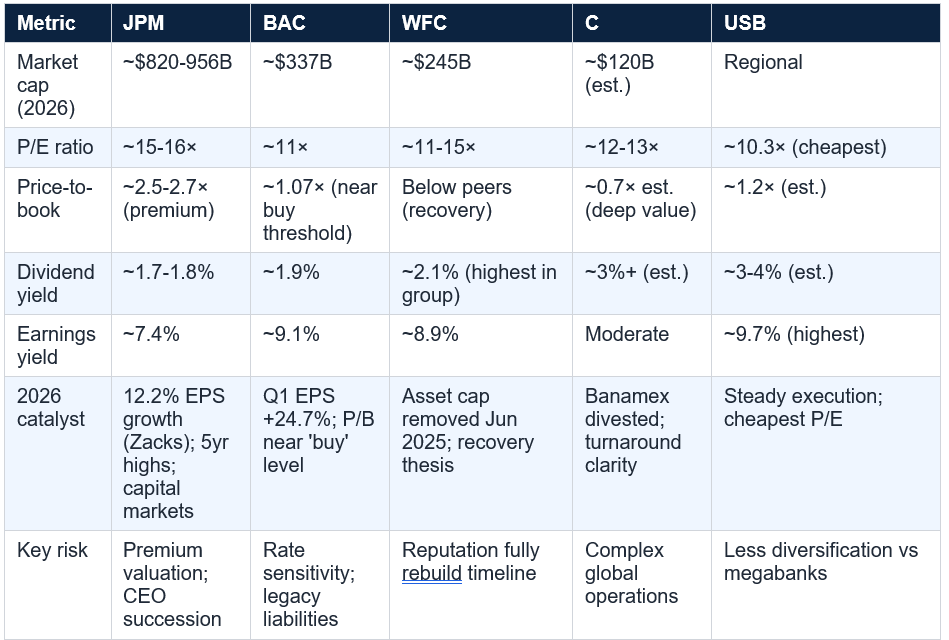
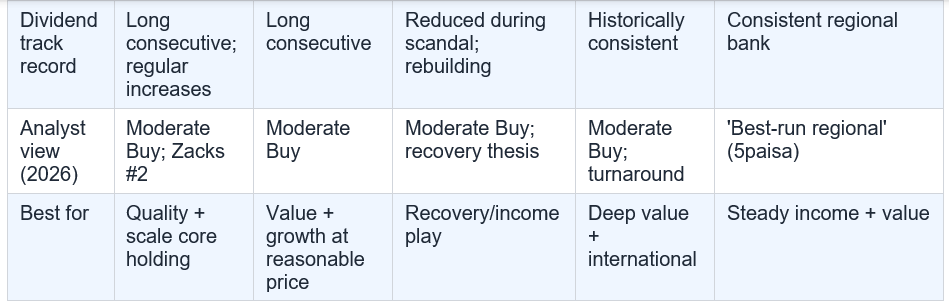
The Zacks/ChartMill July 2026 note on P/B is a useful portfolio management framework: ‘bank analysts say investors should buy at a P/B of 1.0 and sell at 2.0.’ At the time of writing, Bank of America sits at ~1.07× book (OpenCapital Aug 2026) and Citigroup is estimated below 1.0×. JPMorgan at ~2.5-2.7× book is at the upper end of the traditional range. Portfolio sizing should reflect these valuation positions: the stocks nearest to the ‘buy’ zone by P/B deserve more consideration for new money; the stock at the upper valuation range may be better held than added to aggressively.
For long-term investors, the bank sector has historically rewarded those who built positions at reasonable valuations, held through economic cycles, collected dividends, and allowed the compounding to work. The five stocks in this guide — JPM, BAC, WFC, C, USB — represent different points on the quality/value/recovery spectrum, giving investors a range of entry points and risk profiles from which to construct a financial sector allocation. Not financial or investment advice. Always conduct your own research. Consult a qualified, regulated financial adviser before investing.
They represent different investment propositions. JPMorgan is the quality premium: a P/E of ~15-16×, a P/B of ~2.5-2.7×, 12.2% expected earnings growth in 2026 (Zacks), and a track record of consistent outperformance under Jamie Dimon. Bank of America is the value case: a P/E of ~11×, a P/B of ~1.07 (near the traditional 'buy at P/B 1.0' level), and Q1 2026 EPS growing 24.7%. CFRA analyst Kenneth Leon noted both positively in April 2026, saying Bank of America 'has no credit problems' and that 'consumer spending supports credit card income,' while anticipating 'another year of strong results' for JPMorgan. Many investors hold both: JPMorgan as the quality core anchor and Bank of America as the value complement.
Why is Wells Fargo's stock interesting in 2026?
The Federal Reserve removed Wells Fargo's punitive asset cap in June 2025 — the cap had been in place since 2018 following the fake accounts scandal and had constrained the bank's ability to grow loans, deposits, or total assets above a certain threshold for seven years. CFRA analyst Alexander Yokum told US News in April 2026 that the removal 'will enable Wells Fargo to once again pursue offensive growth strategies and regain lost market share.' This structural change unlocks multi-year earnings recovery potential that the bank could not pursue while capped. Additionally, Wells Fargo offers the highest dividend yield in the large-cap bank group at approximately 2.1% (Zacks July 2026), making it the most income-friendly of the three megabanks. The risk is that the trust and reputation rebuilding is not yet complete, and the asset cap removal does not guarantee the market will re-rate the stock quickly.
What metrics should I use to evaluate bank stocks?
The most important bank-specific metrics are: (1) Price-to-book (P/B) — Zacks/ChartMill July 2026 notes that bank analysts 'buy at P/B 1.0 and sell at 2.0.' Currently, Bank of America at ~1.07× is near the traditional buy threshold; JPMorgan at ~2.5-2.7× is at the upper range. (2) P/E ratio — US Bancorp at ~10.3× is the cheapest; JPMorgan at ~15-16× is the most expensive among the five. (3) Earnings yield (the inverse of P/E) — USB leads at 9.7%; JPMorgan at 7.4% (OpenCapital Aug 2026). (4) Return on equity — how efficiently the bank converts capital into profit. (5) Dividend yield — Wells Fargo's 2.1% leads the megabanks. (6) Loan loss provisions — rising provisions signal deteriorating credit quality. MarketBeat's consistent framing: 'bank performance is influenced by interest rates, loan quality, economic conditions, and financial regulations.
Are bank stocks good for dividends?
Yes — all five large-cap banks covered in this article pay dividends (Zacks July 2026). Dividend yields as of 2026: Wells Fargo ~2.1% (highest among megabanks, Zacks July 2026); Bank of America ~1.9%; JPMorgan ~1.7-1.8%; Citigroup ~3%+ (estimated); US Bancorp ~3-4% (estimated). The 5paisa.com December 2025 analysis specifically noted that 'US Bancorp and Truist offer steady dividends' as a key characteristic. Bank dividends have been generally growing: JPMorgan's dividend grew 17.01% in 2025 and 15.86% the year before that (Boerse Stuttgart historical data). The risk factor for dividends: bank dividends can be cut during severe recessions or credit crises — JPMorgan cut its dividend during the 2008 financial crisis as did most major banks. Not investment advice. Dividends are not guaranteed.
How do interest rates affect bank stocks?
Interest rates affect bank stocks through multiple channels, and the relationship is nuanced. Higher interest rates generally benefit bank net interest margins (NIMs) — the spread between what banks earn on loans and pay on deposits. When rates rise, banks can charge more on new loans while deposit rates typically adjust more slowly, expanding the spread and boosting net interest income. This was a major tailwind for US banks in 2022-2024. However, very high rates can also slow loan demand, increase credit losses as borrowers struggle with higher payments, and reduce investment banking and capital markets activity by slowing deal flow. Very low rates compress NIMs, reducing the bank's fundamental earnings power on its core lending business. MarketBeat's consistent bank stock framework (multiple 2026 citations) identifies interest rates as the first of the four key variables: 'bank-stock performance can be affected by interest rates, loan quality, economic conditions, and financial regulations.
Bank stocks are one of the oldest and most debated categories in equity investing. They are the engine of the economy — when banks do well, it usually means the economy is doing well. When banks struggle, the trouble ripples outward. For investors who want exposure to the financial sector’s earnings power, dividend income, and long-run compounding, bank stocks have historically delivered. In 2026, the setup is broadly constructive: Zacks’ July 2026 data shows US banking sector earnings expected to rise 17.8% in 2026 and another 11.4% in 2027. JPMorgan Chase is hitting five-year highs. Bank of America’s Q1 2026 EPS grew 24.7%. Wells Fargo’s asset cap — the regulatory punishment that held it back for seven years — was removed in June 2025. And CFRA’s analysts have flagged supportive policy conditions for capital market activity. This guide covers five of the best bank stocks to consider for your portfolio in 2026: what each one does, the key metrics, the bull case, the bear case, and the context you need to evaluate them honestly.
Table of Contents
- Why Bank Stocks Belong in a Long-Term Portfolio
- How to Evaluate Bank Stocks: The Metrics That Matter
- The 2026 Banking Sector Outlook
- Five Best Bank Stocks at a Glance
- JPM: JPMorgan Chase & Co.
- BAC: Bank of America Corp.
- WFC: Wells Fargo & Co.
- C: Citigroup Inc.
- USB: U.S. Bancorp
- Bank Stock Comparison Table
- Building a Bank Stock Portfolio Position
- Conclusion: Bank Stocks and the Long Game
- Frequently Asked Questions
Why Bank Stocks Belong in a Long-Term Portfolio
Bank stocks sit at the intersection of income and growth in a way that few other sector allocations can replicate. The largest US banks pay dividends consistently, repurchase shares regularly, and have earnings streams that grow alongside the broader economy. When the economy grows, loan volumes rise, transaction volumes increase, and fee income from investment banking, wealth management, and capital markets expands. Banks earn money on the spread between what they pay depositors and what they charge borrowers — a spread that, in the current interest rate environment, has been more supportive than the near-zero rate era that preceded it. For long-term investors, bank stocks have historically delivered a combination of dividend income, buyback-driven per-share earnings growth, and capital appreciation that compounds meaningfully over time. The key risk is cyclicality: banks suffer disproportionately in recessions, credit crises, and financial stress events. But for investors with a time horizon measured in years rather than months, the risk-reward profile of well-selected bank stocks has historically been favourable.US banking sector: earnings expected to rise 17.8% in 2026 and 11.4% in 2027 (Zacks/ChartMill July 2026). JPMorgan 1-year performance: +20.98% (Boerse Stuttgart Aug 2026). Bank of America Q1 2026: EPS +24.7%; net income +16.6%; revenue +7.2% YoY. All five large-cap banks covered in this article pay dividends (Zacks July 2026).
How to Evaluate Bank Stocks: The Metrics That Matter
Bank stocks require a different analytical lens from industrial, technology, or consumer companies. The standard price-to-earnings ratio matters, but for banks, the price-to-book (P/B) ratio carries particular weight — because a bank’s book value is a meaningful proxy for the underlying worth of its balance sheet. Zacks’ July 2026 analysis articulated the rule of thumb most professional bank analysts use: ‘Bank analysts say investors should buy at a P/B of 1.0 and sell at 2.0.’ At 1.0× book value, you are paying exactly what the bank’s net assets are worth. At 2.0×, you are paying a significant premium that prices in future earnings growth, return on equity, and competitive moats.Beyond P/B, the key metrics include: return on equity (ROE) — how effectively the bank converts shareholders’ capital into profit; net interest margin (NIM) — the spread between what the bank earns on loans and pays on deposits; loan loss provision trends — a leading indicator of credit quality; and dividend coverage — whether earnings support the dividend at current levels and under stress scenarios. MarketBeat consistently identifies interest rates, loan quality, economic conditions, and financial regulations as the four primary variables that drive bank-stock performance (multiple 2026 watchlist citations). Understanding these four variables for each bank in your portfolio is the foundation of managing bank stock exposure responsibly.
The 2026 Banking Sector Outlook
The 2026 banking sector backdrop is constructive but not without complexity. Zacks’ July 2026 analysis identified US banking sector earnings expected to rise 17.8% in 2026 and another 11.4% in 2027 — a two-year earnings growth trajectory that, if realised, would provide substantial support for bank stock valuations and dividend growth. CFRA analyst Kenneth Leon, covering JPMorgan Chase for US News in April 2026, pointed to supportive Trump administration policies for capital market activity as a specific 2026 tailwind, anticipating strong investment banking results from deal flow and capital markets activity. Bank of America’s Q1 2026 results confirmed the sector momentum: revenue of $30.3 billion grew 7.2% year-over-year, net income of $8.6 billion grew 16.6%, and diluted EPS grew 24.7% (data from SEC 10-Q filing, OpenCapital). JPMorgan hit new five-year highs. The MarketBeat bank stock watchlist consistently featured JPMorgan, Bank of America, Wells Fargo, Citigroup, and US Bancorp as the highest-dollar-trading-volume bank stocks throughout mid-2026.The risks are real. Bank performance is directly tied to interest rates, credit quality, and regulatory conditions — all three of which can shift. A recession, a credit cycle turn, or an unexpected tightening of capital requirements can rapidly reprice bank stocks. MarketBeat’s standard caveat across all its bank stock watchlists captures it precisely: ‘bank-stock performance can be influenced by interest rates, loan quality, economic conditions, and financial regulations.
Five Best Bank Stocks at a Glance
JPM: JPMorgan Chase & Co.
JPMorgan Chase is the largest bank in the United States by assets and has a strong claim to being the most strategically formidable financial institution in the world. Under CEO Jamie Dimon’s long leadership, JPMorgan has built a diversified revenue engine that spans retail banking, commercial banking, investment banking, asset management, and treasury services — giving it earnings resilience that smaller or less diversified banks cannot match. When investment banking softens, consumer banking compensates. When net interest margins compress, fee income from wealth management and capital markets picks up the slack. CFRA analyst Kenneth Leon told US News in April 2026 that JPMorgan’s outlook for the remainder of 2026 is closely tied to the US economy, and that supportive Trump administration policies will encourage capital market activity. Leon anticipated another year of strong results in 2026. Zacks’ July 2026 analysis confirmed the momentum: JPMorgan is expected to grow earnings by 12.2% in 2026 and another 4.9% in 2027, and was hitting new five-year highs in 2026. The stock carries a Zacks Rank #2 (Buy). With a P/E of approximately 15-16× and a market cap approaching $1 trillion, JPMorgan is not the cheapest bank in the group. But for investors who want the combination of scale, diversification, brand strength, and management quality in a single bank holding, JPMorgan remains the benchmark against which all other bank stocks are measured.Ticker: JPM | NYSE | Market cap: ~$820-956B (2026) | P/E: ~15-16× | Dividend yield: ~1.68-1.80% | 1-year performance: +20.98% | 2026 earnings growth est: +12.2% (Zacks) | Analyst consensus: Moderate Buy. Sources: Boerse Stuttgart Aug 2026; US News/WTOP Apr 2026; Zacks/ChartMill Jul 2026.
Largest US bank by assets; unmatched revenue diversification; 12.2% earnings growth expected 2026; hitting five-year highs; Trump admin policy tailwinds for capital markets; Zacks Rank #2 Buy; CFRA 'another year of strong results.' Sources: Zacks/ChartMill Jul 2026; CFRA/US News Apr 2026.
Premium valuation (P/B ~2.5-2.7) — Zacks/ChartMill note analysts say 'buy at P/B 1.0, sell at 2.0.' Large, complex institution is harder to analyse for retail investors. CEO Jamie Dimon succession question is a long-term concern.
Key metric to watch: P/B ratio (price-to-book): currently ~2.5-2.7×. Zacks/ChartMill July 2026 note that bank analysts traditionally 'buy at P/B 1.0 and sell at 2.0.' JPMorgan trades at a premium to book, reflecting quality but limiting the upside from a value perspective.
BAC: Bank of America Corp.
Bank of America is the bank that Warren Buffett’s Berkshire Hathaway chose to hold as its largest bank position — a signal that carries weight. At a P/E of approximately 11× (OpenCapital, Q1 2026) and a price-to-book of 1.07 (OpenCapital Aug 2026), Bank of America is significantly cheaper than JPMorgan on multiple valuation measures. Whether that discount is opportunity or value trap has been the debate for years. The Q1 2026 results suggest opportunity: revenue of $30.3 billion grew 7.2% year-over-year, net income of $8.6 billion grew 16.6%, and diluted EPS of $1.11 grew 24.7% (OpenCapital, data from SEC 10-Q filed May 1, 2026). CFRA analyst Kenneth Leon told US News in April 2026 that Bank of America is well diversified, has no credit problems, and that consumer spending trends support its credit card income. The bank’s earnings yield was 9.1% in Q1 2026 (OpenCapital), up 4.4% year-over-year from 8.7% — meaning the bank is generating more profit per dollar of market price than it was a year ago. At a dividend yield of approximately 1.9% (Zacks, July 2026) and with MarketBeat consistently listing it among the highest dollar-volume bank stocks to watch in 2026, Bank of America represents the large-cap bank value case in a way that JPMorgan, at its premium valuation, does not.Ticker: BAC | NYSE | Market cap: ~$337B (2026) | P/E: ~11× (Q1 2026) | P/B: ~1.07 | Dividend yield: ~1.9% | Q1 2026 EPS growth: +24.7% | Revenue Q1 2026: $30.3B (+7.2% YoY) | Earnings yield: 9.1%. Sources: OpenCapital (SEC 10-Q May 2026); US News/WTOP Apr 2026; Zacks Jul 2026. Not investment advice.
Cheapest large-cap bank by P/B at ~1.07× (near the traditional 'buy' level); earnings growing strongly (EPS +24.7% Q1 2026); CFRA 'well diversified, no credit problems'; consumer spending tailwind; consistently among highest-volume bank stocks.
Historically more sensitive to interest rate environments than JPMorgan. Large retail banking exposure. P/E has been compressed for years despite earnings growth. Long history of legacy legal liabilities. Not investment advice.
Key metric to watch: Price-to-book ratio: ~1.07× (OpenCapital Aug 2026) — the closest to the traditional 'buy at P/B 1.0' rule of thumb of any large-cap bank in this group. Zacks/ChartMill: 'bank analysts say buy at P/B of 1.0 and sell at 2.0.' BAC is near the buy threshold.
WFC: Wells Fargo & Co.
Wells Fargo is the bank recovery story of 2025-2026. The Federal Reserve’s removal of Wells Fargo’s punitive asset cap in June 2025 was a structural shift that unlocked the bank’s ability to grow again for the first time since the fake accounts scandal landed the cap in 2018. CFRA analyst Alexander Yokum told US News in April 2026 that the asset cap removal ‘will enable Wells Fargo to once again pursue offensive growth strategies and regain lost market share.’ For seven years, the asset cap artificially constrained Wells Fargo’s balance sheet, prevented it from growing loans or deposits above a certain threshold, and prevented the bank from competing at full strength. The removal of that constraint is the fundamental investment thesis: Wells Fargo is a large, well-established bank with a strong franchise that was operating at a self-imposed handicap. With the handicap removed, the argument is that Wells Fargo’s earnings trajectory over the next several years should improve as the growth constraints lift. On valuation, Wells Fargo is the most attractively priced of the three megabanks. It trades at a P/E of approximately 11× (OpenCapital) and offers the highest dividend yield in the large-cap group at 2.1% (Zacks, July 2026).Ticker: WFC | NYSE | Market cap: ~$245B (2026) | P/E: ~11-15× | Dividend yield: ~2.1% (highest in large-cap group) | Revenue: $73.79B | Key catalyst: Fed removed asset cap Jun 2025. Sources: US News/WTOP Apr 2026; Zacks/ChartMill Jul 2026; OpenCapital Aug 2026.
Asset cap removed Jun 2025 — growth constraints lifted after 7 years; CFRA 'can now pursue offensive growth strategies and regain market share'; highest dividend yield in large-cap group (2.1%); cheaper valuation vs JPMorgan; potential multi-year earnings recovery.
Reputational damage from 2016 scandal is not fully resolved. The asset cap removal does not automatically mean trust is fully restored with regulators or customers. Trading lower YTD in 2026 at some data points — the market is not yet fully pricing in the recovery thesis. .
Key metric to watch: Dividend yield: 2.1% (Zacks July 2026) — highest in the large-cap bank group. Wells Fargo's dividend reflects both its commitment to returning capital to shareholders and its relatively depressed share price, which makes the yield appear higher. For income-focused investors, WFC offers the best yield among the megabanks.
C: Citigroup Inc.
Citigroup is the turnaround story that actually appears to be turning. CFRA analyst Kenneth Leon told US News in April 2026 that Citigroup has executed its turnaround strategy effectively, including divesting its Mexican consumer bank in 2025 to streamline operations. For years, Citigroup’s restructuring narrative was a promise rather than a performance. The divestiture of the Mexican business — Banamex, one of the most complex corporate disposals in recent banking history — removes a distraction and simplifies what was an unwieldy global footprint. Citigroup consistently appears at the top of MarketBeat’s highest-dollar-trading-volume bank stock watchlists throughout 2026, which reflects institutional interest in the bank as the turnaround thesis develops. The 5paisa.com December 2025 analysis noted Citigroup has strong operations in Asia, Latin America, and Europe — making it the most internationally diversified of the major US banks. Where JPMorgan and Bank of America are predominantly US-centric in their earnings, Citigroup has genuine global reach. This international diversification is both a complexity risk and a growth opportunity as emerging markets develop. The bank pays a dividend and is generally priced at a meaningful discount to JPMorgan.Ticker: C | NYSE | P/E: ~12-13× (peer comparison) | Strategy: turnaround/simplification | Key 2025 event: Banamex Mexico consumer bank divested | International exposure: Asia, Latin America, Europe | Dividend: yes. Sources: US News/WTOP Apr 2026; 5paisa.com Dec 2025; MarketBeat 2026.
Turnaround executing — Banamex divestiture complete (2025); CFRA 'executed turnaround effectively'; meaningful discount to peers; genuine international diversification in Asia/LatAm/Europe; consistently high institutional trading interest.
Complex global operations; turnaround has been promised before; regulatory complexity of operating in many jurisdictions; historically lower returns on equity than JPMorgan or Bank of America.
Key metric to watch: Discount to book vs peers: Citigroup has historically traded at or below book value, reflecting market scepticism about the turnaround. As the turnaround narrative becomes performance-backed, a re-rating toward book value (1.0×+) is a key element of the bull thesis.
USB: U.S. Bancorp
U.S. Bancorp is the bank that tends to appear at the end of every ‘best bank stocks’ list and gets overlooked precisely because it is less dramatic than JPMorgan, has no scandal recovery story like Wells Fargo, and is not a global turnaround like Citigroup. But the 5paisa.com December 2025 analysis has a clear verdict: US Bancorp is considered ‘one of the best-run regional banks.’ OpenCapital’s August 2026 data puts USB’s P/E at 10.3× and its earnings yield at 9.7% — the second-highest earnings yield in the peer group (behind only the comparable 9.7% for Truist). At 10.3× earnings, USB is the cheapest of the major banks by P/E. The 5paisa.com analysis specifically noted that US Bancorp and Truist offer steady dividends — a characteristic valued by income investors who want bank exposure without the volatility of the larger, more complex institutions. US Bancorp’s operating efficiency has historically ranked it among the best in the regional bank category. For investors who want the steady dividends and consistent execution of a well-run regional bank rather than the headline-driven dynamics of the megabanks, USB makes a compelling quiet inclusion to a diversified financial sector position. .Ticker: USB | NYSE | P/E: ~10.3× (OpenCapital Aug 2026, lowest in peer group) | Earnings yield: 9.7% (OpenCapital Aug 2026) | Description: 'one of the best-run regional banks' (5paisa.com Dec 2025) | Steady dividends. Sources: OpenCapital Aug 2026; 5paisa.com Dec 2025; Zacks.
Cheapest by P/E at 10.3× among the major banks; 9.7% earnings yield; consistently described as well-run; steady dividends; operational efficiency advantage vs megabanks; less regulatory complexity than global banks.
Smaller scale limits fee diversification vs JPMorgan or Bank of America. More exposed to regional economic conditions. Less international growth potential. Less dramatic catalyst to drive near-term re-rating.
Key metric to watch: P/E of 10.3× (OpenCapital Aug 2026) — cheapest of the five major banks on this metric. 9.7% earnings yield means USB generates $9.70 in annual earnings for every $100 of market cap, compared to JPMorgan's 7.4%.
Bank Stock Comparison Table
Building a Bank Stock Portfolio Position
The five bank stocks in this guide are not necessarily competing choices — they can work as complementary positions in a financial sector allocation. A simple framework: JPMorgan as the quality anchor for investors who want scale, diversification, and management depth at a premium valuation; Bank of America as the value complement for investors who want the near-book-value entry point and the Q1 2026 earnings momentum; Wells Fargo as the recovery play for investors who believe the asset cap removal thesis translates into multi-year earnings improvement and appreciate the highest dividend yield in the group; Citigroup as the international diversifier and deep-value position for investors comfortable with turnaround risk; and US Bancorp as the steady-income, best-run-regional addition for investors who want consistent execution and attractive yield without the complexity of the megabanks.The Zacks/ChartMill July 2026 note on P/B is a useful portfolio management framework: ‘bank analysts say investors should buy at a P/B of 1.0 and sell at 2.0.’ At the time of writing, Bank of America sits at ~1.07× book (OpenCapital Aug 2026) and Citigroup is estimated below 1.0×. JPMorgan at ~2.5-2.7× book is at the upper end of the traditional range. Portfolio sizing should reflect these valuation positions: the stocks nearest to the ‘buy’ zone by P/B deserve more consideration for new money; the stock at the upper valuation range may be better held than added to aggressively.
Conclusion
The US banking sector enters the second half of 2026 with earnings momentum, a constructive regulatory environment, and fundamental catalysts at the individual stock level: the Wells Fargo asset cap removal, the Bank of America earnings re-rating, the Citigroup turnaround completion, and JPMorgan’s continued capital markets strength. Zacks’ sector-level projection of 17.8% earnings growth in 2026 and 11.4% in 2027 is the macro backdrop against which each individual stock thesis plays out.For long-term investors, the bank sector has historically rewarded those who built positions at reasonable valuations, held through economic cycles, collected dividends, and allowed the compounding to work. The five stocks in this guide — JPM, BAC, WFC, C, USB — represent different points on the quality/value/recovery spectrum, giving investors a range of entry points and risk profiles from which to construct a financial sector allocation. Not financial or investment advice. Always conduct your own research. Consult a qualified, regulated financial adviser before investing.
Frequently Asked Questions
Which is better: JPMorgan Chase or Bank of America stock in 2026?They represent different investment propositions. JPMorgan is the quality premium: a P/E of ~15-16×, a P/B of ~2.5-2.7×, 12.2% expected earnings growth in 2026 (Zacks), and a track record of consistent outperformance under Jamie Dimon. Bank of America is the value case: a P/E of ~11×, a P/B of ~1.07 (near the traditional 'buy at P/B 1.0' level), and Q1 2026 EPS growing 24.7%. CFRA analyst Kenneth Leon noted both positively in April 2026, saying Bank of America 'has no credit problems' and that 'consumer spending supports credit card income,' while anticipating 'another year of strong results' for JPMorgan. Many investors hold both: JPMorgan as the quality core anchor and Bank of America as the value complement.
Why is Wells Fargo's stock interesting in 2026?
The Federal Reserve removed Wells Fargo's punitive asset cap in June 2025 — the cap had been in place since 2018 following the fake accounts scandal and had constrained the bank's ability to grow loans, deposits, or total assets above a certain threshold for seven years. CFRA analyst Alexander Yokum told US News in April 2026 that the removal 'will enable Wells Fargo to once again pursue offensive growth strategies and regain lost market share.' This structural change unlocks multi-year earnings recovery potential that the bank could not pursue while capped. Additionally, Wells Fargo offers the highest dividend yield in the large-cap bank group at approximately 2.1% (Zacks July 2026), making it the most income-friendly of the three megabanks. The risk is that the trust and reputation rebuilding is not yet complete, and the asset cap removal does not guarantee the market will re-rate the stock quickly.
What metrics should I use to evaluate bank stocks?
The most important bank-specific metrics are: (1) Price-to-book (P/B) — Zacks/ChartMill July 2026 notes that bank analysts 'buy at P/B 1.0 and sell at 2.0.' Currently, Bank of America at ~1.07× is near the traditional buy threshold; JPMorgan at ~2.5-2.7× is at the upper range. (2) P/E ratio — US Bancorp at ~10.3× is the cheapest; JPMorgan at ~15-16× is the most expensive among the five. (3) Earnings yield (the inverse of P/E) — USB leads at 9.7%; JPMorgan at 7.4% (OpenCapital Aug 2026). (4) Return on equity — how efficiently the bank converts capital into profit. (5) Dividend yield — Wells Fargo's 2.1% leads the megabanks. (6) Loan loss provisions — rising provisions signal deteriorating credit quality. MarketBeat's consistent framing: 'bank performance is influenced by interest rates, loan quality, economic conditions, and financial regulations.
Are bank stocks good for dividends?
Yes — all five large-cap banks covered in this article pay dividends (Zacks July 2026). Dividend yields as of 2026: Wells Fargo ~2.1% (highest among megabanks, Zacks July 2026); Bank of America ~1.9%; JPMorgan ~1.7-1.8%; Citigroup ~3%+ (estimated); US Bancorp ~3-4% (estimated). The 5paisa.com December 2025 analysis specifically noted that 'US Bancorp and Truist offer steady dividends' as a key characteristic. Bank dividends have been generally growing: JPMorgan's dividend grew 17.01% in 2025 and 15.86% the year before that (Boerse Stuttgart historical data). The risk factor for dividends: bank dividends can be cut during severe recessions or credit crises — JPMorgan cut its dividend during the 2008 financial crisis as did most major banks. Not investment advice. Dividends are not guaranteed.
How do interest rates affect bank stocks?
Interest rates affect bank stocks through multiple channels, and the relationship is nuanced. Higher interest rates generally benefit bank net interest margins (NIMs) — the spread between what banks earn on loans and pay on deposits. When rates rise, banks can charge more on new loans while deposit rates typically adjust more slowly, expanding the spread and boosting net interest income. This was a major tailwind for US banks in 2022-2024. However, very high rates can also slow loan demand, increase credit losses as borrowers struggle with higher payments, and reduce investment banking and capital markets activity by slowing deal flow. Very low rates compress NIMs, reducing the bank's fundamental earnings power on its core lending business. MarketBeat's consistent bank stock framework (multiple 2026 citations) identifies interest rates as the first of the four key variables: 'bank-stock performance can be affected by interest rates, loan quality, economic conditions, and financial regulations.
0 Comments
Be the first to share your thoughts on this article.