

Investing
Best CD Rates September 2026: Up to 4.60% APY

The best CD rates in September 2026 reach up to 4.60% APY — more than 2.5 percentage points above the 1.71% national average. The Federal Reserve held rates at its July 29, 2026, meeting for the fifth consecutive time, and rate path uncertainty is now two-sided. This guide covers every rate, every term, every CD type, and exactly how to position your savings when the yield curve is flat and the Fed’s next move is genuinely unclear.

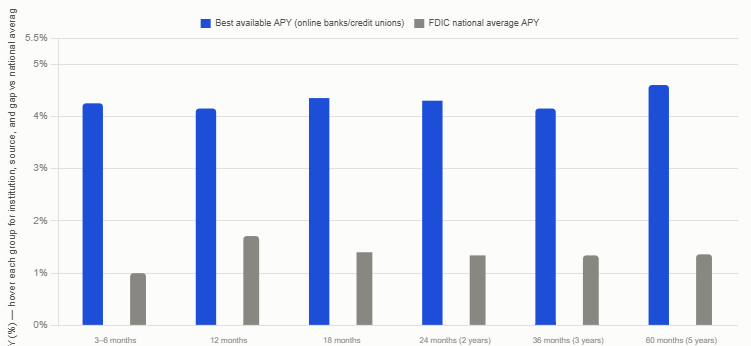
For CD savers, this creates a specific strategic environment. The yield curve on CDs is essentially flat in September 2026 — meaning similar rates are available across short and long terms, which is unusual. Top 6-month CDs, 12-month CDs, and 5-year CDs all pay in a relatively tight band from approximately 4.00% to 4.60% APY at the best institutions. This flatness means there is no automatic premium for locking in longer — and there is no penalty for staying short if you want optionality.
This guide covers the complete September 2026 CD landscape: the best rates by term, the best institutions, the mechanics of how CDs work, the five main CD types, the CD laddering strategy that most advisers recommend for this rate environment, and worked examples of what your money actually earns at the top available rates.
Best CD APY (September 2026): up to 4.60% (Raymond James Bank, 60-month, CDValet.com). National avg 12-month CD: 1.71% (FDIC, August 17, 2026). Fed funds rate: 3.50%–3.75% (held July 29, 2026; fifth consecutive hold). Top 12-month CDs: ~4.00%–4.35% APY (CNBC Select Aug 2026; NerdWallet Sep 2026). FOMC next meeting: September 15–16, 2026. Rate path: two-sided — hike or hold are both credible scenarios.
The key features that distinguish CDs from other savings products:
According to FDIC data as of August 17, 2026, published by US News Money (September 2026):
The national average CD rate is not the rate you should expect or accept. It reflects the average of thousands of institutions — including large traditional banks that have almost no incentive to compete aggressively for deposits because they already have enormous deposit bases. The best rates come from online-only banks and credit unions with lower overhead and higher deposit-gathering incentives. If your CD rate matches the national average, you are almost certainly underperforming what is available to you.
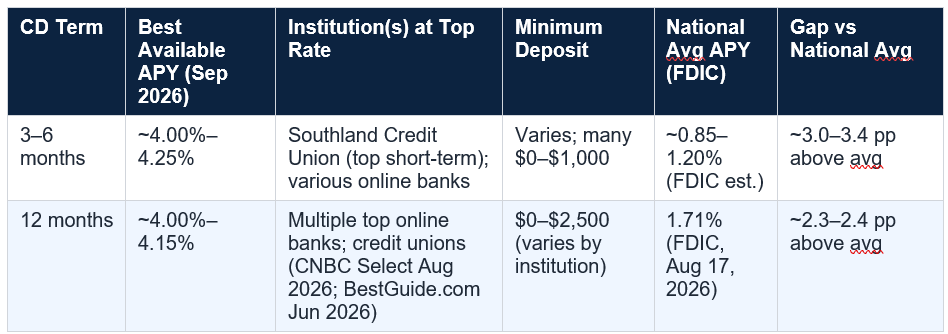
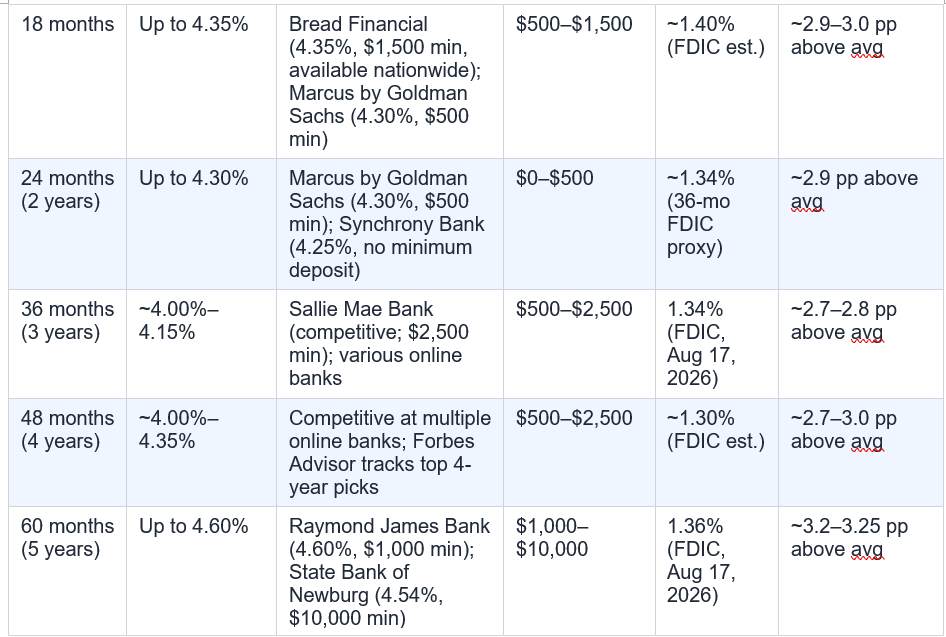
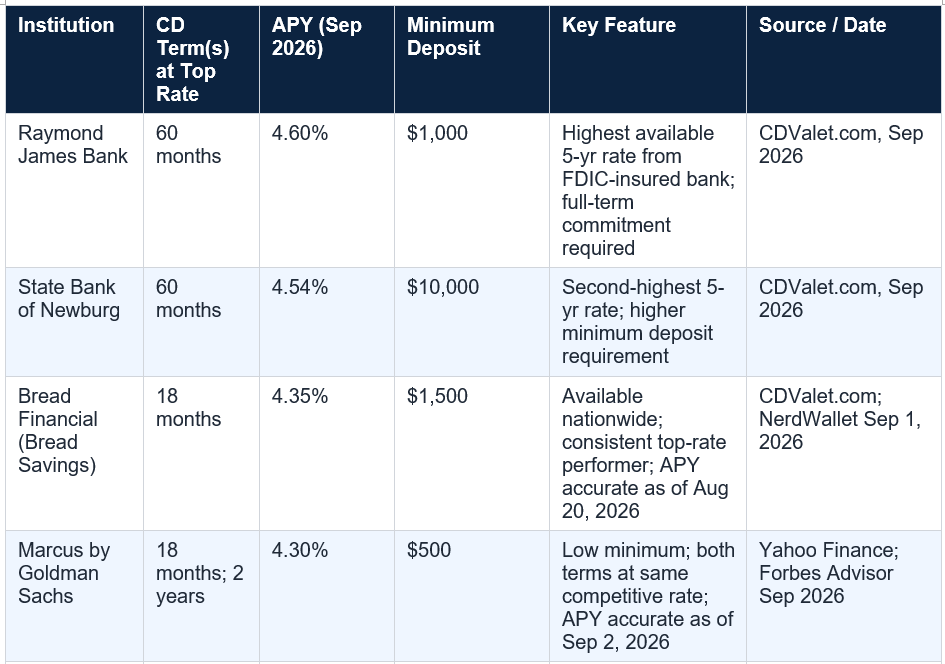
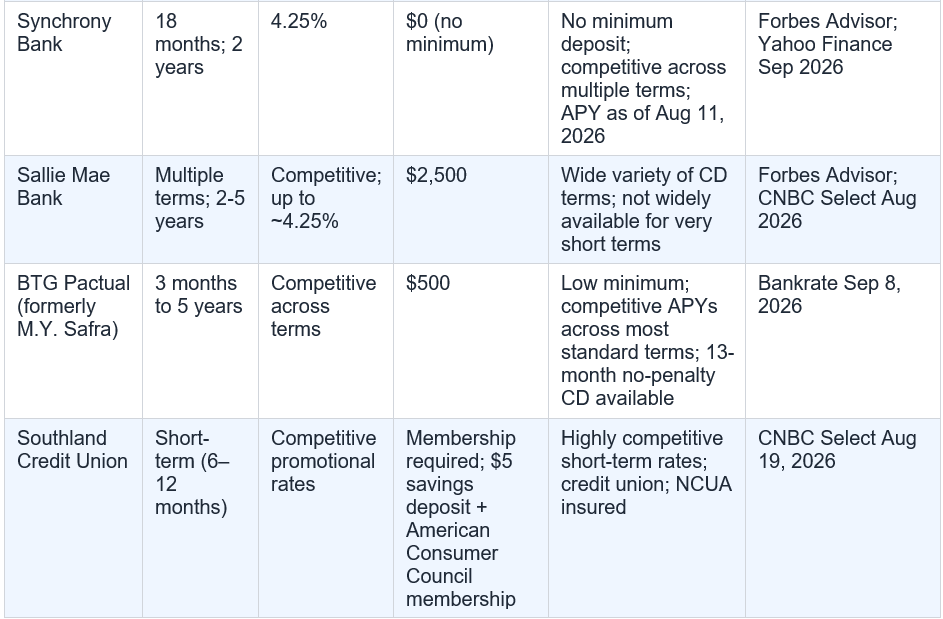

Rates change without notice. An institution offering 4.35% APY today may have adjusted its rate by the time you read this article. Always verify the current rate directly on the institution's website or by calling before opening a CD. The rates above are drawn from published comparisons in August–September 2026 but are not guaranteed to be current at the time you read this guide.
The rate history relevant to September 2026:
The key insight from the Fed's rate history: today's top CD rates (4.00%–4.60% APY) are already significantly below the 2023–2024 peak of 5.50%+, but still historically high relative to the pre-2022 environment. The average 12-month CD yield over the past five years was just 1.16% (Federal Reserve Bank of St. Louis; Bankrate). At 4.00%+ today, CDs are offering more than 3× the five-year average. Whether rates go higher or lower from here is genuinely uncertain — which is exactly what makes the CD ladder strategy so appropriate.
In September 2026, the CD ladder is particularly well-suited to the current environment for three reasons:
To build a CD ladder in September 2026: (1) decide your total allocation; (2) divide into 4–5 equal portions; (3) open CDs at the best available rate for each term — use different FDIC-insured institutions if your deposit exceeds $250,000 to maximise insurance coverage; (4) enable automatic renewal in a term equal to your longest rung when each CD matures; (5) revisit the strategy at each maturity to assess whether reinvestment rates and your financial situation have changed. CDRateComparison.com (May 2026) specifically recommends the ladder approach: 'CD Laddering Strategy 2026 — navigate changing rates with staggered maturities.'
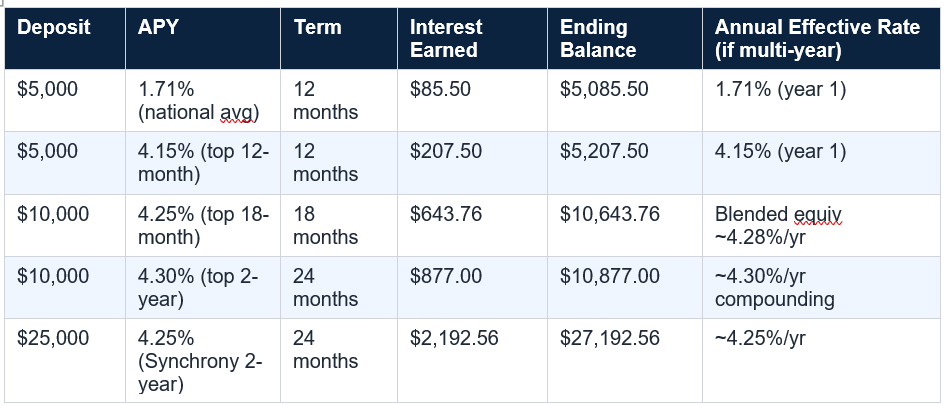
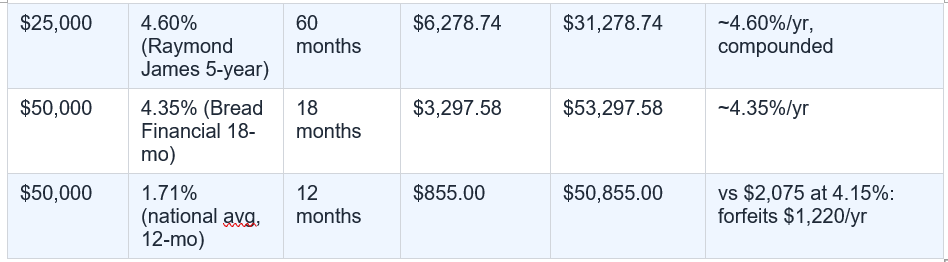
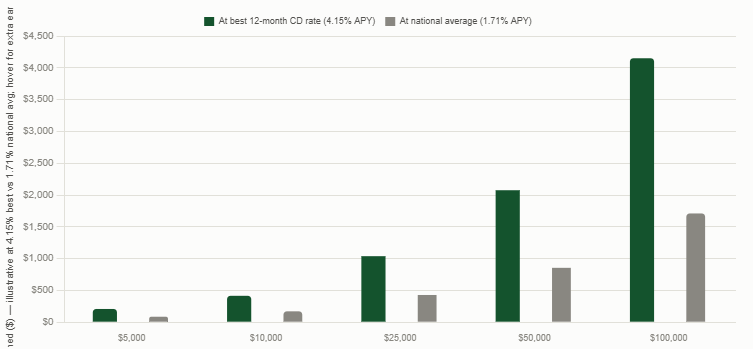
The most striking comparison in the table: $50,000 at the national average 12-month rate (1.71%) earns $855 in interest. The same $50,000 at 4.15% (available at multiple top online banks) earns $2,075 — a difference of $1,220 per year from one account-opening decision. Over five years of reinvestment, this gap compounds significantly. PrimeRates.com (March 2026) notes: ‘On a $25,000 deposit, the difference between a 4.25% CD and a 4.50% CD might seem small, but that 25 basis point gap costs you about $62.50 per year.’ Multiply that logic across larger deposits and the dollar-value of comparison shopping becomes very clear.
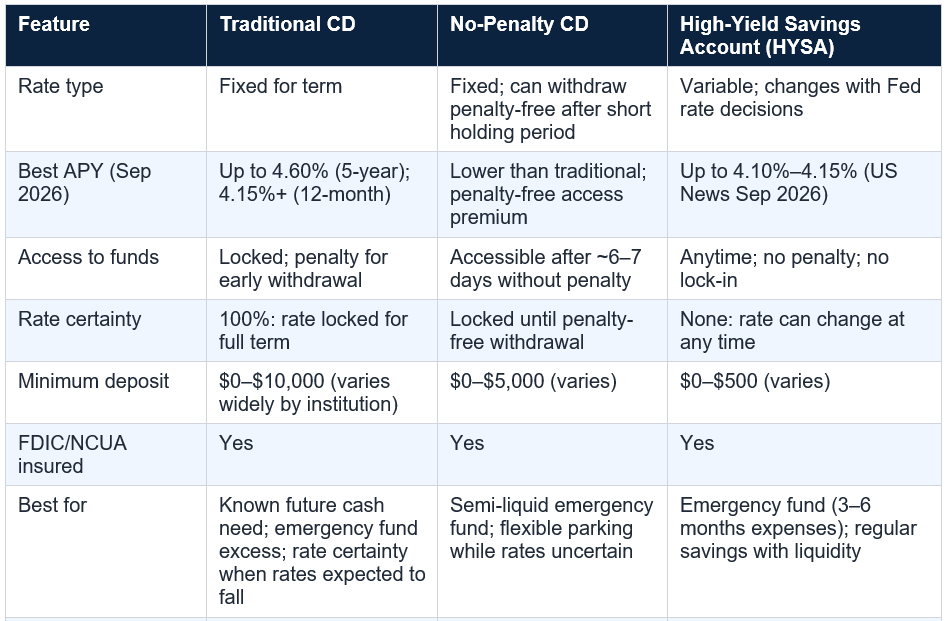

The practical decision rule: use a HYSA for your emergency fund and any money you might need within the next six months. Use a CD (or CD ladder) for savings you are confident you will not need until the maturity date. The rate certainty of a CD is most valuable when you believe rates are more likely to fall than rise — in September 2026’s two-sided environment, the ladder addresses both scenarios.
For most savers, the appropriate response to this environment is a CD ladder: capture today’s attractive rates across multiple terms, maintain regular liquidity as each rung matures, and retain the ability to reinvest at higher rates if they materialise. For savers who are confident they will not need their funds and believe rates are more likely to decline than rise, locking a larger portion into a 3–5 year CD at 4.15–4.60% APY is a reasonable expression of that view.
What is not rational in September 2026 is accepting the national average. At 1.71% for a 12-month CD from a traditional bank versus 4.00%–4.35% from a top online bank, the cost of brand loyalty or inertia is approximately $230–$260 per $10,000 per year. Opening the right CD account is one of the easiest financial decisions available — it takes 15 minutes, carries government-backed protection, and in the current rate environment, it pays more than 2× the national average.
As of September 2026, the best available CD APY reaches 4.60% (Raymond James Bank, 60-month term, $1,000 minimum), with top 12-month CDs offering approximately 4.00%–4.35% APY at online banks. The best 18-month CDs offer up to 4.35% (Bread Financial) and the best 2-year CDs up to 4.30% (Marcus by Goldman Sachs) or 4.25% (Synchrony Bank, no minimum deposit). These compare to the FDIC national average for a 12-month CD of 1.71% (as of August 17, 2026). Rates change daily — always verify directly with the institution before opening. Sources: CDValet.com, CNBC Select (August 19, 2026), NerdWallet (September 1, 2026), Bankrate (September 8, 2026).
Is a CD a good investment in 2026?
CDs are not investments in the traditional sense — they are low-risk savings products that provide a guaranteed, federally insured return. Whether they are appropriate for your money depends on your need for access, your timeline, and your rate outlook. For savings beyond your emergency fund that you will not need for 12 months or more, a CD at today's top rates (4.00%–4.60% APY) offers a guaranteed real return above recent inflation levels. For money you may need within six months, a high-yield savings account or no-penalty CD is more appropriate. The key risk with CDs is opportunity cost: if the Federal Reserve raises rates after you open a long-term CD, your locked rate becomes less competitive. The CD ladder strategy manages this risk by keeping a portion of deposits available for reinvestment at regular intervals.
How does a CD ladder work?
A CD ladder divides a total deposit across multiple CDs of different maturity terms — for example, 20% each in 1-year, 2-year, 3-year, 4-year, and 5-year CDs. Each rung matures at a regular interval (annually in this case). When a rung matures, the proceeds are reinvested in a new CD at the longest term of the ladder (a new 5-year CD in the example). Benefits: regular liquidity as each rung matures without early withdrawal penalties; rate diversification across terms; ability to participate in rising rates when short rungs mature; and protection against falling rates through long-term locked rates on longer rungs. The strategy is particularly well-suited to September 2026's flat CD yield curve and two-sided rate outlook.
What happens when a CD matures?
At maturity, you have three options: (1) withdraw your principal and interest and transfer to another account; (2) renew the CD for another term at the institution's current rate at that time (most banks offer an automatic renewal with a short grace period — typically 7–10 days — during which you can change your mind without penalty); or (3) roll into a different term or institution. The grace period at maturity is the critical window: if you do nothing, most banks will auto-renew your CD at the current rate for the same term, which may be different from today's rate and may not be the best rate available. Set a calendar reminder for your CD maturity date to ensure you make an active decision during the grace period.
Are CDs FDIC insured?
Yes. CDs at FDIC-insured banks are protected up to $250,000 per depositor, per institution, per account ownership category. CDs at NCUA-insured credit unions (where they are called share certificates) have the same $250,000 protection. The insurance covers both your principal and accrued interest up to the limit. For deposits above $250,000, spread across multiple FDIC-insured banks or use a brokerage's brokered CD programme (available at Fidelity and Schwab), which automatically diversifies across multiple issuing banks to maintain full FDIC coverage. Joint accounts receive $250,000 per co-owner, so a married couple in a joint CD account is covered up to $500,000 at the same bank. IRA CDs have a separate $250,000 limit per person per bank.
What is the early withdrawal penalty on a CD?
Early withdrawal penalties are charged when you withdraw your CD's principal before the maturity date. The penalty is typically expressed as a number of months of interest and varies by institution and term length. Common penalty structures in 2026: 3 months of interest on CDs with terms under 12 months; 6 months of interest on 12–24 month CDs; 9–12 months of interest on 24–36 month CDs; 12–18 months of interest on CDs longer than 36 months. For example, on a 24-month CD paying 4.25% APY, a 6-month penalty on a $10,000 deposit would forfeit approximately $210 in interest. The penalty always applies to interest earned, not principal — you always get your principal back. No-penalty CDs avoid this issue entirely, allowing withdrawals (typically after 6–7 days of opening) without any interest forfeiture.
Best Rate By Term vs National Average September 2026
What You Actually Eearn: Interests Atn Key APys On Different Deposits
Table of Contents
- Why September 2026 Is a Critical CD Moment
- What Is a CD? How Certificate of Deposit Accounts Work
- National Average vs Best Available: The Gap That Matters
- Best CD Rates by Term: September 2026 Rate Table
- Top CD Accounts Compared: Institutions, APY, and Minimums
- How the Federal Reserve Shapes CD Rates
- CD Types: Traditional, No-Penalty, Bump-Up, Jumbo, and Brokered
- CD Laddering: The Best Strategy for a Flat Yield Curve
- How Much Can You Actually Earn? Worked Examples at Key APYs
- FDIC and NCUA Insurance: How Your CD Deposits Are Protected
- CD vs High-Yield Savings Account: When to Choose Which
- Who Should Open a CD Right Now?
- Conclusion: Lock In or Ladder? The September 2026 Decision
- Frequently Asked Questions
Why September 2026 Is a Critical CD Moment
The Federal Reserve held the federal funds rate at 3.50%–3.75% at its July 29, 2026 meeting — the fifth consecutive hold of the year. The last rate change was a 0.25 percentage point cut in December 2025. But the Fed’s June 2026 dot plot moved upward: the median projection shifted to 3.8% for year-end 2026, and nine of 18 officials now pencil in at least one rate hike before December. Three policymakers voted for a rate increase at the last meeting. Rate path uncertainty is now genuinely two-sided in a way it has not been for two years.For CD savers, this creates a specific strategic environment. The yield curve on CDs is essentially flat in September 2026 — meaning similar rates are available across short and long terms, which is unusual. Top 6-month CDs, 12-month CDs, and 5-year CDs all pay in a relatively tight band from approximately 4.00% to 4.60% APY at the best institutions. This flatness means there is no automatic premium for locking in longer — and there is no penalty for staying short if you want optionality.
This guide covers the complete September 2026 CD landscape: the best rates by term, the best institutions, the mechanics of how CDs work, the five main CD types, the CD laddering strategy that most advisers recommend for this rate environment, and worked examples of what your money actually earns at the top available rates.
Best CD APY (September 2026): up to 4.60% (Raymond James Bank, 60-month, CDValet.com). National avg 12-month CD: 1.71% (FDIC, August 17, 2026). Fed funds rate: 3.50%–3.75% (held July 29, 2026; fifth consecutive hold). Top 12-month CDs: ~4.00%–4.35% APY (CNBC Select Aug 2026; NerdWallet Sep 2026). FOMC next meeting: September 15–16, 2026. Rate path: two-sided — hike or hold are both credible scenarios.
What Is a CD? How Certificate of Deposit Accounts Work
A certificate of deposit (CD) is a time-deposit savings account offered by banks and credit unions (where they are sometimes called share certificates). The basic agreement is straightforward: you deposit a fixed amount of money for a fixed term, and the financial institution agrees to pay you a fixed, guaranteed interest rate for the duration of that term.The key features that distinguish CDs from other savings products:
- Fixed rate and guaranteed return: unlike a high-yield savings account (HYSA) or money market account, whose rates can be changed by the bank at any time, a CD locks in your rate from the day you open it to the day it matures. If you open a 12-month CD at 4.25% APY today, you will earn 4.25% APY regardless of what the Federal Reserve does over the next 12 months.
- Fixed term: CDs have specific maturity dates — commonly ranging from 3 months to 5 years, with some institutions offering as short as 1 month or as long as 10 years. Your money is committed for the full term.
- Early withdrawal penalties: withdrawing your principal before the CD matures typically incurs a penalty, usually expressed as a number of months of interest (for example, 3 months of interest on a 12-month CD, or 6 months of interest on a 24-month CD). The exact penalty structure varies by institution and term and must be understood before opening.
- Federal insurance: CDs at FDIC-insured banks and NCUA-insured credit unions are protected up to $250,000 per depositor, per institution. Your principal and accrued interest are guaranteed by the US government up to this limit even if the financial institution fails.
- Minimum deposit requirements: vary from $0 (Synchrony Bank) to $500, $1,000, $1,500, $2,500, $5,000, or $10,000 depending on the institution and the specific CD product.
National Average vs Best Available: The Gap That Matters
One of the most important facts in the September 2026 CD landscape is the enormous gap between the national average CD rate and the best available rate from online banks. Understanding this gap is the single most valuable piece of information for most CD savers.According to FDIC data as of August 17, 2026, published by US News Money (September 2026):
- National average 12-month CD rate: 1.71%
- National average 36-month CD rate: 1.34%
- National average 60-month CD rate: 1.36%
- Best 12-month CDs: approximately 4.00%–4.35% APY
- Best 18-month CDs: up to 4.35% APY (Bread Financial, NerdWallet September 2026)
- Best 60-month CDs: up to 4.60% APY (Raymond James Bank, CDValet.com September 2026)
The national average CD rate is not the rate you should expect or accept. It reflects the average of thousands of institutions — including large traditional banks that have almost no incentive to compete aggressively for deposits because they already have enormous deposit bases. The best rates come from online-only banks and credit unions with lower overhead and higher deposit-gathering incentives. If your CD rate matches the national average, you are almost certainly underperforming what is available to you.
Best CD Rates by Term: September 2026 Rate Table
The following table shows the best available CD rates by term as of September 2026. All rates are verified from published sources as of the dates stated. Rates change frequently — verify directly with the institution before opening. All institutions listed are FDIC-insured unless otherwise noted.Top CD Accounts Compared: Institutions, APY, and Minimums
The following institutions are consistently cited across September 2026 CD rate comparisons from Bankrate, CNBC Select, Forbes Advisor, and NerdWallet. Each entry is based on published rate data; verify current rates directly with the institution before opening, as rates change without notice.Rates change without notice. An institution offering 4.35% APY today may have adjusted its rate by the time you read this article. Always verify the current rate directly on the institution's website or by calling before opening a CD. The rates above are drawn from published comparisons in August–September 2026 but are not guaranteed to be current at the time you read this guide.
How the Federal Reserve Shapes CD Rates
The Federal Reserve does not set CD rates directly — banks do. However, the federal funds rate — the overnight lending rate between banks that the Fed controls — acts as an anchor for virtually all other interest rates in the economy, including CD rates. Understanding the Fed’s role is essential for making strategic CD decisions.The rate history relevant to September 2026:
- 2023–2024 peak: the Fed funds rate reached 5.25%–5.50%, the highest in over two decades. CD rates followed, with the best 12-month CDs hitting 5.50%+ APY and some short-term promotional CDs exceeding 5.65%. These were the best CD rates in 15 years.
- Late 2024 cuts: the Fed began cutting in September 2024, reducing rates three times by a total of 1 percentage point.
- 2025 cuts: three additional 0.25 pp cuts (September, October, December 2025), bringing the target range to 3.50%–3.75%.
- 2026 holds: the Fed held rates at every one of its first five meetings of 2026 (through July 29, 2026). The last rate change was the December 2025 cut. CD rates have largely stabilised after declining approximately 0.25%–0.50% from their mid-2024 peak (CDRateComparison.com, May 2026).
- September 2026 FOMC meeting (September 15–16): the next scheduled opportunity for a rate change. Current expectations are divided: three members voted for a hike at the July meeting; the median dot moved to 3.8%. Rate path is two-sided.
The key insight from the Fed's rate history: today's top CD rates (4.00%–4.60% APY) are already significantly below the 2023–2024 peak of 5.50%+, but still historically high relative to the pre-2022 environment. The average 12-month CD yield over the past five years was just 1.16% (Federal Reserve Bank of St. Louis; Bankrate). At 4.00%+ today, CDs are offering more than 3× the five-year average. Whether rates go higher or lower from here is genuinely uncertain — which is exactly what makes the CD ladder strategy so appropriate.
CD Types: Traditional, No-Penalty, Bump-Up, Jumbo, and Brokered
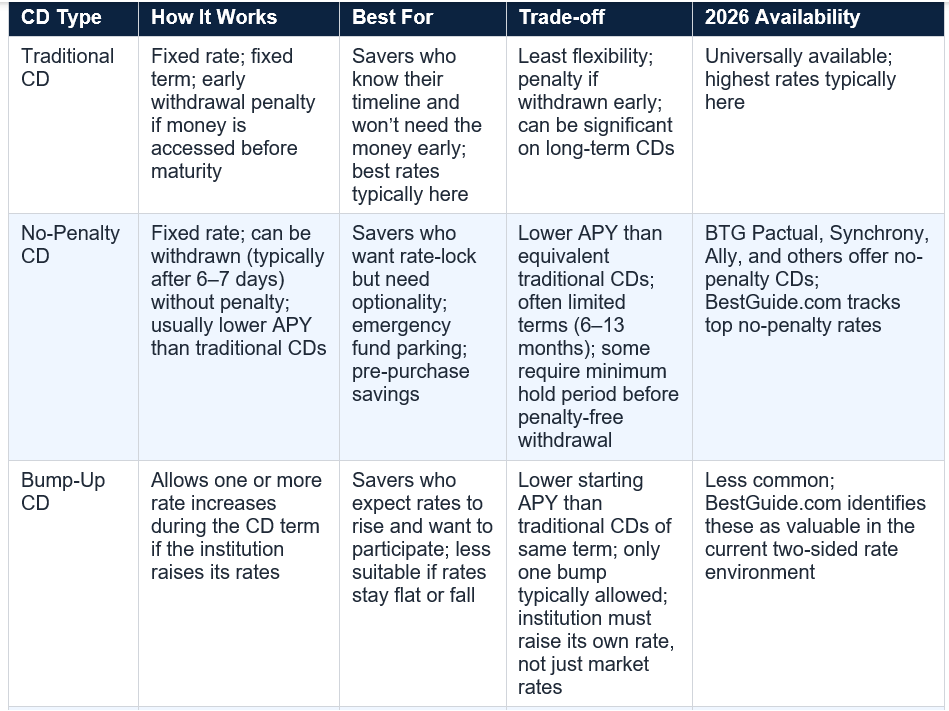
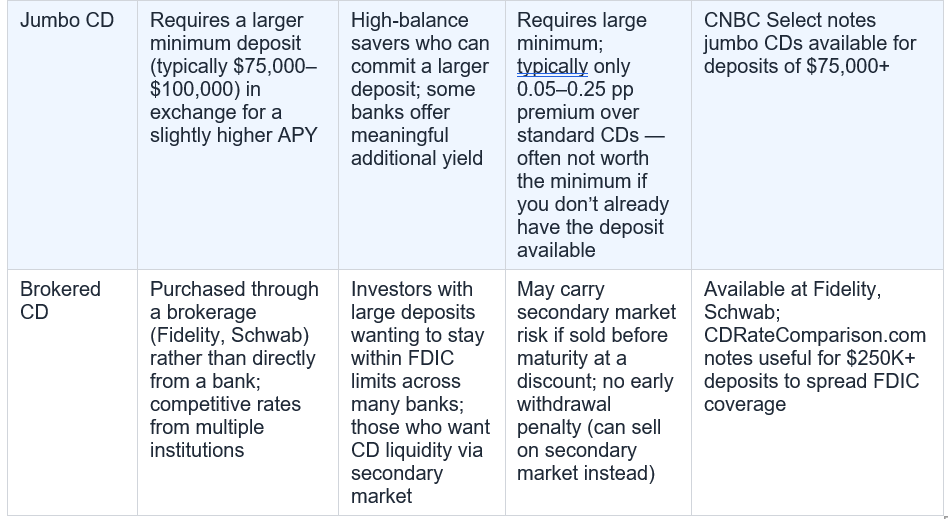
Not all CDs are the same product. Understanding the five main CD types helps match the right instrument to your specific financial situation:
CD Laddering: The Best Strategy for a Flat Yield Curve
A CD ladder is an investment strategy that divides a total savings amount into equal portions deposited in CDs of staggered maturities. Rather than putting all your money into a single CD, you spread it across multiple terms — for example, 6-month, 1-year, 2-year, 3-year, and 5-year CDs. As each rung matures, you reinvest the proceeds in the longest remaining term, maintaining the ladder.In September 2026, the CD ladder is particularly well-suited to the current environment for three reasons:
- The yield curve is flat: short-term and long-term CDs pay similar rates, so you give up very little yield by keeping some rungs short. A traditional steep yield curve penalises short-term CDs with lower rates; the current flat curve does not.
- Rate path uncertainty is two-sided: if rates rise (as three Fed members voted for), short rungs mature and can be reinvested at higher rates. If rates fall, long rungs lock in today’s competitive rates. The ladder hedges both scenarios simultaneously.
- Regular liquidity: a rung matures regularly (every 6 to 12 months if structured well), providing access to funds without triggering early withdrawal penalties.
To build a CD ladder in September 2026: (1) decide your total allocation; (2) divide into 4–5 equal portions; (3) open CDs at the best available rate for each term — use different FDIC-insured institutions if your deposit exceeds $250,000 to maximise insurance coverage; (4) enable automatic renewal in a term equal to your longest rung when each CD matures; (5) revisit the strategy at each maturity to assess whether reinvestment rates and your financial situation have changed. CDRateComparison.com (May 2026) specifically recommends the ladder approach: 'CD Laddering Strategy 2026 — navigate changing rates with staggered maturities.'
How Much Can You Actually Earn? Worked Examples at Key APYs
The following examples illustrate what a CD deposit earns at different APYs and deposit sizes. Interest is calculated as: ending balance = principal × (1 + APY)^term. APY already accounts for compounding. All figures are illustrative; actual earnings depend on compounding frequency, term, and institution-specific terms. CD interest is taxable as ordinary income in the year it is received (or in the year the CD matures for CDs less than a year, depending on your accounting method). Not financial advice.The most striking comparison in the table: $50,000 at the national average 12-month rate (1.71%) earns $855 in interest. The same $50,000 at 4.15% (available at multiple top online banks) earns $2,075 — a difference of $1,220 per year from one account-opening decision. Over five years of reinvestment, this gap compounds significantly. PrimeRates.com (March 2026) notes: ‘On a $25,000 deposit, the difference between a 4.25% CD and a 4.50% CD might seem small, but that 25 basis point gap costs you about $62.50 per year.’ Multiply that logic across larger deposits and the dollar-value of comparison shopping becomes very clear.
FDIC and NCUA Insurance: How Your CD Deposits Are Protected
One of the defining features of CDs — and a key reason they are considered extremely low-risk savings instruments — is federal deposit insurance. Understanding exactly how this protection works is important for depositors with large balances.- FDIC (Federal Deposit Insurance Corporation): insures deposits at member banks up to $250,000 per depositor, per institution, per account ownership category. CDs at FDIC-insured banks are covered. The FDIC guarantee means your principal and accrued interest are protected even if the bank fails.
- NCUA (National Credit Union Administration): the equivalent insurance for credit unions, providing the same $250,000 per member, per institution protection on share certificates (the credit union equivalent of CDs).
- Per-institution limit: the $250,000 limit applies per institution. If you have $300,000 at a single FDIC bank, only $250,000 is covered. The solution: spread deposits across multiple FDIC-insured institutions, or use brokered CDs at Fidelity or Schwab, which automatically diversify across issuing banks (CDRateComparison.com, May 2026).
- Ownership categories: different account ownership categories (individual, joint, trust, retirement account) each have their own separate $250,000 limit at the same institution. A married couple holding a joint CD can be covered up to $500,000 at the same bank ($250,000 per co-owner of the joint account). Retirement accounts (IRA CDs) have a separate $250,000 limit per person per bank.
CD vs High-Yield Savings Account: When to Choose Which
CDs and High-Yield Savings Accounts (HYSAs) are both low-risk savings products offered by many of the same online banks. Choosing between them depends primarily on whether you need immediate access to your money.The practical decision rule: use a HYSA for your emergency fund and any money you might need within the next six months. Use a CD (or CD ladder) for savings you are confident you will not need until the maturity date. The rate certainty of a CD is most valuable when you believe rates are more likely to fall than rise — in September 2026’s two-sided environment, the ladder addresses both scenarios.
Who Should Open a CD Right Now?
CDs are not the right tool for every saver. The following profiles indicate when opening a CD in September 2026 makes clear sense, and when it does not:- Open a CD if: you have savings beyond your 3–6 month emergency fund that you do not need for a defined period; you want to lock in a guaranteed return rather than risk rate variability; you are saving for a specific known expense (home down payment, car purchase, tuition) on a defined timeline; or you are concerned that the Federal Reserve may resume cutting rates, which would reduce HYSA and money market rates.
- Consider a no-penalty CD or HYSA instead if: your savings is your primary emergency fund and you may need immediate access; you believe rates will rise significantly and do not want to be locked into today’s rate; your income is unpredictable and you cannot commit to a term with certainty.
- Consider a CD ladder if: you have more than one CD’s worth of savings and want the combination of rate certainty on some portion and liquidity on another; you are uncertain about the rate direction and want to hedge both scenarios; or you have a large lump sum (inheritance, asset sale proceeds, bonus) that needs to be deployed productively while you decide on a longer-term use.
- CD is not appropriate if: you need the money within 3–6 months and cannot use a no-penalty CD; you need your cash for active investing or business purposes; or you need returns that exceed what CDs offer (noting that CDs’ guaranteed nature comes with lower expected returns than equities over long periods).
Conclusion
In September 2026, the CD landscape offers more strategic complexity than it has in years. The Fed has held rates for five consecutive meetings, but three members voted for a hike and the rate path is genuinely two-sided. CD rates remain historically attractive — the best 12-month CDs at 4.00–4.35% APY are more than 3× the five-year historical average of 1.16% — but the flat yield curve removes the premium that normally makes long-term commitment clearly advantageous.For most savers, the appropriate response to this environment is a CD ladder: capture today’s attractive rates across multiple terms, maintain regular liquidity as each rung matures, and retain the ability to reinvest at higher rates if they materialise. For savers who are confident they will not need their funds and believe rates are more likely to decline than rise, locking a larger portion into a 3–5 year CD at 4.15–4.60% APY is a reasonable expression of that view.
What is not rational in September 2026 is accepting the national average. At 1.71% for a 12-month CD from a traditional bank versus 4.00%–4.35% from a top online bank, the cost of brand loyalty or inertia is approximately $230–$260 per $10,000 per year. Opening the right CD account is one of the easiest financial decisions available — it takes 15 minutes, carries government-backed protection, and in the current rate environment, it pays more than 2× the national average.
Frequently Asked Questions
What are the best CD rates right now in September 2026?As of September 2026, the best available CD APY reaches 4.60% (Raymond James Bank, 60-month term, $1,000 minimum), with top 12-month CDs offering approximately 4.00%–4.35% APY at online banks. The best 18-month CDs offer up to 4.35% (Bread Financial) and the best 2-year CDs up to 4.30% (Marcus by Goldman Sachs) or 4.25% (Synchrony Bank, no minimum deposit). These compare to the FDIC national average for a 12-month CD of 1.71% (as of August 17, 2026). Rates change daily — always verify directly with the institution before opening. Sources: CDValet.com, CNBC Select (August 19, 2026), NerdWallet (September 1, 2026), Bankrate (September 8, 2026).
Is a CD a good investment in 2026?
CDs are not investments in the traditional sense — they are low-risk savings products that provide a guaranteed, federally insured return. Whether they are appropriate for your money depends on your need for access, your timeline, and your rate outlook. For savings beyond your emergency fund that you will not need for 12 months or more, a CD at today's top rates (4.00%–4.60% APY) offers a guaranteed real return above recent inflation levels. For money you may need within six months, a high-yield savings account or no-penalty CD is more appropriate. The key risk with CDs is opportunity cost: if the Federal Reserve raises rates after you open a long-term CD, your locked rate becomes less competitive. The CD ladder strategy manages this risk by keeping a portion of deposits available for reinvestment at regular intervals.
How does a CD ladder work?
A CD ladder divides a total deposit across multiple CDs of different maturity terms — for example, 20% each in 1-year, 2-year, 3-year, 4-year, and 5-year CDs. Each rung matures at a regular interval (annually in this case). When a rung matures, the proceeds are reinvested in a new CD at the longest term of the ladder (a new 5-year CD in the example). Benefits: regular liquidity as each rung matures without early withdrawal penalties; rate diversification across terms; ability to participate in rising rates when short rungs mature; and protection against falling rates through long-term locked rates on longer rungs. The strategy is particularly well-suited to September 2026's flat CD yield curve and two-sided rate outlook.
What happens when a CD matures?
At maturity, you have three options: (1) withdraw your principal and interest and transfer to another account; (2) renew the CD for another term at the institution's current rate at that time (most banks offer an automatic renewal with a short grace period — typically 7–10 days — during which you can change your mind without penalty); or (3) roll into a different term or institution. The grace period at maturity is the critical window: if you do nothing, most banks will auto-renew your CD at the current rate for the same term, which may be different from today's rate and may not be the best rate available. Set a calendar reminder for your CD maturity date to ensure you make an active decision during the grace period.
Are CDs FDIC insured?
Yes. CDs at FDIC-insured banks are protected up to $250,000 per depositor, per institution, per account ownership category. CDs at NCUA-insured credit unions (where they are called share certificates) have the same $250,000 protection. The insurance covers both your principal and accrued interest up to the limit. For deposits above $250,000, spread across multiple FDIC-insured banks or use a brokerage's brokered CD programme (available at Fidelity and Schwab), which automatically diversifies across multiple issuing banks to maintain full FDIC coverage. Joint accounts receive $250,000 per co-owner, so a married couple in a joint CD account is covered up to $500,000 at the same bank. IRA CDs have a separate $250,000 limit per person per bank.
What is the early withdrawal penalty on a CD?
Early withdrawal penalties are charged when you withdraw your CD's principal before the maturity date. The penalty is typically expressed as a number of months of interest and varies by institution and term length. Common penalty structures in 2026: 3 months of interest on CDs with terms under 12 months; 6 months of interest on 12–24 month CDs; 9–12 months of interest on 24–36 month CDs; 12–18 months of interest on CDs longer than 36 months. For example, on a 24-month CD paying 4.25% APY, a 6-month penalty on a $10,000 deposit would forfeit approximately $210 in interest. The penalty always applies to interest earned, not principal — you always get your principal back. No-penalty CDs avoid this issue entirely, allowing withdrawals (typically after 6–7 days of opening) without any interest forfeiture.
0 Comments
Be the first to share your thoughts on this article.