

Credits
7 Ways Rich People Use Debt to Get Richer

Robert Kiyosaki is $1.2 billion in debt. He calls it a confession, but he clearly isn’t ashamed. Jay-Z and Beyoncé carry over $100 million in mortgages on a property they could buy outright from their breakfast money. Warren Buffett runs the world’s most successful investment company using other people’s cash. The wealthy don’t avoid debt — they weaponise it. The difference between how the rich use debt and how everyone else does comes down to one rule: borrow to acquire appreciating assets, never to fund depreciating ones. This article explains the seven specific strategies the wealthy use, who has used them, how they work mechanically, and what regular investors can learn from each. This is Not a financial advice.
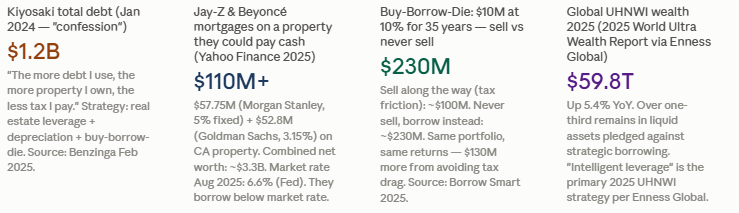
Enness Global, the specialist high-net-worth finance brokerage, summarises the shift in a 2025 strategy report: ‘In 2025, intelligent financing has become one of the most effective investment strategies for preserving wealth and capturing global opportunities. The goal is no longer to avoid debt, but to structure it intelligently, using leverage as a disciplined instrument of modern wealth strategy.’ Global ultra-high-net-worth individual wealth reached $59.8 trillion in 2025, up 5.4% year-on-year — and over a third remained in liquid assets pledged against strategic borrowing.
The second mindset difference is around tax. A loan is not income. When you sell an asset, you crystallise the gain and owe capital gains tax. When you borrow against it, you access the same liquidity without a taxable event. The wealthy have understood for decades that the tax code rewards borrowers and penalises sellers. The seven strategies below are all expressions of that understanding. Not financial advice.
The wealth of global UHNWIs reached $59.8 trillion in 2025, up 5.4% YoY (2025 World Ultra Wealth Report, cited Enness Global 2025). Robert Kiyosaki January 2024: 'I am $1.2 billion in debt.' His reason: 'The more debt I use, the more property I own, the less tax I pay.' (Benzinga February 2025.) Jay-Z and Beyoncé: ~$3.3 billion combined net worth; hold $57.75M + $52.8M mortgages on California property from Morgan Stanley and Goldman Sachs respectively (Yahoo Finance 2025). Grant Cardone: $5 billion real estate portfolio financed primarily with debt. Key principle (Finary.com; Borrow Smart): borrow to acquire appreciating assets; never borrow to buy depreciating consumer goods. Not financial advice.
Buy: purchase appreciating assets — stocks, real estate, businesses, art, private equity. Let them compound. Do not sell. Every sale is a taxable event; the wealthy avoid sales the way the rest of us avoid root canals. Borrow: when cash is needed for lifestyle spending, business opportunities, or new investments, use the appreciated assets as collateral for a loan. A loan is not income and therefore triggers no capital gains tax. The assets stay invested and continue compounding. Die: pass the assets to heirs with a stepped-up cost basis. Under current US tax law, heirs inherit assets at the value on the date of death rather than the original purchase price — decades of accumulated gains are legally erased. Heirs can then sell the assets, repay the loans, and keep the difference tax-free.
The mathematical power is significant. The Borrow Smart newsletter illustrates: $10 million growing at 10% for 35 years, if sold periodically with tax friction along the way, produces approximately $100 million. The same $10 million, never sold but borrowed against, produces approximately $230 million — same portfolio, same returns, $130 million more, from avoiding tax drag. Jay-Z and Beyoncé are the textbook celebrity example: their California property carries over $100 million in mortgages against an asset they could pay for outright, with one mortgage from Goldman Sachs at 3.15% and a newer one from Morgan Stanley at 5% — both below the 6.6% market rate in August 2025 (Federal Reserve). Not financial advice.
Buy, Borrow, Die mechanics: (1) BUY appreciating assets — stocks, real estate, businesses. Let them compound. Never sell. (2) BORROW against the appreciated value. Loan proceeds are not income = no capital gains tax. Assets remain invested. (3) DIE — heirs inherit with stepped-up basis, erasing decades of gains. They repay the loans and keep the rest. 2025 update: the One Big Beautiful Bill Act raised the estate tax exemption to $15M per person permanently (indexed), making the 'die' step even more powerful. Mathematical illustration: $10M at 10% for 35 years — sell along the way: ~$100M. Borrow instead of selling: ~$230M. (Borrow Smart 2025; Senate Finance testimony September 2024.) Not financial advice.
Buy-Borrow-Die risks: (1) Interest rates rise: cheap debt becomes expensive. Many billionaires who borrowed at 2-3% in 2020-2021 faced renewed pressure when rates hit 5%+. (2) Asset values fall: if pledged securities drop, the bank calls the margin — you must top up collateral or face forced sale at the worst time. (3) The law can change: Senate Finance Committee testimony (September 12, 2024) specifically flagged buy-borrow-die as a target for legislative change. The stepped-up basis loophole is politically vulnerable. (4) Complexity: this strategy requires sophisticated legal, tax, and financial planning. Not financial advice.
J.P. Morgan, which actively promotes SBL to private banking clients, describes the advantage: ‘Rather than selling your public market investments to raise money, borrowing against your assets can allow you to stay the course on your investments, defer taxes, and free up money for other opportunities.’ (Fortune, March 2026.) Elon Musk and Mark Zuckerberg have both used securities-backed loans against their company stock holdings. Goldman Sachs, Morgan Stanley, and J.P. Morgan are the primary providers. Enness Global’s 2025 case study involved arranging a £400,000 securities-backed loan for a London client against shares in an international technology company.
The critical mechanics: the portfolio remains fully invested and continues earning dividends and capital appreciation. The loan proceeds are cash the investor can deploy for any purpose — a real estate purchase, a new investment, lifestyle spending — without crystallising a taxable event on the portfolio’s unrealised gains. The interest rate on SBL facilities is typically lower than mortgage rates and far lower than personal loan rates, because the bank holds highly liquid, marketable securities as collateral. Not financial advice.
Can Regular Investors Do This?: Can regular investors use securities-backed lending? Yes, in a limited form. Many brokerage firms offer margin loans that work on the same principle. Fidelity, Schwab, and Interactive Brokers all offer margin at current rates of 6-8% against diversified portfolios. The SBL facilities available to billionaires offer better rates and more flexibility, but the principle is accessible. The risk of a margin call — being forced to sell at the worst moment — is the primary danger for leveraged portfolios. Not financial advice. Consult a CFP.
Grant Cardone, who manages a $5 billion real estate portfolio, operates on the principle that real estate debt is the single most tax-advantaged form of leverage available to US investors. His strategy combines mortgage interest deductions, depreciation (which reduces taxable income without a cash expense), the 20% pass-through deduction on qualified business income under the Tax Cuts and Jobs Act, and the buy-borrow-die strategy on individual properties. Robert Kiyosaki is $1.2 billion in real estate debt and frames it identically: ‘The more debt I use, the more property I own, the less tax I pay.’
The mechanics of real estate depreciation deserve particular emphasis. The IRS allows rental property owners to deduct the cost of the building (not land) over 27.5 years for residential and 39 years for commercial property. On a $1 million property with a $700,000 building component, that’s approximately $25,500 in annual depreciation — a deduction taken against rental income without any actual cash expenditure, directly reducing the investor’s taxable income. The ‘swap til you drop’ variation (confirmed in Senate Finance testimony, September 2024) uses 1031 exchanges to continuously roll properties, deferring gains indefinitely, then eliminating them via stepped-up basis on death. Not financial advice.
Real estate debt tax advantages (multiple sources; Senate Finance testimony September 2024; Benzinga 2025): (1) Mortgage interest deduction — fully deductible on rental properties. (2) Depreciation — ~$25,500/year on a $1M residential property reduces taxable income with no cash cost. (3) 20% QBI pass-through deduction (TCJA, extended permanently 2025) for qualifying real estate businesses. (4) 1031 exchange — sell one investment property, buy another, defer capital gains tax indefinitely. (5) Section 179/bonus depreciation on qualifying assets and vehicles over 6,000 lbs. (6) Stepped-up basis at death — eliminates all accumulated gains. Stack all six, and the real estate investor's tax situation looks very different from the wage earner's. Not tax advice.
The private equity model is the extreme version: a leveraged buyout (LBO) acquires a company using primarily debt, with the debt secured against the company’s own assets and paid down from the company’s operating cash flows. The equity investor controls a large asset with a very small personal capital outlay. When the business grows and the debt is paid down, the equity owner’s stake becomes increasingly valuable. The returns can be extraordinary precisely because the equity base is small relative to the total asset controlled.
For smaller investors, the same principle applies on a more modest scale. SBA 7(a) loans provide up to $5 million for qualifying small businesses; SBA 504 loans fund fixed-asset acquisition. A business owner who borrows $500,000 to expand production capacity, generates $150,000 per year in additional operating profit, and pays $25,000 per year in interest has made a highly profitable use of debt — a 30% effective return on the borrowed capital, with the interest cost deductible against business income. Not financial advice.
Warren Buffett has used this principle at scale for decades. Berkshire Hathaway’s insurance subsidiaries collect premiums before paying claims — the ‘float’ between premium receipt and claim payment is effectively interest-free borrowing that Buffett invests in equities. Berkshire’s insurance float has grown to over $170 billion, providing a massive pool of effectively free capital for equity investment. The BNY Mellon Wealth ‘Borrow Like a Billionaire’ podcast example is more accessible: borrowing at 2% when markets returned 10% meant the leverage generated an 8% return on borrowed capital.
The risk is inherent in the name: arbitrage assumes the spread is stable. When rates rise (as they did aggressively in 2022–23) or when investment returns fall (bear markets), the spread can narrow or reverse. Borrowers who took on floating-rate debt at 2% in 2021 found themselves paying 5%+ by 2023. If their investments were returning less than 5%, they were losing money on the leverage. The strategy requires constant monitoring of both sides of the spread. Not financial advice.
Grant Cardone’s dictum — ‘If you can’t write it off, don’t buy it’ — captures the philosophy. His move to Florida eliminated state income tax; his real estate holdings generate depreciation deductions that can offset other income. Kiyosaki’s strategy is identical: the debt funds the assets, the assets produce the deductions, the deductions reduce the tax bill. The result is that very wealthy real estate investors can have substantial cash flows but minimal taxable income, paying an effective tax rate well below that of a comparable wage earner.
Section 179 and bonus depreciation extend this to business equipment and qualifying vehicles. A business owner who buys a $80,000 SUV over 6,000 lbs for business use can deduct a significant portion or all of its cost in the year of purchase under current bonus depreciation rules. These provisions are designed to stimulate investment; the wealthy simply use them more systematically and at greater scale than most. Not tax advice. Consult a CPA for your specific situation.
Beyoncé’s previous Goldman Sachs mortgage at 3.15% is the celebrity case study. Locked in when rates were at historic lows, this mortgage carried a negative real interest rate through the 2021–2024 inflationary period — the asset it financed (California coastal real estate) appreciated significantly while the real cost of the debt declined. The new Morgan Stanley mortgage at 5% is still below the August 2025 30-year market rate of 6.6%, demonstrating the privileged access to below-market rates that wealthy borrowers receive from their private banking relationships (Yahoo Finance 2025).
The principle is accessible at smaller scales: a homeowner who locked a 30-year mortgage at 3% in 2020 is now holding cheap fixed debt against an asset that has appreciated significantly, with a real borrowing cost that may be negative given post-2020 inflation. This is the same inflation hedge the wealthy use — the difference is scale, rate, and intentionality. Not financial advice.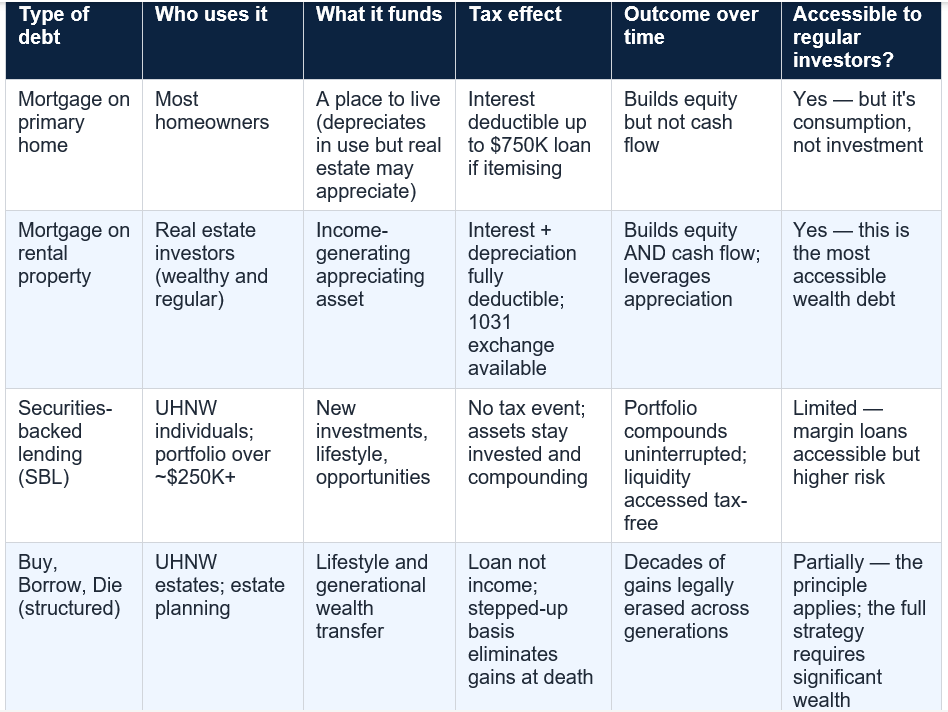
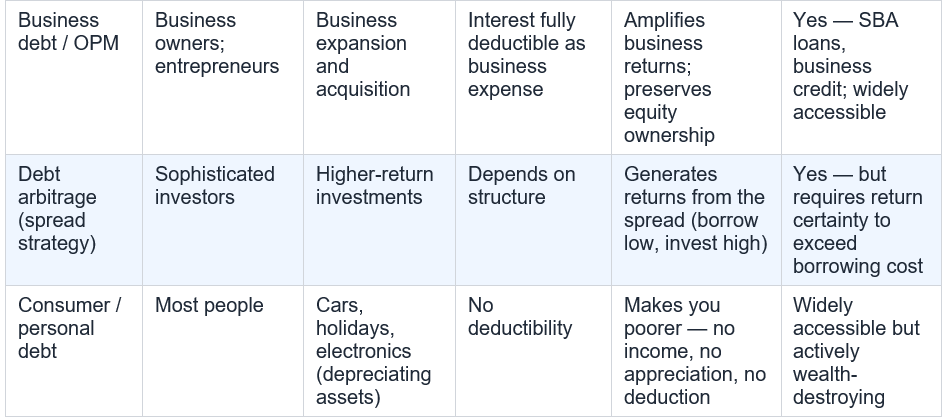
This is Not financial or tax advice. The comparison is illustrative. Tax treatment varies by individual circumstances and jurisdiction. Consult a qualified CFP and CPA for guidance specific to your situation.
The wealthy can absorb these risks because they have diversified wealth across many asset classes, they have access to sophisticated legal and financial advice, they have private banking relationships that give them favourable terms and time to restructure in a crisis, and they have the liquid resources to meet margin calls without forced selling. Regular investors who attempt to replicate these strategies without the same financial cushion can find themselves in very serious difficulty if markets move against them.
The Senate Finance Committee testimony from September 2024 is also a reminder that the legal landscape can change. Buy-borrow-die was explicitly identified as a legislative target. The stepped-up basis loophole, if closed, would fundamentally change the calculus of the strategy. Tax laws change; strategies that work in 2025 may not work in the same way in 2030. Not financial advice. Consult a qualified professional.
Key risks of wealthy debt strategies: (1) Margin calls: SBL and margin loans can force asset sales at the worst time if collateral falls. (2) Rate risk: floating-rate debt becomes expensive when rates rise; billionaires who borrowed at 2% in 2021 faced pain at 5%+ in 2023. (3) Concentration risk: borrowing heavily against a single stock (as Musk did against Tesla shares) creates extreme exposure to one asset. (4) Legislative risk: buy-borrow-die and stepped-up basis are political targets. Law changes can alter the strategy overnight. (5) Complexity: these strategies require specialists to execute correctly. Errors can create large tax liabilities or legal problems. Not financial advice.
Kiyosaki’s $1.2 billion in debt is not recklessness — it is this framework at scale. Jay-Z and Beyoncé’s $100 million in mortgages on a property they could pay for outright is not financial fragility — it is tax efficiency and inflation protection in action. Grant Cardone’s $5 billion real estate portfolio is not a bet — it is a systematic accumulation of assets with stacked tax advantages, funded by other people’s money.
The lesson is not to copy these strategies without professional guidance — they carry real risks and require sophisticated implementation. The lesson is to understand the mindset: debt is not inherently bad. Debt used to buy appreciating, income-generating assets is a wealth-building tool. Debt used to buy depreciating consumer goods is wealth-destruction. The difference is what you buy with the borrowed money. Not financial, legal, or tax advice. Consult a qualified CFP, CPA, and estate attorney for guidance specific to your situation.
Buy, Borrow, Die is a tax strategy named by USC law professor Edward McCaffery in the 1990s. It involves three steps: (1) BUY appreciating assets (stocks, real estate, businesses) and let them grow without selling. (2) BORROW against those assets when cash is needed. A loan is not income, so no capital gains tax is triggered. (3) DIE with the assets still held. Under current US tax law, heirs inherit assets at their value on the date of death (stepped-up basis), erasing decades of accumulated capital gains. Heirs can then repay the loans from the proceeds and keep the rest. It is completely legal — it uses the tax code exactly as written. Senate Finance Committee testimony from September 2024 confirmed it is the primary mechanism of ultra-rich tax avoidance and called for legislative reform. The One Big Beautiful Bill Act (signed 2025) raised the estate tax exemption to $15M per person permanently, making the 'die' step more powerful. The stepped-up basis loophole is politically contested and could be changed by future legislation. Sources: Borrow Smart newsletter 2025; Senate Finance Committee testimony September 12, 2024; Yahoo Finance 2025. Not tax advice.
Why do billionaires like Jay-Z and Elon Musk take out mortgages and loans when they could pay cash?
Primarily for three reasons. (1) Tax efficiency: selling assets to buy property triggers capital gains tax on the gain. Borrowing against existing assets accesses liquidity without a taxable event. (2) Return optimisation: if a billionaire's investment portfolio returns 10% and a mortgage costs 5%, they are better off keeping the portfolio invested and borrowing for the property — they net 5% on the capital that stays invested. (3) Inflation hedge: a fixed-rate mortgage locked at a low rate is worth progressively less in real terms as inflation erodes the debt's value, while the asset appreciates. Jay-Z and Beyoncé's Goldman Sachs mortgage at 3.15% was effectively free money in real terms during the 2021-2024 inflationary period. Fortune (March 2026) and JPMorgan confirm that securities-backed lending is actively promoted to wealthy private banking clients for these reasons. Not financial advice.
Can regular investors borrow against their stock portfolio like billionaires do?
Yes, in a limited form. The billionaire-level product is a securities-backed lending (SBL) facility from a private bank — with very favourable rates, high loan-to-value ratios, and personalised terms. The equivalent available to regular investors is a margin loan from a brokerage (Fidelity, Schwab, Interactive Brokers, etc.). Margin loans work on the same principle: borrow against your portfolio without selling it. Current margin rates at most brokers are approximately 6-8%, though they vary. The risks are significant: if your portfolio falls in value, the broker can issue a margin call requiring you to deposit more cash or accept forced sale of your holdings at the worst time. Margin should only be used against diversified, liquid portfolios by investors who understand the risk and can absorb potential losses. Not financial advice. Consult a CFP.
How does real estate depreciation work as a tax strategy?
Depreciation allows property owners to deduct the cost of a building (not land) over its useful life — 27.5 years for residential rental property, 39 years for commercial. On a $1 million rental property with $700,000 allocated to the building, annual depreciation is approximately $25,454 ($700,000 ÷ 27.5). This deduction reduces taxable income without any cash expenditure — you receive a tax deduction every year simply for owning the property. If the property generates $30,000 in net rental income, the $25,454 depreciation reduces taxable income to approximately $4,546. However, depreciation is subject to 'recapture' when the property is sold — the IRS taxes the accumulated depreciation at 25% on sale. Wealthy investors avoid recapture through 1031 exchanges (rolling into a new property) or by holding until death (stepped-up basis eliminates recapture). Grant Cardone and Robert Kiyosaki both cite depreciation as a core component of their real estate tax strategy. Sources: Benzinga February 2025; Senate Finance testimony September 2024. Not tax advice. Consult a CPA.
What is the difference between good debt and bad debt?
Good debt finances an appreciating asset that generates income or increases in value faster than the cost of borrowing. Bad debt finances a depreciating asset or consumption that generates no return. Examples of good debt: a mortgage on a rental property (asset appreciates; income covers debt service; tax deductions available); a business loan to fund expansion (returns on capital exceed interest cost; interest is tax-deductible); a securities-backed loan against an appreciating portfolio (portfolio keeps compounding; loan provides liquidity without a taxable event). Examples of bad debt: a car loan (car depreciates immediately; no income; interest not deductible); credit card debt (high interest on consumer purchases; no return; compounds against you); a personal loan for a holiday (zero return on capital; pure consumption). The wealthy specifically use good debt and specifically avoid bad debt. Sources: Finary.com; No Bollocks with Matt Haycox; Zacks 2026; Enness Global 2025. Not financial advice.
Table of Contents
- The Mindset Shift: Why the Rich See Debt Differently
- Way #1: Buy, Borrow, Die — The Master Strategy
- Way #2: Securities-Backed Lending — Borrowing Against the Portfolio
- Way #3: Real Estate Leverage — The Most Accessible Wealth Debt
- Way #4: Business Debt — Using Other People’s Money
- Way #5: Debt Arbitrage — Borrow Low, Invest Higher
- Way #6: Debt as a Tax Deduction Engine
- Way #7: Fixed-Rate Debt as an Inflation Hedge
- The Comparison: Rich Debt vs Regular Debt
- The Risks: Why This Isn’t for Everyone
- What Regular Investors Can Apply
- Conclusion: The Seven Rules of Wealthy Debt
- Frequently Asked Questions
The Mindset Shift: Why the Rich See Debt Differently
The fundamental difference between how the wealthy use debt and how most people use it is the asset it purchases. Ordinary debt pays for things that decrease in value: a car, a holiday, a sofa, a night out. Wealthy debt buys things that increase in value and generate income: a rental property, a share portfolio, a business, commercial real estate. Over time, the first type of debt makes you poorer in real terms; the second type can make you significantly wealthier if the asset grows faster than the interest rate.Enness Global, the specialist high-net-worth finance brokerage, summarises the shift in a 2025 strategy report: ‘In 2025, intelligent financing has become one of the most effective investment strategies for preserving wealth and capturing global opportunities. The goal is no longer to avoid debt, but to structure it intelligently, using leverage as a disciplined instrument of modern wealth strategy.’ Global ultra-high-net-worth individual wealth reached $59.8 trillion in 2025, up 5.4% year-on-year — and over a third remained in liquid assets pledged against strategic borrowing.
The second mindset difference is around tax. A loan is not income. When you sell an asset, you crystallise the gain and owe capital gains tax. When you borrow against it, you access the same liquidity without a taxable event. The wealthy have understood for decades that the tax code rewards borrowers and penalises sellers. The seven strategies below are all expressions of that understanding. Not financial advice.
The wealth of global UHNWIs reached $59.8 trillion in 2025, up 5.4% YoY (2025 World Ultra Wealth Report, cited Enness Global 2025). Robert Kiyosaki January 2024: 'I am $1.2 billion in debt.' His reason: 'The more debt I use, the more property I own, the less tax I pay.' (Benzinga February 2025.) Jay-Z and Beyoncé: ~$3.3 billion combined net worth; hold $57.75M + $52.8M mortgages on California property from Morgan Stanley and Goldman Sachs respectively (Yahoo Finance 2025). Grant Cardone: $5 billion real estate portfolio financed primarily with debt. Key principle (Finary.com; Borrow Smart): borrow to acquire appreciating assets; never borrow to buy depreciating consumer goods. Not financial advice.
Buy, Borrow, Die — The Master Strategy
The most powerful debt strategy used by the ultra-wealthy has a name that sounds almost macabre: Buy, Borrow, Die. It was named by University of Southern California law professor Edward McCaffery in the 1990s, but the strategy itself is older than the name. Its elegance lies in three steps that, used together, build enormous wealth while deferring and ultimately eliminating taxes on gains.Buy: purchase appreciating assets — stocks, real estate, businesses, art, private equity. Let them compound. Do not sell. Every sale is a taxable event; the wealthy avoid sales the way the rest of us avoid root canals. Borrow: when cash is needed for lifestyle spending, business opportunities, or new investments, use the appreciated assets as collateral for a loan. A loan is not income and therefore triggers no capital gains tax. The assets stay invested and continue compounding. Die: pass the assets to heirs with a stepped-up cost basis. Under current US tax law, heirs inherit assets at the value on the date of death rather than the original purchase price — decades of accumulated gains are legally erased. Heirs can then sell the assets, repay the loans, and keep the difference tax-free.
The mathematical power is significant. The Borrow Smart newsletter illustrates: $10 million growing at 10% for 35 years, if sold periodically with tax friction along the way, produces approximately $100 million. The same $10 million, never sold but borrowed against, produces approximately $230 million — same portfolio, same returns, $130 million more, from avoiding tax drag. Jay-Z and Beyoncé are the textbook celebrity example: their California property carries over $100 million in mortgages against an asset they could pay for outright, with one mortgage from Goldman Sachs at 3.15% and a newer one from Morgan Stanley at 5% — both below the 6.6% market rate in August 2025 (Federal Reserve). Not financial advice.
Buy, Borrow, Die mechanics: (1) BUY appreciating assets — stocks, real estate, businesses. Let them compound. Never sell. (2) BORROW against the appreciated value. Loan proceeds are not income = no capital gains tax. Assets remain invested. (3) DIE — heirs inherit with stepped-up basis, erasing decades of gains. They repay the loans and keep the rest. 2025 update: the One Big Beautiful Bill Act raised the estate tax exemption to $15M per person permanently (indexed), making the 'die' step even more powerful. Mathematical illustration: $10M at 10% for 35 years — sell along the way: ~$100M. Borrow instead of selling: ~$230M. (Borrow Smart 2025; Senate Finance testimony September 2024.) Not financial advice.
Buy-Borrow-Die risks: (1) Interest rates rise: cheap debt becomes expensive. Many billionaires who borrowed at 2-3% in 2020-2021 faced renewed pressure when rates hit 5%+. (2) Asset values fall: if pledged securities drop, the bank calls the margin — you must top up collateral or face forced sale at the worst time. (3) The law can change: Senate Finance Committee testimony (September 12, 2024) specifically flagged buy-borrow-die as a target for legislative change. The stepped-up basis loophole is politically vulnerable. (4) Complexity: this strategy requires sophisticated legal, tax, and financial planning. Not financial advice.
Securities-Backed Lending — Borrowing Against the Portfolio
Securities-backed lending (SBL) — sometimes called a Lombard loan in European markets — is the mechanism by which wealthy individuals borrow against their investment portfolio without selling any of it. The investor pledges a portfolio of stocks, bonds, or other securities as collateral; the bank extends a credit line, typically at 50–80% of the portfolio’s value, at rates significantly below personal loan or credit card rates.J.P. Morgan, which actively promotes SBL to private banking clients, describes the advantage: ‘Rather than selling your public market investments to raise money, borrowing against your assets can allow you to stay the course on your investments, defer taxes, and free up money for other opportunities.’ (Fortune, March 2026.) Elon Musk and Mark Zuckerberg have both used securities-backed loans against their company stock holdings. Goldman Sachs, Morgan Stanley, and J.P. Morgan are the primary providers. Enness Global’s 2025 case study involved arranging a £400,000 securities-backed loan for a London client against shares in an international technology company.
The critical mechanics: the portfolio remains fully invested and continues earning dividends and capital appreciation. The loan proceeds are cash the investor can deploy for any purpose — a real estate purchase, a new investment, lifestyle spending — without crystallising a taxable event on the portfolio’s unrealised gains. The interest rate on SBL facilities is typically lower than mortgage rates and far lower than personal loan rates, because the bank holds highly liquid, marketable securities as collateral. Not financial advice.
Can Regular Investors Do This?: Can regular investors use securities-backed lending? Yes, in a limited form. Many brokerage firms offer margin loans that work on the same principle. Fidelity, Schwab, and Interactive Brokers all offer margin at current rates of 6-8% against diversified portfolios. The SBL facilities available to billionaires offer better rates and more flexibility, but the principle is accessible. The risk of a margin call — being forced to sell at the worst moment — is the primary danger for leveraged portfolios. Not financial advice. Consult a CFP.
Real Estate Leverage — The Most Accessible Wealth Debt
Real estate debt is the most widely used wealth-building debt strategy, accessible to far more people than securities-backed lending or sophisticated trust structures. The wealthy use mortgages on investment properties for a stacked set of simultaneous advantages: leverage on an appreciating asset, rental income that can exceed the mortgage cost, multiple tax deductions, and eventually the stepped-up basis on death.Grant Cardone, who manages a $5 billion real estate portfolio, operates on the principle that real estate debt is the single most tax-advantaged form of leverage available to US investors. His strategy combines mortgage interest deductions, depreciation (which reduces taxable income without a cash expense), the 20% pass-through deduction on qualified business income under the Tax Cuts and Jobs Act, and the buy-borrow-die strategy on individual properties. Robert Kiyosaki is $1.2 billion in real estate debt and frames it identically: ‘The more debt I use, the more property I own, the less tax I pay.’
The mechanics of real estate depreciation deserve particular emphasis. The IRS allows rental property owners to deduct the cost of the building (not land) over 27.5 years for residential and 39 years for commercial property. On a $1 million property with a $700,000 building component, that’s approximately $25,500 in annual depreciation — a deduction taken against rental income without any actual cash expenditure, directly reducing the investor’s taxable income. The ‘swap til you drop’ variation (confirmed in Senate Finance testimony, September 2024) uses 1031 exchanges to continuously roll properties, deferring gains indefinitely, then eliminating them via stepped-up basis on death. Not financial advice.
Real estate debt tax advantages (multiple sources; Senate Finance testimony September 2024; Benzinga 2025): (1) Mortgage interest deduction — fully deductible on rental properties. (2) Depreciation — ~$25,500/year on a $1M residential property reduces taxable income with no cash cost. (3) 20% QBI pass-through deduction (TCJA, extended permanently 2025) for qualifying real estate businesses. (4) 1031 exchange — sell one investment property, buy another, defer capital gains tax indefinitely. (5) Section 179/bonus depreciation on qualifying assets and vehicles over 6,000 lbs. (6) Stepped-up basis at death — eliminates all accumulated gains. Stack all six, and the real estate investor's tax situation looks very different from the wage earner's. Not tax advice.
Business Debt — Using Other People’s Money
OPM — Other People’s Money — is one of the most repeated phrases in wealth-building literature, and it refers specifically to the use of borrowed capital to control and grow a business without deploying the owner’s full equity. The wealthy use debt to fund business expansion because the interest is tax-deductible, because the returns on the business’s capital can dramatically exceed the cost of borrowing, and because debt financing preserves the owner’s equity stake in a way that issuing new shares does not.The private equity model is the extreme version: a leveraged buyout (LBO) acquires a company using primarily debt, with the debt secured against the company’s own assets and paid down from the company’s operating cash flows. The equity investor controls a large asset with a very small personal capital outlay. When the business grows and the debt is paid down, the equity owner’s stake becomes increasingly valuable. The returns can be extraordinary precisely because the equity base is small relative to the total asset controlled.
For smaller investors, the same principle applies on a more modest scale. SBA 7(a) loans provide up to $5 million for qualifying small businesses; SBA 504 loans fund fixed-asset acquisition. A business owner who borrows $500,000 to expand production capacity, generates $150,000 per year in additional operating profit, and pays $25,000 per year in interest has made a highly profitable use of debt — a 30% effective return on the borrowed capital, with the interest cost deductible against business income. Not financial advice.
Debt Arbitrage — Borrow Low, Invest Higher
Debt arbitrage is the simplest concept among the seven strategies: borrow at a lower rate than the return you expect from the investment. If you can borrow at 5% and invest in assets returning 10%, every dollar of borrowed money produces a net 5% return. The more you borrow, the more wealth you build from the spread — as long as the spread holds.Warren Buffett has used this principle at scale for decades. Berkshire Hathaway’s insurance subsidiaries collect premiums before paying claims — the ‘float’ between premium receipt and claim payment is effectively interest-free borrowing that Buffett invests in equities. Berkshire’s insurance float has grown to over $170 billion, providing a massive pool of effectively free capital for equity investment. The BNY Mellon Wealth ‘Borrow Like a Billionaire’ podcast example is more accessible: borrowing at 2% when markets returned 10% meant the leverage generated an 8% return on borrowed capital.
The risk is inherent in the name: arbitrage assumes the spread is stable. When rates rise (as they did aggressively in 2022–23) or when investment returns fall (bear markets), the spread can narrow or reverse. Borrowers who took on floating-rate debt at 2% in 2021 found themselves paying 5%+ by 2023. If their investments were returning less than 5%, they were losing money on the leverage. The strategy requires constant monitoring of both sides of the spread. Not financial advice.
Debt as a Tax Deduction Engine
The tax code rewards debt in specific, targeted ways that the wealthy exploit systematically. Business loan interest is deductible. Mortgage interest on rental properties is deductible. Investment interest expense is deductible against investment income under Section 163(d). Depreciation on leveraged real estate produces deductions without cash expenditure. Taken together, these provisions mean that a dollar spent on interest and depreciation reduces taxable income in ways that ordinary wage earners, who cannot deduct personal loan or credit card interest, cannot access.Grant Cardone’s dictum — ‘If you can’t write it off, don’t buy it’ — captures the philosophy. His move to Florida eliminated state income tax; his real estate holdings generate depreciation deductions that can offset other income. Kiyosaki’s strategy is identical: the debt funds the assets, the assets produce the deductions, the deductions reduce the tax bill. The result is that very wealthy real estate investors can have substantial cash flows but minimal taxable income, paying an effective tax rate well below that of a comparable wage earner.
Section 179 and bonus depreciation extend this to business equipment and qualifying vehicles. A business owner who buys a $80,000 SUV over 6,000 lbs for business use can deduct a significant portion or all of its cost in the year of purchase under current bonus depreciation rules. These provisions are designed to stimulate investment; the wealthy simply use them more systematically and at greater scale than most. Not tax advice. Consult a CPA for your specific situation.
Fixed-Rate Debt as an Inflation Hedge
The final strategy is perhaps the most underappreciated: using long-term fixed-rate debt as a hedge against inflation. Inflation erodes the purchasing power of money — including the real value of fixed debt. A $1 million mortgage at 3% fixed for 30 years, in an environment where inflation runs at 4% per year, has a real interest rate of -1%. The borrower is being paid, in real terms, to hold the debt. Meanwhile, the asset purchased with the debt typically appreciates with or above inflation.Beyoncé’s previous Goldman Sachs mortgage at 3.15% is the celebrity case study. Locked in when rates were at historic lows, this mortgage carried a negative real interest rate through the 2021–2024 inflationary period — the asset it financed (California coastal real estate) appreciated significantly while the real cost of the debt declined. The new Morgan Stanley mortgage at 5% is still below the August 2025 30-year market rate of 6.6%, demonstrating the privileged access to below-market rates that wealthy borrowers receive from their private banking relationships (Yahoo Finance 2025).
The principle is accessible at smaller scales: a homeowner who locked a 30-year mortgage at 3% in 2020 is now holding cheap fixed debt against an asset that has appreciated significantly, with a real borrowing cost that may be negative given post-2020 inflation. This is the same inflation hedge the wealthy use — the difference is scale, rate, and intentionality. Not financial advice.
The Comparison: Rich Debt vs Regular Debt
This is Not financial or tax advice. The comparison is illustrative. Tax treatment varies by individual circumstances and jurisdiction. Consult a qualified CFP and CPA for guidance specific to your situation.
The Risks: Why This Isn’t for Everyone
The seven strategies above are presented as the wealthy use them, but each carries real and significant risk. Leverage amplifies both gains and losses. A 20% drop in an asset financed 80% by debt wipes out the entire equity contribution (Finary.com). A securities portfolio used as collateral for an SBL loan faces a margin call if values fall. A real estate portfolio financed with floating-rate debt faces cash flow pressure when rates rise. A business funded with debt faces insolvency if revenues fall below the debt service threshold.The wealthy can absorb these risks because they have diversified wealth across many asset classes, they have access to sophisticated legal and financial advice, they have private banking relationships that give them favourable terms and time to restructure in a crisis, and they have the liquid resources to meet margin calls without forced selling. Regular investors who attempt to replicate these strategies without the same financial cushion can find themselves in very serious difficulty if markets move against them.
The Senate Finance Committee testimony from September 2024 is also a reminder that the legal landscape can change. Buy-borrow-die was explicitly identified as a legislative target. The stepped-up basis loophole, if closed, would fundamentally change the calculus of the strategy. Tax laws change; strategies that work in 2025 may not work in the same way in 2030. Not financial advice. Consult a qualified professional.
Key risks of wealthy debt strategies: (1) Margin calls: SBL and margin loans can force asset sales at the worst time if collateral falls. (2) Rate risk: floating-rate debt becomes expensive when rates rise; billionaires who borrowed at 2% in 2021 faced pain at 5%+ in 2023. (3) Concentration risk: borrowing heavily against a single stock (as Musk did against Tesla shares) creates extreme exposure to one asset. (4) Legislative risk: buy-borrow-die and stepped-up basis are political targets. Law changes can alter the strategy overnight. (5) Complexity: these strategies require specialists to execute correctly. Errors can create large tax liabilities or legal problems. Not financial advice.
What Regular Investors Can Apply
The seven strategies are not exclusively for billionaires. The principles scale down, even if the mechanics change. A regular investor with a $200,000 portfolio cannot access JPMorgan’s private banking SBL facility at 2% — but they can use a brokerage margin account. They cannot set up a dynasty trust — but they can ensure they are not selling appreciated investments unnecessarily. They cannot buy a $10 million commercial property with a 70% LTV loan from a private bank — but they can use an SBA loan to fund a $500,000 business expansion or buy a $300,000 rental property with a conventional mortgage.- • Use mortgage debt for investment property, not just your home. Rental property debt gives you leverage on an appreciating asset, rental income, and multiple tax deductions. It is the most accessible of the seven strategies.
- • Avoid selling appreciated investments unless necessary. Every sale is a taxable event. If you need liquidity, explore margin loans before selling. The spread between a margin loan rate (currently 6-8%) and your expected portfolio return (historically 8-10% for diversified equity) may make borrowing more rational than selling.
- • Borrow for income-generating assets, not consumer goods. The discipline is not complicated: debt that produces income or appreciates is good; debt for things that depreciate is bad.
- • Use depreciation if you own rental property. Most small real estate investors underuse depreciation. Ensure your accountant is claiming it, because it reduces taxable income without a cash cost.
- • Understand buy-borrow-die at your scale. Even with modest assets, the principle of not selling appreciated investments and passing them with a stepped-up basis to heirs is worth understanding and planning around. Not financial advice. Consult a CFP and CPA.
Conclusion
The wealthy do not avoid debt. They use it with precision. The seven strategies above all share the same underlying logic: borrow to acquire assets that generate income and appreciate; let the assets grow without selling; use the interest on the debt as a tax deduction; and eventually pass the assets to heirs with a tax basis that eliminates the accumulated gains. Buy, Borrow, Die is the master framework; securities-backed lending, real estate mortgage debt, business OPM, debt arbitrage, tax deduction engineering, and inflation hedging are its expressions.Kiyosaki’s $1.2 billion in debt is not recklessness — it is this framework at scale. Jay-Z and Beyoncé’s $100 million in mortgages on a property they could pay for outright is not financial fragility — it is tax efficiency and inflation protection in action. Grant Cardone’s $5 billion real estate portfolio is not a bet — it is a systematic accumulation of assets with stacked tax advantages, funded by other people’s money.
The lesson is not to copy these strategies without professional guidance — they carry real risks and require sophisticated implementation. The lesson is to understand the mindset: debt is not inherently bad. Debt used to buy appreciating, income-generating assets is a wealth-building tool. Debt used to buy depreciating consumer goods is wealth-destruction. The difference is what you buy with the borrowed money. Not financial, legal, or tax advice. Consult a qualified CFP, CPA, and estate attorney for guidance specific to your situation.
Frequently Asked Questions
What is the Buy, Borrow, Die strategy and is it legal?Buy, Borrow, Die is a tax strategy named by USC law professor Edward McCaffery in the 1990s. It involves three steps: (1) BUY appreciating assets (stocks, real estate, businesses) and let them grow without selling. (2) BORROW against those assets when cash is needed. A loan is not income, so no capital gains tax is triggered. (3) DIE with the assets still held. Under current US tax law, heirs inherit assets at their value on the date of death (stepped-up basis), erasing decades of accumulated capital gains. Heirs can then repay the loans from the proceeds and keep the rest. It is completely legal — it uses the tax code exactly as written. Senate Finance Committee testimony from September 2024 confirmed it is the primary mechanism of ultra-rich tax avoidance and called for legislative reform. The One Big Beautiful Bill Act (signed 2025) raised the estate tax exemption to $15M per person permanently, making the 'die' step more powerful. The stepped-up basis loophole is politically contested and could be changed by future legislation. Sources: Borrow Smart newsletter 2025; Senate Finance Committee testimony September 12, 2024; Yahoo Finance 2025. Not tax advice.
Why do billionaires like Jay-Z and Elon Musk take out mortgages and loans when they could pay cash?
Primarily for three reasons. (1) Tax efficiency: selling assets to buy property triggers capital gains tax on the gain. Borrowing against existing assets accesses liquidity without a taxable event. (2) Return optimisation: if a billionaire's investment portfolio returns 10% and a mortgage costs 5%, they are better off keeping the portfolio invested and borrowing for the property — they net 5% on the capital that stays invested. (3) Inflation hedge: a fixed-rate mortgage locked at a low rate is worth progressively less in real terms as inflation erodes the debt's value, while the asset appreciates. Jay-Z and Beyoncé's Goldman Sachs mortgage at 3.15% was effectively free money in real terms during the 2021-2024 inflationary period. Fortune (March 2026) and JPMorgan confirm that securities-backed lending is actively promoted to wealthy private banking clients for these reasons. Not financial advice.
Can regular investors borrow against their stock portfolio like billionaires do?
Yes, in a limited form. The billionaire-level product is a securities-backed lending (SBL) facility from a private bank — with very favourable rates, high loan-to-value ratios, and personalised terms. The equivalent available to regular investors is a margin loan from a brokerage (Fidelity, Schwab, Interactive Brokers, etc.). Margin loans work on the same principle: borrow against your portfolio without selling it. Current margin rates at most brokers are approximately 6-8%, though they vary. The risks are significant: if your portfolio falls in value, the broker can issue a margin call requiring you to deposit more cash or accept forced sale of your holdings at the worst time. Margin should only be used against diversified, liquid portfolios by investors who understand the risk and can absorb potential losses. Not financial advice. Consult a CFP.
How does real estate depreciation work as a tax strategy?
Depreciation allows property owners to deduct the cost of a building (not land) over its useful life — 27.5 years for residential rental property, 39 years for commercial. On a $1 million rental property with $700,000 allocated to the building, annual depreciation is approximately $25,454 ($700,000 ÷ 27.5). This deduction reduces taxable income without any cash expenditure — you receive a tax deduction every year simply for owning the property. If the property generates $30,000 in net rental income, the $25,454 depreciation reduces taxable income to approximately $4,546. However, depreciation is subject to 'recapture' when the property is sold — the IRS taxes the accumulated depreciation at 25% on sale. Wealthy investors avoid recapture through 1031 exchanges (rolling into a new property) or by holding until death (stepped-up basis eliminates recapture). Grant Cardone and Robert Kiyosaki both cite depreciation as a core component of their real estate tax strategy. Sources: Benzinga February 2025; Senate Finance testimony September 2024. Not tax advice. Consult a CPA.
What is the difference between good debt and bad debt?
Good debt finances an appreciating asset that generates income or increases in value faster than the cost of borrowing. Bad debt finances a depreciating asset or consumption that generates no return. Examples of good debt: a mortgage on a rental property (asset appreciates; income covers debt service; tax deductions available); a business loan to fund expansion (returns on capital exceed interest cost; interest is tax-deductible); a securities-backed loan against an appreciating portfolio (portfolio keeps compounding; loan provides liquidity without a taxable event). Examples of bad debt: a car loan (car depreciates immediately; no income; interest not deductible); credit card debt (high interest on consumer purchases; no return; compounds against you); a personal loan for a holiday (zero return on capital; pure consumption). The wealthy specifically use good debt and specifically avoid bad debt. Sources: Finary.com; No Bollocks with Matt Haycox; Zacks 2026; Enness Global 2025. Not financial advice.
0 Comments
Be the first to share your thoughts on this article.