
Investing
5 Best Index Funds for Long-Term Growth: Picks, Costs, Risks

FZROX 0.00%; FXAIX 0.015%; VOO and VTI 0.03%; VXUS 0.05%; VT about 0.07%; average active fund in one category about 0.64%. On $500 a month for 30 years at 7% before fees: about $609,985 (0.00%) vs $538,276 (0.64%), a $71,700 gap (author’s arithmetic). Returns: S&P 500 funds about 14.6% a year over 10 years (Forbes) and 15.4% (Motley Fool, August); 20-year about 11% and 30-year about 10.4% through 2025; long-run average about 10.26% since 1928; worst year −43.84%. International: VXUS about +10% to +11.5% in 2026 by May–June vs about +8% for the S&P 500, its first year-to-date lead since 2021; but about 51% vs 85% cumulative over five years. Why index: 79% of active large-cap funds trailed the S&P 500 in 2025; the best 4.3% of stocks created all net market wealth since 1926; average investor 6.8% vs 10.2% for the S&P 500 (DALBAR).
The evidence is hard to argue with. S&P Dow Jones Indices found that 79% of active large-cap funds trailed the S&P 500 in 2025, and Hendrik Bessembinder found that the best 4.3% of US stocks created all of the market’s net wealth since 1926, so owning everything guarantees you hold the few that matter. These five funds cover the main jobs, from an S&P 500 core to a one-fund global portfolio, with fees from 0.00% to about 0.07%.
The trade-off is concentration. The index is heavily weighted toward the biggest companies, with technology around 38%, so you own little of smaller companies and international markets. That concentration has paid off: The Motley Fool reported that $1,000 in VOO ten years ago would be worth more than $4,200 in August, a 15.4% annual return. But it is also why valuations deserve a look, with a forward P/E of about 20 and a CAPE of about 41.6 in mid-October.
There is a mutual fund version, VTSAX, at 0.04% with a $3,000 minimum, and Fidelity’s FSKAX at 0.015%. If you already own an S&P 500 fund, adding VTI mostly duplicates it, since the S&P 500 is the bulk of the total market. Choose one or the other, not both.
The 2026 results make the point. VXUS rose about 10% year to date by mid-May, versus about 8% for the S&P 500, its first meaningful lead since 2021, and was up 11.5% by early June. But the longer view is humbling: over five years VXUS returned about 51.3% against roughly 85.4% for the S&P 500, and its 10-year annualized return was about 8.3% in an earlier measure. International stocks may lag for years, then lead for years. Diversification is not about picking the winner; it is about not betting everything on one.
The caveats are practical. It is only available at Fidelity, and it tracks Fidelity’s own index rather than a long-established benchmark. The savings over 0.03% are about $3 a year per $10,000, so do not move brokers just for this. But if you are already at Fidelity, FZROX is a reasonable choice.
The trade-off is slightly higher cost than a US-only fund and less control. If you want more or less international exposure than the market weight, combine separate funds. Because the US is a large share of the world market, VT is mostly American stocks anyway, but you would be diversified if leadership rotates.
On $500 a month for 30 years at a constant 7% before fees: about $609,985 at 0.00%, $606,387 at 0.03% and $538,276 at 0.64%. The gap between the cheapest index fund and a 0.64% active fund is about $71,700. Illustrative constant-return arithmetic.
The risks are real. The S&P 500’s worst calendar year was a 43.84% loss, and in 2020 a broad S&P 500 ETF fell about 34% from its peak. Valuations are high, which has historically coincided with lower long-run returns, though it is a poor timing tool. And behavior matters: DALBAR research found the average investor earned about 6.8% a year over 30 years while the S&P 500 returned about 10.2%, largely because of badly timed trades. The best index fund is the one you can hold through a crash.
Keep in mind: Index funds are diversified but not safe. A 30% to 40% fall can happen, and recoveries can take years. Money you need within about five years usually does not belong in stock funds.
Then decide how much to keep in stocks versus bonds or cash. A young investor with decades ahead may hold mostly stocks; someone nearing retirement may hold much less. Rebalance once a year to your targets. And remember that these funds give you stock exposure only: pair them with an emergency fund and, depending on your timeline, safer assets.
Set up automatic monthly contributions and leave the money alone. Check each fund’s expense ratio on its own website before buying, since sources differ slightly on figures such as VT and VXUS. And do not buy a fund solely because it just had a great year. Do not pay more than you need: avoid actively managed funds with fees of 0.5% or higher unless you have a good reason. Do not own five near-identical funds: VOO, VTI and an S&P 500 mutual fund overlap heavily. Do not chase last year’s winner, whether it is the S&P 500 or international. Do not panic when markets fall, and do not try to time the market. And do not put money you need soon into stock funds.
Pick one or two, automate your contributions, keep costs low, diversify and give the money decades. Expect volatility: the S&P 500 once lost 43.84% in a year, and the international funds that lead one year can lag the next. The best index fund is the one you will hold. This is general education, not personalized advice, and a qualified adviser can help you build a plan.
There is no single best, but for most investors a broad, low-cost fund such as Vanguard’s Total Stock Market ETF (VTI, 0.03%) or an S&P 500 fund such as Fidelity’s FXAIX (0.015%) is a strong core. Adding an international fund such as VXUS (0.05%) or choosing a one-fund global option diversifies beyond US stocks.
Is the S&P 500 or the total market better?
They are very close. The S&P 500 holds about 500 large companies, while a total market fund such as VTI holds roughly 3,600 to 4,000 stocks, including small and mid-sized companies. Returns have been nearly identical over most long periods, so cost, convenience and your broker often decide.
Should I invest in international index funds?
Many advisers suggest some international exposure for diversification. VXUS rose about 10% in 2026 by mid-May versus about 8% for the S&P 500, its first meaningful year-to-date lead since 2021, but it trailed over five years (about 51% versus 85% cumulative). Leadership rotates, and no one can predict which will win next.
Do index funds beat actively managed funds?
Usually, over long periods. S&P Dow Jones Indices found that 79% of active large-cap funds trailed the S&P 500 in 2025. Index funds also cost far less, 0.00% to 0.07% for these five versus roughly 0.64% for the average active fund in one category average.
Can I lose money in an index fund?
Yes. Index funds fall when markets fall. The S&P 500’s worst calendar year was a 43.84% loss, and in 2020 a broad S&P 500 ETF dropped about 34% from peak to trough. That is why money you will need in the next few years should not be in stocks. This is general education, not personal advice.
Table of Contents
- Why Index Funds, and Why These Five
- The Short Answer
- Pick 1: Fidelity 500 Index (FXAIX) and Vanguard S&P 500 ETF (VOO)
- Pick 2: Vanguard Total Stock Market ETF (VTI)
- Pick 3: Vanguard Total International Stock ETF (VXUS)
- Pick 4: Fidelity ZERO Total Market (FZROX)
- Pick 5: Vanguard Total World Stock ETF (VT)
- The Five Side by Side
- What Costs Do to Your Money
- What Returns to Expect, and What Could Go Wrong
- How to Combine Them
- Where and How to Buy
- Mistakes to Avoid
- Conclusion
- Frequently Asked Questions
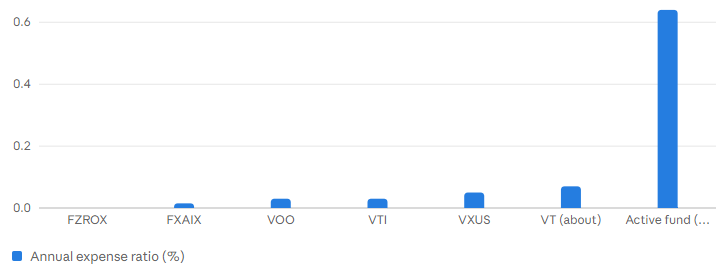
What the five index funds cost vs. a typical active fund (annual expense ratio, %)
Expense ratio (% per year) by Sources: Bankrate, U.S. News, Wallet Grower, 24/7 Wall St., WealthVieu; confirm on each fund's site
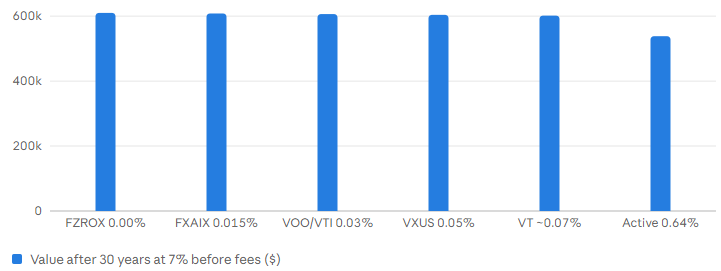
$500 a month for 30 years at 7% before fees: ending value by fund cost ($)
Ending value ($) by Author's constant-return illustration; the cheapest index fund beats a 0.64% fund by about $71,700
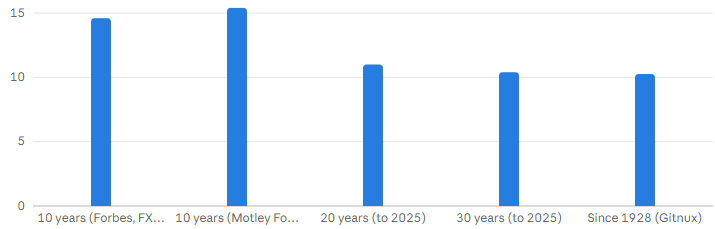
Returns depend on the period: S&P 500 funds' average annual return (%)
Average annual return (%) by Different dates and sources; the recent decade was unusually strong and is not a forecast
Why Index Funds, and Why These Five
There are thousands of funds, and almost all of them promise something. Index funds promise something simpler: to own the market for almost nothing. They do not try to pick winners. They hold everything, or nearly everything, and charge a sliver of a percent. That idea has beaten most professionals over long periods, which is why index funds are the default recommendation for long-term savers.The evidence is hard to argue with. S&P Dow Jones Indices found that 79% of active large-cap funds trailed the S&P 500 in 2025, and Hendrik Bessembinder found that the best 4.3% of US stocks created all of the market’s net wealth since 1926, so owning everything guarantees you hold the few that matter. These five funds cover the main jobs, from an S&P 500 core to a one-fund global portfolio, with fees from 0.00% to about 0.07%.
The Short Answer
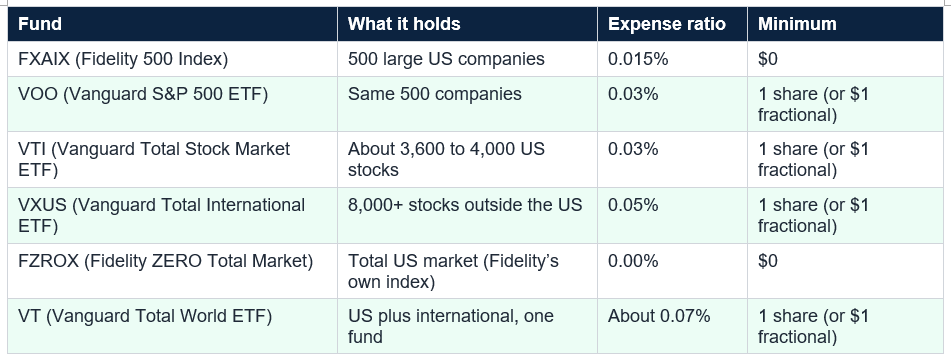
The five funds are the Fidelity 500 Index Fund (FXAIX) or Vanguard S&P 500 ETF (VOO) for large US companies, the Vanguard Total Stock Market ETF (VTI) for the whole US market, the Vanguard Total International Stock ETF (VXUS) for everything outside the US, the Fidelity ZERO Total Market Index Fund (FZROX) as a zero-fee alternative and the Vanguard Total World Stock ETF (VT) for a single global fund. Most people need only one or two. These are examples of low-cost funds, not personalized advice.
Pick 1: Fidelity 500 Index (FXAIX) and Vanguard S&P 500 ETF (VOO)
The S&P 500 is the classic core: about 500 of the largest US companies, weighted by size. FXAIX charges 0.015%, or $1.50 per $10,000 a year, with no minimum. VOO charges 0.03% and trades as an ETF at any broker. U.S. News notes Vanguard’s mutual fund version, VFIAX, costs 0.04% and Schwab’s SWPPX 0.02%. The funds hold the same companies, so returns are nearly identical; Forbes put the 10-year average return of both FXAIX and VOO at about 14.6%.The trade-off is concentration. The index is heavily weighted toward the biggest companies, with technology around 38%, so you own little of smaller companies and international markets. That concentration has paid off: The Motley Fool reported that $1,000 in VOO ten years ago would be worth more than $4,200 in August, a 15.4% annual return. But it is also why valuations deserve a look, with a forward P/E of about 20 and a CAPE of about 41.6 in mid-October.
Pick 2: Vanguard Total Stock Market ETF (VTI)
VTI is the S&P 500’s bigger sibling. It holds roughly 3,600 to 4,000 US stocks, from giants to small companies, for 0.03%. Because the largest companies dominate by weight, its returns have been very close to the S&P 500’s, but you also own mid- and small-cap companies the 500 leaves out. One roundup calls it the best index fund for most long-term investors.There is a mutual fund version, VTSAX, at 0.04% with a $3,000 minimum, and Fidelity’s FSKAX at 0.015%. If you already own an S&P 500 fund, adding VTI mostly duplicates it, since the S&P 500 is the bulk of the total market. Choose one or the other, not both.
Pick 3: Vanguard Total International Stock ETF (VXUS)
VXUS covers roughly everything outside the United States: developed and emerging markets, large and small companies, more than 8,000 stocks, for 0.05% a year and about $137 billion in assets, according to 24/7 Wall St. It is the simplest way to avoid having all your money in one country, since leadership changes over time.The 2026 results make the point. VXUS rose about 10% year to date by mid-May, versus about 8% for the S&P 500, its first meaningful lead since 2021, and was up 11.5% by early June. But the longer view is humbling: over five years VXUS returned about 51.3% against roughly 85.4% for the S&P 500, and its 10-year annualized return was about 8.3% in an earlier measure. International stocks may lag for years, then lead for years. Diversification is not about picking the winner; it is about not betting everything on one.
Pick 4: Fidelity ZERO Total Market (FZROX)
FZROX is the curiosity on this list: a fund with an expense ratio of exactly 0.00%. Fidelity can do this by tracking its own index rather than licensing a name, according to Bankrate’s description of the similar ZERO Large Cap fund. There is no minimum, and it covers the broad US market. For a long-term investor, a zero fee is hard to beat on cost.The caveats are practical. It is only available at Fidelity, and it tracks Fidelity’s own index rather than a long-established benchmark. The savings over 0.03% are about $3 a year per $10,000, so do not move brokers just for this. But if you are already at Fidelity, FZROX is a reasonable choice.
Pick 5: Vanguard Total World Stock ETF (VT)
VT is the one-fund global solution. It holds US and international stocks in a single package, roughly in proportion to the size of each market, for about 0.07% according to one roundup. You get thousands of companies in dozens of countries, with no rebalancing between US and international because the fund does it for you. For beginners who want to set it and forget it, that simplicity has real value.The trade-off is slightly higher cost than a US-only fund and less control. If you want more or less international exposure than the market weight, combine separate funds. Because the US is a large share of the world market, VT is mostly American stocks anyway, but you would be diversified if leadership rotates.
The Five Side by Side
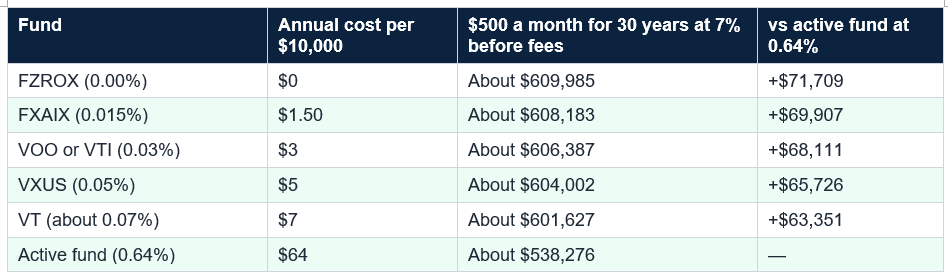
Here is how the costs compare. On a $10,000 investment, FZROX costs nothing, FXAIX $1.50 a year, VOO and VTI $3, VXUS $5 and VT about $7. Compare that with roughly $64 a year for a fund charging 0.64%, a typical active-fund category average. Notice that the cost differences among these five funds are tiny compared with the difference between any of them and the average active fund.On $500 a month for 30 years at a constant 7% before fees: about $609,985 at 0.00%, $606,387 at 0.03% and $538,276 at 0.64%. The gap between the cheapest index fund and a 0.64% active fund is about $71,700. Illustrative constant-return arithmetic.
Fees compound against you. The difference between 0.03% and 0.07% is about $4,800 over thirty years in my illustration, modest. The difference between 0.03% and 0.64% is more than $68,000. That is why the first rule of index investing is to avoid paying for active management you do not need. The main choice is the combination, not the pennies.
What Returns to Expect, and What Could Go Wrong
History offers a range, not a promise. The S&P 500 has averaged about 10.26% a year since 1928, according to Gitnux, and FinanceBuzz reports 20-year and 30-year averages of about 11% and 10.4% through 2025. The last ten years were far better, about 14.6% to 15.4% a year, and that is not a forecast: at 10%, $1,000 grows to about $2,594 in ten years; at 14.6%, about $3,907.The risks are real. The S&P 500’s worst calendar year was a 43.84% loss, and in 2020 a broad S&P 500 ETF fell about 34% from its peak. Valuations are high, which has historically coincided with lower long-run returns, though it is a poor timing tool. And behavior matters: DALBAR research found the average investor earned about 6.8% a year over 30 years while the S&P 500 returned about 10.2%, largely because of badly timed trades. The best index fund is the one you can hold through a crash.
Keep in mind: Index funds are diversified but not safe. A 30% to 40% fall can happen, and recoveries can take years. Money you need within about five years usually does not belong in stock funds.
How to Combine Them
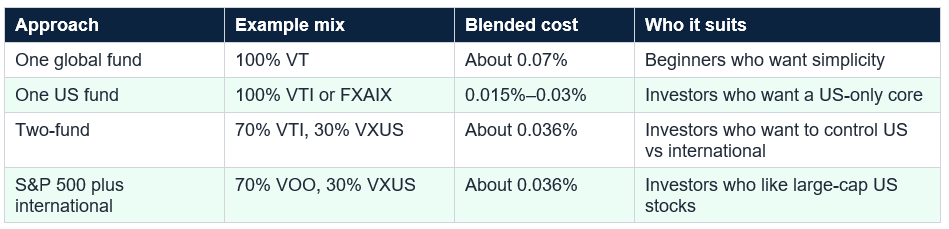
You do not need all five. Here are a few simple, illustrative combinations, not recommendations. The simplest is a single fund: VT for global exposure, or VTI or FXAIX for US-only exposure. A common two-fund mix pairs VTI with VXUS, for example 70% and 30%, for a blended cost of about 0.036% by my arithmetic. A third approach is an S&P 500 fund plus VXUS.Then decide how much to keep in stocks versus bonds or cash. A young investor with decades ahead may hold mostly stocks; someone nearing retirement may hold much less. Rebalance once a year to your targets. And remember that these funds give you stock exposure only: pair them with an emergency fund and, depending on your timeline, safer assets.
Where and How to Buy
You can buy these funds at most major brokers. NerdWallet named Fidelity its best broker for beginners in 2026, and Fidelity and Robinhood allow fractional shares from $1, according to Finder, which lets you buy even an ETF with a few dollars. A Roth IRA, with a 2026 limit of $7,500, is a good home for long-term growth funds because qualified withdrawals are tax-free. The 2026 401(k) limit is $24,500, and your plan may offer low-cost index options.Set up automatic monthly contributions and leave the money alone. Check each fund’s expense ratio on its own website before buying, since sources differ slightly on figures such as VT and VXUS. And do not buy a fund solely because it just had a great year. Do not pay more than you need: avoid actively managed funds with fees of 0.5% or higher unless you have a good reason. Do not own five near-identical funds: VOO, VTI and an S&P 500 mutual fund overlap heavily. Do not chase last year’s winner, whether it is the S&P 500 or international. Do not panic when markets fall, and do not try to time the market. And do not put money you need soon into stock funds.
Conclusion
The five funds here, FXAIX or VOO, VTI, VXUS, FZROX and VT, cover the main jobs in a long-term portfolio at costs from 0.00% to about 0.07%. An S&P 500 fund gives you large US companies, VTI the whole US market, VXUS the rest of the world, FZROX a zero-fee option at Fidelity and VT a one-fund global solution. On $500 a month for thirty years at 7%, the cheapest of these leaves you about $71,700 ahead of a typical 0.64% active fund.Pick one or two, automate your contributions, keep costs low, diversify and give the money decades. Expect volatility: the S&P 500 once lost 43.84% in a year, and the international funds that lead one year can lag the next. The best index fund is the one you will hold. This is general education, not personalized advice, and a qualified adviser can help you build a plan.
Frequently Asked Questions
What is the best index fund for long-term growth?There is no single best, but for most investors a broad, low-cost fund such as Vanguard’s Total Stock Market ETF (VTI, 0.03%) or an S&P 500 fund such as Fidelity’s FXAIX (0.015%) is a strong core. Adding an international fund such as VXUS (0.05%) or choosing a one-fund global option diversifies beyond US stocks.
Is the S&P 500 or the total market better?
They are very close. The S&P 500 holds about 500 large companies, while a total market fund such as VTI holds roughly 3,600 to 4,000 stocks, including small and mid-sized companies. Returns have been nearly identical over most long periods, so cost, convenience and your broker often decide.
Should I invest in international index funds?
Many advisers suggest some international exposure for diversification. VXUS rose about 10% in 2026 by mid-May versus about 8% for the S&P 500, its first meaningful year-to-date lead since 2021, but it trailed over five years (about 51% versus 85% cumulative). Leadership rotates, and no one can predict which will win next.
Do index funds beat actively managed funds?
Usually, over long periods. S&P Dow Jones Indices found that 79% of active large-cap funds trailed the S&P 500 in 2025. Index funds also cost far less, 0.00% to 0.07% for these five versus roughly 0.64% for the average active fund in one category average.
Can I lose money in an index fund?
Yes. Index funds fall when markets fall. The S&P 500’s worst calendar year was a 43.84% loss, and in 2020 a broad S&P 500 ETF dropped about 34% from peak to trough. That is why money you will need in the next few years should not be in stocks. This is general education, not personal advice.
0 Comments
Be the first to share your thoughts on this article.