
Investing
What $1,000 Invested Today Could Be Worth: Real Numbers

$1,000 in the Vanguard S&P 500 ETF became more than $4,200 over 10 years (15.4% a year, as of August 2026); 20- and 30-year averages through 2025 were about 11% and 10.4%; the long-run S&P 500 average is about 10%. Illustration: $1,000 at a constant 7% grows to about $1,967 (10 years), $3,870 (20), $7,612 (30) and $14,974 (40). At 10% it is about $17,449 after 30 years; at 5% about $4,322. After inflation: $10,000 invested 30 years ago grew to about $95,500 in inflation-adjusted terms (Advisor Perspectives); $1,000 held in cash at 3.7% inflation buys about $695 worth after ten years. Risks and costs: S&P 500 worst year −43.84% (about $562 left); 2020 drawdown about −34%; 10-year periods positive 94% of the time. Fees of 0.64% instead of 0.03% cost about $1,190 on $1,000 over 30 years at 7%.
The honest answer is a range, not a number. It depends on the return you earn, how long you wait, what inflation does, what you pay in fees and taxes and whether you hold on through the bad years. This guide shows all of that with real 2026 data: what $1,000 actually became in the past, what it could become in a range of scenarios and what could go wrong.

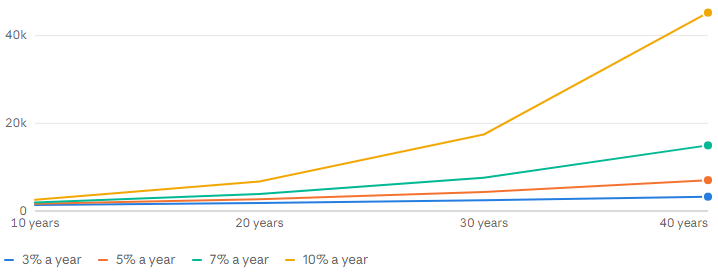
Waiting is expensive. At a constant 7%, $1,000 invested today is worth about $7,612 in thirty years, but the same $1,000 invested ten years from now, with only twenty years to grow, is worth about $3,870, roughly half as much. Wait twenty years and it is about $1,967, a quarter of the original outcome. By the rule of 72, money earning 7% doubles about every ten years, so every decade you delay costs you a doubling. That is why the best time to invest a spare $1,000 is usually now, once your basics are covered. $1,000 at a constant 7%: about $1,967 after 10 years, $3,870 after 20, $7,612 after 30 and $14,974 after 40. At 10%: $2,594, $6,727, $17,449 and $45,259. Illustrative arithmetic, not a forecast.
Longer periods look more modest. FinanceBuzz reports that the 20-year average annual return through December 2025 was 11% and the 30-year average 10.4%. At 11% for 20 years, $1,000 becomes about $8,060, and at 10.4% for 30 years about $19,460. Since 1957, the S&P 500 has produced an annualized total return of about 10%, and Gitnux puts the average since 1928 at 10.26%. These are the numbers behind the common 10% assumption, not a promise about the future.
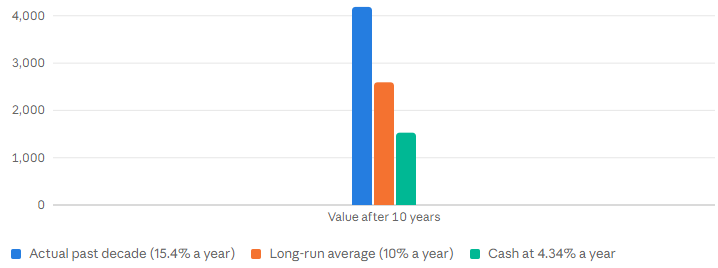
Valuations also matter. The S&P 500’s forward price-to-earnings ratio was about 20 in mid-October, and the cyclically adjusted P/E near 41.6, which is historically high. Higher starting valuations have tended to coincide with lower subsequent returns, though they are a poor timing tool. The point is not to predict a crash, only to avoid planning on the best decade in your lifetime repeating. At 15.4% a year, $1,000 grows to about $4,190 in ten years. At the long-run 10%, it grows to about $2,590. Planning with the lower number leaves room for pleasant surprises.
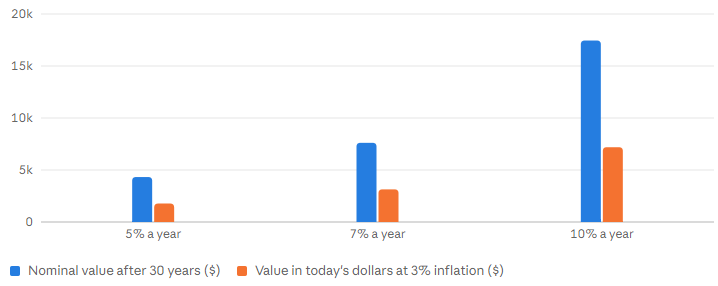
You can see the effect in my own illustration. Assume 3% inflation. A constant 7% nominal return then grows $1,000 to about $1,464 in today’s purchasing power after ten years, $2,143 after twenty and $3,136 after thirty, rather than $7,612. A 5% return grows it to just $1,781 in real terms after thirty years. Real returns, not headline returns, are what you can spend.

But cash does not build wealth. Over 30 years, 4.34% grows $1,000 to about $3,580, against $7,612 at 7%. The trade-off is risk: cash is insured and steady, while stocks can fall sharply. A sensible approach is to keep money you need within a few years in cash or Treasury bills, and money for decades from now in diversified stocks.

$1,000 plus $100 a month for 30 years at a constant 7%: about $130,114 on $37,000 contributed. The same $1,000 left alone becomes about $7,612.
Taxes matter too. In a taxable account, long-term capital gains are taxed at 0%, 15% or 20%, plus a possible 3.8% surcharge for higher earners, according to Porte Brown. If the $7,612 gain at 7% were taxed at 15% when sold, you would keep about $6,620. In a Roth IRA, funded with after-tax money, qualified withdrawals are generally tax-free, so you would keep all $7,612. With a 2026 Roth limit of $7,500, $1,000 fits easily.
Behavior is a risk too. DALBAR research, cited by MyETFJourney, found that the average investor earned about 6.8% a year over 30 years, versus 10.2% for the S&P 500, largely because of poorly timed buying and selling. Missing just the 60 best days from 1995 to 2025 would have turned the return negative, according to the same Motley Fool analysis. The best protection is a plan you can stick with.
Fourth, decide between investing all at once or gradually. Historically, lump-sum investing has beaten spreading money out most of the time, but a gradual approach can ease anxiety. Fifth, automate monthly contributions, and sixth, leave the money alone. The long-run odds reward patience, and the biggest wins come from consistency rather than cleverness.
Equally important is what not to do. Do not put the whole $1,000 into a single hot stock or cryptocurrency because of a video you saw. A Swiss Finance Institute study found that 56% of finfluencers had negative skill, and S&P Dow Jones Indices found that 79% of active large-cap funds trailed the S&P 500 in 2025. Do not borrow to invest. And do not check your balance every day; the more often you look, the more tempting it is to react. Pick the account, pick one broad fund, buy, then set a recurring monthly transfer, even $25. The habit matters more than the amount.
The number depends less on the $1,000 than on your habits: adding $100 a month turns $7,612 into about $130,000 in thirty years at 7%. Keep fees low, use a Roth when you can, stay diversified, remember inflation and expect bad years. This is general education, not personalized advice, and a qualified adviser can help you apply it.
It depends on the return. In my illustrations, $1,000 at a constant 3% becomes about $2,430, at 5% about $4,320, at 7% about $7,610 and at 10% about $17,450. The S&P 500 has averaged roughly 10% a year over long periods, but returns vary, can be negative for years and are not guaranteed.
What did $1,000 in the S&P 500 become over the past 10 years?
About $4,200 in the Vanguard S&P 500 ETF, a 322% total return or 15.4% a year as of August 2026, according to The Motley Fool. That is well above the roughly 10% long-run average, and driven heavily by technology stocks, so it is a poor guide to the next decade.
Is $1,000 enough to start investing?
Yes. Fidelity and Robinhood allow fractional shares from $1 and Schwab from $5, and the major brokers have $0 account minimums. Before investing, pay off high-interest debt and keep a small emergency fund so you do not have to sell at a bad time.
How much is $1,000 worth after inflation?
Less than the headline number. With 3.7% inflation in September, $1,000 of purchasing power today is worth about $695 after ten years if it earns nothing. For the S&P 500, Advisor Perspectives reports that $10,000 invested 30 years ago grew to about $95,500 in inflation-adjusted terms, roughly $9,550 per $1,000.
Should I invest $1,000 all at once or gradually?
Historically, investing a lump sum has beaten spreading it out most of the time, because markets rise more often than they fall. But gradual investing can feel easier and reduces regret if prices drop right after you buy. The best choice is the one you will actually stick with, and regular monthly investing is a good habit either way.
Table of Contents
- A Small Sum With a Big Question
- The Short Answer: What $1,000 Could Become
- What $1,000 Actually Became in the Past
- Why the Last Decade Is Not a Forecast
- The Inflation Haircut
- Cash vs. Stocks
- Adding $100 a Month
- Fees and Taxes
- The Bad Scenarios
- How to Invest $1,000 Today
- Conclusion
- Frequently Asked Questions
What $1,000 invested once could become at constant returns ($)
Value of $1,000 ($) by Author's compound-growth illustration; real returns vary and are not guaranteed
$1,000 over 10 years: the past decade vs. the long-run average vs. cash ($)
Value of $1,000 ($) by VOO 10-year return per The Motley Fool (Aug 2026); 10% long-run average; top savings 4.34% (MyMoneyBlog)
The inflation haircut: $1,000 after 30 years, nominal vs. today's dollars ($)
A Small Sum With a Big Question
A thousand dollars is an awkward amount. It is too much to waste and too little to feel like real investing. It might be a tax refund, a bonus, a gift or the leftovers of a good month. And it raises the question everyone eventually asks: if I invest this now, what could it become?The honest answer is a range, not a number. It depends on the return you earn, how long you wait, what inflation does, what you pay in fees and taxes and whether you hold on through the bad years. This guide shows all of that with real 2026 data: what $1,000 actually became in the past, what it could become in a range of scenarios and what could go wrong.
The Short Answer: What $1,000 Could Become
In my illustrations at constant returns, $1,000 invested once and left alone becomes about $1,967 in ten years at 7%, $3,870 in twenty and $7,612 in thirty. At 10%, the figures are $2,594, $6,727 and $17,449. At a cautious 3%, $1,000 reaches about $1,344, $1,806 and $2,427. The longer you wait, the more compounding dominates: at 7% the money roughly doubles every ten years.Waiting is expensive. At a constant 7%, $1,000 invested today is worth about $7,612 in thirty years, but the same $1,000 invested ten years from now, with only twenty years to grow, is worth about $3,870, roughly half as much. Wait twenty years and it is about $1,967, a quarter of the original outcome. By the rule of 72, money earning 7% doubles about every ten years, so every decade you delay costs you a doubling. That is why the best time to invest a spare $1,000 is usually now, once your basics are covered. $1,000 at a constant 7%: about $1,967 after 10 years, $3,870 after 20, $7,612 after 30 and $14,974 after 40. At 10%: $2,594, $6,727, $17,449 and $45,259. Illustrative arithmetic, not a forecast.
What $1,000 Actually Became in the Past
History offers a reality check. According to The Motley Fool, $1,000 invested in the Vanguard S&P 500 ETF exactly ten years ago would be worth more than $4,200 as of August 2026, a 322% total return, or 15.4% a year. Another Vanguard ETF summary reports that $10,000 invested in September 2010 became about $91,800 by September 2026, roughly 14.9% a year over sixteen years.Longer periods look more modest. FinanceBuzz reports that the 20-year average annual return through December 2025 was 11% and the 30-year average 10.4%. At 11% for 20 years, $1,000 becomes about $8,060, and at 10.4% for 30 years about $19,460. Since 1957, the S&P 500 has produced an annualized total return of about 10%, and Gitnux puts the average since 1928 at 10.26%. These are the numbers behind the common 10% assumption, not a promise about the future.
Why the Last Decade Is Not a Forecast
The past ten years were exceptional. A 15.4% annual return is far above the long-run average of about 10%, and much of it was driven by technology. The Motley Fool notes that technology represents about 38% of the Vanguard S&P 500 ETF, and a handful of large technology companies account for a disproportionate share of the gains. If the next decade returned 10%, $1,000 would become about $2,594, not $4,188.Valuations also matter. The S&P 500’s forward price-to-earnings ratio was about 20 in mid-October, and the cyclically adjusted P/E near 41.6, which is historically high. Higher starting valuations have tended to coincide with lower subsequent returns, though they are a poor timing tool. The point is not to predict a crash, only to avoid planning on the best decade in your lifetime repeating. At 15.4% a year, $1,000 grows to about $4,190 in ten years. At the long-run 10%, it grows to about $2,590. Planning with the lower number leaves room for pleasant surprises.
The Inflation Haircut
Nominal dollars flatter. Inflation was 3.7% in September, and while it will not stay there forever, it quietly shrinks purchasing power. If $1,000 sat in a drawer for ten years at 3.7% inflation, it would buy what about $695 buys today. For stocks, Advisor Perspectives’ May 2026 update reports that $10,000 invested in the S&P 500 ten years ago grew to about $32,055 in inflation-adjusted terms, $53,625 over twenty years and $95,505 over thirty. Per $1,000, that is roughly $3,205, $5,363 and $9,551.You can see the effect in my own illustration. Assume 3% inflation. A constant 7% nominal return then grows $1,000 to about $1,464 in today’s purchasing power after ten years, $2,143 after twenty and $3,136 after thirty, rather than $7,612. A 5% return grows it to just $1,781 in real terms after thirty years. Real returns, not headline returns, are what you can spend.
Cash vs. Stocks
Cash has become a real competitor. In mid-October, a 52-week Treasury bill paid about 4.46% and top savings accounts 4.34% to 4.50%, compared with an FDIC average of 0.38%, according to MyMoneyBlog and Experian. At 4.34%, $1,000 becomes about $1,529 in ten years, and at 4.46% about $1,547. That beats the average savings account, which would reach only $1,039, and it modestly beats 3.7% inflation, leaving about $1,063 of real purchasing power.But cash does not build wealth. Over 30 years, 4.34% grows $1,000 to about $3,580, against $7,612 at 7%. The trade-off is risk: cash is insured and steady, while stocks can fall sharply. A sensible approach is to keep money you need within a few years in cash or Treasury bills, and money for decades from now in diversified stocks.
Adding $100 a Month
The single most powerful upgrade to the $1,000 is to add to it. Suppose you invest $1,000 today and then add $100 a month. At a constant 7%, that grows to about $19,300 in ten years, $56,100 in twenty and $130,100 in thirty, on total contributions of $13,000, $25,000 and $37,000. At 5% it reaches $87,700 after thirty years, and at 10% about $245,900. The initial $1,000 matters far less than the habit.$1,000 plus $100 a month for 30 years at a constant 7%: about $130,114 on $37,000 contributed. The same $1,000 left alone becomes about $7,612.
Fees and Taxes
Costs shrink what you keep. Top S&P 500 index funds charge 0.015% to 0.04% a year, according to Bankrate, and the Vanguard fund charges 0.03%. On $1,000 at 7% before fees for 30 years, a 0.03% fund ends at about $7,548, while a 0.64% fund ends at about $6,358, a difference of about $1,190, or nearly 16%. Over longer periods and larger sums, the gap grows.Taxes matter too. In a taxable account, long-term capital gains are taxed at 0%, 15% or 20%, plus a possible 3.8% surcharge for higher earners, according to Porte Brown. If the $7,612 gain at 7% were taxed at 15% when sold, you would keep about $6,620. In a Roth IRA, funded with after-tax money, qualified withdrawals are generally tax-free, so you would keep all $7,612. With a 2026 Roth limit of $7,500, $1,000 fits easily.
The Bad Scenarios
Averages hide the pain. Gitnux reports that the S&P 500’s worst calendar year was a loss of 43.84%, which would turn $1,000 into about $562. In March 2020, the Vanguard S&P 500 ETF fell about 34% from its February peak, leaving about $660. Those drops recovered, but they tested patience. The Motley Fool reports that the S&P 500 produced a positive return over 94% of 10-year periods, so the odds favor patient investors, but 6% of the time they did not.Behavior is a risk too. DALBAR research, cited by MyETFJourney, found that the average investor earned about 6.8% a year over 30 years, versus 10.2% for the S&P 500, largely because of poorly timed buying and selling. Missing just the 60 best days from 1995 to 2025 would have turned the return negative, according to the same Motley Fool analysis. The best protection is a plan you can stick with.
How to Invest $1,000 Today
First, check the basics. If you carry credit card debt near 21%, paying it off beats any investment. Keep a small emergency fund, since only 47% of Americans could cover a $1,000 emergency, according to Bankrate. Second, choose an account: a Roth IRA is a good home for long-term money, and a taxable account offers flexibility. Third, pick a broad, low-cost index fund or ETF. Fidelity and Robinhood allow fractional shares from $1 and Schwab from $5, so the entire $1,000 can go to work.Fourth, decide between investing all at once or gradually. Historically, lump-sum investing has beaten spreading money out most of the time, but a gradual approach can ease anxiety. Fifth, automate monthly contributions, and sixth, leave the money alone. The long-run odds reward patience, and the biggest wins come from consistency rather than cleverness.
Equally important is what not to do. Do not put the whole $1,000 into a single hot stock or cryptocurrency because of a video you saw. A Swiss Finance Institute study found that 56% of finfluencers had negative skill, and S&P Dow Jones Indices found that 79% of active large-cap funds trailed the S&P 500 in 2025. Do not borrow to invest. And do not check your balance every day; the more often you look, the more tempting it is to react. Pick the account, pick one broad fund, buy, then set a recurring monthly transfer, even $25. The habit matters more than the amount.
Conclusion
So, what could $1,000 invested today be worth? At a constant 7%, about $1,967 in ten years, $3,870 in twenty and $7,612 in thirty. At the S&P 500’s roughly 10% long-run average, about $17,449 in thirty years. In the past ten years the figure would have been over $4,200, but that was an unusually strong decade, and after inflation the results are much more modest.The number depends less on the $1,000 than on your habits: adding $100 a month turns $7,612 into about $130,000 in thirty years at 7%. Keep fees low, use a Roth when you can, stay diversified, remember inflation and expect bad years. This is general education, not personalized advice, and a qualified adviser can help you apply it.
Frequently Asked Questions
How much will $1,000 be worth in 30 years?It depends on the return. In my illustrations, $1,000 at a constant 3% becomes about $2,430, at 5% about $4,320, at 7% about $7,610 and at 10% about $17,450. The S&P 500 has averaged roughly 10% a year over long periods, but returns vary, can be negative for years and are not guaranteed.
What did $1,000 in the S&P 500 become over the past 10 years?
About $4,200 in the Vanguard S&P 500 ETF, a 322% total return or 15.4% a year as of August 2026, according to The Motley Fool. That is well above the roughly 10% long-run average, and driven heavily by technology stocks, so it is a poor guide to the next decade.
Is $1,000 enough to start investing?
Yes. Fidelity and Robinhood allow fractional shares from $1 and Schwab from $5, and the major brokers have $0 account minimums. Before investing, pay off high-interest debt and keep a small emergency fund so you do not have to sell at a bad time.
How much is $1,000 worth after inflation?
Less than the headline number. With 3.7% inflation in September, $1,000 of purchasing power today is worth about $695 after ten years if it earns nothing. For the S&P 500, Advisor Perspectives reports that $10,000 invested 30 years ago grew to about $95,500 in inflation-adjusted terms, roughly $9,550 per $1,000.
Should I invest $1,000 all at once or gradually?
Historically, investing a lump sum has beaten spreading it out most of the time, because markets rise more often than they fall. But gradual investing can feel easier and reduces regret if prices drop right after you buy. The best choice is the one you will actually stick with, and regular monthly investing is a good habit either way.
0 Comments
Be the first to share your thoughts on this article.