
Investing
Finfluencer or Real Expert? 7 Ways to Tell Before You Invest

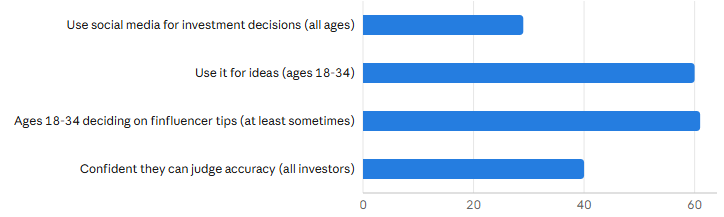
60% of investors aged 18–34 use social media for investment ideas and 61% say they frequently or sometimes decide based on finfluencer recommendations; 29% of investors overall use social media for decisions; only 40% are confident they can assess the accuracy of financial information. Research: 56% of finfluencers have “antiskill,” earning −2.3% monthly abnormal returns; 28% are skilled (+2.6%); 16% unskilled (Swiss Finance Institute). The median portfolio following influencer picks trailed the S&P 500 by 43 percentage points over a year (UNSW). ASIC (March 2026), Gen Z: 63% used social media for financial advice; 56% trust financial information on social media; 52% trust finfluencers; 64% trust AI tools. Scams: $2.1 billion lost to social-media scams in 2025, $1.1 billion of it in investment scams (FINRA panel).
The trouble is that they all look the same: friendly, fluent, certain. A follower count looks like credibility, and your own worry about falling behind makes it feel urgent. This guide gives you seven practical checks to tell a financial expert from a finfluencer before you put a dollar behind what you hear, plus the 2026 data that shows why they matter.
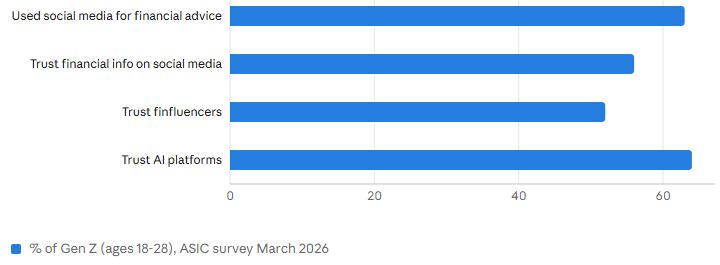
Australia’s regulator found the same pattern. A March 2026 ASIC survey of 18-to-28-year-olds found that 63% had used social media for financial advice, 56% trusted financial information on it and 52% trusted finfluencers. ASIC’s commissioner warned that what people see is shaped by algorithms designed to drive clicks rather than accuracy. The stakes are real: consumers lost $2.1 billion to social media scams in 2025, $1.1 billion of it in fraudulent investment scams.
FINRA (2026): 60% of investors aged 18–34 use social media for investment ideas; 61% decide on finfluencer recommendations at least sometimes; only 40% feel confident judging accuracy. ASIC (2026): 52% of Gen Z trust finfluencers. Social media scam losses in 2025: $2.1 billion ($1.1 billion in investment scams).
A newer UNSW study analyzed thousands of hours of video and found that the median portfolio built by following financial influencer recommendations underperformed the S&P 500 by 43 percentage points over a one-year holding period. No observable characteristic predicted which influencer would do better, and confident delivery had little relationship to later performance. A Dutch study of 453 recommendations from 21 influencers found returns typically negative after the recommendation, partly because influencers tended to jump on assets that were already hyped.
Swiss Finance Institute: 28% of finfluencers skilled (+2.6% a month), 16% unskilled, 56% antiskilled (−2.3% a month); antiskilled had more followers. UNSW: median influencer-following portfolio trailed the S&P 500 by 43 percentage points over one year.
Read credentials closely. A title like “market strategist” or “investment coach” is not a license. Ask what the person is registered as, whether they are a fiduciary who must put your interests first and how they are paid. Finfluencers are often not registered at all. That does not make them frauds, but no regulator is checking their advice.
They give you their full name and registration number and invite you to check them on BrokerCheck, the SEC adviser database or the CFP Board.
Red flag: No searchable record, vague titles or a refusal to say how they are paid.
CFA Institute research found inadequate disclosure of paid collaborations by finfluencers. If a creator pushes a specific platform, coin or course, assume they earn when you sign up. That is not automatically disqualifying, but it should change how much weight you give the advice. They disclose sponsorships and affiliate links up front, in plain words, before the recommendation. Hidden links in the bio, urgent pushes to open an account through their code, or a “free” signals group that leads to a paid one.
The comparison that matters is against a simple benchmark. S&P Dow Jones Indices found that 79% of active large-cap funds trailed the S&P 500 in 2025, and those are professional teams with research budgets. A stranger’s hot streak deserves skepticism. Independent verification, losses shown alongside gains, and honest comparison with a plain index fund. Screenshots, “my students made X,” returns with no time frame or comparison.
There is also fear of missing out. A simple rule helps: wait at least a day before acting on any investment idea you saw online. A genuine opportunity will still be there tomorrow.
Green flag: They explain risks, say that losses are possible and never pressure you to decide right now. Guaranteed returns, secret tips, deadlines, requests to move to private channels or to send money.
Transparency also means owning errors. Real experts talk about calls that went wrong; hype accounts delete old posts. If a creator predicted a crash that never came and never mentions it, that tells you how they treat accountability. Sources are cited, assumptions are explained and old mistakes are acknowledged.
Red flag: Claims with no source, deleted posts, shifting predictions and no admission of error.
If the advice is speculative, treat it as such: use only money you can afford to lose and keep it a small part of your portfolio. If the idea only makes sense because of the excitement around it, step back. Boring, diversified, low-cost investing rarely goes viral, which is probably why it works.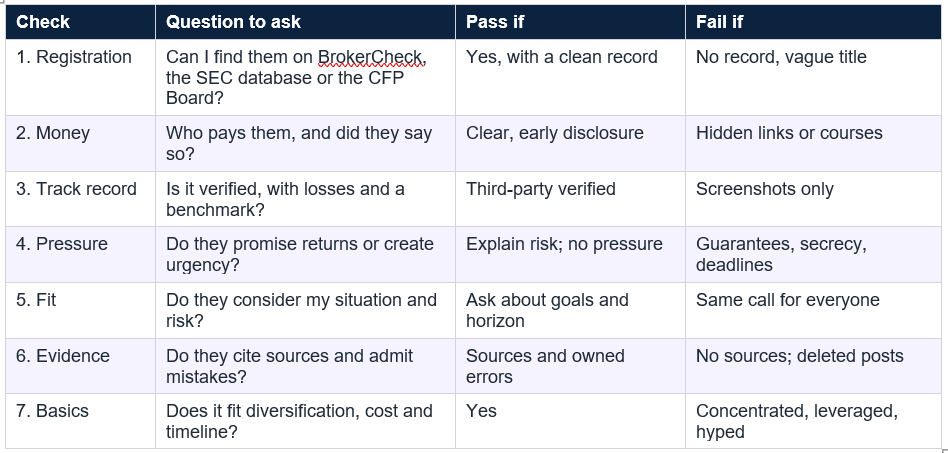
Score each check pass or fail. A creator who passes five or more is probably worth listening to for education. One who fails checks 1, 2 and 4 together should worry you, whatever their follower count. Even a perfect score does not mean you should copy their trades without considering your own situation.
When a creator moves from “here is how a Roth IRA works” to “buy this stock today,” that is the moment to run your seven checks.
None of that means you must ignore social media. Enjoy the education, verify the claims and keep your own plan in charge. When money is on the line, a boring answer from a registered professional who knows your situation beats an exciting one from a stranger. A registered adviser can help you apply this.
A finfluencer is a social media creator who talks about investing, money or markets. Many are educators; some are paid promoters; a few are fraudsters. The term says nothing about whether the person is qualified, registered or accurate.
Are all finfluencers bad?
No. Investors told FINRA that social media helped break down jargon. The risk is acting on specific buy or sell calls from unregistered strangers; education is where finfluencers add the most value.
How do I check whether someone is a registered financial professional?
Search FINRA BrokerCheck for brokers, the SEC’s Investment Adviser Public Disclosure site for advisers and the CFP Board’s lookup for certified financial planners. These free tools show registration, employment history and disciplinary records.
Do finfluencers have to disclose paid promotions?
In the US, the Federal Trade Commission expects influencers to clearly disclose material connections such as payments, free products or affiliate commissions. CFA Institute research found disclosure of paid collaborations is often inadequate, so a missing label does not mean there is no payment.
What should I do if I already acted on a finfluencer’s tip?
Do not panic or double down. Write down what you bought, why and what you paid, and check whether it fits your goals. If you think you were defrauded, report it to the SEC, the FTC and your state securities regulator.
Investors and social media: usage, reliance and confidence (%, FINRA)
% of investors by Source: FINRA research presented at the 2026 FINRA Annual Conference
Trust vs. reality: Gen Z, social media and AI for financial information (%)
% of respondents by Source: ASIC (Australia), March 2026; US figures differ but the pattern is similar
Table of Contents
- Your Feed Is Full of Confident Strangers
- The Short Answer
- Why This Matters Now
- What the Research Says About Finfluencer Advice
- Check 1: Verify Their Registration and Credentials
- Check 2: Follow the Money
- Check 3: Demand a Verified Track Record
- Check 4: Watch for Guarantees and Urgency
- Check 5: Do They Talk About Risk and Your Situation?
- Check 6: Do They Show Their Work?
- Check 7: Test the Advice Against the Basics
- Your Seven-Point Scorecard
- What Finfluencers Do Well
- What About AI “Advice”?
- If You Already Followed a Tip
- Conclusion
- Frequently Asked Questions
Your Feed Is Full of Confident Strangers
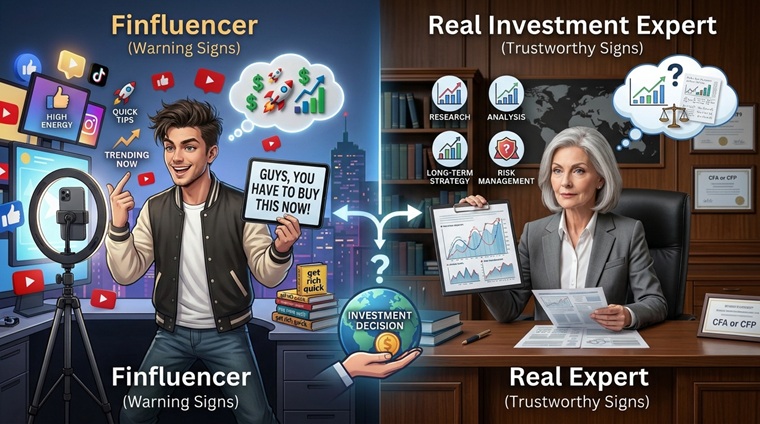
It starts innocently. You watch a short video about index funds, and the algorithm decides you are an investor now. By the end of the week, your feed is a parade of confident people in nice cars explaining which stock will double, which coin is about to explode and which “secret” the banks do not want you to know. Some are teaching real lessons. Some are selling a course. A few are running something much darker.The trouble is that they all look the same: friendly, fluent, certain. A follower count looks like credibility, and your own worry about falling behind makes it feel urgent. This guide gives you seven practical checks to tell a financial expert from a finfluencer before you put a dollar behind what you hear, plus the 2026 data that shows why they matter.
The Short Answer
Do not judge by confidence, popularity or lifestyle. Judge by verifiable things: whether the person is registered, who pays them, whether their track record is real, whether they promise returns or create urgency, whether they discuss risk and your situation, whether they show sources and whether the advice survives common sense. A finfluencer can pass some of these tests. A real expert should pass nearly all.Why This Matters Now
More investors than ever get ideas from social media, especially younger ones. At FINRA’s 2026 Annual Conference, researchers reported that 29% of investors overall use social media for investment decisions, but 60% of investors aged 18 to 34 use it for ideas, and 61% say they frequently or sometimes decide based on finfluencer recommendations. Meanwhile, only 40% of investors are confident they can assess the accuracy of what they see.Australia’s regulator found the same pattern. A March 2026 ASIC survey of 18-to-28-year-olds found that 63% had used social media for financial advice, 56% trusted financial information on it and 52% trusted finfluencers. ASIC’s commissioner warned that what people see is shaped by algorithms designed to drive clicks rather than accuracy. The stakes are real: consumers lost $2.1 billion to social media scams in 2025, $1.1 billion of it in fraudulent investment scams.
FINRA (2026): 60% of investors aged 18–34 use social media for investment ideas; 61% decide on finfluencer recommendations at least sometimes; only 40% feel confident judging accuracy. ASIC (2026): 52% of Gen Z trust finfluencers. Social media scam losses in 2025: $2.1 billion ($1.1 billion in investment scams).
What the Research Says About Finfluencer Advice
Researchers have tested whether following finfluencers pays. A Swiss Finance Institute study of more than 29,000 finfluencers found 28% were skilled, generating about 2.6% monthly abnormal returns; 16% were unskilled; and 56% had negative skill, with recommendations producing about negative 2.3% a month. Worse, those with negative skill tended to have more followers and more influence on retail trading. Popularity was not a sign of quality.A newer UNSW study analyzed thousands of hours of video and found that the median portfolio built by following financial influencer recommendations underperformed the S&P 500 by 43 percentage points over a one-year holding period. No observable characteristic predicted which influencer would do better, and confident delivery had little relationship to later performance. A Dutch study of 453 recommendations from 21 influencers found returns typically negative after the recommendation, partly because influencers tended to jump on assets that were already hyped.
Swiss Finance Institute: 28% of finfluencers skilled (+2.6% a month), 16% unskilled, 56% antiskilled (−2.3% a month); antiskilled had more followers. UNSW: median influencer-following portfolio trailed the S&P 500 by 43 percentage points over one year.
Check 1: Verify Their Registration and Credentials
The first check takes two minutes. Professionals who give personalized advice or sell investments generally must be registered, and the records are public. Search brokers on FINRA’s BrokerCheck, investment advisers on the SEC’s Investment Adviser Public Disclosure site and certified financial planners on the CFP Board’s tool. They show registration status, employment history and disciplinary actions.Read credentials closely. A title like “market strategist” or “investment coach” is not a license. Ask what the person is registered as, whether they are a fiduciary who must put your interests first and how they are paid. Finfluencers are often not registered at all. That does not make them frauds, but no regulator is checking their advice.
They give you their full name and registration number and invite you to check them on BrokerCheck, the SEC adviser database or the CFP Board.
Red flag: No searchable record, vague titles or a refusal to say how they are paid.
Check 2: Follow the Money
Everyone on social media is paid somehow; the question is whether you are told. Look for sponsorships, affiliate links, referral codes, paid courses, “exclusive” signals groups and platforms they promote. In the United States, the Federal Trade Commission’s guidance expects influencers to clearly disclose material connections such as payments, free products and commissions.CFA Institute research found inadequate disclosure of paid collaborations by finfluencers. If a creator pushes a specific platform, coin or course, assume they earn when you sign up. That is not automatically disqualifying, but it should change how much weight you give the advice. They disclose sponsorships and affiliate links up front, in plain words, before the recommendation. Hidden links in the bio, urgent pushes to open an account through their code, or a “free” signals group that leads to a paid one.
Check 3: Demand a Verified Track Record
Anyone can post screenshots of winning trades. Few can show an audited track record that includes the losers. Ask whether returns are verified by a third party, include fees and losses, and what period they cover. Remember survivorship bias: you see the creators whose picks worked, not the many who disappeared.The comparison that matters is against a simple benchmark. S&P Dow Jones Indices found that 79% of active large-cap funds trailed the S&P 500 in 2025, and those are professional teams with research budgets. A stranger’s hot streak deserves skepticism. Independent verification, losses shown alongside gains, and honest comparison with a plain index fund. Screenshots, “my students made X,” returns with no time frame or comparison.
Check 4: Watch for Guarantees and Urgency
Real investing involves risk, and real professionals say so. Promises of guaranteed returns, “risk-free” profits, “insider” tips or limited-time chances are classic warning signs, and pressure to act now, send money or move to a private chat app is how scams work. The losses are large: $2.1 billion to social media scams in 2025, and the FTC reported $2.7 billion of investment scam losses that began on social media in the first half of 2023 alone.There is also fear of missing out. A simple rule helps: wait at least a day before acting on any investment idea you saw online. A genuine opportunity will still be there tomorrow.
Green flag: They explain risks, say that losses are possible and never pressure you to decide right now. Guaranteed returns, secret tips, deadlines, requests to move to private channels or to send money.
Check 5: Do They Talk About Risk and Your Situation?
Good advice depends on the person receiving it. A real professional asks about your goals, time horizon, income, debts, emergency savings and tolerance for losses. A finfluencer speaking to millions cannot, so a specific “buy this now” call to a general audience is a red flag. Notice how risk is discussed. Honest experts explain the downside and the scenarios in which they are wrong. A video that tells you what to buy without mentioning what could go wrong is marketing, not advice. The best content teaches you how to think, not just what to buy.Check 6: Do They Show Their Work?
Credible sources can be checked. Does the creator point to filings, official data or published research, or just their own opinion? Do they admit uncertainty and past mistakes? You can cross-check claims on SEC filings, central bank websites and Investor.gov. If a claim cannot be traced to anything, treat it as an opinion.Transparency also means owning errors. Real experts talk about calls that went wrong; hype accounts delete old posts. If a creator predicted a crash that never came and never mentions it, that tells you how they treat accountability. Sources are cited, assumptions are explained and old mistakes are acknowledged.
Red flag: Claims with no source, deleted posts, shifting predictions and no admission of error.
Check 7: Test the Advice Against the Basics
The last check is common sense. Is the advice diversified, low cost and appropriate for your timeline, or is it a concentrated bet on a single stock, a leveraged product, a meme coin or an options strategy? Research on individual stocks is sobering: Hendrik Bessembinder found that the best 4.3% of US stocks explain all of the market’s net gains since 1926, and 58% failed to beat Treasury bills over their lifetimes. Picking winners is hard for everyone.If the advice is speculative, treat it as such: use only money you can afford to lose and keep it a small part of your portfolio. If the idea only makes sense because of the excitement around it, step back. Boring, diversified, low-cost investing rarely goes viral, which is probably why it works.
Your Seven-Point Scorecard
Score each check pass or fail. A creator who passes five or more is probably worth listening to for education. One who fails checks 1, 2 and 4 together should worry you, whatever their follower count. Even a perfect score does not mean you should copy their trades without considering your own situation.
What Finfluencers Do Well
It would be unfair to paint every creator with the same brush. FINRA researchers noted that investors said social media helped break down jargon. Many creators explain budgeting, retirement accounts and index funds clearly, reaching people who would never read a prospectus. That is a real service.When a creator moves from “here is how a Roth IRA works” to “buy this stock today,” that is the moment to run your seven checks.
What About AI “Advice”?
A new twist is artificial intelligence. ASIC’s March 2026 survey found that 64% of Gen Z respondents trusted AI platforms for financial information, and about one in five used AI for financial advice. The regulator warned that information from social media and AI tools can be incomplete, promotional or misleading. The same checks apply: can you verify the claims, does it know your situation and who is responsible if it is wrong? An AI tool can help you understand a concept, but it is not a registered adviser.If You Already Followed a Tip
If you have already acted on a finfluencer’s advice, do not panic and do not double down to “win it back.” Write down what you bought, when, why and at what price. Check whether the position is a small, tolerable share of your portfolio and whether it still fits your plan. Consider a conversation with a registered adviser. If you suspect fraud, such as a guaranteed-return scheme or pressure to send money, stop sending funds, keep records and report it to the SEC, the FTC and your state securities regulator.Conclusion
Finfluencer or real expert? You cannot tell from the follower count, the car or the confidence. You can tell from seven checks: registration, who pays, verified results, guarantees and urgency, personal fit, sources and basic soundness. The data show why they matter: 60% of investors aged 18 to 34 use social media for investment ideas, only 40% of investors feel confident judging accuracy, 56% of finfluencers in one large study had negative skill and the median portfolio following influencer picks trailed the S&P 500 by 43 percentage points in a year.None of that means you must ignore social media. Enjoy the education, verify the claims and keep your own plan in charge. When money is on the line, a boring answer from a registered professional who knows your situation beats an exciting one from a stranger. A registered adviser can help you apply this.
Frequently Asked Questions
What is a finfluencer?A finfluencer is a social media creator who talks about investing, money or markets. Many are educators; some are paid promoters; a few are fraudsters. The term says nothing about whether the person is qualified, registered or accurate.
Are all finfluencers bad?
No. Investors told FINRA that social media helped break down jargon. The risk is acting on specific buy or sell calls from unregistered strangers; education is where finfluencers add the most value.
How do I check whether someone is a registered financial professional?
Search FINRA BrokerCheck for brokers, the SEC’s Investment Adviser Public Disclosure site for advisers and the CFP Board’s lookup for certified financial planners. These free tools show registration, employment history and disciplinary records.
Do finfluencers have to disclose paid promotions?
In the US, the Federal Trade Commission expects influencers to clearly disclose material connections such as payments, free products or affiliate commissions. CFA Institute research found disclosure of paid collaborations is often inadequate, so a missing label does not mean there is no payment.
What should I do if I already acted on a finfluencer’s tip?
Do not panic or double down. Write down what you bought, why and what you paid, and check whether it fits your goals. If you think you were defrauded, report it to the SEC, the FTC and your state securities regulator.
0 Comments
Be the first to share your thoughts on this article.