

Investing
5 Types of Stocks to Avoid as Interest Rates Rise This Fall?

Fed target 3.75%–4.00% after a September hike, another hike back on the table; 10-year about 5.2%–5.3% (touched 5.00% on September 14); 30-year 5.66% on October 5; 30-year mortgage 7.40% (6.36% in May); inflation 3.7%. BlackRock (Oct 12): worst damage in consumer, utilities, housing and small caps; homebuilders down about 16% from their summer peak; tech is the market’s key support but many large tech firms are funding AI spending with debt. Yield contest: S&P 500 yield about 1.0%; utilities about 3.56% and REITs about 5.39% among dividend payers (Dividend.com); 52-week T-bill 4.46%; 10-year about 5.24%. Housing: payment on the median home $417,500 rose from about $2,080 (May) to about $2,313 (7.40%); existing-home sales ran at 3.99 million, down 2.2% from a year earlier. Exposure in the S&P 500 (June 30): technology 38.0%, consumer discretionary 9.3%, utilities 2.2%, real estate 1.8%. Six months after 10-year yield breakouts above 5%: 1966 −1.6%; 2006 +4.7%; 2023 +19.6%.
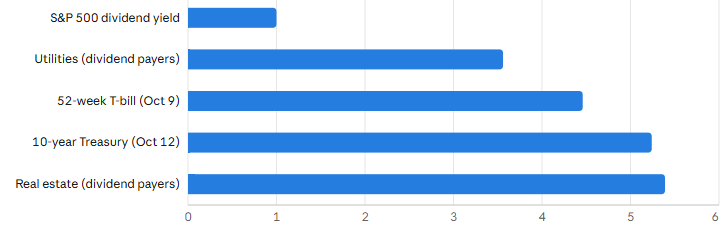
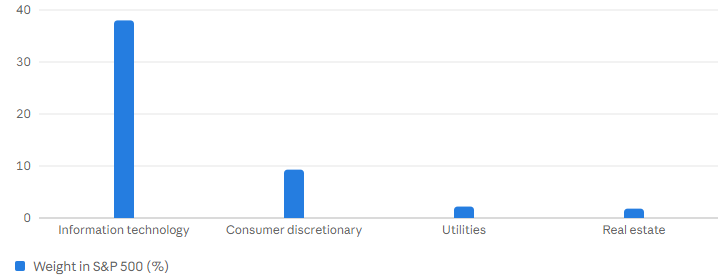
Table of Contents
Naturally, investors are asking which stocks to avoid. It deserves a careful answer rather than a list of scary tickers. Rising rates do not hurt all stocks equally, and “avoid” is stronger than the evidence usually supports. So this post looks at five types of stocks most exposed, shows the 2026 data behind each and ends with a checklist for deciding what, if anything, to do.
I am deliberately not naming individual companies to dump. Being in a vulnerable group is a risk factor, not a verdict: a strong balance sheet, pricing power or low valuation can offset rate sensitivity, and a stock in a “safe” sector can still be a bad one.
There is an important caveat, which BlackRock stresses: the level of rates and small changes tend to have little effect on stocks, while large abrupt moves have historically coincided with negative returns. That is why the speed of this year’s move matters as much as the number itself.
Builders are fighting back with incentives. The Close reported that reduced mortgage rates appeared on 13.8% of listings in August data, at an average advertised rate of 3.92%, though that includes temporary buydowns and adjustable-rate loans. Those incentives protect sales but cost builders margin, and housing-related stocks such as building products and home-improvement retailers share the risk of a slower market. The upside case is that they are already down and lower rates would revive demand quickly, but with rates still rising, that is a bet on timing.
The numbers: 30-year mortgage: 6.36% (May 14) to 7.40% (Oct 15). Payment on a $334,000 loan: about $2,080 to $2,313 a month (+$232). Existing-home sales: 3.99 million pace, −2.2% year over year. Homebuilders: about −16% from summer peak (BlackRock).
The nuance is that small caps have had a strong year. The S&P SmallCap 600 returned 16.30% through October 2, ahead of the S&P 500’s 13.79%, according to First Trust, and Royce noted in July that small-cap valuations relative to large caps were near their lowest in 25 years. So the risk is not that small caps are broadly bad; it is that the weakest, most indebted ones are most exposed. Check debt maturities, interest coverage and cash before assuming a bargain.
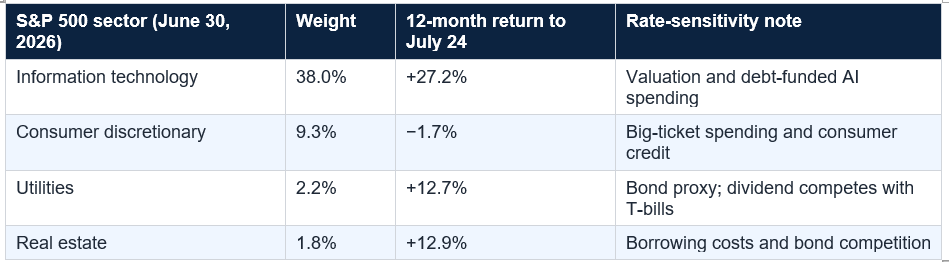
Both groups also depend on borrowing. Morningstar notes that rising rates are bad for real estate developers and REITs that need to borrow, and that utilities are sensitive because higher rates constrain capital spending. BlackRock named utilities among the sectors most damaged this fall. They had been doing well beforehand: Schwab data show real estate up 12.9% and utilities up 12.7% over the twelve months to July 24, before yields spiked. Not every REIT is the same, though, and any REIT particularly sensitive to the economy will be hurt, according to a Morningstar analyst.
Valuation is the other issue. The S&P 500’s forward P/E is about 20, an earnings yield of about 5.0%, against a 10-year yield of about 5.24%, a gap of about negative 0.2 points by my arithmetic, and CAPE is near 41.6. When the risk-free return matches the earnings yield, expensive stocks need earnings growth to justify prices. The most vulnerable have high valuations, little profit today and heavy borrowing, which is not all of tech.
Households paying more for debt and prices have less to spend on cars, furniture and travel. BlackRock’s recommendation, an opinion rather than a fact, is to stay underweight consumer and housing-related names, along with small caps, while rates stay elevated. As elsewhere, strong brands with pricing power and little debt are less vulnerable than leveraged ones.
If you decide to reduce risk, there are gentler options than dumping everything: rebalance to targets, direct new contributions toward underweight areas and hold Treasury bills for near-term needs. The alternative to rate-sensitive stocks is not zero risk, only different risk.
A sector can be vulnerable and still be a good long-term holding. Rates can fall as quickly as they rise, and stocks that were hit hardest sometimes rebound the most. Do not let a one-season theme override a long-term plan.
But avoiding whole categories is a blunt tool. Most index fund investors hold only small slices of the most rate-sensitive sectors, the biggest rate risk may be in expensive technology, and past 5% yield episodes ended very differently. The better approach is to understand your exposure, check each holding’s debt and valuation, rebalance rather than react and keep your timeline in view. A qualified adviser can help with your situation.
Stocks that depend on borrowing, are valued on far-off earnings or compete with bonds for income tend to be most exposed: homebuilders and housing-related companies, small caps with heavy debt, bond-like dividend payers such as utilities and REITs, expensive growth stocks and consumer discretionary names reliant on big-ticket borrowing. BlackRock’s October 2026 analysis found the worst damage in consumer, utilities, housing and small caps.
Should I sell these stocks now?
Not automatically. BlackRock notes that the level of rates and small changes have little impact on stocks, while large abrupt moves have historically coincided with negative returns. Selling requires two correct decisions, when to exit and when to return, and may trigger taxes. Review your goals, time horizon and the specific companies, not just their sector label.
Are there stocks that benefit from rising rates?
Some may. Energy led on October 23 as Brent crude hit about $116, though that was driven by oil rather than interest rates. Exchanges earn more on collateral when short-term rates rise, according to Morningstar. But benefiting from higher rates does not make a stock a good buy; valuation and business quality still matter.
Does the Fed raising rates always push stocks down?
No. History is mixed. After the 10-year yield broke above 5% in 2023, the S&P 500 gained 19.6% over the next six months, while in 1966 it fell 1.6% and in 2006 it rose 4.7%. What mattered was valuation, earnings growth and why yields were rising.
What should long-term investors do as rates rise?
For most, the answer is to keep a diversified portfolio, rebalance if needed and avoid large bets on one theory. Money needed within a few years can sit in Treasury bills or insured savings now yielding about 4.3% to 4.5%. This article is general education, not personal advice.
Group 3: bond proxies face a tougher yield contest (%, 2026)
Yield (%) by Fidelity Q3; Dividend.com (Aug 13); MyMoneyBlog (Oct). Sector yields cover dividend payers only
How exposed is an S&P 500 fund? Sector weights (%, June 30, 2026)
% of index by Source: Schwab / S&P Dow Jones Indices. Homebuilders are a sliver; small caps are not in the indexTable of Contents
- A Fall Defined by Rates
- The Short Answer: Five Groups, Not Five Tickers
- Why Rising Rates Hurt Some Stocks
- Group 1: Homebuilders and Housing-Related Stocks
- Group 2: Small Caps With Heavy Debt
- Group 3: Bond Proxies, Utilities and REITs
- Group 4: Expensive Growth and Debt-Funded AI Spenders
- Group 5: Consumer Discretionary and Big-Ticket Borrowers
- What Has Held Up
- How Exposed Is Your Portfolio?
- What History Says
- A Checklist Before You Avoid or Sell Anything
- Conclusion
- Frequently Asked Questions
A Fall Defined by Rates
Every autumn has a theme, and this year’s is the cost of money. The Federal Reserve raised its target range to 3.75%–4.00% in September, and Reuters reported in mid-October that another hike was back on the table after a hotter inflation reading. The 10-year Treasury yield touched 5.00% on September 14, the first time since 2023, and was around 5.2% to 5.3% in October, while the 30-year closed at 5.66% on October 5, its highest close in over 24 years. The 30-year mortgage rate reached 7.40%.Naturally, investors are asking which stocks to avoid. It deserves a careful answer rather than a list of scary tickers. Rising rates do not hurt all stocks equally, and “avoid” is stronger than the evidence usually supports. So this post looks at five types of stocks most exposed, shows the 2026 data behind each and ends with a checklist for deciding what, if anything, to do.
The Short Answer: Five Groups, Not Five Tickers
The five groups most exposed to rising rates are homebuilders and housing-related stocks, small caps with heavy debt, bond-like dividend payers such as utilities and REITs, expensive growth stocks and debt-funded spenders, and consumer discretionary companies that rely on big-ticket borrowing. BlackRock’s Russ Koesterich wrote on October 12 that the worst damage had been concentrated in consumer, utilities, housing and small caps, with homebuilders down about 16% from their summer peak.I am deliberately not naming individual companies to dump. Being in a vulnerable group is a risk factor, not a verdict: a strong balance sheet, pricing power or low valuation can offset rate sensitivity, and a stock in a “safe” sector can still be a bad one.
Why Rising Rates Hurt Some Stocks
There are three channels. First, valuation: a higher Treasury yield raises the discount rate used to value future earnings, which lowers the present value of profits expected far in the future. Second, borrowing costs: companies and households with floating-rate or refinancing needs pay more. Third, competition: when a Treasury bill pays about 4.46% and the 10-year yields around 5.2%, a stock with a 2% dividend has to offer something extra to compete.There is an important caveat, which BlackRock stresses: the level of rates and small changes tend to have little effect on stocks, while large abrupt moves have historically coincided with negative returns. That is why the speed of this year’s move matters as much as the number itself.
Group 1: Homebuilders and Housing-Related Stocks
Housing is where rates hit first. The 30-year mortgage rate climbed from 6.36% in May to 7.40% on October 15, which adds about $232 a month to the principal-and-interest payment on a $334,000 loan, by my calculation. NAR reported that existing-home sales ran at a 3.99 million annual pace in September, down 2.2% from a year earlier, with the median price at $417,500. BlackRock noted homebuilders were down about 16% from their summer peak as of its late-September data.Builders are fighting back with incentives. The Close reported that reduced mortgage rates appeared on 13.8% of listings in August data, at an average advertised rate of 3.92%, though that includes temporary buydowns and adjustable-rate loans. Those incentives protect sales but cost builders margin, and housing-related stocks such as building products and home-improvement retailers share the risk of a slower market. The upside case is that they are already down and lower rates would revive demand quickly, but with rates still rising, that is a bet on timing.
The numbers: 30-year mortgage: 6.36% (May 14) to 7.40% (Oct 15). Payment on a $334,000 loan: about $2,080 to $2,313 a month (+$232). Existing-home sales: 3.99 million pace, −2.2% year over year. Homebuilders: about −16% from summer peak (BlackRock).
Group 2: Small Caps With Heavy Debt
Small companies tend to borrow more, at floating rates and with shorter maturities, so rising rates hit their interest costs and refinancing plans directly. Morningstar notes that higher rates are generally negative for investments that rely on debt financing, including small caps, and BlackRock listed small caps among the most rate-sensitive areas of the market in October.The nuance is that small caps have had a strong year. The S&P SmallCap 600 returned 16.30% through October 2, ahead of the S&P 500’s 13.79%, according to First Trust, and Royce noted in July that small-cap valuations relative to large caps were near their lowest in 25 years. So the risk is not that small caps are broadly bad; it is that the weakest, most indebted ones are most exposed. Check debt maturities, interest coverage and cash before assuming a bargain.
Group 3: Bond Proxies, Utilities and REITs
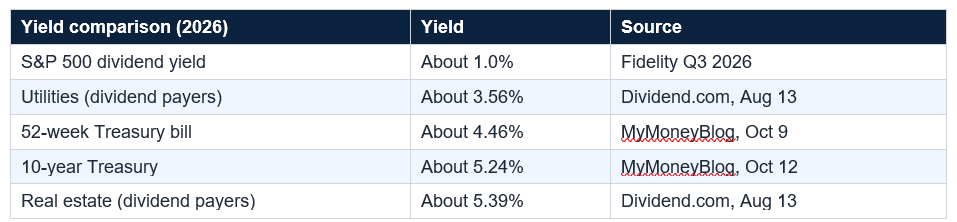
Utilities and REITs earn their place in portfolios through steady dividends, which makes them behave like bonds. When bond yields rise, that income is less special. Dividend.com’s August survey found utilities yielding about 3.56% and real estate about 5.39% among dividend payers, while a 52-week T-bill paid 4.46% and the 10-year around 5.24%. By my arithmetic, the average utility dividend payer yields about 0.9 points less than a T-bill, which carries essentially no stock risk. That is a hard comparison to win.Both groups also depend on borrowing. Morningstar notes that rising rates are bad for real estate developers and REITs that need to borrow, and that utilities are sensitive because higher rates constrain capital spending. BlackRock named utilities among the sectors most damaged this fall. They had been doing well beforehand: Schwab data show real estate up 12.9% and utilities up 12.7% over the twelve months to July 24, before yields spiked. Not every REIT is the same, though, and any REIT particularly sensitive to the economy will be hurt, according to a Morningstar analyst.
Group 4: Expensive Growth and Debt-Funded AI Spenders
The fourth group is the trickiest, because technology has been the market’s engine. It is 38.0% of the S&P 500 and gained 27.2% over the twelve months to July 24, according to Schwab, and BlackRock calls it the market’s key support. But BlackRock also warns that many large tech companies are financing massive AI spending with debt, which could make them more sensitive to further rate increases.Valuation is the other issue. The S&P 500’s forward P/E is about 20, an earnings yield of about 5.0%, against a 10-year yield of about 5.24%, a gap of about negative 0.2 points by my arithmetic, and CAPE is near 41.6. When the risk-free return matches the earnings yield, expensive stocks need earnings growth to justify prices. The most vulnerable have high valuations, little profit today and heavy borrowing, which is not all of tech.
Group 5: Consumer Discretionary and Big-Ticket Borrowers
The fifth group is consumer discretionary, especially companies selling big-ticket items that people finance. BlackRock includes consumer in its list of the hardest-hit areas, and Schwab data show consumer discretionary was the weakest sector over the twelve months to July 24, down 1.7%. The squeeze on shoppers is real: inflation was 3.7% in September, real hourly earnings are down 0.7% and the New York Fed reports credit card balances of $1.263 trillion, with an average card rate near 21%.Households paying more for debt and prices have less to spend on cars, furniture and travel. BlackRock’s recommendation, an opinion rather than a fact, is to stay underweight consumer and housing-related names, along with small caps, while rates stay elevated. As elsewhere, strong brands with pricing power and little debt are less vulnerable than leveraged ones.
What Has Held Up
It helps to see the other side. On October 23, energy was the best sector with a 2.51% gain as Brent crude reached about $116 a barrel, and Exxon, Chevron and ConocoPhillips closed at all-time highs, according to TipRanks and The Wall Street Republic. That strength comes from oil, not interest rates, and can reverse quickly. Morningstar notes that exchanges benefit modestly from higher short-term rates because they earn interest on collateral. Benefiting from rising rates does not make a stock cheap or safe.How Exposed Is Your Portfolio?
Here is a reassuring fact for index fund investors: the most rate-sensitive groups are small slices of the S&P 500. As of June 30, utilities were 2.2% and real estate 1.8%, while consumer discretionary was 9.3%; homebuilders are a sliver and small caps are not in the index at all. Technology, by contrast, is 38.0%. So the bigger rate risk in a typical S&P 500 fund may be its concentration in expensive tech, not the sectors on a typical “avoid” list.
What History Says
History offers perspective, not a forecast. After the 10-year yield broke above 5% in October 2023, the S&P 500 fell a bit further, then gained 19.6% over six months as yields retreated. In 1966 it was down 1.6% over six months, and in 2006 it rose 4.7%. UBS found stocks roughly flat on average over the three months after sharp yield spikes since 1985. In 2007, stocks kept rising about four months before a severe bear market. The difference was valuation, earnings growth and why yields were rising.A Checklist Before You Avoid or Sell Anything
Before acting on any list, ask a few questions. How much debt does the company carry, and when must it refinance? Does its dividend compare well to Treasury bills, and is it safe? Is the stock expensive relative to earnings? What would selling cost in taxes, and when would you buy back? Does the position matter to your overall portfolio? And what is your time horizon? A long-term investor can usually ride out rate cycles; money needed in two years should not be in stocks in the first place.If you decide to reduce risk, there are gentler options than dumping everything: rebalance to targets, direct new contributions toward underweight areas and hold Treasury bills for near-term needs. The alternative to rate-sensitive stocks is not zero risk, only different risk.
A sector can be vulnerable and still be a good long-term holding. Rates can fall as quickly as they rise, and stocks that were hit hardest sometimes rebound the most. Do not let a one-season theme override a long-term plan.
Conclusion
As interest rates rise this fall, five groups are most exposed: homebuilders and housing-related stocks, debt-laden small caps, bond-like utilities and REITs, expensive and debt-funded growth stocks and consumer discretionary companies tied to big-ticket borrowing. BlackRock’s October analysis, the New York Fed’s debt data and sector yields all point the same way: the more a stock depends on cheap borrowing, distant earnings or a yield that competes with bonds, the more rising rates matter.But avoiding whole categories is a blunt tool. Most index fund investors hold only small slices of the most rate-sensitive sectors, the biggest rate risk may be in expensive technology, and past 5% yield episodes ended very differently. The better approach is to understand your exposure, check each holding’s debt and valuation, rebalance rather than react and keep your timeline in view. A qualified adviser can help with your situation.
Frequently Asked Questions
Which stocks are hurt most when interest rates rise?Stocks that depend on borrowing, are valued on far-off earnings or compete with bonds for income tend to be most exposed: homebuilders and housing-related companies, small caps with heavy debt, bond-like dividend payers such as utilities and REITs, expensive growth stocks and consumer discretionary names reliant on big-ticket borrowing. BlackRock’s October 2026 analysis found the worst damage in consumer, utilities, housing and small caps.
Should I sell these stocks now?
Not automatically. BlackRock notes that the level of rates and small changes have little impact on stocks, while large abrupt moves have historically coincided with negative returns. Selling requires two correct decisions, when to exit and when to return, and may trigger taxes. Review your goals, time horizon and the specific companies, not just their sector label.
Are there stocks that benefit from rising rates?
Some may. Energy led on October 23 as Brent crude hit about $116, though that was driven by oil rather than interest rates. Exchanges earn more on collateral when short-term rates rise, according to Morningstar. But benefiting from higher rates does not make a stock a good buy; valuation and business quality still matter.
Does the Fed raising rates always push stocks down?
No. History is mixed. After the 10-year yield broke above 5% in 2023, the S&P 500 gained 19.6% over the next six months, while in 1966 it fell 1.6% and in 2006 it rose 4.7%. What mattered was valuation, earnings growth and why yields were rising.
What should long-term investors do as rates rise?
For most, the answer is to keep a diversified portfolio, rebalance if needed and avoid large bets on one theory. Money needed within a few years can sit in Treasury bills or insured savings now yielding about 4.3% to 4.5%. This article is general education, not personal advice.
0 Comments
Be the first to share your thoughts on this article.