

Investing
The Best Aerospace and Defense ETFs to Buy After the Selloff

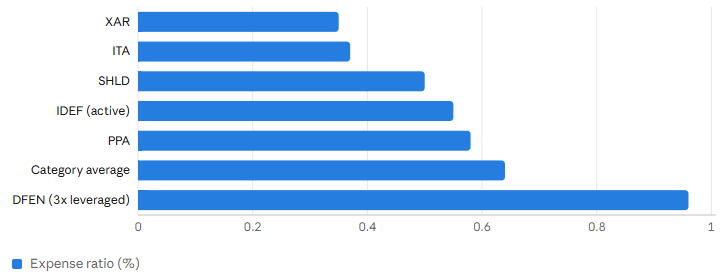
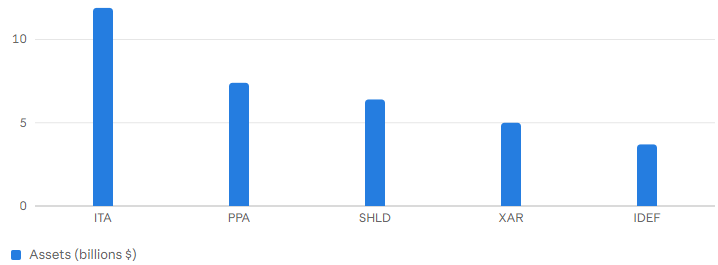
Selloff: ITA, PPA and XAR fell 17.4%, 15.6% and 19.3% over six weeks since August (six straight weekly losses); ITA is down 3.90% and XAR 7.49% year to date (Oct 21). Of XAR’s 50 stocks, 42 fell in September. Valuation swing: defense went from a 15% premium to the S&P 500 in February to a 12% discount (analyst view); in April the S&P 500 aerospace and defense index traded at about 32 times forward earnings vs about 20 for the S&P 500. Fees (expense ratio): XAR 0.35%, ITA 0.37%, SHLD 0.50%, IDEF 0.55%, PPA 0.58%, leveraged DFEN 0.96%; category average 0.64%. Assets: ITA $11.9B, PPA $7.4B, SHLD $6.4B, XAR $5.0B, IDEF $3.7B. Concentration: GE Aerospace and RTX together exceed 38% of ITA (July); Palantir 11.69%, RTX 9.05% and General Dynamics 8.31% lead SHLD (about 29% combined). Budget: the 2027 request of $1.5 trillion compares with $901 billion approved for 2026 (about 66% higher); Congress has not approved it.
That puzzle is why this is a good moment to look at these funds carefully. Lower prices can mean opportunity, or they can mean the market sees problems you do not. This guide explains what happened, compares the main ETFs on cost, holdings and risk, and helps you decide which, if any, fits. I will not call any fund a sure thing, because none is.
But first decide whether you want defense exposure at all, because the sector is volatile and currently out of favor. Treat any of these as a satellite holding, sized so that a 20% drop would not hurt your plan.
Third, the fall selloff. Benzinga reported that ITA, PPA and XAR each posted six straight weekly losses, falling 17.4%, 15.6% and 19.3% since August, erasing the year’s gains. Of XAR’s 50 stocks, 42 fell in September, including Axon (−25%), Carpenter Technology (−19.1%), Boeing (−11.3%) and RTX (−9.7%). A stalled budget was a major factor. One analyst noted that defense went from a 15% premium to the S&P 500 in February, when a $1.5 trillion budget proposal was in focus, to a 12% discount.
Six straight weekly losses: ITA −17.4%, PPA −15.6%, XAR −19.3% since August. Year to date (Oct 21): ITA −3.90%, XAR −7.49%. Defense moved from a 15% premium to the S&P 500 in February to a 12% discount (one analyst’s estimate). The 2027 budget request is $1.5 trillion versus $901 billion approved for 2026.
Structure also differs. Some funds weight companies by size, which concentrates your money in the giants. Others weight them equally, giving smaller suppliers a bigger say. Newer thematic funds tilt toward defense technology, such as software, drones and cybersecurity. Understanding which you are buying matters more than the ticker.
ITA lost 0.80% over the year to September 30 and was down 3.90% year to date as of October 21, and it fell slightly less than XAR in the selloff. If you want one fund that mostly mirrors the established US aerospace and defense industry, this is the usual choice. Remember, though, that GE Aerospace alone was roughly a fifth of the fund in older data, so commercial jet engines matter.
The flip side is volatility. XAR fell 9.95% in September and 18.63% in the third quarter, and was down 7.49% year to date. The September pain was broad, with 42 of its 50 holdings declining and drone and defense-technology names leading the losses. Expect bigger swings than ITA in both directions.
It is still top-heavy: GE Aerospace, RTX and Boeing lead, and the top five account for roughly 40% of the portfolio. PPA fell 15.6% over the six weeks since August. Its longer record is a plus, with a five-year annualized return of about 16.6% in one data set, but the higher fee is a cost to weigh.
It has been the weakest of the group: SHLD returned about negative 13.5% over the year to late September, versus negative 0.8% for ITA. If you believe future warfare is about software and drones, SHLD is a direct way to express that view, but it comes with higher fees, higher volatility and heavy dependence on a handful of names.
The one to skip, for most buy-and-hold investors, is the leveraged funds. The Direxion Daily Aerospace & Defense Bull 3X ETF carries a 0.96% expense ratio and aims to deliver three times the sector’s daily return. Because it resets daily, it can lose money over time even when the sector is flat, and it magnifies the kind of drops defense has just experienced. These are trading tools, not core holdings.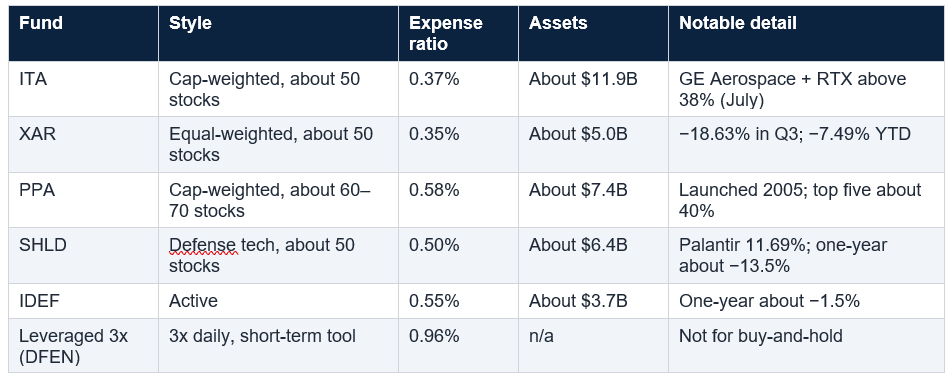
On the bearish side, the budget could stay stalled, and a continuing resolution would lock spending at 2026 levels. Peace headlines can hurt as quickly as conflict headlines help. Valuations, though lower now, were stretched earlier in the year, and some analysts note that funding gets diverted to immediate operational needs during conflicts rather than modernization. Commercial aerospace adds its own cycle. None of this is predictable, which is why position size matters.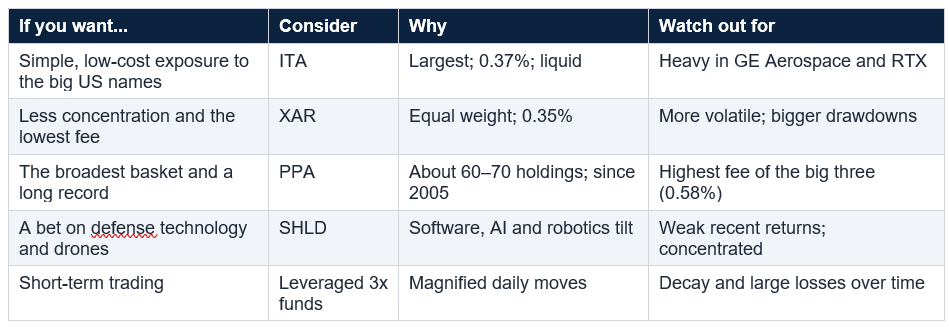
Remember why you are buying. If the reason is a war headline, be careful: this year showed that conflict headlines do not guarantee returns. If it is a long-term view on government spending and technology, be patient, and accept that a lower price is not proof of a bargain. The S&P 500 has averaged about 10.26% a year since 1928, according to Gitnux, and a broad fund captures that without betting on one sector.
The timing is genuinely uncertain. Defense stocks fell 15% to 19% in six weeks despite a war, valuations have compressed, budgets are unresolved and the November elections could be a turning point. That can be an opportunity for patient investors and a trap for impatient ones. Decide your position size first, choose the fund that fits your goals and costs, and treat headlines with caution. A qualified adviser can help you apply this.
There is no single best fund. ITA is the largest and a low-cost way to hold the big US names, XAR spreads weight evenly across about 50 stocks at the lowest fee, PPA is the broadest and oldest, and SHLD focuses on defense technology. The best one depends on whether you want the giants, more smaller companies or a technology tilt.
Why have defense ETFs fallen in 2026 despite the Iran war?
Several things overlapped: a “buy on expectations, sell on reality” pattern after the conflict began, valuations of about 32 times forward earnings in April, and a stalled US budget this fall. One analyst said defense went from a 15% premium to the S&P 500 in February to a 12% discount.
Are aerospace and defense ETFs pure defense plays?
No. Funds such as ITA and PPA hold large commercial aerospace names such as GE Aerospace and Boeing alongside defense contractors like RTX and Lockheed Martin. That means commercial air travel, aircraft deliveries and supply chains matter as much as military budgets.
Should I buy a leveraged defense ETF?
Leveraged funds, such as a 3x daily ETF with a 0.96% expense ratio, reset every day and can lose value even when the sector is flat over time. They are designed for short-term trading, not buy-and-hold investing.
How much of my portfolio should be in defense ETFs?
Only you and your adviser can decide, but a sector fund is usually a satellite holding. A broad index fund may already include several defense and aerospace companies. Limit any single-sector position to an amount you could see fall 20% or more without changing your plans.
What it costs: annual expense ratios of aerospace and defense ETFs (%)
Expense ratio (% per year) by Sources: Finder, U.S. News, PortfoliosLab, The Motley Fool
How big are they? Assets under management ($ billions, October 2026)
Assets ($ billions) by Sources: Finder, Dividend Vision, The Motley Fool; assets differ by provider and date
Table of Contents
- The Odd Case of a War and a Bear Market
- The Short Answer
- What Happened to Defense Stocks in 2026
- What You Are Actually Buying
- ITA: The Big Names, Lowest Hassle
- XAR: Equal-Weight and More Volatile
- PPA: The Broadest and Oldest
- SHLD: The Defense-Tech Bet
- Other Options and One to Skip
- The Funds Side by Side
- Costs: Small Differences That Add Up
- What Could Move Defense Next
- Which Fund Fits Which Investor?
- How to Buy Without Betting the Farm
- Conclusion
- Frequently Asked Questions
The Odd Case of a War and a Bear Market
Ask most investors in February whether defense stocks would do well in a year with a major war, and they would have said yes. The conflict with Iran began on February 28, oil is above $100 and governments are talking about the largest military budgets in a generation. Yet the biggest aerospace and defense ETFs are in a bear market, with the year’s gains erased.That puzzle is why this is a good moment to look at these funds carefully. Lower prices can mean opportunity, or they can mean the market sees problems you do not. This guide explains what happened, compares the main ETFs on cost, holdings and risk, and helps you decide which, if any, fits. I will not call any fund a sure thing, because none is.
The Short Answer
If you want broad, low-cost exposure to the big US aerospace and defense companies, the iShares U.S. Aerospace & Defense ETF (ITA) is the largest and a sensible starting point. If you want to avoid concentration in a few giants, the SPDR S&P Aerospace & Defense ETF (XAR) equal-weights about 50 stocks at the lowest fee. The Invesco Aerospace & Defense ETF (PPA) casts the widest net, and the Global X Defense Tech ETF (SHLD) leans toward software, drones and cybersecurity.But first decide whether you want defense exposure at all, because the sector is volatile and currently out of favor. Treat any of these as a satellite holding, sized so that a 20% drop would not hurt your plan.
What Happened to Defense Stocks in 2026
The story has three chapters. First, expectations: defense stocks surged from 2020 to 2025, with the defense index up more than 150%, according to Reuters, and by early April the S&P 500 aerospace and defense index traded at about 32 times forward earnings versus about 20 for the S&P 500. Second, “buy on expectations, sell on reality”: after the Iran war began, the NYSE Arca Defense index dropped nearly 8% in March, against a 5% fall in the S&P 500, as investors concluded that much of the conflict premium was already in prices.Third, the fall selloff. Benzinga reported that ITA, PPA and XAR each posted six straight weekly losses, falling 17.4%, 15.6% and 19.3% since August, erasing the year’s gains. Of XAR’s 50 stocks, 42 fell in September, including Axon (−25%), Carpenter Technology (−19.1%), Boeing (−11.3%) and RTX (−9.7%). A stalled budget was a major factor. One analyst noted that defense went from a 15% premium to the S&P 500 in February, when a $1.5 trillion budget proposal was in focus, to a 12% discount.
Six straight weekly losses: ITA −17.4%, PPA −15.6%, XAR −19.3% since August. Year to date (Oct 21): ITA −3.90%, XAR −7.49%. Defense moved from a 15% premium to the S&P 500 in February to a 12% discount (one analyst’s estimate). The 2027 budget request is $1.5 trillion versus $901 billion approved for 2026.
What You Are Actually Buying
A common misunderstanding is that aerospace and defense ETFs are pure military plays. They hold defense contractors such as RTX, Lockheed Martin, Northrop Grumman and General Dynamics, and large commercial aerospace names such as GE Aerospace, Boeing and TransDigm. Passenger jet demand and aircraft deliveries can matter as much as Pentagon budgets.Structure also differs. Some funds weight companies by size, which concentrates your money in the giants. Others weight them equally, giving smaller suppliers a bigger say. Newer thematic funds tilt toward defense technology, such as software, drones and cybersecurity. Understanding which you are buying matters more than the ticker.
ITA: The Big Names, Lowest Hassle
The iShares U.S. Aerospace & Defense ETF is the category’s heavyweight, with about $11.9 billion in assets, roughly 50 holdings and an expense ratio of 0.37%, according to Finder. It is cap-weighted, which makes it simple and liquid but concentrated: GE Aerospace and RTX together made up more than 38% of the fund as of late July, according to U.S. News. The yield is modest, around 0.3%.ITA lost 0.80% over the year to September 30 and was down 3.90% year to date as of October 21, and it fell slightly less than XAR in the selloff. If you want one fund that mostly mirrors the established US aerospace and defense industry, this is the usual choice. Remember, though, that GE Aerospace alone was roughly a fifth of the fund in older data, so commercial jet engines matter.
XAR: Equal-Weight and More Volatile
The SPDR S&P Aerospace & Defense ETF holds about 50 stocks with roughly $5.0 billion in assets and the lowest expense ratio of the main funds at 0.35%. Its equal-weight approach spreads money across large primes, mid-sized suppliers and smaller technology names, so no single stock dominates. In strong stretches for smaller companies, XAR can outrun the cap-weighted funds. U.S. News reported an annualized 33.4% return over three years as of July.The flip side is volatility. XAR fell 9.95% in September and 18.63% in the third quarter, and was down 7.49% year to date. The September pain was broad, with 42 of its 50 holdings declining and drone and defense-technology names leading the losses. Expect bigger swings than ITA in both directions.
PPA: The Broadest and Oldest
The Invesco Aerospace & Defense ETF launched in 2005 and is one of the oldest in the category. It has about $7.4 billion in assets, roughly 60 to 70 holdings and the highest expense ratio of the big three at 0.58%, about $58 a year on every $10,000. It casts a wider net, including adjacent aerospace and defense-technology businesses beyond the primes.It is still top-heavy: GE Aerospace, RTX and Boeing lead, and the top five account for roughly 40% of the portfolio. PPA fell 15.6% over the six weeks since August. Its longer record is a plus, with a five-year annualized return of about 16.6% in one data set, but the higher fee is a cost to weigh.
SHLD: The Defense-Tech Bet
The Global X Defense Tech ETF is the newest of the big four, launched about three years ago, and now holds around $6.4 billion across 50 stocks. It charges 0.50%. Instead of centering on traditional primes, it targets companies positioned to benefit from technology, systems and hardware for national security, including cybersecurity, artificial intelligence, robotics and drones. Its top holdings are Palantir at 11.69%, RTX at 9.05% and General Dynamics at 8.31%, about 29% combined, according to The Motley Fool.It has been the weakest of the group: SHLD returned about negative 13.5% over the year to late September, versus negative 0.8% for ITA. If you believe future warfare is about software and drones, SHLD is a direct way to express that view, but it comes with higher fees, higher volatility and heavy dependence on a handful of names.
Other Options and One to Skip
A few other funds deserve a mention. The actively managed iShares Defense Industrials and Tech ETF (IDEF) has about $3.7 billion and a 0.55% expense ratio. The Select STOXX Europe Aerospace & Defense ETF (EUAD) offers European exposure with about $1.1 billion and a 0.50% fee, though MSCI’s Europe aerospace and defense index fell 9.2% in March, its biggest monthly drop in five years. The SPDR S&P Kensho Future Security ETF (FITE) is small, at $143 million and 0.45%.The one to skip, for most buy-and-hold investors, is the leveraged funds. The Direxion Daily Aerospace & Defense Bull 3X ETF carries a 0.96% expense ratio and aims to deliver three times the sector’s daily return. Because it resets daily, it can lose money over time even when the sector is flat, and it magnifies the kind of drops defense has just experienced. These are trading tools, not core holdings.
The Funds Side by Side
Costs: Small Differences That Add Up
Fees look small, but they are certain, while returns are not. The category’s average expense ratio is about 0.64%, according to PortfoliosLab. On a $10,000 investment, that is $35 a year at XAR, $37 at ITA, $50 at SHLD, $55 at IDEF and $58 at PPA, versus $96 at the leveraged fund. Using my own illustration, $10,000 earning 7% a year before fees for ten years grows to about $19,037 in a 0.35% fund and about $18,631 in a 0.58% fund, a difference of roughly $400. That gap is not enormous, but it is a guaranteed drag. Fees should not be the only criterion, but when two funds do roughly the same job, pick the cheaper one.What Could Move Defense Next
Several catalysts could swing the sector either way. On the bullish side, the Pentagon’s 2027 request is $1.5 trillion versus $901 billion approved for 2026, a roughly 66% increase, though Congress has not approved it. One analyst argued that the November 3 elections are a clearing event and that the 2027 investment budget could rise by more than 10%. Backlogs are strong: RTX reported a record $271 billion, up 25%, and GE Aerospace’s first-quarter revenue rose 25%. And the conflict is unresolved: Brent crude hit about $116 on October 23 as the US and Iran prepared for a return to action.On the bearish side, the budget could stay stalled, and a continuing resolution would lock spending at 2026 levels. Peace headlines can hurt as quickly as conflict headlines help. Valuations, though lower now, were stretched earlier in the year, and some analysts note that funding gets diverted to immediate operational needs during conflicts rather than modernization. Commercial aerospace adds its own cycle. None of this is predictable, which is why position size matters.
Which Fund Fits Which Investor?
How to Buy Without Betting the Farm
A few practical rules help. Treat a sector ETF as a satellite around a diversified core. Decide in advance the maximum share of your portfolio you will put in defense and aerospace, and stick to it. Consider buying in stages over several months, since the sector has proven volatile. Check what your existing funds already hold, because a broad index fund may already include RTX, GE Aerospace and others.Remember why you are buying. If the reason is a war headline, be careful: this year showed that conflict headlines do not guarantee returns. If it is a long-term view on government spending and technology, be patient, and accept that a lower price is not proof of a bargain. The S&P 500 has averaged about 10.26% a year since 1928, according to Gitnux, and a broad fund captures that without betting on one sector.
Conclusion
The best aerospace and defense ETF depends on what you want. ITA is the largest, low-cost, big-company choice. XAR is cheaper and more diversified but more volatile. PPA is the broadest and oldest, at a higher fee. SHLD is the technology-focused bet, and it has been the weakest this year. Leveraged funds are tools for traders, not for most investors.The timing is genuinely uncertain. Defense stocks fell 15% to 19% in six weeks despite a war, valuations have compressed, budgets are unresolved and the November elections could be a turning point. That can be an opportunity for patient investors and a trap for impatient ones. Decide your position size first, choose the fund that fits your goals and costs, and treat headlines with caution. A qualified adviser can help you apply this.
Frequently Asked Questions
What is the best aerospace and defense ETF?There is no single best fund. ITA is the largest and a low-cost way to hold the big US names, XAR spreads weight evenly across about 50 stocks at the lowest fee, PPA is the broadest and oldest, and SHLD focuses on defense technology. The best one depends on whether you want the giants, more smaller companies or a technology tilt.
Why have defense ETFs fallen in 2026 despite the Iran war?
Several things overlapped: a “buy on expectations, sell on reality” pattern after the conflict began, valuations of about 32 times forward earnings in April, and a stalled US budget this fall. One analyst said defense went from a 15% premium to the S&P 500 in February to a 12% discount.
Are aerospace and defense ETFs pure defense plays?
No. Funds such as ITA and PPA hold large commercial aerospace names such as GE Aerospace and Boeing alongside defense contractors like RTX and Lockheed Martin. That means commercial air travel, aircraft deliveries and supply chains matter as much as military budgets.
Should I buy a leveraged defense ETF?
Leveraged funds, such as a 3x daily ETF with a 0.96% expense ratio, reset every day and can lose value even when the sector is flat over time. They are designed for short-term trading, not buy-and-hold investing.
How much of my portfolio should be in defense ETFs?
Only you and your adviser can decide, but a sector fund is usually a satellite holding. A broad index fund may already include several defense and aerospace companies. Limit any single-sector position to an amount you could see fall 20% or more without changing your plans.
0 Comments
Be the first to share your thoughts on this article.