

Finance
5 Questions to Stop Your News Feed Managing Your Money

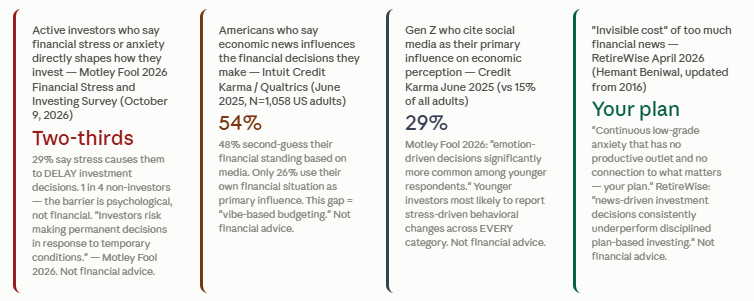
Two-thirds of investors say financial stress shapes how they invest (Motley Fool 2026). 48% second-guess their financial standing based on media coverage. 54% let news influence their financial decisions. The news did not write your financial plan. It should not be editing it. Here is what a typical Tuesday evening looks like in 2026. You open your phone to check something unrelated. An economic headline catches your eye. A market movement, a tariff warning. A recession prediction. A financial influencer explaining exactly what you should do about your investments right now. Before you have finished reading, you have felt something — anxiety, urgency, the unmistakeable pull of needing to do something. And that feeling, the Charles Schwab analysis from August 2025 identified, is ‘the emotional undercurrent of the media’ doing its job. The Intuit Credit Karma survey from June 2025 found that 54% of people say economic news influences the financial decisions they make. Two-thirds of active investors told the Motley Fool’s 2026 Financial Stress and Investing Survey that financial stress or anxiety directly shapes how they invest. The phenomenon even has a name now: ‘vibe-based budgeting’ — making financial decisions based on the perceived state of the economy rather than your actual personal financial circumstances. This article does not argue that you should ignore all financial news. It argues that you need five specific questions to separate the news that requires action from the noise that only requires a scroll. The questions do not take long to answer. But the habit of asking them is what keeps your financial plan in charge of your money — instead of the algorithm.
This question interrupts the news-to-action pipeline that produces stress-driven financial decisions. The Motley Fool 2026 survey found that investors who respond to short-term swings risk 'making permanent decisions in response to temporary conditions.' Asking whether the headline changes the plan separates informational noise from genuinely actionable information. Headlines are designed for engagement, not for your financial decision-making. RetireWise April 2026: 'Financial news is designed to generate engagement, not to improve your investment decisions.' Fear, urgency, and uncertainty are the mechanics of engagement. They are not the mechanics of good financial planning. Before taking any action based on a news story: write down what your plan currently says you should do. Then ask whether this specific news changes that answer. If you cannot identify a specific change to a specific part of your actual plan, the answer is no.
Financial plans are written on the investor's timeline — retirement in 25 years, emergency fund for 3 months, mortgage in 7 years. News is written on the editor's timeline — the last 4 hours. The Motley Fool survey found 29% of investors delay decisions under news-induced stress. That delay is the news cycle's timeline in action. News creates urgency. Urgency creates the feeling that something must be done now. Courtney Alev (Intuit Credit Karma): 'External factors often influence how we spend money... but it's important to ground your financial decisions in your personal financial reality.' The news's 'now' is not your 'now'.
When a headline produces an impulse to act: write down what your specific timeline says. If your investment horizon is 15 years, ask whether a news event that will be forgotten in a week changes anything about that 15-year trajectory. Then wait 48 hours before acting.
Vibe-based budgeting' (Intuit Credit Karma June 2025) is the operationalisation of the macro/personal confusion. 48% second-guess their financial standing based on media. 26% actually use their individual financial situation as their primary influence. The 22% gap is where news-fear lives. Financial news reports on aggregates. Your finances are specific. Recession fears are about aggregate GDP. Your job security is about your specific employer. National house price data is about national averages. Your mortgage is your specific rate. The news gives you the aggregate; you live in the specific. When economic news produces financial anxiety: write down the five specific data points of your actual financial situation — your income trajectory, your savings balance, your debt level, your job security, your specific investment performance. Compare those to what the news is saying is happening. If the two pictures don't match, trust your specific data.
The Motley Fool 2026 survey found that emotion-driven decisions are significantly more common in younger investors — the same group most influenced by social media (Credit Karma June 2025: 29% of Gen Z cite social media as their primary economic influence). The correlation is the point. Social media algorithms are not optimised for your financial wellbeing. They are optimised for time-on-platform. Fear, excitement, and outrage retain attention. A calm, evidence-based 'stick to your plan' post gets less engagement than 'everything is about to collapse.' The algorithm selects for emotional content.
Before acting on financial content seen on social media: ask who made it, what their regulated qualifications are, and whether they benefit financially from you taking the action they're suggesting. If the answer to the last question is 'yes' (via referral, commission, or sponsored content), treat the advice with proportionate scepticism.
RetireWise April 2026: 'books on investing and personal finance produce better long-term investment outcomes than daily news consumption.' A written financial plan is the antidote to vibe-based budgeting. It provides the decision rules before the emotional reaction, not after. Financial news creates the feeling that constant vigilance and adjustment are required to protect your money. This feeling is the news cycle's product, not a reflection of investment reality. Most long-term investment plans require very few active adjustments. The news doesn't have an economic incentive to tell you that. Write down (or review) your financial plan's specific instructions for what to do during periods of news-driven market volatility. If the plan doesn't address this scenario, that is the one gap worth filling — with the help of a qualified financial adviser. The plan should pre-answer the question 'what do I do now?' before the news makes it urgent.
No — but the relationship between news consumption and financial outcomes depends on how it is used. RetireWise's April 2026 analysis identifies a specific category of news that IS actionable: news about your financial adviser or fund house (fraud, investigation, licence issues), direct legislative changes to your tax situation, and rate changes affecting products you hold. Most other financial news — market movements, economic predictions, stock tips, recession warnings — requires no action from a long-term investor with a sound plan. The analysis also notes that 'books on investing and personal finance produce better long-term investment outcomes than daily news consumption.' The distinction is between information you use and information that uses you.
What is 'vibe-based budgeting' and am I doing it?
The term was coined in Intuit Credit Karma's June 2025 survey (N=1,058 US adults) to describe making financial decisions based on the perceived state of the economy — the 'vibes' from news and social media — rather than your actual personal financial circumstances. The survey found that 48% of Americans second-guess their financial standing based on media coverage, and that 44% believe prices are rising rapidly, 34% believe their financial situation is uncertain, and 28% believe a recession is imminent — all beliefs shaped more by media consumption than personal financial data. If you have found yourself changing saving or spending behaviour based on what the news says is happening to 'people' or 'the economy' rather than what is happening to your specific income, savings, and debt — that is vibe-based budgeting.
Why are younger investors more vulnerable to news-driven financial decisions?
The Motley Fool 2026 Financial Stress and Investing Survey found that emotion-driven investment decisions are 'significantly more common among younger respondents' and that younger investors are 'the most likely to report stress-driven behavioral changes across every category the survey measured.' The Intuit Credit Karma June 2025 survey found that social media as a financial influence jumps from 15% of all adults to 29% of Gen Z. The combination is significant: higher social media exposure, higher financial anxiety, and less experience of market cycles (which would provide the historical context that corrections are normal and temporary). The Motley Fool survey specifically identified 'frequent portfolio-checking' as a behaviour that 'can cause emotional reactions to short-term volatility, which can lead to worse investing outcomes over time.
How do I know if a piece of news requires action?
RetireWise's April 2026 analysis provides the clearest filter: news that requires action is news about your specific financial institutions (fraud, investigation, licence issues), direct legislative changes to your tax position, or rate changes affecting specific products you hold. Everything else — market movements, economic predictions, analyst warnings, social media stock tips, influencer recommendations — is noise unless it specifically changes the logic of your financial plan. The test from Question 1 of this article: does this headline change a specific element of your specific financial plan? If you cannot name the specific element it changes and what you would do differently, it does not require action.
What is the difference between a financial plan and reacting to news?
A financial plan is a document (formal or informal) that specifies your goals, timeline, risk tolerance, allocation, and the rules you will follow to maintain it — including what you will do during periods of market volatility and negative headlines. Reacting to news is making decisions outside that framework in response to short-term emotional triggers. RetireWise April 2026: 'news-driven investment decisions consistently underperform disciplined plan-based investing.' The Motley Fool 2026 survey found that investors who respond to short-term swings 'risk making permanent decisions in response to temporary conditions.' The plan is your permanent decision framework. The news is a temporary condition. They should not be confused.
Table of Contents
- Why Your News Feed Wants to Manage Your Money
- Question 1 Does This Headline Affect My Actual Financial Plan?
- Question 2 Am I Reacting on My Timeline or the News Cycle's Timeline?
- Question 3 Is This News About the Economy, or About My Economy?
- Question 4 Would I Have Made This Decision Without Social Media?
- Question 5 What Does My Financial Plan Actually Say to Do Right Now?
- The News vs Your Plan: A Master Comparison Table
- Conclusion: The Algorithm Is Not Your Financial Adviser
- Frequently Asked Questions
Why Your News Feed Wants to Manage Your Money
The financial media has always had a structural interest in making you feel that you need to pay attention right now. But the 2026 version of this problem is materially different from the one that existed when most personal finance advice was written. RetireWise’s April 2026 analysis puts the evolution plainly: ‘In 2016 when this article was first written, the concern was 24-hour television news and financial websites. Social media algorithms, YouTube thumbnails, WhatsApp stock tips, Telegram channels with “multibagger picks,” and Instagram reels from financial influencers have created a continuous, personalised, and often completely unregulated stream of financial noise.’ The traditional financial news cycle employed professional journalists with editorial accountability, even if their incentives favoured engagement over accuracy. Social media has no such constraint. An algorithm that learns you respond emotionally to financial anxiety headlines will serve you more of them, regardless of whether they have any bearing on your actual financial situation. The Motley Fool 2026 Financial Stress and Investing Survey found that two-thirds of active investors say financial stress or anxiety directly shapes how they invest. The Intuit Credit Karma survey from June 2025 found that 48% of Americans second-guess their financial standing based on media coverage. The question is not whether the news influences your financial decisions. The data shows it does. The question is whether that influence is operating by design — yours — or by accident — the algorithm’s. The five questions that follow are the design. Two-thirds of active investors say financial stress shapes how they invest (Motley Fool 2026 Financial Stress and Investing Survey). 54% say economic news influences their financial decisions (Intuit Credit Karma/Qualtrics June 2025, N=1,058). 48% second-guess their financial standing based on media (Credit Karma June 2025). 40% of consumers driven to avoid media due to news fatigue (May 2026).Question 1 "Does This Headline Affect My Actual Financial Plan?"
The first and most fundamental question you can ask when a financial headline lands in your news feed is deceptively simple: does this specifically change anything about my actual financial plan? Not the market in general. Not the economy in theory. Your plan. Your timeline. Your specific investments or accounts. The Intuit Credit Karma survey from June 2025 (N=1,058 US adults) found that 54% of people say the economic news they consume influences the financial decisions they make. But only 26% identified their individual financial situation as the greatest influence on their economic perception. The gap between those two numbers is where the news takes control: most people are being influenced by news they are reading about an economy that may or may not reflect their personal financial reality. RetireWise’s April 2026 analysis identifies the test directly: ‘Not all financial news is noise.’ Genuinely actionable news includes: news about your specific financial adviser or fund house (fraud, investigation, licence issues); changes to legislation that directly affect your tax situation; and rate changes that affect a product you currently hold. The vast majority of financial headlines — ‘recession fears mount,’ ‘market drops X%,’ ‘analyst warns of correction’ — require no action because they do not change the logic of a sound, long-term financial plan. The question ‘does this change my plan?’ forces the news from its emotional register (alarm, urgency) into a practical one (does my plan account for this?). If the answer is yes, the follow-up is: in what specific way, and what specifically should I do differently? If the answer is no, the appropriate response is to return to the plan unchanged.This question interrupts the news-to-action pipeline that produces stress-driven financial decisions. The Motley Fool 2026 survey found that investors who respond to short-term swings risk 'making permanent decisions in response to temporary conditions.' Asking whether the headline changes the plan separates informational noise from genuinely actionable information. Headlines are designed for engagement, not for your financial decision-making. RetireWise April 2026: 'Financial news is designed to generate engagement, not to improve your investment decisions.' Fear, urgency, and uncertainty are the mechanics of engagement. They are not the mechanics of good financial planning. Before taking any action based on a news story: write down what your plan currently says you should do. Then ask whether this specific news changes that answer. If you cannot identify a specific change to a specific part of your actual plan, the answer is no.
Question 2 "Am I Reacting on My Timeline or the News Cycle's Timeline?"
The financial news cycle operates on a fundamentally different timeline from a sound personal financial plan. Breaking news has a half-life of hours. Trend stories have a lifespan of days or weeks. Financial plans operate on timelines of years and decades. This mismatch is not accidental. It is structural. The Motley Fool 2026 Financial Stress and Investing Survey found that 29% of investors say financial stress causes them to delay making investing decisions. Delay caused by anxiety about news headlines is the news cycle’s timeline substituting for the investor’s own timeline. The Charles Schwab analysis from August 2025 captures the mechanism: ‘When the tone leans toward fear, uncertainty or urgency, consumers may respond emotionally, often by becoming more conservative in their financial behavior.’ That conservatism may be exactly right for a 70-year-old approaching retirement. It is probably exactly wrong for a 35-year-old in the accumulation phase of a decades-long investment strategy. The news does not know your age. It does not know your timeline. It delivers the same tone of urgency to everyone on your feed. The question ‘am I reacting on my timeline or the news cycle’s?’ forces the issue: whose schedule is driving this decision? If the answer is ‘the news cycle,’ that is a sign that the news has taken temporary occupancy of your financial decision-making.Financial plans are written on the investor's timeline — retirement in 25 years, emergency fund for 3 months, mortgage in 7 years. News is written on the editor's timeline — the last 4 hours. The Motley Fool survey found 29% of investors delay decisions under news-induced stress. That delay is the news cycle's timeline in action. News creates urgency. Urgency creates the feeling that something must be done now. Courtney Alev (Intuit Credit Karma): 'External factors often influence how we spend money... but it's important to ground your financial decisions in your personal financial reality.' The news's 'now' is not your 'now'.
When a headline produces an impulse to act: write down what your specific timeline says. If your investment horizon is 15 years, ask whether a news event that will be forgotten in a week changes anything about that 15-year trajectory. Then wait 48 hours before acting.
Question 3 "Is This News About the Economy, or About My Economy?"
The Intuit Credit Karma June 2025 survey introduced a phrase that captures one of the most important financial literacy concepts of the current era: ‘vibe-based budgeting.’ The concept describes a growing pattern in which people make financial decisions based on the perceived state of the economy — the ‘vibes’ of the economic news they consume — rather than their actual personal financial circumstances. The survey found that 48% of Americans said media coverage and changing economic conditions had made them second-guess their financial standing. But second-guessing your financial standing based on aggregate economic data misapplies macro data to a personal situation that may be entirely different. The national unemployment rate, GDP growth, inflation figures, and housing market statistics are averages and aggregates. They describe the central tendency of a distribution that contains enormous individual variation. A household with stable employment, growing savings, and a fixed-rate mortgage is not in the same financial position as the economy at large, even if aggregate economic news sounds alarming. The Credit Karma survey found 44% of Americans believe prices are rising rapidly (a media-influenced belief), 34% believe their financial situation is uncertain, and 28% believe a recession is imminent — all described as beliefs shaped significantly by news and social media consumption rather than personal financial data. Question 3 is the antidote: not ‘what is happening to the economy’ but ‘what is happening to my income, my savings, my debt, my job?Vibe-based budgeting' (Intuit Credit Karma June 2025) is the operationalisation of the macro/personal confusion. 48% second-guess their financial standing based on media. 26% actually use their individual financial situation as their primary influence. The 22% gap is where news-fear lives. Financial news reports on aggregates. Your finances are specific. Recession fears are about aggregate GDP. Your job security is about your specific employer. National house price data is about national averages. Your mortgage is your specific rate. The news gives you the aggregate; you live in the specific. When economic news produces financial anxiety: write down the five specific data points of your actual financial situation — your income trajectory, your savings balance, your debt level, your job security, your specific investment performance. Compare those to what the news is saying is happening. If the two pictures don't match, trust your specific data.
Question 4 "Would I Have Made This Decision Without Social Media?"
The 2026 version of news-feed financial management is not just the traditional financial media. RetireWise’s April 2026 analysis identifies the specific upgrade: ‘Social media algorithms, YouTube thumbnails, WhatsApp stock tips, Telegram channels with “multibagger picks”, and Instagram reels from financial influencers have created a continuous, personalised, and often completely unregulated stream of financial noise.’ The traditional financial news cycle, for all its problems, employed journalists with editorial accountability. A Telegram channel with 50,000 subscribers has no such constraint. The Intuit Credit Karma survey found that 15% of all Americans cite social media as their primary influence on economic perception — jumping to 29% of Gen Z. The Motley Fool 2026 survey found that emotion-driven investment decisions are ‘significantly more common among younger respondents,’ and that younger investors are ‘the most likely to report stress-driven behavioral changes across every category the survey measured.’ Question 4 is a test of source quality as much as decision quality: would you have made this financial move if you had seen it in a financial plan document written for you by a qualified adviser, rather than in a Reel watched at 11pm? The social media financial content ecosystem is optimised for engagement, not for your financial outcomes. A 60-second video explaining why a specific stock is about to explode is not a financial plan. It is content. The distinction matters.The Motley Fool 2026 survey found that emotion-driven decisions are significantly more common in younger investors — the same group most influenced by social media (Credit Karma June 2025: 29% of Gen Z cite social media as their primary economic influence). The correlation is the point. Social media algorithms are not optimised for your financial wellbeing. They are optimised for time-on-platform. Fear, excitement, and outrage retain attention. A calm, evidence-based 'stick to your plan' post gets less engagement than 'everything is about to collapse.' The algorithm selects for emotional content.
Before acting on financial content seen on social media: ask who made it, what their regulated qualifications are, and whether they benefit financially from you taking the action they're suggesting. If the answer to the last question is 'yes' (via referral, commission, or sponsored content), treat the advice with proportionate scepticism.
Question 5 "What Does My Financial Plan Actually Say to Do Right Now?"
The fifth question is the most actionable of all, and the one that closes the loop on every news headline, social media post, WhatsApp forward, and financial influencer video you will ever encounter: what does your plan say? Not what the news says you should do. Not what the loudest voice in your feed says is coming. What does the financial plan you have — or should have — say about what to do during this type of market or economic event? RetireWise’s April 2026 analysis identifies the alternative to news-driven investing precisely: ‘news-driven investment decisions consistently underperform disciplined plan-based investing.’ The evidence base for this finding is substantial and well-established across decades of behavioural finance research. The investor who sells during a correction because the news said ‘it’s different this time’ crystallises a loss that a patient investor would have recovered from. The investor who buys a specific stock because a Telegram channel said it was undervalued has made a speculative bet without a process. The investor who delays contributing to their pension because 48% of people around them are second-guessing their financial standing has allowed the vibes of the news cycle to interrupt their accumulation. The plan-based investor asks: what was I supposed to do this month? And then they do it. Regular contributions. Portfolio review at the scheduled interval. Rebalancing when the allocation drifts beyond the agreed threshold. These are plan-driven actions. They have nothing to do with this week’s news.RetireWise April 2026: 'books on investing and personal finance produce better long-term investment outcomes than daily news consumption.' A written financial plan is the antidote to vibe-based budgeting. It provides the decision rules before the emotional reaction, not after. Financial news creates the feeling that constant vigilance and adjustment are required to protect your money. This feeling is the news cycle's product, not a reflection of investment reality. Most long-term investment plans require very few active adjustments. The news doesn't have an economic incentive to tell you that. Write down (or review) your financial plan's specific instructions for what to do during periods of news-driven market volatility. If the plan doesn't address this scenario, that is the one gap worth filling — with the help of a qualified financial adviser. The plan should pre-answer the question 'what do I do now?' before the news makes it urgent.
The News vs Your Plan: A Master Comparison Table
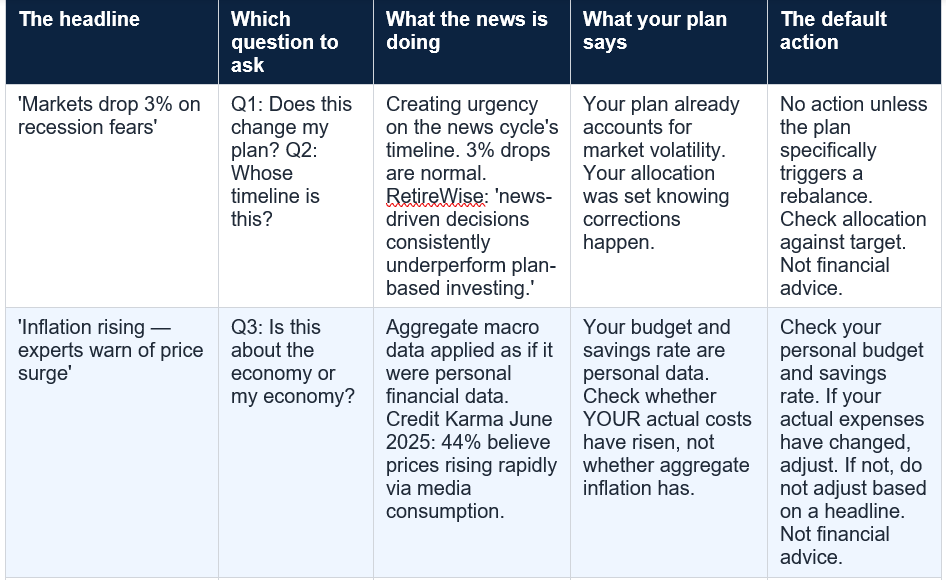
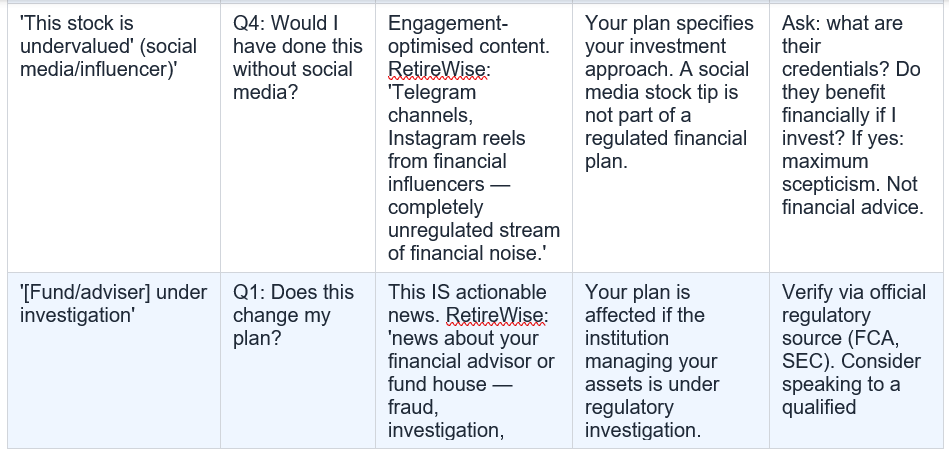
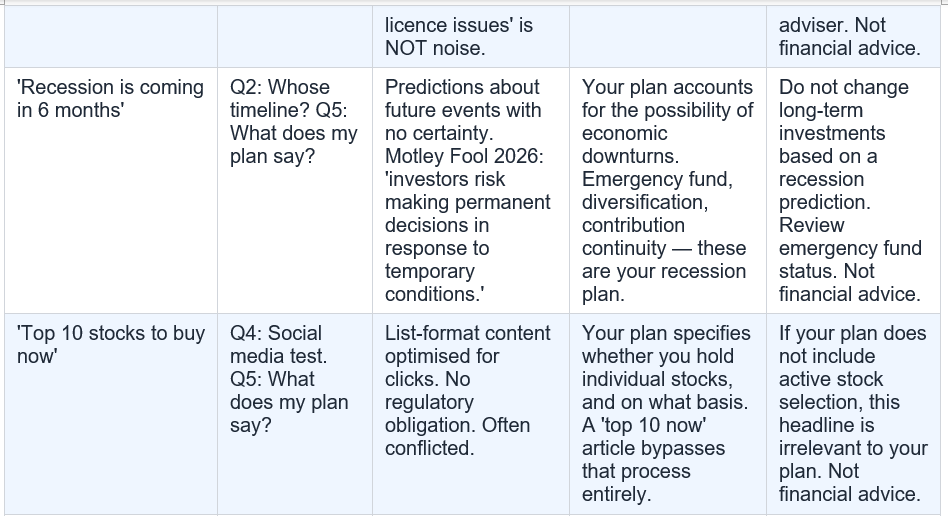
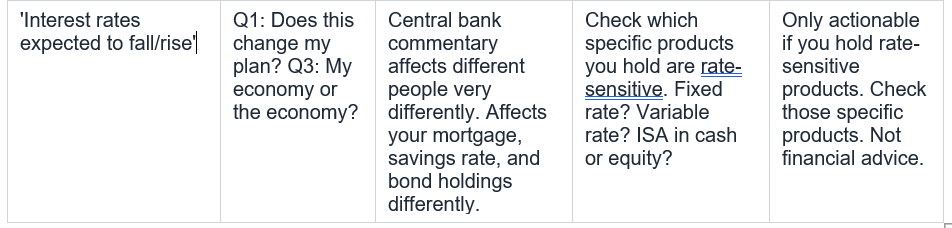
This table maps typical news-feed financial content against the question framework. It is designed to be used as a practical reference when a headline produces a financial impulse. Not financial advice.
Conclusion
RetireWise’s April 2026 analysis identified what may be the most useful single sentence in the entire news-and-money conversation: ‘The invisible cost of too much financial news consumption is not bad investment decisions necessarily, but continuous low-grade anxiety that has no productive outlet and no connection to what matters — your plan.’ The Intuit Credit Karma survey named the consequence: ‘vibe-based budgeting.’ The Motley Fool 2026 Financial Stress and Investing Survey quantified it: two-thirds of investors affected, 29% delaying decisions, younger investors most susceptible. The five questions in this article are not a system for ignoring financial news. They are a system for giving it the correct amount of weight. Question 1 asks whether the news changes the plan. Question 2 asks whose timeline is driving the response. Question 3 asks whether this is about the economy or about your economy. Question 4 asks whether social media is the legitimate source for this decision. Question 5 asks what the plan itself says to do. Most of the time, the answer to all five questions redirects you back to the same place: the plan. Which is, as it was designed to be, a document that handles market volatility, economic news, and financial uncertainty without requiring a reaction to every headline. The algorithm wants to manage your money. Five questions is what stops it. This is not financial advice. Always consult a qualified, regulated financial adviser.Frequently Asked Questions
Is it bad to follow financial news at all?No — but the relationship between news consumption and financial outcomes depends on how it is used. RetireWise's April 2026 analysis identifies a specific category of news that IS actionable: news about your financial adviser or fund house (fraud, investigation, licence issues), direct legislative changes to your tax situation, and rate changes affecting products you hold. Most other financial news — market movements, economic predictions, stock tips, recession warnings — requires no action from a long-term investor with a sound plan. The analysis also notes that 'books on investing and personal finance produce better long-term investment outcomes than daily news consumption.' The distinction is between information you use and information that uses you.
What is 'vibe-based budgeting' and am I doing it?
The term was coined in Intuit Credit Karma's June 2025 survey (N=1,058 US adults) to describe making financial decisions based on the perceived state of the economy — the 'vibes' from news and social media — rather than your actual personal financial circumstances. The survey found that 48% of Americans second-guess their financial standing based on media coverage, and that 44% believe prices are rising rapidly, 34% believe their financial situation is uncertain, and 28% believe a recession is imminent — all beliefs shaped more by media consumption than personal financial data. If you have found yourself changing saving or spending behaviour based on what the news says is happening to 'people' or 'the economy' rather than what is happening to your specific income, savings, and debt — that is vibe-based budgeting.
Why are younger investors more vulnerable to news-driven financial decisions?
The Motley Fool 2026 Financial Stress and Investing Survey found that emotion-driven investment decisions are 'significantly more common among younger respondents' and that younger investors are 'the most likely to report stress-driven behavioral changes across every category the survey measured.' The Intuit Credit Karma June 2025 survey found that social media as a financial influence jumps from 15% of all adults to 29% of Gen Z. The combination is significant: higher social media exposure, higher financial anxiety, and less experience of market cycles (which would provide the historical context that corrections are normal and temporary). The Motley Fool survey specifically identified 'frequent portfolio-checking' as a behaviour that 'can cause emotional reactions to short-term volatility, which can lead to worse investing outcomes over time.
How do I know if a piece of news requires action?
RetireWise's April 2026 analysis provides the clearest filter: news that requires action is news about your specific financial institutions (fraud, investigation, licence issues), direct legislative changes to your tax position, or rate changes affecting specific products you hold. Everything else — market movements, economic predictions, analyst warnings, social media stock tips, influencer recommendations — is noise unless it specifically changes the logic of your financial plan. The test from Question 1 of this article: does this headline change a specific element of your specific financial plan? If you cannot name the specific element it changes and what you would do differently, it does not require action.
What is the difference between a financial plan and reacting to news?
A financial plan is a document (formal or informal) that specifies your goals, timeline, risk tolerance, allocation, and the rules you will follow to maintain it — including what you will do during periods of market volatility and negative headlines. Reacting to news is making decisions outside that framework in response to short-term emotional triggers. RetireWise April 2026: 'news-driven investment decisions consistently underperform disciplined plan-based investing.' The Motley Fool 2026 survey found that investors who respond to short-term swings 'risk making permanent decisions in response to temporary conditions.' The plan is your permanent decision framework. The news is a temporary condition. They should not be confused.
0 Comments
Be the first to share your thoughts on this article.