

Finance
How Soon Into Dating Do You Talk About Your Salary?

There used to be an unwritten rule that salary was off the table until the relationship got serious. You could talk about your job, your industry, your ambitions — but the actual number? That was private. Intimate. Something you revealed carefully, and only once trust had been properly established. That rule is dissolving in real time, and the data is unambiguous about who is dissolving it. A 2025 eToro survey found that over a third of active daters are bringing up money on the very first date, three-quarters have done so by date three, and 85% have had some form of financial conversation by date five. Gen Z, the first generation to come of age with radical transparency as a social norm, says the right time to discuss salary is after about three dates. Their grandparents’ generation often waited until engagement. Somewhere between those two positions is the question that couples navigate every day: when exactly is the right moment to bring up what you earn — and what happens when you do? This is Not relationship advice.
That contract no longer describes how a large share of daters — particularly those under 35 — actually behave. The shift has been driven by several converging forces: the radical transparency culture of social media, in which people share financial journeys, debt payoffs, and salary milestones publicly; the #MeToo-adjacent ‘pay transparency’ movement, which normalised salary disclosure as a matter of equity; and the practical financial pressures of an era of high inflation and housing costs, where incompatible financial situations represent a real and immediate compatibility issue rather than a distant theoretical problem. Gen Z, who grew up with TikTok salary-reveal content and workplace pay transparency advocacy, simply have a different default setting about money. Not relationship advice.
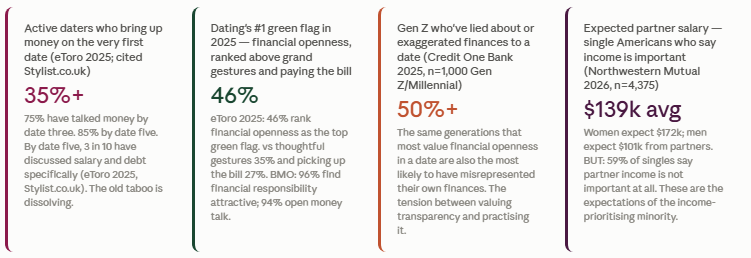
The old rule is gone: 35%+ of active daters are bringing up money on the very first date; 75% by date three; 85% by date five (eToro 2025, cited Stylist.co.uk). Gen Z: best time to discuss salary is 'after three dates' (29%, Monarch June 2024 survey, n=1,000). Baby Boomers: best time is 'after three months' (28%, Monarch 2024). 14% of Boomer women prefer to wait until engagement (Monarch 2024). Sources cited. Not relationship advice.
eToro’s 2025 research, cited extensively by Stylist.co.uk, produced the most striking figures: over a third of active daters bring up money on the very first date, with three-quarters doing so by date three and 85% by date five. By date five, 3 in 10 have already talked about investing, and 3 in 10 have opened up about salaries and debt specifically. A 2025 Chime/Talker Research survey of 2,000 US singles found that 31% believe the salary conversation should happen between the first and third date. A separate BMO survey (February 2025) found that 39% say money conversations should begin by the time the relationship becomes official, while 10% say after just the first few dates. A Skipton Building Society study cited in 2026 put the ideal moment at eight dates. Talker Research’s 2024 poll of 2,000 Americans in serious relationships found the preferred timing at 6.5 months — but noted the average couple takes almost 8 months to actually become fully transparent. These numbers are not contradictory; they reflect the range of reasonable positions, with the trend clearly moving toward earlier disclosure. Not relationship advice.
The Chime/Talker Research survey (June 2025, n=2,000) quantified the generational attitude gap directly: half of both Gen Z and millennials find it attractive when a casual date is open about how much money they make. Among Gen X, that figure drops to 37%. Among baby boomers, just 23%. Rachel Lawrence, Monarch’s Head of Advice and Planning, offered a key observation on why this is happening: ‘The more we normalise talking about money, the more comfortable younger generations will be to talk about it.’ The mechanism is self-reinforcing: the more Gen Z and millennials discuss money publicly on social media, the more it becomes expected and even desirable in dating contexts too. Not relationship advice.
The generational timeline gap (Monarch June 2024 survey, n=1,000 Americans): Gen Z preferred timing: after 3 dates (29% most common answer). Millennials: after 1-3 months. Gen X: after 1-3 months. Baby Boomers: after 3+ months (28% most common answer); 14% Baby Boomer women: wait until engaged. Attractiveness of income openness: Gen Z/Millennials 50%; Gen X 37%; Baby Boomers 23% (Chime/Talker Research June 2025, n=2,000). Source: Monarch Money June 2024; Chime/Talker Research June 2025. Not relationship advice.
The logic behind this shift is straightforward. Financial incompatibility is one of the leading causes of relationship breakdown and divorce. Two people with different spending habits, different risk tolerances, different relationships to debt, and wildly different incomes will encounter genuine practical problems when the relationship reaches the stages that involve shared financial decisions — moving in together, sharing holidays, eventually buying property. Discovering these incompatibilities on date two is infinitely preferable to discovering them on year three. A person who is financially open early is, in this framework, demonstrating exactly the kind of honesty and pragmatism that makes a long-term partnership viable. The Skipton Building Society’s Alex Sitaras put the long-term case clearly: ‘Being open about money — from personal spending habits, to sharing financial commitments from previous relationships and long-term financial goals — will help couples align values and build a foundation for a stable, honest connection.’ Not relationship advice.
Financial openness ranked the #1 green flag in dating (2025), above grand gestures and paying the bill (eToro 2025; Stylist.co.uk). Top financial traits Americans find attractive: financial responsibility (96%); open money talk (94%); good financial plan (92%) (BMO February 2025). 74% say transparency about finances is essential when seeking something serious (Skipton Building Society 2026). Source: eToro/Stylist.co.uk 2025; BMO February 2025; Skipton 2026. Not relationship advice.
The tendency for women to be more conservative about early financial disclosure has historically been explained through a combination of safety concerns (sharing income can create power dynamics), social conditioning (women were traditionally expected to be coy about financial topics), and practical experience (higher-earning women have reported being on the receiving end of hostility or discomfort when their income exceeded a partner’s). The generational data suggests this gap is closing: among Gen Z women, the reluctance to discuss money early is significantly less pronounced than among older women. Skipton Building Society’s research noted that 51% of those aged 45-54 wanted to keep their finances private when dating — but that age cohort is precisely the group where the old norms about financial privacy remain strongest. Not relationship advice.
These are striking numbers. The median household income in the United States is approximately $80,000. An expectation that a potential partner earns $139,000 — let alone $172,000 — is a significantly above-median threshold that many capable and financially responsible partners will not meet. The study includes a significant moderating finding: 59% of singles who responded said they do not believe a potential partner’s income is important at all. The salary expectations data therefore represents the views of the minority who do prioritise income — a real cohort, but not the majority. The context matters too: this research was conducted against the backdrop of what experts are calling a ‘dating recession,’ with just 31% of Americans aged 22-35 actively dating in 2026 (Institute for Family Studies, cited KXAN/NewsNation). Financial anxiety about potential partners is partly a product of a broader financial anxiety about the present. Not relationship advice.
The apparent contradiction dissolves when you consider the social pressure dynamic: if financial transparency is valued and a high salary is a desirable trait, the incentive to exaggerate your own financial situation is real and immediate. Presenting as more financially stable, more debt-free, or more income-secure than you are can feel like a competitive advantage in a dating pool that is increasingly financially evaluative. The Chime/Talker Research survey (June 2025) adds another dimension: 23% of Gen Z would rather discuss topics they have no knowledge or interest in than talk about finances on a date, and 26% would rather chat about their deepest darkest fears. The financial conversation is valued in theory and dreaded in practice — which creates the conditions for avoidance or embellishment. Not relationship advice.
The honesty gap: 50%+ of Gen Z and millennial adults have lied about or exaggerated their finances to someone online or in person (Credit One Bank survey 2025, n=1,000). 1 in 10 Americans in serious relationships don't know their partner's salary (Talker Research 2024, n=2,000). 11% in committed relationships rarely or never discuss household finances (BMO February 2025). The same generations that value financial openness are the most likely to have misrepresented their own financial situation. Source: KXAN/NewsNation (Credit One Bank 2025); Talker Research 2024; BMO 2025. Not relationship advice.
The consequence is predictable. The same Talker Research poll found the average couple fights about money about once per month, with millennials and Gen Xers fighting about money twice per month. Money is consistently identified as one of the leading causes of relationship stress and relationship breakdown. The BMO survey found that those who are truthful about money also spend more quality time together, and that disparate salary levels tend to cause less of a headache for couples who share their finances openly. The causality probably runs both ways: couples who communicate well talk about money more, and couples who talk about money avoid the resentments and misunderstandings that financial opacity creates. Not relationship advice.
The conversation tends to open naturally through adjacent topics: what do you do for work and how do you feel about it? What are your financial goals — do you want to own property, retire early, travel extensively? Are you someone who saves first and spends after, or the reverse? These questions reveal financial values and habits — arguably more important than the raw salary number — without requiring anyone to state a figure prematurely. The salary number often follows naturally once financial values have been established and trust has been built. Janelle Sallenave, Chief Spending Officer at Chime, noted that ‘Americans are divided over the right way to talk about who pays for a first date, and whether it should be on the actual date (37%) or a message before it even begins (31%)’ — which suggests the money conversation does not have to wait for a formal sit-down; it can begin with the entirely practical question of how to share the bill.
Natural openers for the financial conversation: 'What are you working toward financially right now?' — opens goals and values without a salary interrogation. 'How do you feel about splitting the bill?' — practical, immediate, and reveals a lot about attitudes to money and fairness. 'Are you more of a saver or a spender?' — reveals financial personality without requiring numbers. 'What does financial security look like to you?' — opens the conversation about values, not just figures. Not relationship advice. These are illustrative conversation starters, not scripts.
The broader picture from BMO is instructive: only 55% of couples share equal responsibility for meeting with a professional financial adviser. This suggests that even in couples where both partners are financially engaged, the default often tilts toward one partner managing the financial relationship while the other is relatively passive. The research also found that those who start early tend to sustain the habit — couples who discuss finances before they are in a committed relationship are more likely to continue discussing them throughout the relationship. Not relationship advice.
Alex Sitaras, Head of Savings & Partnerships at Skipton Building Society: 'Many daters tend to avoid awkward conversations about finances, especially in the early stages, as money can feel like a sensitive topic. As the relationship progresses, being open about money — from personal spending habits, to sharing financial commitments from previous relationships and long-term financial goals — will help couples align values and build a foundation for a stable, honest connection.' Rachel Lawrence, Monarch Head of Advice and Planning: 'The more we normalise talking about money, the more comfortable younger generations will be to talk about it.' Source: Stornoway Gazette / Skipton Building Society 2026; Monarch Money June 2024. Not relationship advice.
The more useful reframe is not ‘when should I reveal my salary?’ but ‘when is financial incompatibility a problem I need to know about?’ The answer to the second question is: before the relationship has developed to a point where discovery of incompatibility would be genuinely disruptive. That is not date one for most people. But it is certainly before moving in together, and arguably before exclusivity for anyone with significant debt, unusual financial obligations, or a strong view about how a shared financial life should be structured. The conversations that matter most are not about the number — they are about values, habits, and goals. The salary figure is context. The relationship to money is character.
As 74% of those looking for something serious say: financial transparency is not optional. It is foundational. Not relationship advice.
The data varies by generation and survey but converges on a clear trend: money conversations are happening earlier than ever before. eToro's 2025 survey found over a third of active daters bring up money on the very first date, with 75% doing so by date three and 85% by date five. A 2025 Chime/Talker Research survey (2,000 US singles) found 31% believe the financial conversation should start between dates one and three. A separate 2024 Monarch survey (1,000 Americans) found Gen Z most commonly say 'after three dates' is the right time, while Baby Boomers most commonly say 'after more than three months.' Skipton Building Society's research puts the ideal moment for salary disclosure specifically at around eight dates. Talker Research's 2024 poll of those already in serious relationships found the average couple prefers to have the full money talk at 6.5 months, but actually takes almost 8 months to become fully transparent. The most accurate answer: it depends heavily on your age and relationship style, with a clear generational trend toward earlier disclosure. Not relationship advice.
Is it a green flag when someone talks about money early on a date?
For most people in 2025 — and especially for younger generations — yes. eToro's 2025 research found financial openness ranked as the single most important green flag in dating, above thoughtful romantic gestures (35%) and paying the bill (27%), with 46% ranking it the top positive signal. BMO's February 2025 survey found the top three most attractive financial traits are financial responsibility (96%), talking about money openly (94%), and having a good financial plan (92%). Half of Gen Z and millennials find it attractive when a casual date is open about income, compared to 37% of Gen X and 23% of Baby Boomers (Chime/Talker Research June 2025). 74% of those seeking a serious relationship say financial transparency is essential (Skipton Building Society 2026). The consensus among those under 40 is that financial openness is a sign of maturity, honesty, and readiness for a real relationship. Sources: eToro/Stylist 2025; BMO 2025; Chime/Talker Research 2025; Skipton 2026. Not relationship advice.
Do men or women bring up money earlier when dating?
Men bring up financial topics earlier than women in most surveys. eToro's 2025 data found 20% of men would mention their salary by the third date, compared to 12% of women. Men are also nearly twice as likely to raise debt by the third date. However, the gender gap is narrowing among younger generations. The reluctance among women to disclose early has historically been linked to safety concerns, social norms, and the experience of high-earning women receiving hostile responses when their income exceeded a partner's. Older women are more conservative: 51% of those aged 45-54 want to keep finances private when dating (Skipton Building Society 2026), and 14% of Baby Boomer women prefer to wait until engagement (Monarch 2024). Gen Z women show a significantly smaller gender gap in financial disclosure timing compared to older generations. Sources: eToro/Stylist 2025; Skipton 2026; Monarch 2024. Not relationship advice.
What salary do single people expect their partner to earn?
Northwestern Mutual's 2026 Planning & Progress Study (4,375 US adults) found that single Americans who consider income important in a potential lifelong partner expect them to earn an average of $139,000 per year. The gender breakdown is significant: women expected an average of $172,000 from potential mates, while men were satisfied with $101,000. However, the important moderating finding is that 59% of singles don't believe a potential partner's income is important at all — meaning these expectations represent the subset of daters for whom income is a priority, not the full dating population. These expectations also reflect the financial anxiety of an era in which basic life milestones (homeownership, family formation) require high combined incomes in many US cities. The lofty expectations come alongside a 'dating recession': just 31% of Americans aged 22-35 are actively dating in 2026 (Institute for Family Studies). Sources: KXAN/NewsNation (Northwestern Mutual 2026). Not relationship advice.
Do couples who talk about money early have better relationships?
The data suggests a correlation between financial openness and relationship quality, though causality is complex. BMO's February 2025 survey found that those who are truthful about money also spend more quality time together, and that couples with disparate salary levels have less financial conflict when they share their finances openly. The same research found that 11% of Americans in committed relationships rarely or never discuss household finances — and the average couple fights about money about once per month, with millennials and Gen Xers fighting twice per month (Talker Research 2024). Couples who communicate well generally tend to communicate well about money too, which makes the causality run in both directions: financial transparency supports relationship quality, and good relationship quality supports financial transparency. The practical implication: early financial conversations are an investment in relationship quality, not just a box to tick. Sources: BMO February 2025; Talker Research 2024. Not relationship advice.
Table of Contents
- The Old Rule About Money and Dating — and Why It’s Gone
- What the Research Actually Shows: The Timeline Data
- The Generational Gulf: Gen Z Versus Baby Boomers
- Why Financial Openness Has Become the Ultimate Green Flag
- The Gender Difference in Financial Disclosure
- The Salary Expectations People Quietly Carry Into Dating
- Financial Lies and Exaggerations: The Other Side of the Data
- What Happens When You Wait Too Long
- How to Actually Have the Money Conversation (Without It Being Awkward)
- The Spectrum: From First Date to Moving In
- The Couples Who Get It Right — What the Data Shows
- Conclusion: There Is No Perfect Moment. There Is Just ‘Soon Enough.’
- Frequently Asked Questions
The Old Rule About Money and Dating — and Why It’s Gone
Money used to occupy the same conversational category as political affiliation and religious beliefs in early dating: you circled it, you alluded to it, you maybe got to it eventually, but you certainly did not lead with it. The implicit social contract was that revealing your salary too early was either gauche (if you earned a lot) or alarming (if you earned less than expected). The salary conversation happened somewhere around the point when things got serious — which meant several months in, at minimum.That contract no longer describes how a large share of daters — particularly those under 35 — actually behave. The shift has been driven by several converging forces: the radical transparency culture of social media, in which people share financial journeys, debt payoffs, and salary milestones publicly; the #MeToo-adjacent ‘pay transparency’ movement, which normalised salary disclosure as a matter of equity; and the practical financial pressures of an era of high inflation and housing costs, where incompatible financial situations represent a real and immediate compatibility issue rather than a distant theoretical problem. Gen Z, who grew up with TikTok salary-reveal content and workplace pay transparency advocacy, simply have a different default setting about money. Not relationship advice.
The old rule is gone: 35%+ of active daters are bringing up money on the very first date; 75% by date three; 85% by date five (eToro 2025, cited Stylist.co.uk). Gen Z: best time to discuss salary is 'after three dates' (29%, Monarch June 2024 survey, n=1,000). Baby Boomers: best time is 'after three months' (28%, Monarch 2024). 14% of Boomer women prefer to wait until engagement (Monarch 2024). Sources cited. Not relationship advice.
What the Research Actually Shows: The Timeline Data
The data on when people actually discuss money in dating comes from multiple surveys spanning 2024-2026, and while the specific numbers vary, the directional consensus is clear: money conversations are happening earlier than they used to, they are welcomed by most people as a green flag rather than a faux pas, and the biggest variable is generational, not gender.eToro’s 2025 research, cited extensively by Stylist.co.uk, produced the most striking figures: over a third of active daters bring up money on the very first date, with three-quarters doing so by date three and 85% by date five. By date five, 3 in 10 have already talked about investing, and 3 in 10 have opened up about salaries and debt specifically. A 2025 Chime/Talker Research survey of 2,000 US singles found that 31% believe the salary conversation should happen between the first and third date. A separate BMO survey (February 2025) found that 39% say money conversations should begin by the time the relationship becomes official, while 10% say after just the first few dates. A Skipton Building Society study cited in 2026 put the ideal moment at eight dates. Talker Research’s 2024 poll of 2,000 Americans in serious relationships found the preferred timing at 6.5 months — but noted the average couple takes almost 8 months to actually become fully transparent. These numbers are not contradictory; they reflect the range of reasonable positions, with the trend clearly moving toward earlier disclosure. Not relationship advice.
The Generational Gulf: Gen Z Versus Baby Boomers
Nowhere is the shift more visible than in the generational comparison. Monarch’s June 2024 survey of 1,000 Americans found a dramatic divide: Gen Z most commonly say the best time to discuss income is after three dates, while Baby Boomers most commonly say after more than three months of dating. Baby Boomer women are the most conservative: 14% prefer to wait until they are engaged before discussing finances with a partner. That position — which would have seemed perfectly normal a generation ago — is now held by a small minority even within the Boomer cohort.The Chime/Talker Research survey (June 2025, n=2,000) quantified the generational attitude gap directly: half of both Gen Z and millennials find it attractive when a casual date is open about how much money they make. Among Gen X, that figure drops to 37%. Among baby boomers, just 23%. Rachel Lawrence, Monarch’s Head of Advice and Planning, offered a key observation on why this is happening: ‘The more we normalise talking about money, the more comfortable younger generations will be to talk about it.’ The mechanism is self-reinforcing: the more Gen Z and millennials discuss money publicly on social media, the more it becomes expected and even desirable in dating contexts too. Not relationship advice.
The generational timeline gap (Monarch June 2024 survey, n=1,000 Americans): Gen Z preferred timing: after 3 dates (29% most common answer). Millennials: after 1-3 months. Gen X: after 1-3 months. Baby Boomers: after 3+ months (28% most common answer); 14% Baby Boomer women: wait until engaged. Attractiveness of income openness: Gen Z/Millennials 50%; Gen X 37%; Baby Boomers 23% (Chime/Talker Research June 2025, n=2,000). Source: Monarch Money June 2024; Chime/Talker Research June 2025. Not relationship advice.
Why Financial Openness Has Become the Ultimate Green Flag
The framing of financial transparency as a green flag — a signal of desirable character rather than a social awkwardness to be endured — is one of the most significant shifts in contemporary dating culture. eToro’s 2025 research found that financial openness ranked as the ultimate green flag among active daters in 2025, above romantic grand gestures (35%) and picking up the bill (27%), with 46% of daters ranking financial openness as the most important signal. BMO’s February 2025 survey found that the top three most attractive financial traits were financial responsibility (96%), talking about money openly (94%), and having a good financial plan (92%).The logic behind this shift is straightforward. Financial incompatibility is one of the leading causes of relationship breakdown and divorce. Two people with different spending habits, different risk tolerances, different relationships to debt, and wildly different incomes will encounter genuine practical problems when the relationship reaches the stages that involve shared financial decisions — moving in together, sharing holidays, eventually buying property. Discovering these incompatibilities on date two is infinitely preferable to discovering them on year three. A person who is financially open early is, in this framework, demonstrating exactly the kind of honesty and pragmatism that makes a long-term partnership viable. The Skipton Building Society’s Alex Sitaras put the long-term case clearly: ‘Being open about money — from personal spending habits, to sharing financial commitments from previous relationships and long-term financial goals — will help couples align values and build a foundation for a stable, honest connection.’ Not relationship advice.
Financial openness ranked the #1 green flag in dating (2025), above grand gestures and paying the bill (eToro 2025; Stylist.co.uk). Top financial traits Americans find attractive: financial responsibility (96%); open money talk (94%); good financial plan (92%) (BMO February 2025). 74% say transparency about finances is essential when seeking something serious (Skipton Building Society 2026). Source: eToro/Stylist.co.uk 2025; BMO February 2025; Skipton 2026. Not relationship advice.
The Gender Difference in Financial Disclosure
The gender split in financial disclosure is consistent across multiple studies, though the gap has been narrowing. eToro’s 2025 data showed that 20% of men would mention their salary by the third date, compared to 12% of women. Men are also nearly twice as likely to raise debt by the third date. The Chime/Talker Research survey (June 2025) found that 21% of men have gone into debt from dating, compared to 16% of women — reflecting a pattern of men spending more on early dates and financing that spending on credit.The tendency for women to be more conservative about early financial disclosure has historically been explained through a combination of safety concerns (sharing income can create power dynamics), social conditioning (women were traditionally expected to be coy about financial topics), and practical experience (higher-earning women have reported being on the receiving end of hostility or discomfort when their income exceeded a partner’s). The generational data suggests this gap is closing: among Gen Z women, the reluctance to discuss money early is significantly less pronounced than among older women. Skipton Building Society’s research noted that 51% of those aged 45-54 wanted to keep their finances private when dating — but that age cohort is precisely the group where the old norms about financial privacy remain strongest. Not relationship advice.
The Salary Expectations People Quietly Carry Into Dating
Alongside the question of when to reveal your own salary, there is a parallel question about what salary expectations people bring to dating. Northwestern Mutual’s 2026 Planning & Progress Study, which surveyed 4,375 US adults, found that single Americans who consider income important in a potential long-term partner expect their partners to earn an average of $139,000 per year. The gender gap is considerable: women expect an average of $172,000 from potential mates, while men are satisfied with $101,000 from potential partners.These are striking numbers. The median household income in the United States is approximately $80,000. An expectation that a potential partner earns $139,000 — let alone $172,000 — is a significantly above-median threshold that many capable and financially responsible partners will not meet. The study includes a significant moderating finding: 59% of singles who responded said they do not believe a potential partner’s income is important at all. The salary expectations data therefore represents the views of the minority who do prioritise income — a real cohort, but not the majority. The context matters too: this research was conducted against the backdrop of what experts are calling a ‘dating recession,’ with just 31% of Americans aged 22-35 actively dating in 2026 (Institute for Family Studies, cited KXAN/NewsNation). Financial anxiety about potential partners is partly a product of a broader financial anxiety about the present. Not relationship advice.
Financial Lies and Exaggerations: The Other Side of the Data
The data on transparency has a shadow side. A 2025 Credit One Bank survey of 1,000 Gen Z and millennial adults found that more than half said they had lied about or exaggerated their finances to someone either online or in person. This is a remarkable figure: the same generations that most value financial openness in a date are also the most likely to have misrepresented their own financial situation to a date.The apparent contradiction dissolves when you consider the social pressure dynamic: if financial transparency is valued and a high salary is a desirable trait, the incentive to exaggerate your own financial situation is real and immediate. Presenting as more financially stable, more debt-free, or more income-secure than you are can feel like a competitive advantage in a dating pool that is increasingly financially evaluative. The Chime/Talker Research survey (June 2025) adds another dimension: 23% of Gen Z would rather discuss topics they have no knowledge or interest in than talk about finances on a date, and 26% would rather chat about their deepest darkest fears. The financial conversation is valued in theory and dreaded in practice — which creates the conditions for avoidance or embellishment. Not relationship advice.
The honesty gap: 50%+ of Gen Z and millennial adults have lied about or exaggerated their finances to someone online or in person (Credit One Bank survey 2025, n=1,000). 1 in 10 Americans in serious relationships don't know their partner's salary (Talker Research 2024, n=2,000). 11% in committed relationships rarely or never discuss household finances (BMO February 2025). The same generations that value financial openness are the most likely to have misrepresented their own financial situation. Source: KXAN/NewsNation (Credit One Bank 2025); Talker Research 2024; BMO 2025. Not relationship advice.
What Happens When You Wait Too Long
The Talker Research 2024 poll of 2,000 Americans in serious relationships, engaged or married found a striking residual fact: 1 in 10 people in those committed relationships do not know their partner’s salary. BMO’s February 2025 survey found that 11% of Americans in committed relationships say they rarely or never talk with their significant other about household finances. These are not new couples. They are people who have chosen each other — and are managing shared life without full financial transparency.The consequence is predictable. The same Talker Research poll found the average couple fights about money about once per month, with millennials and Gen Xers fighting about money twice per month. Money is consistently identified as one of the leading causes of relationship stress and relationship breakdown. The BMO survey found that those who are truthful about money also spend more quality time together, and that disparate salary levels tend to cause less of a headache for couples who share their finances openly. The causality probably runs both ways: couples who communicate well talk about money more, and couples who talk about money avoid the resentments and misunderstandings that financial opacity creates. Not relationship advice.
How to Actually Have the Money Conversation (Without It Being Awkward)
The research is clear that financial conversations are welcome and even sought by most daters — particularly younger ones. The question is not whether to have the conversation but how to open it in a way that feels natural rather than interrogative. There is a useful distinction between ‘discussing finances’ and ‘demanding a salary figure.’ The first is a normal part of getting to know someone; the second feels like a job interview.The conversation tends to open naturally through adjacent topics: what do you do for work and how do you feel about it? What are your financial goals — do you want to own property, retire early, travel extensively? Are you someone who saves first and spends after, or the reverse? These questions reveal financial values and habits — arguably more important than the raw salary number — without requiring anyone to state a figure prematurely. The salary number often follows naturally once financial values have been established and trust has been built. Janelle Sallenave, Chief Spending Officer at Chime, noted that ‘Americans are divided over the right way to talk about who pays for a first date, and whether it should be on the actual date (37%) or a message before it even begins (31%)’ — which suggests the money conversation does not have to wait for a formal sit-down; it can begin with the entirely practical question of how to share the bill.
Natural openers for the financial conversation: 'What are you working toward financially right now?' — opens goals and values without a salary interrogation. 'How do you feel about splitting the bill?' — practical, immediate, and reveals a lot about attitudes to money and fairness. 'Are you more of a saver or a spender?' — reveals financial personality without requiring numbers. 'What does financial security look like to you?' — opens the conversation about values, not just figures. Not relationship advice. These are illustrative conversation starters, not scripts.
The Spectrum: From First Date to Moving In
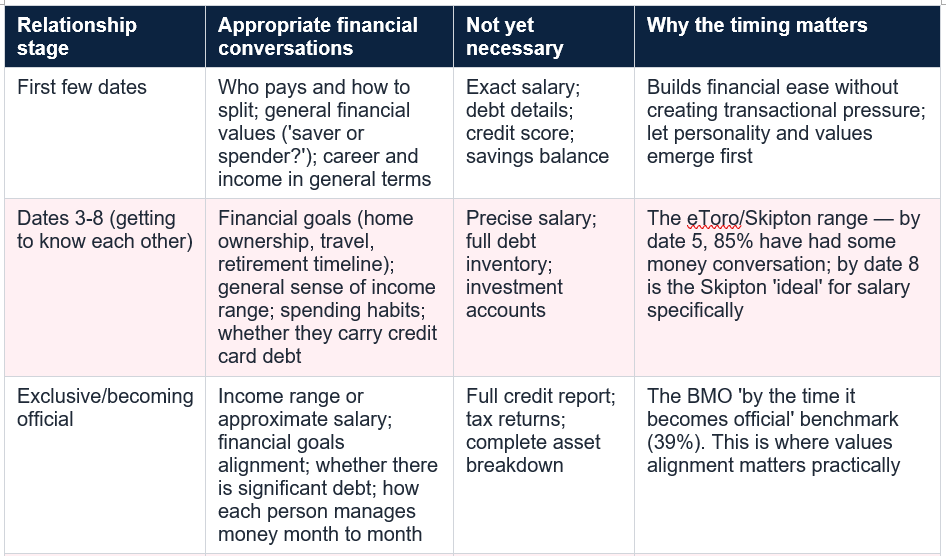
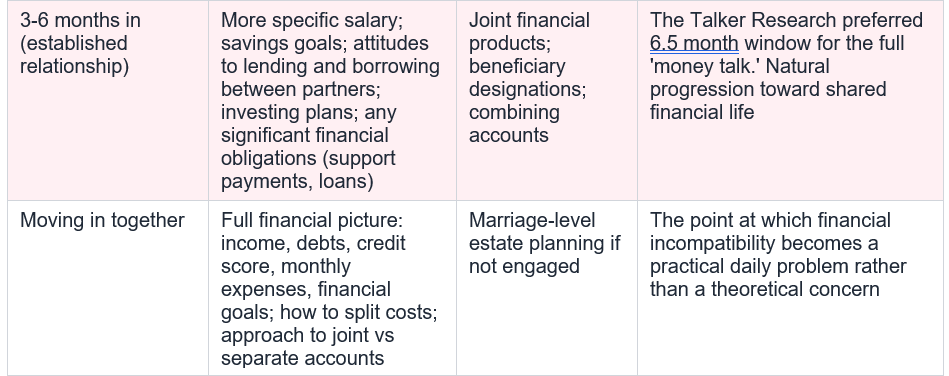
Different financial conversations belong at different stages of a relationship, and conflating ‘discussing money’ with ‘full financial disclosure’ creates unnecessary anxiety. Not every money conversation is a salary disclosure. The spectrum runs roughly as follows, with each stage naturally prompted by the relationship’s development rather than a calendar. Not relationship advice.
The Couples Who Get It Right — What the Data Shows
BMO’s February 2025 research on couples who discuss money openly found two consistent correlates of financial transparency: those who are truthful about money spend more quality time together, and those with disparate salary levels have less financial conflict when they share their finances openly. These are not causal claims from controlled experiments — correlation between financial openness and relationship quality runs in both directions, since couples who communicate well generally will also communicate well about money. But the pattern is consistent enough to be informative.The broader picture from BMO is instructive: only 55% of couples share equal responsibility for meeting with a professional financial adviser. This suggests that even in couples where both partners are financially engaged, the default often tilts toward one partner managing the financial relationship while the other is relatively passive. The research also found that those who start early tend to sustain the habit — couples who discuss finances before they are in a committed relationship are more likely to continue discussing them throughout the relationship. Not relationship advice.
Alex Sitaras, Head of Savings & Partnerships at Skipton Building Society: 'Many daters tend to avoid awkward conversations about finances, especially in the early stages, as money can feel like a sensitive topic. As the relationship progresses, being open about money — from personal spending habits, to sharing financial commitments from previous relationships and long-term financial goals — will help couples align values and build a foundation for a stable, honest connection.' Rachel Lawrence, Monarch Head of Advice and Planning: 'The more we normalise talking about money, the more comfortable younger generations will be to talk about it.' Source: Stornoway Gazette / Skipton Building Society 2026; Monarch Money June 2024. Not relationship advice.
Conclusion
The research does not produce a single correct answer to the question of when to discuss salary when dating. It produces a range — from date one (35% of active daters) to date three (Gen Z consensus) to date eight (Skipton Building Society research) to six-and-a-half months (Talker Research average preference) to engagement (14% of Boomer women). What the research does agree on is the direction: earlier than the previous generation’s norms, and explicitly welcomed by most people as a green flag rather than a red one.The more useful reframe is not ‘when should I reveal my salary?’ but ‘when is financial incompatibility a problem I need to know about?’ The answer to the second question is: before the relationship has developed to a point where discovery of incompatibility would be genuinely disruptive. That is not date one for most people. But it is certainly before moving in together, and arguably before exclusivity for anyone with significant debt, unusual financial obligations, or a strong view about how a shared financial life should be structured. The conversations that matter most are not about the number — they are about values, habits, and goals. The salary figure is context. The relationship to money is character.
As 74% of those looking for something serious say: financial transparency is not optional. It is foundational. Not relationship advice.
Frequently Asked Questions
When do most people first talk about money when dating?The data varies by generation and survey but converges on a clear trend: money conversations are happening earlier than ever before. eToro's 2025 survey found over a third of active daters bring up money on the very first date, with 75% doing so by date three and 85% by date five. A 2025 Chime/Talker Research survey (2,000 US singles) found 31% believe the financial conversation should start between dates one and three. A separate 2024 Monarch survey (1,000 Americans) found Gen Z most commonly say 'after three dates' is the right time, while Baby Boomers most commonly say 'after more than three months.' Skipton Building Society's research puts the ideal moment for salary disclosure specifically at around eight dates. Talker Research's 2024 poll of those already in serious relationships found the average couple prefers to have the full money talk at 6.5 months, but actually takes almost 8 months to become fully transparent. The most accurate answer: it depends heavily on your age and relationship style, with a clear generational trend toward earlier disclosure. Not relationship advice.
Is it a green flag when someone talks about money early on a date?
For most people in 2025 — and especially for younger generations — yes. eToro's 2025 research found financial openness ranked as the single most important green flag in dating, above thoughtful romantic gestures (35%) and paying the bill (27%), with 46% ranking it the top positive signal. BMO's February 2025 survey found the top three most attractive financial traits are financial responsibility (96%), talking about money openly (94%), and having a good financial plan (92%). Half of Gen Z and millennials find it attractive when a casual date is open about income, compared to 37% of Gen X and 23% of Baby Boomers (Chime/Talker Research June 2025). 74% of those seeking a serious relationship say financial transparency is essential (Skipton Building Society 2026). The consensus among those under 40 is that financial openness is a sign of maturity, honesty, and readiness for a real relationship. Sources: eToro/Stylist 2025; BMO 2025; Chime/Talker Research 2025; Skipton 2026. Not relationship advice.
Do men or women bring up money earlier when dating?
Men bring up financial topics earlier than women in most surveys. eToro's 2025 data found 20% of men would mention their salary by the third date, compared to 12% of women. Men are also nearly twice as likely to raise debt by the third date. However, the gender gap is narrowing among younger generations. The reluctance among women to disclose early has historically been linked to safety concerns, social norms, and the experience of high-earning women receiving hostile responses when their income exceeded a partner's. Older women are more conservative: 51% of those aged 45-54 want to keep finances private when dating (Skipton Building Society 2026), and 14% of Baby Boomer women prefer to wait until engagement (Monarch 2024). Gen Z women show a significantly smaller gender gap in financial disclosure timing compared to older generations. Sources: eToro/Stylist 2025; Skipton 2026; Monarch 2024. Not relationship advice.
What salary do single people expect their partner to earn?
Northwestern Mutual's 2026 Planning & Progress Study (4,375 US adults) found that single Americans who consider income important in a potential lifelong partner expect them to earn an average of $139,000 per year. The gender breakdown is significant: women expected an average of $172,000 from potential mates, while men were satisfied with $101,000. However, the important moderating finding is that 59% of singles don't believe a potential partner's income is important at all — meaning these expectations represent the subset of daters for whom income is a priority, not the full dating population. These expectations also reflect the financial anxiety of an era in which basic life milestones (homeownership, family formation) require high combined incomes in many US cities. The lofty expectations come alongside a 'dating recession': just 31% of Americans aged 22-35 are actively dating in 2026 (Institute for Family Studies). Sources: KXAN/NewsNation (Northwestern Mutual 2026). Not relationship advice.
Do couples who talk about money early have better relationships?
The data suggests a correlation between financial openness and relationship quality, though causality is complex. BMO's February 2025 survey found that those who are truthful about money also spend more quality time together, and that couples with disparate salary levels have less financial conflict when they share their finances openly. The same research found that 11% of Americans in committed relationships rarely or never discuss household finances — and the average couple fights about money about once per month, with millennials and Gen Xers fighting twice per month (Talker Research 2024). Couples who communicate well generally tend to communicate well about money too, which makes the causality run in both directions: financial transparency supports relationship quality, and good relationship quality supports financial transparency. The practical implication: early financial conversations are an investment in relationship quality, not just a box to tick. Sources: BMO February 2025; Talker Research 2024. Not relationship advice.
0 Comments
Be the first to share your thoughts on this article.