
Spending
6 Ways to Enjoy a Luxury Winter Getaway Without Overspending

From choosing the right travel dates to taking advantage of resort amenities, a relaxing winter getaway does not have to mean overspending. Holiday airfare at a 10-year high (Hopper); Christmas hotels $197 a night, up 18%; Jan 2 domestic departure up to 45% cheaper than Dec 27 (Kayak); resort fees average $33 to $43 a night; split tickets can save up to 30% internationally.
Luxury and budget are not opposites, but they do not sit comfortably together either. The trick is to be deliberate about where you spend and where you do not. Here are the six ways I would use for a winter trip this year: pick your dates, choose where your money stretches, make the resort work for you, let points carry the luxury, plan the slopes and activities early, and fly smarter.
The case for acting deliberately is strong. According to Hopper, airfare for Thanksgiving and Christmas is at a 10-year high, and Christmas hotel rooms average $197 a night, up 18% on last year. Standard habits, such as flying out on the most popular day, will cost you more than usual. The good news is that timing still moves prices a lot. KAYAK says a domestic departure on 2 January could be up to 45% cheaper than 27 December. Expedia says early December and February offer the best flight savings. Small shifts add up.
Key takeaway: Spend on the one or two things you will remember, such as the room, the spa or the view, and save on the dates, the flights and the fees. A calm, flexible plan beats an expensive one.
Hotels tell a similar story. Thanksgiving rooms average about $170 a night, in line with last year, while Christmas rooms average $197, up 18%. My calculation: that is $27 more a night, or about 16%, than Thanksgiving.
Some pressure could ease. WCPO notes that airlines are scheduling roughly 3% fewer domestic seats this holiday season, which pushes prices up, but ABC reports that Spirit Airlines' shutdown is expected to have pulled fares down about 15% in its former markets. Local conditions matter. In short, prices are high, but the spread between cheap and expensive days is also large. That spread is your opportunity.
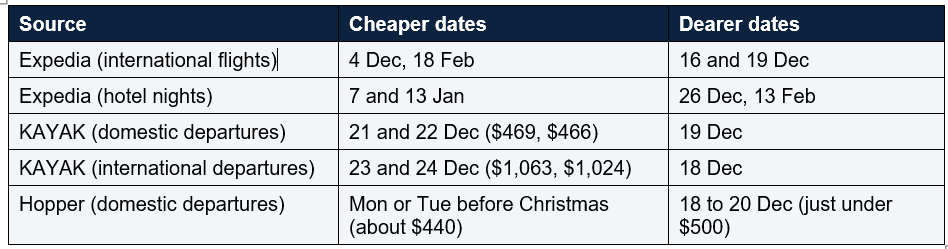
KAYAK adds that domestic fares on 21 and 22 December are 18% below the priciest date, 19 December. By my calculation, if $466 is 18% below the peak, the peak is about $568, so a family of four saves roughly $400 by shifting two days. That is approximate, since the peak fare is worked out from the percentage.
After Christmas, KAYAK says an international departure on 31 December could be up to 40% cheaper than 26 December. Hopper says to avoid returning on 27 December, when fares are up 20%, and notes that returning before 2 January is cheapest, with prices rising above $560 after that. The two sources look at departures and returns differently, so they point in slightly different directions. Both agree on one thing: avoid 27 December. A caution from KAYAK: most timing savings are "expected", and prices may vary. Treat these as patterns, not promises. And if Thanksgiving is on your mind, Hopper suggests leaving on Monday 23 November or on Thanksgiving Day itself, and avoiding Sunday 29 November for the return, when fares can reach $604 against about $350 on a Monday or Tuesday.
Be careful with the trendy places. Expedia says searches for Exuma in the Bahamas are up 115%, Quebec City 75% and Hakone in Japan 40%. When demand jumps, prices often follow (general reasoning), so a quieter neighbour may give you the same feel for less. Another idea is to mix luxury with ordinary days. One guide suggests thinking of your trip as "on" days and "off" days, with one memorable dinner and casual local spots the rest of the time. It is a lower-quality source, but it works in practice: the contrast makes the splurge feel bigger.
How big is the fee? NerdWallet's study of 160 hotels found resort fees range from $15 to $50 a night and average $33 where charged. By brand, the averages were Marriott $50, Hyatt $33.80, Hilton $33, IHG $32.57 and Wyndham $25. Other sources give higher figures. One widely cited number is about $42 a night, and another site puts the 2026 average at $43. Checkbook says mandatory hotel fees added $27 a night on average. These differ because they measure different things, such as only hotels that charge, or all mandatory fees. My reading is that $33 to $43 is a fair planning range. Resort fees are usually charged per room, per night, not per person. By my calculation, five nights at $33 is $165 and at $43 is $215. WealthVieu gives the same $215 figure for a $43 fee.
The rules help a little. Since 12 May 2025, a Federal Trade Commission rule requires hotels and booking platforms to show the total price, including resort fees, upfront. The rule does not ban the fee, only the surprise. So compare the total price, not the headline rate. Now the part you can control. If you are paying the fee, use what it covers. That usually means pool, fitness, internet and sometimes spa access or activities (check the property's list). Plan one signature spa or dining experience and use the included amenities for the rest. Where the fee is high, as in Las Vegas and Hawaii where $35 to $65 is common, compare the same room on a second site or look for properties that advertise no resort fee.
One more tip from ABC: hotel prices may drop 24 to 48 hours before a holiday in major cities. That is a gamble if you need a specific property, but it can pay off if you are flexible.
Free night certificates are the easiest win. The Points Guy values 85,000 Marriott points at $638, which is about 0.75 cents a point (my calculation: 638 divided by 85,000). And to get the most from a certificate, use it during the peak season at your destination or at a luxury resort, where cash rates are highest. Winter is peak season in many places, so a certificate can be worth more now than in summer. As an illustration, a Hyatt award night of 15,000 points at a property charging $300 works out at 2 cents per point (my calculation: 300 divided by 15,000 is 0.02).
Read the small print. Some certificates still leave you paying the resort fee at certain hotels. So a "free" night may cost $33 to $50 once the fee is added. One more perk to explore is a booking programme that adds breakfast and a hotel credit to luxury stays. A points blog estimates breakfast plus the credit at around $200 of value per stay at a $700-a-night property. That is a blogger's estimate and I have not verified the programme's terms, so check them before you rely on it. A fair warning: do not open a credit card just to chase a hotel stay unless you will use the benefits and can pay the balance in full (general advice). A free night is not free if you pay interest or an annual fee you would not otherwise have paid.
Notice the deadlines. Epic prices rose on 7 October and Ikon's final day to save was 8 October. If you missed them, look at multi-day passes or advance lift tickets instead.
The break-even is what matters. One resort says an adult buying at its September price breaks even against window-rate tickets in about seven ski days. By my calculation, an Epic pass at $1,169 pays for itself in about five days at Beaver Creek's lowest window price of $230, or about three and a half days at $356. Remember that the pass covers only the lifts, not the room.
Epic also offers friend tickets for 50% off the window price. If you ski with others, that matters: where the walk-up price is $330, a friend pays $165. If you do not ski, the same idea applies: book spa treatments, tours and dinners in advance when you can, and avoid buying them at the resort desk at peak rates (general advice).
The third move is the clock. Hopper says flights departing after 9 a.m. are twice as likely to be delayed as those between 5 and 8 a.m.. An early flight can save you a night in a hotel and a lot of frustration. The fourth is flexibility on the day. KAYAK says Thanksgiving Day itself is expected to be the cheapest day to fly, up to 19% lower domestically and 49% lower internationally than 20 November. The same pattern, flying on the quiet day, applies at Christmas.
Now apply the six ways. Shift the stay towards 7 or 13 January, the cheapest hotel nights. Use a free night certificate for one or two nights. Choose a property with a smaller fee or none. Fly on the quiet days, saving roughly $100 a ticket if the 18% figure holds. And spend your saved money on one great dinner or a spa day. I cannot give you a precise total, since I do not have rates for a specific resort, and it would be wrong to pretend otherwise. But the pattern is consistent: dates, fees and flights are where most of the savings hide.
Mistakes I would avoid: booking the headline rate and ignoring the resort fee; flying out on the busiest day because it suits you by habit; assuming all points are worth the same chasing a trendy destination when a quieter one would do; buying lift tickets at the window when a pass or advance ticket is cheaper; and treating a single comparison site as the whole market.
Also, do not forget the basics: check travel insurance and cancellation terms before you pay, especially for non-refundable fares (general advice).
A few caveats. Most date savings are based on search data and averages, which KAYAK warns are expected, not guaranteed. Expedia's findings are drawn from searches between July and October. Conflicts: resort fees average $33, $42 or $43, and Checkbook says $27; Epic Pass prices are given as $1,169 and $1,089, and described as both a rise and a cut; Hyatt point values range from 1.7 to 2.5 cents to 1.8 cents; and Hopper and KAYAK treat post-Christmas dates in different ways. Several sources are lower quality, such as the repost of luxury-agent advice, a points blog and a card guide, and I label them as such. I did not retrieve specific luxury resort rates, hotel loyalty programme terms from the companies themselves, or travel insurance data.
Prices are high this winter, so there is more to gain from care than usual. Pick the one or two things that matter most to you, protect them, and save on everything else. This post is general information, not advice, and prices change daily.
Expedia says 4 December and 18 February are cheapest for international flights, and 7 and 13 January for hotel nights. KAYAK says 21 and 22 December are the cheapest domestic departures around Christmas.
How much are resort fees?
NerdWallet found an average of $33 a night where charged, with a range of $15 to $50 [8]. Other sources say $42 to $43.
Are hotel free night certificates worth it?
They can be, especially at peak-season luxury properties. Check whether you still have to pay a resort fee.
Is it cheaper to buy two one-way tickets?
Sometimes. KAYAK says its Hacker Fares can save up to 30% internationally and 29% domestically, but compare both options.
Does a ski pass save money?
It can, if you ski enough days. One resort estimates break-even at about seven ski days, and a day ticket at Beaver Creek runs $230 to $356.
Table of Contents
- The quick answer
- What winter 2026-27 is costing
- Way 1: Pick your dates
- Way 2: Choose where your money stretches
- Way 3: Make the resort work for you
- Way 4: Let points and certificates carry the luxury
- Way 5: Plan the slopes and activities early
- Way 6: Fly smarter
- A worked example
- Conclusion
- FAQ
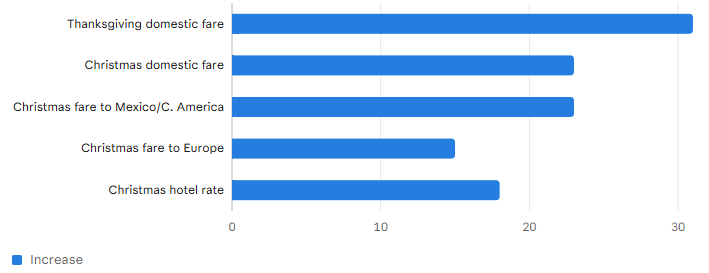
Holiday 2026 price increases vs last year (%)
% change vs 2025 by Source: Hopper via ABC News, 26 Sep 2026
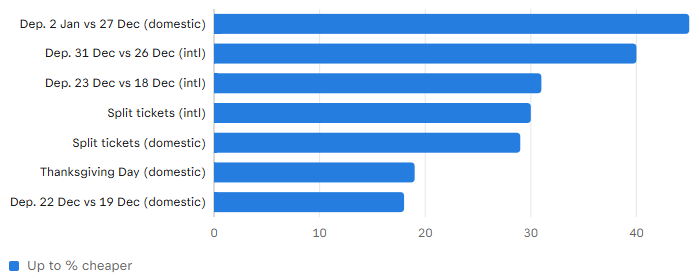
Maximum savings from flexible dates and split tickets (%)
% cheaper by Source: KAYAK, 'up to' figures, expected not guaranteed
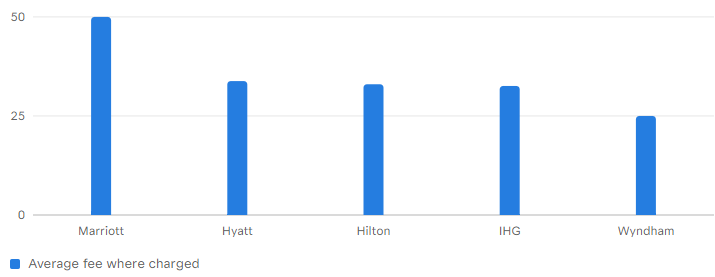
Average resort fee by hotel brand ($ per night)
$ per night by Source: NerdWallet study of 160 hotels (other sources report $27 to $43 overall)Luxury and budget are not opposites, but they do not sit comfortably together either. The trick is to be deliberate about where you spend and where you do not. Here are the six ways I would use for a winter trip this year: pick your dates, choose where your money stretches, make the resort work for you, let points carry the luxury, plan the slopes and activities early, and fly smarter.
The case for acting deliberately is strong. According to Hopper, airfare for Thanksgiving and Christmas is at a 10-year high, and Christmas hotel rooms average $197 a night, up 18% on last year. Standard habits, such as flying out on the most popular day, will cost you more than usual. The good news is that timing still moves prices a lot. KAYAK says a domestic departure on 2 January could be up to 45% cheaper than 27 December. Expedia says early December and February offer the best flight savings. Small shifts add up.
Key takeaway: Spend on the one or two things you will remember, such as the room, the spa or the view, and save on the dates, the flights and the fees. A calm, flexible plan beats an expensive one.
What winter 2026-27 is costing
Let me set the scene with the current numbers. Hopper puts the average domestic round trip at about $402 for Thanksgiving, up 31% on last year, and $452 for Christmas, up 23%. For Christmas, fares to Mexico and Central America are up 23% and to Europe up 15%, while Middle East, Asia and Oceania fares are similar to or slightly below 2025.Hotels tell a similar story. Thanksgiving rooms average about $170 a night, in line with last year, while Christmas rooms average $197, up 18%. My calculation: that is $27 more a night, or about 16%, than Thanksgiving.
Some pressure could ease. WCPO notes that airlines are scheduling roughly 3% fewer domestic seats this holiday season, which pushes prices up, but ABC reports that Spirit Airlines' shutdown is expected to have pulled fares down about 15% in its former markets. Local conditions matter. In short, prices are high, but the spread between cheap and expensive days is also large. That spread is your opportunity.
Way 1: Pick your dates
Dates are the biggest lever, and the data is fresh. Expedia's Winter Travel Outlook looked at flight and hotel searches made between July and October 2026. It found that 4 December and 18 February are the cheapest days to fly internationally, while 16 and 19 December are the most expensive. For hotels, the cheapest nights to book are 7 and 13 January, and the most expensive are 26 December and 13 February. There is a catch: Expedia also lists 4 and 27 December among the most crowded nights, so the cheap flight on 4 December may come with a busy hotel. Check both before you commit.KAYAK adds that domestic fares on 21 and 22 December are 18% below the priciest date, 19 December. By my calculation, if $466 is 18% below the peak, the peak is about $568, so a family of four saves roughly $400 by shifting two days. That is approximate, since the peak fare is worked out from the percentage.
After Christmas, KAYAK says an international departure on 31 December could be up to 40% cheaper than 26 December. Hopper says to avoid returning on 27 December, when fares are up 20%, and notes that returning before 2 January is cheapest, with prices rising above $560 after that. The two sources look at departures and returns differently, so they point in slightly different directions. Both agree on one thing: avoid 27 December. A caution from KAYAK: most timing savings are "expected", and prices may vary. Treat these as patterns, not promises. And if Thanksgiving is on your mind, Hopper suggests leaving on Monday 23 November or on Thanksgiving Day itself, and avoiding Sunday 29 November for the return, when fares can reach $604 against about $350 on a Monday or Tuesday.
Way 2: Choose where your money stretches
Luxury is partly about where you go and partly about how you go. A luxury travel agent quoted in a repost of Black Tomato advice recommends travelling off-peak and choosing destinations where your budget stretches further. It is a lower-quality source, but the logic holds: the same level of comfort costs less where demand is lower. Use the fare data as a guide. KAYAK's lowest average round-trip fares for the holidays include Punta Gorda, Florida at $307 and Toronto at $486. It also says Canada and Mexico account for 8 of the 10 lowest-priced international destinations, with The Bahamas and Colombia also featuring. Fares to Cusco, Peru are 20% lower than last year.Be careful with the trendy places. Expedia says searches for Exuma in the Bahamas are up 115%, Quebec City 75% and Hakone in Japan 40%. When demand jumps, prices often follow (general reasoning), so a quieter neighbour may give you the same feel for less. Another idea is to mix luxury with ordinary days. One guide suggests thinking of your trip as "on" days and "off" days, with one memorable dinner and casual local spots the rest of the time. It is a lower-quality source, but it works in practice: the contrast makes the splurge feel bigger.
Way 3: Make the resort work for you
Resorts have one thing you can control and one thing you cannot. The thing you cannot control is the resort fee. The thing you can control is whether you get your money's worth from it.How big is the fee? NerdWallet's study of 160 hotels found resort fees range from $15 to $50 a night and average $33 where charged. By brand, the averages were Marriott $50, Hyatt $33.80, Hilton $33, IHG $32.57 and Wyndham $25. Other sources give higher figures. One widely cited number is about $42 a night, and another site puts the 2026 average at $43. Checkbook says mandatory hotel fees added $27 a night on average. These differ because they measure different things, such as only hotels that charge, or all mandatory fees. My reading is that $33 to $43 is a fair planning range. Resort fees are usually charged per room, per night, not per person. By my calculation, five nights at $33 is $165 and at $43 is $215. WealthVieu gives the same $215 figure for a $43 fee.
The rules help a little. Since 12 May 2025, a Federal Trade Commission rule requires hotels and booking platforms to show the total price, including resort fees, upfront. The rule does not ban the fee, only the surprise. So compare the total price, not the headline rate. Now the part you can control. If you are paying the fee, use what it covers. That usually means pool, fitness, internet and sometimes spa access or activities (check the property's list). Plan one signature spa or dining experience and use the included amenities for the rest. Where the fee is high, as in Las Vegas and Hawaii where $35 to $65 is common, compare the same room on a second site or look for properties that advertise no resort fee.
One more tip from ABC: hotel prices may drop 24 to 48 hours before a holiday in major cities. That is a gamble if you need a specific property, but it can pay off if you are flexible.
Way 4: Let points and certificates carry the luxury
Points can turn a $700 night into a much smaller bill, but only if you understand what a point is worth. Values differ a lot between programmes. NerdWallet values World of Hyatt points at 1.8 cents each, while a Hilton point is valued at about 0.5 cents. Another ranking says Hyatt points typically value 1.7 to 2.5 cents against 0.5 cents for Hilton and 0.7 cents for Marriott. The ranges differ between sources, so always do the maths yourself.Free night certificates are the easiest win. The Points Guy values 85,000 Marriott points at $638, which is about 0.75 cents a point (my calculation: 638 divided by 85,000). And to get the most from a certificate, use it during the peak season at your destination or at a luxury resort, where cash rates are highest. Winter is peak season in many places, so a certificate can be worth more now than in summer. As an illustration, a Hyatt award night of 15,000 points at a property charging $300 works out at 2 cents per point (my calculation: 300 divided by 15,000 is 0.02).
Read the small print. Some certificates still leave you paying the resort fee at certain hotels. So a "free" night may cost $33 to $50 once the fee is added. One more perk to explore is a booking programme that adds breakfast and a hotel credit to luxury stays. A points blog estimates breakfast plus the credit at around $200 of value per stay at a $700-a-night property. That is a blogger's estimate and I have not verified the programme's terms, so check them before you rely on it. A fair warning: do not open a credit card just to chase a hotel stay unless you will use the benefits and can pay the balance in full (general advice). A free night is not free if you pay interest or an annual fee you would not otherwise have paid.
Way 5: Plan the slopes and activities early
If your luxury winter means snow, lift costs can rival the hotel. A one-day adult ticket at Beaver Creek, Colorado, runs between $230 and $356 this season. That is why season passes matter. Pass prices are confusing this year, and sources disagree. One site lists the Epic Pass at $1,169, while another reported the adult Epic Pass at $1,089 before a price rise on 25 May. A local report said Epic prices hit new highs for 2026/27, while a ski magazine said the pass lowered prices. Prices may also have moved again since. The Ikon Pass was reported starting at $1,449 for adults and the Ikon Base at $1,019.Notice the deadlines. Epic prices rose on 7 October and Ikon's final day to save was 8 October. If you missed them, look at multi-day passes or advance lift tickets instead.
The break-even is what matters. One resort says an adult buying at its September price breaks even against window-rate tickets in about seven ski days. By my calculation, an Epic pass at $1,169 pays for itself in about five days at Beaver Creek's lowest window price of $230, or about three and a half days at $356. Remember that the pass covers only the lifts, not the room.
Epic also offers friend tickets for 50% off the window price. If you ski with others, that matters: where the walk-up price is $330, a friend pays $165. If you do not ski, the same idea applies: book spa treatments, tours and dinners in advance when you can, and avoid buying them at the resort desk at peak rates (general advice).
Way 6: Fly smarter
Flights deserve a plan of their own. The first move is timing: Expedia's research suggests booking domestic flights by 10 November to save up to $166, and international flights by 1 December to save up to $422. Domestic has passed, but international is 13 days away from today, 18 November (my calculation). The second move is to split your ticket. KAYAK's "Hacker Fares" combine two one-way tickets, and it says savings could reach up to 30% internationally and 29% domestically. Simpson Bay in St. Maarten was 30% cheaper and Washington D.C. 29% cheaper. It does not always work, so compare both ways.The third move is the clock. Hopper says flights departing after 9 a.m. are twice as likely to be delayed as those between 5 and 8 a.m.. An early flight can save you a night in a hotel and a lot of frustration. The fourth is flexibility on the day. KAYAK says Thanksgiving Day itself is expected to be the cheapest day to fly, up to 19% lower domestically and 49% lower internationally than 20 November. The same pattern, flying on the quiet day, applies at Christmas.
A worked example
Let me put numbers together for a five-night stay in Christmas week. The Hopper average of $197 a night gives $985 for the room. Add a resort fee of $33 to $43 a night, and the stay is $1,150 to $1,200 before tax (my calculation: 985 plus 165, or 985 plus 215). Remember that $197 is an average hotel, not a luxury one, so a true luxury property will cost more.Now apply the six ways. Shift the stay towards 7 or 13 January, the cheapest hotel nights. Use a free night certificate for one or two nights. Choose a property with a smaller fee or none. Fly on the quiet days, saving roughly $100 a ticket if the 18% figure holds. And spend your saved money on one great dinner or a spa day. I cannot give you a precise total, since I do not have rates for a specific resort, and it would be wrong to pretend otherwise. But the pattern is consistent: dates, fees and flights are where most of the savings hide.
Mistakes I would avoid: booking the headline rate and ignoring the resort fee; flying out on the busiest day because it suits you by habit; assuming all points are worth the same chasing a trendy destination when a quieter one would do; buying lift tickets at the window when a pass or advance ticket is cheaper; and treating a single comparison site as the whole market.
Also, do not forget the basics: check travel insurance and cancellation terms before you pay, especially for non-refundable fares (general advice).
A few caveats. Most date savings are based on search data and averages, which KAYAK warns are expected, not guaranteed. Expedia's findings are drawn from searches between July and October. Conflicts: resort fees average $33, $42 or $43, and Checkbook says $27; Epic Pass prices are given as $1,169 and $1,089, and described as both a rise and a cut; Hyatt point values range from 1.7 to 2.5 cents to 1.8 cents; and Hopper and KAYAK treat post-Christmas dates in different ways. Several sources are lower quality, such as the repost of luxury-agent advice, a points blog and a card guide, and I label them as such. I did not retrieve specific luxury resort rates, hotel loyalty programme terms from the companies themselves, or travel insurance data.
Conclusion
A luxury winter break without overspending is mostly a planning exercise. Choose dates away from the peak: early December, early January or February are your friends. Choose where your money stretches, and use the amenities you are paying for. Let points and certificates do some heavy lifting, but know what a point is worth. Plan the slopes early, and fly smart.Prices are high this winter, so there is more to gain from care than usual. Pick the one or two things that matter most to you, protect them, and save on everything else. This post is general information, not advice, and prices change daily.
FAQ
What are the cheapest dates to travel this winter?Expedia says 4 December and 18 February are cheapest for international flights, and 7 and 13 January for hotel nights. KAYAK says 21 and 22 December are the cheapest domestic departures around Christmas.
How much are resort fees?
NerdWallet found an average of $33 a night where charged, with a range of $15 to $50 [8]. Other sources say $42 to $43.
Are hotel free night certificates worth it?
They can be, especially at peak-season luxury properties. Check whether you still have to pay a resort fee.
Is it cheaper to buy two one-way tickets?
Sometimes. KAYAK says its Hacker Fares can save up to 30% internationally and 29% domestically, but compare both options.
Does a ski pass save money?
It can, if you ski enough days. One resort estimates break-even at about seven ski days, and a day ticket at Beaver Creek runs $230 to $356.
0 Comments
Be the first to share your thoughts on this article.