

Spending
Personal Finance Experts on Grocery Affordability

You are not imagining it and you are not alone. Grocery prices in the United States are up 30% compared to five years ago, according to Bureau of Labor Statistics data. The average American family now spends $677 a month on groceries — roughly $160 more per month than before the pandemic, according to Motley Fool Money research. Fifty-three percent of American adults in an AP-NORC poll say grocery prices are a major stressor. One in five is using personal savings to pay for food. The inflation headlines have moved on, but the grocery store has not caught up. In fact, food prices were 3.8% higher in August 2026 compared to the same month the year before, per USDA data. Personal finance experts who have been tracking this crisis have clear, specific, and actionable guidance. This article assembles their direct quotes, their reasoning, and the numbers behind what they recommend — not to make the situation feel less real, but to give you specific tools that demonstrably reduce the grocery bill without reducing the quality of what you eat.
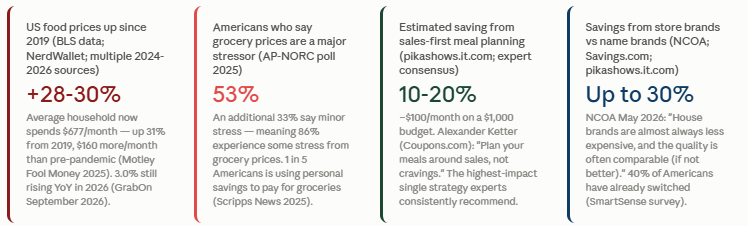
The stress is measurable too. An AP-NORC poll found that 53% of American adults describe grocery prices as a major stressor in 2025, with an additional 33% calling it a minor stressor. That means 86% of American adults report some level of stress from food prices. One in five Americans is using personal savings to pay for groceries. The USDA’s Food Price Outlook noted that food prices were 3.8% higher in August 2026 compared to a year prior (cited NCOA, May 2026), and GrabOn.com’s September 2026 grocery price tracker confirmed food up 3.0% year-over-year, with egg prices the notable exception at 27.9% lower than 2025.
What the personal finance experts covering this story all emphasise is that the path through the crisis is not about waiting for prices to fall — the USDA’s forecast range for 2027 runs from a 5% drop to a 10% increase, which is not a reliable path to relief. It is about changing the system under which you shop.
US grocery affordability by the numbers (2024-2026): +28-30% since 2019 (NerdWallet; BLS data). Average household spend 2025: $677/month (Motley Fool Money). Up 31% from 2019 / +$160/month (Motley Fool). AP-NORC poll: 53% major stress, 33% minor stress from grocery prices. 1 in 5 using savings to pay for groceries. Food prices 3.8% higher August 2026 vs year prior (USDA; NCOA May 2026). 3.0% YoY food inflation 2026 (GrabOn September 2026). Egg prices: -27.9% vs 2025 (BLS; GrabOn September 2026). USDA 2026 end-year forecast: +2.7%. Sources cited. Not financial advice.
Scripps News’ 2025 reporting on grocery prices makes another structural point: most Americans shop on autopilot. ‘Grocery shopping for many consumers is habitual — shopping at the same store on the same day every week.’ This habit means that even when prices shift, many consumers do not adjust their behaviour quickly enough to capture available savings. The stores that have announced price reductions benefit consumers who buy the same discounted products each week — but experts warn those reductions are not expected to last.
The factors driving food prices are largely outside any individual shopper’s control: weather affecting crops, livestock disease cycles, international trade policy, and energy costs. What is within a shopper’s control is the system under which they shop — and that is exactly what the following experts address. Not financial advice.
Wagner’s specific strategies extend beyond list-making. She suggests splitting the grocery run between stores when the price differential justifies it: buying meat at one store and produce at another. This sounds time-consuming, but for items where one store’s pricing is significantly better than another’s — especially on proteins, which represent a large share of grocery spending — the savings can justify the extra stop. Her third recommendation is to increase the share of frozen food in the shopping basket for items where fresh is not essential, specifically because frozen extends the usable life of the food and reduces waste. Not financial advice.
Corie Wagner, Savings.com (ABC7/WLS September 2024): 'It’s going to cut down on food waste and cut down on impulse purchasing.' On frozen food: 'They’re going to save you cost over time, because you don’t have to use them up as quickly as you would a fresh food.' On generics: 'You can also consider trying more generic brands to save money.' Summary: list discipline, frozen staples, strategic multi-store shopping, and store apps for coupons and rewards. Source: ABC7/WLS (abc7.com; abc11.com; abc30.com), September 24-25, 2024.
The economic logic of frozen food is straightforward. Fresh proteins — chicken, fish, ground beef — need to be consumed within two to four days or frozen anyway. Buying them already frozen means buying when the price is right rather than buying because the clock is running. Frozen vegetables are nutritionally comparable to fresh in most studies and dramatically reduce the waste that comes from fresh produce going soft at the back of the fridge. For a household where the fresh produce drawer is regularly producing waste, shifting 30-40% of vegetable consumption to frozen would reduce both the grocery bill and the frequency of trips. Not financial advice.
The conventional meal planning model starts with what you want to eat this week and then shops for those ingredients. The Ketter model starts with what is on sale this week — which proteins, which vegetables, which pantry staples — and then constructs the week’s meals from what the store is offering at its best price. This approach captures the promotional pricing cycle that every major grocery chain runs as a matter of business practice. Sale prices at large grocery chains are typically 20-40% below regular shelf prices. A household that consistently builds its week’s meals around the sales flyer will systematically buy proteins and produce at promotional prices rather than paying standard shelf rates.
The practical implementation: before writing the shopping list, open the store’s app or website and look at this week’s featured deals. Chicken is on sale? This is a chicken week. Ground beef is at a low? Time for burgers, tacos, and pasta bolognese. The meals follow the prices, not the other way around. This does not require culinary flexibility — it requires a shift in sequence. Not financial advice.
Alexander Ketter (Coupons.com, CNHI.com 2025): 'Plan your meals around sales, not cravings.' Practical implementation: every week, open the store app before writing the shopping list. Note what proteins, produce, and pantry staples are featured at lowest prices. Build this week's meals around those items. A 20-40% savings on proteins alone — the highest-cost grocery category — materially reduces the total bill. Source: CNHI.com 2025. Not financial advice.
The conventional version builds a meal plan and then shops for ingredients. The reverse version audits the pantry, fridge, and freezer first, identifies what needs to be used, and then builds the meal plan around those existing ingredients. This approach has two compounding benefits: it eliminates the waste of items that expire unused, and it reduces the total shopping list for the week by using what is already there. A household that consistently does a weekly pantry audit before shopping will buy fewer redundant items, waste less food, and reduce the overall grocery bill without changing what they eat.
Woroch also makes a specific point about leftovers that most households underutilise: ‘Save the leftovers for lunch or an entirely new meal.’ In the context of a $677/month grocery budget, leftovers that replace a purchased lunch or a second night’s cooking represent real, measurable savings. The household that brings last night’s dinner to work instead of buying lunch has converted a sunk cooking cost into a second meal, effectively cutting the per-meal cost in half. Not financial advice.
This matters for how households should think about their grocery budget. If you are spending $160 more per month than you were in 2019 and your basket is essentially unchanged, you have not made a lifestyle upgrade — you have simply absorbed a cost increase on the same consumption pattern. Caporal’s analysis supports the core message of every other expert in this article: the response to food inflation has to be a change in the purchasing system, because passive continuation of existing habits simply passes the full cost increase through to the household budget.
The logical extension of Caporal’s point is that households have room to make strategic substitutions — to store brands, to frozen, to different stores, to sales-based planning — that reduce the cost of the basket without reducing what they eat. Not financial advice.
The key NCOA recommendation that aligns with expert consensus is to plan meals around the store’s weekly sales flyer. This is the same principle as Ketter’s sale-first meal planning, expressed as an institutional recommendation: ‘To make the most of your grocery savings, try planning your meals around your store’s weekly sales flyer.’ NCOA also makes a direct statement on store brands that is worth citing in full: ‘House brands are almost always less expensive than the leading brands, and the quality is often comparable (if not better).’ The ‘if not better’ qualifier is significant — it reflects a genuine improvement in private-label product quality over the past decade that has changed the calculus for quality-conscious shoppers. Not financial advice.
The store brand quality argument has shifted materially in the 2020s. Consumer goods manufacturers have cut costs on branded products through ‘shrinkflation’ — reducing net weights while maintaining price — while many retailers have invested in improving their own-label product quality to drive loyalty. In several categories — canned tomatoes, dried pasta, frozen vegetables, dairy products, and cooking oils — the gap between national brand and store brand quality is negligible or reversed. The 40% of Americans who switch to store brands to cut costs (SmartSense survey, cited CNHI.com) are responding to a real and demonstrable quality parity that was not always present a decade ago. Not financial advice.
The Aldi and Lidl model is effectively the physical embodiment of expert consensus: store brands as the default, limited selection to reduce overwhelm, regular promotions on seasonal items (the ‘Aldi Finds’ aisle), and lower overhead passed to customers through lower prices. For households in markets where these stores operate, they represent a structural solution to grocery inflation rather than a tactical one. A shopper who does 80% of their grocery shopping at Aldi or Lidl and supplements with a conventional supermarket for the remaining items has combined the discount grocer’s base pricing with the flexibility to capture sale prices on name-brand items they specifically prefer. Not financial advice.
Beyond the official loyalty ecosystem, CNHI.com’s 2025 reporting noted a cultural shift that has real practical implications: ‘Platforms like TikTok and Instagram have created entire communities around budget cooking, grocery hauls and “$10 dinner” challenges.’ These communities function as crowd-sourced frugality research — practical strategies tested by real households, shared in accessible formats, and continuously updated as prices change. For households that are new to active grocery management, these communities provide a low-friction entry point to budget cooking strategies that complement the expert advice above. Not financial advice.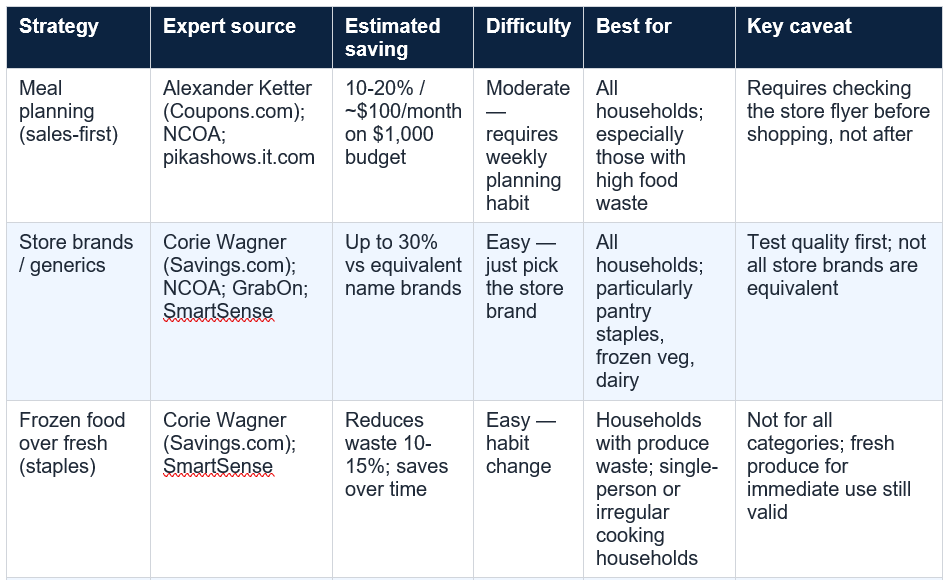
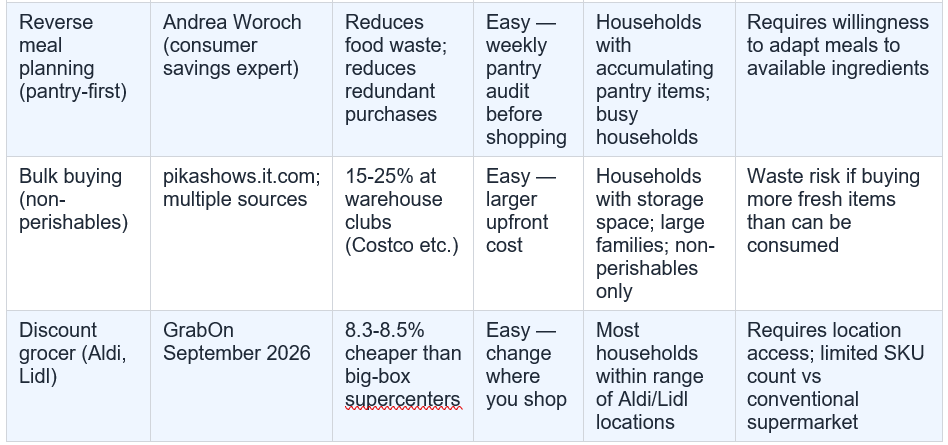
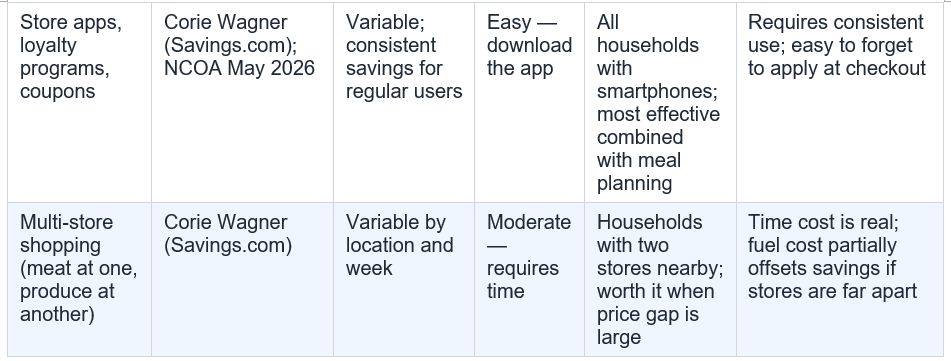
Plan your meals around sales, not around cravings — Alexander Ketter’s six words cover the most impactful single strategy. Supplement that with a pantry audit before each shopping trip (Andrea Woroch’s reverse meal planning), switch to store brands on staples where quality is comparable (NCOA; Corie Wagner), incorporate more frozen staples to reduce waste (Corie Wagner; SmartSense data), and use the store’s app for loyalty rewards and coupons (NCOA; Corie Wagner). If Aldi or Lidl operates in your market, use it as the primary store for non-negotiable staples.
The $677 average monthly grocery bill is not inevitable. A household that implements three or four of these strategies simultaneously — particularly sales-first meal planning, store brand switching, and a discount grocer for staples — can expect to bring that bill meaningfully lower without eating differently. The food prices are not coming down quickly. The system under which you shop can change today.
Depending on the measurement source: 28% since 2019 per NerdWallet analysis; 30% over five years per Bureau of Labor Statistics data cited by CNHI.com in 2025. Motley Fool Money's research on household spending found the average American household spent $677 per month on groceries in 2025, up 31% from 2019 — about $160 more per month than before the pandemic. Food prices were 3.8% higher in August 2026 compared to August 2025 per USDA Food Price Outlook data cited by NCOA. The USDA predicts grocery prices will rise a further 2.7% by end of 2026. The one major exception: retail egg prices fell 27.9% compared to 2025 (GrabOn.com, September 2026; BLS). Sources: NerdWallet; BLS; Motley Fool Money; USDA; GrabOn.com September 2026; NCOA May 2026. Not financial advice.
What is the single most impactful strategy experts recommend for grocery savings?
The most consistently cited high-impact strategy across multiple experts is meal planning that starts with the store's weekly sales rather than with a predetermined menu. Alexander Ketter of Coupons.com put it most directly: 'Plan your meals around sales, not cravings' (CNHI.com 2025). NCOA's May 2026 guidance similarly recommends planning meals around the store's weekly sales flyer as the primary savings approach. The savings estimate for meal planning is 10-20% of the total grocery budget, or roughly $100/month on a $1,000 budget (pikashows.it.com). This strategy is most impactful combined with store brand switching and loyalty app coupons. Sources: CNHI.com 2025; NCOA May 2026; pikashows.it.com. Not financial advice.
Are store brands actually as good as name brands?
Increasingly yes, particularly for pantry staples. NCOA's May 2026 guidance states: 'House brands are almost always less expensive than the leading brands, and the quality is often comparable (if not better).' The 'if not better' qualifier reflects genuine quality improvement in private-label products. Multiple experts recommend store brands: Corie Wagner (Savings.com) specifically suggests trying more generic brands; NCOA endorses them as a core savings strategy; Corie Wagner recommends store brand savings of up to 30%. SmartSense survey data found 40% of Americans have already switched to store brands to cut costs. Categories where quality parity is strongest: canned goods, dried pasta, frozen vegetables, dairy products, cooking oils, and cleaning products. Categories where name brand preference may be more justified: specific branded seasonings, baked goods with proprietary recipes. Sources: NCOA May 2026; ABC7/WLS September 2024; CNHI.com 2025; SmartSense survey. Not financial advice.
What is reverse meal planning and how does it save money?
Reverse meal planning is a strategy coined or popularised by consumer savings expert Andrea Woroch, as quoted by CNHI.com in 2025. Conventional meal planning starts with a predetermined menu and shops for ingredients. Reverse meal planning starts with a pantry, fridge, and freezer audit — identifying what ingredients are already on hand, particularly items approaching their use-by date or that have been accumulating unused — and then builds the week's meals around what is already there. This approach saves money in two ways: it reduces food waste by using items before they expire, and it reduces the shopping list for the week by replacing purchases with existing inventory. Woroch also recommends saving leftovers for lunch or a new meal, effectively halving the per-serving cost of meals that generate leftovers. Sources: CNHI.com 2025; Andrea Woroch consumer savings expert. Not financial advice.
Will grocery prices come down in 2026 and 2027?
Not significantly, according to expert consensus. The USDA's Food Price Outlook forecasts grocery prices rising about 2.7% by end of 2026 (GrabOn.com September 2026). For 2027, USDA's latest forecast range runs from a 5% drop to a 10% increase — underscoring just how unpredictable food prices remain (Scripps News 2025). Experts do not expect the savings from the retailer price reductions announced in 2025 to last, and note those reductions only benefit consumers who buy the same discounted products each week. Grocery shopping being habitual means most consumers do not fully capture available savings even when they exist. The broader expert consensus: the factors driving food prices — weather, livestock cycles, tariffs, energy costs — are outside any individual shopper's control, and waiting for structural relief is not a reliable financial strategy. Sources: GrabOn.com September 2026; NCOA May 2026; Scripps News 2025; ABC7/WLS September 2024. Not financial advice.
Table of Contents
- The Grocery Crisis in Numbers: Why Experts Are Talking About This
- Why Prices Aren’t Coming Down — What the Data Actually Shows
- Expert #1: Corie Wagner (Savings.com) — Plan Around What You Buy, Not What You Want
- Expert Tip: Frozen Food Is the Under-Rated Budget Strategy
- Expert #2: Alexander Ketter (Coupons.com) — “Plan Your Meals Around Sales, Not Cravings”
- Expert #3: Andrea Woroch — Reverse Meal Planning and the Pantry-First Approach
- Expert #4: Jack Caporal (Motley Fool) — Spending More Doesn’t Mean Eating More
- What NCOA Says: Budget Calendars and the Sales Flyer as a Planning Tool
- The Store Brand Argument: Quality vs Cost in 2026
- The Discount Grocer Advantage: Aldi, Lidl, and the Store-Brand Ecosystem
- The Digital Savings Layer: Apps, Loyalty Programs, and the TikTok Effect
- The Complete Expert Strategy Comparison Table
- Conclusion: The Experts Agree More Than You’d Expect
- Frequently Asked Questions
The Grocery Crisis in Numbers: Why Experts Are Talking About This
Grocery affordability has become one of the defining personal finance issues of the mid-2020s. The data behind the stress is not subtle. Food prices in the United States are up 30% compared to five years ago, according to Bureau of Labor Statistics data cited across multiple 2025 reporting sources. A separate NerdWallet analysis put the total increase at 28% since 2019. The average American household spent $677 per month on groceries in 2025, according to Motley Fool Money research — up 31% from 2019, or roughly $160 more per month than before the pandemic began.The stress is measurable too. An AP-NORC poll found that 53% of American adults describe grocery prices as a major stressor in 2025, with an additional 33% calling it a minor stressor. That means 86% of American adults report some level of stress from food prices. One in five Americans is using personal savings to pay for groceries. The USDA’s Food Price Outlook noted that food prices were 3.8% higher in August 2026 compared to a year prior (cited NCOA, May 2026), and GrabOn.com’s September 2026 grocery price tracker confirmed food up 3.0% year-over-year, with egg prices the notable exception at 27.9% lower than 2025.
What the personal finance experts covering this story all emphasise is that the path through the crisis is not about waiting for prices to fall — the USDA’s forecast range for 2027 runs from a 5% drop to a 10% increase, which is not a reliable path to relief. It is about changing the system under which you shop.
US grocery affordability by the numbers (2024-2026): +28-30% since 2019 (NerdWallet; BLS data). Average household spend 2025: $677/month (Motley Fool Money). Up 31% from 2019 / +$160/month (Motley Fool). AP-NORC poll: 53% major stress, 33% minor stress from grocery prices. 1 in 5 using savings to pay for groceries. Food prices 3.8% higher August 2026 vs year prior (USDA; NCOA May 2026). 3.0% YoY food inflation 2026 (GrabOn September 2026). Egg prices: -27.9% vs 2025 (BLS; GrabOn September 2026). USDA 2026 end-year forecast: +2.7%. Sources cited. Not financial advice.
Why Prices Aren’t Coming Down — What the Data Actually Shows
The most frustrating aspect of grocery inflation is the structural quality of it. When used car prices or gasoline prices fall, consumers feel the relief quickly. Grocery prices do not work the same way. Corie Wagner, an expert at Savings.com, told ABC7/WLS in September 2024: ‘Those prices have climbed faster than food at like restaurants.’ This counterintuitive finding — that eating at home has become more expensive relative to eating out — reflects the multiple cost pressures hitting the grocery supply chain simultaneously: farm input costs, fuel, labour, packaging, and the ripple effects of tariffs.Scripps News’ 2025 reporting on grocery prices makes another structural point: most Americans shop on autopilot. ‘Grocery shopping for many consumers is habitual — shopping at the same store on the same day every week.’ This habit means that even when prices shift, many consumers do not adjust their behaviour quickly enough to capture available savings. The stores that have announced price reductions benefit consumers who buy the same discounted products each week — but experts warn those reductions are not expected to last.
The factors driving food prices are largely outside any individual shopper’s control: weather affecting crops, livestock disease cycles, international trade policy, and energy costs. What is within a shopper’s control is the system under which they shop — and that is exactly what the following experts address. Not financial advice.
Expert #1: Corie Wagner (Savings.com) — Plan Around What You Buy, Not What You Want
Corie Wagner, described as an expert at Savings.com by ABC7/WLS Chicago in their September 2024 grocery affordability reporting, offered several specific strategies that cut across multiple budget categories simultaneously. Her foundational argument is that the shopper who goes to the store without a list is making an extremely expensive decision. As she told ABC7’s Jason Knowles and Ann Pistone: ‘It’s going to cut down on food waste and cut down on impulse purchasing.’ That double reduction — waste and impulse — addresses two separate money drains with the same tool.Wagner’s specific strategies extend beyond list-making. She suggests splitting the grocery run between stores when the price differential justifies it: buying meat at one store and produce at another. This sounds time-consuming, but for items where one store’s pricing is significantly better than another’s — especially on proteins, which represent a large share of grocery spending — the savings can justify the extra stop. Her third recommendation is to increase the share of frozen food in the shopping basket for items where fresh is not essential, specifically because frozen extends the usable life of the food and reduces waste. Not financial advice.
Corie Wagner, Savings.com (ABC7/WLS September 2024): 'It’s going to cut down on food waste and cut down on impulse purchasing.' On frozen food: 'They’re going to save you cost over time, because you don’t have to use them up as quickly as you would a fresh food.' On generics: 'You can also consider trying more generic brands to save money.' Summary: list discipline, frozen staples, strategic multi-store shopping, and store apps for coupons and rewards. Source: ABC7/WLS (abc7.com; abc11.com; abc30.com), September 24-25, 2024.
Expert Tip: Frozen Food Is the Under-Rated Budget Strategy
Frozen food occupies a specific and important place in the grocery affordability toolkit that is underutilised by many households. Wagner’s point — that frozen goods save money over time because you can use them more slowly than fresh food — is backed by behavioural data. A SmartSense survey cited by CNHI.com in 2025 found that 39% of Americans have turned to frozen food specifically because it lasts longer, making it a mainstream rather than niche response to food inflation.The economic logic of frozen food is straightforward. Fresh proteins — chicken, fish, ground beef — need to be consumed within two to four days or frozen anyway. Buying them already frozen means buying when the price is right rather than buying because the clock is running. Frozen vegetables are nutritionally comparable to fresh in most studies and dramatically reduce the waste that comes from fresh produce going soft at the back of the fridge. For a household where the fresh produce drawer is regularly producing waste, shifting 30-40% of vegetable consumption to frozen would reduce both the grocery bill and the frequency of trips. Not financial advice.
Expert #2: Alexander Ketter (Coupons.com) — “Plan Your Meals Around Sales, Not Cravings”
Alexander Ketter, identified as a consumer and savings expert at Coupons.com, offered what may be the single most condensed and actionable piece of advice in this article. As quoted by CNHI.com in 2025: ‘Plan your meals around sales, not cravings.’ Six words that represent a complete inversion of how most people approach weekly meal planning.The conventional meal planning model starts with what you want to eat this week and then shops for those ingredients. The Ketter model starts with what is on sale this week — which proteins, which vegetables, which pantry staples — and then constructs the week’s meals from what the store is offering at its best price. This approach captures the promotional pricing cycle that every major grocery chain runs as a matter of business practice. Sale prices at large grocery chains are typically 20-40% below regular shelf prices. A household that consistently builds its week’s meals around the sales flyer will systematically buy proteins and produce at promotional prices rather than paying standard shelf rates.
The practical implementation: before writing the shopping list, open the store’s app or website and look at this week’s featured deals. Chicken is on sale? This is a chicken week. Ground beef is at a low? Time for burgers, tacos, and pasta bolognese. The meals follow the prices, not the other way around. This does not require culinary flexibility — it requires a shift in sequence. Not financial advice.
Alexander Ketter (Coupons.com, CNHI.com 2025): 'Plan your meals around sales, not cravings.' Practical implementation: every week, open the store app before writing the shopping list. Note what proteins, produce, and pantry staples are featured at lowest prices. Build this week's meals around those items. A 20-40% savings on proteins alone — the highest-cost grocery category — materially reduces the total bill. Source: CNHI.com 2025. Not financial advice.
Expert #3: Andrea Woroch — Reverse Meal Planning and the Pantry-First Approach
Consumer savings expert Andrea Woroch offers a variation on meal planning that solves a specific problem many households have: the accumulation of partially used pantry items, freezer bags with unidentified proteins, and canned goods that are approaching their use-by dates. Her approach, quoted by CNHI.com in 2025, is what she calls ‘reverse meal planning.’The conventional version builds a meal plan and then shops for ingredients. The reverse version audits the pantry, fridge, and freezer first, identifies what needs to be used, and then builds the meal plan around those existing ingredients. This approach has two compounding benefits: it eliminates the waste of items that expire unused, and it reduces the total shopping list for the week by using what is already there. A household that consistently does a weekly pantry audit before shopping will buy fewer redundant items, waste less food, and reduce the overall grocery bill without changing what they eat.
Woroch also makes a specific point about leftovers that most households underutilise: ‘Save the leftovers for lunch or an entirely new meal.’ In the context of a $677/month grocery budget, leftovers that replace a purchased lunch or a second night’s cooking represent real, measurable savings. The household that brings last night’s dinner to work instead of buying lunch has converted a sunk cooking cost into a second meal, effectively cutting the per-meal cost in half. Not financial advice.
Expert #4: Jack Caporal (Motley Fool) — Spending More Doesn’t Mean Eating More
Jack Caporal, research director at The Motley Fool, makes a point that is easy to miss in the headline spending statistics. Motley Fool Money’s research found that the average American household spent $677 per month on groceries in 2025, up 31% from 2019. Caporal’s commentary, cited by Scripps News in 2025, is that this spending increase does not necessarily mean households have 31% more food at home. They have largely the same food at a higher price.This matters for how households should think about their grocery budget. If you are spending $160 more per month than you were in 2019 and your basket is essentially unchanged, you have not made a lifestyle upgrade — you have simply absorbed a cost increase on the same consumption pattern. Caporal’s analysis supports the core message of every other expert in this article: the response to food inflation has to be a change in the purchasing system, because passive continuation of existing habits simply passes the full cost increase through to the household budget.
The logical extension of Caporal’s point is that households have room to make strategic substitutions — to store brands, to frozen, to different stores, to sales-based planning — that reduce the cost of the basket without reducing what they eat. Not financial advice.
What NCOA Says: Budget Calendars and the Sales Flyer as a Planning Tool
The National Council on Aging (NCOA), whose guidance is particularly oriented towards older adults and those on fixed or limited incomes, updated its grocery affordability guidance in May 2026 with specific strategies for managing the ongoing food inflation environment. NCOA’s approach is distinctive in its emphasis on the budget calendar — a structured approach to grocery spending that maps purchase timing to both the household’s cash flow and the store’s promotional cycles.The key NCOA recommendation that aligns with expert consensus is to plan meals around the store’s weekly sales flyer. This is the same principle as Ketter’s sale-first meal planning, expressed as an institutional recommendation: ‘To make the most of your grocery savings, try planning your meals around your store’s weekly sales flyer.’ NCOA also makes a direct statement on store brands that is worth citing in full: ‘House brands are almost always less expensive than the leading brands, and the quality is often comparable (if not better).’ The ‘if not better’ qualifier is significant — it reflects a genuine improvement in private-label product quality over the past decade that has changed the calculus for quality-conscious shoppers. Not financial advice.
The Store Brand Argument: Quality vs Cost in 2026
Store brands — also called private label, own brand, or generics depending on the context — represent the clearest single-item savings opportunity in the grocery store. Corie Wagner (Savings.com) recommends trying generic brands. NCOA says house brands are almost always cheaper and often comparable or better in quality. GrabOn.com’s September 2026 grocery price analysis notes that discount grocers like Aldi and Lidl offer the lowest prices by stocking mostly exclusive store brands, running 8.3-8.5% cheaper than big-box supercenters overall. The pikashows.it.com 2025 consumer analysis estimates store brand savings at up to 30% versus equivalent name-brand products.The store brand quality argument has shifted materially in the 2020s. Consumer goods manufacturers have cut costs on branded products through ‘shrinkflation’ — reducing net weights while maintaining price — while many retailers have invested in improving their own-label product quality to drive loyalty. In several categories — canned tomatoes, dried pasta, frozen vegetables, dairy products, and cooking oils — the gap between national brand and store brand quality is negligible or reversed. The 40% of Americans who switch to store brands to cut costs (SmartSense survey, cited CNHI.com) are responding to a real and demonstrable quality parity that was not always present a decade ago. Not financial advice.
The Discount Grocer Advantage: Aldi, Lidl, and the Store-Brand Ecosystem
The discount grocer model — exemplified by Aldi and Lidl in the US market — deserves specific attention because it operationalises several of the expert strategies simultaneously. GrabOn.com’s September 2026 grocery price analysis found that discount grocers are 8.3-8.5% cheaper than big-box supercenters, primarily by stocking mostly exclusive store brands. But the operational model goes further than price: the limited SKU count (Aldi typically carries around 1,400 products compared to 30,000+ at a conventional supermarket) dramatically reduces the cognitive load of shopping, makes comparison easier, and reduces impulse purchasing.The Aldi and Lidl model is effectively the physical embodiment of expert consensus: store brands as the default, limited selection to reduce overwhelm, regular promotions on seasonal items (the ‘Aldi Finds’ aisle), and lower overhead passed to customers through lower prices. For households in markets where these stores operate, they represent a structural solution to grocery inflation rather than a tactical one. A shopper who does 80% of their grocery shopping at Aldi or Lidl and supplements with a conventional supermarket for the remaining items has combined the discount grocer’s base pricing with the flexibility to capture sale prices on name-brand items they specifically prefer. Not financial advice.
The Digital Savings Layer: Apps, Loyalty Programs, and the TikTok Effect
On top of the structural strategies — meal planning, store brands, discount grocers — there is a digital savings layer that the experts consistently mention. Corie Wagner’s ABC7 recommendations include taking advantage of store coupons and rewards through stores’ own apps. NCOA’s May 2026 guidance includes joining store loyalty programs as a core savings tool. These tools are free, widely available, and represent genuine additional discounts on top of whatever other strategy a household uses.Beyond the official loyalty ecosystem, CNHI.com’s 2025 reporting noted a cultural shift that has real practical implications: ‘Platforms like TikTok and Instagram have created entire communities around budget cooking, grocery hauls and “$10 dinner” challenges.’ These communities function as crowd-sourced frugality research — practical strategies tested by real households, shared in accessible formats, and continuously updated as prices change. For households that are new to active grocery management, these communities provide a low-friction entry point to budget cooking strategies that complement the expert advice above. Not financial advice.
The Complete Expert Strategy Comparison Table
Conclusion
Across four named experts, NCOA institutional guidance, two major research organisations, and multiple consumer surveys, a remarkably consistent picture emerges. Grocery prices are high and are likely to stay high for the foreseeable future. The strategies that reliably reduce the grocery bill are not exotic or difficult. They require a shift in the sequence of shopping decisions, not a downgrade in the quality of eating.Plan your meals around sales, not around cravings — Alexander Ketter’s six words cover the most impactful single strategy. Supplement that with a pantry audit before each shopping trip (Andrea Woroch’s reverse meal planning), switch to store brands on staples where quality is comparable (NCOA; Corie Wagner), incorporate more frozen staples to reduce waste (Corie Wagner; SmartSense data), and use the store’s app for loyalty rewards and coupons (NCOA; Corie Wagner). If Aldi or Lidl operates in your market, use it as the primary store for non-negotiable staples.
The $677 average monthly grocery bill is not inevitable. A household that implements three or four of these strategies simultaneously — particularly sales-first meal planning, store brand switching, and a discount grocer for staples — can expect to bring that bill meaningfully lower without eating differently. The food prices are not coming down quickly. The system under which you shop can change today.
Frequently Asked Questions
How much have grocery prices actually increased since 2019?Depending on the measurement source: 28% since 2019 per NerdWallet analysis; 30% over five years per Bureau of Labor Statistics data cited by CNHI.com in 2025. Motley Fool Money's research on household spending found the average American household spent $677 per month on groceries in 2025, up 31% from 2019 — about $160 more per month than before the pandemic. Food prices were 3.8% higher in August 2026 compared to August 2025 per USDA Food Price Outlook data cited by NCOA. The USDA predicts grocery prices will rise a further 2.7% by end of 2026. The one major exception: retail egg prices fell 27.9% compared to 2025 (GrabOn.com, September 2026; BLS). Sources: NerdWallet; BLS; Motley Fool Money; USDA; GrabOn.com September 2026; NCOA May 2026. Not financial advice.
What is the single most impactful strategy experts recommend for grocery savings?
The most consistently cited high-impact strategy across multiple experts is meal planning that starts with the store's weekly sales rather than with a predetermined menu. Alexander Ketter of Coupons.com put it most directly: 'Plan your meals around sales, not cravings' (CNHI.com 2025). NCOA's May 2026 guidance similarly recommends planning meals around the store's weekly sales flyer as the primary savings approach. The savings estimate for meal planning is 10-20% of the total grocery budget, or roughly $100/month on a $1,000 budget (pikashows.it.com). This strategy is most impactful combined with store brand switching and loyalty app coupons. Sources: CNHI.com 2025; NCOA May 2026; pikashows.it.com. Not financial advice.
Are store brands actually as good as name brands?
Increasingly yes, particularly for pantry staples. NCOA's May 2026 guidance states: 'House brands are almost always less expensive than the leading brands, and the quality is often comparable (if not better).' The 'if not better' qualifier reflects genuine quality improvement in private-label products. Multiple experts recommend store brands: Corie Wagner (Savings.com) specifically suggests trying more generic brands; NCOA endorses them as a core savings strategy; Corie Wagner recommends store brand savings of up to 30%. SmartSense survey data found 40% of Americans have already switched to store brands to cut costs. Categories where quality parity is strongest: canned goods, dried pasta, frozen vegetables, dairy products, cooking oils, and cleaning products. Categories where name brand preference may be more justified: specific branded seasonings, baked goods with proprietary recipes. Sources: NCOA May 2026; ABC7/WLS September 2024; CNHI.com 2025; SmartSense survey. Not financial advice.
What is reverse meal planning and how does it save money?
Reverse meal planning is a strategy coined or popularised by consumer savings expert Andrea Woroch, as quoted by CNHI.com in 2025. Conventional meal planning starts with a predetermined menu and shops for ingredients. Reverse meal planning starts with a pantry, fridge, and freezer audit — identifying what ingredients are already on hand, particularly items approaching their use-by date or that have been accumulating unused — and then builds the week's meals around what is already there. This approach saves money in two ways: it reduces food waste by using items before they expire, and it reduces the shopping list for the week by replacing purchases with existing inventory. Woroch also recommends saving leftovers for lunch or a new meal, effectively halving the per-serving cost of meals that generate leftovers. Sources: CNHI.com 2025; Andrea Woroch consumer savings expert. Not financial advice.
Will grocery prices come down in 2026 and 2027?
Not significantly, according to expert consensus. The USDA's Food Price Outlook forecasts grocery prices rising about 2.7% by end of 2026 (GrabOn.com September 2026). For 2027, USDA's latest forecast range runs from a 5% drop to a 10% increase — underscoring just how unpredictable food prices remain (Scripps News 2025). Experts do not expect the savings from the retailer price reductions announced in 2025 to last, and note those reductions only benefit consumers who buy the same discounted products each week. Grocery shopping being habitual means most consumers do not fully capture available savings even when they exist. The broader expert consensus: the factors driving food prices — weather, livestock cycles, tariffs, energy costs — are outside any individual shopper's control, and waiting for structural relief is not a reliable financial strategy. Sources: GrabOn.com September 2026; NCOA May 2026; Scripps News 2025; ABC7/WLS September 2024. Not financial advice.
0 Comments
Be the first to share your thoughts on this article.