
Savings
7 Gas-Saving Tips That Actually Work
Gas hit $4.15 a gallon as of September 2026 — and that's for regular. At 15,000 miles a year and 25 MPG, the average American driver now spends well over $2,400 per year at the pump. Most of them could cut that number by $300 to $600 without buying a new car, without a single costly repair, and without any special equipment. The US Department of Energy has quantified each of these seven strategies. Some save 3%. Some save 40%. This guide gives you the numbers, not the vague advice.
For the average American driver covering 15,000 miles per year in a car getting 25 miles per gallon, today's gas price translates to a fuel bill of approximately $2,490 per year — more than $200 per month. Autoinsurance.com's August 2026 fuel cost calculator estimates US household gas spending at $150 to $200-plus per month even before accounting for higher prices in coastal states or premium-fuel vehicles.
The good news: the US Department of Energy (DOE), the EPA, MIT, and Oak Ridge National Laboratory have collectively spent decades quantifying exactly how much specific driving habits and vehicle maintenance choices affect fuel consumption. The numbers are specific, peer-reviewed, and in some cases surprisingly large. Aggressive driving alone can cost you 10 to 40% of your fuel economy. A neglected tyre can cost 4%. A roof-top cargo box at highway speeds can cost 25%. These are not marginal differences — at $4.15 a gallon across a full year of driving, they translate to hundreds of dollars in unnecessary fuel spending. This guide presents all seven strategies with the actual DOE and EPA numbers behind them, and tells you exactly what each one is worth at current 2026 gas prices.
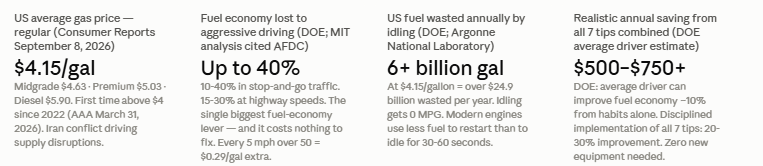
US average gas price: $4.15/gallon regular (September 8, 2026, Consumer Reports). Midgrade: $4.63. Premium: $5.03. Diesel: $5.90. Average US household: $150-$200+/month on gas (autoinsurance.com August 2026). 15,000 miles/year at 25 MPG at $4.15/gallon = ~$2,490/year. US idling alone wastes 6+ billion gallons/year (DOE; Argonne National Laboratory). Aggressive driving can cut fuel economy by up to 40% in stop-and-go traffic (DOE; MIT). Average driver can improve fuel economy by roughly 10% through better habits (AFDC/DOE).
In stop-and-go urban traffic, the range tops out at 40%. That is not a typo. A driver who accelerates hard from every light, speeds up to the next red light, and brakes sharply can burn 40% more fuel over the same urban route as a driver who anticipates traffic, maintains a smooth following distance, and brakes gradually. Every time you accelerate from a stop, you are spending stored kinetic energy — energy that came from the fuel you just burned — only to immediately destroy it with the next brake application. The smooth driver keeps that energy and coasts; the aggressive driver burns it twice.
At highway speeds, the range is 15 to 30%. The mechanism here is different: aggressive highway driving wastes fuel primarily through speed (aerodynamic drag rises with the square of speed) and through unnecessary accelerations and decelerations rather than the traffic-light scenario. A driver cruising at a steady 65 mph in light traffic does far better than one who accelerates to 80, brakes to 55, and repeats.
Smooth driving savings in real 2026 dollars. Baseline: 25 MPG vehicle, 15,000 miles/year, $4.15/gallon. Current annual fuel cost: $2,490/year. 15% improvement from smoother driving: saves $374/year. 25% improvement: saves $623/year. 40% improvement (stop-and-go focus): saves $996/year. The DOE's equivalent-cost framing: aggressive driving is like paying an extra $0.18 to $1.18 per gallon for your fuel (AFDC/DOE gas-saving tips). At $4.15, smooth driving is equivalent to buying your fuel at $3.97 to $2.97/gallon instead. Source: DOE fueleconomy.gov; AFDC/DOE gas-saving tips PDF; MIT analysis cited AFDC. Not financial advice.
The three specific changes that matter most for smooth driving: (1) Accelerate gently from stops — take 10-15 seconds to reach cruising speed rather than flooring it. (2) Anticipate traffic ahead — lift off the accelerator early when you see a red light or slowing traffic, letting the car coast rather than braking at the last second. (3) Maintain a generous following distance — it gives you the space to avoid unnecessary braking and re-acceleration cycles. GPS fleet data from Verizon Connect's 2025 Fleet Technology Trends survey found fleet drivers using GPS tracking and driver feedback averaged 16% fuel savings — double the 8% measured in 2021 — demonstrating that simply seeing your own driving scored produces measurable improvement. Not financial advice.
Tip #1 Verdict: Biggest potential saving on this list. DOE/MIT: 10-40% fuel economy improvement from eliminating aggressive driving. Zero cost to implement. At 25 MPG / 15,000 miles / $4.15/gallon, even a modest 15% improvement saves $374/year. A fully committed smooth-driving approach in urban traffic can save close to $1,000/year. No other single habit change on this list comes close.
This matters because tyres lose pressure naturally. Fox News's March 2026 fuel efficiency piece, citing tyre industry data, notes that tyres naturally lose 1 to 3 psi per month. A tyre that was properly inflated in January may be 5 to 10 psi underinflated by mid-summer without the driver ever noticing — because the visual difference between a properly inflated tyre and one that is 8 psi low is imperceptible to the naked eye. Yet Carvira's May 2026 fuel economy guide notes that a 6 psi underinflation across all four tyres reduces fuel economy 3 to 4%.
The mechanism is rolling resistance. An underinflated tyre deforms more as it rolls, creating a larger contact patch with the road and generating more heat and friction. The engine has to work harder to push the car forward against that resistance — burning more fuel to deliver the same forward motion. At highway speeds, this effect is magnified. eTags' May 2026 fuel savings guide adds that proper tyre inflation also extends tyre life and improves safety — making it one of the few maintenance items on this list that pays dividends beyond just the fuel saving.
Tyre pressure savings in 2026. Scenario: tyres 8 psi underinflated (common after 3-4 months without a check). DOE: 0.2% per 1 psi drop x 8 psi = 1.6% fuel economy loss. Carvira May 2026: 6 PSI underinflation = 3-4% loss. Fox News: 10 psi drop = up to 4% loss. At $4.15/gallon baseline and $2,490/year spend: 3% improvement = $75/year saving. Tyre pressure gauges cost $5 to $15. Payback period: days. Additionally: properly inflated tyres last longer, saving $50-$150 per replacement on accelerated tyre wear. Source: DOE fueleconomy.gov; Carvira May 2026; Fox News March 2026; eTags May 2026. Not financial advice.
Check tyre pressure monthly — or at every fill-up. The correct pressure is found on a sticker on the driver's door jamb (not on the tyre sidewall, which shows the maximum pressure, not the recommended operating pressure). Check when the tyres are cold — meaning the car has been parked for at least three hours. Pressure increases when tyres warm up from driving, so checking hot tyres will give a falsely elevated reading. Most modern cars with model year 2008 or later have a Tyre Pressure Monitoring System (TPMS) that alerts when a tyre drops 25% below specification — but this threshold is below where fuel economy impact is already significant. Do not rely on TPMS alone; check manually monthly.
Tip #2 Verdict: Small but effortless and free. DOE/EPA: 0.6%-3% improvement from proper tyre pressure. At $4.15/gallon, 3% improvement saves ~$75/year. Takes 3 minutes monthly. The tyre pressure gauge costs $10. Bonus: extends tyre life and improves braking distance. Do this today.
The DOE quantifies the highway speed penalty precisely: every 5 mph driven above 50 mph is equivalent to paying an additional $0.18 to $0.34 per gallon for your gas. LiveViewGPS's July 2026 fuel savings statistics report updates this to $0.29 per gallon at current prices. In practical terms: driving 70 mph instead of 60 mph on a highway trip is like voluntarily paying $0.58 more per gallon — every gallon, for the entire highway portion of the trip. Carvira's May 2026 guide puts the fuel economy penalty at 7 to 14% per 5 mph above 50 mph.
At highway speeds, slowing from 80 mph to 65 mph can produce a 15 to 20% improvement in fuel economy depending on the vehicle. At 65 mph versus 70 mph, the difference is smaller but still real. The practical advice is not to drive dangerously slowly on highways — it is simply to drive at the speed limit, avoid the passing lane when not passing, and resist the temptation to cruise at 80 when the limit is 65. At $4.15 a gallon across 10,000 highway miles per year, that habit change is worth $50 to $200+ in annual fuel savings depending on how aggressive your current highway speed is.
The speed-fuel relationship is not linear — it worsens rapidly with speed. A car getting 30 MPG at 55 mph might get 27 MPG at 60 mph (-10%), 24 MPG at 65 mph (-20%), 22 MPG at 70 mph (-27%), and 18 MPG at 80 mph (-40%). This means the fuel cost per mile, not per gallon, rises steeply with speed — a driver covering the same distance at 80 mph instead of 60 mph burns roughly 35-40% more fuel for that trip. At $4.15/gallon, a 3-hour highway trip at 80 mph instead of 65 mph could easily cost $8-$15 more in fuel. Source: DOE fueleconomy.gov speed data; AFDC; Carvira May 2026. Not financial advice.
The reason is simple: human drivers on long highway stretches unconsciously vary their speed far more than they realise. Accelerating to pass, then decelerating, then speeding back up, creating small but repeated cycles of acceleration and braking that each consume extra fuel. Cruise control eliminates these variations on flat or gently rolling terrain, maintaining exactly the programmed speed with minimal throttle adjustment.
eTags' May 2026 guide specifically notes that frequent speed changes burn extra gas, particularly over long trips, and that cruise control is ideal for maintaining consistent speed and optimising fuel efficiency on highway stretches. WMST's December 2025 fuel efficiency guide calls cruise control your best friend for maintaining steady, efficient speed on long, flat stretches.
The key qualification is terrain: cruise control works best on flat or gently rolling highways. On hilly terrain, conventional cruise control can actually hurt fuel economy — it holds a set speed by accelerating into climbs, burning more fuel than a human driver who might let speed drop slightly on a hill and recover on the descent. Modern adaptive cruise control systems on many 2022-and-newer vehicles handle this more efficiently. For drivers with older vehicles, use cruise control selectively on flat highway sections and disengage on hills.
Use cruise control whenever you are on a flat highway stretch at consistent speed. Set it to the speed limit or just below. Disengage on hilly sections. The simple discipline of activating cruise control for the highway portion of your commute or road trip is the lowest-effort fuel-saving behaviour on this list beyond checking tyre pressure. It requires nothing except pressing the button.
The DOE's data, from the AFDC gas-saving tips publication, quantifies it: idling uses a quarter to a half gallon of fuel per hour, depending on engine size and whether the air conditioner is running. In aggregate, US drivers idle away more than 6 billion gallons of gasoline and diesel per year, according to the Department of Energy and Argonne National Laboratory. At $4.15 per gallon, 6 billion gallons equals more than $24.9 billion in fuel burned while stationary — every year.
The winter warm-up myth is one of the biggest contributors to unnecessary idling in cold climates. Modern fuel-injected engines, which have been standard since the early 1990s, do not benefit from extended idling warm-up. They warm up faster and more efficiently under gentle load — driving slowly for the first minute or two. AAA's guidance, cited in the FIGFCU April 2026 gas-saving article, confirms this: modern engines warm up faster by driving than by idling. The old advice to idle for 10 minutes before driving a cold engine was appropriate for carbureted engines that have not been produced in significant volume since the mid-1980s.
The turn-off threshold is lower than most drivers assume. The DOE notes that a modern engine uses less fuel to restart than it does to idle for more than 30 to 60 seconds. WMST's December 2025 guide is consistent: if you are stopped for more than 30 to 60 seconds outside of traffic, turn the engine off. This applies at drive-through lanes, while waiting for a passenger, and while parked with the engine running. The exception is active traffic — do not turn off your engine in a traffic queue where you could need to move within seconds.
Idling costs in 2026. DOE: idling uses 0.25-0.50 gallons/hour. At $4.15/gallon: 0.25 gal/hr = $1.04/hour of idling. 0.50 gal/hr (AC on, larger engine) = $2.08/hour. A driver who idles for 10 minutes every day warming up the car in winter: 10 min x 180 days = 30 hours of idling. At $1.50 average (0.36 gal/hr x $4.15): approximately $45/year in warm-up idling alone. Drive-through lanes, school pickup, and parking lot waiting add to this total. Cutting daily unnecessary idling by 15 minutes: estimated $60-$100+/year saving. Source: DOE AFDC gas-saving tips PDF; LiveViewGPS July 2026; WMST December 2025. Not financial advice.
For most drivers, the invisible weight accumulation is in the boot and cargo area: camping gear left in from a trip three months ago, tools that were not unloaded after a project, children's sports equipment that lives in the car all season, boxes that never made it to the donation centre. eTags' May 2026 guide specifically notes this dynamic: lots of folks are carting around stuff in their trunk or cargo area without realising the effect the extra weight has on fuel economy.
Roof cargo creates a dramatically larger penalty through a different mechanism: aerodynamic drag. The DOE's AFDC publication gives specific data: a large, blunt roof-top cargo box reduces fuel economy by 2 to 8 percent in city driving, 6 to 17 percent on highways, and 10 to 25 percent at interstate speeds of 65 to 75 mph. At 70 mph, a large cargo box is a 10 to 25 percent fuel economy penalty for the entire highway journey — a potential 25% surcharge on your fuel cost just from leaving a cargo box mounted when it is not needed. Rear-mount cargo boxes or trays perform far better: 1 to 2 percent in city driving and 1 to 5 percent on the highway.
The roof cargo box is the most commonly underestimated fuel penalty on this list. Most drivers buy a roof-top cargo box for a skiing trip or camping holiday, mount it, use it for a weekend, then leave it mounted because removing it is effort. At 70 mph, that box may be costing 10 to 25% of their highway fuel economy every single day of their commute — even though it is empty. At $4.15/gallon, a 15% highway penalty on a driver covering 10,000 highway miles per year at 30 MPG costs approximately $200/year in unnecessary fuel. The box takes 20 minutes to remove. Source: DOE AFDC gas-saving tips PDF. Not financial advice.
GasBuddy, the most widely used gas price comparison app, published its annual best-day-to-buy-gas analysis in February 2026. The finding, cited by FIGFCU's April 2026 gas-saving guide: prices are consistently lowest on Sunday and Monday in most states. Wednesday through Saturday are consistently the most expensive days, as gas stations tend to raise prices ahead of the weekend when traffic and demand increase. In markets with meaningful price variation throughout the week, this timing difference can represent $0.10 to $0.20 or more per gallon — approximately $2 to $4 per fill-up on a 20-gallon tank.
Location matters as much as timing. GasBuddy, Waze, and Google Maps all surface real-time gas prices for stations near your location, and price differences of $0.15 to $0.30 per gallon between stations a mile apart are common in most urban and suburban markets. A driver who consistently uses the cheapest station within a reasonable distance rather than defaulting to the nearest one can save $50 to $150 per year without any change to driving habits.
Gas rewards programmes compound the saving. Grocery store fuel rewards (Kroger's fuel points programme is the largest, but most major grocery chains have equivalents) offer 10 cents off per gallon for typical spend levels, with promotional periods offering much more. Warehouse club memberships at Costco and Sam's Club consistently deliver below-market gas prices, with Costco members frequently reporting savings of 15 to 25 cents per gallon versus nearby non-member stations. Rewards credit cards with gas cash-back — typically 3 to 5 percent at the pump — add another layer. A driver combining optimal day/location buying, a grocery reward programme, and a 4% cash-back credit card can realistically save $0.30 to $0.50 per gallon on a consistent basis.
Set up GasBuddy on your phone today. Check the app before your next fill-up. Plan your next two fill-ups for Sunday or Monday. Sign up for your primary grocery store's fuel rewards programme — enrollment is free and the savings begin immediately. If you have a Costco membership, check whether the nearest Costco gas station is within reasonable distance for your regular fill-ups. These four steps take 15 minutes to set up and can save $100 to $200+ per year with zero change to your driving habits. Not financial advice.
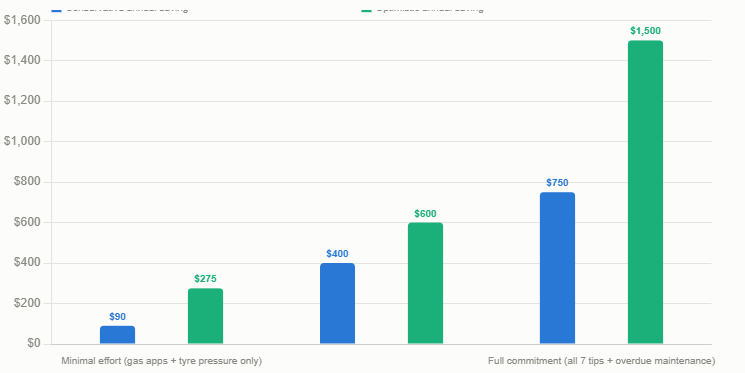
The DOE's own summary guidance — published on fueleconomy.gov and in the AFDC gas-saving tips PDF — states that studies suggest the average driver can improve his or her fuel economy by roughly 10 percent through proper maintenance and driving habits alone. The more optimistic scenario — a driver who addresses every item on this list, including removing roof cargo, driving smoothly, checking tyres monthly, using cruise control, and eliminating unnecessary idling — can realistically reach 20 to 30 percent better fuel economy than their current baseline.
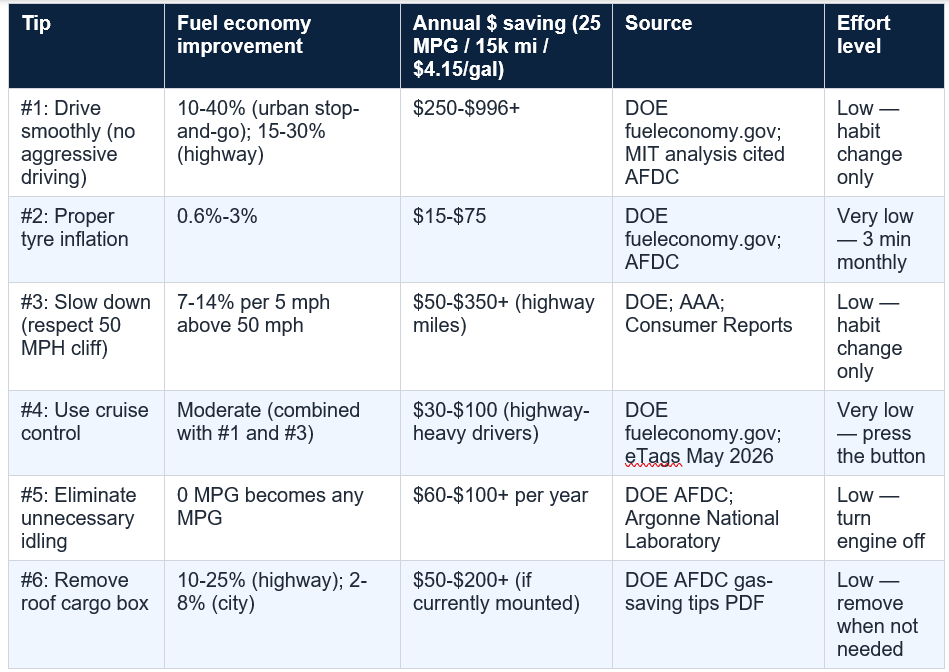
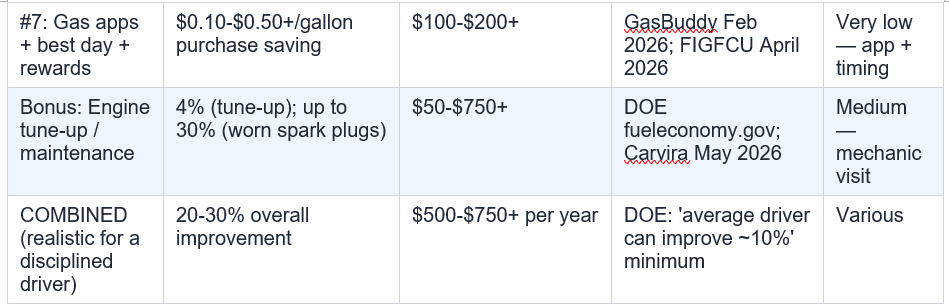
Dollar savings calculated at 25 MPG baseline, 15,000 miles/year, $4.15/gallon (Consumer Reports September 8, 2026). Actual savings depend on your current MPG, annual mileage, local gas prices, vehicle type, and how consistently each tip is applied. Not financial advice. Consult a qualified mechanic for vehicle-specific maintenance guidance.
The US Department of Energy has quantified every strategy in this guide. The numbers are not from industry marketing or vague claims about fuel additives — they are from peer-reviewed testing at Oak Ridge National Laboratory, MIT analysis, and decades of DOE data collection on real-world driving behaviour. Aggressive driving costs up to 40% of your fuel economy in stop-and-go traffic. Underinflated tyres cost up to 4%. A roof box at 70 mph costs up to 25%. Worn spark plugs cost up to 30%. None of these require a new car, an electric vehicle, or any significant expenditure.
The seven tips in this guide, implemented consistently, can produce a realistic saving of $500 to $750 per year for the average driver at current gas prices. For higher-mileage drivers, or for drivers currently practising every bad habit on this list, the saving can exceed $1,000. The cheapest tank of gas you will ever buy is one where you drive 25% further on it than you did last week — without spending a cent on fuel economy upgrades. That is the opportunity these tips represent.
Changing how you drive — specifically eliminating aggressive acceleration, speeding, and hard braking — is the most impactful single fuel-saving strategy, with a potential improvement of 10 to 40 percent in stop-and-go traffic and 15 to 30 percent at highway speeds, according to US Department of Energy data confirmed by MIT analysis cited by the Alternative Fuels Data Center. At $4.15/gallon and 15,000 miles per year in a 25 MPG vehicle, even a conservative 15% improvement saves $374 per year. No other single habit change on this list approaches that potential. The DOE equivalently states that aggressive driving is like paying an extra $0.18 to $1.18 per gallon for your fuel — with smooth driving, your effective fuel cost at the pump is $2.97 to $3.97 rather than $4.15 for the same physical gallon.
What is the average US gas price in September 2026?
The national average price for regular unleaded gasoline was $4.15 per gallon as of September 8, 2026, according to Consumer Reports, which is one of the most closely watched sources for weekly gas price tracking. Midgrade fuel is averaging $4.63 per gallon, premium is $5.03, and diesel is $5.90. Gas prices crossed $4 per gallon on March 31, 2026 for the first time since 2022, according to AAA data, driven by supply disruptions related to geopolitical tensions including the Iran conflict. Gas prices fluctuate daily and vary significantly by state and region. California, Hawaii, and Pacific Northwest states typically carry premiums above the national average; Gulf Coast states and the Midwest typically run below average.
Does cruise control actually save gas?
Yes, on flat or gently rolling highways. The US Department of Energy's fueleconomy.gov guidance confirms that using cruise control on the highway helps maintain a constant speed and, in most cases, saves gas. The reason is that human drivers unconsciously vary their speed on long highway stretches — speeding up slightly, then decelerating, then accelerating again — creating repeated cycles that each burn extra fuel. Cruise control eliminates these variations on flat terrain, maintaining exact speed with minimal throttle adjustment. The qualification is important: on hilly terrain, conventional cruise control can hurt fuel economy by accelerating aggressively into climbs. Use it selectively on flat sections. Modern adaptive cruise control systems on newer vehicles handle hills more efficiently than older conventional cruise control.
How much does tyre pressure affect fuel economy?
The US Department of Energy's data: keeping tyres properly inflated improves gas mileage by 0.6% on average, and up to 3% in some cases. Under-inflation reduces gas mileage by 0.2% for every 1 psi drop in pressure across all four tyres (DOE fueleconomy.gov). A 10 psi drop in pressure reduces fuel economy by up to 4%, according to Fox News' March 2026 expert fuel tips piece. Tyres naturally lose 1 to 3 psi per month, so a car that was properly inflated three months ago may now be 5 to 9 psi low. At $4.15/gallon, a 3% improvement saves approximately $75 per year for an average driver. The fix is free (air at most stations is free or $1 to $2), takes 3 minutes, and also extends tyre life and improves safety. Check your door jamb for the correct pressure, not the tyre sidewall.
What is the best day of the week to buy gas in 2026?
Sunday and Monday are consistently the cheapest days to buy gas in most US states, according to GasBuddy's 2026 annual best-day-to-buy analysis, published in February 2026 and cited by FIGFCU in their April 9, 2026 gas-saving guide. Wednesday through Saturday are consistently the most expensive days, as gas stations tend to raise prices ahead of the weekend when demand increases. The best time of day is typically early morning, when prices are set for the day. The GasBuddy app and Google Maps both show real-time gas prices by location — price differences of $0.10 to $0.30 per gallon between stations a mile apart are common in most urban and suburban markets. Combining optimal timing, optimal location selection, and a grocery fuel rewards programme or warehouse club membership can realistically save $0.20 to $0.50 per gallon compared to defaulting to the nearest most convenient station.
Table of Contents
- Why Gas Prices in 2026 Make This Worth Reading
- Tip #1 — Drive Smoothly: The Biggest Single Saving (Up to 40%)
- Tip #2 — Keep Your Tyres Properly Inflated (Up to 3% Improvement)
- Tip #3 — Slow Down and Respect the 50 MPH Efficiency Cliff
- Tip #4 — Use Cruise Control on Highways
- Tip #5 — Stop Idling: Your Engine at Rest Gets 0 MPG
- Tip #6 — Remove Excess Weight and Roof Cargo (Up to 25% Penalty)
- Tip #7 — Use Gas Apps, Buy on the Right Day, and Earn Rewards
- The Annual Saving: What Combining All Seven Tips Can Do
- Bonus: Vehicle Maintenance That Pays for Itself at the Pump
- The Complete Savings Summary Table
- Conclusion: The Cheapest Tank of Gas Is the One You Use More Efficiently
- Frequently Asked Questions
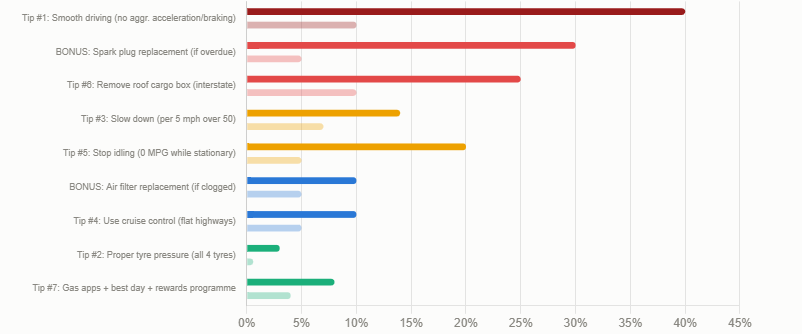
Fuel economy improvement: all 7 tips ranked by impact
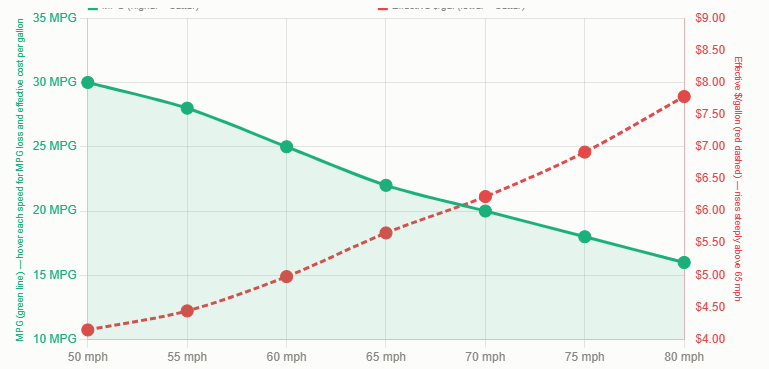
The speed cliff: how MPG falls above 50 mph
Annual dollar savings by driving behaviour at $4.15/gal
Why Gas Prices in 2026 Make This Worth Reading
Gas prices crossed $4 per gallon on March 31, 2026 for the first time since 2022, according to AAA. By September 8, 2026, Consumer Reports was reporting the national average at $4.15 per gallon for regular — with midgrade at $4.63, premium at $5.03, and diesel at $5.90. The spike is connected to supply disruptions and geopolitical tensions including the Iran conflict, which has roiled global oil markets throughout 2026, according to NPR's April 2026 coverage.For the average American driver covering 15,000 miles per year in a car getting 25 miles per gallon, today's gas price translates to a fuel bill of approximately $2,490 per year — more than $200 per month. Autoinsurance.com's August 2026 fuel cost calculator estimates US household gas spending at $150 to $200-plus per month even before accounting for higher prices in coastal states or premium-fuel vehicles.
The good news: the US Department of Energy (DOE), the EPA, MIT, and Oak Ridge National Laboratory have collectively spent decades quantifying exactly how much specific driving habits and vehicle maintenance choices affect fuel consumption. The numbers are specific, peer-reviewed, and in some cases surprisingly large. Aggressive driving alone can cost you 10 to 40% of your fuel economy. A neglected tyre can cost 4%. A roof-top cargo box at highway speeds can cost 25%. These are not marginal differences — at $4.15 a gallon across a full year of driving, they translate to hundreds of dollars in unnecessary fuel spending. This guide presents all seven strategies with the actual DOE and EPA numbers behind them, and tells you exactly what each one is worth at current 2026 gas prices.
US average gas price: $4.15/gallon regular (September 8, 2026, Consumer Reports). Midgrade: $4.63. Premium: $5.03. Diesel: $5.90. Average US household: $150-$200+/month on gas (autoinsurance.com August 2026). 15,000 miles/year at 25 MPG at $4.15/gallon = ~$2,490/year. US idling alone wastes 6+ billion gallons/year (DOE; Argonne National Laboratory). Aggressive driving can cut fuel economy by up to 40% in stop-and-go traffic (DOE; MIT). Average driver can improve fuel economy by roughly 10% through better habits (AFDC/DOE).
Tip #1 — Drive Smoothly: The Biggest Single Saving (Up to 40%)
If there is one gas-saving tip that dwarfs every other on this list in potential impact, it is this: drive smoothly. Stop accelerating hard, stop braking hard, stop speeding. The US Department of Energy's own data, confirmed by MIT analysis cited by the Department of Energy's Alternative Fuels Data Center (AFDC), is unambiguous: aggressive driving — defined as speeding combined with rapid acceleration and hard braking — lowers fuel economy by roughly 15 to 30 percent at highway speeds and 10 to 40 percent in stop-and-go traffic.In stop-and-go urban traffic, the range tops out at 40%. That is not a typo. A driver who accelerates hard from every light, speeds up to the next red light, and brakes sharply can burn 40% more fuel over the same urban route as a driver who anticipates traffic, maintains a smooth following distance, and brakes gradually. Every time you accelerate from a stop, you are spending stored kinetic energy — energy that came from the fuel you just burned — only to immediately destroy it with the next brake application. The smooth driver keeps that energy and coasts; the aggressive driver burns it twice.
At highway speeds, the range is 15 to 30%. The mechanism here is different: aggressive highway driving wastes fuel primarily through speed (aerodynamic drag rises with the square of speed) and through unnecessary accelerations and decelerations rather than the traffic-light scenario. A driver cruising at a steady 65 mph in light traffic does far better than one who accelerates to 80, brakes to 55, and repeats.
Smooth driving savings in real 2026 dollars. Baseline: 25 MPG vehicle, 15,000 miles/year, $4.15/gallon. Current annual fuel cost: $2,490/year. 15% improvement from smoother driving: saves $374/year. 25% improvement: saves $623/year. 40% improvement (stop-and-go focus): saves $996/year. The DOE's equivalent-cost framing: aggressive driving is like paying an extra $0.18 to $1.18 per gallon for your fuel (AFDC/DOE gas-saving tips). At $4.15, smooth driving is equivalent to buying your fuel at $3.97 to $2.97/gallon instead. Source: DOE fueleconomy.gov; AFDC/DOE gas-saving tips PDF; MIT analysis cited AFDC. Not financial advice.
The three specific changes that matter most for smooth driving: (1) Accelerate gently from stops — take 10-15 seconds to reach cruising speed rather than flooring it. (2) Anticipate traffic ahead — lift off the accelerator early when you see a red light or slowing traffic, letting the car coast rather than braking at the last second. (3) Maintain a generous following distance — it gives you the space to avoid unnecessary braking and re-acceleration cycles. GPS fleet data from Verizon Connect's 2025 Fleet Technology Trends survey found fleet drivers using GPS tracking and driver feedback averaged 16% fuel savings — double the 8% measured in 2021 — demonstrating that simply seeing your own driving scored produces measurable improvement. Not financial advice.
Tip #1 Verdict: Biggest potential saving on this list. DOE/MIT: 10-40% fuel economy improvement from eliminating aggressive driving. Zero cost to implement. At 25 MPG / 15,000 miles / $4.15/gallon, even a modest 15% improvement saves $374/year. A fully committed smooth-driving approach in urban traffic can save close to $1,000/year. No other single habit change on this list comes close.
Tip #2 — Keep Your Tyres Properly Inflated (Up to 3% Improvement)
Tyre pressure is one of the most consistently underperformed maintenance tasks in American motoring, and one of the most quantified fuel economy factors in DOE research. The DOE's fueleconomy.gov data is specific: keeping tyres inflated to the proper pressure improves gas mileage by 0.6% on average, with improvements of up to 3% in some cases. The inverse — underinflation — lowers gas mileage by 0.2% for every 1 psi drop in pressure across all four tyres.This matters because tyres lose pressure naturally. Fox News's March 2026 fuel efficiency piece, citing tyre industry data, notes that tyres naturally lose 1 to 3 psi per month. A tyre that was properly inflated in January may be 5 to 10 psi underinflated by mid-summer without the driver ever noticing — because the visual difference between a properly inflated tyre and one that is 8 psi low is imperceptible to the naked eye. Yet Carvira's May 2026 fuel economy guide notes that a 6 psi underinflation across all four tyres reduces fuel economy 3 to 4%.
The mechanism is rolling resistance. An underinflated tyre deforms more as it rolls, creating a larger contact patch with the road and generating more heat and friction. The engine has to work harder to push the car forward against that resistance — burning more fuel to deliver the same forward motion. At highway speeds, this effect is magnified. eTags' May 2026 fuel savings guide adds that proper tyre inflation also extends tyre life and improves safety — making it one of the few maintenance items on this list that pays dividends beyond just the fuel saving.
Tyre pressure savings in 2026. Scenario: tyres 8 psi underinflated (common after 3-4 months without a check). DOE: 0.2% per 1 psi drop x 8 psi = 1.6% fuel economy loss. Carvira May 2026: 6 PSI underinflation = 3-4% loss. Fox News: 10 psi drop = up to 4% loss. At $4.15/gallon baseline and $2,490/year spend: 3% improvement = $75/year saving. Tyre pressure gauges cost $5 to $15. Payback period: days. Additionally: properly inflated tyres last longer, saving $50-$150 per replacement on accelerated tyre wear. Source: DOE fueleconomy.gov; Carvira May 2026; Fox News March 2026; eTags May 2026. Not financial advice.
Check tyre pressure monthly — or at every fill-up. The correct pressure is found on a sticker on the driver's door jamb (not on the tyre sidewall, which shows the maximum pressure, not the recommended operating pressure). Check when the tyres are cold — meaning the car has been parked for at least three hours. Pressure increases when tyres warm up from driving, so checking hot tyres will give a falsely elevated reading. Most modern cars with model year 2008 or later have a Tyre Pressure Monitoring System (TPMS) that alerts when a tyre drops 25% below specification — but this threshold is below where fuel economy impact is already significant. Do not rely on TPMS alone; check manually monthly.
Tip #2 Verdict: Small but effortless and free. DOE/EPA: 0.6%-3% improvement from proper tyre pressure. At $4.15/gallon, 3% improvement saves ~$75/year. Takes 3 minutes monthly. The tyre pressure gauge costs $10. Bonus: extends tyre life and improves braking distance. Do this today.
Tip #3 — Slow Down and Respect the 50 MPH Efficiency Cliff
Every car has a speed at which it achieves peak fuel efficiency. For most passenger vehicles, that speed is around 50 miles per hour — a figure confirmed by both AAA and Consumer Reports, as cited in Georgia Public Broadcasting's April 2026 coverage. Above 50 mph, fuel economy begins to decline as aerodynamic drag increases with the square of speed. The faster you go, the harder the car has to work against the air, and the more fuel it burns per mile.The DOE quantifies the highway speed penalty precisely: every 5 mph driven above 50 mph is equivalent to paying an additional $0.18 to $0.34 per gallon for your gas. LiveViewGPS's July 2026 fuel savings statistics report updates this to $0.29 per gallon at current prices. In practical terms: driving 70 mph instead of 60 mph on a highway trip is like voluntarily paying $0.58 more per gallon — every gallon, for the entire highway portion of the trip. Carvira's May 2026 guide puts the fuel economy penalty at 7 to 14% per 5 mph above 50 mph.
At highway speeds, slowing from 80 mph to 65 mph can produce a 15 to 20% improvement in fuel economy depending on the vehicle. At 65 mph versus 70 mph, the difference is smaller but still real. The practical advice is not to drive dangerously slowly on highways — it is simply to drive at the speed limit, avoid the passing lane when not passing, and resist the temptation to cruise at 80 when the limit is 65. At $4.15 a gallon across 10,000 highway miles per year, that habit change is worth $50 to $200+ in annual fuel savings depending on how aggressive your current highway speed is.
The speed-fuel relationship is not linear — it worsens rapidly with speed. A car getting 30 MPG at 55 mph might get 27 MPG at 60 mph (-10%), 24 MPG at 65 mph (-20%), 22 MPG at 70 mph (-27%), and 18 MPG at 80 mph (-40%). This means the fuel cost per mile, not per gallon, rises steeply with speed — a driver covering the same distance at 80 mph instead of 60 mph burns roughly 35-40% more fuel for that trip. At $4.15/gallon, a 3-hour highway trip at 80 mph instead of 65 mph could easily cost $8-$15 more in fuel. Source: DOE fueleconomy.gov speed data; AFDC; Carvira May 2026. Not financial advice.
Tip #4 — Use Cruise Control on Highways
Cruise control is the mechanical implementation of smooth, consistent-speed driving on highways — the same principle as Tip #1, but enforced automatically rather than requiring constant driver effort and discipline. The DOE's fueleconomy.gov guidance is direct: using cruise control on the highway helps maintain a constant speed and, in most cases, will save gas.The reason is simple: human drivers on long highway stretches unconsciously vary their speed far more than they realise. Accelerating to pass, then decelerating, then speeding back up, creating small but repeated cycles of acceleration and braking that each consume extra fuel. Cruise control eliminates these variations on flat or gently rolling terrain, maintaining exactly the programmed speed with minimal throttle adjustment.
eTags' May 2026 guide specifically notes that frequent speed changes burn extra gas, particularly over long trips, and that cruise control is ideal for maintaining consistent speed and optimising fuel efficiency on highway stretches. WMST's December 2025 fuel efficiency guide calls cruise control your best friend for maintaining steady, efficient speed on long, flat stretches.
The key qualification is terrain: cruise control works best on flat or gently rolling highways. On hilly terrain, conventional cruise control can actually hurt fuel economy — it holds a set speed by accelerating into climbs, burning more fuel than a human driver who might let speed drop slightly on a hill and recover on the descent. Modern adaptive cruise control systems on many 2022-and-newer vehicles handle this more efficiently. For drivers with older vehicles, use cruise control selectively on flat highway sections and disengage on hills.
Use cruise control whenever you are on a flat highway stretch at consistent speed. Set it to the speed limit or just below. Disengage on hilly sections. The simple discipline of activating cruise control for the highway portion of your commute or road trip is the lowest-effort fuel-saving behaviour on this list beyond checking tyre pressure. It requires nothing except pressing the button.
Tip #5 — Stop Idling: Your Engine at Rest Gets 0 MPG
An idling engine gets exactly zero miles per gallon. It is burning fuel to go nowhere. Yet idling is so embedded in American driving culture — warming up the car before winter drives, leaving the engine running at long drive-throughs, sitting with the engine on while waiting for school pickup — that most drivers underestimate how much it costs them.The DOE's data, from the AFDC gas-saving tips publication, quantifies it: idling uses a quarter to a half gallon of fuel per hour, depending on engine size and whether the air conditioner is running. In aggregate, US drivers idle away more than 6 billion gallons of gasoline and diesel per year, according to the Department of Energy and Argonne National Laboratory. At $4.15 per gallon, 6 billion gallons equals more than $24.9 billion in fuel burned while stationary — every year.
The winter warm-up myth is one of the biggest contributors to unnecessary idling in cold climates. Modern fuel-injected engines, which have been standard since the early 1990s, do not benefit from extended idling warm-up. They warm up faster and more efficiently under gentle load — driving slowly for the first minute or two. AAA's guidance, cited in the FIGFCU April 2026 gas-saving article, confirms this: modern engines warm up faster by driving than by idling. The old advice to idle for 10 minutes before driving a cold engine was appropriate for carbureted engines that have not been produced in significant volume since the mid-1980s.
The turn-off threshold is lower than most drivers assume. The DOE notes that a modern engine uses less fuel to restart than it does to idle for more than 30 to 60 seconds. WMST's December 2025 guide is consistent: if you are stopped for more than 30 to 60 seconds outside of traffic, turn the engine off. This applies at drive-through lanes, while waiting for a passenger, and while parked with the engine running. The exception is active traffic — do not turn off your engine in a traffic queue where you could need to move within seconds.
Idling costs in 2026. DOE: idling uses 0.25-0.50 gallons/hour. At $4.15/gallon: 0.25 gal/hr = $1.04/hour of idling. 0.50 gal/hr (AC on, larger engine) = $2.08/hour. A driver who idles for 10 minutes every day warming up the car in winter: 10 min x 180 days = 30 hours of idling. At $1.50 average (0.36 gal/hr x $4.15): approximately $45/year in warm-up idling alone. Drive-through lanes, school pickup, and parking lot waiting add to this total. Cutting daily unnecessary idling by 15 minutes: estimated $60-$100+/year saving. Source: DOE AFDC gas-saving tips PDF; LiveViewGPS July 2026; WMST December 2025. Not financial advice.
Tip #6 — Remove Excess Weight and Roof Cargo (Up to 25% Penalty)
Extra weight is extra fuel — every time, every trip, with no exceptions. The DOE's fueleconomy.gov data establishes the relationship clearly: every extra 100 pounds in your vehicle reduces fuel economy by approximately 1 to 2 percent, with the effect being proportionally larger in lighter, smaller vehicles. An extra 200 pounds in a compact car is a more significant fuel penalty than the same weight in a full-size SUV.For most drivers, the invisible weight accumulation is in the boot and cargo area: camping gear left in from a trip three months ago, tools that were not unloaded after a project, children's sports equipment that lives in the car all season, boxes that never made it to the donation centre. eTags' May 2026 guide specifically notes this dynamic: lots of folks are carting around stuff in their trunk or cargo area without realising the effect the extra weight has on fuel economy.
Roof cargo creates a dramatically larger penalty through a different mechanism: aerodynamic drag. The DOE's AFDC publication gives specific data: a large, blunt roof-top cargo box reduces fuel economy by 2 to 8 percent in city driving, 6 to 17 percent on highways, and 10 to 25 percent at interstate speeds of 65 to 75 mph. At 70 mph, a large cargo box is a 10 to 25 percent fuel economy penalty for the entire highway journey — a potential 25% surcharge on your fuel cost just from leaving a cargo box mounted when it is not needed. Rear-mount cargo boxes or trays perform far better: 1 to 2 percent in city driving and 1 to 5 percent on the highway.
The roof cargo box is the most commonly underestimated fuel penalty on this list. Most drivers buy a roof-top cargo box for a skiing trip or camping holiday, mount it, use it for a weekend, then leave it mounted because removing it is effort. At 70 mph, that box may be costing 10 to 25% of their highway fuel economy every single day of their commute — even though it is empty. At $4.15/gallon, a 15% highway penalty on a driver covering 10,000 highway miles per year at 30 MPG costs approximately $200/year in unnecessary fuel. The box takes 20 minutes to remove. Source: DOE AFDC gas-saving tips PDF. Not financial advice.
Tip #7 — Use Gas Apps, Buy on the Right Day, and Earn Rewards
The previous six tips all save fuel by changing how you drive or maintain your car. This tip saves money at the pump by being smarter about where and when you buy the gas you do need. The savings here are less about fuel economy and more about purchasing efficiency — but at $4.15 per gallon for a tank that costs $70 to $100, even small per-gallon savings add up across a full year.GasBuddy, the most widely used gas price comparison app, published its annual best-day-to-buy-gas analysis in February 2026. The finding, cited by FIGFCU's April 2026 gas-saving guide: prices are consistently lowest on Sunday and Monday in most states. Wednesday through Saturday are consistently the most expensive days, as gas stations tend to raise prices ahead of the weekend when traffic and demand increase. In markets with meaningful price variation throughout the week, this timing difference can represent $0.10 to $0.20 or more per gallon — approximately $2 to $4 per fill-up on a 20-gallon tank.
Location matters as much as timing. GasBuddy, Waze, and Google Maps all surface real-time gas prices for stations near your location, and price differences of $0.15 to $0.30 per gallon between stations a mile apart are common in most urban and suburban markets. A driver who consistently uses the cheapest station within a reasonable distance rather than defaulting to the nearest one can save $50 to $150 per year without any change to driving habits.
Gas rewards programmes compound the saving. Grocery store fuel rewards (Kroger's fuel points programme is the largest, but most major grocery chains have equivalents) offer 10 cents off per gallon for typical spend levels, with promotional periods offering much more. Warehouse club memberships at Costco and Sam's Club consistently deliver below-market gas prices, with Costco members frequently reporting savings of 15 to 25 cents per gallon versus nearby non-member stations. Rewards credit cards with gas cash-back — typically 3 to 5 percent at the pump — add another layer. A driver combining optimal day/location buying, a grocery reward programme, and a 4% cash-back credit card can realistically save $0.30 to $0.50 per gallon on a consistent basis.
Set up GasBuddy on your phone today. Check the app before your next fill-up. Plan your next two fill-ups for Sunday or Monday. Sign up for your primary grocery store's fuel rewards programme — enrollment is free and the savings begin immediately. If you have a Costco membership, check whether the nearest Costco gas station is within reasonable distance for your regular fill-ups. These four steps take 15 minutes to set up and can save $100 to $200+ per year with zero change to your driving habits. Not financial advice.
The Annual Saving: What Combining All Seven Tips Can Do
Implementing all seven tips simultaneously, with disciplined consistency, produces a compounding effect that is more than the sum of individual parts — because some improvements interact. Smoother driving reduces the fuel burn that idling and heavy acceleration cause. Properly inflated tyres reduce the rolling resistance that all those miles are fighting against. Lighter weight means the smooth driving habit requires less energy. The tips reinforce each other.The DOE's own summary guidance — published on fueleconomy.gov and in the AFDC gas-saving tips PDF — states that studies suggest the average driver can improve his or her fuel economy by roughly 10 percent through proper maintenance and driving habits alone. The more optimistic scenario — a driver who addresses every item on this list, including removing roof cargo, driving smoothly, checking tyres monthly, using cruise control, and eliminating unnecessary idling — can realistically reach 20 to 30 percent better fuel economy than their current baseline.
Dollar savings calculated at 25 MPG baseline, 15,000 miles/year, $4.15/gallon (Consumer Reports September 8, 2026). Actual savings depend on your current MPG, annual mileage, local gas prices, vehicle type, and how consistently each tip is applied. Not financial advice. Consult a qualified mechanic for vehicle-specific maintenance guidance.
Bonus: Vehicle Maintenance That Pays for Itself at the Pump
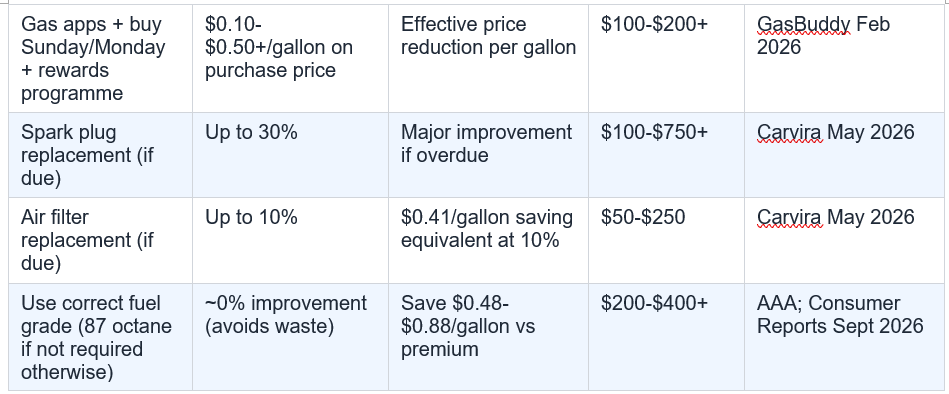
The seven tips above are primarily about driving habits and purchasing behaviour. But the condition of your vehicle has its own significant impact on fuel economy — and several maintenance items that most drivers defer or skip have quantified fuel economy penalties that can add up to hundreds of dollars per year.- Spark plugs: worn or fouled spark plugs can reduce fuel economy by up to 30%, according to Carvira's May 2026 fuel economy guide. Spark plugs are inexpensive ($5 to $25 per plug) and are typically changed every 30,000 to 100,000 miles depending on the type (copper vs iridium vs platinum). If you are behind on your spark plug service interval, this is the highest-ROI maintenance item on the list.
- Air filter: a clogged air filter reduces fuel economy by up to 10% (Carvira May 2026). An air filter replacement typically costs $15 to $50 and takes about 10 minutes to do yourself or 20 minutes at a shop. A filter that is visibly grey or dark rather than white or light tan needs replacement.
- Engine tune-up: fixing a car that is noticeably out of tune or has failed an emissions test can improve gas mileage by an average of 4%, according to DOE fueleconomy.gov. A more comprehensive tune-up on a well-maintained vehicle produces smaller gains; on a neglected one, the gains can be larger.
- Oil viscosity: using the wrong oil viscosity for your engine increases internal friction measurably (Carvira May 2026). Always use the viscosity specified on the oil filler cap or in your owner's manual (typically 0W-20, 5W-20, or 5W-30 for modern passenger cars). Thicker-than-specified oil creates more resistance.
- Premium fuel for regular-grade engines: Consumer Reports' September 2026 fuel tips article specifically addresses this. Most cars are designed for regular 87-octane fuel. Using a higher octane than recommended does not improve mileage or efficiency, according to AAA. It is simply a more expensive fuel that provides no benefit to most engines. Unless your vehicle specifies required (not recommended) premium, use regular 87.
The Complete Savings Summary Table
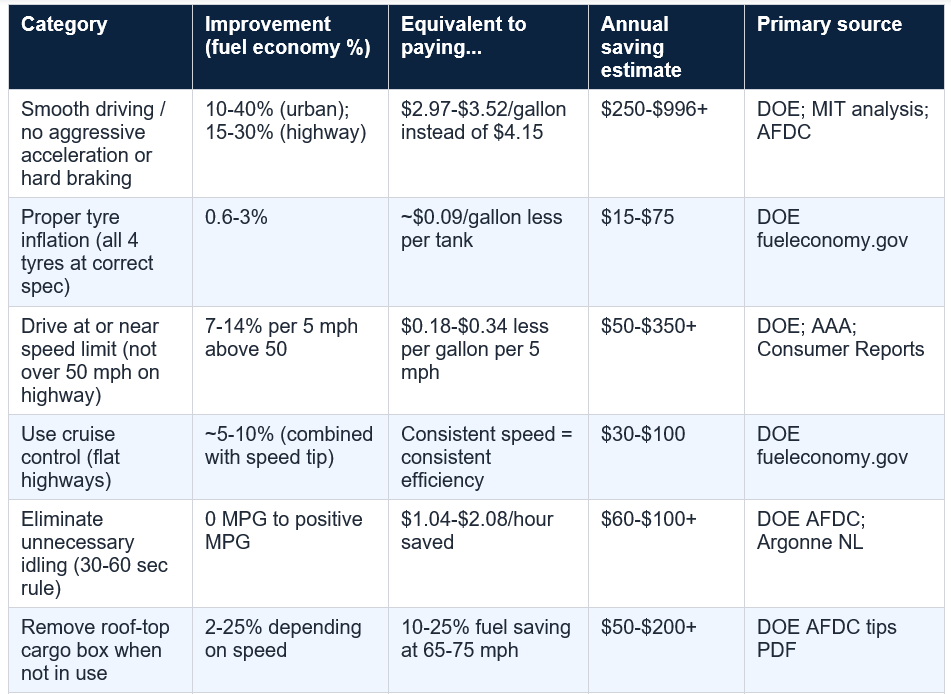
The following table summarises all seven tips plus the maintenance bonus with their DOE-source fuel economy improvements and realistic 2026 dollar savings. These figures assume the US average 2026 gas price of $4.15/gallon (Consumer Reports September 8, 2026), 15,000 miles/year driving, and a baseline of 25 MPG. Your mileage will vary based on your vehicle, local gas prices, and current driving habits.
Conclusion
Gas at $4.15 a gallon as of September 2026 is painful. It is also, for almost every driver on the road, 10 to 40 percent more expensive than it needs to be — not because the price is artificially high, but because the way most drivers drive burns more fuel than the same journey requires.The US Department of Energy has quantified every strategy in this guide. The numbers are not from industry marketing or vague claims about fuel additives — they are from peer-reviewed testing at Oak Ridge National Laboratory, MIT analysis, and decades of DOE data collection on real-world driving behaviour. Aggressive driving costs up to 40% of your fuel economy in stop-and-go traffic. Underinflated tyres cost up to 4%. A roof box at 70 mph costs up to 25%. Worn spark plugs cost up to 30%. None of these require a new car, an electric vehicle, or any significant expenditure.
The seven tips in this guide, implemented consistently, can produce a realistic saving of $500 to $750 per year for the average driver at current gas prices. For higher-mileage drivers, or for drivers currently practising every bad habit on this list, the saving can exceed $1,000. The cheapest tank of gas you will ever buy is one where you drive 25% further on it than you did last week — without spending a cent on fuel economy upgrades. That is the opportunity these tips represent.
Frequently Asked Questions
What is the most effective gas-saving tip in 2026?Changing how you drive — specifically eliminating aggressive acceleration, speeding, and hard braking — is the most impactful single fuel-saving strategy, with a potential improvement of 10 to 40 percent in stop-and-go traffic and 15 to 30 percent at highway speeds, according to US Department of Energy data confirmed by MIT analysis cited by the Alternative Fuels Data Center. At $4.15/gallon and 15,000 miles per year in a 25 MPG vehicle, even a conservative 15% improvement saves $374 per year. No other single habit change on this list approaches that potential. The DOE equivalently states that aggressive driving is like paying an extra $0.18 to $1.18 per gallon for your fuel — with smooth driving, your effective fuel cost at the pump is $2.97 to $3.97 rather than $4.15 for the same physical gallon.
What is the average US gas price in September 2026?
The national average price for regular unleaded gasoline was $4.15 per gallon as of September 8, 2026, according to Consumer Reports, which is one of the most closely watched sources for weekly gas price tracking. Midgrade fuel is averaging $4.63 per gallon, premium is $5.03, and diesel is $5.90. Gas prices crossed $4 per gallon on March 31, 2026 for the first time since 2022, according to AAA data, driven by supply disruptions related to geopolitical tensions including the Iran conflict. Gas prices fluctuate daily and vary significantly by state and region. California, Hawaii, and Pacific Northwest states typically carry premiums above the national average; Gulf Coast states and the Midwest typically run below average.
Does cruise control actually save gas?
Yes, on flat or gently rolling highways. The US Department of Energy's fueleconomy.gov guidance confirms that using cruise control on the highway helps maintain a constant speed and, in most cases, saves gas. The reason is that human drivers unconsciously vary their speed on long highway stretches — speeding up slightly, then decelerating, then accelerating again — creating repeated cycles that each burn extra fuel. Cruise control eliminates these variations on flat terrain, maintaining exact speed with minimal throttle adjustment. The qualification is important: on hilly terrain, conventional cruise control can hurt fuel economy by accelerating aggressively into climbs. Use it selectively on flat sections. Modern adaptive cruise control systems on newer vehicles handle hills more efficiently than older conventional cruise control.
How much does tyre pressure affect fuel economy?
The US Department of Energy's data: keeping tyres properly inflated improves gas mileage by 0.6% on average, and up to 3% in some cases. Under-inflation reduces gas mileage by 0.2% for every 1 psi drop in pressure across all four tyres (DOE fueleconomy.gov). A 10 psi drop in pressure reduces fuel economy by up to 4%, according to Fox News' March 2026 expert fuel tips piece. Tyres naturally lose 1 to 3 psi per month, so a car that was properly inflated three months ago may now be 5 to 9 psi low. At $4.15/gallon, a 3% improvement saves approximately $75 per year for an average driver. The fix is free (air at most stations is free or $1 to $2), takes 3 minutes, and also extends tyre life and improves safety. Check your door jamb for the correct pressure, not the tyre sidewall.
What is the best day of the week to buy gas in 2026?
Sunday and Monday are consistently the cheapest days to buy gas in most US states, according to GasBuddy's 2026 annual best-day-to-buy analysis, published in February 2026 and cited by FIGFCU in their April 9, 2026 gas-saving guide. Wednesday through Saturday are consistently the most expensive days, as gas stations tend to raise prices ahead of the weekend when demand increases. The best time of day is typically early morning, when prices are set for the day. The GasBuddy app and Google Maps both show real-time gas prices by location — price differences of $0.10 to $0.30 per gallon between stations a mile apart are common in most urban and suburban markets. Combining optimal timing, optimal location selection, and a grocery fuel rewards programme or warehouse club membership can realistically save $0.20 to $0.50 per gallon compared to defaulting to the nearest most convenient station.

0 Comments Comments