

Retirement
7 Signs You’ll Thrive in Retirement: A Self-Check Guide

83% of people with a financial plan felt confident about retiring vs 38% without one (Fidelity 2026); 74% have a plan; 61% of workers and 73% of retirees feel confident about having enough money (EBRI 2026). What predicts satisfaction: money, health and relationships cluster (Finke, 20,000 retirees); good or excellent health goes with 58% higher satisfaction; social connectedness predicted health about four times more strongly than finances; top scorers on all four pillars about 95% very satisfied (Blanchett via a secondary source). Money and risk: average Social Security benefit about $2,071 a month; health care costs about $185,500 for a single 65-year-old ($371,000 for a couple); inflation 3.7%; $4,000 a month today would need about $8,270 in 20 years at 3.7%; a $1,429 monthly income gap implies a nest egg of about $428,700 at the 4% guideline (my arithmetic).
This guide distills the research, using 2026 data where I could find it, into seven signs that you are likely to thrive, with a short self-score and a 90-day plan for the weak spots. Think of it as a pre-flight check for the biggest transition of your adult life, with one caution: these are patterns in large groups, not promises about you.
Plans cover more than savings. The same study found that only 15% of adults with retirement or investment accounts had completed a Roth conversion and just 25% funded a health savings account. Confidence overall has slipped: the 2026 EBRI Retirement Confidence Survey found 61% of workers confident about having enough money, down six points, and 73% of retirees, down from 78% in 2025. A plan will not remove uncertainty, but it turns a vague worry into a list of decisions.
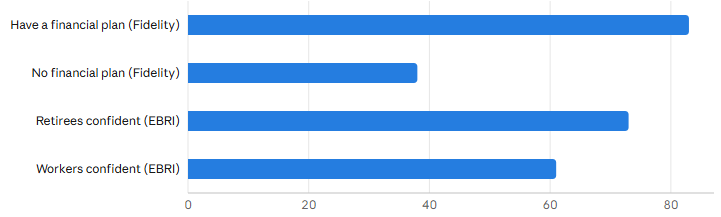
Fidelity 2026: 83% of people with a plan feel confident about retiring vs 38% without; 74% have a plan. EBRI 2026: 61% of workers and 73% of retirees feel confident about having enough money.
A study in BMC Geriatrics reached a striking conclusion: social connectedness predicted retirees’ mental and physical health on average four times more strongly than financial security did, though financial security helps by making social life affordable. The practical takeaway is to build a social life before you retire, because work often supplies it automatically and retirement does not. If you are single, Fidelity notes that social investments may matter even more.
Purpose does not have to be grand: volunteering, mentoring, caring for grandchildren, part-time work, a craft or a long project will do. The sign to look for is not that you have a hobby, but that you can name how a typical Tuesday will feel meaningful. If you cannot picture it, rehearse it before you leave work.
Health is also a financial matter. Fidelity estimates that a single 65-year-old retiring in 2026 will need about $185,500 for health care, about $371,000 for a couple, not counting long-term care. That is roughly $620 a month over 25 years for one person, by my arithmetic. Budgeting for it, using a health savings account while you can and understanding Medicare before you enroll are signs you are ready.
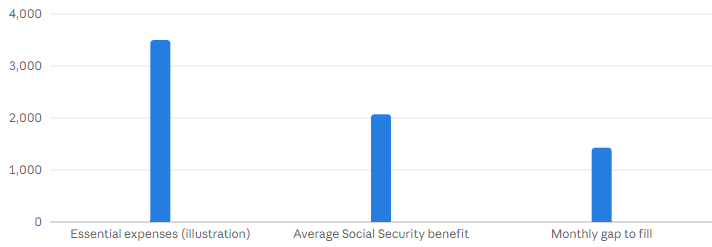
Here is an illustration of my own. Suppose your essential expenses are $3,500 a month. Average Social Security covers about 59% of that, leaving a $1,429 monthly gap, or $17,148 a year. Under the common 4% withdrawal guideline, closing that gap would take about $428,700 of savings. If you have that, or a pension covering part of it, you hold a strong sign; if not, working longer, delaying Social Security or trimming essentials can close the gap. The 2026 Trustees Report also projects Social Security could pay about 83% of scheduled benefits from 2034 without changes, so a margin of safety helps.

There is good news in the research. Life satisfaction tends to peak between about 65 and 71 and stay fairly high after, according to analyses of the Health and Retirement Study. But averages hide individual cases: satisfaction often falls after health losses or the death of a spouse. Flexibility is the sign: a willingness to adjust, try things, move closer to family or change your plan if needed.
Rehearse retirement. Take a two-week stretch of vacation with no schedule and notice how you feel on day ten. Or try phased retirement, a four-day week or a sabbatical. What surprises you is information about your readiness.
Realism also means knowing what you do not need. Kiplinger’s review reports that between about 60% and more than 90% of retirees say they are happy, depending on the survey, no matter their income or wealth. Money has diminishing returns once essentials and a cushion are covered. The sign is knowing your number, living comfortably within it and having a plan for the major risks: health care, long life, inflation and market downturns.

Then repeat once a year. Retirement is not one decision but a series of adjustments, and the people who thrive tend to keep adjusting. If your plan involves large tax, withdrawal or claiming decisions, consider a one-time consult with a qualified adviser. This is general education, not personalized advice.
The encouraging part is that most of these can be built. You cannot control every outcome, but you can make friends, build habits, close an income gap, rehearse the transition and review your plan each year. Score yourself honestly, pick the weakest sign and work on it for 90 days. Retirement can be among the best chapters of life, and the best preparation is not only a bigger number but a fuller life to retire into. This is general education, not personalized advice.
Research points to a cluster rather than one factor: money, health and relationships. In a survey of 20,000 retirees, economist Michael Finke found that these three areas explained most of the differences in life satisfaction, with social spending showing the highest correlation. Other work finds purpose and social connection among the strongest predictors, often more important than the size of your savings.
Do you need a lot of money to be happy in retirement?
Not necessarily. Kiplinger reports that between about 60% and more than 90% of retirees, depending on the survey, say they are happy regardless of their income or wealth. But reliable income that covers essentials matters. Researchers find retirees with dependable lifetime income report much higher satisfaction than those with limited resources.
What age are people happiest in retirement?
Research using the Health and Retirement Study suggests average life satisfaction peaks between about 65 and 71 and stays fairly high afterward, though individual satisfaction often falls after health losses or the death of a spouse. That is why planning for health and relationships matters as much as planning for money.
How much does having a retirement plan matter?
A lot, according to Fidelity’s 2026 State of Retirement Planning study: 83% of people with a financial plan felt confident about retiring, compared with 38% of those without one. A plan more than doubles the odds of feeling confident, though a plan is no guarantee of outcomes.
What if I score low on this self-check?
Treat a low score as a to-do list, not a verdict. Each sign can be strengthened: build a plan, join groups, find volunteer or part-time work, improve your health habits, secure income for essentials and rehearse retirement before you leave work. This is general education, not personal advice.
Table of Contents
- Retirement Is Not Just a Math Problem
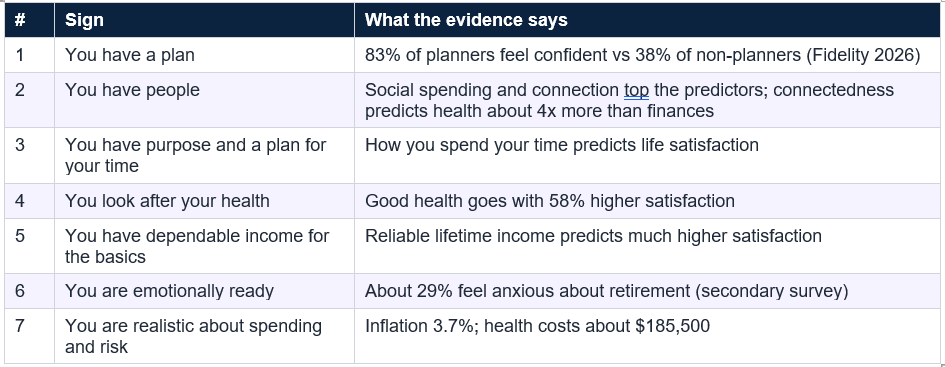
- The Short Answer: Seven Signs
- Sign 1: You Have a Plan
- Sign 2: You Have People
- Sign 3: You Have Purpose and a Plan for Your Time
- Sign 4: You Look After Your Health
- Sign 5: You Have Dependable Income for the Basics
- Sign 6: You Are Emotionally Ready
- Sign 7: You Are Realistic About Spending and Risk
- Score Yourself
- A 90-Day Plan to Strengthen Weak Spots
- Conclusion
- Frequently Asked Questions
Sign 1: a plan changes confidence about retirement (%)
% feeling confident by Fidelity 2026 State of Retirement Planning; EBRI 2026 Retirement Confidence Survey, via Boldin (secondary)
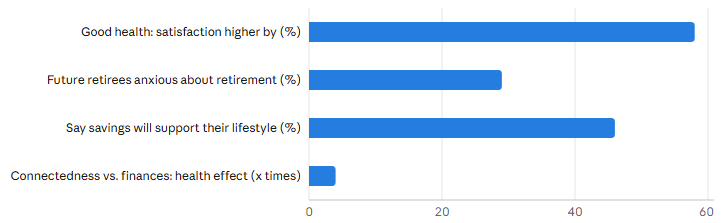
Signs 2, 4 and 6: the evidence in numbers
Percent (last bar: times) by Finke via Fidelity; 2026 readiness survey via APSI (secondary); BMC Geriatrics (2019). The last bar is a multiple, not a percent
Sign 5: the income gap, essentials of $3,500 a month vs. average Social Security ($)
$ per month by Author's illustration; benefit per SSA data via WTOP; a $1,429 gap implies about $428,700 at a 4% withdrawal rate
Retirement Is Not Just a Math Problem
Ask most people whether they will be okay in retirement and they will answer with a number: how much they have saved, how much they need. It is a reasonable question, and an incomplete one. Two people with identical savings can have wildly different retirements, one thriving and the other restless, lonely or worried. The difference is often not in the portfolio.This guide distills the research, using 2026 data where I could find it, into seven signs that you are likely to thrive, with a short self-score and a 90-day plan for the weak spots. Think of it as a pre-flight check for the biggest transition of your adult life, with one caution: these are patterns in large groups, not promises about you.
The Short Answer: Seven Signs
You are more likely to thrive if you have a plan, people, purpose, good health habits, dependable income for essentials, emotional readiness and a realistic view of spending and risk. Economist Michael Finke, using a survey of 20,000 retirees, found that satisfaction clusters in three areas: money, health and relationships; other researchers add purpose. Only some of the signs are financial, and the rest can be built at almost any age.
Sign 1: You Have a Plan
The strongest single contrast in the 2026 data is between people who have a plan and people who do not. In Fidelity’s 2026 State of Retirement Planning study, 83% of people with a financial plan felt confident about retiring, compared with 38% of those without one, so having a plan more than doubled confidence. About 74% of surveyed investors said they had a plan to reach their retirement goals, and roughly 70% knew their target retirement age.Plans cover more than savings. The same study found that only 15% of adults with retirement or investment accounts had completed a Roth conversion and just 25% funded a health savings account. Confidence overall has slipped: the 2026 EBRI Retirement Confidence Survey found 61% of workers confident about having enough money, down six points, and 73% of retirees, down from 78% in 2025. A plan will not remove uncertainty, but it turns a vague worry into a list of decisions.
Fidelity 2026: 83% of people with a plan feel confident about retiring vs 38% without; 74% have a plan. EBRI 2026: 61% of workers and 73% of retirees feel confident about having enough money.
Sign 2: You Have People
If one sign matters most, it may be this. Finke’s research found that social spending, money spent on gatherings, shared hobbies and gifts, had the highest correlation with life satisfaction among spending categories. David Blanchett’s analysis of nearly 6,000 retirees in the Health and Retirement Study, as summarized by an adviser, found social connections among the most powerful predictors, with retirees who kept strong friendships reporting much higher satisfaction than lonely ones even after accounting for wealth and health.A study in BMC Geriatrics reached a striking conclusion: social connectedness predicted retirees’ mental and physical health on average four times more strongly than financial security did, though financial security helps by making social life affordable. The practical takeaway is to build a social life before you retire, because work often supplies it automatically and retirement does not. If you are single, Fidelity notes that social investments may matter even more.
Sign 3: You Have Purpose and a Plan for Your Time
Retirement hands you roughly 2,000 extra hours a year, and what you do with them matters. Fidelity’s summary of the research says that how you spend your time is a key predictor of life satisfaction, and Boldin’s review notes that purpose and social connection show up again and again as the strongest predictors. Older Edward Jones and Age Wave research (a 2021 Canadian edition) likewise found that retirees with a strong sense of purpose are happier.Purpose does not have to be grand: volunteering, mentoring, caring for grandchildren, part-time work, a craft or a long project will do. The sign to look for is not that you have a hobby, but that you can name how a typical Tuesday will feel meaningful. If you cannot picture it, rehearse it before you leave work.
Sign 4: You Look After Your Health
Health is the quiet kingmaker of retirement. In Finke’s studies, retirees who rated their health as good or excellent had a satisfaction rating 58% higher than those who rated it poor. Blanchett’s analysis found that health had an even stronger relationship with satisfaction than wealth did once other factors were controlled, and Kiplinger’s review calls health the best predictor next to relationships. Regular movement, sleep, checkups and managing chronic conditions are an investment in how enjoyable your money turns out to be.Health is also a financial matter. Fidelity estimates that a single 65-year-old retiring in 2026 will need about $185,500 for health care, about $371,000 for a couple, not counting long-term care. That is roughly $620 a month over 25 years for one person, by my arithmetic. Budgeting for it, using a health savings account while you can and understanding Medicare before you enroll are signs you are ready.
Sign 5: You Have Dependable Income for the Basics
Money matters most in a particular way: not a headline number, but a reliable stream that covers the essentials. Retirees with higher levels of dependable lifetime income reported much higher satisfaction. The usual building block is Social Security, which averaged about $2,071 a month in 2026; the 3.6% cost-of-living adjustment for 2027 adds about $75. Pensions, annuities and part-time work can add to the floor.Here is an illustration of my own. Suppose your essential expenses are $3,500 a month. Average Social Security covers about 59% of that, leaving a $1,429 monthly gap, or $17,148 a year. Under the common 4% withdrawal guideline, closing that gap would take about $428,700 of savings. If you have that, or a pension covering part of it, you hold a strong sign; if not, working longer, delaying Social Security or trimming essentials can close the gap. The 2026 Trustees Report also projects Social Security could pay about 83% of scheduled benefits from 2034 without changes, so a margin of safety helps.
Sign 6: You Are Emotionally Ready
Not everyone who is financially ready is emotionally ready. A 2026 readiness survey summarized by a tax firm found that 29% of future retirees feel anxious when they think about retirement, and only 46% felt their savings would support their desired lifestyle. Retirement removes the structure, status and daily contact work provides. People who thrive think about that in advance: who they will be without the title, what will shape their days and how they will handle a partner who is suddenly home all day.There is good news in the research. Life satisfaction tends to peak between about 65 and 71 and stay fairly high after, according to analyses of the Health and Retirement Study. But averages hide individual cases: satisfaction often falls after health losses or the death of a spouse. Flexibility is the sign: a willingness to adjust, try things, move closer to family or change your plan if needed.
Rehearse retirement. Take a two-week stretch of vacation with no schedule and notice how you feel on day ten. Or try phased retirement, a four-day week or a sabbatical. What surprises you is information about your readiness.
Sign 7: You Are Realistic About Spending and Risk
The final sign is realism, especially about inflation and long life. Inflation was 3.7% in September. In my illustration, $4,000 a month of spending today would need about $5,750 a month in ten years, about $8,270 in twenty and about $11,900 in thirty at a constant 3.7%; even at 3%, about $7,220 in twenty years. Retirees who build in spending flexibility, keep some growth investments and review their plan each year are most comfortable with this arithmetic.Realism also means knowing what you do not need. Kiplinger’s review reports that between about 60% and more than 90% of retirees say they are happy, depending on the survey, no matter their income or wealth. Money has diminishing returns once essentials and a cushion are covered. The sign is knowing your number, living comfortably within it and having a plan for the major risks: health care, long life, inflation and market downturns.
Score Yourself
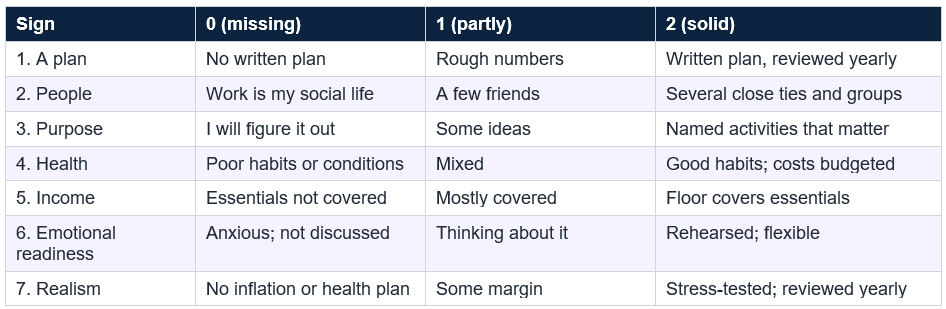
For each sign, give yourself 0 if it is missing, 1 if partly in place and 2 if it is solid. A score of 12 to 14 suggests you are well set up, 8 to 11 means strengths and some gaps, and 7 or below means meaningful but fixable homework. There is no official scale; this is a conversation starter. Blanchett’s analysis found that as scores across four categories improved, satisfaction rose almost in a straight line, with top scorers about 95% very satisfied, so every improvement counts.
A 90-Day Plan to Strengthen Weak Spots
In the first 30 days, write a one-page plan: target age, essential expenses, expected income and the gap, and check your Social Security estimate at ssa.gov. In days 31 to 60, work on people and purpose: join one group, schedule a weekly social commitment and sample a volunteer or part-time role. In days 61 to 90, work on health and readiness: book checkups, add one exercise habit, rehearse a stretch of unstructured time and talk the plan through with your partner or a friend.Then repeat once a year. Retirement is not one decision but a series of adjustments, and the people who thrive tend to keep adjusting. If your plan involves large tax, withdrawal or claiming decisions, consider a one-time consult with a qualified adviser. This is general education, not personalized advice.
Conclusion
The research on happy retirements is remarkably consistent. Money matters, particularly dependable income for the basics, but health, relationships and purpose matter as much or more, and a plan changes how confident people feel: 83% of planners felt confident about retiring versus 38% of non-planners in Fidelity’s 2026 study. Seven signs capture it: a plan, people, purpose, health, dependable income, emotional readiness and realism about spending and risk.The encouraging part is that most of these can be built. You cannot control every outcome, but you can make friends, build habits, close an income gap, rehearse the transition and review your plan each year. Score yourself honestly, pick the weakest sign and work on it for 90 days. Retirement can be among the best chapters of life, and the best preparation is not only a bigger number but a fuller life to retire into. This is general education, not personalized advice.
Frequently Asked Questions
What is the biggest predictor of a happy retirement?Research points to a cluster rather than one factor: money, health and relationships. In a survey of 20,000 retirees, economist Michael Finke found that these three areas explained most of the differences in life satisfaction, with social spending showing the highest correlation. Other work finds purpose and social connection among the strongest predictors, often more important than the size of your savings.
Do you need a lot of money to be happy in retirement?
Not necessarily. Kiplinger reports that between about 60% and more than 90% of retirees, depending on the survey, say they are happy regardless of their income or wealth. But reliable income that covers essentials matters. Researchers find retirees with dependable lifetime income report much higher satisfaction than those with limited resources.
What age are people happiest in retirement?
Research using the Health and Retirement Study suggests average life satisfaction peaks between about 65 and 71 and stays fairly high afterward, though individual satisfaction often falls after health losses or the death of a spouse. That is why planning for health and relationships matters as much as planning for money.
How much does having a retirement plan matter?
A lot, according to Fidelity’s 2026 State of Retirement Planning study: 83% of people with a financial plan felt confident about retiring, compared with 38% of those without one. A plan more than doubles the odds of feeling confident, though a plan is no guarantee of outcomes.
What if I score low on this self-check?
Treat a low score as a to-do list, not a verdict. Each sign can be strengthened: build a plan, join groups, find volunteer or part-time work, improve your health habits, secure income for essentials and rehearse retirement before you leave work. This is general education, not personal advice.
0 Comments
Be the first to share your thoughts on this article.