

Retirement
How to Retire at 45, 50, 55 or 60: The FIRE Guide

FIRE savers accumulate 25× annual expenses, then withdraw 4% per year. At a 50% savings rate, financial independence takes 17 years. This guide covers the exact numbers for retiring at each age — the FIRE number, the savings rate required, the obstacles, and the UK/US specifics.
Retiring early is not a fantasy reserved for Silicon Valley founders and lottery winners. The FIRE movement — Financial Independence, Retire Early — has made the mechanics of early retirement explicit, repeatable, and available to anyone with sufficient income, savings rate, and time. The walnutinvest.com FIRE statistics 2026 are direct: a household saving 50% of income reaches financial independence in approximately 17 years. Against the US personal saving rate of 3.0% in May 2026 (BEA), which implies roughly 51 years to financial independence. The difference between 51 years and 17 years is the savings rate. This guide covers the four most common early retirement targets — 45, 50, 55, and 60 — with the specific numbers each requires, the realistic obstacles at each age, and the strategies the FIRE community has developed to address them. Figures are given for both US and UK contexts where relevant. Not financial, investment, or retirement advice.
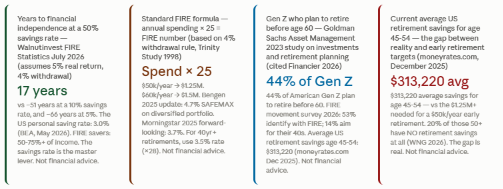
FIRE formula: FIRE number = annual spending × 25. $50k/year → $1.25M. $60k/year → $1.5M. $80k/year → $2M. 4% withdrawal rule — designed for 30-year retirement (Trinity Study 1998). Bengen 2025 update: 4.7% SAFEMAX on diversified 55% stock portfolio. Morningstar 2025 forward-looking estimate: 3.7%. Sources: Walnutinvest July 2026; Monarch.com May 2026.
The practical guidance is to understand the range and plan accordingly. For a 30-year retirement (retiring at 55 or 60), the 4% rule remains reasonable and well-validated historically. For a 40-45 year retirement (retiring at 45 or 50), a more conservative 3.5% withdrawal rate — implying a FIRE number of annual spending × 28-29 rather than × 25 — provides additional buffer against the sequence-of-returns risk that the Financier 2026 article identifies: ‘even a moderate deviation from initial assumptions — especially in the early years after retirement — can undermine the stability of an established investment portfolio.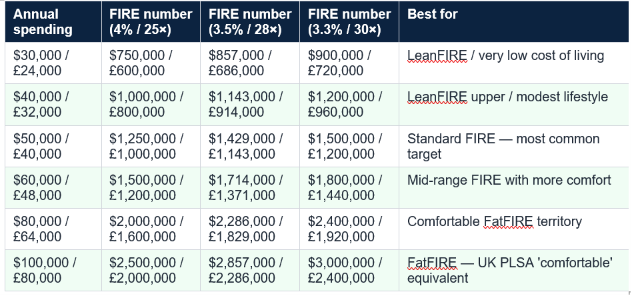
FIRE number target for retiring at 45: Low spending ($30-40k/year): $750k-$1M. Moderate spending ($50-60k/year): $1.25M-$1.5M. Comfortable ($80k+/year): $2M+. Required savings rate: 60-70%+ of income for 15-20 years. Sources: Walnutinvest July 2026; Monarch.com May 2026. Not financial advice.
The 45 blueprint: start investing aggressively by 25. Save 60-70% of income. Build in a large taxable brokerage account for pre-59½ access. Plan healthcare costs explicitly — the ACA marketplace or BaristaFIRE (part-time work for health insurance) are the primary tools. Target FIRE number: annual spending × 28-30 (using conservative 3.3-3.5% withdrawal) rather than the standard 25. Sources: Walnutinvest FIRE statistics July 2026; Monarch.com May 2026; Motley
A 45-year retirement is 50% longer than the Trinity Study's 30-year baseline. The standard 4% rule may be too aggressive for this timeline — some researchers recommend 3-3.5%. Sequence-of-returns risk is highest in the first five years: a major market decline early in retirement can permanently impair a portfolio (Financier 2026 citing FIRE research).
UK: pension access rises to age 57 in 2028. Retiring at 45 means 12 years of bridging before pension access. State Pension won't arrive until 67. Build ISA assets (£20,000/year tax-free) as the primary bridging vehicle. SIPP contributions grow tax-free but are inaccessible until 57.
FIRE number target for retiring at 50: Low spending ($30-40k/year): $750k-$1M. Moderate spending ($50-60k/year): $1.25M-$1.5M. Comfortable ($80k+/year): $2M+. Required savings rate: 50-60% of income for 20+ years.
The 50 blueprint: start aggressive saving in your late 20s or early 30s. Target 50-60% savings rate. Prioritise tax-advantaged accounts (401k/IRA in the US; SIPP/ISA in the UK) first, then taxable brokerage for pre-59½ access. Target FIRE number: annual spending × 27-28 (3.5-3.7% withdrawal rate). Build a 5-year cash/bond buffer for sequence-of-returns protection.
35-year retirement horizon extends beyond the Trinity Study's validation. Healthcare gap of 15 years in the US requires explicit planning and budget line. Inflation risk over 35+ years is significant — ensure investments include equities and inflation-protected assets. Not financial advice.
🇬🇧 UK note: UK: retiring at 50 means 7 years before pension access (age 57 from 2028). 17 years before State Pension at 67. Bridge with ISAs and taxable investments. PLSA comfortable retirement standard: £43,900/year single; FIRE number at 3.5%: ~£1.25M.
FIRE number target for retiring at 55: Low spending ($30-40k/year): $750k-$1M. Moderate spending ($50-60k/year): $1.25M-$1.5M. Comfortable ($80k+/year): $2M+. Required savings rate: 40-50% of income for 25+ years.
The 55 blueprint: 40-50% savings rate through working life. Max out all tax-advantaged contributions (401k up to $23,500; IRA $7,000; catch-up after 50). Rule of 55 (US) allows penalty-free 401k access. FIRE number: annual spending × 25-27. Diversified equity-heavy portfolio (55%+ equities). Build 2-3 years cash/short-term bonds as buffer.
Average US retirement savings for age 45-54 is only $313,220 (moneyrates.com December 2025) — far short of the $1.25M+ target. If you are in your 40s and behind, the catch-up window is 10-15 years of aggressive saving. The FIRE formula demands discipline, not magic.
UK: pension access from age 57 (2028 change). Retiring at 55 requires 2 years of ISA/taxable assets before SIPP access. State Pension from 67. PLSA comfortable retirement £43,900/year; FIRE number ~£1.1M at 4%. UK ISA allowance £20,000/year.
FIRE number target for retiring at 60: Low spending ($30-40k/year): $750k-$1M. Moderate spending ($50-60k/year): $1.25M-$1.5M. Comfortable ($80k+/year): $2M+. Required savings rate: 25-40% of income over career.
The 60 blueprint: a 25-40% savings rate over a full career is sufficient for many incomes. Maximise tax-advantaged accounts throughout; use catch-up contributions from age 50. BaristaFIRE (part-time work at 60) reduces the required FIRE number significantly. Target: annual spending × 25. Healthcare gap is 5 years (to Medicare at 65). Social Security strategy matters: delaying to 67 or 70 significantly increases lifetime benefit.
The National Bureau of Economic Research found that over one-third of retirees wish they had worked longer (WNG 2026). Retiring at 60 may feel premature once there. Build flexibility into the plan — BaristaFIRE or phased retirement reduces the all-or-nothing risk.
UK: pension access from 57 means 3-year bridging from ISAs/taxable accounts before 60. State Pension from 67. PLSA comfortable retirement £43,900/year. Average UK retirement age 2025: approximately 64-65.
The walnutinvest.com July 2026 FIRE statistics capture the core insight: a household saving 50% of income reaches independence in approximately 17 years, versus 51 years at 10%. The gap between those two timelines is not primarily about income. It is about savings rate and spending decisions. The Financier 2026 article on the FIRE movement concludes: ‘Its core principles — a high savings rate, consistent investing, and mindful expense control — help build a solid foundation for long-term financial resilience, regardless of whether early retirement is your ultimate goal.’ That sentence applies whether you are targeting 45 or 65. Not financial, investment, or retirement advice. Always consult a qualified, regulated independent financial adviser before making retirement planning decisions.
Using the standard FIRE formula (annual spending × 25), you need $1.25 million to retire at 50 on $50,000/year spending. However, since a 40-year retirement horizon (50 to 90) extends beyond the Trinity Study's 30-year validation, a more conservative 3.5-3.75% withdrawal rate is often recommended — implying a FIRE number of $1.33-$1.43 million. Walnutinvest.com's 2026 FIRE statistics estimate that a portfolio of approximately $962,000 is achievable in 15 years from zero at appropriate savings rates. The average US retirement savings for those aged 45-54 is $313,220 (moneyrates.com December 2025), suggesting most people are well behind this target if they have not been following a deliberate FIRE strategy. Healthcare is the primary obstacle: you will need 15 years of non-Medicare coverage from 50 to 65. ACA marketplace plans or BaristaFIRE (part-time employment for coverage) are the primary solutions.
Is the 4% rule still valid in 2026?
The 4% rule remains the most widely used planning tool in the FIRE community, but the 2025-2026 research has refined it. William Bengen raised his SAFEMAX to 4.7% for a well-diversified portfolio in his 2025 book (walnutinvest.com July 2026). However, Morningstar's 2025 forward-looking research, cited in Advisor Perspectives, estimates a more conservative 3.7% rate when using expected future returns rather than historical returns. The prudent approach in 2026 is to plan with the 4% rule as your benchmark, build in a buffer by targeting 25-28× annual expenses depending on your retirement age, and consider reducing to 3.5% for retirements lasting 40+ years. The 4% rule was specifically designed for a 30-year retirement — those retiring at 45 should use a more conservative rate.
How does the FIRE plan work differently in the UK?
The FIRE mathematics are the same — 25× annual expenses at 4% withdrawal. The UK-specific considerations are: (1) Pension access age: rising to 57 from 2028 (from 55). Retiring before 57 requires non-pension assets to bridge the gap. (2) State Pension: accessible from age 67. Retiring at 45, 50, or 55 means years or decades without State Pension income. (3) ISA allowance: £20,000/year tax-free growth and withdrawal — the primary flexible early retirement vehicle. (4) SIPP contributions are tax-free but inaccessible until pension access age. (5) PLSA standards 2025: comfortable retirement for a single person requires £43,900/year; the FIRE number at 4% is approximately £1.1 million. The UK FIRE calculator approach mirrors the US but with ISA as the pre-pension tax wrapper and SIPP as the long-term vehicle.
What is BaristaFIRE and is it a good option?
BaristaFIRE means reaching a portfolio that covers 60-80% of your living expenses, then taking part-time or lower-intensity work to cover the remaining 20-40%. Walnutinvest.com's July 2026 FIRE statistics identifies BaristaFIRE as the portfolio covering 60-80% of expenses while part-time work fills the gap. In the US context, 'BaristaFIRE' historically referred to taking a job (such as a coffee shop) specifically for employer health insurance benefits — a critical need before Medicare eligibility at 65. Whether BaristaFIRE is a good option depends on your situation. It reduces the required FIRE number significantly (you need only 60-80% of full FIRE, so perhaps $750k-$1M instead of $1.25M for $50k/year spending), and it provides social engagement and structured time that some early retirees miss. The NBER study found that over one-third of retirees wish they had worked longer — BaristaFIRE addresses this directly.
What is the biggest risk in early retirement?
Sequence-of-returns risk is the most widely cited structural risk. The Financier 2026 article on the FIRE movement notes: 'even a moderate deviation from initial assumptions — especially in the early years after retirement — can undermine the stability of an established investment portfolio.' If the market falls 30% in years one and two of retirement and you are withdrawing 4% annually, you are selling shares at depressed prices, permanently reducing your portfolio's recovery potential. The standard mitigation strategies are: (1) Build a 2-3 year cash/short-term bond buffer so you do not need to sell equities during downturns. (2) Use a more conservative withdrawal rate (3-3.5%) for very long retirements. (3) Consider flexibility in spending — reduce withdrawals in down markets if possible. (4) BaristaFIRE provides an income buffer that reduces withdrawal pressure during market stress.
Retiring early is not a fantasy reserved for Silicon Valley founders and lottery winners. The FIRE movement — Financial Independence, Retire Early — has made the mechanics of early retirement explicit, repeatable, and available to anyone with sufficient income, savings rate, and time. The walnutinvest.com FIRE statistics 2026 are direct: a household saving 50% of income reaches financial independence in approximately 17 years. Against the US personal saving rate of 3.0% in May 2026 (BEA), which implies roughly 51 years to financial independence. The difference between 51 years and 17 years is the savings rate. This guide covers the four most common early retirement targets — 45, 50, 55, and 60 — with the specific numbers each requires, the realistic obstacles at each age, and the strategies the FIRE community has developed to address them. Figures are given for both US and UK contexts where relevant. Not financial, investment, or retirement advice.
Table of Contents
- The FIRE Formula: How the Maths Works
- The Savings Rate Is the Master Lever
- The 4% Rule, Bengen’s 2025 Update, and What to Actually Use
- FIRE Number Quick Reference: How Much You Need by Spending Level
- How to Retire at 45: The Numbers, the Plan, the Obstacles
- How to Retire at 50: The Numbers, the Plan, the Obstacles
- How to Retire at 55: The Numbers, the Plan, the Obstacles
- How to Retire at 60: The Numbers, the Plan, the Obstacles
- FIRE Variants: LeanFIRE, FatFIRE, BaristaFIRE, CoastFIRE
- The Early Retirement Comparison Table
- Conclusion: The Earlier You Start, the More Forgiving the Maths
- Frequently Asked Questions
The FIRE Formula: How the Maths Works
Financial Independence, Retire Early is built on two numbers and one rule. The first number is your annual spending in retirement — what you expect to spend each year to live the life you want, excluding any income. The second is your FIRE number — the total invested portfolio value you need to sustain that spending indefinitely. The rule connecting them is the 4% withdrawal rate: if you withdraw no more than 4% of your portfolio in year one, and adjust subsequent withdrawals for inflation, the historical data suggests your portfolio will last at least 30 years. The calculation is simple: FIRE number = annual spending × 25. If you plan to spend $50,000 per year, your FIRE number is $1.25 million. If you plan to spend $60,000, it is $1.5 million. Monarch.com’s May 2026 FIRE guide puts it directly: ‘accumulate enough invested assets that you can live off of your portfolio indefinitely without depending on employment income.’ The FIRE framework was formalised in the early 2010s but the underlying maths goes back to William Bengen’s 1994 research and the 1998 Trinity Study. Those studies analysed historical market performance to identify a sustainable withdrawal rate. The Motley Fool’s February 2025 guide notes the 4% rule was specifically designed to last 30 years. For retirements lasting 40+ years (retiring at 45 with a life expectancy of 90+), more conservative rates may be appropriate.FIRE formula: FIRE number = annual spending × 25. $50k/year → $1.25M. $60k/year → $1.5M. $80k/year → $2M. 4% withdrawal rule — designed for 30-year retirement (Trinity Study 1998). Bengen 2025 update: 4.7% SAFEMAX on diversified 55% stock portfolio. Morningstar 2025 forward-looking estimate: 3.7%. Sources: Walnutinvest July 2026; Monarch.com May 2026.
The Savings Rate Is the Master Lever
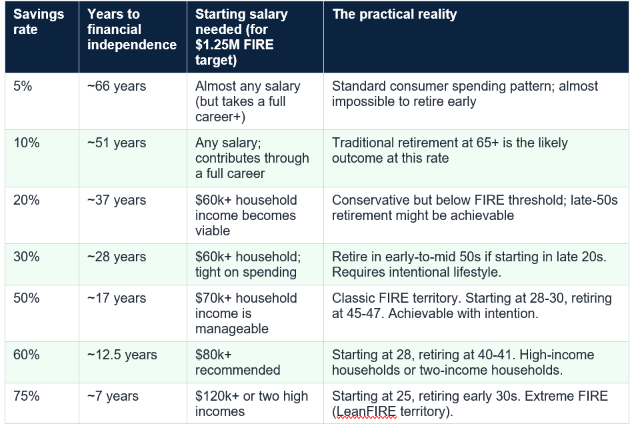
The single most important variable in early retirement planning is not your income. It is your savings rate. Walnutinvest.com’s July 2026 FIRE statistics analysis is explicit: ‘The savings rate is the whole game.’ The reason savings rate matters more than income is structural: increasing your savings rate does two things simultaneously. It increases the amount you are investing each year. And it decreases the amount you will need to live on in retirement — which reduces the FIRE number you are targeting. These two effects compound together in a non-linear way. Pushing from a 10% to a 50% savings rate does not merely cut the timeline by a factor of five. It collapses it from a full working career to approximately 17 years, because you are simultaneously building wealth faster and needing less of it to sustain your lifestyle. The contrast with the US average is striking: the US personal saving rate was just 3.0% in May 2026 (Bureau of Economic Analysis), which implies approximately 51 years to financial independence. FIRE followers typically save 50-75% or more of income. The BEA comparison implies that the average American is almost permanently on a traditional retirement timeline regardless of income.
The 4% Rule, Bengen’s 2025 Update, and What to Actually Use
The 4% rule is the FIRE community’s foundational planning tool, but it has been through meaningful updates that the walnutinvest.com July 2026 analysis captures precisely. The original 4% rule was established by William Bengen in 1994 and validated by the Trinity Study in 1998, both based on historical US market data. Bengen himself updated his analysis for his 2025 book, raising the ‘SAFEMAX’ to 4.7% for a well-diversified portfolio of approximately 55% equities. Separately, Morningstar’s 2025 forward-looking research, cited in Advisor Perspectives, placed the prudent starting rate closer to 3.7% — reflecting more modest return expectations for the coming decades compared to the historical data on which the original rule was based.The practical guidance is to understand the range and plan accordingly. For a 30-year retirement (retiring at 55 or 60), the 4% rule remains reasonable and well-validated historically. For a 40-45 year retirement (retiring at 45 or 50), a more conservative 3.5% withdrawal rate — implying a FIRE number of annual spending × 28-29 rather than × 25 — provides additional buffer against the sequence-of-returns risk that the Financier 2026 article identifies: ‘even a moderate deviation from initial assumptions — especially in the early years after retirement — can undermine the stability of an established investment portfolio.
FIRE Number Quick Reference: How Much You Need by Spending Level
How to Retire at 45: The Numbers, the Plan, the Obstacles
Retiring at 45 is achievable — but it is the most demanding version of early retirement. A 45-year-old today may live to 90 or beyond, which means their portfolio must support 45+ years of withdrawals. That extended timeline changes the mathematics of the 4% rule: the Trinity Study was designed for a 30-year retirement. A 45-year retirement requires a more conservative withdrawal rate — 3-3.5% is widely recommended for very early retirees — which means a larger required portfolio. If you plan to spend $50,000 per year and use a 3.5% withdrawal rate, your FIRE number is approximately $1.43 million. If you use the standard 4% rate, it is $1.25 million. Walnutinvest.com’s FIRE statistics 2026 data identifies that at a 50% savings rate, financial independence takes approximately 17 years from zero. Starting at 25 with a 50% savings rate on a meaningful income, retiring at 42 is the model. Starting at 30, retiring at 45 requires the same 50%+ savings rate but has less runway. The FIRE movement survey data (walnutinvest.com July 2026) found that 14% of FIRE adherents aim to retire in their 40s. Goldman Sachs Asset Management’s 2023 study found that 44% of Gen Z plan to retire before 60 — not all at 45, but the directional ambition is broad. The most significant practical obstacles for retiring at 45 in the US are healthcare (Medicare begins at 65, leaving a 20-year gap) and early pension access (most tax-advantaged accounts penalise withdrawals before 59½). Both are solvable with taxable brokerage accounts and an Affordable Care Act marketplace plan, but they require deliberate planning.FIRE number target for retiring at 45: Low spending ($30-40k/year): $750k-$1M. Moderate spending ($50-60k/year): $1.25M-$1.5M. Comfortable ($80k+/year): $2M+. Required savings rate: 60-70%+ of income for 15-20 years. Sources: Walnutinvest July 2026; Monarch.com May 2026. Not financial advice.
The 45 blueprint: start investing aggressively by 25. Save 60-70% of income. Build in a large taxable brokerage account for pre-59½ access. Plan healthcare costs explicitly — the ACA marketplace or BaristaFIRE (part-time work for health insurance) are the primary tools. Target FIRE number: annual spending × 28-30 (using conservative 3.3-3.5% withdrawal) rather than the standard 25. Sources: Walnutinvest FIRE statistics July 2026; Monarch.com May 2026; Motley
A 45-year retirement is 50% longer than the Trinity Study's 30-year baseline. The standard 4% rule may be too aggressive for this timeline — some researchers recommend 3-3.5%. Sequence-of-returns risk is highest in the first five years: a major market decline early in retirement can permanently impair a portfolio (Financier 2026 citing FIRE research).
UK: pension access rises to age 57 in 2028. Retiring at 45 means 12 years of bridging before pension access. State Pension won't arrive until 67. Build ISA assets (£20,000/year tax-free) as the primary bridging vehicle. SIPP contributions grow tax-free but are inaccessible until 57.
How to Retire at 50: The Numbers, the Plan, the Obstacles
Retiring at 50 gives the FIRE plan five more accumulation years than retiring at 45 — and on compound growth, five years is significant. At 7% average real return, $500,000 at 45 becomes approximately $700,000 at 50. The walnutinvest.com FIRE statistics 2026 data identifies a portfolio value of approximately $962,000 achievable in 15 years from zero at appropriate savings rates. The Motley Fool’s February 2025 analysis of retiring at 55 via FIRE establishes the framework that scales directly to age 50 with more aggressive saving: the FIRE number for $50,000/year spending is $1.25 million at 4% withdrawal, and the savings strategy requires at least 50% of annual income. At 50, the retirement horizon is approximately 35-40 years. The 4% rule was designed for 30 years, so a 35-40-year horizon still warrants a slight conservatism: 3.5-3.75% is more robust. The FIRE number adjusts accordingly: $50,000/year at 3.5% withdrawal = $1.43 million. The healthcare gap in the US runs from retirement to Medicare eligibility at 65 — 15 years rather than the 20-year gap at age 45. The sequence-of-returns risk remains significant for a 50-year retiree; the Financier 2026 article notes that ‘even a moderate deviation from initial assumptions — especially in the early years after retirement — can undermine the stability of an established investment portfolio.’FIRE number target for retiring at 50: Low spending ($30-40k/year): $750k-$1M. Moderate spending ($50-60k/year): $1.25M-$1.5M. Comfortable ($80k+/year): $2M+. Required savings rate: 50-60% of income for 20+ years.
The 50 blueprint: start aggressive saving in your late 20s or early 30s. Target 50-60% savings rate. Prioritise tax-advantaged accounts (401k/IRA in the US; SIPP/ISA in the UK) first, then taxable brokerage for pre-59½ access. Target FIRE number: annual spending × 27-28 (3.5-3.7% withdrawal rate). Build a 5-year cash/bond buffer for sequence-of-returns protection.
35-year retirement horizon extends beyond the Trinity Study's validation. Healthcare gap of 15 years in the US requires explicit planning and budget line. Inflation risk over 35+ years is significant — ensure investments include equities and inflation-protected assets. Not financial advice.
🇬🇧 UK note: UK: retiring at 50 means 7 years before pension access (age 57 from 2028). 17 years before State Pension at 67. Bridge with ISAs and taxable investments. PLSA comfortable retirement standard: £43,900/year single; FIRE number at 3.5%: ~£1.25M.
How to Retire at 55: The Numbers, the Plan, the Obstacles
Retiring at 55 is the point at which the standard 4% rule begins to apply with greater confidence — a 30-year retirement from 55 to 85 matches the Trinity Study’s validation period reasonably well, though many people will live beyond 85. The Motley Fool’s February 2025 guide to retiring at 55 via FIRE establishes the canonical framework: accumulate 25 times your expected annual expenses, invest in a diversified portfolio, and draw down at 4% per year. For $50,000/year spending: FIRE number $1.25 million. The moneyrates.com December 2025 data provides the sobering comparison: the average US retirement savings for those aged 45-54 is $313,220 — a figure that needs to reach $1.25-$1.5 million before age 55 for a comfortable early retirement. The gap is real and large for most people. The Motley Fool notes that in 2025, 401(k)s have a contribution limit of $23,500 for adults under 50, while IRAs limit to $7,000 per year. Those aged 50+ receive catch-up contribution allowances. By 55, most people have access to their pension and retirement accounts (the Rule of 55 in the US allows penalty-free 401(k) withdrawals from the employer you leave at 55 or older). In the UK, pension access rises to 57 from 2028 — so those targeting retirement at 55 in the UK need a 2-year bridging window from non-pension assets.FIRE number target for retiring at 55: Low spending ($30-40k/year): $750k-$1M. Moderate spending ($50-60k/year): $1.25M-$1.5M. Comfortable ($80k+/year): $2M+. Required savings rate: 40-50% of income for 25+ years.
The 55 blueprint: 40-50% savings rate through working life. Max out all tax-advantaged contributions (401k up to $23,500; IRA $7,000; catch-up after 50). Rule of 55 (US) allows penalty-free 401k access. FIRE number: annual spending × 25-27. Diversified equity-heavy portfolio (55%+ equities). Build 2-3 years cash/short-term bonds as buffer.
Average US retirement savings for age 45-54 is only $313,220 (moneyrates.com December 2025) — far short of the $1.25M+ target. If you are in your 40s and behind, the catch-up window is 10-15 years of aggressive saving. The FIRE formula demands discipline, not magic.
UK: pension access from age 57 (2028 change). Retiring at 55 requires 2 years of ISA/taxable assets before SIPP access. State Pension from 67. PLSA comfortable retirement £43,900/year; FIRE number ~£1.1M at 4%. UK ISA allowance £20,000/year.
How to Retire at 60: The Numbers, the Plan, the Obstacles
Retiring at 60 is the most achievable version of early retirement for most people — it is five years ahead of the traditional benchmark and aligns with the FIRE movement’s less extreme sub-strategies. BaristaFIRE — where the portfolio covers 60-80% of expenses and part-time work fills the rest — is a particularly practical model for those targeting 60, where a less-than-full FIRE number is acceptable given the flexibility of some continued income. The Goldman Sachs Asset Management 2023 study finding that 44% of Gen Z plan to retire before 60 reflects the aspirational mainstream of the FIRE movement for younger cohorts. The standard FIRE number of 25× annual expenses (4% withdrawal) applies with confidence for a 60-year retirement horizon of 25-35 years. The moneyrates.com December 2025 data shows average US retirement savings for age 55-64 at $537,560 — still short of the $1.25 million target for $50,000/year spending, but considerably closer than at younger ages. At 60, US Social Security income can be accessed (though with penalties before 62 and reductions before 67). Medicare begins at 65, leaving only a 5-year healthcare gap rather than 20 years. UK residents accessing their pension from 57 (2028) have a 3-year gap before 60. Retiring at 60 in the US benefits from the last five years of peak earning (when incomes typically peak for most professionals) and the largest window for catch-up contributions (those over 50 can contribute $7,500 extra to 401(k) and $1,000 extra to IRA annually).FIRE number target for retiring at 60: Low spending ($30-40k/year): $750k-$1M. Moderate spending ($50-60k/year): $1.25M-$1.5M. Comfortable ($80k+/year): $2M+. Required savings rate: 25-40% of income over career.
The 60 blueprint: a 25-40% savings rate over a full career is sufficient for many incomes. Maximise tax-advantaged accounts throughout; use catch-up contributions from age 50. BaristaFIRE (part-time work at 60) reduces the required FIRE number significantly. Target: annual spending × 25. Healthcare gap is 5 years (to Medicare at 65). Social Security strategy matters: delaying to 67 or 70 significantly increases lifetime benefit.
The National Bureau of Economic Research found that over one-third of retirees wish they had worked longer (WNG 2026). Retiring at 60 may feel premature once there. Build flexibility into the plan — BaristaFIRE or phased retirement reduces the all-or-nothing risk.
UK: pension access from 57 means 3-year bridging from ISAs/taxable accounts before 60. State Pension from 67. PLSA comfortable retirement £43,900/year. Average UK retirement age 2025: approximately 64-65.
FIRE Variants: LeanFIRE, FatFIRE, BaristaFIRE, CoastFIRE
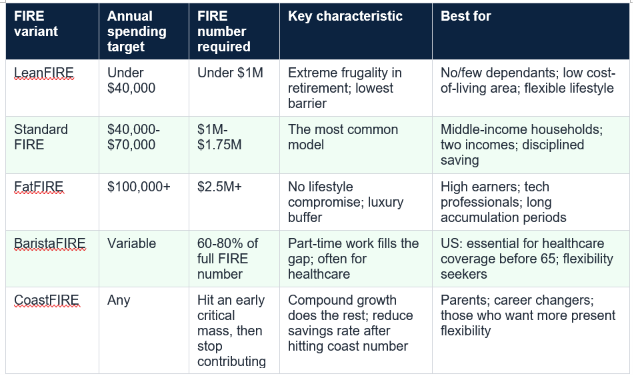
The FIRE movement has produced several variants that accommodate different spending levels, risk tolerances, and flexibility preferences. Understanding which variant fits your situation is important before targeting a specific retirement age. LeanFIRE targets retirement on $40,000/year or less, requiring a FIRE number of $1 million or under. It demands frugality in retirement and is most achievable for those without dependants in low cost-of-living areas. FatFIRE targets retirement on $100,000+/year, requiring a FIRE number of $2.5M+. It requires either high income, long accumulation time, or both, but allows retirement without lifestyle compromise. BaristaFIRE — identified in the walnutinvest.com July 2026 FIRE statistics — is where the portfolio covers 60-80% of expenses and part-time work fills the rest. This is particularly useful for healthcare purposes in the US (part-time employer coverage) and for those who want a reduced FIRE number in exchange for some continued income. CoastFIRE means investing enough early that compound growth alone will reach the FIRE number without additional contributions. For example: investing $200,000 at age 30 at 7% real return reaches approximately $1.28M by age 60 without a single additional contribution. CoastFIRE allows the saver to ‘coast’ — maintaining expenses but not actively accumulating — once the critical mass is reached.
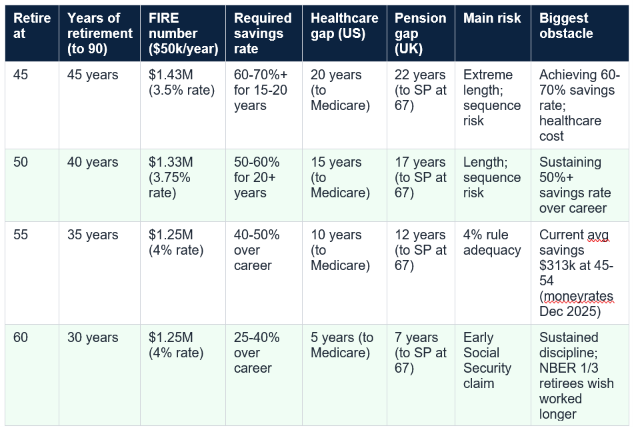
The Early Retirement Comparison Table
Conclusion
The FIRE framework gives every early retirement target a number and a path. Retiring at 45 requires approximately a 60-70% savings rate for 15-20 years and a FIRE number of $1.4M+ for modest spending. Retiring at 60 requires 25-40% over a full career and a FIRE number of $1.25M. The mathematics of compound interest means every year of delay in starting increases the required savings rate significantly — and every year of delay in spending also reduces the FIRE number through accumulated growth.The walnutinvest.com July 2026 FIRE statistics capture the core insight: a household saving 50% of income reaches independence in approximately 17 years, versus 51 years at 10%. The gap between those two timelines is not primarily about income. It is about savings rate and spending decisions. The Financier 2026 article on the FIRE movement concludes: ‘Its core principles — a high savings rate, consistent investing, and mindful expense control — help build a solid foundation for long-term financial resilience, regardless of whether early retirement is your ultimate goal.’ That sentence applies whether you are targeting 45 or 65. Not financial, investment, or retirement advice. Always consult a qualified, regulated independent financial adviser before making retirement planning decisions.
Frequently Asked Questions
How much do I need to retire at 50 in the US?Using the standard FIRE formula (annual spending × 25), you need $1.25 million to retire at 50 on $50,000/year spending. However, since a 40-year retirement horizon (50 to 90) extends beyond the Trinity Study's 30-year validation, a more conservative 3.5-3.75% withdrawal rate is often recommended — implying a FIRE number of $1.33-$1.43 million. Walnutinvest.com's 2026 FIRE statistics estimate that a portfolio of approximately $962,000 is achievable in 15 years from zero at appropriate savings rates. The average US retirement savings for those aged 45-54 is $313,220 (moneyrates.com December 2025), suggesting most people are well behind this target if they have not been following a deliberate FIRE strategy. Healthcare is the primary obstacle: you will need 15 years of non-Medicare coverage from 50 to 65. ACA marketplace plans or BaristaFIRE (part-time employment for coverage) are the primary solutions.
Is the 4% rule still valid in 2026?
The 4% rule remains the most widely used planning tool in the FIRE community, but the 2025-2026 research has refined it. William Bengen raised his SAFEMAX to 4.7% for a well-diversified portfolio in his 2025 book (walnutinvest.com July 2026). However, Morningstar's 2025 forward-looking research, cited in Advisor Perspectives, estimates a more conservative 3.7% rate when using expected future returns rather than historical returns. The prudent approach in 2026 is to plan with the 4% rule as your benchmark, build in a buffer by targeting 25-28× annual expenses depending on your retirement age, and consider reducing to 3.5% for retirements lasting 40+ years. The 4% rule was specifically designed for a 30-year retirement — those retiring at 45 should use a more conservative rate.
How does the FIRE plan work differently in the UK?
The FIRE mathematics are the same — 25× annual expenses at 4% withdrawal. The UK-specific considerations are: (1) Pension access age: rising to 57 from 2028 (from 55). Retiring before 57 requires non-pension assets to bridge the gap. (2) State Pension: accessible from age 67. Retiring at 45, 50, or 55 means years or decades without State Pension income. (3) ISA allowance: £20,000/year tax-free growth and withdrawal — the primary flexible early retirement vehicle. (4) SIPP contributions are tax-free but inaccessible until pension access age. (5) PLSA standards 2025: comfortable retirement for a single person requires £43,900/year; the FIRE number at 4% is approximately £1.1 million. The UK FIRE calculator approach mirrors the US but with ISA as the pre-pension tax wrapper and SIPP as the long-term vehicle.
What is BaristaFIRE and is it a good option?
BaristaFIRE means reaching a portfolio that covers 60-80% of your living expenses, then taking part-time or lower-intensity work to cover the remaining 20-40%. Walnutinvest.com's July 2026 FIRE statistics identifies BaristaFIRE as the portfolio covering 60-80% of expenses while part-time work fills the gap. In the US context, 'BaristaFIRE' historically referred to taking a job (such as a coffee shop) specifically for employer health insurance benefits — a critical need before Medicare eligibility at 65. Whether BaristaFIRE is a good option depends on your situation. It reduces the required FIRE number significantly (you need only 60-80% of full FIRE, so perhaps $750k-$1M instead of $1.25M for $50k/year spending), and it provides social engagement and structured time that some early retirees miss. The NBER study found that over one-third of retirees wish they had worked longer — BaristaFIRE addresses this directly.
What is the biggest risk in early retirement?
Sequence-of-returns risk is the most widely cited structural risk. The Financier 2026 article on the FIRE movement notes: 'even a moderate deviation from initial assumptions — especially in the early years after retirement — can undermine the stability of an established investment portfolio.' If the market falls 30% in years one and two of retirement and you are withdrawing 4% annually, you are selling shares at depressed prices, permanently reducing your portfolio's recovery potential. The standard mitigation strategies are: (1) Build a 2-3 year cash/short-term bond buffer so you do not need to sell equities during downturns. (2) Use a more conservative withdrawal rate (3-3.5%) for very long retirements. (3) Consider flexibility in spending — reduce withdrawals in down markets if possible. (4) BaristaFIRE provides an income buffer that reduces withdrawal pressure during market stress.
0 Comments
Be the first to share your thoughts on this article.