

Retirement
Working While on Social Security? The 2026 Numbers to Know

The 2026 earnings limit is $24,480. Exceed it and you lose $1 for every $2 earned above it. But the money isn’t gone forever. Here’s every number that matters.
You are allowed to work while collecting Social Security. The rules do not prevent it. But the rules do create a trap for anyone who earns above a specific threshold before reaching full retirement age — and discovering that trap from a smaller-than-expected monthly deposit is a genuinely unpleasant surprise. In 2026, the earnings-test limit for most people claiming Social Security before full retirement age is $24,480. Earn more than that from work, and you will have $1 in benefits withheld for every $2 you earn above it. If you are in the year you will reach full retirement age, that limit rises to $65,160 and the withholding rate softens to $1 for every $3. Once you actually reach full retirement age, the earnings test disappears entirely — you can earn any amount. This article sets out every number you need to check, what counts as earnings and what does not, what happens to the money that is withheld, and how working in retirement affects the taxes on your Social Security benefits. This is Not financial, tax, or retirement planning advice but general informational and educational purposes ONLY.
The important word in the previous paragraph is ‘temporarily.’ Benefits withheld under the earnings test are not permanently lost. When you reach FRA, the Social Security Administration recalculates your benefit upward to account for the months that benefits were withheld. You receive a higher monthly benefit from FRA onward. That said, the timing matters — and many people are caught off guard by the withholding rule because they plan on receiving both their salary and their Social Security check, and the withholding rule eliminates one of those income streams without warning if the earnings limit is exceeded.
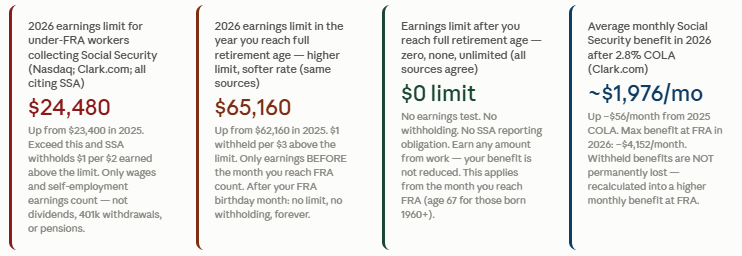
2026 Social Security key numbers: Full retirement age (FRA) for those born 1960+: 67. Under-FRA earnings limit: $24,480 ($23,400 in 2025). FRA-year earnings limit: $65,160 ($62,160 in 2025). After FRA: no earnings limit. Average monthly benefit 2026: ~$1,976 (after 2.8% COLA). Maximum benefit at FRA 2026: ~$4,152/month. Withholding rate: $1 per $2 (under-FRA) or $1 per $3 (FRA year) above the limit. Sources: Nasdaq; Clark.com; Beancount.io.
To illustrate with a concrete worked example: a 64-year-old collecting Social Security in 2026, with an annual salary of $30,480. Excess earnings above the limit: $30,480 minus $24,480 equals $6,000. Withholding: $6,000 divided by 2 equals $3,000 in benefits withheld for the year. If the monthly benefit is $1,500, that means two full monthly checks are withheld. The SSA typically implements this by stopping payments for enough months at the start of the year to cover the expected withholding — so an individual may receive no benefit check in January and February, then resume receiving full checks for the rest of the year. The total withheld across the year is $3,000, matching the formula.
Worked example (under-FRA all year): Annual earnings from work: $30,480. Annual earnings limit: $24,480. Excess: $30,480 − $24,480 = $6,000. Withholding: $6,000 ÷ 2 = $3,000. On a $1,500/month benefit: SSA withholds 2 months of benefits. Benefits resume after the 2-month 'debt' is repaid. This $3,000 is NOT lost — it is recalculated into a higher monthly benefit at FRA. Source: Nasdaq; NationalTaxTools; VisionRetirement.
Equally important: in the year you reach FRA, only earnings before your birthday month count toward the test. Earnings in the month you reach FRA, and all months after, are completely excluded from the earnings test calculation. So if your 67th birthday is in July, only your earnings from January through June are counted. The limit of $65,160 applies to just those first six months of earnings. National Tax Tools’ Social Security earnings test guide describes this clearly: ‘The limit nearly triples (to $65,160 in 2026), the withholding rate softens to $1 for every $3 of excess, and only earnings before the month you reach FRA count.’ Not financial advice.
FRA year rules (2026): Earnings limit: $65,160 (up from $62,160 in 2025). Withholding rate: $1 withheld per $3 earned above the limit. Earnings counted: ONLY those earned in months BEFORE the month you turn your FRA age. Earnings in the month you reach FRA and after: not counted. Result: someone who reaches FRA in July counts only January-June earnings. Sources: Nasdaq; Clark.com; NationalTaxTools 2026. Not financial advice.
This is why the timing of both the Social Security claim date and the FRA milestone matters so much to working retirees. If you are currently 65, earn $60,000 per year, and are considering claiming Social Security, waiting until you reach FRA at 67 before claiming means you never face the earnings test at all — and you additionally receive a higher monthly benefit for having waited. The calculus depends on individual health, financial need, and expected longevity, but the earnings test is a strong argument for waiting until FRA to claim if you expect to continue working at any meaningful income level.
After FRA: no earnings limit, no withholding, no SSA reporting obligation tied to the earnings test. Earn any amount from any source without affecting your Social Security benefit. This applies from the month you reach FRA onward. Source: Nasdaq; Clark.com; NationalTaxTools. Not financial advice. Verify your specific FRA at ssa.gov.
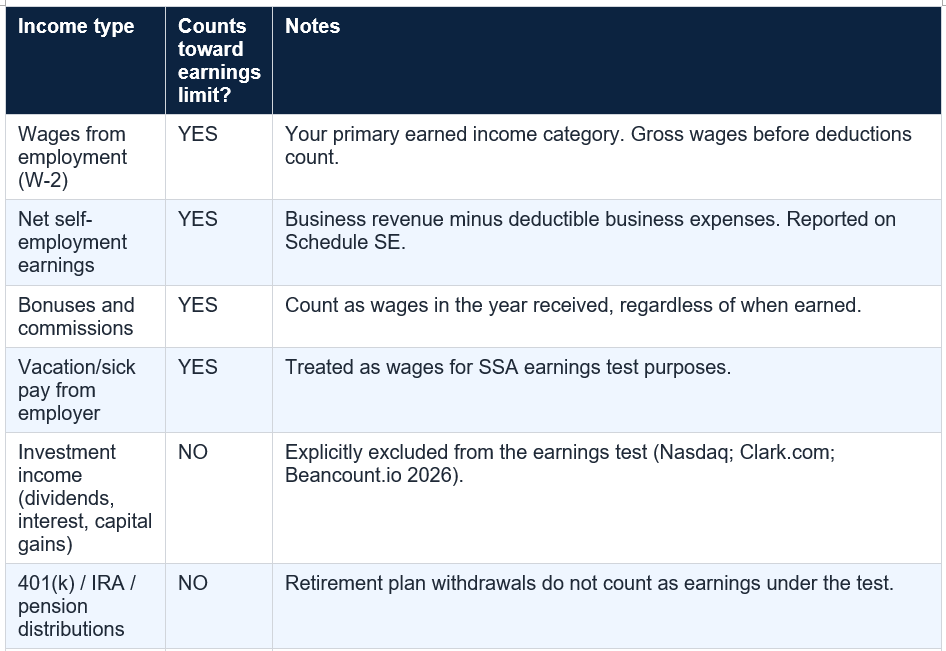
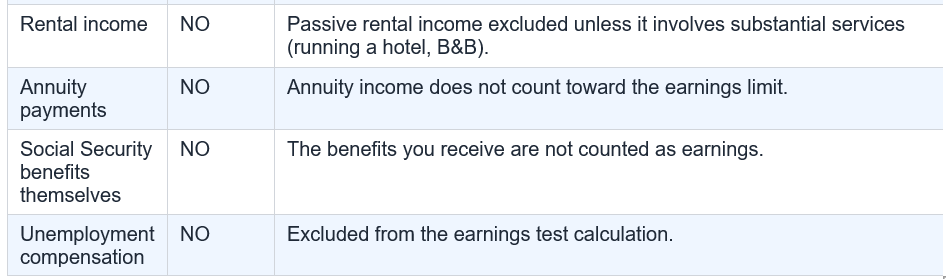
Beancount.io’s 2026 earnings test guide noted that earnings in the form of dividends or retirement plan withdrawals do not count toward the limit. VisionRetirement similarly confirmed that only earnings from work count toward the Social Security earnings limit. The practical implication is substantial. A retiree with $20,000 in dividend income, $15,000 in 401k withdrawals, a $12,000 pension, and $10,000 in part-time wages has $10,000 in earnings counted by the test — well below the $24,480 limit — even though their total income is $57,000.
The implication is that the withholding can feel more severe than the $1-for-$2 formula suggests, because it comes in the form of complete months without a payment rather than a small percentage reduction from each check. Beancount.io’s guide noted that ‘the expensive outcome is the unplanned one: claiming, working full-tilt, and discovering the withholding rule from a shrunken deposit.’ If your actual earnings turn out to be different from your estimate, the SSA reconciles the difference. National Tax Tools specifies: ‘Tell SSA promptly if your expected earnings change (call 1-800-772-1213; earnings estimates cannot be updated online).’ Withholding can never exceed the benefits payable for the tested months — you cannot be required to pay back more than was available to
The withholding surprise: the SSA withholds ENTIRE monthly payments, not a small portion of each. Exceeding the limit by $6,000 means two full monthly checks are withheld, not a 25% reduction to each check. If your earnings change mid-year, call SSA at 1-800-772-1213 to update your estimate — this cannot be done online. Withholding cannot exceed total payable benefits. Source: NationalTaxTools; Beancount.io September 2026.
However, there is a critical misconception to address. Nasdaq’s reporting is equally explicit about what the recalculation is not: ‘One misconception is that once you reach full retirement age, Social Security will pay you a lump sum to make up for all the benefits you had withheld under the earnings test.’ The recalculation is a permanent upward adjustment to your monthly benefit — not a one-time payment. If two months of your $1,500 benefit were withheld, your monthly benefit at FRA is adjusted upward slightly to account for those two months. The increase is permanent and recurring, but it is spread across all your future monthly checks rather than delivered as a single sum. The break-even point — the number of months of higher benefits required to recoup the withheld amount — varies by individual but generally occurs within a few years after FRA.
Withheld benefits are NOT permanently lost. At FRA, SSA recalculates your monthly benefit upward to credit the withheld months. The money comes back as a permanently higher monthly benefit — not a lump sum. Source: Nasdaq (Motley Fool); Clark.com; NationalTaxTools. Not financial advice. Verify your specific recalculation at ssa.gov.
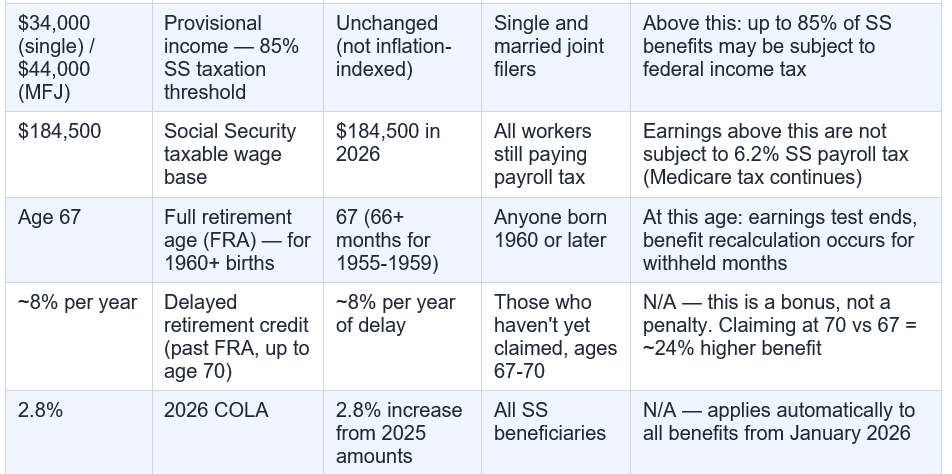
Provisional income is calculated as: adjusted gross income (AGI), plus any non-taxable interest, plus half of your annual Social Security benefits. For a single filer: if provisional income is below $25,000, none of your Social Security benefits are federally taxed. Between $25,000 and $34,000, up to 50% may be taxable. Above $34,000, up to 85% may be taxable. For married filing jointly: the thresholds are $32,000 (below which no SS is taxable), $32,000-$44,000 (up to 50% taxable), and above $44,000 (up to 85% taxable). Beancount.io’s 2026 working-while-collecting guide notes: ‘Working while collecting is precisely how people drift over those thresholds without noticing — the paycheck pushes provisional income up, and suddenly most of the benefit check is taxable too.’ These thresholds have not been adjusted for inflation since 1983 and 1994, which means they capture a steadily increasing share of Social Security recipients over time. Not financial advice. State income tax rules on Social Security vary by state and are not addressed here.
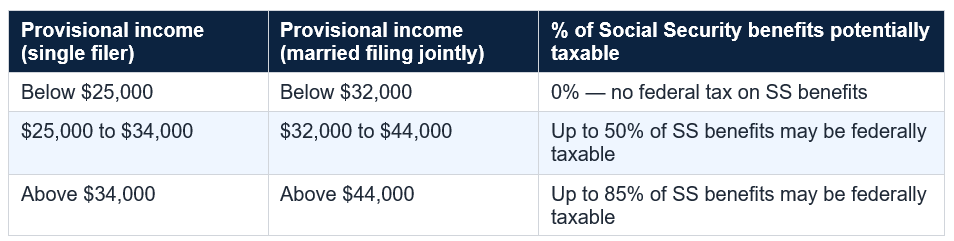
Provisional income = Adjusted Gross Income + non-taxable interest income + 50% of annual Social Security benefits. These thresholds are NOT indexed to inflation and have not changed since 1983 (0%/50% thresholds) and 1994 (85% threshold). Working adds earned income to AGI, directly increasing provisional income. Sources: Beancount.io September 2026; NationalTaxTools; SSA taxation rules. Not financial, tax, or retirement planning advice. State tax rules vary. Consult a tax professional.
Beancount.io’s September 2026 guide specifically notes this in the working-while-collecting context: the $184,500 wage base means high earners keep paying Social Security payroll tax longer into the year. For a worker at full salary who is also collecting benefits, this is a real additional cost in the months before the wage base limit is reached. The payroll tax contribution also has a benefit side: working years that add to your earnings record may increase your eventual Social Security benefit calculation if those years replace lower-earning years in the 35-year calculation history.
The Social Security Administration addresses this through the monthly earnings test for the first year of retirement. In the first year a person receives Social Security benefits, the SSA can use a monthly rather than annual earnings test: benefits are paid for any month in which earnings are below one-twelfth of the annual limit — in 2026, that monthly threshold is approximately $2,040 for the under-FRA limit. National Tax Tools’ guide confirms: ‘People who retire mid-year often earned more than the annual limit before they stopped working. A retiree living on a pension, portfolio withdrawals, and a part-time job under the limit keeps every Social Security dollar.’ The monthly test only applies in the first year of benefit receipt. In subsequent years, the annual test applies. If you retired mid-year and are planning to claim Social Security, it is worth discussing the monthly test with the SSA. Not financial advice.
The mid-year retirement monthly test: in the first year you receive Social Security, SSA can use a MONTHLY earnings test. In 2026, the monthly limit is approximately $2,040 (1/12 of $24,480). Benefits are paid for each month you earn below this, regardless of how much you earned earlier in the year. This only applies in the first year of benefit receipt. Contact SSA at 1-800-772-1213 to apply this rule. Source: NationalTaxTools 2026. Not financial advice.
First, working years that fall within your highest-earning 35 years can increase your lifetime average indexed monthly earnings (AIME), which is the basis for your benefit calculation. If a current working year, even a part-time one, replaces a zero-earnings year or a very low-earning year in your 35-year history, it can increase your calculated benefit. The SSA recalculates benefits annually based on updated earnings records, so increases from additional working years are reflected in your benefit. Second, if you have not yet claimed Social Security and are above full retirement age, delayed retirement credits add approximately 8% per year to your eventual benefit for each year of delay beyond FRA, up to age 70. Working and delaying the claim to 70 instead of 67 can produce a benefit approximately 24% higher than at FRA — a significant and permanent lifetime uplift. Not financial advice. Verify delayed retirement credit rates at ssa.gov.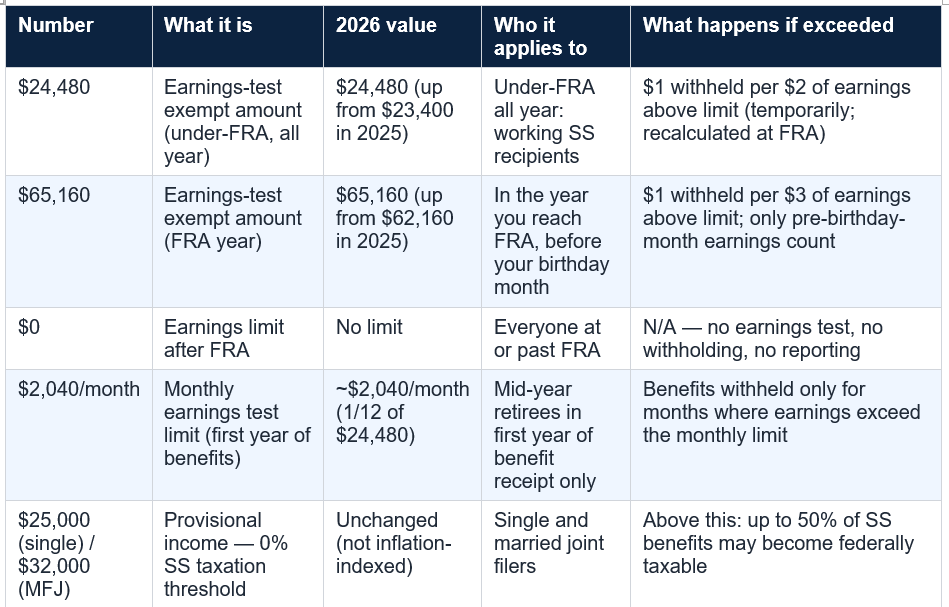
The numbers to check are: $24,480 (under-FRA annual limit), $65,160 (FRA-year annual limit), $0 (after FRA). What counts as earnings: wages and self-employment income only — not dividends, not 401k withdrawals, not pensions, not rental income. What the withheld money becomes: a higher monthly benefit from FRA onward, not a lump sum. And what working adds to your tax position: earned income pushed through provisional income thresholds can make up to 85% of your Social Security benefit federally taxable. The combination of the earnings test and the taxation interaction is what Beancount.io called ‘precisely how people drift over those thresholds without noticing.’ Understanding these six numbers before the paychecks start arriving is how you avoid that drift. Not financial, tax, or retirement planning advice. Verify all limits at ssa.gov or call 1-800-772-1213.
In 2026, the answer depends on whether you have reached full retirement age. If you will not reach full retirement age (FRA) at any point during 2026, the earnings-test exempt amount is $24,480. Earn more than this from work and Social Security withholds $1 for every $2 above the limit. If you will reach FRA during 2026 (turning 67 at some point in the year), the limit is $65,160, and only earnings before the month you reach FRA count — withholding is $1 for every $3 above this limit. Once you have reached full retirement age, there is no earnings limit — you can earn any amount with no effect on your Social Security benefit. These limits apply only to earned income (wages, self-employment). Dividends, retirement plan withdrawals, pensions, and rental income do not count. Sources: Nasdaq/Motley Fool; Clark.com; NationalTaxTools 2026.
Do I permanently lose Social Security benefits if I earn too much?
No. Benefits withheld under the earnings test are not permanently lost. When you reach full retirement age, the Social Security Administration recalculates your monthly benefit upward to give you credit for the months that benefits were withheld. Your monthly benefit from FRA onward is permanently increased to reflect those missing months. However, there is a common misconception to address: the SSA does NOT pay a lump sum at FRA to make up for withheld benefits. The recovery comes as a permanently higher monthly payment, spread across all future benefit checks. The break-even point — when the higher monthly payments have cumulatively recovered the withheld amount — typically occurs within a few years after FRA, depending on how long benefits were withheld and the size of the benefit increase. Sources: Nasdaq (Motley Fool); Clark.com; NationalTaxTools.
What income counts toward the Social Security earnings limit?
Only earned income counts: wages from employment (W-2 income) and net earnings from self-employment. A significant range of income types that retirees commonly receive does NOT count toward the earnings limit: investment income (dividends, interest, capital gains); retirement plan distributions (401k, IRA, pension withdrawals); rental income (unless you provide substantial services like a hotel); annuity payments; and Social Security benefits themselves. As a practical example: a 64-year-old with $20,000 in dividends, $15,000 in 401k withdrawals, and $10,000 in part-time wages has only $10,000 counted toward the $24,480 limit — well under the threshold — even though total income is $45,000. Sources: Nasdaq/Motley Fool; Clark.com; Beancount.io 2026; VisionRetirement.
Can working in retirement actually increase my Social Security benefit?
Yes, in two ways. First, if your current working year earns enough to replace one of the lower-earning years in your 35-year Social Security earnings history, the SSA's annual benefit recalculation will reflect the higher average — producing a modestly higher benefit. The SSA recalculates benefits annually as new earnings are reported. Second, if you have not yet claimed Social Security and are past full retirement age, delaying the claim earns delayed retirement credits of approximately 8% per year for each year of delay beyond FRA, up to age 70. Claiming at 70 instead of 67 can produce a monthly benefit approximately 24% higher than at FRA — a significant and permanent increase that compounds across a long retirement. Working past FRA and delaying the claim is therefore doubly beneficial for those in good health with above-average life expectancy. Sources: Beancount.io 2026; VisionRetirement; SSA delayed retirement credit rules. Not financial advice.
How does working affect the taxes I pay on my Social Security benefits?
Working while collecting Social Security can increase the proportion of your benefits that is subject to federal income tax, through a calculation called provisional income. Provisional income = Adjusted Gross Income + non-taxable interest + 50% of your annual Social Security benefits. Wages from work are included in AGI, which directly increases provisional income. For single filers: if provisional income exceeds $34,000, up to 85% of your Social Security benefits may be subject to federal income tax. For married filing jointly: the threshold is $44,000. These thresholds have not been adjusted for inflation since 1983 and 1994, which means more beneficiaries fall into the higher taxation tiers each year as incomes rise. Beancount.io's 2026 guide notes that working while collecting is 'precisely how people drift over those thresholds without noticing — the paycheck pushes provisional income up, and suddenly most of the benefit check is taxable too.' Note: state income tax treatment of Social Security benefits varies by state. Sources: Beancount.io September 2026; NationalTaxTools. Not tax advice. Consult a qualified tax professional.
You are allowed to work while collecting Social Security. The rules do not prevent it. But the rules do create a trap for anyone who earns above a specific threshold before reaching full retirement age — and discovering that trap from a smaller-than-expected monthly deposit is a genuinely unpleasant surprise. In 2026, the earnings-test limit for most people claiming Social Security before full retirement age is $24,480. Earn more than that from work, and you will have $1 in benefits withheld for every $2 you earn above it. If you are in the year you will reach full retirement age, that limit rises to $65,160 and the withholding rate softens to $1 for every $3. Once you actually reach full retirement age, the earnings test disappears entirely — you can earn any amount. This article sets out every number you need to check, what counts as earnings and what does not, what happens to the money that is withheld, and how working in retirement affects the taxes on your Social Security benefits. This is Not financial, tax, or retirement planning advice but general informational and educational purposes ONLY.
Table of Contents
- The Big Picture: Can You Work and Collect at the Same Time?
- Number 1: $24,480 — The Under-FRA Annual Earnings Limit
- Number 2: $65,160 — The FRA-Year Earnings Limit
- Number 3: $0 — The Earnings Limit After Full Retirement Age
- What Counts as ‘Earnings’ — and What Doesn’t
- How the Withholding Actually Works in Practice
- Number 4: The Recalculation at Full Retirement Age
- Number 5: The Provisional Income Thresholds and Your Tax Bill
- Number 6: $184,500 — The Social Security Wage Base
- The Mid-Year Retirement Rule: When the Monthly Limit Applies
- Working in Retirement: The Positive Effects on Your Benefit
- The Complete Numbers Reference Table
- Conclusion: The Earnings Test Is a Temporary Cashflow Problem, Not a Permanent Loss
- Frequently Asked Questions
The Big Picture: Can You Work and Collect at the Same Time?
Yes. You can work while collecting Social Security retirement benefits. The Social Security Administration does not prohibit it, and millions of Americans do exactly this. The complication arises when you are collecting benefits before reaching your full retirement age (FRA) — currently age 67 for everyone born in 1960 or later — and you earn above certain thresholds from work. In that situation, the Social Security earnings test applies, and benefits are temporarily withheld based on how much you earn. If you are at or past full retirement age, none of this applies to you. Earn what you like. The earnings test has no relevance once you have reached FRA.The important word in the previous paragraph is ‘temporarily.’ Benefits withheld under the earnings test are not permanently lost. When you reach FRA, the Social Security Administration recalculates your benefit upward to account for the months that benefits were withheld. You receive a higher monthly benefit from FRA onward. That said, the timing matters — and many people are caught off guard by the withholding rule because they plan on receiving both their salary and their Social Security check, and the withholding rule eliminates one of those income streams without warning if the earnings limit is exceeded.
2026 Social Security key numbers: Full retirement age (FRA) for those born 1960+: 67. Under-FRA earnings limit: $24,480 ($23,400 in 2025). FRA-year earnings limit: $65,160 ($62,160 in 2025). After FRA: no earnings limit. Average monthly benefit 2026: ~$1,976 (after 2.8% COLA). Maximum benefit at FRA 2026: ~$4,152/month. Withholding rate: $1 per $2 (under-FRA) or $1 per $3 (FRA year) above the limit. Sources: Nasdaq; Clark.com; Beancount.io.
Number 1: $24,480 — The Under-FRA Annual Earnings Limit
The first number every working Social Security recipient needs to know is $24,480. This is the 2026 earnings-test exempt amount for workers who will not reach full retirement age at any point during 2026. It is up from $23,400 in 2025 — a meaningful increase that reflects Social Security’s annual adjustment of the earnings limits. If your annual earnings from work exceed $24,480, the Social Security Administration withholds $1 in benefits for every $2 of earnings above that threshold. This is known as the $1-for-$2 rule.To illustrate with a concrete worked example: a 64-year-old collecting Social Security in 2026, with an annual salary of $30,480. Excess earnings above the limit: $30,480 minus $24,480 equals $6,000. Withholding: $6,000 divided by 2 equals $3,000 in benefits withheld for the year. If the monthly benefit is $1,500, that means two full monthly checks are withheld. The SSA typically implements this by stopping payments for enough months at the start of the year to cover the expected withholding — so an individual may receive no benefit check in January and February, then resume receiving full checks for the rest of the year. The total withheld across the year is $3,000, matching the formula.
Worked example (under-FRA all year): Annual earnings from work: $30,480. Annual earnings limit: $24,480. Excess: $30,480 − $24,480 = $6,000. Withholding: $6,000 ÷ 2 = $3,000. On a $1,500/month benefit: SSA withholds 2 months of benefits. Benefits resume after the 2-month 'debt' is repaid. This $3,000 is NOT lost — it is recalculated into a higher monthly benefit at FRA. Source: Nasdaq; NationalTaxTools; VisionRetirement.
Number 2: $65,160 — The FRA-Year Earnings Limit
The second critical number is $65,160 — the earnings-test exempt amount for individuals who will reach full retirement age at some point during 2026 but have not yet done so at the start of the year. This limit is substantially higher than the under-FRA limit, and the withholding rate is more forgiving: for every $3 of earnings above $65,160, only $1 in benefits is withheld. This is known as the $1-for-$3 rule.Equally important: in the year you reach FRA, only earnings before your birthday month count toward the test. Earnings in the month you reach FRA, and all months after, are completely excluded from the earnings test calculation. So if your 67th birthday is in July, only your earnings from January through June are counted. The limit of $65,160 applies to just those first six months of earnings. National Tax Tools’ Social Security earnings test guide describes this clearly: ‘The limit nearly triples (to $65,160 in 2026), the withholding rate softens to $1 for every $3 of excess, and only earnings before the month you reach FRA count.’ Not financial advice.
FRA year rules (2026): Earnings limit: $65,160 (up from $62,160 in 2025). Withholding rate: $1 withheld per $3 earned above the limit. Earnings counted: ONLY those earned in months BEFORE the month you turn your FRA age. Earnings in the month you reach FRA and after: not counted. Result: someone who reaches FRA in July counts only January-June earnings. Sources: Nasdaq; Clark.com; NationalTaxTools 2026. Not financial advice.
Number 3: $0 — The Earnings Limit After Full Retirement Age
The most liberating number in this entire framework is zero: the earnings limit that applies once you have reached full retirement age. After FRA, there is no earnings test, no withholding, no reporting obligation tied to the test, and no cap on how much you can earn from work while receiving your full Social Security benefit. The National Tax Tools Social Security earnings test guide states it plainly: ‘The test ends the month you reach full retirement age — from then on you can earn any amount with zero withholding.’This is why the timing of both the Social Security claim date and the FRA milestone matters so much to working retirees. If you are currently 65, earn $60,000 per year, and are considering claiming Social Security, waiting until you reach FRA at 67 before claiming means you never face the earnings test at all — and you additionally receive a higher monthly benefit for having waited. The calculus depends on individual health, financial need, and expected longevity, but the earnings test is a strong argument for waiting until FRA to claim if you expect to continue working at any meaningful income level.
After FRA: no earnings limit, no withholding, no SSA reporting obligation tied to the earnings test. Earn any amount from any source without affecting your Social Security benefit. This applies from the month you reach FRA onward. Source: Nasdaq; Clark.com; NationalTaxTools. Not financial advice. Verify your specific FRA at ssa.gov.
What Counts as ‘Earnings’ — and What Doesn’t
One of the most significant and widely misunderstood aspects of the Social Security earnings test is the definition of ‘earnings.’ Not all income counts. The earnings test applies only to earned income — specifically wages from employment and net earnings from self-employment. A significant range of income types that working retirees commonly receive do not count toward the earnings limit at all.Beancount.io’s 2026 earnings test guide noted that earnings in the form of dividends or retirement plan withdrawals do not count toward the limit. VisionRetirement similarly confirmed that only earnings from work count toward the Social Security earnings limit. The practical implication is substantial. A retiree with $20,000 in dividend income, $15,000 in 401k withdrawals, a $12,000 pension, and $10,000 in part-time wages has $10,000 in earnings counted by the test — well below the $24,480 limit — even though their total income is $57,000.
How the Withholding Actually Works in Practice
The mechanics of Social Security benefit withholding are different from what most people expect. The SSA does not reduce each individual monthly check by a small amount. Instead, it typically withholds entire monthly benefit payments until the annual ‘debt’ created by excess earnings is fully covered. National Tax Tools’ guide explains: withholding is based on the earnings estimate you provide to the SSA at the start of the year. If the SSA expects you to earn $30,480, they calculate the expected withholding of $3,000 and withhold the first two monthly checks entirely (if monthly benefit is $1,500), then resume full payments.The implication is that the withholding can feel more severe than the $1-for-$2 formula suggests, because it comes in the form of complete months without a payment rather than a small percentage reduction from each check. Beancount.io’s guide noted that ‘the expensive outcome is the unplanned one: claiming, working full-tilt, and discovering the withholding rule from a shrunken deposit.’ If your actual earnings turn out to be different from your estimate, the SSA reconciles the difference. National Tax Tools specifies: ‘Tell SSA promptly if your expected earnings change (call 1-800-772-1213; earnings estimates cannot be updated online).’ Withholding can never exceed the benefits payable for the tested months — you cannot be required to pay back more than was available to
The withholding surprise: the SSA withholds ENTIRE monthly payments, not a small portion of each. Exceeding the limit by $6,000 means two full monthly checks are withheld, not a 25% reduction to each check. If your earnings change mid-year, call SSA at 1-800-772-1213 to update your estimate — this cannot be done online. Withholding cannot exceed total payable benefits. Source: NationalTaxTools; Beancount.io September 2026.
Number 4: The Recalculation at Full Retirement Age
The most reassuring fact about the Social Security earnings test is that withheld benefits are not permanently lost. When you reach full retirement age, the Social Security Administration recalculates your benefit amount to give you credit for the months that benefits were withheld. Your monthly benefit from FRA onward is increased to reflect those missing months. Nasdaq’s 2026 coverage is explicit: ‘Once you reach full retirement age, you’ll get the money back in the form of larger ongoing Social Security benefits.’However, there is a critical misconception to address. Nasdaq’s reporting is equally explicit about what the recalculation is not: ‘One misconception is that once you reach full retirement age, Social Security will pay you a lump sum to make up for all the benefits you had withheld under the earnings test.’ The recalculation is a permanent upward adjustment to your monthly benefit — not a one-time payment. If two months of your $1,500 benefit were withheld, your monthly benefit at FRA is adjusted upward slightly to account for those two months. The increase is permanent and recurring, but it is spread across all your future monthly checks rather than delivered as a single sum. The break-even point — the number of months of higher benefits required to recoup the withheld amount — varies by individual but generally occurs within a few years after FRA.
Withheld benefits are NOT permanently lost. At FRA, SSA recalculates your monthly benefit upward to credit the withheld months. The money comes back as a permanently higher monthly benefit — not a lump sum. Source: Nasdaq (Motley Fool); Clark.com; NationalTaxTools. Not financial advice. Verify your specific recalculation at ssa.gov.
Number 5: The Provisional Income Thresholds and Your Tax Bill
The earnings test is not the only number that matters if you are working while collecting Social Security. There is a second, separate calculation that determines how much of your Social Security benefit is subject to federal income tax. It is called provisional income, and working adds to it in ways that can push more of your benefit into the taxable tiers.Provisional income is calculated as: adjusted gross income (AGI), plus any non-taxable interest, plus half of your annual Social Security benefits. For a single filer: if provisional income is below $25,000, none of your Social Security benefits are federally taxed. Between $25,000 and $34,000, up to 50% may be taxable. Above $34,000, up to 85% may be taxable. For married filing jointly: the thresholds are $32,000 (below which no SS is taxable), $32,000-$44,000 (up to 50% taxable), and above $44,000 (up to 85% taxable). Beancount.io’s 2026 working-while-collecting guide notes: ‘Working while collecting is precisely how people drift over those thresholds without noticing — the paycheck pushes provisional income up, and suddenly most of the benefit check is taxable too.’ These thresholds have not been adjusted for inflation since 1983 and 1994, which means they capture a steadily increasing share of Social Security recipients over time. Not financial advice. State income tax rules on Social Security vary by state and are not addressed here.
Provisional income = Adjusted Gross Income + non-taxable interest income + 50% of annual Social Security benefits. These thresholds are NOT indexed to inflation and have not changed since 1983 (0%/50% thresholds) and 1994 (85% threshold). Working adds earned income to AGI, directly increasing provisional income. Sources: Beancount.io September 2026; NationalTaxTools; SSA taxation rules. Not financial, tax, or retirement planning advice. State tax rules vary. Consult a tax professional.
Number 6: $184,500 — The Social Security Wage Base
If you are still working and have not yet reached full retirement age, a sixth number is worth knowing: $184,500. This is the 2026 Social Security taxable wage base — the maximum earnings level on which you pay Social Security payroll tax. Wages up to $184,500 are subject to the 6.2% Social Security payroll tax (employee share). Wages above this amount are not subject to Social Security payroll tax — though they remain subject to the 1.45% Medicare payroll tax, which has no ceiling.Beancount.io’s September 2026 guide specifically notes this in the working-while-collecting context: the $184,500 wage base means high earners keep paying Social Security payroll tax longer into the year. For a worker at full salary who is also collecting benefits, this is a real additional cost in the months before the wage base limit is reached. The payroll tax contribution also has a benefit side: working years that add to your earnings record may increase your eventual Social Security benefit calculation if those years replace lower-earning years in the 35-year calculation history.
The Mid-Year Retirement Rule: When the Monthly Limit Applies
The annual earnings limit creates a problem for people who retire mid-year. Someone who worked full-time from January through June and then retired and claimed Social Security might have earned $50,000 in that first six months — far above the $24,480 annual limit. Under the strict annual test, this would trigger significant benefit withholding for the rest of the year, even though the person is no longer working.The Social Security Administration addresses this through the monthly earnings test for the first year of retirement. In the first year a person receives Social Security benefits, the SSA can use a monthly rather than annual earnings test: benefits are paid for any month in which earnings are below one-twelfth of the annual limit — in 2026, that monthly threshold is approximately $2,040 for the under-FRA limit. National Tax Tools’ guide confirms: ‘People who retire mid-year often earned more than the annual limit before they stopped working. A retiree living on a pension, portfolio withdrawals, and a part-time job under the limit keeps every Social Security dollar.’ The monthly test only applies in the first year of benefit receipt. In subsequent years, the annual test applies. If you retired mid-year and are planning to claim Social Security, it is worth discussing the monthly test with the SSA. Not financial advice.
The mid-year retirement monthly test: in the first year you receive Social Security, SSA can use a MONTHLY earnings test. In 2026, the monthly limit is approximately $2,040 (1/12 of $24,480). Benefits are paid for each month you earn below this, regardless of how much you earned earlier in the year. This only applies in the first year of benefit receipt. Contact SSA at 1-800-772-1213 to apply this rule. Source: NationalTaxTools 2026. Not financial advice.
Working in Retirement: The Positive Effects on Your Benefit
The conversation about working while collecting Social Security is often framed entirely around the risks — the earnings test, the withholding, the tax implications. But there are genuine positive effects of continued work on Social Security benefits that are worth understanding alongside the risks.First, working years that fall within your highest-earning 35 years can increase your lifetime average indexed monthly earnings (AIME), which is the basis for your benefit calculation. If a current working year, even a part-time one, replaces a zero-earnings year or a very low-earning year in your 35-year history, it can increase your calculated benefit. The SSA recalculates benefits annually based on updated earnings records, so increases from additional working years are reflected in your benefit. Second, if you have not yet claimed Social Security and are above full retirement age, delayed retirement credits add approximately 8% per year to your eventual benefit for each year of delay beyond FRA, up to age 70. Working and delaying the claim to 70 instead of 67 can produce a benefit approximately 24% higher than at FRA — a significant and permanent lifetime uplift. Not financial advice. Verify delayed retirement credit rates at ssa.gov.
The Complete Numbers Reference Table
Conclusion
The single most important thing to understand about working while collecting Social Security before full retirement age is that the earnings test does not permanently reduce your lifetime benefits. The money withheld is recalculated into a permanently higher monthly benefit at FRA. What the earnings test does create is a cashflow problem: months when your Social Security check does not arrive, even though you planned on receiving it. For someone depending on that income to meet monthly expenses, the surprise of withheld payments can be genuinely disruptive.The numbers to check are: $24,480 (under-FRA annual limit), $65,160 (FRA-year annual limit), $0 (after FRA). What counts as earnings: wages and self-employment income only — not dividends, not 401k withdrawals, not pensions, not rental income. What the withheld money becomes: a higher monthly benefit from FRA onward, not a lump sum. And what working adds to your tax position: earned income pushed through provisional income thresholds can make up to 85% of your Social Security benefit federally taxable. The combination of the earnings test and the taxation interaction is what Beancount.io called ‘precisely how people drift over those thresholds without noticing.’ Understanding these six numbers before the paychecks start arriving is how you avoid that drift. Not financial, tax, or retirement planning advice. Verify all limits at ssa.gov or call 1-800-772-1213.
Frequently Asked Questions
How much can I earn on Social Security before my benefits are reduced in 2026?In 2026, the answer depends on whether you have reached full retirement age. If you will not reach full retirement age (FRA) at any point during 2026, the earnings-test exempt amount is $24,480. Earn more than this from work and Social Security withholds $1 for every $2 above the limit. If you will reach FRA during 2026 (turning 67 at some point in the year), the limit is $65,160, and only earnings before the month you reach FRA count — withholding is $1 for every $3 above this limit. Once you have reached full retirement age, there is no earnings limit — you can earn any amount with no effect on your Social Security benefit. These limits apply only to earned income (wages, self-employment). Dividends, retirement plan withdrawals, pensions, and rental income do not count. Sources: Nasdaq/Motley Fool; Clark.com; NationalTaxTools 2026.
Do I permanently lose Social Security benefits if I earn too much?
No. Benefits withheld under the earnings test are not permanently lost. When you reach full retirement age, the Social Security Administration recalculates your monthly benefit upward to give you credit for the months that benefits were withheld. Your monthly benefit from FRA onward is permanently increased to reflect those missing months. However, there is a common misconception to address: the SSA does NOT pay a lump sum at FRA to make up for withheld benefits. The recovery comes as a permanently higher monthly payment, spread across all future benefit checks. The break-even point — when the higher monthly payments have cumulatively recovered the withheld amount — typically occurs within a few years after FRA, depending on how long benefits were withheld and the size of the benefit increase. Sources: Nasdaq (Motley Fool); Clark.com; NationalTaxTools.
What income counts toward the Social Security earnings limit?
Only earned income counts: wages from employment (W-2 income) and net earnings from self-employment. A significant range of income types that retirees commonly receive does NOT count toward the earnings limit: investment income (dividends, interest, capital gains); retirement plan distributions (401k, IRA, pension withdrawals); rental income (unless you provide substantial services like a hotel); annuity payments; and Social Security benefits themselves. As a practical example: a 64-year-old with $20,000 in dividends, $15,000 in 401k withdrawals, and $10,000 in part-time wages has only $10,000 counted toward the $24,480 limit — well under the threshold — even though total income is $45,000. Sources: Nasdaq/Motley Fool; Clark.com; Beancount.io 2026; VisionRetirement.
Can working in retirement actually increase my Social Security benefit?
Yes, in two ways. First, if your current working year earns enough to replace one of the lower-earning years in your 35-year Social Security earnings history, the SSA's annual benefit recalculation will reflect the higher average — producing a modestly higher benefit. The SSA recalculates benefits annually as new earnings are reported. Second, if you have not yet claimed Social Security and are past full retirement age, delaying the claim earns delayed retirement credits of approximately 8% per year for each year of delay beyond FRA, up to age 70. Claiming at 70 instead of 67 can produce a monthly benefit approximately 24% higher than at FRA — a significant and permanent increase that compounds across a long retirement. Working past FRA and delaying the claim is therefore doubly beneficial for those in good health with above-average life expectancy. Sources: Beancount.io 2026; VisionRetirement; SSA delayed retirement credit rules. Not financial advice.
How does working affect the taxes I pay on my Social Security benefits?
Working while collecting Social Security can increase the proportion of your benefits that is subject to federal income tax, through a calculation called provisional income. Provisional income = Adjusted Gross Income + non-taxable interest + 50% of your annual Social Security benefits. Wages from work are included in AGI, which directly increases provisional income. For single filers: if provisional income exceeds $34,000, up to 85% of your Social Security benefits may be subject to federal income tax. For married filing jointly: the threshold is $44,000. These thresholds have not been adjusted for inflation since 1983 and 1994, which means more beneficiaries fall into the higher taxation tiers each year as incomes rise. Beancount.io's 2026 guide notes that working while collecting is 'precisely how people drift over those thresholds without noticing — the paycheck pushes provisional income up, and suddenly most of the benefit check is taxable too.' Note: state income tax treatment of Social Security benefits varies by state. Sources: Beancount.io September 2026; NationalTaxTools. Not tax advice. Consult a qualified tax professional.
0 Comments
Be the first to share your thoughts on this article.