

Retirement
3 Questions to Inflation-Proof Your Retirement Plan

Inflation is the retirement risk almost nobody plans for properly. People spend years calculating how much they need to save, what withdrawal rate to use, and when to claim Social Security. Then they assume that once those decisions are made, the plan holds. It doesn’t. According to The Senior Citizens League, Social Security benefits lost 20% of their purchasing power between 2010 and 2024. The 2026 COLA of 2.8% sounds like a raise — until you notice that Medicare Part B premiums jumped from $185 to $202.90 in the same year, which consumed nearly a third of the average retiree’s COLA increase. Healthcare is inflating at 5.8% per year according to HealthView Services’ 2026 Retirement Healthcare Costs Data Report. The COLA is growing at 2.4% on average. The gap between those two numbers is your problem. This article frames the inflation-proofing challenge as three specific questions your retirement plan needs to answer. If it can’t answer all three, it has a hole in it.
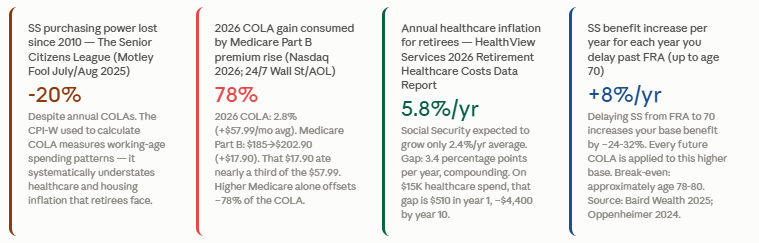
The proof of this is not hypothetical. The Senior Citizens League, a nonprofit advocacy group that tracks Social Security and seniors’ finances, found that Social Security benefits lost 20% of their purchasing power between 2010 and 2024. The benefit checks got bigger every year through the annual COLA adjustments — and yet the purchasing power still declined, because the cost of the things retirees actually buy inflated faster than the COLA measured. The mechanism is simple: the COLA is calculated using the CPI-W, which measures the spending patterns of working people, not retirees. Retirees spend proportionally more on healthcare and housing, both of which have inflated faster than the overall CPI-W. So the raise doesn’t cover the price increase.
This article is structured around three questions that, together, diagnose whether a retirement plan is genuinely inflation-resistant or merely nominally funded. None of them requires a financial degree to answer. All of them are worth asking before a single month of retirement income is drawn. Not financial advice.
The inflation gap in real numbers (2026): Social Security 2026 COLA: 2.8% (confirmed, 24/7 Wall St / AOL 2026). Average monthly benefit 2026: $2,071. Average COLA increase: ~$57.99/month. Medicare Part B premium increase 2025→2026: $185→$202.90 (+$17.90). That $17.90 consumed nearly a third of the average $57.99 COLA increase. Higher Medicare Part B costs alone could offset roughly 78% of the 2.8% COLA for the average retiree. Healthcare inflation rate: 5.8%/year (HealthView Services 2026 Retirement Healthcare Costs Data Report). Expected average Social Security COLA long-term: 2.4%. The gap between healthcare inflation (5.8%) and Social Security growth (2.4%) widens by 3.4 percentage points every year. Sources: 24/7 Wall St/AOL 2026; Nasdaq 2026; HealthView Services 2026. Not financial advice.
Clark.com’s analysis of inflation-proofing retirement describes retirees as facing ‘a perfect storm’ when it comes to inflation: fixed income, healthcare costs that inflate at double the general rate, and a spending pattern that the standard inflation measure doesn’t accurately capture. Unlike working people who might get cost-of-living raises, most retirees live on relatively fixed incomes with no mechanism for adjustment except the explicit COLA built into Social Security — which, as the numbers above show, is already losing the battle.
There is also something specific to retirement that makes inflation more dangerous than it is during working years: sequence of returns risk. If markets drop during the early years of retirement, you are forced to sell assets at depressed prices to fund living expenses. Inflation compounds this problem by forcing higher withdrawals during exactly the periods when portfolio values may be suppressed. The combination of inflation and a bear market in the early years of retirement can permanently damage a portfolio’s ability to sustain income across a 20-30 year horizon. Not financial advice.
Question 1: Does your income actually keep up with inflation? (Question 1: the income test.) Your retirement income comes from some combination of Social Security, pensions, part-time work, rental income, and portfolio withdrawals. Which of these have automatic inflation adjustment built in? Which are fixed in nominal terms? How much of your baseline income comes from sources that will lose real value every year? This is the income-side inflation test.
Question 2: Does your portfolio have enough growth to outpace inflation? (Question 2: the asset test.) A portfolio that is too conservatively invested may produce stable nominal returns but declining real returns. A portfolio that is entirely in bonds during a period of above-average inflation can lose real purchasing power every year even as the bond coupons arrive on schedule. Is your asset allocation positioned to grow faster than inflation over the time horizon of your retirement? This is the asset-side inflation test.
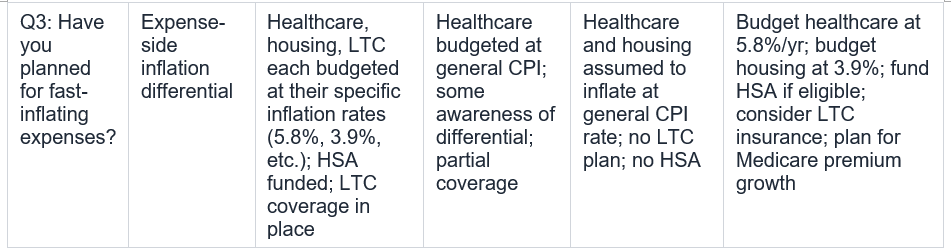
Question 3: Have you planned specifically for the costs inflation hits hardest in retirement? (Question 3: the expense test.) Healthcare inflates at 5.8% per year according to HealthView Services’ 2026 data. Long-term care costs are not covered by Medicare. Housing costs have been rising above the COLA rate. Do you have a specific plan for these specific expense categories — or does your budget assume uniform inflation across all your spending? This is the expense-side inflation test. Not financial advice.
The math of a fixed pension income over twenty years is sobering. If your pension pays $2,000 per month today and inflation averages 3% per year, that same $2,000 will have the purchasing power of approximately $1,107 in twenty years. The nominal check hasn’t changed. The real check has almost halved. If your retirement income is primarily from a fixed pension plus Social Security, you are running an income base that gets weaker in real terms every year — and that means your portfolio withdrawal rate must increase over time to maintain your lifestyle, which accelerates portfolio depletion.
The Oppenheimer 2024 retirement inflation analysis notes that maintaining a withdrawal burn rate below 3% of the portfolio while receiving Social Security significantly improves inflation survival for the overall retirement plan. The lower the withdrawal rate from the portfolio in the early years of retirement, the more the portfolio can grow and the better positioned it is to fund higher real withdrawals later when fixed-income purchasing power has eroded. Not financial advice.
Income inflation audit (takes 30 minutes): List every income source in retirement. For each one: (1) Is it adjusted for inflation? Yes/No/Partial. (2) At what rate? (SS COLA: historically avg 3.7%; pensions: usually 0%; rental income: depends on lease terms.) (3) How much of my total baseline income comes from inflation-adjusted sources vs fixed sources? If more than 60% of your baseline income is from fixed (non-inflation-adjusted) sources, your plan has an income-side inflation vulnerability that needs addressing. Not financial advice. Consult a fee-only CFP.
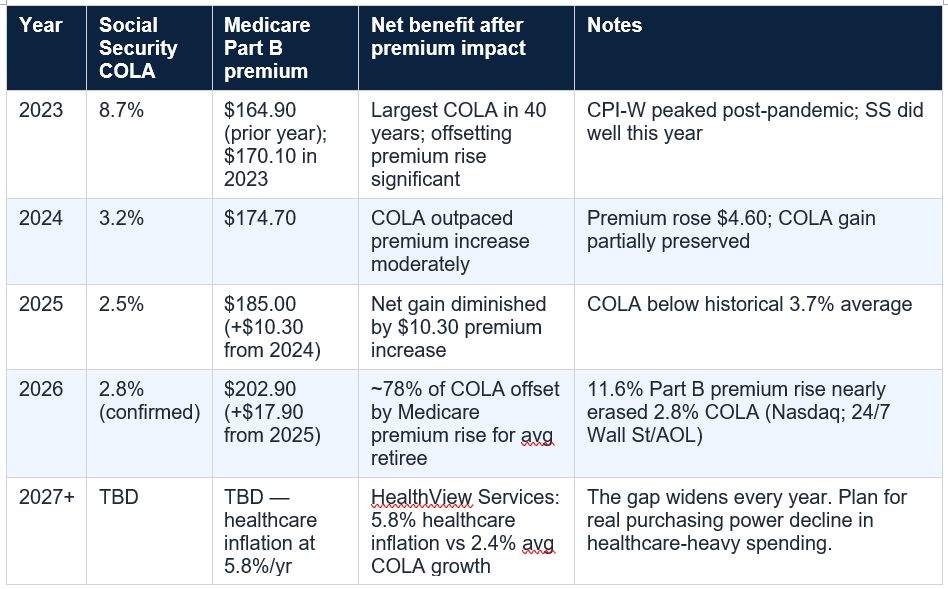
The Nasdaq analysis summarising the 2026 COLA situation is blunt: higher Medicare Part B costs alone could offset roughly 78% of the 2.8% COLA for the average retiree. The 2025 Social Security and Medicare Trustees Report found that Part B premiums rose by an average of 11.6% in 2026. So the COLA rises 2.8% and a key expense rises 11.6%. This is the structural problem described by The Senior Citizens League: the 20% purchasing power loss since 2010 is not from COLA being zero — it is from COLA consistently being smaller than the inflation that retirees actually experience.
The deeper structural flaw is the CPI-W metric. This index measures the spending of urban wage earners and clerical workers — working-age people who spend relatively less on healthcare and housing than retirees. Using the CPI-W to calibrate a raise for people whose spending is dominated by healthcare and housing means the measurement is structurally biased against accurately reflecting retiree inflation. The CPI-E, an alternative measure that weights retiree spending patterns, has historically been higher. Motley Fool’s July 2025 analysis confirms: housing prices rose 3.9% and medical care prices increased 2.8% through the first six months of 2025 — both above the CPI-W reading. Not financial advice.
The Alpine Mountaineer’s December 2026 summary of inflation-fighting strategies for retirees is direct: ‘You can start collecting Social Security benefits at 62, but your monthly checks will be much bigger if you wait until your full retirement age, likely between 66 and 67. Of course, if you need the money to help support your retirement, you may not be able to afford to wait, but if you can, your bigger checks can be a big help against inflation.’ The Baird Wealth inflation-proofing guide (May 2025) also lists delaying Social Security as a core strategy.
The compounding effect of a higher base amount is significant over a long retirement. If your benefit is $500 higher per month at age 70 than it would have been at 65, and you live to 90, that $500 difference compounds through 25 years of COLA adjustments. The absolute dollar difference grows every year. The break-even point for delaying (at which the total lifetime benefits of the delayed, higher benefit exceed those of the earlier, lower benefit) is typically around age 78-80 — meaning anyone who expects to live past 80 is likely better off financially by delaying. Not financial advice. Consult a CFP who can run the specific calculation for your earnings record.
Delay Social Security if you can afford to: the 8% per year increase in benefits for each year past FRA (up to age 70) is effectively a guaranteed, risk-free 8% return on deferred income — substantially higher than most bond returns. It also creates a permanently larger base for every future COLA to be applied to. For married couples, delaying the higher earner's benefit to 70 maximises the survivor benefit. The break-even age is typically 78-80. Sources: The Alpine Mountaineer December 2026; Baird Wealth May 2025; Oppenheimer 2024. Not financial advice. Consult a fee-only CFP for your specific calculation.
Baird Wealth’s May 2025 inflation-proofing guide makes the equity argument directly: ‘Stocks offer higher potential returns, which can help your portfolio outpace the rate of inflation. If your risk tolerance allows it, consider holding a greater portion of your portfolio in stocks to take advantage of higher potential returns.’ The historical long-run equity return of approximately 10% nominal (7% real after inflation) means that a portfolio with meaningful equity exposure has a built-in inflation buffer that bonds alone cannot replicate. Baird also warns explicitly about the bond trap.
The challenge is the emotional reality of holding equities in retirement. When a 30% market drawdown hits, a working person can wait it out. A retiree who needs $5,000 per month to live must sell assets at depressed prices, which crystallises the loss and permanently reduces the portfolio’s recovery capacity. The solution is not to avoid equities but to structure the portfolio so that near-term income needs are covered by stable assets (cash, short-term bonds) while long-term growth assets (equities) are given time to recover. The bucket strategy is the most commonly cited implementation of this approach. Not financial advice.
Baird Wealth’s May 2025 inflation-proofing article states this plainly: ‘Many financial advisors suggest that retirees should shift heavily into bonds as they age, but this approach can leave you defenseless against inflation.’ Clark.com’s retirement inflation analysis echoes it. A bond portfolio in an inflationary environment loses real value every year the inflation rate exceeds the bond yield. A retiree with 80% of their portfolio in bonds at 4% yield in an environment where inflation is running at 4.5% is experiencing negative real returns on most of their portfolio — which means every withdrawal further accelerates the real depletion.
The reframe: the goal is not to minimise portfolio volatility. The goal is to maintain purchasing power and income security across a 20-30 year horizon. These are related but different objectives. A moderate equity allocation (40-60% depending on risk tolerance, time horizon, and income sources) maintained through retirement is typically more inflation-resistant than a heavily bond-weighted portfolio, even though it introduces more short-term price volatility. Not financial advice. Consult a CFP for an allocation appropriate to your specific situation.
The bond-heavy retirement trap: bonds have two inflation vulnerabilities. (1) Fixed coupon payments that don’t adjust for inflation mean the real value of each payment declines every year inflation persists. (2) Rising interest rates (a response to inflation) push existing bond prices down. The 2022 bond market saw the worst single-year bond returns in decades coinciding with peak inflation — exactly the wrong combination for a bond-heavy retiree portfolio. Baird Wealth (May 2025): 'This approach can leave you defenseless against inflation.' Source: Baird Wealth May 2025; Clark.com. Not financial advice.
TIPS are US government bonds whose principal value is indexed to the Consumer Price Index (CPI). When inflation rises, the principal adjusts upward, and your interest payments increase accordingly. Held to maturity, they are essentially a government guarantee that this portion of your fixed income will at minimum keep up with CPI inflation. Baird Wealth’s 2025 guide lists TIPS as a core inflation-proofing tool; Oppenheimer’s 2024 retirement inflation guide describes building a TIPS ladder — a series of TIPS maturing in successive years — as a way to create ‘a steady, inflation-adjusted income stream.’ Noted Boglehead adviser Rick Ferri recommends retirees hold 20% of their fixed-income allocation in TIPS.
I Bonds offer complementary protection: their interest rate adjusts every six months based on the CPI, which means they automatically reflect current inflation. The major limitation is the $10,000 annual purchase limit per person, which prevents them from being a large portfolio anchor. The Alpine Mountaineer’s December 2026 summary calls them ‘a nice piece of an inflation strategy, but they can’t anchor an entire retirement plan.’ Both TIPS and I Bonds are best understood as the inflation-resistant component of your fixed-income allocation, complementing rather than replacing equities as the primary growth and inflation-beating engine. Not financial advice.
Inflation multiplies this risk. In an inflationary period, the living expenses that force the withdrawal are higher, while the portfolio may be experiencing lower real (and potentially nominal) returns. The 2022 environment — elevated inflation combined with a significant equity market drawdown and the worst bond returns in decades — was a perfect example of sequence of returns risk amplified by inflation. A retiree who entered 2022 with a balanced portfolio and began regular withdrawals experienced both the price impact (living expenses rising) and the asset impact (portfolio value falling) simultaneously.
The most effective mitigations for sequence risk: holding 1-2 years of living expenses in cash or highly liquid assets so you do not have to sell long-term assets during a drawdown; maintaining a TIPS or short-term bond ladder that provides inflation-adjusted income for the near term while equities recover; and keeping overall withdrawal rates conservative (below 4%) in the early years of retirement to preserve portfolio mass. Clark.com’s analysis calls sequence of returns risk something that ‘can devastate retirement plans during inflationary periods.’ Not financial advice.
According to Vision Retirement’s analysis cited by Nasdaq and GOBankingRates, the five biggest expense categories for most retirees are housing, healthcare, transportation, food, and utilities. The 2026 COLA of 2.8% does not keep pace with four of the five. Housing inflation ran at 3.9% through the first half of 2025. Healthcare at 5.8% annually per HealthView Services. Transportation and food prices have shown elevated volatility. Only utilities are anywhere near COLA-parity.
The retirement budget that plans for these specific inflation differentials — rather than assuming the overall CPI covers everything — is the one that avoids the ‘golden years don’t feel so golden’ problem that Clark.com’s inflation article describes. The retiree who budgets 3% annual increase for healthcare and experiences 5.8% is building a gap of 2.8 percentage points every year, compounding over 20 years into a significant shortfall relative to what they had planned. Not financial advice.
The gap — 3.4 percentage points per year — compounds relentlessly. In year one, the difference on a $15,000 annual healthcare spend is $510. By year ten, with healthcare inflating at 5.8% and the income covering it growing at 2.4%, the annual gap is roughly $4,400. Over a twenty-year retirement, the cumulative uncovered healthcare cost growth reaches tens of thousands of dollars for the average couple. This is not a dramatic scenario. It is the baseline.
The solutions are specific: a Health Savings Account (HSA) if you are still working and eligible, which allows tax-free saving specifically for healthcare costs; long-term care insurance or a hybrid life/LTC policy, which addresses the largest single uncovered healthcare cost (nursing home care averages approximately $7,908 per month for a semi-private room); Medigap or Medicare Advantage supplemental coverage to cap out-of-pocket Medicare costs; and a specific healthcare inflation line item in your retirement budget that uses 5-6% annual growth rather than general CPI. Not financial advice.
HealthView Services 2026 Retirement Healthcare Costs Data Report (cited 24/7 Wall St / AOL 2026): for a 65-year-old couple retiring in 2026 with average healthcare expenditures, healthcare costs are expected to inflate at 5.8% per year. Social Security benefits are only expected to increase by around 2.4% on average during that couple's retirement. The gap: 3.4 percentage points every year, compounding. This is not an edge case. This is the median retired American household. Not financial advice.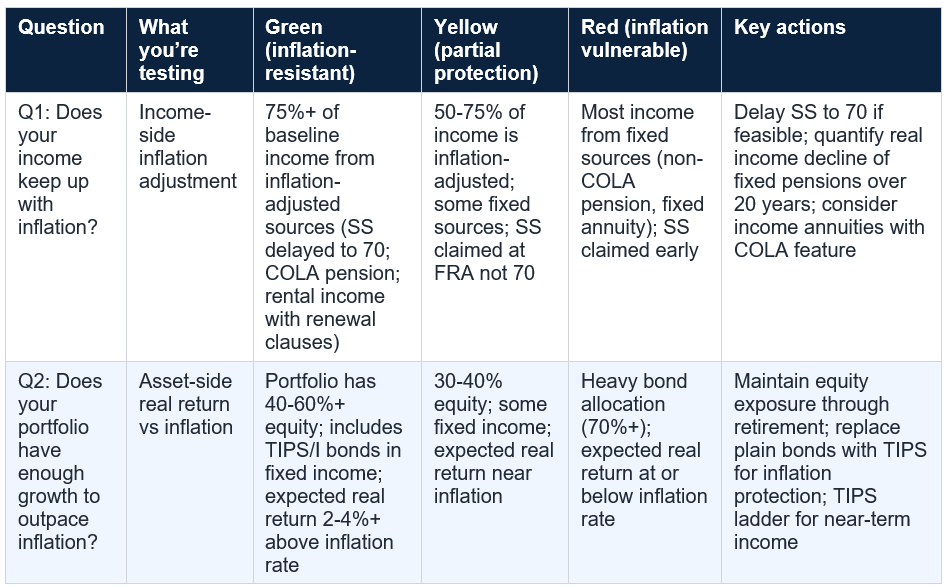
The numbers from 2026 make the urgency concrete. Social Security has lost 20% of its purchasing power since 2010. The 2026 COLA of 2.8% was nearly consumed by Medicare premium increases. Healthcare is inflating at more than twice the rate Social Security is growing. The 2.8% COLA won’t keep pace with four of the five biggest retiree expense categories. None of this happened suddenly — it has been the slow, consistent erosion that comes from a plan that assumed prices would stay roughly where they were.
The three questions in this article are not a complete retirement plan. They are a diagnostic. If you go through them and your current plan has vulnerabilities — an income base that is mostly fixed, a portfolio that is too conservatively positioned, a budget that uses general CPI for healthcare — those vulnerabilities are worth addressing now, when adjustments are still available and have the most time to compound in your favour. Inflation-proofing is not a one-time portfolio rebalancing. It is an ongoing commitment to ensuring your plan’s assumptions remain honest about what things actually cost. Not financial, investment, or tax advice. Consult a qualified fee-only financial adviser (CFP) and CPA for guidance specific to your situation.
According to The Senior Citizens League, a nonprofit advocacy group, Social Security benefits lost 20% of their purchasing power between 2010 and 2024. This happened despite annual COLA adjustments, because the COLAs were calculated using the CPI-W — a measure of urban wage earner spending patterns that underweights healthcare and housing, the two categories where retiree costs inflate fastest. In 2026, the COLA was 2.8%, but Medicare Part B premiums rose from $185 to $202.90 — a $17.90 increase that consumed nearly a third of the average retiree's $57.99 monthly COLA gain. Healthcare inflation is running at 5.8% annually (HealthView Services 2026), compared to an expected 2.4% average Social Security COLA growth — a 3.4 percentage point annual gap that compounds every year. Sources: The Senior Citizens League (Motley Fool July 2025; August 2025). 24/7 Wall St / AOL (2026 data). HealthView Services 2026 Retirement Healthcare Costs Data Report. Not financial advice.
Is it worth delaying Social Security to help fight inflation?
For most people who can afford to wait, yes — delaying Social Security is one of the most powerful individual actions for improving inflation resistance in retirement. Every year you delay past your Full Retirement Age (FRA, between 66-67 depending on birth year) increases your benefit by approximately 8% per year, up to age 70. A larger base benefit means a larger dollar COLA adjustment every subsequent year — because each year's COLA percentage is applied to a higher starting number. The break-even age (at which the cumulative higher benefit exceeds the cumulative foregone earlier benefits) is typically around age 78-80 for most individuals. Anyone who expects to live past 80 is likely better served financially by delaying. For married couples, delaying the higher earner's benefit to age 70 also maximises the survivor benefit. Sources: The Alpine Mountaineer December 2026 (Edward Jones); Baird Wealth May 2025; Oppenheimer 2024. Not financial advice. Consult a fee-only CFP for your specific earnings record calculation.
Should I really hold stocks in retirement to fight inflation?
Yes, according to multiple sources — with the important caveat that the equity allocation should be sized appropriately for your risk tolerance and income sources. Baird Wealth's May 2025 inflation-proofing guide explicitly states: 'If your risk tolerance allows it, consider holding a greater portion of your portfolio in stocks to take advantage of higher potential returns' and warns that shifting heavily into bonds 'can leave you defenseless against inflation.' The S&P 500 has historically averaged approximately 10% nominal annual return (~7% real after inflation), providing a meaningful buffer above long-run average inflation. The practical implementation for retirees is typically a bucket approach: keep 1-2 years of living expenses in cash/liquid assets for near-term needs, hold 3-10 years of needs in bonds/TIPS, and allow the remainder to stay in equities with a long runway to recover from drawdowns. Not financial advice. Consult a fee-only CFP for an allocation appropriate to your specific situation.
What are TIPS and how do they help against inflation in retirement?
Treasury Inflation-Protected Securities (TIPS) are US government bonds whose principal value is indexed to the Consumer Price Index (CPI). When inflation rises, the principal adjusts upward and your interest payments increase proportionally. Held to maturity, TIPS provide a government guarantee that this portion of your fixed income will at minimum keep up with CPI inflation — unlike regular bonds, whose fixed coupon payments lose real value during inflation. Oppenheimer's 2024 retirement inflation guide recommends building a 'TIPS ladder' — a series of TIPS maturing in successive years — to create a steady, inflation-adjusted income stream. Rick Ferri (Boglehead adviser) suggests 20% of fixed income in TIPS for retirees. I Bonds (separate from TIPS) offer complementary protection with an interest rate that adjusts every six months, but are limited to $10,000 annual purchases per person. Both TIPS and I Bonds are best used as the inflation-resistant component of your fixed-income allocation, complementing equities rather than replacing them. Sources: Oppenheimer 2024; Baird Wealth 2025; The Alpine Mountaineer December 2026; early-retirement.org forum discussion. Not financial advice. Consult a fee-only CFP.
How should I plan for healthcare inflation in retirement?
Healthcare costs for retirees are inflating at approximately 5.8% annually, according to HealthView Services' 2026 Retirement Healthcare Costs Data Report — more than double the average expected Social Security COLA growth of 2.4%. This means a healthcare budget that assumes general CPI growth will fall progressively further behind reality each year. Specific strategies: (1) Budget healthcare costs at 5.8% annual growth, not general CPI. (2) Fund a Health Savings Account (HSA) during working years if eligible — contributions are tax-deductible, growth is tax-free, and qualified medical expense withdrawals are tax-free. (3) Investigate Medigap or Medicare Advantage supplemental coverage to cap out-of-pocket Medicare costs, which have been rising significantly (Part B premiums rose 9.7% from 2025 to 2026). (4) Consider long-term care insurance or a hybrid life/LTC policy — the average nursing home semi-private room costs approximately $7,908/month and is not covered by Medicare. (5) Model the 2026 COLA/Medicare premium dynamic (78% offset per Nasdaq analysis) into your retirement income projections as an ongoing structural issue. Sources: HealthView Services 2026 (cited AOL/24/7 Wall St 2026); Nasdaq 2026; Genworth Cost of Care Survey. Not financial advice.
Table of Contents
- The Inflation Gap Nobody Warned You About
- Why Retirees Are Especially Vulnerable
- The Framework: Three Questions, One Retirement
- Question 1: Does Your Income Actually Keep Up With Inflation?
- The Social Security COLA Problem — In Plain Numbers
- The Most Powerful Income Move: Delaying Social Security
- Question 2: Does Your Portfolio Have Enough Growth to Outpace Inflation?
- The Bond-Heavy Portfolio Trap
- TIPS, I Bonds, and Inflation-Linked Assets
- Sequence of Returns Risk: The Inflation Multiplier
- Question 3: Have You Planned for the Costs Inflation Hits Hardest?
- The Healthcare Inflation Gap: 5.8% vs 2.4%
- The Three-Question Scorecard: Rate Your Retirement Plan
- Conclusion: Inflation-Proofing Is a Verb, Not a Setting
- Frequently Asked Questions
The Inflation Gap Nobody Warned You About
Most retirement plans are built around a simple question: will I have enough money? The more precise question — the one that retirement plans routinely fail to answer — is: will I have enough money that keeps its value? A dollar today and a dollar twenty years from now are not the same dollar. A retirement income that felt comfortable in the first year can feel pinched by year ten and genuinely difficult by year twenty, even if the nominal numbers haven’t changed much.The proof of this is not hypothetical. The Senior Citizens League, a nonprofit advocacy group that tracks Social Security and seniors’ finances, found that Social Security benefits lost 20% of their purchasing power between 2010 and 2024. The benefit checks got bigger every year through the annual COLA adjustments — and yet the purchasing power still declined, because the cost of the things retirees actually buy inflated faster than the COLA measured. The mechanism is simple: the COLA is calculated using the CPI-W, which measures the spending patterns of working people, not retirees. Retirees spend proportionally more on healthcare and housing, both of which have inflated faster than the overall CPI-W. So the raise doesn’t cover the price increase.
This article is structured around three questions that, together, diagnose whether a retirement plan is genuinely inflation-resistant or merely nominally funded. None of them requires a financial degree to answer. All of them are worth asking before a single month of retirement income is drawn. Not financial advice.
The inflation gap in real numbers (2026): Social Security 2026 COLA: 2.8% (confirmed, 24/7 Wall St / AOL 2026). Average monthly benefit 2026: $2,071. Average COLA increase: ~$57.99/month. Medicare Part B premium increase 2025→2026: $185→$202.90 (+$17.90). That $17.90 consumed nearly a third of the average $57.99 COLA increase. Higher Medicare Part B costs alone could offset roughly 78% of the 2.8% COLA for the average retiree. Healthcare inflation rate: 5.8%/year (HealthView Services 2026 Retirement Healthcare Costs Data Report). Expected average Social Security COLA long-term: 2.4%. The gap between healthcare inflation (5.8%) and Social Security growth (2.4%) widens by 3.4 percentage points every year. Sources: 24/7 Wall St/AOL 2026; Nasdaq 2026; HealthView Services 2026. Not financial advice.
Why Retirees Are Especially Vulnerable
Most workers have a built-in partial inflation hedge: their salary tends to rise over time, at least loosely tracking the cost of living. They can ask for a raise. They can change jobs. They can pick up extra work. Retirees cannot. Their income is broadly fixed — Social Security with its imperfect COLA, perhaps a pension (most private pensions have no COLA at all), and withdrawals from a portfolio that may or may not be positioned to grow faster than inflation.Clark.com’s analysis of inflation-proofing retirement describes retirees as facing ‘a perfect storm’ when it comes to inflation: fixed income, healthcare costs that inflate at double the general rate, and a spending pattern that the standard inflation measure doesn’t accurately capture. Unlike working people who might get cost-of-living raises, most retirees live on relatively fixed incomes with no mechanism for adjustment except the explicit COLA built into Social Security — which, as the numbers above show, is already losing the battle.
There is also something specific to retirement that makes inflation more dangerous than it is during working years: sequence of returns risk. If markets drop during the early years of retirement, you are forced to sell assets at depressed prices to fund living expenses. Inflation compounds this problem by forcing higher withdrawals during exactly the periods when portfolio values may be suppressed. The combination of inflation and a bear market in the early years of retirement can permanently damage a portfolio’s ability to sustain income across a 20-30 year horizon. Not financial advice.
The Framework: Three Questions, One Retirement
Inflation touches a retirement plan in three distinct places: the income side, the asset side, and the expense side. Most people intuitively think about the expense side — things getting more expensive. Far fewer think carefully about whether their income is growing fast enough to keep up, or whether their portfolio’s growth rate is structurally positioned to outpace inflation. A retirement plan that can answer all three of the following questions is genuinely inflation-resistant. A plan that struggles with even one of them has a structural vulnerability. Not financial advice.Question 1: Does your income actually keep up with inflation? (Question 1: the income test.) Your retirement income comes from some combination of Social Security, pensions, part-time work, rental income, and portfolio withdrawals. Which of these have automatic inflation adjustment built in? Which are fixed in nominal terms? How much of your baseline income comes from sources that will lose real value every year? This is the income-side inflation test.
Question 2: Does your portfolio have enough growth to outpace inflation? (Question 2: the asset test.) A portfolio that is too conservatively invested may produce stable nominal returns but declining real returns. A portfolio that is entirely in bonds during a period of above-average inflation can lose real purchasing power every year even as the bond coupons arrive on schedule. Is your asset allocation positioned to grow faster than inflation over the time horizon of your retirement? This is the asset-side inflation test.
Question 3: Have you planned specifically for the costs inflation hits hardest in retirement? (Question 3: the expense test.) Healthcare inflates at 5.8% per year according to HealthView Services’ 2026 data. Long-term care costs are not covered by Medicare. Housing costs have been rising above the COLA rate. Do you have a specific plan for these specific expense categories — or does your budget assume uniform inflation across all your spending? This is the expense-side inflation test. Not financial advice.
Question 1: Does Your Income Actually Keep Up With Inflation?
The income test starts with a simple audit. List every source of regular income you have or will have in retirement and ask one question about each: does this income adjust for inflation, and if so, how? Social Security has its COLA, which is imperfect but real. Some government and military pensions have COLA adjustments. Some annuities are indexed to inflation. Rental income can be adjusted when leases renew. Part-time work income can rise if you negotiate. Most private-sector pensions have no COLA whatsoever — the check you receive at 65 is the same nominal amount at 85, two decades of inflation later.The math of a fixed pension income over twenty years is sobering. If your pension pays $2,000 per month today and inflation averages 3% per year, that same $2,000 will have the purchasing power of approximately $1,107 in twenty years. The nominal check hasn’t changed. The real check has almost halved. If your retirement income is primarily from a fixed pension plus Social Security, you are running an income base that gets weaker in real terms every year — and that means your portfolio withdrawal rate must increase over time to maintain your lifestyle, which accelerates portfolio depletion.
The Oppenheimer 2024 retirement inflation analysis notes that maintaining a withdrawal burn rate below 3% of the portfolio while receiving Social Security significantly improves inflation survival for the overall retirement plan. The lower the withdrawal rate from the portfolio in the early years of retirement, the more the portfolio can grow and the better positioned it is to fund higher real withdrawals later when fixed-income purchasing power has eroded. Not financial advice.
Income inflation audit (takes 30 minutes): List every income source in retirement. For each one: (1) Is it adjusted for inflation? Yes/No/Partial. (2) At what rate? (SS COLA: historically avg 3.7%; pensions: usually 0%; rental income: depends on lease terms.) (3) How much of my total baseline income comes from inflation-adjusted sources vs fixed sources? If more than 60% of your baseline income is from fixed (non-inflation-adjusted) sources, your plan has an income-side inflation vulnerability that needs addressing. Not financial advice. Consult a fee-only CFP.
The Social Security COLA Problem — In Plain Numbers
The Social Security COLA is the only automatic inflation adjustment most retirees have, and understanding its specific limitations is essential for accurate retirement planning. The 2026 COLA is 2.8% — an increase from 2.5% in 2025 and significantly below the peak of 8.7% in 2023. For the average retiree receiving $2,071 per month, that 2.8% translates to approximately $57.99 more per month. Before celebrating: Medicare Part B premiums rose from $185 to $202.90 in the same year. That $17.90 increase consumed nearly a third of the $57.99 COLA increase.The Nasdaq analysis summarising the 2026 COLA situation is blunt: higher Medicare Part B costs alone could offset roughly 78% of the 2.8% COLA for the average retiree. The 2025 Social Security and Medicare Trustees Report found that Part B premiums rose by an average of 11.6% in 2026. So the COLA rises 2.8% and a key expense rises 11.6%. This is the structural problem described by The Senior Citizens League: the 20% purchasing power loss since 2010 is not from COLA being zero — it is from COLA consistently being smaller than the inflation that retirees actually experience.
The deeper structural flaw is the CPI-W metric. This index measures the spending of urban wage earners and clerical workers — working-age people who spend relatively less on healthcare and housing than retirees. Using the CPI-W to calibrate a raise for people whose spending is dominated by healthcare and housing means the measurement is structurally biased against accurately reflecting retiree inflation. The CPI-E, an alternative measure that weights retiree spending patterns, has historically been higher. Motley Fool’s July 2025 analysis confirms: housing prices rose 3.9% and medical care prices increased 2.8% through the first six months of 2025 — both above the CPI-W reading. Not financial advice.
The Most Powerful Income Move: Delaying Social Security
If the COLA problem is that Social Security income grows more slowly than the costs it is meant to cover, the most powerful tool to partially offset this is delaying when you claim Social Security. Every year you delay past your Full Retirement Age (FRA, currently between 66 and 67 depending on birth year) increases your benefit by approximately 8% per year, up to age 70. A benefit that would be $2,071 per month at FRA becomes approximately $2,590 per month at age 70 — a 25% higher base amount that every subsequent COLA is then applied to.The Alpine Mountaineer’s December 2026 summary of inflation-fighting strategies for retirees is direct: ‘You can start collecting Social Security benefits at 62, but your monthly checks will be much bigger if you wait until your full retirement age, likely between 66 and 67. Of course, if you need the money to help support your retirement, you may not be able to afford to wait, but if you can, your bigger checks can be a big help against inflation.’ The Baird Wealth inflation-proofing guide (May 2025) also lists delaying Social Security as a core strategy.
The compounding effect of a higher base amount is significant over a long retirement. If your benefit is $500 higher per month at age 70 than it would have been at 65, and you live to 90, that $500 difference compounds through 25 years of COLA adjustments. The absolute dollar difference grows every year. The break-even point for delaying (at which the total lifetime benefits of the delayed, higher benefit exceed those of the earlier, lower benefit) is typically around age 78-80 — meaning anyone who expects to live past 80 is likely better off financially by delaying. Not financial advice. Consult a CFP who can run the specific calculation for your earnings record.
Delay Social Security if you can afford to: the 8% per year increase in benefits for each year past FRA (up to age 70) is effectively a guaranteed, risk-free 8% return on deferred income — substantially higher than most bond returns. It also creates a permanently larger base for every future COLA to be applied to. For married couples, delaying the higher earner's benefit to 70 maximises the survivor benefit. The break-even age is typically 78-80. Sources: The Alpine Mountaineer December 2026; Baird Wealth May 2025; Oppenheimer 2024. Not financial advice. Consult a fee-only CFP for your specific calculation.
Question 2: Does Your Portfolio Have Enough Growth to Outpace Inflation?
The asset test is about the growth engine inside your retirement portfolio. An income of $50,000 per year from a portfolio that earns 5% nominally in a 3% inflation environment produces a real return of 2% — enough to maintain purchasing power, provided withdrawals are calibrated carefully. An income of $50,000 per year from a portfolio that earns 2% nominally in a 3% inflation environment is producing a negative real return every year. The portfolio is shrinking in real terms even if the nominal balance is roughly stable.Baird Wealth’s May 2025 inflation-proofing guide makes the equity argument directly: ‘Stocks offer higher potential returns, which can help your portfolio outpace the rate of inflation. If your risk tolerance allows it, consider holding a greater portion of your portfolio in stocks to take advantage of higher potential returns.’ The historical long-run equity return of approximately 10% nominal (7% real after inflation) means that a portfolio with meaningful equity exposure has a built-in inflation buffer that bonds alone cannot replicate. Baird also warns explicitly about the bond trap.
The challenge is the emotional reality of holding equities in retirement. When a 30% market drawdown hits, a working person can wait it out. A retiree who needs $5,000 per month to live must sell assets at depressed prices, which crystallises the loss and permanently reduces the portfolio’s recovery capacity. The solution is not to avoid equities but to structure the portfolio so that near-term income needs are covered by stable assets (cash, short-term bonds) while long-term growth assets (equities) are given time to recover. The bucket strategy is the most commonly cited implementation of this approach. Not financial advice.
The Bond-Heavy Portfolio Trap
The conventional wisdom about retirement investing goes something like this: as you get older, shift more of your portfolio into bonds to reduce volatility. The rule of thumb version is ‘your age in bonds’ — a 70-year-old should hold 70% bonds, 30% equities. This advice is intuitive. It is also, in inflationary environments, potentially very damaging.Baird Wealth’s May 2025 inflation-proofing article states this plainly: ‘Many financial advisors suggest that retirees should shift heavily into bonds as they age, but this approach can leave you defenseless against inflation.’ Clark.com’s retirement inflation analysis echoes it. A bond portfolio in an inflationary environment loses real value every year the inflation rate exceeds the bond yield. A retiree with 80% of their portfolio in bonds at 4% yield in an environment where inflation is running at 4.5% is experiencing negative real returns on most of their portfolio — which means every withdrawal further accelerates the real depletion.
The reframe: the goal is not to minimise portfolio volatility. The goal is to maintain purchasing power and income security across a 20-30 year horizon. These are related but different objectives. A moderate equity allocation (40-60% depending on risk tolerance, time horizon, and income sources) maintained through retirement is typically more inflation-resistant than a heavily bond-weighted portfolio, even though it introduces more short-term price volatility. Not financial advice. Consult a CFP for an allocation appropriate to your specific situation.
The bond-heavy retirement trap: bonds have two inflation vulnerabilities. (1) Fixed coupon payments that don’t adjust for inflation mean the real value of each payment declines every year inflation persists. (2) Rising interest rates (a response to inflation) push existing bond prices down. The 2022 bond market saw the worst single-year bond returns in decades coinciding with peak inflation — exactly the wrong combination for a bond-heavy retiree portfolio. Baird Wealth (May 2025): 'This approach can leave you defenseless against inflation.' Source: Baird Wealth May 2025; Clark.com. Not financial advice.
TIPS, I Bonds, and Inflation-Linked Assets
If equities provide the growth needed to outpace inflation but bonds leave you defenseless against it, what is the inflation-conscious alternative to traditional bonds? The answer most commonly cited by both academic and practitioner sources: Treasury Inflation-Protected Securities (TIPS) and I Bonds as a component of the fixed-income allocation.TIPS are US government bonds whose principal value is indexed to the Consumer Price Index (CPI). When inflation rises, the principal adjusts upward, and your interest payments increase accordingly. Held to maturity, they are essentially a government guarantee that this portion of your fixed income will at minimum keep up with CPI inflation. Baird Wealth’s 2025 guide lists TIPS as a core inflation-proofing tool; Oppenheimer’s 2024 retirement inflation guide describes building a TIPS ladder — a series of TIPS maturing in successive years — as a way to create ‘a steady, inflation-adjusted income stream.’ Noted Boglehead adviser Rick Ferri recommends retirees hold 20% of their fixed-income allocation in TIPS.
I Bonds offer complementary protection: their interest rate adjusts every six months based on the CPI, which means they automatically reflect current inflation. The major limitation is the $10,000 annual purchase limit per person, which prevents them from being a large portfolio anchor. The Alpine Mountaineer’s December 2026 summary calls them ‘a nice piece of an inflation strategy, but they can’t anchor an entire retirement plan.’ Both TIPS and I Bonds are best understood as the inflation-resistant component of your fixed-income allocation, complementing rather than replacing equities as the primary growth and inflation-beating engine. Not financial advice.
Sequence of Returns Risk: The Inflation Multiplier
Sequence of returns risk describes a specific danger unique to the withdrawal phase of retirement: the order in which investment returns occur matters, not just the average. If a portfolio suffers significant losses in the first years of retirement, the retiree must sell a larger number of shares at depressed prices to fund each year’s withdrawals. This permanently reduces the number of shares available to participate in the eventual recovery, meaning the portfolio may never fully recover even if markets return to their long-run average.Inflation multiplies this risk. In an inflationary period, the living expenses that force the withdrawal are higher, while the portfolio may be experiencing lower real (and potentially nominal) returns. The 2022 environment — elevated inflation combined with a significant equity market drawdown and the worst bond returns in decades — was a perfect example of sequence of returns risk amplified by inflation. A retiree who entered 2022 with a balanced portfolio and began regular withdrawals experienced both the price impact (living expenses rising) and the asset impact (portfolio value falling) simultaneously.
The most effective mitigations for sequence risk: holding 1-2 years of living expenses in cash or highly liquid assets so you do not have to sell long-term assets during a drawdown; maintaining a TIPS or short-term bond ladder that provides inflation-adjusted income for the near term while equities recover; and keeping overall withdrawal rates conservative (below 4%) in the early years of retirement to preserve portfolio mass. Clark.com’s analysis calls sequence of returns risk something that ‘can devastate retirement plans during inflationary periods.’ Not financial advice.
Question 3: Have You Planned for the Costs Inflation Hits Hardest?
The expense test is the most specific and often the most neglected of the three. General inflation is a problem for every retiree. But certain expense categories inflate far faster than the general CPI, and they are disproportionately the categories that retirees depend on most. If your retirement budget assumes uniform inflation across all your spending, you are underestimating the real cost of the things that matter most.According to Vision Retirement’s analysis cited by Nasdaq and GOBankingRates, the five biggest expense categories for most retirees are housing, healthcare, transportation, food, and utilities. The 2026 COLA of 2.8% does not keep pace with four of the five. Housing inflation ran at 3.9% through the first half of 2025. Healthcare at 5.8% annually per HealthView Services. Transportation and food prices have shown elevated volatility. Only utilities are anywhere near COLA-parity.
The retirement budget that plans for these specific inflation differentials — rather than assuming the overall CPI covers everything — is the one that avoids the ‘golden years don’t feel so golden’ problem that Clark.com’s inflation article describes. The retiree who budgets 3% annual increase for healthcare and experiences 5.8% is building a gap of 2.8 percentage points every year, compounding over 20 years into a significant shortfall relative to what they had planned. Not financial advice.
The Healthcare Inflation Gap: 5.8% vs 2.4%
HealthView Services’ 2026 Retirement Healthcare Costs Data Report is the source that puts the sharpest point on the healthcare inflation problem. For a 65-year-old couple retiring in 2026 with average healthcare expenditures, healthcare costs are expected to inflate at 5.8% annually over the course of their retirement. Social Security benefits, which are the primary income source for most retirees, are expected to increase by only around 2.4% on average over the same period.The gap — 3.4 percentage points per year — compounds relentlessly. In year one, the difference on a $15,000 annual healthcare spend is $510. By year ten, with healthcare inflating at 5.8% and the income covering it growing at 2.4%, the annual gap is roughly $4,400. Over a twenty-year retirement, the cumulative uncovered healthcare cost growth reaches tens of thousands of dollars for the average couple. This is not a dramatic scenario. It is the baseline.
The solutions are specific: a Health Savings Account (HSA) if you are still working and eligible, which allows tax-free saving specifically for healthcare costs; long-term care insurance or a hybrid life/LTC policy, which addresses the largest single uncovered healthcare cost (nursing home care averages approximately $7,908 per month for a semi-private room); Medigap or Medicare Advantage supplemental coverage to cap out-of-pocket Medicare costs; and a specific healthcare inflation line item in your retirement budget that uses 5-6% annual growth rather than general CPI. Not financial advice.
HealthView Services 2026 Retirement Healthcare Costs Data Report (cited 24/7 Wall St / AOL 2026): for a 65-year-old couple retiring in 2026 with average healthcare expenditures, healthcare costs are expected to inflate at 5.8% per year. Social Security benefits are only expected to increase by around 2.4% on average during that couple's retirement. The gap: 3.4 percentage points every year, compounding. This is not an edge case. This is the median retired American household. Not financial advice.
The Three-Question Scorecard: Rate Your Retirement Plan
Conclusion
Nobody can fully inflation-proof a retirement plan. Clark.com says it directly: ‘There’s no such thing as a perfect inflation hedge for retirees.’ What you can do is build a plan that addresses each of the three dimensions where inflation does its damage: the income side, the asset side, and the expense side. A plan that delays Social Security to maximise the base for future COLA increases. A plan that maintains meaningful equity exposure to provide the long-run real return that bonds cannot. A plan that accounts for healthcare and housing inflation at their actual rates rather than the general CPI.The numbers from 2026 make the urgency concrete. Social Security has lost 20% of its purchasing power since 2010. The 2026 COLA of 2.8% was nearly consumed by Medicare premium increases. Healthcare is inflating at more than twice the rate Social Security is growing. The 2.8% COLA won’t keep pace with four of the five biggest retiree expense categories. None of this happened suddenly — it has been the slow, consistent erosion that comes from a plan that assumed prices would stay roughly where they were.
The three questions in this article are not a complete retirement plan. They are a diagnostic. If you go through them and your current plan has vulnerabilities — an income base that is mostly fixed, a portfolio that is too conservatively positioned, a budget that uses general CPI for healthcare — those vulnerabilities are worth addressing now, when adjustments are still available and have the most time to compound in your favour. Inflation-proofing is not a one-time portfolio rebalancing. It is an ongoing commitment to ensuring your plan’s assumptions remain honest about what things actually cost. Not financial, investment, or tax advice. Consult a qualified fee-only financial adviser (CFP) and CPA for guidance specific to your situation.
Frequently Asked Questions
How much purchasing power has Social Security actually lost to inflation?According to The Senior Citizens League, a nonprofit advocacy group, Social Security benefits lost 20% of their purchasing power between 2010 and 2024. This happened despite annual COLA adjustments, because the COLAs were calculated using the CPI-W — a measure of urban wage earner spending patterns that underweights healthcare and housing, the two categories where retiree costs inflate fastest. In 2026, the COLA was 2.8%, but Medicare Part B premiums rose from $185 to $202.90 — a $17.90 increase that consumed nearly a third of the average retiree's $57.99 monthly COLA gain. Healthcare inflation is running at 5.8% annually (HealthView Services 2026), compared to an expected 2.4% average Social Security COLA growth — a 3.4 percentage point annual gap that compounds every year. Sources: The Senior Citizens League (Motley Fool July 2025; August 2025). 24/7 Wall St / AOL (2026 data). HealthView Services 2026 Retirement Healthcare Costs Data Report. Not financial advice.
Is it worth delaying Social Security to help fight inflation?
For most people who can afford to wait, yes — delaying Social Security is one of the most powerful individual actions for improving inflation resistance in retirement. Every year you delay past your Full Retirement Age (FRA, between 66-67 depending on birth year) increases your benefit by approximately 8% per year, up to age 70. A larger base benefit means a larger dollar COLA adjustment every subsequent year — because each year's COLA percentage is applied to a higher starting number. The break-even age (at which the cumulative higher benefit exceeds the cumulative foregone earlier benefits) is typically around age 78-80 for most individuals. Anyone who expects to live past 80 is likely better served financially by delaying. For married couples, delaying the higher earner's benefit to age 70 also maximises the survivor benefit. Sources: The Alpine Mountaineer December 2026 (Edward Jones); Baird Wealth May 2025; Oppenheimer 2024. Not financial advice. Consult a fee-only CFP for your specific earnings record calculation.
Should I really hold stocks in retirement to fight inflation?
Yes, according to multiple sources — with the important caveat that the equity allocation should be sized appropriately for your risk tolerance and income sources. Baird Wealth's May 2025 inflation-proofing guide explicitly states: 'If your risk tolerance allows it, consider holding a greater portion of your portfolio in stocks to take advantage of higher potential returns' and warns that shifting heavily into bonds 'can leave you defenseless against inflation.' The S&P 500 has historically averaged approximately 10% nominal annual return (~7% real after inflation), providing a meaningful buffer above long-run average inflation. The practical implementation for retirees is typically a bucket approach: keep 1-2 years of living expenses in cash/liquid assets for near-term needs, hold 3-10 years of needs in bonds/TIPS, and allow the remainder to stay in equities with a long runway to recover from drawdowns. Not financial advice. Consult a fee-only CFP for an allocation appropriate to your specific situation.
What are TIPS and how do they help against inflation in retirement?
Treasury Inflation-Protected Securities (TIPS) are US government bonds whose principal value is indexed to the Consumer Price Index (CPI). When inflation rises, the principal adjusts upward and your interest payments increase proportionally. Held to maturity, TIPS provide a government guarantee that this portion of your fixed income will at minimum keep up with CPI inflation — unlike regular bonds, whose fixed coupon payments lose real value during inflation. Oppenheimer's 2024 retirement inflation guide recommends building a 'TIPS ladder' — a series of TIPS maturing in successive years — to create a steady, inflation-adjusted income stream. Rick Ferri (Boglehead adviser) suggests 20% of fixed income in TIPS for retirees. I Bonds (separate from TIPS) offer complementary protection with an interest rate that adjusts every six months, but are limited to $10,000 annual purchases per person. Both TIPS and I Bonds are best used as the inflation-resistant component of your fixed-income allocation, complementing equities rather than replacing them. Sources: Oppenheimer 2024; Baird Wealth 2025; The Alpine Mountaineer December 2026; early-retirement.org forum discussion. Not financial advice. Consult a fee-only CFP.
How should I plan for healthcare inflation in retirement?
Healthcare costs for retirees are inflating at approximately 5.8% annually, according to HealthView Services' 2026 Retirement Healthcare Costs Data Report — more than double the average expected Social Security COLA growth of 2.4%. This means a healthcare budget that assumes general CPI growth will fall progressively further behind reality each year. Specific strategies: (1) Budget healthcare costs at 5.8% annual growth, not general CPI. (2) Fund a Health Savings Account (HSA) during working years if eligible — contributions are tax-deductible, growth is tax-free, and qualified medical expense withdrawals are tax-free. (3) Investigate Medigap or Medicare Advantage supplemental coverage to cap out-of-pocket Medicare costs, which have been rising significantly (Part B premiums rose 9.7% from 2025 to 2026). (4) Consider long-term care insurance or a hybrid life/LTC policy — the average nursing home semi-private room costs approximately $7,908/month and is not covered by Medicare. (5) Model the 2026 COLA/Medicare premium dynamic (78% offset per Nasdaq analysis) into your retirement income projections as an ongoing structural issue. Sources: HealthView Services 2026 (cited AOL/24/7 Wall St 2026); Nasdaq 2026; Genworth Cost of Care Survey. Not financial advice.
555
555