

Retirement
The Rule of 240 Paychecks: How to Pay Yourself in Retirement

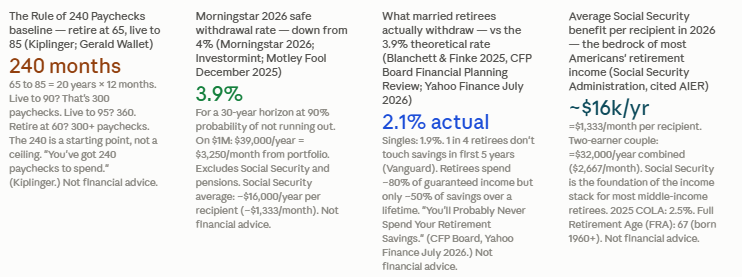
Retire at 65, live to 85, and you have exactly 240 monthly paychecks to fund your retirement. That’s the Rule of 240 Paychecks — a deceptively simple mental model that turns the abstract challenge of retirement income into a concrete, manageable question: how much does each of those 240 monthly cheques need to be, where does the money come from, and how do you make sure it lasts? In 2026, Morningstar revised the safe withdrawal rate from 4% to 3.9%. Real retirees are only drawing 2.1% on average. And 1 in 4 retirees doesn’t touch their portfolio at all in the first five years. The math of retirement income is not what most people think. This article unpacks it — paycheck by paycheck. Not financial advice.
Popularised by Kiplinger’s retirement planning coverage, the rule is elegantly simple: retire at 65, plan to live to approximately 85, and you have 20 years times 12 months, which equals 240 monthly paychecks to fund. ‘You’ve got 240 paychecks to spend.’ That is the entire framework. Not a complex model, not a portfolio allocation strategy, not a tax optimisation scheme — just a number. 240 monthly paychecks. And the question becomes: how much does each one need to be, where does it come from, and how do you make sure the 240th paycheck arrives as reliably as the first?
As David Rosenstrock, Director of Financial Planning and Investments at Wharton Wealth Planning, puts it via Kiplinger: ‘How much you want to spend in retirement is one of the biggest factors driving how much you need for a secure retirement.’ The rule is not primarily a savings target. It is a spending framework. Not financial advice.
The Rule of 240 Paychecks in full: Retire at 65 + Plan to live to 85 = 20 years × 12 months = 240 monthly retirement paychecks. The rule reframes retirement income planning from the abstract ('I need $X saved') to the concrete ('I need $X per month for 240 months'). Key variable: the monthly withdrawal amount. Key challenge: making the 240th paycheck as secure as the 1st. Source: Kiplinger Retirement Tips; Gerald Wallet. Not financial advice.
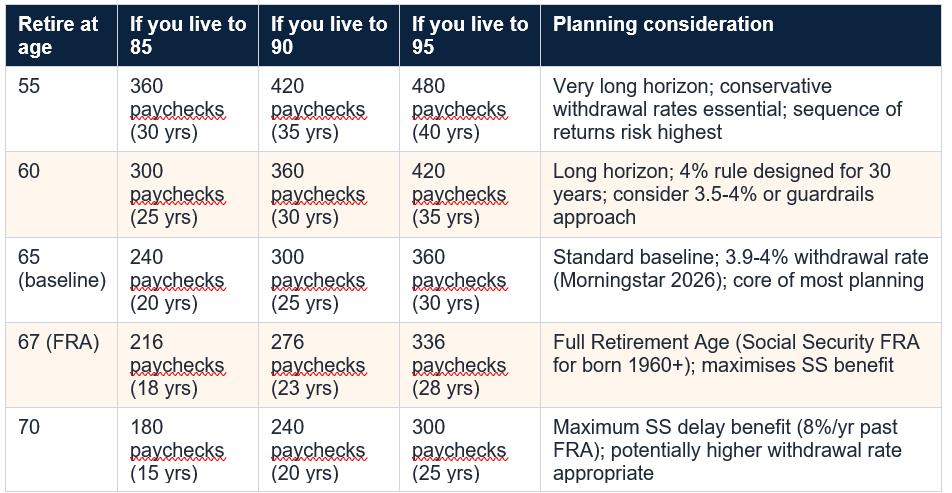
Longevity is the first pressure point. Today’s 65-year-olds have a roughly 50% chance of living past 85, and a meaningful probability of reaching 90 or beyond. Modern medicine and increasing longevity mean that a retirement built on 20-year assumptions may run 25, 30, or even 35 years. The Drip Trickle Flow Flood podcast noted that 240 is ‘both a helpful benchmark and wildly outdated’ in the context of modern life expectancy. A 65-year-old who lives to 95 needs 360 monthly paychecks, not 240. That is 50% more income than the baseline rule implies.
Retirement timing is the second variable. Retire at 60 and expect to live to 85? That is 300 paychecks. Retire at 55 with a 35-year horizon? 420 paychecks. Retire at 70 and expect a 15-year retirement? 180 paychecks — and potentially higher withdrawal rates are appropriate because you have fewer years to cover. The 240 number is the starting point, not the finish line. Your personal version of the rule requires your own life expectancy estimate, your planned retirement age, and your honest assessment of longevity in your family. Not financial advice.
The psychological shift is substantial. During the accumulation phase, every contribution is a positive reinforcement: the number goes up. During the distribution phase, every withdrawal is a negative: the number goes down. This transition from accumulation to decumulation is one of the most psychologically difficult aspects of retirement, and research consistently shows that retirees systematically underspend relative to what their financial situation would sustainably support (more on this in Section 10).
The mechanics of creating a monthly paycheck from a portfolio involve three core decisions: how much to withdraw each month (the withdrawal rate), which accounts to draw from first (the withdrawal sequence), and how to maintain the principal long enough to fund all 240 paychecks without depletion. Each of these decisions has significant financial consequences. Not financial advice.
In 2026, Morningstar revised the starting safe withdrawal rate downward to 3.9% for a 30-year retirement horizon with a 90% probability of not running out of money. The Motley Fool (December 2025) and Investormint (2026) both confirmed this figure. Three factors explain the downward pressure: higher current equity valuations (reducing expected future returns), lower expected bond yields, and longer retirements. The practical impact is modest on an annual basis: on a $500,000 portfolio, the difference between 4% and 3.9% is $500 per year. On $1 million, it is $1,000. Not headline-grabbing — but meaningful compounded across 30 years.
Critically: Morningstar’s 3.9% baseline excludes Social Security, pensions, annuities, and any other non-portfolio income. For the majority of retirees who receive Social Security, the effective portfolio withdrawal rate needs to be much lower because Social Security is already covering part of their income needs. Investormint (2026) gives the example: a couple with a $1 million portfolio withdrawing 3.9% ($39,000/year) plus $28,000 in combined Social Security has $67,000 in annual household income. Not financial advice.
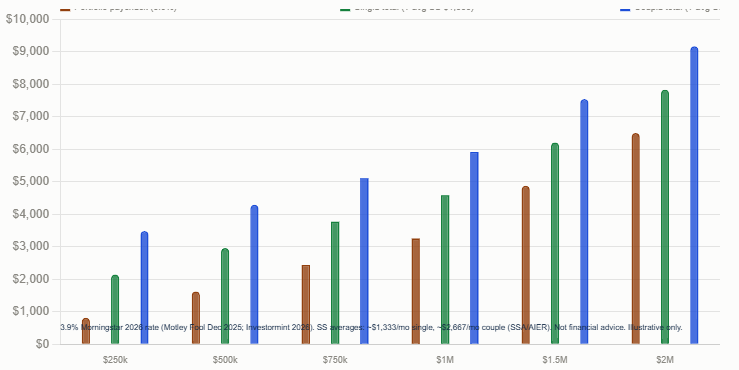
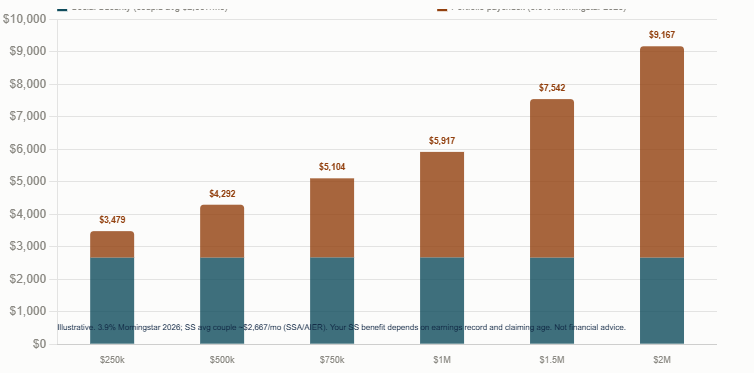
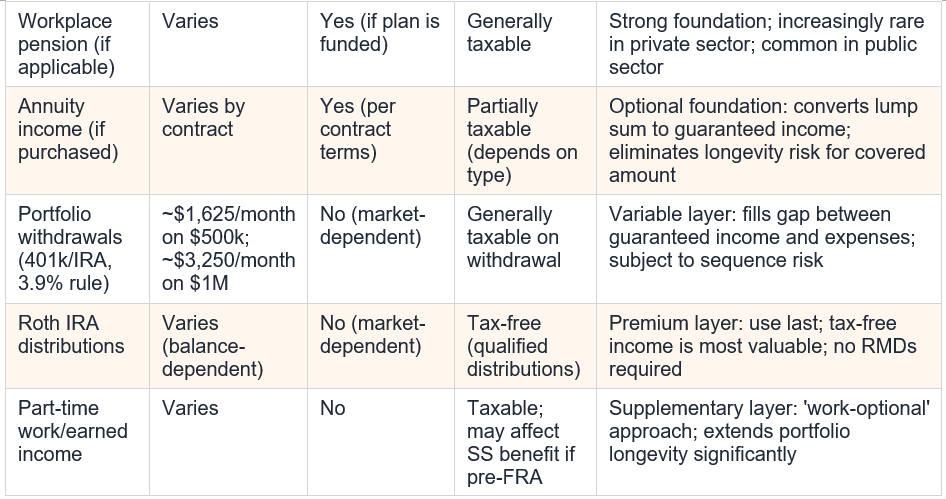
The 3.9% paycheck calculator (illustrative, October 2026): $250,000 portfolio: 3.9% = $9,750/year = $812.50/month portfolio paycheck. $500,000: 3.9% = $19,500/year = $1,625/month. $750,000: 3.9% = $29,250/year = $2,437.50/month. $1,000,000: 3.9% = $39,000/year = $3,250/month. $1,500,000: 3.9% = $58,500/year = $4,875/month. ADD: Social Security (average ~$1,333/month per recipient in 2026; ~$2,667/month combined couple). These portfolio paychecks are supplemented by, not replaced by, Social Security. Source: Morningstar 2026 (Investormint; Motley Fool December 2025). Not financial advice. Illustrative only.
Even more striking: Vanguard data shows that one in four retirees does not touch their savings at all during the first five years after leaving work. The same research found that retirees spend about 80% of their guaranteed income — Social Security, pensions — but only about half of their retirement savings over a lifetime. Many retirees die with significant assets remaining. The CFP Board’s July 2026 headline, citing the study, put it directly: ‘You’ll Probably Never Spend Your Retirement Savings.’
The explanation has two parts. First, most middle-income retirees have Social Security covering the majority of their core expenses, meaning portfolio withdrawals are supplemental rather than primary. The median retiree Vanguard 401(k) balance at retirement is $133,000 — at 4%, that generates just $5,300 a year, a figure that only makes sense as a supplement to Social Security’s $16,000 per year average. Second: fear of longevity (outliving your money) causes systematic underspending even when the assets are sufficient. This is the underspending paradox addressed in Section 10. Not financial advice.
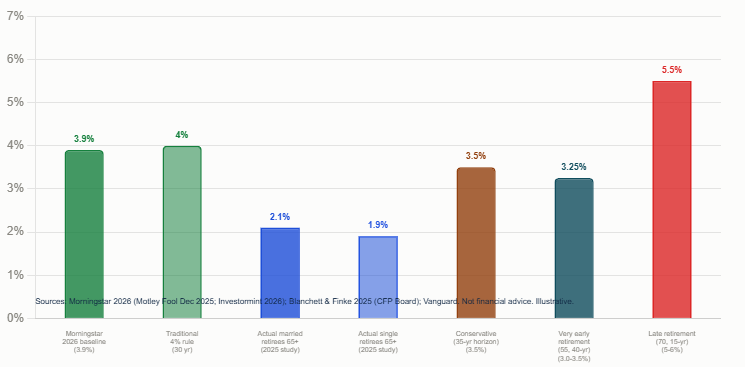
Actual retiree withdrawal rates (2025-2026 research): married 65-year-olds: 2.1% average annual withdrawal. Single 65-year-olds: 1.9%. Vanguard: 1 in 4 retirees don't touch savings in first 5 years. Retirees spend ~80% of guaranteed income but only ~50% of retirement savings. Median Vanguard 401(k) at retirement: $133,000 (generates ~$5,300/year at 4%). Average Social Security per recipient: ~$16,000/year (~$1,333/month). Theoretical safe rate (Morningstar 2026): 3.9%. GAP between theoretical (3.9%) and actual (2.1%): most retirees leave significant money on the table. Sources: Blanchett and Finke (2025) Financial Planning Review; Vanguard data; Yahoo Finance/CFP Board July 2026.
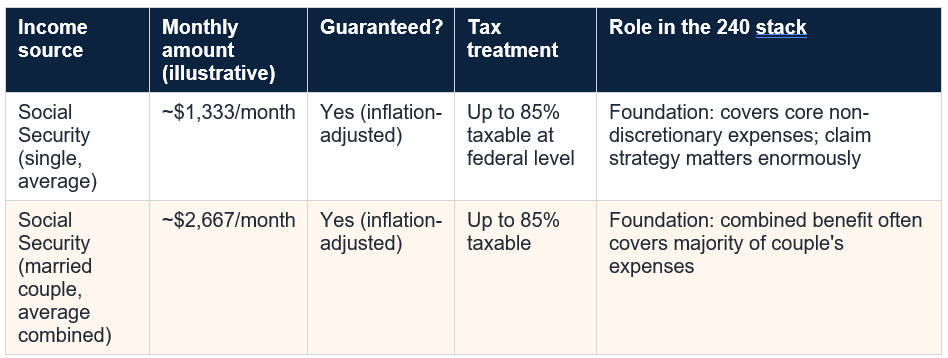
The bedrock of the stack for most Americans is Social Security. At approximately $16,000 per year per recipient ($1,333/month) for the average retiree in 2026, Social Security alone covers a substantial portion of core living expenses for many households. A two-earner couple receives approximately $32,000 per year combined. Delaying Social Security to age 70 adds approximately 8% per year past Full Retirement Age (67 for those born in 1960 or later), potentially increasing monthly benefits by 24% over claiming at 67. This is one of the most powerful available financial planning moves for most retirees.
Above Social Security, the income stack adds: any workplace pension (a declining but still significant source for public sector workers and long-tenure private sector employees); 401(k)/IRA portfolio withdrawals at the 3.9% rate; Roth IRA tax-free distributions; annuity income if an annuity has been purchased; and potentially investment income from taxable accounts, dividends, interest, or part-time work. The goal is to structure the stack so that the most secure sources (Social Security, pensions, annuities) cover the non-negotiable expenses, and the portfolio withdrawals cover the discretionary spending — because the portfolio is the component most susceptible to market and sequence-of-returns risk. Not financial advice.
Early retirement (ages 65–72, before Required Minimum Distributions begin at age 73) is often a window of unusually low taxable income. Social Security is not yet fully taxable, pension income may not yet have started, and portfolio withdrawals are at your discretion. This is the ideal window for Roth conversions: converting traditional IRA and 401(k) balances to Roth
IRAs at a low tax rate, paying tax now on amounts that would otherwise face RMD-driven taxation later at potentially higher rates. The converted funds then grow and withdraw tax-free.
The compound value of Roth conversions in the low-income early retirement window is one of the most powerful and least discussed tools in retirement planning. An advisor (CFP or tax professional) can model the specific break-even point for conversions given projected future income, RMD amounts, and applicable tax brackets. The 240 Paycheck framework makes this timing explicit: the low-income paychecks of early retirement (ages 65–72) are the conversion window; the high-income paychecks of later retirement (RMDs, peak Social Security) are the tax headache you are proactively avoiding. Not financial or tax advice.
Tax planning actions for your 240 paychecks: (1) Map your expected income by year from age 65 to 85, noting when Social Security starts, when pension starts, when RMDs begin (age 73). (2) Identify the low-income years (often ages 65-72) as your Roth conversion window. (3) Model the tax cost of converting amounts that keep you within the 12% or 22% federal bracket annually. (4) Consider the withdrawal sequence strategy (Section 8). (5) Consult a CFP or CPA -- this is one of the highest-value advisory conversations available in early retirement. Not tax or financial advice.
Stage one: draw from taxable accounts first (regular brokerage accounts, savings, CDs). These accounts have already been partially or fully taxed and draw them down first reduces the tax drag on your overall portfolio. The assets remaining in tax-advantaged accounts (IRAs, 401(k)s) continue to compound tax-deferred. Stage two: draw from tax-deferred accounts (traditional 401(k), traditional IRA). These distributions are fully taxable as ordinary income. However, by the time you reach this stage (typically after exhausting taxable accounts), you may be in a lower tax bracket. Stage three: draw from tax-free accounts last (Roth IRA, Roth 401(k)). These are your most valuable assets because every dollar withdrawn is tax-free. Preserving them as long as possible maximises their benefit.
Required Minimum Distributions (RMDs) complicate this sequence: at age 73 (under current SECURE 2.0 rules), the IRS requires minimum annual withdrawals from traditional 401(k)s and IRAs, regardless of whether you need the income. This is why the early-retirement Roth conversion window (Section 7) is so valuable: reducing the balance subject to RMDs reduces the forced taxable income in later retirement. Not financial or tax advice; consult a qualified adviser.
RMD risk: if you have significant traditional 401k/IRA assets and haven't done Roth conversions, your RMDs at age 73 may push you into a higher tax bracket than expected, potentially increasing tax on Social Security benefits, Medicare IRMAA surcharges, and other income-tested thresholds. This is a well-documented retirement tax trap. Planning before age 65 is far more effective than responding to it at 73. Consult a CFP or CPA for personalised RMD and Roth conversion modelling. Not tax advice.
The responses to longevity risk are well-established. Annuitisation: converting a portion of the portfolio into a guaranteed lifetime annuity eliminates longevity risk for the covered amount by shifting the risk of living longer than expected to an insurance company. The guaranteed income floor (Social Security plus annuity) covers non-discretionary expenses regardless of how long you live. Flexible withdrawal rates: guardrails strategies (reducing withdrawals in down markets, increasing in up markets) can extend portfolio longevity substantially beyond a fixed-rate approach. Maintaining growth investments: keeping a meaningful equity allocation throughout retirement provides returns that outpace inflation and fund longer retirements, at the cost of volatility.
The most powerful single move for longevity risk remains Social Security delay. Each year you delay claiming Social Security past Full Retirement Age (67) increases your monthly benefit by approximately 8%, up to age 70. A retiree who delays from 67 to 70 receives approximately 24% higher monthly Social Security benefits for life, inflation-adjusted. Since Social Security is guaranteed for life regardless of how long you live, the delayed benefit provides the most longevity insurance of any available action. Not financial advice; consult a CFP for personalised Social Security claiming strategy.
Kiplinger identifies the psychological dimension directly: ‘Which raises the real question: What will you do with your 240 paychecks?’ The rule is not just a reminder to plan for enough income. It is a reminder that the income exists to be used — that 240 paychecks are 240 opportunities to live the retirement you saved for, not 240 months of anxious watching a spreadsheet.
The underspending paradox has real costs. Retirees who systematically underspend relative to their resources forgo experiences, time with family, travel, and pursuits that cannot be recovered later when health or mobility may be more limited. The early years of retirement — the ‘go-go years’ before health slows activity — are the highest-value spending years. A retiree with a $1 million portfolio who withdraws 2.1% ($21,000/year) instead of the sustainable 3.9% ($39,000/year) is leaving $18,000 per year unspent that could fund meaningful experiences, family time, or charitable giving. Not financial advice. The appropriate withdrawal rate depends on individual circumstances.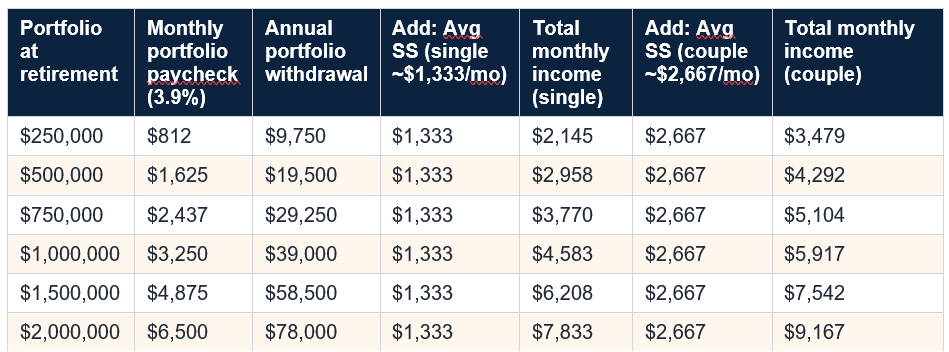
Notes: 3.9% Morningstar 2026 safe withdrawal rate (Morningstar; Motley Fool December 2025; Investormint 2026). Social Security figures are approximate average benefits; your actual benefit depends on your earnings record and claiming age. Table shows first-year withdrawal only; amounts adjust annually for inflation. Total income pre-tax; after-tax amount depends on tax situation. Not a recommendation to take any specific withdrawal rate. Consult a CFP. Not financial advice.
The data is clear. Morningstar says 3.9% is the safe starting withdrawal rate in 2026. Real retirees are only taking 2.1%. One in four doesn’t touch their savings at all for the first five years. The underspending paradox is real and has real human costs. The Rule of 240 Paychecks exists not just to prevent running out of money — it exists to prevent running out of retirement.
Your 240 paychecks — or 300, or 360, depending on your longevity plan — represent 20 to 30 years of deliberate, meaningful retirement living. The withdrawal rate, the income stack, the tax strategy, the sequence, the Social Security timing: all of these are mechanisms in service of that single purpose. Build the plan. Know the number. Pay yourself well. Not financial, tax, or investment advice. Consult a qualified CFP for a personalised retirement income plan.
The Rule of 240 Paychecks is a retirement income planning framework popularised by Kiplinger. The concept: if you retire at 65 and plan to live to approximately 85, you have 20 years × 12 months = 240 monthly retirement paychecks to fund. The rule reframes the question of retirement planning from 'how much do I need saved?' to 'how much does each monthly paycheck need to be, and where does it come from?' David Rosenstrock (Wharton Wealth Planning, via Kiplinger): 'How much you want to spend in retirement is one of the biggest factors driving how much you need for a secure retirement.' The 240 number is a baseline -- it increases if you retire earlier or live longer. Retire at 60 to live to 90: 360 paychecks. Retire at 70 to live to 85: 180 paychecks. The Drip Trickle Flow Flood podcast noted it is 'both a helpful benchmark and wildly outdated' given modern longevity. Not financial advice.
What is the safe withdrawal rate in 2026?
Morningstar's 2026 analysis found the safest starting withdrawal rate for someone retiring in 2026 with a 30-year horizon and a 90% probability of not running out of money is 3.9% -- not the traditional 4% rule (Morningstar, cited by Motley Fool December 2025; Investormint 2026). On a $1,000,000 portfolio: 3.9% = $39,000/year = $3,250/month (before tax). The downward revision from 4% reflects higher equity valuations, lower expected bond yields, and longer expected retirements. However, this baseline excludes Social Security, pensions, or annuities -- which most retirees also receive. For someone with $28,000/year in combined Social Security, the portfolio only needs to fill the gap above $28,000. Not financial advice. The appropriate withdrawal rate depends on individual circumstances; consult a CFP.
What do retirees actually withdraw from their savings?
Far less than the theoretical safe rate. A 2025 study in the CFP Board's Financial Planning Review (Blanchett and Finke) found that married 65-year-olds with at least $100,000 in assets withdraw just 2.1% per year. Single 65-year-olds: 1.9%. Vanguard data shows 1 in 4 retirees don't touch their savings at all in the first 5 years. Retirees spend about 80% of their guaranteed income (Social Security, pensions) but only about half their retirement savings over a lifetime. The CFP Board's July 2026 headline (Yahoo Finance): 'You'll Probably Never Spend Your Retirement Savings.' The gap between the sustainable 3.9% and the actual 2.1% reflects systematic underspending driven primarily by fear of longevity -- spending less than necessary to maintain financial security that was already present. Not financial advice.
What is the best withdrawal sequence for retirement accounts?
The conventional tax-optimised withdrawal sequence is: (1) taxable accounts first (brokerage, savings, CDs) -- these have already been partially taxed and drawing them first allows tax-advantaged accounts to continue compounding; (2) tax-deferred accounts next (traditional 401(k), traditional IRA) -- taxable as ordinary income, but typically in the lower-bracket years of mid-retirement; (3) tax-free accounts last (Roth IRA, Roth 401(k)) -- these are the most valuable assets because every dollar withdrawn is completely tax-free; preserve them as long as possible. Complication: RMDs (Required Minimum Distributions) force withdrawals from traditional accounts starting at age 73 (SECURE 2.0), regardless of need. This is why early-retirement Roth conversions (ages 65-72 when income may be low) can reduce the tax impact of RMDs. Not tax or financial advice; consult a CFP or CPA for personalised withdrawal sequencing.
How do I plan if I might live longer than 240 paychecks?
The 240 Paycheck baseline assumes living to 85 from age 65 -- a 20-year retirement. Modern longevity means many people need 25-35 year retirements (300-420 paychecks). Key strategies: (1) Use the 3.9% withdrawal rate (or lower 3.5% for 35-year retirements) rather than a more aggressive rate. (2) Delay Social Security to age 70 -- each year past FRA (67) adds approximately 8% to the monthly benefit permanently; at age 70 you receive approximately 24% more per month than at 67, for life. (3) Annuitise a portion of the portfolio -- a lifetime annuity converts longevity risk to an insurance company. (4) Maintain some equity exposure throughout retirement -- equities outperform inflation over long periods and fund longer retirements at the cost of short-term volatility. (5) Consider a 'floor and upside' strategy: guaranteed income (Social Security + annuity + pension) covers non-discretionary expenses; portfolio funds discretionary spending. Not financial advice. Consult a CFP
Table of Contents
- What Is the Rule of 240 Paychecks?
- Where the 240 Number Comes From — and When It Changes
- The Paycheck Problem: Turning a Lump Sum Into Monthly Income
- How Much Is Each Paycheck? The 4% Rule (Now 3.9%) Explained
- The Real Number: What Retirees Actually Withdraw
- Where Your 240 Paychecks Come From: The Income Stack
- Tax Planning: The Hidden Lever in Your 240 Paychecks
- The Withdrawal Sequence Strategy: Which Account First?
- Longevity Risk: What If You Need 360 Paychecks, Not 240?
- The Underspending Paradox: Too Scared to Use the Money
- The Full 240 Paycheck Planner: Your Numbers by Portfolio Size
- Conclusion: Pay Yourself Well — for All 240 Months
- Frequently Asked Questions
Your 240 paycheck planner — portfolio size × monthly income
Withdrawal rates — theoretical vs actual vs longevity scenarios
The income stack — where each monthly paycheck comes from
What Is the Rule of 240 Paychecks?
When you were working, someone paid you. A paycheck arrived every two weeks or every month, and the rhythm of that income structured your financial life. You knew what was coming in, you planned what went out, and the gap between the two was the foundation of your financial security. Retirement ends that rhythm. The paycheck stops — but the bills do not. The Rule of 240 Paychecks is the framework that replaces one rhythm with another.Popularised by Kiplinger’s retirement planning coverage, the rule is elegantly simple: retire at 65, plan to live to approximately 85, and you have 20 years times 12 months, which equals 240 monthly paychecks to fund. ‘You’ve got 240 paychecks to spend.’ That is the entire framework. Not a complex model, not a portfolio allocation strategy, not a tax optimisation scheme — just a number. 240 monthly paychecks. And the question becomes: how much does each one need to be, where does it come from, and how do you make sure the 240th paycheck arrives as reliably as the first?
As David Rosenstrock, Director of Financial Planning and Investments at Wharton Wealth Planning, puts it via Kiplinger: ‘How much you want to spend in retirement is one of the biggest factors driving how much you need for a secure retirement.’ The rule is not primarily a savings target. It is a spending framework. Not financial advice.
The Rule of 240 Paychecks in full: Retire at 65 + Plan to live to 85 = 20 years × 12 months = 240 monthly retirement paychecks. The rule reframes retirement income planning from the abstract ('I need $X saved') to the concrete ('I need $X per month for 240 months'). Key variable: the monthly withdrawal amount. Key challenge: making the 240th paycheck as secure as the 1st. Source: Kiplinger Retirement Tips; Gerald Wallet. Not financial advice.
Where the 240 Number Comes From — and When It Changes
The 240 number is based on a 20-year retirement from age 65 to age 85. This was a reasonable expectation when the rule was first articulated, and it remains a useful baseline. But it has two vulnerabilities: it underestimates how long many people live, and it doesn’t account for retiring early.Longevity is the first pressure point. Today’s 65-year-olds have a roughly 50% chance of living past 85, and a meaningful probability of reaching 90 or beyond. Modern medicine and increasing longevity mean that a retirement built on 20-year assumptions may run 25, 30, or even 35 years. The Drip Trickle Flow Flood podcast noted that 240 is ‘both a helpful benchmark and wildly outdated’ in the context of modern life expectancy. A 65-year-old who lives to 95 needs 360 monthly paychecks, not 240. That is 50% more income than the baseline rule implies.
Retirement timing is the second variable. Retire at 60 and expect to live to 85? That is 300 paychecks. Retire at 55 with a 35-year horizon? 420 paychecks. Retire at 70 and expect a 15-year retirement? 180 paychecks — and potentially higher withdrawal rates are appropriate because you have fewer years to cover. The 240 number is the starting point, not the finish line. Your personal version of the rule requires your own life expectancy estimate, your planned retirement age, and your honest assessment of longevity in your family. Not financial advice.
The Paycheck Problem: Turning a Lump Sum Into Monthly Income
The core challenge of the Rule of 240 Paychecks is not saving the money. It is converting a lump sum — your accumulated 401(k), IRA, and other assets — into a reliable monthly income stream that mimics the paycheck you no longer receive from an employer. This is, as Kiplinger notes, ‘no small feat.’The psychological shift is substantial. During the accumulation phase, every contribution is a positive reinforcement: the number goes up. During the distribution phase, every withdrawal is a negative: the number goes down. This transition from accumulation to decumulation is one of the most psychologically difficult aspects of retirement, and research consistently shows that retirees systematically underspend relative to what their financial situation would sustainably support (more on this in Section 10).
The mechanics of creating a monthly paycheck from a portfolio involve three core decisions: how much to withdraw each month (the withdrawal rate), which accounts to draw from first (the withdrawal sequence), and how to maintain the principal long enough to fund all 240 paychecks without depletion. Each of these decisions has significant financial consequences. Not financial advice.
How Much Is Each Paycheck? The 4% Rule (Now 3.9%) Explained
The most widely used framework for determining the withdrawal amount is the 4% rule, developed by financial planner William Bengen in 1994. The rule states: withdraw 4% of your total retirement savings in the first year of retirement, then adjust that amount each year for inflation. Bengen found that a portfolio with this withdrawal strategy had a strong historical probability of surviving 30 years. It became the cornerstone of retirement withdrawal planning for three decades.In 2026, Morningstar revised the starting safe withdrawal rate downward to 3.9% for a 30-year retirement horizon with a 90% probability of not running out of money. The Motley Fool (December 2025) and Investormint (2026) both confirmed this figure. Three factors explain the downward pressure: higher current equity valuations (reducing expected future returns), lower expected bond yields, and longer retirements. The practical impact is modest on an annual basis: on a $500,000 portfolio, the difference between 4% and 3.9% is $500 per year. On $1 million, it is $1,000. Not headline-grabbing — but meaningful compounded across 30 years.
Critically: Morningstar’s 3.9% baseline excludes Social Security, pensions, annuities, and any other non-portfolio income. For the majority of retirees who receive Social Security, the effective portfolio withdrawal rate needs to be much lower because Social Security is already covering part of their income needs. Investormint (2026) gives the example: a couple with a $1 million portfolio withdrawing 3.9% ($39,000/year) plus $28,000 in combined Social Security has $67,000 in annual household income. Not financial advice.
The 3.9% paycheck calculator (illustrative, October 2026): $250,000 portfolio: 3.9% = $9,750/year = $812.50/month portfolio paycheck. $500,000: 3.9% = $19,500/year = $1,625/month. $750,000: 3.9% = $29,250/year = $2,437.50/month. $1,000,000: 3.9% = $39,000/year = $3,250/month. $1,500,000: 3.9% = $58,500/year = $4,875/month. ADD: Social Security (average ~$1,333/month per recipient in 2026; ~$2,667/month combined couple). These portfolio paychecks are supplemented by, not replaced by, Social Security. Source: Morningstar 2026 (Investormint; Motley Fool December 2025). Not financial advice. Illustrative only.
The Real Number: What Retirees Actually Withdraw
If the theoretical safe withdrawal rate is 3.9–4%, what do real retirees actually take from their portfolios? The answer — consistently found across multiple studies — is dramatically lower. A 2025 study published in the CFP Board’s Financial Planning Review (David Blanchett and Michael Finke) found that married 65-year-olds with at least $100,000 in assets withdraw just 2.1% of their retirement accounts annually. Single 65-year-olds withdraw even less: just 1.9%. (Yahoo Finance 2025; CFP Board/Yahoo Finance July 2026.)Even more striking: Vanguard data shows that one in four retirees does not touch their savings at all during the first five years after leaving work. The same research found that retirees spend about 80% of their guaranteed income — Social Security, pensions — but only about half of their retirement savings over a lifetime. Many retirees die with significant assets remaining. The CFP Board’s July 2026 headline, citing the study, put it directly: ‘You’ll Probably Never Spend Your Retirement Savings.’
The explanation has two parts. First, most middle-income retirees have Social Security covering the majority of their core expenses, meaning portfolio withdrawals are supplemental rather than primary. The median retiree Vanguard 401(k) balance at retirement is $133,000 — at 4%, that generates just $5,300 a year, a figure that only makes sense as a supplement to Social Security’s $16,000 per year average. Second: fear of longevity (outliving your money) causes systematic underspending even when the assets are sufficient. This is the underspending paradox addressed in Section 10. Not financial advice.
Actual retiree withdrawal rates (2025-2026 research): married 65-year-olds: 2.1% average annual withdrawal. Single 65-year-olds: 1.9%. Vanguard: 1 in 4 retirees don't touch savings in first 5 years. Retirees spend ~80% of guaranteed income but only ~50% of retirement savings. Median Vanguard 401(k) at retirement: $133,000 (generates ~$5,300/year at 4%). Average Social Security per recipient: ~$16,000/year (~$1,333/month). Theoretical safe rate (Morningstar 2026): 3.9%. GAP between theoretical (3.9%) and actual (2.1%): most retirees leave significant money on the table. Sources: Blanchett and Finke (2025) Financial Planning Review; Vanguard data; Yahoo Finance/CFP Board July 2026.
Where Your 240 Paychecks Come From: The Income Stack
The Rule of 240 Paychecks is most powerful when it forces the question: where, specifically, does each monthly cheque come from? For most American retirees, the answer is a combination of several sources layered on top of each other — an ‘income stack’ where the most secure and predictable sources form the foundation, and portfolio withdrawals provide the variable top layer.The bedrock of the stack for most Americans is Social Security. At approximately $16,000 per year per recipient ($1,333/month) for the average retiree in 2026, Social Security alone covers a substantial portion of core living expenses for many households. A two-earner couple receives approximately $32,000 per year combined. Delaying Social Security to age 70 adds approximately 8% per year past Full Retirement Age (67 for those born in 1960 or later), potentially increasing monthly benefits by 24% over claiming at 67. This is one of the most powerful available financial planning moves for most retirees.
Above Social Security, the income stack adds: any workplace pension (a declining but still significant source for public sector workers and long-tenure private sector employees); 401(k)/IRA portfolio withdrawals at the 3.9% rate; Roth IRA tax-free distributions; annuity income if an annuity has been purchased; and potentially investment income from taxable accounts, dividends, interest, or part-time work. The goal is to structure the stack so that the most secure sources (Social Security, pensions, annuities) cover the non-negotiable expenses, and the portfolio withdrawals cover the discretionary spending — because the portfolio is the component most susceptible to market and sequence-of-returns risk. Not financial advice.
Tax Planning: The Hidden Lever in Your 240 Paychecks
Patrick Fontana, CFP and founder of Fontana Financial Planning, makes a point that deserves its own section: ‘Many retirees focus solely on generating income without considering the tax planning opportunities that come with lower income early in retirement.’ (Kiplinger.) This observation, cited in the original Kiplinger article on the Rule of 240 Paychecks, identifies one of the most overlooked value-creation opportunities in retirement planning.Early retirement (ages 65–72, before Required Minimum Distributions begin at age 73) is often a window of unusually low taxable income. Social Security is not yet fully taxable, pension income may not yet have started, and portfolio withdrawals are at your discretion. This is the ideal window for Roth conversions: converting traditional IRA and 401(k) balances to Roth
IRAs at a low tax rate, paying tax now on amounts that would otherwise face RMD-driven taxation later at potentially higher rates. The converted funds then grow and withdraw tax-free.
The compound value of Roth conversions in the low-income early retirement window is one of the most powerful and least discussed tools in retirement planning. An advisor (CFP or tax professional) can model the specific break-even point for conversions given projected future income, RMD amounts, and applicable tax brackets. The 240 Paycheck framework makes this timing explicit: the low-income paychecks of early retirement (ages 65–72) are the conversion window; the high-income paychecks of later retirement (RMDs, peak Social Security) are the tax headache you are proactively avoiding. Not financial or tax advice.
Tax planning actions for your 240 paychecks: (1) Map your expected income by year from age 65 to 85, noting when Social Security starts, when pension starts, when RMDs begin (age 73). (2) Identify the low-income years (often ages 65-72) as your Roth conversion window. (3) Model the tax cost of converting amounts that keep you within the 12% or 22% federal bracket annually. (4) Consider the withdrawal sequence strategy (Section 8). (5) Consult a CFP or CPA -- this is one of the highest-value advisory conversations available in early retirement. Not tax or financial advice.
The Withdrawal Sequence Strategy: Which Account First?
The order in which you draw down your various retirement accounts — the withdrawal sequence — has a significant impact on the total after-tax income you receive over 240 paychecks. The conventional wisdom, supported by most tax-optimisation research, is a three-stage sequence.Stage one: draw from taxable accounts first (regular brokerage accounts, savings, CDs). These accounts have already been partially or fully taxed and draw them down first reduces the tax drag on your overall portfolio. The assets remaining in tax-advantaged accounts (IRAs, 401(k)s) continue to compound tax-deferred. Stage two: draw from tax-deferred accounts (traditional 401(k), traditional IRA). These distributions are fully taxable as ordinary income. However, by the time you reach this stage (typically after exhausting taxable accounts), you may be in a lower tax bracket. Stage three: draw from tax-free accounts last (Roth IRA, Roth 401(k)). These are your most valuable assets because every dollar withdrawn is tax-free. Preserving them as long as possible maximises their benefit.
Required Minimum Distributions (RMDs) complicate this sequence: at age 73 (under current SECURE 2.0 rules), the IRS requires minimum annual withdrawals from traditional 401(k)s and IRAs, regardless of whether you need the income. This is why the early-retirement Roth conversion window (Section 7) is so valuable: reducing the balance subject to RMDs reduces the forced taxable income in later retirement. Not financial or tax advice; consult a qualified adviser.
RMD risk: if you have significant traditional 401k/IRA assets and haven't done Roth conversions, your RMDs at age 73 may push you into a higher tax bracket than expected, potentially increasing tax on Social Security benefits, Medicare IRMAA surcharges, and other income-tested thresholds. This is a well-documented retirement tax trap. Planning before age 65 is far more effective than responding to it at 73. Consult a CFP or CPA for personalised RMD and Roth conversion modelling. Not tax advice.
Longevity Risk: What If You Need 360 Paychecks, Not 240?
The 240 Paycheck rule’s most significant limitation is that it assumes a 20-year retirement. Modern longevity makes a 25, 30, or even 35-year retirement increasingly common. A 65-year-old today has roughly a 50% chance of living past 85, meaning there is a coin-flip probability that the 240 paycheck plan will run short. Living to 90 requires 300 monthly paychecks; living to 95 requires 360. The difference between 240 and 360 paychecks is 120 additional months of income that the 240 plan did not budget for.The responses to longevity risk are well-established. Annuitisation: converting a portion of the portfolio into a guaranteed lifetime annuity eliminates longevity risk for the covered amount by shifting the risk of living longer than expected to an insurance company. The guaranteed income floor (Social Security plus annuity) covers non-discretionary expenses regardless of how long you live. Flexible withdrawal rates: guardrails strategies (reducing withdrawals in down markets, increasing in up markets) can extend portfolio longevity substantially beyond a fixed-rate approach. Maintaining growth investments: keeping a meaningful equity allocation throughout retirement provides returns that outpace inflation and fund longer retirements, at the cost of volatility.
The most powerful single move for longevity risk remains Social Security delay. Each year you delay claiming Social Security past Full Retirement Age (67) increases your monthly benefit by approximately 8%, up to age 70. A retiree who delays from 67 to 70 receives approximately 24% higher monthly Social Security benefits for life, inflation-adjusted. Since Social Security is guaranteed for life regardless of how long you live, the delayed benefit provides the most longevity insurance of any available action. Not financial advice; consult a CFP for personalised Social Security claiming strategy.
The Underspending Paradox: Too Scared to Use the Money
Perhaps the most counterintuitive finding in all of retirement income research is what the CFP Board’s July 2026 publication captures with its headline: ‘You’ll Probably Never Spend Your Retirement Savings.’ Real retirees withdraw at 2.1% when the safe withdrawal rate is 3.9%. One in four never touch their portfolios at all in the first five years. Most retirees die with assets remaining.Kiplinger identifies the psychological dimension directly: ‘Which raises the real question: What will you do with your 240 paychecks?’ The rule is not just a reminder to plan for enough income. It is a reminder that the income exists to be used — that 240 paychecks are 240 opportunities to live the retirement you saved for, not 240 months of anxious watching a spreadsheet.
The underspending paradox has real costs. Retirees who systematically underspend relative to their resources forgo experiences, time with family, travel, and pursuits that cannot be recovered later when health or mobility may be more limited. The early years of retirement — the ‘go-go years’ before health slows activity — are the highest-value spending years. A retiree with a $1 million portfolio who withdraws 2.1% ($21,000/year) instead of the sustainable 3.9% ($39,000/year) is leaving $18,000 per year unspent that could fund meaningful experiences, family time, or charitable giving. Not financial advice. The appropriate withdrawal rate depends on individual circumstances.
The Full 240 Paycheck Planner: Your Numbers by Portfolio Size
Notes: 3.9% Morningstar 2026 safe withdrawal rate (Morningstar; Motley Fool December 2025; Investormint 2026). Social Security figures are approximate average benefits; your actual benefit depends on your earnings record and claiming age. Table shows first-year withdrawal only; amounts adjust annually for inflation. Total income pre-tax; after-tax amount depends on tax situation. Not a recommendation to take any specific withdrawal rate. Consult a CFP. Not financial advice.
Conclusion
The Rule of 240 Paychecks does something no spreadsheet can fully do: it makes retirement income human. You are not managing a ‘portfolio decumulation strategy.’ You are paying yourself a monthly salary from the business of your own life savings — and like any good boss, you need to pay yourself wisely: enough to live well, consistently enough to last, and not so cautiously that you leave a fortune unspent in a financial account while experiences go unlived.The data is clear. Morningstar says 3.9% is the safe starting withdrawal rate in 2026. Real retirees are only taking 2.1%. One in four doesn’t touch their savings at all for the first five years. The underspending paradox is real and has real human costs. The Rule of 240 Paychecks exists not just to prevent running out of money — it exists to prevent running out of retirement.
Your 240 paychecks — or 300, or 360, depending on your longevity plan — represent 20 to 30 years of deliberate, meaningful retirement living. The withdrawal rate, the income stack, the tax strategy, the sequence, the Social Security timing: all of these are mechanisms in service of that single purpose. Build the plan. Know the number. Pay yourself well. Not financial, tax, or investment advice. Consult a qualified CFP for a personalised retirement income plan.
Frequently Asked Questions
What is the Rule of 240 Paychecks?The Rule of 240 Paychecks is a retirement income planning framework popularised by Kiplinger. The concept: if you retire at 65 and plan to live to approximately 85, you have 20 years × 12 months = 240 monthly retirement paychecks to fund. The rule reframes the question of retirement planning from 'how much do I need saved?' to 'how much does each monthly paycheck need to be, and where does it come from?' David Rosenstrock (Wharton Wealth Planning, via Kiplinger): 'How much you want to spend in retirement is one of the biggest factors driving how much you need for a secure retirement.' The 240 number is a baseline -- it increases if you retire earlier or live longer. Retire at 60 to live to 90: 360 paychecks. Retire at 70 to live to 85: 180 paychecks. The Drip Trickle Flow Flood podcast noted it is 'both a helpful benchmark and wildly outdated' given modern longevity. Not financial advice.
What is the safe withdrawal rate in 2026?
Morningstar's 2026 analysis found the safest starting withdrawal rate for someone retiring in 2026 with a 30-year horizon and a 90% probability of not running out of money is 3.9% -- not the traditional 4% rule (Morningstar, cited by Motley Fool December 2025; Investormint 2026). On a $1,000,000 portfolio: 3.9% = $39,000/year = $3,250/month (before tax). The downward revision from 4% reflects higher equity valuations, lower expected bond yields, and longer expected retirements. However, this baseline excludes Social Security, pensions, or annuities -- which most retirees also receive. For someone with $28,000/year in combined Social Security, the portfolio only needs to fill the gap above $28,000. Not financial advice. The appropriate withdrawal rate depends on individual circumstances; consult a CFP.
What do retirees actually withdraw from their savings?
Far less than the theoretical safe rate. A 2025 study in the CFP Board's Financial Planning Review (Blanchett and Finke) found that married 65-year-olds with at least $100,000 in assets withdraw just 2.1% per year. Single 65-year-olds: 1.9%. Vanguard data shows 1 in 4 retirees don't touch their savings at all in the first 5 years. Retirees spend about 80% of their guaranteed income (Social Security, pensions) but only about half their retirement savings over a lifetime. The CFP Board's July 2026 headline (Yahoo Finance): 'You'll Probably Never Spend Your Retirement Savings.' The gap between the sustainable 3.9% and the actual 2.1% reflects systematic underspending driven primarily by fear of longevity -- spending less than necessary to maintain financial security that was already present. Not financial advice.
What is the best withdrawal sequence for retirement accounts?
The conventional tax-optimised withdrawal sequence is: (1) taxable accounts first (brokerage, savings, CDs) -- these have already been partially taxed and drawing them first allows tax-advantaged accounts to continue compounding; (2) tax-deferred accounts next (traditional 401(k), traditional IRA) -- taxable as ordinary income, but typically in the lower-bracket years of mid-retirement; (3) tax-free accounts last (Roth IRA, Roth 401(k)) -- these are the most valuable assets because every dollar withdrawn is completely tax-free; preserve them as long as possible. Complication: RMDs (Required Minimum Distributions) force withdrawals from traditional accounts starting at age 73 (SECURE 2.0), regardless of need. This is why early-retirement Roth conversions (ages 65-72 when income may be low) can reduce the tax impact of RMDs. Not tax or financial advice; consult a CFP or CPA for personalised withdrawal sequencing.
How do I plan if I might live longer than 240 paychecks?
The 240 Paycheck baseline assumes living to 85 from age 65 -- a 20-year retirement. Modern longevity means many people need 25-35 year retirements (300-420 paychecks). Key strategies: (1) Use the 3.9% withdrawal rate (or lower 3.5% for 35-year retirements) rather than a more aggressive rate. (2) Delay Social Security to age 70 -- each year past FRA (67) adds approximately 8% to the monthly benefit permanently; at age 70 you receive approximately 24% more per month than at 67, for life. (3) Annuitise a portion of the portfolio -- a lifetime annuity converts longevity risk to an insurance company. (4) Maintain some equity exposure throughout retirement -- equities outperform inflation over long periods and fund longer retirements at the cost of short-term volatility. (5) Consider a 'floor and upside' strategy: guaranteed income (Social Security + annuity + pension) covers non-discretionary expenses; portfolio funds discretionary spending. Not financial advice. Consult a CFP
0 Comments
Be the first to share your thoughts on this article.