

Retirement
How Teachers Can Maximize Their 403(b) and 457(b)

Here’s a number that should keep every teacher up at night: $500 billion. That’s how far short US state teacher pension systems are from what they owe. Over 40% of public pension systems were classified as ‘significantly underfunded’ by the Government Accountability Office in 2022. In 38 states, teachers and employers are paying more into the pension than teachers ever get back. And yet most teachers — the people quietly doing the most important work in society — do almost nothing with their 403(b) and 457(b) plans, the supplemental retirement accounts that sit alongside those pensions and offer some of the most generous tax-sheltered contribution room available to any American worker. This article explains exactly what those plans are, exactly how much you can put in, and the specific strategies that make the educator’s retirement toolkit genuinely powerful.
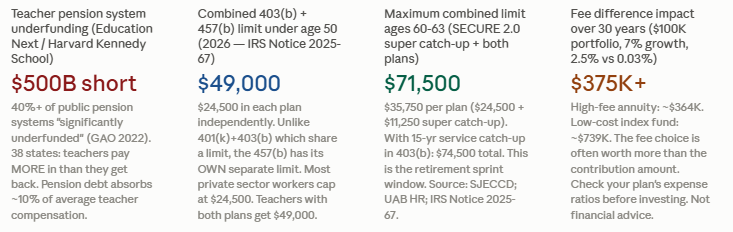
The personal impact is stark. Pension debt alone eats up approximately 10% of the average teacher’s compensation package in many states — money that is legally earmarked for the pension system but may never translate into benefits the teacher receives. In 38 states, according to the NCTQ (National Council on Teacher Quality), teachers and their employers are literally paying more into the pension than teachers are expected to ever receive back. Missouri teachers lose about 10% of their salary to this structural problem; North Carolina teachers lose about 3.5%. Olivia Mitchell, executive director of the Pension Research Council at the University of Pennsylvania, put it directly: ‘I think we’re headed for a big crisis across the country.’
The pension is also brutally unforgiving for teachers who move states, change careers, or leave teaching before reaching the often-distant vesting cliff. Most state teacher pension vesting periods run five to ten years, and leaving before that point means walking away with only your own contributions — sometimes with modest interest — regardless of how long you taught. The 403(b) and 457(b) plans that sit alongside the pension are fully portable, fully yours from day one, and governed by limits that make them extraordinarily powerful for the educator who uses them intentionally. Not financial advice.
Teacher pension crisis data: $500 billion total underfunding of US state teacher pension systems (Education Next/Harvard Kennedy School). $1.2 trillion total unfunded liabilities across all public pensions (GAO 2022 report). 40%+ of public pension systems 'significantly underfunded' (GAO 2022). 38 states: teachers pay MORE in than they get back (NCTQ 'No One Benefits'). ~10% of average teacher compensation absorbed by pension debt (Education Next). Missouri: teachers lose ~10% of salary. NC: ~3.5% loss. 'Big crisis across the country' — Olivia Mitchell, Pension Research Council, UPenn (PBS NewsHour). Only $3 of every $20 spent per teacher in Colorado goes to their actual retirement benefit (Colorado state retirement system, PBS NewsHour). Not investment advice.
A 457(b) plan is a deferred compensation plan available primarily to state and local government employees — which includes most public school teachers. It works similarly to a 403(b) in terms of tax treatment, but with one crucial structural difference that we’ll cover in the next section. It also has a unique withdrawal rule: unlike 403(b) plans, which impose a 10% early withdrawal penalty on distributions before age 59½ (with exceptions), 457(b) plans have no 10% early withdrawal penalty. A teacher who retires at 55 can access their 457(b) money immediately without penalty, paying only ordinary income tax on withdrawals. This makes the 457(b) the more flexible plan for teachers considering early retirement.
Both plans are offered through your school district. Not all districts offer both. The first thing every teacher should do is ask their HR department: ‘Do we have both a 403(b) and a 457(b) plan?’ The answer determines which of the strategies below are available to you. Not financial advice.
403(b) vs 457(b) at a glance: Both: salary deferral; tax-deferred or Roth option; $24,500 base limit 2026; age-based catch-up; SECURE 2.0 super catch-up ages 60-63. 403(b) unique: 15-year service catch-up; 10% early withdrawal penalty before 59½ (exceptions apply); typically offered by most school districts. 457(b) unique: NO 10% early withdrawal penalty — access funds any time you leave employment (ideal for early retirees); special 3-year pre-retirement catch-up (up to twice the annual limit); contribution does NOT coordinate with 403(b) (they have SEPARATE limits). Source: IRS; Walnut Invest August 2026; SJECCD 2026 limits document. Not financial advice.
Compare this to what a private sector worker can do. A 401(k) participant has one $24,500 limit. Period. They might also have access to a Roth IRA ($7,500), bringing their total to $32,000. A teacher with both a 403(b) and a 457(b) can shelter $49,000, plus Roth IRA, plus catch-ups — and do it across two completely independent contribution buckets. Walnut Invest’s August 2026 guide on 457(b) plans describes this as ‘the most valuable and least-known fact about the plan.’
The practical reality is that most teachers never reach the 403(b) limit, let alone run both plans at their maximum. But understanding that the dual-plan ceiling exists is the first step to building a strategy that uses all of it. Even contributing modestly to both plans — say, $500 per month to each — creates two compounding engines growing simultaneously toward a retirement that a pension alone may not fully fund. Not financial advice.
Walnut Invest (August 2026): 'This is the most valuable and least known fact about the plan. An employee with both can defer $24,500 into each in 2026, for $49,000 total before any catch-up.' The 403(b) and 457(b) limits do NOT coordinate with each other, unlike 403(b) and 401(k) limits which DO aggregate. Source: Walnut Invest August 2026 (citing IRS Notice 2025-67 and IRC 457(b) coordination rules). Not financial advice.
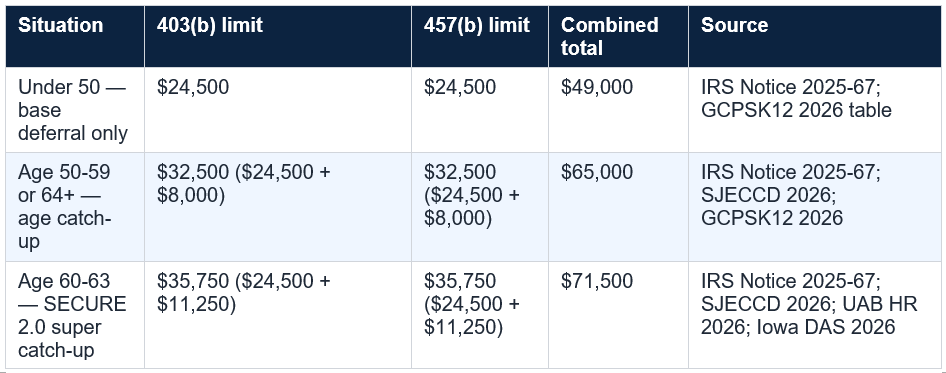
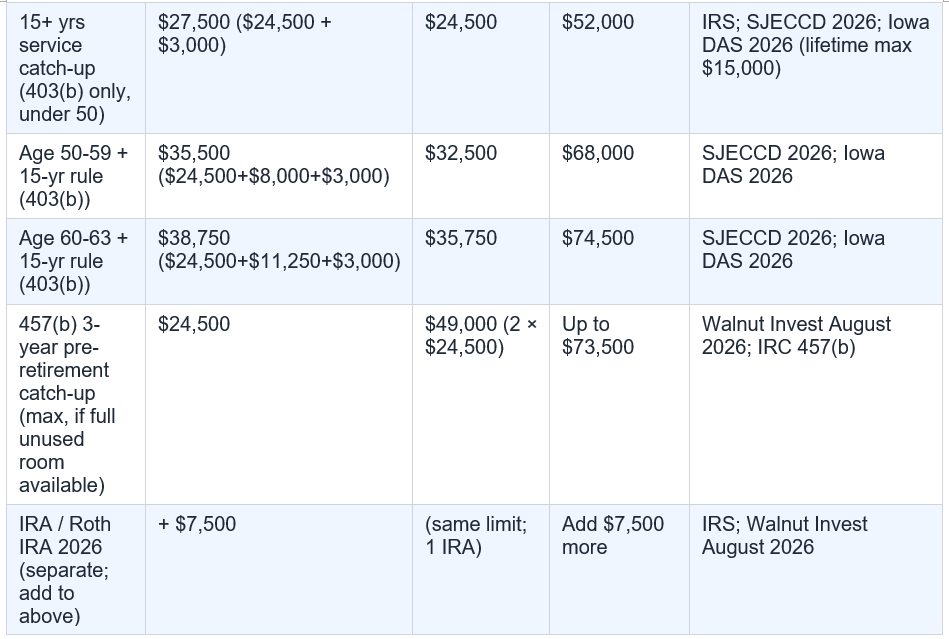
Note: the 457(b) three-year pre-retirement catch-up and the age-based catch-up cannot be COMBINED in the 457(b) — you may only use the HIGHER of the two in any given year (Walnut Invest August 2026; GCPSK12 2026). In the 403(b), the IRS applies contributions above the base limit first to the 15-year rule, then to the age-based catch-up. Not financial advice.
The maths matter here. The qualifying condition — an average annual contribution below $5,000 over your career — describes the vast majority of veteran teachers. Most teachers start contributing later in their career, contribute modest amounts for many years, or had gaps where they contributed nothing. That under-contribution history, which feels like a retirement failure in retrospect, is actually what creates the 15-year catch-up eligibility. The system is designed to let you make up for exactly what most teachers have done.
The interaction with the age-based catch-up is important: if you are over 50 AND have 15+ years of service, the IRS applies your contributions above the base limit first to the 15-year rule ($3,000), then to the age-based catch-up ($8,000). At age 60–63, the stacking is: $24,500 base + $3,000 15-year rule + $11,250 SECURE 2.0 super catch-up = $38,750 in the 403(b) alone (SJECCD 2026). Not financial advice. A calculation is required to determine your specific eligible amount.
To check your 15-year catch-up eligibility: (1) Confirm you have 15+ years with your current employer (same district; not total years teaching). (2) Ask your HR or plan administrator for your contribution history. (3) Calculate your average annual contribution: total contributions ÷ years of service. If average is below $5,000, you likely qualify. (4) Request the calculation from your plan administrator — they are required to perform it. (5) If eligible, elect the additional $3,000 per year for up to 5 years (lifetime max $15,000). Source: Iowa DAS 2026; IRS; SJECCD 2026. Not financial advice. Consult a CFP who specialises in educator finances.
For a teacher, this applies to BOTH the 403(b) and the 457(b) independently. A 61-year-old teacher with access to both plans can contribute $35,750 to the 403(b) and $35,750 to the 457(b) — $71,500 total, before considering the 15-year rule. Add the 15-year service catch-up to the 403(b) and the total reaches $74,500 in a single calendar year. For most teachers, that’s more than they earn. The point is not that every teacher can max this out — it’s that the ceiling is extraordinary, and even partial use of these provisions makes a material difference to retirement security.
The four-year window (ages 60, 61, 62, 63) followed by a return to the standard $8,000 catch-up at 64+ is important to plan around. The sprint to retirement, if you know it’s coming, can be turbocharged by maximising both plans during these four years. Not financial advice.
SECURE 2.0 super catch-up in practice (2026): Teacher aged 61, both plans available, 15+ years service: 403(b) = $24,500 + $11,250 + $3,000 = $38,750. 457(b) = $24,500 + $11,250 = $35,750. Total: $74,500. Plus Roth IRA $7,500 (if income permits) = $82,000 possible annual shelter. Teacher aged 61, no 15-year rule, both plans: $35,750 + $35,750 = $71,500. Teacher aged 61, 403(b) only: $35,750. Source: SJECCD 2026; UAB HR 2026; Gwinnett County 2026 table; Iowa DAS 2026. Not financial advice.
Walnut Invest’s August 2026 guide captures why this matters: ‘Available in each of the three taxable years ending the year before you attain normal retirement age... allowing up to twice the annual limit. This is the most valuable and least-known fact about the plan.’ The plan administrator calculates your available unused room from your contribution history. If you have consistently under-contributed throughout your career — which, again, describes most teachers — you likely have substantial unused room and could use the full double limit.
The critical rule: you cannot combine the three-year catch-up with the age-based catch-up in the 457(b). You may only use the higher of the two in any given year (Gwinnett County Public Schools 2026; Walnut Invest August 2026). If you qualify for the three-year catch-up (potentially $49,000/year) and you’re also 60–63 (catch-up of $35,750), you choose the larger: the three-year catch-up wins. Check your plan document for your plan’s normal retirement age — it is plan-specific and determines when the three-year window opens. Not financial advice.
For a teacher, several factors typically favour Roth contributions, at least in part. First, teaching salaries — national average around $68,000–70,000 — place most teachers in the 22% or lower federal tax bracket during their working years. In retirement, depending on state taxes, Social Security income, and pension income, the effective rate may be similar or even higher in some cases if pension income is fully taxable. Second, Roth accounts have no required minimum distributions (RMDs) during the owner’s lifetime (though traditional 403(b) and 457(b) accounts do), providing more flexibility in retirement income planning.
A practical approach for many teachers: split contributions between pre-tax and Roth. Pre-tax contributions lower today’s tax bill during high-earning years; Roth contributions build a tax-free bucket for flexibility in retirement. Many financial advisers who specialise in educator finances recommend Roth contributions in the early career and pre-tax contributions in peak earning years where every deduction has more value. Not financial advice. Consult a CFP and CPA for your specific situation.
A 1% difference in annual fees over 30 years costs approximately $70,000 on a $100,000 starting portfolio growing at 7% — compounded over a full career, the drag from high fees can exceed six figures per teacher. The good news: many school districts have reformed their 403(b) plan menus in recent years, adding low-cost Vanguard, Fidelity, and Schwab index fund options. If your plan offers these, use them. If it only offers high-fee products, you have two options: advocate through your union or district for better options, or direct your 457(b) contributions to whichever plan in your district has the better investment menu.
The target: expense ratios of 0.03–0.15% for index funds (Vanguard VTSAX, Fidelity ZERO funds, Schwab index funds) or 0.10–0.20% for target-date index funds. Avoid products with surrender charges, mortality and expense fees, or total annual costs above 0.5%. Not financial advice.
The fee trap: a common 403(b) scenario for teachers: a variable annuity with 2.5% total annual fees vs a Vanguard index fund at 0.03%. On $200,000 growing at 7% over 20 years: at 2.5% fees = ~$364,000. At 0.03% fees = ~$739,000. The fee difference costs over $375,000 in a single account. Many teachers are in the annuity product without realising it. Check your 403(b) plan document or most recent statement for the fund's total expense ratio. Not financial advice. Consult a fee-only CFP.
This rule applies to the 457(b) plan for affected workers, per Iowa DAS’s 2026 documentation. There is an important exception: the 403(b)’s 15-year service catch-up is excluded from this Roth requirement. That means a high-earning teacher with 15+ years of service can still make the $3,000 15-year catch-up on a pre-tax basis even if they earn over $150,000. The age-based catch-up in the 457(b) would need to be Roth for those teachers.
The practical impact for most teachers is minimal — the national average teacher salary is approximately $68,000–70,000, well below the $150,000 threshold. But teachers in high-cost states like California, New York, and Massachusetts, particularly at senior career levels or in dual-income households, may be affected. Not tax advice. Consult a CPA for your specific situation.
Whether your traditional IRA contribution is tax-deductible depends on your income and whether you (or your spouse) are covered by an employer retirement plan. Because you are contributing to a 403(b) and/or 457(b), you are ‘covered’ — the deductibility phase-out for traditional IRA contributions begins at $79,000 adjusted gross income for single filers and $126,000 for married filing jointly in 2026 (verify current thresholds with the IRS).
The Roth IRA is the more straightforward option for most teachers at typical salary levels. The Roth IRA income phase-out begins at $161,000 for single filers and $240,000 for married filing jointly in 2026. Most teachers — earning $68,000–85,000 on average — are well below this threshold and can make the full Roth IRA contribution regardless of their 403(b) or 457(b) participation. A Roth IRA also has no required minimum distributions during the owner’s lifetime, making it a valuable flexible pool alongside the employer plans. Not financial advice.
The pension alone may not be enough. $500 billion in underfunding is not an abstraction — it is a structural problem that has already eroded benefits in dozens of states and will continue to do so. Teachers who understand this and act on it — opening both plans, contributing consistently, choosing low-fee investments, and using the catch-up provisions at every eligible age — build the kind of retirement security that the pension system was supposed to provide but increasingly cannot guarantee.
Start by calling HR this week. Ask two questions: ‘Does our district offer a 457(b) plan in addition to the 403(b)?’ and ‘What investment options are available in each plan?’ Those two questions can unlock a retirement strategy that most teachers working next to you have never thought to ask about. Not financial, investment, or tax advice. Consult a fee-only CFP who specialises in educator finances and a CPA for your specific situation.
Yes — and this is the single most important fact in this article. The 403(b) and 457(b) have completely independent contribution limits that do NOT coordinate with each other. In 2026, a teacher can contribute $24,500 to the 403(b) AND $24,500 to the 457(b), for a combined total of $49,000 before any catch-up contributions. This is entirely different from the 401(k)/403(b) relationship: those two plans DO aggregate and share a single limit. The 457(b) stands apart. Walnut Invest's August 2026 guide calls this 'the most valuable and least-known fact about the plan.' However, not all school districts offer a 457(b) plan — check with your HR department. Source: Walnut Invest August 2026; IRS Notice 2025-67; Gwinnett County Public Schools 2026 limits. Not financial advice.
What is the 15-year service catch-up in the 403(b) and how do I know if I qualify?
The 15-year service catch-up allows qualifying 403(b) participants to contribute an additional $3,000 per year above the base limit, up to a lifetime maximum of $15,000. To qualify, you must: (1) have 15 or more years of service with your CURRENT employer (same school district — not total teaching years across multiple districts); and (2) have an average annual 403(b) contribution over your career of less than $5,000 per year. The actual eligible amount is the lesser of $3,000, or $15,000 minus prior 15-year catch-up contributions used, or ($5,000 × years of service minus total prior elective deferrals). Since most teachers contribute less than $5,000 per year in their early career, many veterans are eligible. The IRS applies contributions above the base limit first to the 15-year rule, then to age-based catch-ups. Request the calculation from your plan administrator. Source: Iowa DAS 2026; SJECCD 2026; IRS; GCPSK12 2026. Not financial advice.
What's the difference between the 403(b) and 457(b) early withdrawal rules?
This difference is important for teachers considering early retirement. The 403(b) follows the same early withdrawal rules as a 401(k): distributions before age 59½ are subject to a 10% early withdrawal penalty in addition to ordinary income tax, unless an exception applies (disability, death, separation from service at age 55+, substantially equal periodic payments under 72(t), and others). The 457(b) has NO 10% early withdrawal penalty at any age — once you separate from your employer (retire, resign, or are laid off), you can withdraw 457(b) money at any time, paying only ordinary income tax on withdrawals. This makes the 457(b) the more flexible plan for teachers who plan to retire before 59½. A teacher who retires at 56 can access their 457(b) immediately; accessing 403(b) money before 59½ (outside the age-55-separation exception) will incur the 10% penalty. Source: IRS; Walnut Invest August 2026; IRS Publication 571. Not financial advice. Consult a CFP.
How does the SECURE 2.0 super catch-up work for teachers?
The SECURE 2.0 Act introduced a higher catch-up contribution limit for workers aged 60, 61, 62, or 63 (at any point during the calendar year). In 2026, instead of the standard age-50 catch-up of $8,000, workers in this age band can contribute an additional $11,250 above the base deferral limit. For teachers, this applies independently to both the 403(b) and the 457(b). A teacher aged 61 with access to both plans: $35,750 in the 403(b) + $35,750 in the 457(b) = $71,500 total. If also eligible for the 15-year service catch-up in the 403(b): $38,750 + $35,750 = $74,500. The window is specifically four years (ages 60-63); at age 64 the catch-up returns to $8,000. This is the retirement sprint window for teachers — plan ahead to maximise contributions during these years. Source: IRS Notice 2025-67; SJECCD 2026; UAB HR 2026; Iowa DAS 2026. Not financial advice.
Should I choose pre-tax or Roth contributions in my 403(b) and 457(b)?
The answer depends on whether you expect to be in a higher or lower tax bracket in retirement compared to now. Pre-tax: reduces your taxable income today; you pay taxes on withdrawals in retirement at whatever rate applies then. Roth: no immediate deduction; growth and qualified withdrawals are completely tax-free. For most teachers — earning approximately $68,000-$70,000 nationally — the 22% federal bracket applies during working years. In retirement, teacher pension income, Social Security (if applicable), and 403(b)/457(b) withdrawals could add up to a comparable or higher effective rate depending on the state. Roth contributions build a tax-free bucket that provides flexibility regardless of future tax rates. Many specialist educator financial advisers suggest Roth in early career and lower-earning years; pre-tax in peak earning years. Note: starting January 1, 2026, workers over 50 earning above $150,000 in OASDI wages in the prior year must make catch-up contributions on a Roth basis. Source: Iowa DAS 2026; IRS. Not tax or financial advice. Consult a CFP and CPA.
Table of Contents
- The Pension Reality Check: Why Teachers Cannot Rely on a Pension Alone
- What Are 403(b) and 457(b) Plans? The Plain-English Explanation
- The Biggest Secret in Educator Retirement: The Dual-Plan Advantage
- 2026 Contribution Limits: The Complete Numbers
- The 15-Year Service Catch-Up: The 403(b) Bonus Most Teachers Ignore
- The SECURE 2.0 Super Catch-Up: Age 60–63 Supercharges Both Plans
- The 457(b) Three-Year Catch-Up: Double Your Limit Before Retirement
- Roth vs Pre-Tax: Which Option Is Right for a Teacher?
- The Fee Problem: Why Your Plan’s Fund Menu Matters as Much as the Limit
- How to Stack Every Advantage: The Optimal Contribution Order
- The 2026 Roth Catch-Up Rule Change High Earners Must Know
- Your IRA Options Alongside the 403(b) and 457(b)
- Conclusion: Thirty Years of Teaching Deserves a Real Retirement
- Frequently Asked Questions
The Pension Reality Check: Why Teachers Cannot Rely on a Pension Alone
Let’s start with the honest, uncomfortable truth that most school districts and teacher unions don’t advertise. The traditional teacher pension — the defined-benefit plan that promises a monthly payment in retirement based on years of service and final salary — is in serious trouble in most states. Education Next, based at Harvard Kennedy School, reports that US state teacher pension systems are underfunded by approximately $500 billion. In 2022, the Government Accountability Office classified over 40% of public pension systems as ‘significantly underfunded,’ with total unfunded liabilities across all public pensions reaching $1.2 trillion.The personal impact is stark. Pension debt alone eats up approximately 10% of the average teacher’s compensation package in many states — money that is legally earmarked for the pension system but may never translate into benefits the teacher receives. In 38 states, according to the NCTQ (National Council on Teacher Quality), teachers and their employers are literally paying more into the pension than teachers are expected to ever receive back. Missouri teachers lose about 10% of their salary to this structural problem; North Carolina teachers lose about 3.5%. Olivia Mitchell, executive director of the Pension Research Council at the University of Pennsylvania, put it directly: ‘I think we’re headed for a big crisis across the country.’
The pension is also brutally unforgiving for teachers who move states, change careers, or leave teaching before reaching the often-distant vesting cliff. Most state teacher pension vesting periods run five to ten years, and leaving before that point means walking away with only your own contributions — sometimes with modest interest — regardless of how long you taught. The 403(b) and 457(b) plans that sit alongside the pension are fully portable, fully yours from day one, and governed by limits that make them extraordinarily powerful for the educator who uses them intentionally. Not financial advice.
Teacher pension crisis data: $500 billion total underfunding of US state teacher pension systems (Education Next/Harvard Kennedy School). $1.2 trillion total unfunded liabilities across all public pensions (GAO 2022 report). 40%+ of public pension systems 'significantly underfunded' (GAO 2022). 38 states: teachers pay MORE in than they get back (NCTQ 'No One Benefits'). ~10% of average teacher compensation absorbed by pension debt (Education Next). Missouri: teachers lose ~10% of salary. NC: ~3.5% loss. 'Big crisis across the country' — Olivia Mitchell, Pension Research Council, UPenn (PBS NewsHour). Only $3 of every $20 spent per teacher in Colorado goes to their actual retirement benefit (Colorado state retirement system, PBS NewsHour). Not investment advice.
What Are 403(b) and 457(b) Plans? The Plain-English Explanation
A 403(b) plan is a tax-advantaged retirement savings account available to employees of public schools, certain tax-exempt organisations, and some ministers. It works like a 401(k) does for private sector workers: you contribute a portion of your salary before income tax is calculated, that money is invested in funds within the plan, and it grows tax-deferred until withdrawal in retirement. Withdrawals in retirement are taxed as ordinary income. Many plans also offer a Roth option: you contribute after-tax money, it grows tax-free, and qualified withdrawals in retirement are completely tax-free.A 457(b) plan is a deferred compensation plan available primarily to state and local government employees — which includes most public school teachers. It works similarly to a 403(b) in terms of tax treatment, but with one crucial structural difference that we’ll cover in the next section. It also has a unique withdrawal rule: unlike 403(b) plans, which impose a 10% early withdrawal penalty on distributions before age 59½ (with exceptions), 457(b) plans have no 10% early withdrawal penalty. A teacher who retires at 55 can access their 457(b) money immediately without penalty, paying only ordinary income tax on withdrawals. This makes the 457(b) the more flexible plan for teachers considering early retirement.
Both plans are offered through your school district. Not all districts offer both. The first thing every teacher should do is ask their HR department: ‘Do we have both a 403(b) and a 457(b) plan?’ The answer determines which of the strategies below are available to you. Not financial advice.
403(b) vs 457(b) at a glance: Both: salary deferral; tax-deferred or Roth option; $24,500 base limit 2026; age-based catch-up; SECURE 2.0 super catch-up ages 60-63. 403(b) unique: 15-year service catch-up; 10% early withdrawal penalty before 59½ (exceptions apply); typically offered by most school districts. 457(b) unique: NO 10% early withdrawal penalty — access funds any time you leave employment (ideal for early retirees); special 3-year pre-retirement catch-up (up to twice the annual limit); contribution does NOT coordinate with 403(b) (they have SEPARATE limits). Source: IRS; Walnut Invest August 2026; SJECCD 2026 limits document. Not financial advice.
The Biggest Secret in Educator Retirement: The Dual-Plan Advantage
Here’s the feature of the educator’s retirement toolkit that almost nobody outside of specialist financial advisers knows: the 403(b) and the 457(b) have completely separate, independent contribution limits. They do not share a cap. A teacher who has access to both plans can contribute $24,500 to the 403(b) AND $24,500 to the 457(b) in 2026 — $49,000 total — before any catch-up contributions. Every catch-up provision then stacks on top of each limit independently.Compare this to what a private sector worker can do. A 401(k) participant has one $24,500 limit. Period. They might also have access to a Roth IRA ($7,500), bringing their total to $32,000. A teacher with both a 403(b) and a 457(b) can shelter $49,000, plus Roth IRA, plus catch-ups — and do it across two completely independent contribution buckets. Walnut Invest’s August 2026 guide on 457(b) plans describes this as ‘the most valuable and least-known fact about the plan.’
The practical reality is that most teachers never reach the 403(b) limit, let alone run both plans at their maximum. But understanding that the dual-plan ceiling exists is the first step to building a strategy that uses all of it. Even contributing modestly to both plans — say, $500 per month to each — creates two compounding engines growing simultaneously toward a retirement that a pension alone may not fully fund. Not financial advice.
Walnut Invest (August 2026): 'This is the most valuable and least known fact about the plan. An employee with both can defer $24,500 into each in 2026, for $49,000 total before any catch-up.' The 403(b) and 457(b) limits do NOT coordinate with each other, unlike 403(b) and 401(k) limits which DO aggregate. Source: Walnut Invest August 2026 (citing IRS Notice 2025-67 and IRC 457(b) coordination rules). Not financial advice.
2026 Contribution Limits: The Complete Numbers
Every number below comes from IRS Notice 2025-67 and official school district documents published for 2026 (Gwinnett County Public Schools; San Jose–Evergreen CCD; University of Alabama at Birmingham; Iowa DAS; Walnut Invest August 2026). Not financial advice. Verify current limits with your plan administrator.Note: the 457(b) three-year pre-retirement catch-up and the age-based catch-up cannot be COMBINED in the 457(b) — you may only use the HIGHER of the two in any given year (Walnut Invest August 2026; GCPSK12 2026). In the 403(b), the IRS applies contributions above the base limit first to the 15-year rule, then to the age-based catch-up. Not financial advice.
The 15-Year Service Catch-Up: The 403(b) Bonus Most Teachers Ignore
If you have worked for the same school district for at least 15 years and your average annual 403(b) contributions over your career have been below $5,000 per year, you may qualify for one of the most overlooked provisions in the entire tax code: the 15-year service catch-up. This provision allows qualifying 403(b) participants to contribute an additional $3,000 per year above the base limit, up to a lifetime maximum of $15,000 (meaning you can use this provision for a maximum of five years).The maths matter here. The qualifying condition — an average annual contribution below $5,000 over your career — describes the vast majority of veteran teachers. Most teachers start contributing later in their career, contribute modest amounts for many years, or had gaps where they contributed nothing. That under-contribution history, which feels like a retirement failure in retrospect, is actually what creates the 15-year catch-up eligibility. The system is designed to let you make up for exactly what most teachers have done.
The interaction with the age-based catch-up is important: if you are over 50 AND have 15+ years of service, the IRS applies your contributions above the base limit first to the 15-year rule ($3,000), then to the age-based catch-up ($8,000). At age 60–63, the stacking is: $24,500 base + $3,000 15-year rule + $11,250 SECURE 2.0 super catch-up = $38,750 in the 403(b) alone (SJECCD 2026). Not financial advice. A calculation is required to determine your specific eligible amount.
To check your 15-year catch-up eligibility: (1) Confirm you have 15+ years with your current employer (same district; not total years teaching). (2) Ask your HR or plan administrator for your contribution history. (3) Calculate your average annual contribution: total contributions ÷ years of service. If average is below $5,000, you likely qualify. (4) Request the calculation from your plan administrator — they are required to perform it. (5) If eligible, elect the additional $3,000 per year for up to 5 years (lifetime max $15,000). Source: Iowa DAS 2026; IRS; SJECCD 2026. Not financial advice. Consult a CFP who specialises in educator finances.
The SECURE 2.0 Super Catch-Up: Age 60–63 Supercharges Both Plans
The SECURE 2.0 Act introduced one of the most generous retirement provision changes in recent memory: a ‘super catch-up’ for people aged 60 through 63. Starting in 2025 and continuing in 2026, if you turn 60, 61, 62, or 63 at any point during the calendar year, your catch-up contribution is elevated from $8,000 to $11,250 — the greater of $10,000 or 150% of the regular age-50 catch-up amount (which works out to $11,250 for 2026, per SJECCD 2026 and Iowa DAS 2026).For a teacher, this applies to BOTH the 403(b) and the 457(b) independently. A 61-year-old teacher with access to both plans can contribute $35,750 to the 403(b) and $35,750 to the 457(b) — $71,500 total, before considering the 15-year rule. Add the 15-year service catch-up to the 403(b) and the total reaches $74,500 in a single calendar year. For most teachers, that’s more than they earn. The point is not that every teacher can max this out — it’s that the ceiling is extraordinary, and even partial use of these provisions makes a material difference to retirement security.
The four-year window (ages 60, 61, 62, 63) followed by a return to the standard $8,000 catch-up at 64+ is important to plan around. The sprint to retirement, if you know it’s coming, can be turbocharged by maximising both plans during these four years. Not financial advice.
SECURE 2.0 super catch-up in practice (2026): Teacher aged 61, both plans available, 15+ years service: 403(b) = $24,500 + $11,250 + $3,000 = $38,750. 457(b) = $24,500 + $11,250 = $35,750. Total: $74,500. Plus Roth IRA $7,500 (if income permits) = $82,000 possible annual shelter. Teacher aged 61, no 15-year rule, both plans: $35,750 + $35,750 = $71,500. Teacher aged 61, 403(b) only: $35,750. Source: SJECCD 2026; UAB HR 2026; Gwinnett County 2026 table; Iowa DAS 2026. Not financial advice.
The 457(b) Three-Year Catch-Up: Double Your Limit Before Retirement
The 457(b) has its own catch-up provision that has no equivalent in the 403(b), 401(k), or IRA world: the three-year pre-retirement catch-up. In each of the three years before the year you reach the plan’s normal retirement age, a 457(b) participant may contribute up to twice the annual base limit — $49,000 in 2026 — subject to one constraint: you can only use as much of this catch-up as you have unused contribution room from prior years.Walnut Invest’s August 2026 guide captures why this matters: ‘Available in each of the three taxable years ending the year before you attain normal retirement age... allowing up to twice the annual limit. This is the most valuable and least-known fact about the plan.’ The plan administrator calculates your available unused room from your contribution history. If you have consistently under-contributed throughout your career — which, again, describes most teachers — you likely have substantial unused room and could use the full double limit.
The critical rule: you cannot combine the three-year catch-up with the age-based catch-up in the 457(b). You may only use the higher of the two in any given year (Gwinnett County Public Schools 2026; Walnut Invest August 2026). If you qualify for the three-year catch-up (potentially $49,000/year) and you’re also 60–63 (catch-up of $35,750), you choose the larger: the three-year catch-up wins. Check your plan document for your plan’s normal retirement age — it is plan-specific and determines when the three-year window opens. Not financial advice.
Roth vs Pre-Tax: Which Option Is Right for a Teacher?
Most 403(b) and 457(b) plans now offer both traditional (pre-tax) and Roth options. Pre-tax contributions reduce your taxable income today — every $1 contributed saves you roughly your marginal tax rate in taxes immediately. Roth contributions are made from after-tax income, provide no immediate deduction, but all future growth and qualified withdrawals are completely tax-free. Which is better depends on whether your tax rate is likely to be higher now or in retirement.For a teacher, several factors typically favour Roth contributions, at least in part. First, teaching salaries — national average around $68,000–70,000 — place most teachers in the 22% or lower federal tax bracket during their working years. In retirement, depending on state taxes, Social Security income, and pension income, the effective rate may be similar or even higher in some cases if pension income is fully taxable. Second, Roth accounts have no required minimum distributions (RMDs) during the owner’s lifetime (though traditional 403(b) and 457(b) accounts do), providing more flexibility in retirement income planning.
A practical approach for many teachers: split contributions between pre-tax and Roth. Pre-tax contributions lower today’s tax bill during high-earning years; Roth contributions build a tax-free bucket for flexibility in retirement. Many financial advisers who specialise in educator finances recommend Roth contributions in the early career and pre-tax contributions in peak earning years where every deduction has more value. Not financial advice. Consult a CFP and CPA for your specific situation.
The Fee Problem: Why Your Plan’s Fund Menu Matters as Much as the Limit
There’s a trap waiting inside many school district 403(b) plans, and it has cost teachers enormous sums in retirement security over the past 30 years: high-fee annuity products. Historically, 403(b) plans were dominated by insurance company products — fixed annuities, variable annuities, equity-indexed annuities — that carried fees of 1–3% per year or more. These products were marketed aggressively to teachers, often by salespeople who visited schools directly.A 1% difference in annual fees over 30 years costs approximately $70,000 on a $100,000 starting portfolio growing at 7% — compounded over a full career, the drag from high fees can exceed six figures per teacher. The good news: many school districts have reformed their 403(b) plan menus in recent years, adding low-cost Vanguard, Fidelity, and Schwab index fund options. If your plan offers these, use them. If it only offers high-fee products, you have two options: advocate through your union or district for better options, or direct your 457(b) contributions to whichever plan in your district has the better investment menu.
The target: expense ratios of 0.03–0.15% for index funds (Vanguard VTSAX, Fidelity ZERO funds, Schwab index funds) or 0.10–0.20% for target-date index funds. Avoid products with surrender charges, mortality and expense fees, or total annual costs above 0.5%. Not financial advice.
The fee trap: a common 403(b) scenario for teachers: a variable annuity with 2.5% total annual fees vs a Vanguard index fund at 0.03%. On $200,000 growing at 7% over 20 years: at 2.5% fees = ~$364,000. At 0.03% fees = ~$739,000. The fee difference costs over $375,000 in a single account. Many teachers are in the annuity product without realising it. Check your 403(b) plan document or most recent statement for the fund's total expense ratio. Not financial advice. Consult a fee-only CFP.
How to Stack Every Advantage: The Optimal Contribution Order
Given everything above, here is the logical order for a teacher to build their retirement contribution strategy. This is not financial advice — it is the framework that emerges from the plan rules. Consult a CFP for your specific situation.- Step 1: Emergency fund first. Before maximising any retirement account, ensure you have three to six months of living expenses in an accessible savings account. Retirement accounts have withdrawal restrictions and penalties (the 403(b) especially). Financial security requires a liquid buffer.
- Step 2: Any employer match in the 403(b). If your district offers any employer match in the 403(b), contribute at least enough to capture the full match before directing money elsewhere. A match is an immediate 50–100% return on invested capital that no investment can replicate.
- Step 3: Decide which plan gets priority based on fees. If your district’s 403(b) has high-fee options but the 457(b) has low-cost index funds (or vice versa), direct additional contributions to whichever plan has the better investment menu. Fee drag kills returns more reliably than any market cycle.
- Step 4: Contribute to the 457(b) if you are planning early retirement. The 457(b)’s lack of 10% early withdrawal penalty makes it the first pool to tap if you retire before 59½. Teachers who plan to retire at 55 or 60 should prioritise 457(b) contributions for this reason.
- Step 5: Check your 15-year service eligibility if you have 15+ years with the same district. The additional $3,000 per year in the 403(b) is free money with no income constraint — claim it if you qualify.
- Step 6: Maximise catch-ups if you are 50+. At ages 50–59 and 64+: $32,500 per plan. At ages 60–63: $35,750 per plan. At ages 60–63 with 15-year rule: $38,750 in the 403(b). Stacking both plans at these levels during the final decade before retirement can dramatically accelerate the finishing line.
- Step 7: Add a Roth IRA if income permits. The 2026 Roth IRA limit is $7,500. Subject to income phase-out limits ($161,000 single; $240,000 married for full contribution). A Roth IRA builds a tax-free pool outside the employer plans that provides flexibility in retirement income management.
The 2026 Roth Catch-Up Rule Change High Earners Must Know
Starting January 1, 2026, a new rule applies to catch-up contributions made by workers aged 50 and older who earned more than $150,000 in Social Security wages (OASDI wages) in the prior year. These workers must make their catch-up contributions — the amount above the base deferral limit — on a Roth basis rather than a pre-tax basis. This means the catch-up portion loses its immediate tax deduction but gains tax-free growth and tax-free qualified withdrawals.This rule applies to the 457(b) plan for affected workers, per Iowa DAS’s 2026 documentation. There is an important exception: the 403(b)’s 15-year service catch-up is excluded from this Roth requirement. That means a high-earning teacher with 15+ years of service can still make the $3,000 15-year catch-up on a pre-tax basis even if they earn over $150,000. The age-based catch-up in the 457(b) would need to be Roth for those teachers.
The practical impact for most teachers is minimal — the national average teacher salary is approximately $68,000–70,000, well below the $150,000 threshold. But teachers in high-cost states like California, New York, and Massachusetts, particularly at senior career levels or in dual-income households, may be affected. Not tax advice. Consult a CPA for your specific situation.
Your IRA Options Alongside the 403(b) and 457(b)
Contributing to a 403(b) or 457(b) does not reduce your ability to also contribute to an IRA — but it does affect some rules. The 2026 IRA contribution limit is $7,500 (including a $1,000 catch-up for those 50 and over). You can contribute to both a traditional IRA and a Roth IRA in the same year, but the combined total cannot exceed $7,500.Whether your traditional IRA contribution is tax-deductible depends on your income and whether you (or your spouse) are covered by an employer retirement plan. Because you are contributing to a 403(b) and/or 457(b), you are ‘covered’ — the deductibility phase-out for traditional IRA contributions begins at $79,000 adjusted gross income for single filers and $126,000 for married filing jointly in 2026 (verify current thresholds with the IRS).
The Roth IRA is the more straightforward option for most teachers at typical salary levels. The Roth IRA income phase-out begins at $161,000 for single filers and $240,000 for married filing jointly in 2026. Most teachers — earning $68,000–85,000 on average — are well below this threshold and can make the full Roth IRA contribution regardless of their 403(b) or 457(b) participation. A Roth IRA also has no required minimum distributions during the owner’s lifetime, making it a valuable flexible pool alongside the employer plans. Not financial advice.
Conclusion
You chose teaching because you care about shaping the next generation. You didn’t choose it for the pay, the resources, or the institutional support — teachers have made peace with all of that. But retirement security is something you can actually build deliberately, using tools that the tax code has made remarkably generous for educators specifically. The 403(b) and 457(b) combination — with their independent limits, educator-specific catch-up provisions, and the SECURE 2.0 super catch-up for the final sprint — is genuinely one of the best retirement accumulation opportunities available to any American worker.The pension alone may not be enough. $500 billion in underfunding is not an abstraction — it is a structural problem that has already eroded benefits in dozens of states and will continue to do so. Teachers who understand this and act on it — opening both plans, contributing consistently, choosing low-fee investments, and using the catch-up provisions at every eligible age — build the kind of retirement security that the pension system was supposed to provide but increasingly cannot guarantee.
Start by calling HR this week. Ask two questions: ‘Does our district offer a 457(b) plan in addition to the 403(b)?’ and ‘What investment options are available in each plan?’ Those two questions can unlock a retirement strategy that most teachers working next to you have never thought to ask about. Not financial, investment, or tax advice. Consult a fee-only CFP who specialises in educator finances and a CPA for your specific situation.
Frequently Asked Questions
Can a teacher really contribute to BOTH a 403(b) and a 457(b) in the same year?Yes — and this is the single most important fact in this article. The 403(b) and 457(b) have completely independent contribution limits that do NOT coordinate with each other. In 2026, a teacher can contribute $24,500 to the 403(b) AND $24,500 to the 457(b), for a combined total of $49,000 before any catch-up contributions. This is entirely different from the 401(k)/403(b) relationship: those two plans DO aggregate and share a single limit. The 457(b) stands apart. Walnut Invest's August 2026 guide calls this 'the most valuable and least-known fact about the plan.' However, not all school districts offer a 457(b) plan — check with your HR department. Source: Walnut Invest August 2026; IRS Notice 2025-67; Gwinnett County Public Schools 2026 limits. Not financial advice.
What is the 15-year service catch-up in the 403(b) and how do I know if I qualify?
The 15-year service catch-up allows qualifying 403(b) participants to contribute an additional $3,000 per year above the base limit, up to a lifetime maximum of $15,000. To qualify, you must: (1) have 15 or more years of service with your CURRENT employer (same school district — not total teaching years across multiple districts); and (2) have an average annual 403(b) contribution over your career of less than $5,000 per year. The actual eligible amount is the lesser of $3,000, or $15,000 minus prior 15-year catch-up contributions used, or ($5,000 × years of service minus total prior elective deferrals). Since most teachers contribute less than $5,000 per year in their early career, many veterans are eligible. The IRS applies contributions above the base limit first to the 15-year rule, then to age-based catch-ups. Request the calculation from your plan administrator. Source: Iowa DAS 2026; SJECCD 2026; IRS; GCPSK12 2026. Not financial advice.
What's the difference between the 403(b) and 457(b) early withdrawal rules?
This difference is important for teachers considering early retirement. The 403(b) follows the same early withdrawal rules as a 401(k): distributions before age 59½ are subject to a 10% early withdrawal penalty in addition to ordinary income tax, unless an exception applies (disability, death, separation from service at age 55+, substantially equal periodic payments under 72(t), and others). The 457(b) has NO 10% early withdrawal penalty at any age — once you separate from your employer (retire, resign, or are laid off), you can withdraw 457(b) money at any time, paying only ordinary income tax on withdrawals. This makes the 457(b) the more flexible plan for teachers who plan to retire before 59½. A teacher who retires at 56 can access their 457(b) immediately; accessing 403(b) money before 59½ (outside the age-55-separation exception) will incur the 10% penalty. Source: IRS; Walnut Invest August 2026; IRS Publication 571. Not financial advice. Consult a CFP.
How does the SECURE 2.0 super catch-up work for teachers?
The SECURE 2.0 Act introduced a higher catch-up contribution limit for workers aged 60, 61, 62, or 63 (at any point during the calendar year). In 2026, instead of the standard age-50 catch-up of $8,000, workers in this age band can contribute an additional $11,250 above the base deferral limit. For teachers, this applies independently to both the 403(b) and the 457(b). A teacher aged 61 with access to both plans: $35,750 in the 403(b) + $35,750 in the 457(b) = $71,500 total. If also eligible for the 15-year service catch-up in the 403(b): $38,750 + $35,750 = $74,500. The window is specifically four years (ages 60-63); at age 64 the catch-up returns to $8,000. This is the retirement sprint window for teachers — plan ahead to maximise contributions during these years. Source: IRS Notice 2025-67; SJECCD 2026; UAB HR 2026; Iowa DAS 2026. Not financial advice.
Should I choose pre-tax or Roth contributions in my 403(b) and 457(b)?
The answer depends on whether you expect to be in a higher or lower tax bracket in retirement compared to now. Pre-tax: reduces your taxable income today; you pay taxes on withdrawals in retirement at whatever rate applies then. Roth: no immediate deduction; growth and qualified withdrawals are completely tax-free. For most teachers — earning approximately $68,000-$70,000 nationally — the 22% federal bracket applies during working years. In retirement, teacher pension income, Social Security (if applicable), and 403(b)/457(b) withdrawals could add up to a comparable or higher effective rate depending on the state. Roth contributions build a tax-free bucket that provides flexibility regardless of future tax rates. Many specialist educator financial advisers suggest Roth in early career and lower-earning years; pre-tax in peak earning years. Note: starting January 1, 2026, workers over 50 earning above $150,000 in OASDI wages in the prior year must make catch-up contributions on a Roth basis. Source: Iowa DAS 2026; IRS. Not tax or financial advice. Consult a CFP and CPA.
0 Comments
Be the first to share your thoughts on this article.