

Retirement
Can You Live on $10,000 a Month in Retirement? Full Guide

In this article I'll explore how the average American retiree spends $5,007 per month. $10,000 a month is nearly double that — putting you in the top 15–20% of retirement income earners. But $10,000 gross is not $10,000 net. A single retiree drawing primarily from a traditional IRA could lose $16,000–$19,000 of that $120,000 annual income to federal taxes. Medicare surcharges kick in at $106,000 MAGI. And in Manhattan or San Francisco, $10,000 a month leaves you stretching. In Arizona, Tennessee, or Portugal, it makes you wealthy. This article answers the real question: what does $10,000 a month in retirement income actually look like — and what does it take to build it?
Yahoo Finance (February 2026), citing calculations for the $3K vs $5K vs $10K retirement income comparison, confirms: ‘For most people, a six-figure annual budget is a luxury in retirement.’ The Schroders 2025 US Retirement Survey found the average worker’s ‘magic number’ for retirement is $1.28 million — a portfolio that at 3.9% (Morningstar 2026 rate) generates approximately $49,920 per year, far short of $120,000. Getting to $10,000 a month requires building well above the average retirement savings target.
But $10,000 gross and $10,000 net are different things. Taxes, Medicare premiums, and healthcare costs reduce the spending power of that $10,000 significantly. And the purchasing power of $10,000 varies enormously by location: it is tight in Manhattan, comfortable in Charlotte, and genuinely affluent in Tucson, Mexico City, or Lisbon. This article works through the full picture. Not financial advice.
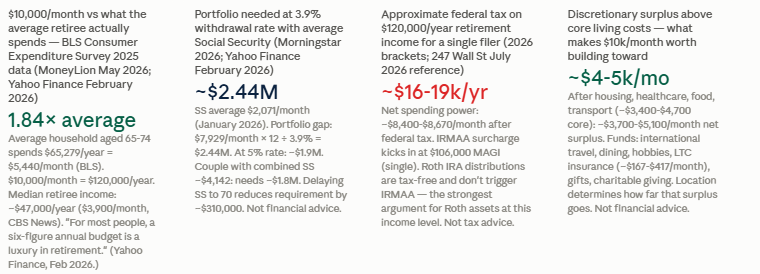
Average monthly Social Security benefit (January 2026): $2,071 per retired individual. (Yahoo Finance February 2026.) Average retired household spending (BLS 2025 data for 65-74): $65,279/year = $5,440/month (MoneyLion May 2026); Fidelity/BLS: $65,149/year ($5,429/month) (Yahoo Finance February 2026). Median retiree income: ~$47,000/year ($3,900/month). $10,000/month = $120,000/year = nearly double the average retiree spending. Schroders 2025 US Retirement Survey: average worker 'magic number' = $1.28 million. Sources: Yahoo Finance February 2026; BLS Consumer Expenditure Survey 2024/2025; MoneyLion May 2026; Schroders 2025.
For households aged 65 and over, average annual expenditure is approximately $60,087 per year ($5,007/month), on pre-tax income of about $64,326/year ($5,360/month). The average retiree household has 1.7–1.8 people. For the 65–74 age band specifically — the most active, highest-spending retirement years — average spending rises to approximately $65,279/year ($5,440/month), consistent with Fidelity’s analysis of BLS data cited by Yahoo Finance (February 2026). Motley Fool’s June 2026 analysis notes that retirees’ income averages $5,622/month pre-tax, versus $8,684/month for all US households — a 35% lower income supporting a household that is 20–30% smaller.
Fidelity’s analysis found that typical retirees spend between 55% and 80% of their pre-retirement income, with an average of 67.5% (MoneyLion May 2026). Against the BLS average household income of $80,610, this suggests an average retiree needs approximately $54,400/year ($4,533/month) — consistent with the BLS actual expenditure data. $10,000 a month is therefore approximately 84% above what the data says the average household needs. Not financial advice.
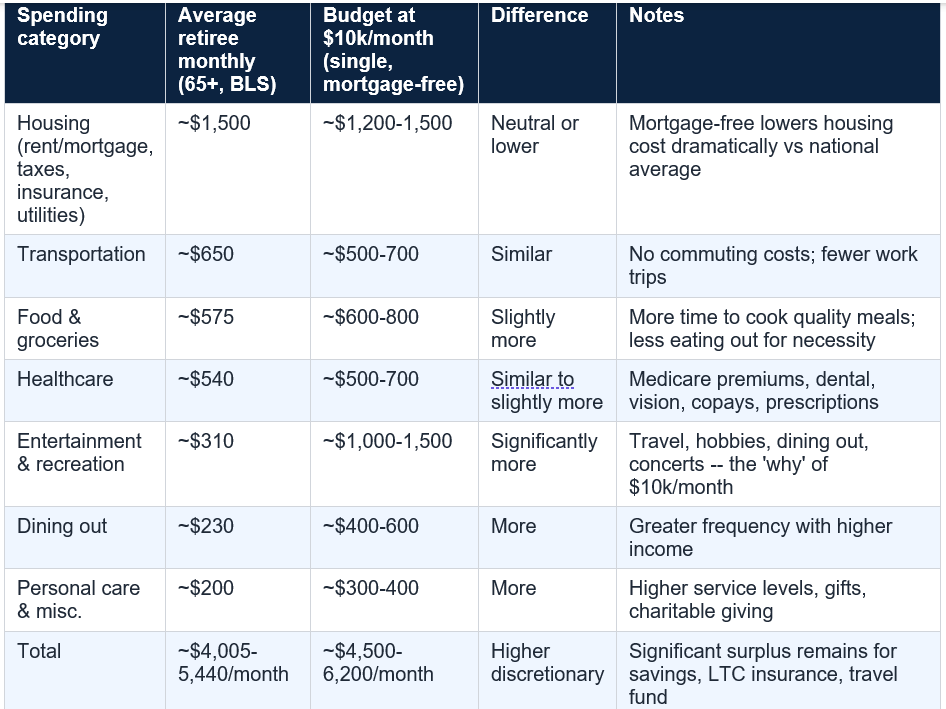
Of that net, the primary budget categories for a mortgage-free single retiree are well-established. Housing — property taxes, homeowners insurance, utilities, and maintenance — runs approximately $1,200–$1,500 per month when there is no mortgage, compared to $2,500–3,500 for a renter in a moderate-cost city. Healthcare — Medicare Part B premiums ($202.90–$244.60/month in 2026), plus dental, vision, hearing, copays, prescriptions, and supplemental Medicare (Medigap or Medicare Advantage) — runs $500–$700 per month for a typical 65-year-old in good health.
The remaining budget, after housing and healthcare, is where the $10,000/month lifestyle becomes genuinely rewarding. A retiree at this income level has approximately $5,000–$6,000/month after core living costs for discretionary spending: international and domestic travel, dining, entertainment, gifts to family, hobbies, charitable giving, and a long-term care insurance policy ($2,000–$5,000/year for a comprehensive policy at age 65). This is the practical reason many people target $10,000 a month: not just to cover costs, but to fund the experiences that retirement is supposed to enable. Not financial advice.
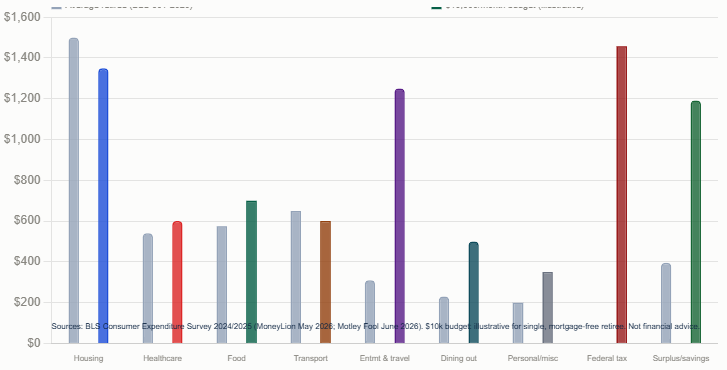
$10,000/month retirement income breakdown (illustrative, single, mortgage-free): Gross: $10,000. Federal tax (approx.): -$1,330 to -$1,583/month (-$16,000 to -$19,000/year). Net spending power: ~$8,400-8,670/month. Housing (no mortgage): -$1,200 to -$1,500. Healthcare: -$500 to -$700. Food: -$600 to -$800. Transportation: -$500 to -$700. CORE TOTAL: ~$2,800-3,700. REMAINING for discretionary: ~$4,700-5,870. Travel budget (international + domestic): ~$1,000-1,500. Dining/entertainment: ~$400-600. Personal/misc: ~$300-400. Long-term care insurance: ~$167-417/month ($2k-5k/year). Surplus/emergency/gifts: ~$2,500-3,800. Note: state income taxes excluded (9 states have no income tax). Not financial advice. Illustrative only.
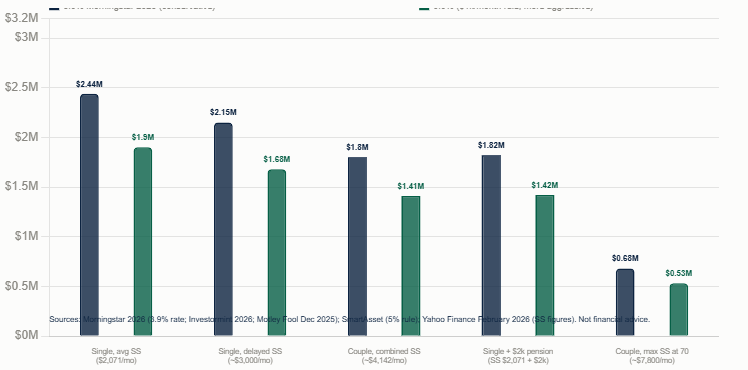
Using Morningstar’s 2026 safe withdrawal rate of 3.9% (cited by Investormint 2026 and Motley Fool December 2025), the required portfolio is: $7,929/month × 12 = $95,148/year ÷ 0.039 = approximately $2.44 million. Yahoo Finance (February 2026) confirms this calculation directly: ‘Based on the calculations above, you’d need $7,929 per month from retirement savings — which, coupled with $2,071 from Social Security, makes $10,000 per month.’ The 3.9% rate assumes a 30-year retirement horizon with a 90% probability of not running out of money (Morningstar 2026).
The portfolio requirement drops significantly if other income sources are available. A couple with two Social Security incomes combined at $4,142/month needs only $5,858/month from the portfolio — requiring approximately $1.8 million at 3.9%. A retiree with a pension providing $2,000/month needs only $3,929/month from the portfolio, requiring approximately $1.2 million. At a more aggressive 5% withdrawal rate (SmartAsset’s $1,000-a-month rule: $240,000 per $1,000/month), the portfolio requirement for $7,929/month drops to approximately $1.9 million. However, the 5% rate carries higher depletion risk over 30 years than Morningstar’s 3.9%. Not financial advice.
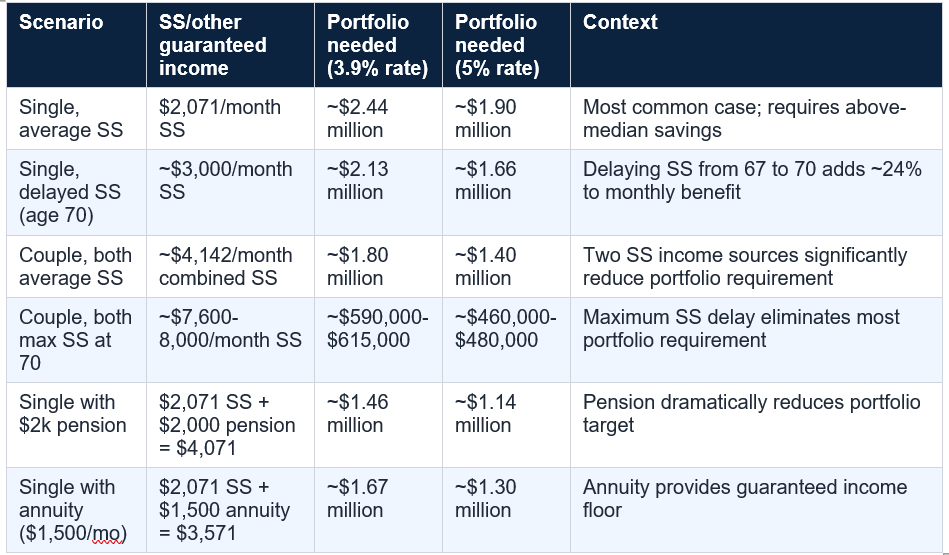
For a couple where both spouses delay Social Security to age 70 and both have strong earnings histories, combined benefits can approach $7,600–$8,000 per month — meaning a couple in this position needs only approximately $590,000–$615,000 in portfolio assets at 3.9% to generate $10,000/month total. This is why Social Security delay is one of the highest-return decisions available to most retirees: each year of delay past FRA adds approximately 8% to the monthly benefit for life, guaranteed, and inflation-adjusted through the annual COLA.
For a single retiree with average earnings history, the $2,071 average benefit represents 20.7% of the $10,000 target. But a retiree who spent 35 years in a high-earning career and delays to 70 could claim the maximum $5,108/month, representing 51% of the $10,000 target and reducing the portfolio requirement by more than $900,000 compared to the average claimant. The Social Security claiming decision is arguably more impactful on retirement income than any portfolio allocation decision. Not financial advice.
Social Security claiming strategy for $10,000/month: (1) For single retirees: if you can afford to delay, every year past FRA (67) adds approximately 8% to your monthly benefit. Delaying from 67 to 70 increases your benefit by approximately 24% for life. (2) For couples: the higher earner should delay as long as possible (ideally to 70); this maximises the survivor benefit, which continues for the remaining spouse for life. (3) The breakeven for delaying (recouping delayed benefits through higher monthly payments) is typically around age 79-82. Given average life expectancy well into the 80s, delay is often the optimal strategy. (4) Working past FRA while collecting SS: benefits are not reduced (the earnings test only applies before FRA). Consult a Social Security expert or CFP. Not financial advice.
The Social Security taxation layer adds complexity. At a combined income above $34,000 for single filers (which $120,000 gross far exceeds), up to 85% of Social Security benefits become taxable as ordinary income. This means the SS portion of the income is not tax-free — a common retirement planning misconception. However, a retiree with a portion of their income from Roth IRA distributions has a significant advantage: Roth withdrawals are entirely tax-free, do not count toward combined income for Social Security taxation purposes, and do not count toward MAGI for Medicare IRMAA surcharges. This is the central argument for building Roth assets before retirement.
The net effect: a single retiree generating $10,000/month gross from a traditional IRA plus average Social Security ends up with approximately $8,400–$8,670/month in net spending power after federal taxes. A retiree generating the same $10,000 through a mix of Roth distributions, taxable account withdrawals (with favorable capital gains rates), and Social Security might retain $9,000–$9,500 net — a meaningful difference of $600–$1,000/month over a 30-year retirement that can add up to $216,000–$360,000. Not financial or tax advice. Consult a CFP or CPA.
IRMAA: Medicare Part B surcharge at $120,000 MAGI. The standard 2026 Medicare Part B premium is $202.90/month per person. IRMAA (Income-Related Monthly Adjustment Amount) surcharges apply when MAGI exceeds $106,000/year for single filers. At $120,000 MAGI, Part B premium rises to approximately $244.60/month (IRMAA Tier 1) -- an extra $41.70/month ($500/year) per person. (247 Wall Street July 2026 citing 2026 Medicare figures.) For a couple both on Medicare, the IRMAA surcharge at $120,000+ combined MAGI can be double this. Roth IRA distributions do NOT count toward MAGI for IRMAA purposes -- a powerful advantage. Not tax advice.
Medicare Part A (hospitalisation) is typically premium-free for those who paid Medicare taxes for 10+ years. Part D (prescription drugs) adds approximately $30–75/month depending on the plan. A comprehensive Medigap (Medicare Supplement) policy, which covers the gaps in standard Medicare — deductibles, co-insurance, and out-of-pocket limits — costs approximately $100–$300/month at age 65 depending on plan type and location. The total Medicare cost for a single retiree at $10,000/month income is approximately $375–$525/month, which is higher than many people plan for.
The IRMAA trap is particularly relevant for retirees who take large IRA distributions in a single year — for example, to fund a home renovation or make a large gift. A one-time income spike that pushes MAGI above $106,000 triggers IRMAA surcharges for the following year, since Medicare uses a two-year lookback period. Roth conversions done before the IRMAA threshold, spreading large distributions across multiple tax years, and using Roth distributions (which don’t count toward MAGI) are the primary tools for managing this. Not financial or tax advice.
A 2026 Fidelity research estimate put the average healthcare cost for a 65-year-old couple over a 20-year retirement at approximately $300,000–$330,000 in today’s dollars — an average of $15,000–$16,500/year per couple, or $1,250–$1,375/month. For a single retiree, approximately half that amount. These figures include Medicare premiums, out-of-pocket costs, dental, vision, and hearing — but typically exclude long-term care, which is a separate and potentially catastrophic cost.
Long-term care — nursing home, assisted living, or in-home care for activities of daily living — can run $4,000–8,000/month or more in 2026. A standalone long-term care insurance policy purchased at age 65 can cost $2,000–5,000/year depending on benefit level and inflation protection. At $10,000/month income, a retiree has the financial capacity to purchase a meaningful LTC policy — one of the most important uses of the surplus above the median retirement budget. Not financial advice.
The variation is most extreme in housing. In New York City or San Francisco, a decent two-bedroom apartment rents for $3,500–5,000/month, consuming 35–50% of a $10,000 gross income before any other bill. In Tucson, Arizona, the equivalent costs $1,100–1,400/month. In Charlotte, North Carolina or Nashville, Tennessee: $1,500–2,000. The no-income-tax states (Florida, Texas, Nevada, Washington, Alaska, Wyoming, South Dakota, Tennessee, New Hampshire) are particularly advantageous for $10,000/month retirees, saving $3,000–8,000/year in state taxes depending on the state.
Internationally, $10,000/month is transformative. In Mexico (Ajijic, Puerto Vallarta, San Miguel de Allende), Portugal (Lisbon, Porto, the Algarve), Panama, Thailand, or Colombia, $10,000/month is wealthy. High-quality apartments rent for $1,000–2,000/month; private healthcare is available at a fraction of US costs; and a full-service lifestyle costs less than half what it would in a US city. An estimated 700,000–1,000,000 Americans are currently living abroad in retirement, many specifically because $10,000/month goes dramatically further outside the US. Not financial advice.
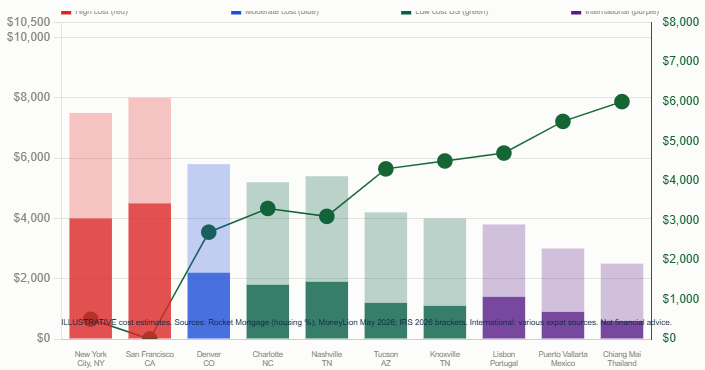
$10,000/month income benchmark by location (illustrative): HIGH COST (NYC, San Francisco, Honolulu): tight to moderate -- housing alone can be $3,500-5,000+; not much surplus. MODERATE COST (Charlotte NC, Austin TX, Denver CO, Nashville TN): comfortable -- housing $1,500-2,500; good discretionary surplus; no state income tax in TX/TN. LOW COST (Tucson AZ, Knoxville TN, Oklahoma City OK, Midwest mid-size cities): generous -- housing $900-1,400; significant surplus for travel and savings. INTERNATIONAL (Mexico, Portugal, Panama, Thailand): wealthy -- $10k is upper-income level; full-service lifestyle at well under $5,000/month. Sources: Rocket Mortgage (housing % of income); MoneyLion May 2026 (cost of living). Not financial advice. All figures approximate.
The Budget $10k Retiree: lives in a moderate-cost city, mortgage-free, in a paid-off home. Spends $1,200/month on housing; $600/month on food; $500/month on transportation; $600/month on healthcare. Core expenses: $2,900/month. Discretionary: $2,000/month (one international trip per year, dining out 2–3 times per week, hobbies). After tax ($8,500 net): surplus of $3,600/month flowing into savings for emergencies, long-term care, or grandchildren’s education. This retiree is financially secure, has excellent lifestyle quality, and is building a growing financial buffer.
The Balanced $10k Retiree: lives in a moderately high-cost city, rents a good apartment ($2,000/month). Core expenses: $4,500/month. Discretionary: $2,500/month (two international trips, regular dining, golf or other active hobby, cultural subscriptions). After tax net: $8,500. Surplus: $1,500/month. Comfortable but requiring some discipline; has limited room for large unplanned expenses.
The Affluent $10k Retiree (low-cost location or abroad): lives in Portugal, Mexico, or a low-cost US state. Total monthly cost: $4,000–4,500 including housing, healthcare, food, and leisure. After-tax net: $8,500. Surplus: $4,000–4,500/month. This retiree is effectively wealthy by local standards, accumulating wealth in retirement rather than depleting it. Not financial advice. These profiles are illustrative.
The mechanics of getting there follow the same principles as any retirement accumulation plan, but at a higher savings rate and over a longer time horizon. Using employer 401(k) matching fully is the first step; maximising contributions to the 2026 limit ($24,500 for under 50; $32,000 for ages 50–59 and 63+; $35,750 for ages 60–63 with the SECURE 2.0 super catch-up) follows. Supplementing with a Roth IRA ($7,000/year; $8,000 over 50) builds the tax-free income pool that reduces IRMAA exposure and taxes in retirement. A consistent, long-term equity allocation in a low-cost index fund has historically been the most reliable path to the portfolio required.
The 247 Wall Street analysis (July 2026) of what it takes to fund a $15,000/month retirement concluded that ‘a 50-year-old starting from zero needs to save closer to $6,500 a month’ to reach the $2.9 million portfolio target. Scaling that to $2.44 million for $10,000/month: a 50-year-old would need to save approximately $5,200–$5,500/month from age 50. Starting earlier makes the monthly savings requirement significantly more manageable. Not financial advice.
Building to $10,000/month: (1) Max your 401(k) contribution every year -- the 2026 limit is $24,500 ($32,000-$35,750 with catch-up). (2) Use Roth IRA or Roth 401(k) contributions to build the tax-free income pool that reduces taxes and IRMAA in retirement. (3) Delay Social Security to 70 -- the +24% benefit increase vs claiming at 67 can reduce your portfolio requirement by up to $550,000. (4) Minimise investment fees -- each 0.5% in extra fees costs approximately $100,000 on a $2M portfolio over 20 years. (5) Consult a CFP by age 55 to run a retirement income gap analysis and identify specific actions to close the gap. Not financial advice.
But $10,000 gross is not $10,000 net. Federal taxes reduce it by $1,300–$1,580/month. Medicare IRMAA surcharges add another $42–84/month per person. Healthcare costs are the biggest variable. Location determines whether $10,000 is tight, comfortable, or wealthy. Tax structure matters: a retiree with significant Roth assets keeps dramatically more of their $10,000 than one entirely dependent on traditional IRA withdrawals.
Building to $10,000/month requires approximately $2.44 million in portfolio assets alongside average Social Security — roughly double the average worker’s retirement savings target. Getting there requires starting early, maximising tax-advantaged contributions, delaying Social Security, minimising fees, and planning the income mix deliberately. The payoff is a retirement that puts you firmly above the financial stress line and gives you the resources to fully live the life you saved for. Not financial, tax, or investment advice. Consult a qualified CFP for personalised guidance.
Yes -- by US data benchmarks, $10,000/month ($120,000/year) is a well-above-average retirement income. The Bureau of Labor Statistics Consumer Expenditure Survey data for households aged 65-74 shows average spending of approximately $65,279/year ($5,440/month) as of 2025-2026. The median retiree income is approximately $47,000/year ($3,900/month, CBS News). $10,000/month is nearly double the average retiree spending and approximately 2.5x the median income. Yahoo Finance (February 2026): 'For most people, a six-figure annual budget is a luxury in retirement.' However, this is gross income -- taxes, Medicare, and healthcare costs reduce actual spending power. After federal tax, a single retiree has approximately $8,400-$8,670/month net. Not financial advice.
How much portfolio do you need to generate $10,000 a month in retirement?
Using Morningstar's 2026 safe withdrawal rate of 3.9% (30-year horizon, 90% probability): a single retiree with average Social Security of $2,071/month (January 2026) needs $7,929/month from the portfolio. $7,929 × 12 = $95,148/year ÷ 3.9% = approximately $2.44 million. (Yahoo Finance February 2026 confirms this calculation.) If you delay Social Security to age 70 and receive approximately $3,000/month, the portfolio requirement drops to approximately $2.13 million. A couple with combined SS of $4,142/month needs approximately $1.80 million. A more aggressive 5% withdrawal rate (SmartAsset's $1,000-a-month rule: $240,000 per $1,000/month) reduces the requirement to approximately $1.9 million -- but carries higher depletion risk over 30 years. Not financial advice.
What are the taxes on $10,000 a month in retirement?
At $120,000/year gross primarily from traditional IRA withdrawals plus average Social Security: a single filer can expect approximately $16,000-$19,000 in federal income tax annually ($1,333-$1,583/month). The 2026 standard deduction is approximately $15,000 for single filers. Up to 85% of Social Security benefits are taxable at this income level. Medicare IRMAA surcharges kick in at $106,000 MAGI for single filers, raising the Part B premium from $202.90 to approximately $244.60/month. Net spending power after federal tax: approximately $8,400-$8,670/month. State income taxes vary widely; 9 states have no income tax (Florida, Texas, Nevada, Washington, Alaska, Wyoming, South Dakota, Tennessee, New Hampshire). Roth IRA distributions are tax-free and do not count toward MAGI or Social Security taxation thresholds -- making Roth assets especially valuable at this income level. Not tax advice. Consult a CPA.
Where does $10,000 a month go furthest in retirement?
In the US: low-cost states with no income tax offer the best value. Knoxville TN, Tucson AZ, Oklahoma City OK, and mid-size Midwest cities typically offer comfortable housing at $900-$1,400/month, very low overall costs, and excellent healthcare access. No-income-tax states (Florida, Texas, Nevada, Tennessee) save $3,000-$8,000/year in state taxes. Florida (particularly smaller cities like Sarasota, Cape Coral, or St. Augustine outside Miami) combines no income tax with warm weather at moderate cost. Internationally: $10,000/month is wealthy in Mexico (Ajijic, San Miguel de Allende, Puerto Vallarta), Portugal (Algarve, Porto), Panama (Boquete, Panama City), and Thailand (Chiang Mai). Private healthcare is available at a fraction of US costs; quality housing rents for $1,000-$2,000/month; and total living costs of $3,000-$4,500/month leave $5,500-$7,000/month as surplus. Not financial advice.
What is the $1,000-a-month rule for retirement?
The $1,000-a-month rule (also called the $240,000 rule) is a simple guideline: for every $1,000/month of income you want from your retirement portfolio, you need approximately $240,000 saved -- based on a 5% annual withdrawal rate ($240,000 × 5% = $12,000/year = $1,000/month). (SmartAsset; Yahoo Finance.) For $10,000/month total, if Social Security provides $2,071, you need $7,929/month from the portfolio: $7,929 × $240,000 / $1,000 = approximately $1.9 million at the 5% rate. The Morningstar 2026 more conservative 3.9% rate implies a higher requirement of approximately $2.44 million. The $240,000 rule is a useful planning shortcut but is slightly more aggressive than the Morningstar 2026 research-based rate. Use it for quick estimates; use 3.9% for conservative planning. Not financial advice.
Table of Contents
- $10,000 a Month: Putting the Number in Context
- What the Average American Retiree Actually Spends
- The Full $10,000/Month Budget: Where the Money Goes
- What It Costs to Build: The Portfolio Behind $10,000/Month
- Social Security’s Role: How Much It Contributes to $10,000/Month
- The Tax Reality of $10,000/Month Retirement Income
- Medicare and IRMAA: The Hidden Cost at $120,000 a Year
- Healthcare Costs: The Biggest Budget Wildcard
- Location, Location, Location: Where $10,000/Month Is Rich, Middle-Class, or Stretched
- The Three $10,000/Month Lifestyles: Budget, Balanced, and Affluent
- Building to $10,000/Month: The Accumulation Plan
- Conclusion: $10,000 a Month Is a Top-Tier Retirement — Use It Wisely
- Frequently Asked Questions
The $10k/month budget — what it buys and what's left over
Portfolio required --- how much you need to build
Location matters — where $10k goes furthest
$10,000 a Month: Putting the Number in Context
$10,000 a month sounds like a lot. And by most American retirement standards, it is. The median US retiree income, as cited by CBS News, is approximately $47,000 per year, or roughly $3,900 per month. The Bureau of Labor Statistics Consumer Expenditure Survey data for households aged 65–74 shows average annual spending of approximately $65,279, or roughly $5,440 per month. $10,000 a month — $120,000 per year — is nearly double what the average household in that age group spends. It puts you firmly in the top 15–20% of retirement income earners.Yahoo Finance (February 2026), citing calculations for the $3K vs $5K vs $10K retirement income comparison, confirms: ‘For most people, a six-figure annual budget is a luxury in retirement.’ The Schroders 2025 US Retirement Survey found the average worker’s ‘magic number’ for retirement is $1.28 million — a portfolio that at 3.9% (Morningstar 2026 rate) generates approximately $49,920 per year, far short of $120,000. Getting to $10,000 a month requires building well above the average retirement savings target.
But $10,000 gross and $10,000 net are different things. Taxes, Medicare premiums, and healthcare costs reduce the spending power of that $10,000 significantly. And the purchasing power of $10,000 varies enormously by location: it is tight in Manhattan, comfortable in Charlotte, and genuinely affluent in Tucson, Mexico City, or Lisbon. This article works through the full picture. Not financial advice.
Average monthly Social Security benefit (January 2026): $2,071 per retired individual. (Yahoo Finance February 2026.) Average retired household spending (BLS 2025 data for 65-74): $65,279/year = $5,440/month (MoneyLion May 2026); Fidelity/BLS: $65,149/year ($5,429/month) (Yahoo Finance February 2026). Median retiree income: ~$47,000/year ($3,900/month). $10,000/month = $120,000/year = nearly double the average retiree spending. Schroders 2025 US Retirement Survey: average worker 'magic number' = $1.28 million. Sources: Yahoo Finance February 2026; BLS Consumer Expenditure Survey 2024/2025; MoneyLion May 2026; Schroders 2025.
What the Average American Retiree Actually Spends
Before deciding whether $10,000 a month is enough, it helps to understand what the average American retiree is spending. The most reliable source is the Bureau of Labor Statistics (BLS) Consumer Expenditure Survey, which tracks actual household spending by age group. The most recent data (2024 BLS survey, with 2025 updates cited by MoneyLion in May 2026 and Motley Fool in June 2026) shows:For households aged 65 and over, average annual expenditure is approximately $60,087 per year ($5,007/month), on pre-tax income of about $64,326/year ($5,360/month). The average retiree household has 1.7–1.8 people. For the 65–74 age band specifically — the most active, highest-spending retirement years — average spending rises to approximately $65,279/year ($5,440/month), consistent with Fidelity’s analysis of BLS data cited by Yahoo Finance (February 2026). Motley Fool’s June 2026 analysis notes that retirees’ income averages $5,622/month pre-tax, versus $8,684/month for all US households — a 35% lower income supporting a household that is 20–30% smaller.
Fidelity’s analysis found that typical retirees spend between 55% and 80% of their pre-retirement income, with an average of 67.5% (MoneyLion May 2026). Against the BLS average household income of $80,610, this suggests an average retiree needs approximately $54,400/year ($4,533/month) — consistent with the BLS actual expenditure data. $10,000 a month is therefore approximately 84% above what the data says the average household needs. Not financial advice.
The Full $10,000/Month Budget: Where the Money Goes
A $10,000 gross monthly income does not mean $10,000 in spending power. Federal income taxes, Medicare Part B premiums, and any state income taxes reduce the net figure before a single bill is paid. A single retiree drawing primarily from a traditional IRA at $120,000/year can expect to pay approximately $16,000–$19,000 in federal taxes (see Section 6), leaving approximately $101,000–$104,000 net per year, or approximately $8,400–$8,670 per month.Of that net, the primary budget categories for a mortgage-free single retiree are well-established. Housing — property taxes, homeowners insurance, utilities, and maintenance — runs approximately $1,200–$1,500 per month when there is no mortgage, compared to $2,500–3,500 for a renter in a moderate-cost city. Healthcare — Medicare Part B premiums ($202.90–$244.60/month in 2026), plus dental, vision, hearing, copays, prescriptions, and supplemental Medicare (Medigap or Medicare Advantage) — runs $500–$700 per month for a typical 65-year-old in good health.
The remaining budget, after housing and healthcare, is where the $10,000/month lifestyle becomes genuinely rewarding. A retiree at this income level has approximately $5,000–$6,000/month after core living costs for discretionary spending: international and domestic travel, dining, entertainment, gifts to family, hobbies, charitable giving, and a long-term care insurance policy ($2,000–$5,000/year for a comprehensive policy at age 65). This is the practical reason many people target $10,000 a month: not just to cover costs, but to fund the experiences that retirement is supposed to enable. Not financial advice.
$10,000/month retirement income breakdown (illustrative, single, mortgage-free): Gross: $10,000. Federal tax (approx.): -$1,330 to -$1,583/month (-$16,000 to -$19,000/year). Net spending power: ~$8,400-8,670/month. Housing (no mortgage): -$1,200 to -$1,500. Healthcare: -$500 to -$700. Food: -$600 to -$800. Transportation: -$500 to -$700. CORE TOTAL: ~$2,800-3,700. REMAINING for discretionary: ~$4,700-5,870. Travel budget (international + domestic): ~$1,000-1,500. Dining/entertainment: ~$400-600. Personal/misc: ~$300-400. Long-term care insurance: ~$167-417/month ($2k-5k/year). Surplus/emergency/gifts: ~$2,500-3,800. Note: state income taxes excluded (9 states have no income tax). Not financial advice. Illustrative only.
What It Costs to Build: The Portfolio Behind $10,000/Month
Generating $10,000 a month in retirement requires understanding how much of that needs to come from a portfolio versus guaranteed income sources. The calculation starts with Social Security. As of January 2026, the average monthly Social Security benefit for a retired individual is $2,071 (Yahoo Finance, citing SSA data). That leaves $7,929/month that the portfolio must provide.Using Morningstar’s 2026 safe withdrawal rate of 3.9% (cited by Investormint 2026 and Motley Fool December 2025), the required portfolio is: $7,929/month × 12 = $95,148/year ÷ 0.039 = approximately $2.44 million. Yahoo Finance (February 2026) confirms this calculation directly: ‘Based on the calculations above, you’d need $7,929 per month from retirement savings — which, coupled with $2,071 from Social Security, makes $10,000 per month.’ The 3.9% rate assumes a 30-year retirement horizon with a 90% probability of not running out of money (Morningstar 2026).
The portfolio requirement drops significantly if other income sources are available. A couple with two Social Security incomes combined at $4,142/month needs only $5,858/month from the portfolio — requiring approximately $1.8 million at 3.9%. A retiree with a pension providing $2,000/month needs only $3,929/month from the portfolio, requiring approximately $1.2 million. At a more aggressive 5% withdrawal rate (SmartAsset’s $1,000-a-month rule: $240,000 per $1,000/month), the portfolio requirement for $7,929/month drops to approximately $1.9 million. However, the 5% rate carries higher depletion risk over 30 years than Morningstar’s 3.9%. Not financial advice.
Social Security’s Role: How Much It Contributes to $10,000/Month
Social Security is the foundation of the income stack for most American retirees, and its contribution to the $10,000/month target varies enormously based on claiming decisions. The average monthly benefit of $2,071 (January 2026) represents 20.7% of the $10,000 target — meaningful but insufficient on its own. The maximum monthly benefit for someone claiming at their Full Retirement Age (FRA, which is 67 for those born in 1960 or later) in 2026 is $4,018 per month. For someone who delays to age 70, the maximum benefit rises to approximately $5,108/month (adding 24% to the FRA benefit).For a couple where both spouses delay Social Security to age 70 and both have strong earnings histories, combined benefits can approach $7,600–$8,000 per month — meaning a couple in this position needs only approximately $590,000–$615,000 in portfolio assets at 3.9% to generate $10,000/month total. This is why Social Security delay is one of the highest-return decisions available to most retirees: each year of delay past FRA adds approximately 8% to the monthly benefit for life, guaranteed, and inflation-adjusted through the annual COLA.
For a single retiree with average earnings history, the $2,071 average benefit represents 20.7% of the $10,000 target. But a retiree who spent 35 years in a high-earning career and delays to 70 could claim the maximum $5,108/month, representing 51% of the $10,000 target and reducing the portfolio requirement by more than $900,000 compared to the average claimant. The Social Security claiming decision is arguably more impactful on retirement income than any portfolio allocation decision. Not financial advice.
Social Security claiming strategy for $10,000/month: (1) For single retirees: if you can afford to delay, every year past FRA (67) adds approximately 8% to your monthly benefit. Delaying from 67 to 70 increases your benefit by approximately 24% for life. (2) For couples: the higher earner should delay as long as possible (ideally to 70); this maximises the survivor benefit, which continues for the remaining spouse for life. (3) The breakeven for delaying (recouping delayed benefits through higher monthly payments) is typically around age 79-82. Given average life expectancy well into the 80s, delay is often the optimal strategy. (4) Working past FRA while collecting SS: benefits are not reduced (the earnings test only applies before FRA). Consult a Social Security expert or CFP. Not financial advice.
The Tax Reality of $10,000/Month Retirement Income
$10,000 a month sounds like $120,000 to spend. The federal tax system reduces that. At $120,000 in gross annual retirement income, a single retiree is subject to federal income tax at 2026 rates. The 2026 standard deduction for a single filer is approximately $15,000. With most income from a traditional IRA (where all withdrawals are ordinary income), the tax calculation for a single retiree on $120,000 gross: approximately $16,000–$19,000 in federal tax annually, depending on the Social Security portion of income and applicable deductions.The Social Security taxation layer adds complexity. At a combined income above $34,000 for single filers (which $120,000 gross far exceeds), up to 85% of Social Security benefits become taxable as ordinary income. This means the SS portion of the income is not tax-free — a common retirement planning misconception. However, a retiree with a portion of their income from Roth IRA distributions has a significant advantage: Roth withdrawals are entirely tax-free, do not count toward combined income for Social Security taxation purposes, and do not count toward MAGI for Medicare IRMAA surcharges. This is the central argument for building Roth assets before retirement.
The net effect: a single retiree generating $10,000/month gross from a traditional IRA plus average Social Security ends up with approximately $8,400–$8,670/month in net spending power after federal taxes. A retiree generating the same $10,000 through a mix of Roth distributions, taxable account withdrawals (with favorable capital gains rates), and Social Security might retain $9,000–$9,500 net — a meaningful difference of $600–$1,000/month over a 30-year retirement that can add up to $216,000–$360,000. Not financial or tax advice. Consult a CFP or CPA.
IRMAA: Medicare Part B surcharge at $120,000 MAGI. The standard 2026 Medicare Part B premium is $202.90/month per person. IRMAA (Income-Related Monthly Adjustment Amount) surcharges apply when MAGI exceeds $106,000/year for single filers. At $120,000 MAGI, Part B premium rises to approximately $244.60/month (IRMAA Tier 1) -- an extra $41.70/month ($500/year) per person. (247 Wall Street July 2026 citing 2026 Medicare figures.) For a couple both on Medicare, the IRMAA surcharge at $120,000+ combined MAGI can be double this. Roth IRA distributions do NOT count toward MAGI for IRMAA purposes -- a powerful advantage. Not tax advice.
Medicare and IRMAA: The Hidden Cost at $120,000 a Year
Medicare is not free for $10,000/month retirees. The 2026 standard Part B premium is $202.90 per month per person — covering outpatient care, doctor visits, and preventive services. For a single retiree with $120,000 in MAGI (Modified Adjusted Gross Income), the IRMAA Tier 1 surcharge pushes the monthly premium to approximately $244.60/month, an extra $500/year per person. For a married couple both on Medicare with combined MAGI exceeding $212,000, the IRMAA surcharge doubles.Medicare Part A (hospitalisation) is typically premium-free for those who paid Medicare taxes for 10+ years. Part D (prescription drugs) adds approximately $30–75/month depending on the plan. A comprehensive Medigap (Medicare Supplement) policy, which covers the gaps in standard Medicare — deductibles, co-insurance, and out-of-pocket limits — costs approximately $100–$300/month at age 65 depending on plan type and location. The total Medicare cost for a single retiree at $10,000/month income is approximately $375–$525/month, which is higher than many people plan for.
The IRMAA trap is particularly relevant for retirees who take large IRA distributions in a single year — for example, to fund a home renovation or make a large gift. A one-time income spike that pushes MAGI above $106,000 triggers IRMAA surcharges for the following year, since Medicare uses a two-year lookback period. Roth conversions done before the IRMAA threshold, spreading large distributions across multiple tax years, and using Roth distributions (which don’t count toward MAGI) are the primary tools for managing this. Not financial or tax advice.
Healthcare Costs: The Biggest Budget Wildcard
Healthcare is the spending category that most differentiates a $10,000/month retirement plan from one that fails. The BLS Consumer Expenditure Survey data shows average healthcare spending for 65+ households of approximately $540/month. But this is an average that includes healthy 65-year-olds and very sick 85-year-olds. The realistic range is $500–$2,000/month, with costs that tend to increase significantly in the later years of retirement.A 2026 Fidelity research estimate put the average healthcare cost for a 65-year-old couple over a 20-year retirement at approximately $300,000–$330,000 in today’s dollars — an average of $15,000–$16,500/year per couple, or $1,250–$1,375/month. For a single retiree, approximately half that amount. These figures include Medicare premiums, out-of-pocket costs, dental, vision, and hearing — but typically exclude long-term care, which is a separate and potentially catastrophic cost.
Long-term care — nursing home, assisted living, or in-home care for activities of daily living — can run $4,000–8,000/month or more in 2026. A standalone long-term care insurance policy purchased at age 65 can cost $2,000–5,000/year depending on benefit level and inflation protection. At $10,000/month income, a retiree has the financial capacity to purchase a meaningful LTC policy — one of the most important uses of the surplus above the median retirement budget. Not financial advice.
Location, Location, Location: Where $10,000/Month Is Rich, Middle-Class, or Stretched
The same $10,000 monthly income produces fundamentally different retirement experiences depending on where you live. This is one of the most consequential and underappreciated dimensions of retirement planning. The MoneyLion (May 2026) analysis found that the average retiree would need $41,400/year to live comfortably nationally — and that this figure is achievable in roughly half of US counties at $48,000/year ($4,000/month). At $10,000/month, you are well above the national comfort threshold in virtually every US market.The variation is most extreme in housing. In New York City or San Francisco, a decent two-bedroom apartment rents for $3,500–5,000/month, consuming 35–50% of a $10,000 gross income before any other bill. In Tucson, Arizona, the equivalent costs $1,100–1,400/month. In Charlotte, North Carolina or Nashville, Tennessee: $1,500–2,000. The no-income-tax states (Florida, Texas, Nevada, Washington, Alaska, Wyoming, South Dakota, Tennessee, New Hampshire) are particularly advantageous for $10,000/month retirees, saving $3,000–8,000/year in state taxes depending on the state.
Internationally, $10,000/month is transformative. In Mexico (Ajijic, Puerto Vallarta, San Miguel de Allende), Portugal (Lisbon, Porto, the Algarve), Panama, Thailand, or Colombia, $10,000/month is wealthy. High-quality apartments rent for $1,000–2,000/month; private healthcare is available at a fraction of US costs; and a full-service lifestyle costs less than half what it would in a US city. An estimated 700,000–1,000,000 Americans are currently living abroad in retirement, many specifically because $10,000/month goes dramatically further outside the US. Not financial advice.
$10,000/month income benchmark by location (illustrative): HIGH COST (NYC, San Francisco, Honolulu): tight to moderate -- housing alone can be $3,500-5,000+; not much surplus. MODERATE COST (Charlotte NC, Austin TX, Denver CO, Nashville TN): comfortable -- housing $1,500-2,500; good discretionary surplus; no state income tax in TX/TN. LOW COST (Tucson AZ, Knoxville TN, Oklahoma City OK, Midwest mid-size cities): generous -- housing $900-1,400; significant surplus for travel and savings. INTERNATIONAL (Mexico, Portugal, Panama, Thailand): wealthy -- $10k is upper-income level; full-service lifestyle at well under $5,000/month. Sources: Rocket Mortgage (housing % of income); MoneyLion May 2026 (cost of living). Not financial advice. All figures approximate.
The Three $10,000/Month Lifestyles: Budget, Balanced, and Affluent
$10,000 a month is a target, not a lifestyle specification. The same gross income produces dramatically different retirement experiences depending on spending priorities, location, and housing status. The following three profiles illustrate how different $10,000/month can look in practice.The Budget $10k Retiree: lives in a moderate-cost city, mortgage-free, in a paid-off home. Spends $1,200/month on housing; $600/month on food; $500/month on transportation; $600/month on healthcare. Core expenses: $2,900/month. Discretionary: $2,000/month (one international trip per year, dining out 2–3 times per week, hobbies). After tax ($8,500 net): surplus of $3,600/month flowing into savings for emergencies, long-term care, or grandchildren’s education. This retiree is financially secure, has excellent lifestyle quality, and is building a growing financial buffer.
The Balanced $10k Retiree: lives in a moderately high-cost city, rents a good apartment ($2,000/month). Core expenses: $4,500/month. Discretionary: $2,500/month (two international trips, regular dining, golf or other active hobby, cultural subscriptions). After tax net: $8,500. Surplus: $1,500/month. Comfortable but requiring some discipline; has limited room for large unplanned expenses.
The Affluent $10k Retiree (low-cost location or abroad): lives in Portugal, Mexico, or a low-cost US state. Total monthly cost: $4,000–4,500 including housing, healthcare, food, and leisure. After-tax net: $8,500. Surplus: $4,000–4,500/month. This retiree is effectively wealthy by local standards, accumulating wealth in retirement rather than depleting it. Not financial advice. These profiles are illustrative.
Building to $10,000/Month: The Accumulation Plan
Reaching $10,000/month in retirement income requires either a portfolio of approximately $2.44 million (supplemented by average Social Security) or some combination of higher Social Security, pension, and/or annuity income that reduces the portfolio requirement. The Schroders 2025 US Retirement Survey found the average worker’s retirement magic number is $1.28 million — a portfolio that generates only $49,920/year at 3.9%. Building to $2.44 million requires approximately doubling the average accumulation goal.The mechanics of getting there follow the same principles as any retirement accumulation plan, but at a higher savings rate and over a longer time horizon. Using employer 401(k) matching fully is the first step; maximising contributions to the 2026 limit ($24,500 for under 50; $32,000 for ages 50–59 and 63+; $35,750 for ages 60–63 with the SECURE 2.0 super catch-up) follows. Supplementing with a Roth IRA ($7,000/year; $8,000 over 50) builds the tax-free income pool that reduces IRMAA exposure and taxes in retirement. A consistent, long-term equity allocation in a low-cost index fund has historically been the most reliable path to the portfolio required.
The 247 Wall Street analysis (July 2026) of what it takes to fund a $15,000/month retirement concluded that ‘a 50-year-old starting from zero needs to save closer to $6,500 a month’ to reach the $2.9 million portfolio target. Scaling that to $2.44 million for $10,000/month: a 50-year-old would need to save approximately $5,200–$5,500/month from age 50. Starting earlier makes the monthly savings requirement significantly more manageable. Not financial advice.
Building to $10,000/month: (1) Max your 401(k) contribution every year -- the 2026 limit is $24,500 ($32,000-$35,750 with catch-up). (2) Use Roth IRA or Roth 401(k) contributions to build the tax-free income pool that reduces taxes and IRMAA in retirement. (3) Delay Social Security to 70 -- the +24% benefit increase vs claiming at 67 can reduce your portfolio requirement by up to $550,000. (4) Minimise investment fees -- each 0.5% in extra fees costs approximately $100,000 on a $2M portfolio over 20 years. (5) Consult a CFP by age 55 to run a retirement income gap analysis and identify specific actions to close the gap. Not financial advice.
Conclusion
$10,000 a month is nearly double what the average American retiree spends, positions you in the top 15–20% of retirement income earners, and provides a financial cushion that the majority of retirees never achieve. The BLS data is clear: the average 65–74-year-old household spends $5,440/month. At $10,000, you have $4,500–$5,000 of monthly headroom to fund the experiences, security, and generosity that make retirement meaningful.But $10,000 gross is not $10,000 net. Federal taxes reduce it by $1,300–$1,580/month. Medicare IRMAA surcharges add another $42–84/month per person. Healthcare costs are the biggest variable. Location determines whether $10,000 is tight, comfortable, or wealthy. Tax structure matters: a retiree with significant Roth assets keeps dramatically more of their $10,000 than one entirely dependent on traditional IRA withdrawals.
Building to $10,000/month requires approximately $2.44 million in portfolio assets alongside average Social Security — roughly double the average worker’s retirement savings target. Getting there requires starting early, maximising tax-advantaged contributions, delaying Social Security, minimising fees, and planning the income mix deliberately. The payoff is a retirement that puts you firmly above the financial stress line and gives you the resources to fully live the life you saved for. Not financial, tax, or investment advice. Consult a qualified CFP for personalised guidance.
Frequently Asked Questions
Is $10,000 a month a good retirement income?Yes -- by US data benchmarks, $10,000/month ($120,000/year) is a well-above-average retirement income. The Bureau of Labor Statistics Consumer Expenditure Survey data for households aged 65-74 shows average spending of approximately $65,279/year ($5,440/month) as of 2025-2026. The median retiree income is approximately $47,000/year ($3,900/month, CBS News). $10,000/month is nearly double the average retiree spending and approximately 2.5x the median income. Yahoo Finance (February 2026): 'For most people, a six-figure annual budget is a luxury in retirement.' However, this is gross income -- taxes, Medicare, and healthcare costs reduce actual spending power. After federal tax, a single retiree has approximately $8,400-$8,670/month net. Not financial advice.
How much portfolio do you need to generate $10,000 a month in retirement?
Using Morningstar's 2026 safe withdrawal rate of 3.9% (30-year horizon, 90% probability): a single retiree with average Social Security of $2,071/month (January 2026) needs $7,929/month from the portfolio. $7,929 × 12 = $95,148/year ÷ 3.9% = approximately $2.44 million. (Yahoo Finance February 2026 confirms this calculation.) If you delay Social Security to age 70 and receive approximately $3,000/month, the portfolio requirement drops to approximately $2.13 million. A couple with combined SS of $4,142/month needs approximately $1.80 million. A more aggressive 5% withdrawal rate (SmartAsset's $1,000-a-month rule: $240,000 per $1,000/month) reduces the requirement to approximately $1.9 million -- but carries higher depletion risk over 30 years. Not financial advice.
What are the taxes on $10,000 a month in retirement?
At $120,000/year gross primarily from traditional IRA withdrawals plus average Social Security: a single filer can expect approximately $16,000-$19,000 in federal income tax annually ($1,333-$1,583/month). The 2026 standard deduction is approximately $15,000 for single filers. Up to 85% of Social Security benefits are taxable at this income level. Medicare IRMAA surcharges kick in at $106,000 MAGI for single filers, raising the Part B premium from $202.90 to approximately $244.60/month. Net spending power after federal tax: approximately $8,400-$8,670/month. State income taxes vary widely; 9 states have no income tax (Florida, Texas, Nevada, Washington, Alaska, Wyoming, South Dakota, Tennessee, New Hampshire). Roth IRA distributions are tax-free and do not count toward MAGI or Social Security taxation thresholds -- making Roth assets especially valuable at this income level. Not tax advice. Consult a CPA.
Where does $10,000 a month go furthest in retirement?
In the US: low-cost states with no income tax offer the best value. Knoxville TN, Tucson AZ, Oklahoma City OK, and mid-size Midwest cities typically offer comfortable housing at $900-$1,400/month, very low overall costs, and excellent healthcare access. No-income-tax states (Florida, Texas, Nevada, Tennessee) save $3,000-$8,000/year in state taxes. Florida (particularly smaller cities like Sarasota, Cape Coral, or St. Augustine outside Miami) combines no income tax with warm weather at moderate cost. Internationally: $10,000/month is wealthy in Mexico (Ajijic, San Miguel de Allende, Puerto Vallarta), Portugal (Algarve, Porto), Panama (Boquete, Panama City), and Thailand (Chiang Mai). Private healthcare is available at a fraction of US costs; quality housing rents for $1,000-$2,000/month; and total living costs of $3,000-$4,500/month leave $5,500-$7,000/month as surplus. Not financial advice.
What is the $1,000-a-month rule for retirement?
The $1,000-a-month rule (also called the $240,000 rule) is a simple guideline: for every $1,000/month of income you want from your retirement portfolio, you need approximately $240,000 saved -- based on a 5% annual withdrawal rate ($240,000 × 5% = $12,000/year = $1,000/month). (SmartAsset; Yahoo Finance.) For $10,000/month total, if Social Security provides $2,071, you need $7,929/month from the portfolio: $7,929 × $240,000 / $1,000 = approximately $1.9 million at the 5% rate. The Morningstar 2026 more conservative 3.9% rate implies a higher requirement of approximately $2.44 million. The $240,000 rule is a useful planning shortcut but is slightly more aggressive than the Morningstar 2026 research-based rate. Use it for quick estimates; use 3.9% for conservative planning. Not financial advice.
0 Comments
Be the first to share your thoughts on this article.