

Retirement
I’m 62 With $5.3 Million: Can I Have a Luxury Retirement?

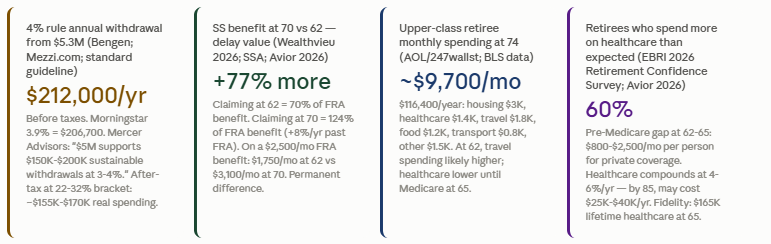
You’ve done something that fewer than one in a hundred Americans manages to do. You have $5.3 million, you’re 62, and the word retirement is no longer hypothetical — it’s the actual question on the table. And the question you’re really asking is not whether you can afford to retire. You can. The question is whether the retirement you have earned — the travel, the home, the lifestyle, the freedom from compromise — is sustainable. Whether the money you built over a career will match the retirement you imagined. This article answers that question honestly, with real numbers. The 4% rule on $5.3 million generates $212,000 per year before taxes. Mercer Advisors estimates sustainable withdrawals of $150,000–$200,000 annually on a $5 million portfolio at a 3–4% rate. An upper-class retiree in their early 70s spends approximately $9,500–$10,500 per month on average. But taxes, healthcare, Social Security timing, and the sequence of your market returns will determine whether those numbers work in your favour or quietly erode a fortune that took decades to build.
The 2026 Northwestern Mutual Planning & Progress Study, cited by Avior Wealth Management, found that high-net-worth Americans estimate they need $2.67 million to retire comfortably. You have nearly double that. The question is not whether you have enough in the aggregate. The question is whether the specific decisions you make over the next three to five years — on Social Security timing, tax strategy, healthcare coverage, and withdrawal sequencing — will let the portfolio sustain the lifestyle you’ve worked toward, or quietly erode it through taxes, inflation, and compounding costs. Not financial advice.
How rare is $5M+ at retirement: 0.8% of US households reach $3M in retirement accounts (Federal Reserve data; Mezzi.com). Only 1.8% have $2M+. Roughly 3 in 4 millionaire retirees have between $1M-$3M (Boldin; 247wallst July 2026). 2026 Northwestern Mutual Study: HNW Americans estimate needing $2.67M to retire comfortably. At $5.3M, this person has roughly twice the estimated comfort threshold. Sources: Mezzi.com; 247wallst/Boldin July 2026; Avior Wealth Management 2026; Northwestern Mutual 2026. Not financial advice.
Morningstar recommends a more conservative 3.9% withdrawal rate for those preferring a cautious approach, which on $5.3 million generates $206,700 annually. At 3.5% — appropriate for someone retiring at 62 who could face a 30-35 year retirement — the annual withdrawal is $185,500. At 3% conservative, it is $159,000. Mercer Advisors’ guidance on $5 million portfolios is direct: ‘A $5 million portfolio can generally support approximately $150,000 to $200,000 of annual sustainable withdrawals using a 3–4% withdrawal rate.’ Importantly, Bengen himself updated his ceiling to 4.7% in 2025, per Mezzi.com, reflecting that higher current bond yields support a somewhat higher sustainable rate.
The critical caveat for someone retiring at 62 rather than 65 or 67: the longer the retirement horizon, the more conservative the appropriate withdrawal rate. A 62-year-old planning for a 30-year retirement has meaningfully more sequence of returns risk than a 70-year-old. Farther.com’s analysis of early retirement with $5 million specifically recommends considering withdrawal rates below the standard 4% to account for the longer horizon. Not financial advice.
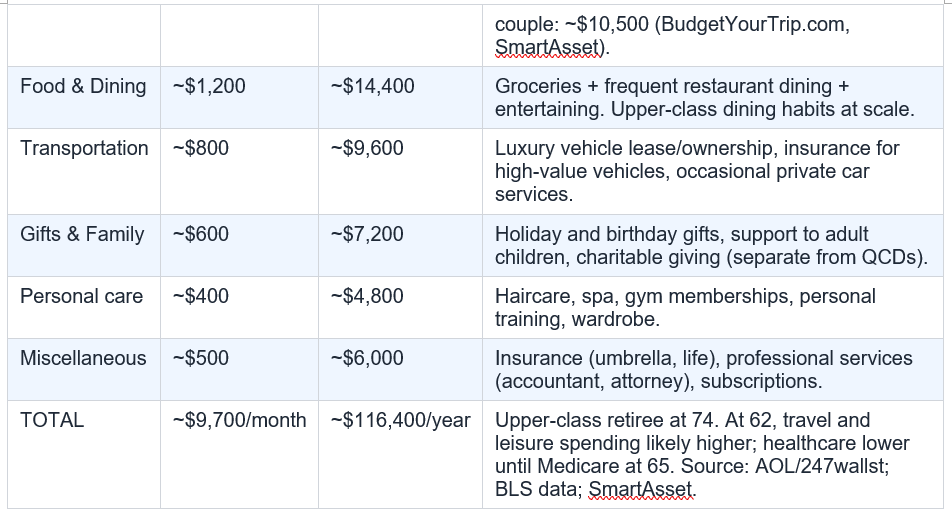
$116,400 per year is the spending profile of an established upper-class retirement in its settled phase. In the first five years of retirement at 62 — the ‘go-go’ years of early retirement — discretionary spending on travel and experiences typically runs higher. Financial planner research consistently shows that the first 5-10 years of retirement are the highest-spending period before the ‘spending smile’ curve begins its gradual decline. A luxury retirement budget for ages 62-67 might realistically run $140,000–$180,000 per year before taxes. Not financial advice.
At $212,000 in annual withdrawals from a traditional IRA or 401(k), you are in the 32% marginal federal income tax bracket (2026 rates). Your effective tax rate on $212,000 of ordinary income — after the standard deduction and assuming the 2026 tax brackets — is approximately 20-24%, meaning after-tax spendable income from the $212,000 withdrawal is approximately $160,000–$170,000. From that, healthcare and Medicare costs (including IRMAA) subtract a further $15,000–$25,000 annually. Real lifestyle spending might be approximately $140,000–$155,000 per year from a $212,000 gross withdrawal.
The 247wallst/Boldin July 2026 study found that median non-Social Security retirement income for the $5M+ tier is $51,600 per year — and when you layer typical Social Security on top, combined income is $76,000–$106,000 annually. This is significantly below the 4% rule headline, and it illustrates the point precisely: the gap between what you theoretically can withdraw and what millionaire retirees actually draw in practice is real, because taxes, healthcare, and behavioural caution all constrain actual spending. Not financial advice.
IRMAA at $5.3M: your high withdrawal income will almost certainly trigger Medicare IRMAA surcharges. 2026 standard Medicare Part B premium: $202.90/month. First IRMAA tier: $284.10/month. IRMAA is based on MAGI from 2 years prior. A year of $212,000 in withdrawals from pre-tax accounts in 2026 will affect your 2028 Medicare premiums. Well-structured Roth conversions and QCD strategies (up to $105,000/year tax-free from IRAs at age 70½+) can manage IRMAA exposure. Sources: 247wallst July 2026; Wealthvieu 2026; Avior Wealth Management 2026. Not tax advice. Consult a CPA.
Wealthvieu’s 2026 comprehensive retirement finance guide lays out the claiming structure clearly: claiming at 62 delivers 70% of your Full Retirement Age (FRA) benefit. Claiming at FRA (67 for those born in 1960 or later) delivers 100%. Delaying to age 70 delivers 124% — an 8% increase per year of delay past FRA, as confirmed by Avior Wealth Management 2026 and the Social Security Administration. On a benefit of $2,500 at FRA, claiming at 62 delivers $1,750/month; waiting to 70 delivers $3,100/month. That $1,350/month differential, compounded across 20 years of retirement, represents a very large sum.
With $5.3 million, you have the portfolio to sustain your lifestyle from investments alone until age 70 without touching Social Security. Every year of delay between 62 and 70 is an 8% permanent increase in a guaranteed, inflation-adjusted, government-backed income stream. For a high-net-worth retiree with a potentially long life, this is one of the highest-returning decisions available. The break-even age is approximately 78-80; if you live past that — likely for someone healthy at 62 — the delayed claiming strategy wins financially. Not financial advice.
Social Security strategy at $5.3M: delay claiming to 70 and fund the pre-SS years entirely from the portfolio. At 4% withdrawal on $5.3M, you have $212,000/year before taxes without Social Security. When SS begins at 70, reduce portfolio withdrawals by the benefit amount — extending the portfolio's longevity. For married couples: the higher earner should delay to 70 to maximise both the primary benefit and the survivor benefit. Sources: Wealthvieu 2026; Avior Wealth Management 2026; SSA. Not financial advice.
COBRA continuation coverage from a former employer can bridge the first 18 months but at the full premium plus up to 2% administrative fee. Private individual health plans for a 62-year-old couple can run $1,500–3,000 per month depending on coverage level, location, and health status. Over three years (62 to 65), that is $54,000–$108,000 in healthcare premiums alone — before any copays, deductibles, or out-of-pocket costs. Fidelity estimates a 65-year-old who retired in 2024 can expect to spend $165,000 on healthcare throughout retirement (SmartAsset). Healthcare compounds at 4–6% per year (Yahoo Finance 2026): by age 85, healthcare alone may consume $25,000–$40,000 per year in today’s dollars.
The upper-class retiree spending data from AOL/247wallst includes $1,400 per month for healthcare at age 74 — covering Medicare Part B/D premiums, IRMAA surcharges, a Medigap plan, and concierge care. The 60% of retirees who report spending more than expected on healthcare (2026 EBRI Retirement Confidence Survey, cited Avior Wealth Management) did not budget at this level. Not financial advice.
During these years, your ordinary income from the portfolio may be relatively low (you are controlling withdrawals; SS and RMDs have not yet started). Converting money from a traditional IRA to a Roth IRA in these lower-income years pays tax now at a lower rate, in exchange for: (1) all future growth in the Roth being permanently tax-free; (2) eliminating or reducing future RMDs, which can otherwise force large taxable withdrawals beginning at 73 that push you into higher brackets and trigger higher IRMAA; and (3) lowering lifetime Social Security taxation. Yahoo Finance’s 2026 analysis of a $2 million retiree scenario notes that ‘filling the 12% bracket (up to $50,400 of taxable income for a single filer in 2026) and selectively the 22% bracket (up to $105,700) with conversions reduces lifetime ordinary income, lowers future IRMAA surcharges, and trims Social Security taxation.’ At $5.3 million, this strategy is even more powerful. Not tax advice. Consult a CPA.
Avior Wealth Management’s 2026 retirement planning guide cites the RMD penalty directly: 25% of the missed distribution, reduced to 10% if corrected within two years. Managing RMDs proactively — through Roth conversions in the 62-72 window, Qualified Charitable Distributions (up to $105,000/year tax-free from IRAs at age 70½+, per Wealthvieu 2026), and strategic portfolio rebalancing — is one of the most important tax planning exercises for the $5 million retiree. BPM.com’s retirement planning guide notes that ‘large RMDs can also trigger or increase IRMAA surcharges, making coordination between RMD planning and Medicare premium management essential.’ Not tax advice. Consult a CPA.
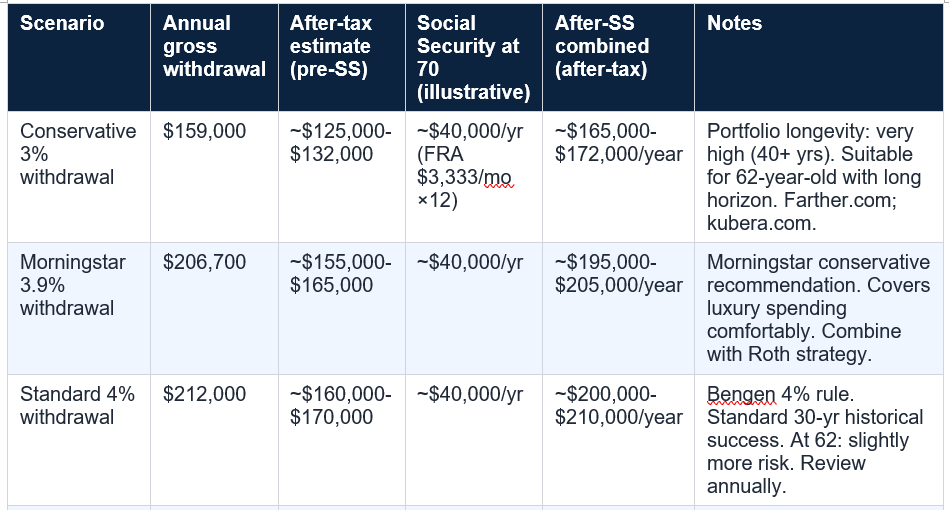
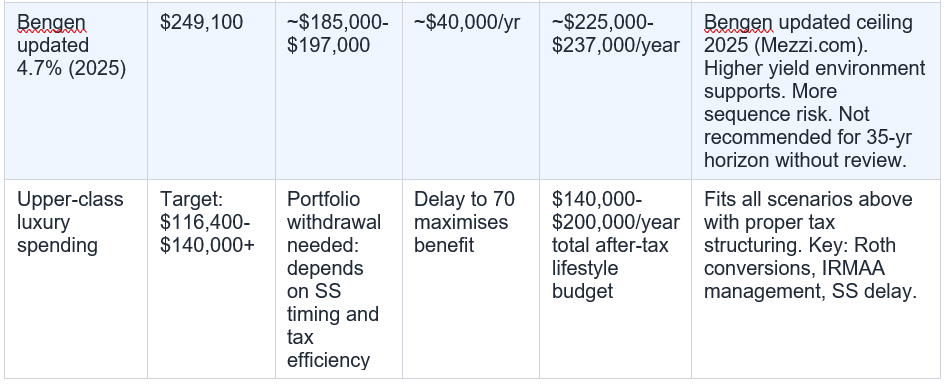
The conclusion from the model is clear: at $5.3 million and age 62, a luxury retirement spending $120,000–$180,000 per year in after-tax lifestyle income is sustainable at all credible withdrawal rates. The variables that determine whether it stays sustainable are taxes (Roth conversion strategy), healthcare costs (budget properly; IRMAA management), and Social Security timing (delay to 70 to lock in the higher permanent benefit). Not financial advice.
The Boldin data specifically for the $5 million-plus tier finds median non-Social Security income of $51,600 per year. Combined with Social Security, the $5M+ band produces $76,000–$106,000 in total combined income (247wallst July 2026). This is significantly below the 4% rule’s theoretical $200,000+ withdrawal, and it illustrates something important: having $5 million does not automatically translate into spending $200,000 per year. Many people with $5 million retire and spend $100,000-$130,000 — comfortable, well-insulated, but not at the upper ceiling of what the portfolio could support.
Morningstar’s David Blanchett’s research on the ‘retirement spending smile’ explains part of this: real, inflation-adjusted spending declines through the 60s and 70s, with a possible late uptick tied to healthcare costs (Boldin.com 2026; 247wallst July 2026). Early retirement enthusiasm for travel and experience gradually gives way to simpler, lower-cost living. The luxury retirement at 62 may cost more than the luxury retirement at 74, which is both a planning insight and a reassurance: if you spend a bit more in the first decade, the spending curve tends to moderate itself. Not financial advice.
Kubera.com’s analysis of $5 million retirement scenarios notes this directly: ‘large market downturns in the early years of retirement can drain principal.’ If a $5.3 million portfolio drops to $3.5 million in year two while you are withdrawing $212,000, the 4% rule now requires the portfolio to sustain the same nominal withdrawal from a much-reduced base. The practical mitigation is well-established: maintain two to three years of living expenses in cash or short-term instruments (CDs, T-bills, money market) that can fund withdrawals during a market downturn without selling equities at depressed prices. This cash buffer strategy, cited by Motley Fool 2025 and others, is the most practical and widely recommended protection against sequence risk. Not financial advice.
The 3% withdrawal rate recommendation for 62-year-olds (Farther.com; kubera.com) is itself a structural response to sequence risk: by withdrawing less, you build in a larger cushion against early portfolio losses. A 3.5% withdrawal on $5.3 million ($185,500/year) that combines with a delayed Social Security benefit of $40,000/year at 70 produces a combined pre-tax income of $225,500 — more than sufficient for a genuine luxury retirement with the sequence risk buffer built in. Not financial advice.
First: delay Social Security to 70. With $5.3 million, you can fund the gap. The 8% annual increase in a permanent, inflation-adjusted benefit is one of the best risk-free returns available. Second: budget healthcare properly, including the pre-Medicare gap from 62 to 65 and the compounding healthcare cost trajectory through your 70s and 80s. Third: use the Roth conversion window between 62 and 72 aggressively and intelligently to reduce lifetime tax burden and future RMD exposure. Fourth: maintain a two-to-three-year cash buffer against sequence of returns risk, especially in the first decade of retirement when portfolio withdrawals are most dangerous in a market downturn.
At $5.3 million with those four decisions made well, $120,000–$180,000 per year in after-tax lifestyle spending — enough for the travel, the home, the experiences, and the freedom — is not just possible. It is the likely outcome. The luxury retirement is not a question of having enough. It is a question of protecting and managing what you have built. Not financial, investment, or tax advice. Consult a fee-only CFP, CPA, and estate planning attorney for personalised guidance.
Multiple credible sources suggest the following annual sustainable withdrawals from $5.3 million: 4% rule (Bengen; Mezzi.com): $212,000/year before taxes. 3.9% (Morningstar conservative recommendation): $206,700/year before taxes. 3-4% range (Mercer Advisors FAQ on $5M portfolios): $159,000-$212,000/year before taxes. For someone retiring at 62 with a potential 30-35 year horizon, Farther.com and kubera.com recommend considering rates below the standard 4% to account for the longer period and greater sequence of returns risk. William Bengen updated his ceiling to 4.7% in 2025 (Mezzi.com), reflecting higher current bond yields. After taxes at typical brackets, the after-tax lifestyle budget from these withdrawals will be approximately $120,000-$175,000/year, depending on account types and tax structure. Sources: Mezzi.com; Mercer Advisors; Morningstar; Farther.com. Not financial advice.
Should I claim Social Security at 62 if I have $5.3 million?
Almost certainly not, though this is a decision requiring personalised advice. The core argument for waiting: claiming at 62 delivers permanently reduced benefits — approximately 70% of your Full Retirement Age (FRA) benefit, versus 100% at FRA (67 for those born 1960+) or 124% at age 70 (Wealthvieu 2026; SSA). Delayed retirement credits add approximately 8% per year past FRA up to age 70 (Avior Wealth Management 2026). With $5.3 million, you have the portfolio to fund your lifestyle entirely from investments until age 70 without needing Social Security income. The break-even age for delaying from 62 to 70 is approximately 80-82 — if you live past this (likely for a healthy 62-year-old), the higher lifetime benefit from delaying wins. For married couples, the higher earner's delayed claim also maximises the survivor benefit. Sources: Wealthvieu 2026; Avior Wealth Management 2026; SmartAsset; SSA. Not financial advice.
What does a luxury retirement actually cost per month?
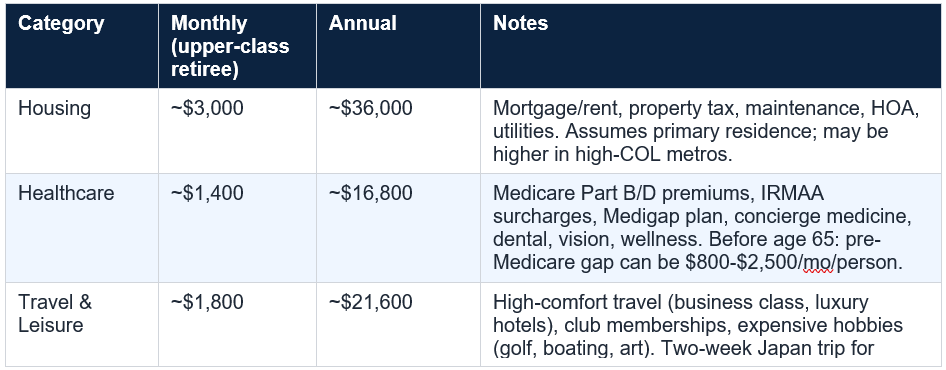
AOL and 247wallst's analysis of upper-class retiree spending (top 20% of earners, BLS data) found approximately $9,500-$10,500 per month = $114,000-$126,000 per year. The breakdown at age 74 approximately: housing $3,000/month; healthcare $1,400/month (Medicare premiums, IRMAA, concierge care, Medigap); travel and leisure $1,800/month (high-comfort travel, club memberships, expensive hobbies); food and dining $1,200/month; transportation $800/month (luxury vehicle, private car services); other $500-$1,000/month. Note: in early retirement (ages 62-67), discretionary travel and experience spending typically runs higher than the settled-phase 74-year-old profile, before the 'retirement spending smile' curve moderates spending through the 70s (David Blanchett/Morningstar research; Boldin.com 2026). Sources: AOL/247wallst; BLS; SmartAsset. Not financial advice.
What is IRMAA and how does it affect my retirement at $5.3 million?
IRMAA (Income-Related Monthly Adjustment Amount) is a Medicare surcharge that applies to Part B and Part D premiums when your Modified Adjusted Gross Income (MAGI) exceeds certain thresholds. The 2026 standard Medicare Part B premium is $202.90/month. At the first IRMAA tier, it rises to $284.10/month (247wallst July 2026). IRMAA is determined by MAGI from two years prior — so 2026 income affects 2028 Medicare premiums. At $5.3 million with significant pre-tax account balances, large withdrawals from traditional IRAs and 401(k)s will trigger IRMAA surcharges, potentially adding $1,000-$5,000+ per year to healthcare costs. Strategies to manage IRMAA: Roth conversions during the lower-income years before Social Security and RMDs begin (ages 62-72); Qualified Charitable Distributions (QCDs) from IRAs at age 70½+ to satisfy RMD obligations without MAGI recognition (up to $105,000/year in 2026; Wealthvieu 2026); careful withdrawal sequencing to stay below IRMAA thresholds where possible. Sources: 247wallst July 2026; Wealthvieu 2026; Avior Wealth Management 2026; BPM.com. Not tax advice. Consult a CPA.
What is the Roth conversion window and why does it matter for $5.3 million?
The Roth conversion window is the period between retirement (in your case, age 62) and when Social Security and Required Minimum Distributions (RMDs) begin to generate mandatory taxable income. During this window — roughly ages 62-72 — you control your taxable income almost entirely. Converting traditional IRA and 401(k) balances to a Roth IRA during these years means: (1) paying income tax now at current (potentially lower) rates; (2) all future growth in the Roth is completely tax-free; (3) Roth accounts are not subject to RMDs; (4) lower pre-tax balances at age 73 mean lower forced RMDs, which reduces future IRMAA exposure and bracket pressure. Yahoo Finance's 2026 analysis cited filling the 12% bracket (up to $50,400 single) and selectively the 22% bracket (up to $105,700 single) with conversions as reducing lifetime ordinary income and lowering future IRMAA. At $5.3 million with significant pre-tax balances, strategic Roth conversions during ages 62-72 can save tens of thousands of dollars in lifetime taxes. Sources: Yahoo Finance 2026; Wealthvieu 2026; Avior Wealth Management 2026. Not tax advice. Consult a CPA.
Table of Contents
- First, Just How Rare Is $5.3 Million at 62?
- What the Withdrawal Rules Say You Can Spend
- What Luxury Retirement Actually Costs Month by Month
- The $212,000 After-Tax Reality
- Decision #1: Social Security — The Most Consequential Choice You’ll Make
- Decision #2: The Healthcare Gap Between 62 and 65
- Decision #3: The Roth Conversion Window You Cannot Get Back
- Decision #4: Managing RMDs Before They Manage You
- The Complete $5.3M Retirement Income Model
- What the Spending Research Actually Shows About Millionaire Retirees
- The Sequence of Returns Risk at 62
- Conclusion: Yes. With These Four Conditions.
- Frequently Asked Questions
First, Just How Rare Is $5.3 Million at 62?
Let’s start with the context, because it matters. Mezzi.com’s analysis of Federal Reserve data found that only 1.8% of US households have $2 million or more in retirement accounts, and just 0.8% reach $3 million. The $5 million tier is not tracked as a standard Federal Reserve category because so few households reach it. What we know from wealth distribution data is that three out of four $1 million-plus households sit between $1 million and $3 million in net worth (247wallst/Boldin, July 2026). The $5 million tier is rare. The $5 million tier at age 62 — with twenty or thirty years of retirement ahead — is the planning question that most retirement guides never seriously engage with, because most of their readers are not in it.The 2026 Northwestern Mutual Planning & Progress Study, cited by Avior Wealth Management, found that high-net-worth Americans estimate they need $2.67 million to retire comfortably. You have nearly double that. The question is not whether you have enough in the aggregate. The question is whether the specific decisions you make over the next three to five years — on Social Security timing, tax strategy, healthcare coverage, and withdrawal sequencing — will let the portfolio sustain the lifestyle you’ve worked toward, or quietly erode it through taxes, inflation, and compounding costs. Not financial advice.
How rare is $5M+ at retirement: 0.8% of US households reach $3M in retirement accounts (Federal Reserve data; Mezzi.com). Only 1.8% have $2M+. Roughly 3 in 4 millionaire retirees have between $1M-$3M (Boldin; 247wallst July 2026). 2026 Northwestern Mutual Study: HNW Americans estimate needing $2.67M to retire comfortably. At $5.3M, this person has roughly twice the estimated comfort threshold. Sources: Mezzi.com; 247wallst/Boldin July 2026; Avior Wealth Management 2026; Northwestern Mutual 2026. Not financial advice.
What the Withdrawal Rules Say You Can Spend
The 4% rule is the most cited guideline in retirement planning — pioneered by financial planner William Bengen in 1994, it states that you can withdraw 4% of your portfolio in year one and adjust for inflation annually, with a historically strong probability of the money lasting 30 years. On $5.3 million, 4% generates $212,000 per year before taxes. Mezzi.com’s analysis of the rule puts it plainly: ‘With $5 million saved, applying the 4% withdrawal rule may provide about $200,000 annually, or roughly $16,667 per month before taxes.’Morningstar recommends a more conservative 3.9% withdrawal rate for those preferring a cautious approach, which on $5.3 million generates $206,700 annually. At 3.5% — appropriate for someone retiring at 62 who could face a 30-35 year retirement — the annual withdrawal is $185,500. At 3% conservative, it is $159,000. Mercer Advisors’ guidance on $5 million portfolios is direct: ‘A $5 million portfolio can generally support approximately $150,000 to $200,000 of annual sustainable withdrawals using a 3–4% withdrawal rate.’ Importantly, Bengen himself updated his ceiling to 4.7% in 2025, per Mezzi.com, reflecting that higher current bond yields support a somewhat higher sustainable rate.
The critical caveat for someone retiring at 62 rather than 65 or 67: the longer the retirement horizon, the more conservative the appropriate withdrawal rate. A 62-year-old planning for a 30-year retirement has meaningfully more sequence of returns risk than a 70-year-old. Farther.com’s analysis of early retirement with $5 million specifically recommends considering withdrawal rates below the standard 4% to account for the longer horizon. Not financial advice.
What Luxury Retirement Actually Costs Month by Month
The word ‘luxury’ in retirement planning is often used imprecisely. Let’s define it in actual spending numbers. AOL and 247wallst’s analysis of upper-class retiree spending at age 74 — drawing on Bureau of Labor Statistics data and financial planning research — found that upper-class retirees in the top 20% of earners spend approximately $9,500–10,500 per month, driven heavily by discretionary choices. Here is that breakdown:$116,400 per year is the spending profile of an established upper-class retirement in its settled phase. In the first five years of retirement at 62 — the ‘go-go’ years of early retirement — discretionary spending on travel and experiences typically runs higher. Financial planner research consistently shows that the first 5-10 years of retirement are the highest-spending period before the ‘spending smile’ curve begins its gradual decline. A luxury retirement budget for ages 62-67 might realistically run $140,000–$180,000 per year before taxes. Not financial advice.
The $212,000 After-Tax Reality
The 4% rule on $5.3 million generates $212,000 before taxes. What arrives in your bank account for actual spending is substantially less. The gap depends on your specific account types — how much is in traditional pre-tax accounts like 401(k)s and IRAs versus Roth accounts versus taxable brokerage — but here is the illustrative maths for a retiree drawing primarily from pre-tax accounts.At $212,000 in annual withdrawals from a traditional IRA or 401(k), you are in the 32% marginal federal income tax bracket (2026 rates). Your effective tax rate on $212,000 of ordinary income — after the standard deduction and assuming the 2026 tax brackets — is approximately 20-24%, meaning after-tax spendable income from the $212,000 withdrawal is approximately $160,000–$170,000. From that, healthcare and Medicare costs (including IRMAA) subtract a further $15,000–$25,000 annually. Real lifestyle spending might be approximately $140,000–$155,000 per year from a $212,000 gross withdrawal.
The 247wallst/Boldin July 2026 study found that median non-Social Security retirement income for the $5M+ tier is $51,600 per year — and when you layer typical Social Security on top, combined income is $76,000–$106,000 annually. This is significantly below the 4% rule headline, and it illustrates the point precisely: the gap between what you theoretically can withdraw and what millionaire retirees actually draw in practice is real, because taxes, healthcare, and behavioural caution all constrain actual spending. Not financial advice.
IRMAA at $5.3M: your high withdrawal income will almost certainly trigger Medicare IRMAA surcharges. 2026 standard Medicare Part B premium: $202.90/month. First IRMAA tier: $284.10/month. IRMAA is based on MAGI from 2 years prior. A year of $212,000 in withdrawals from pre-tax accounts in 2026 will affect your 2028 Medicare premiums. Well-structured Roth conversions and QCD strategies (up to $105,000/year tax-free from IRAs at age 70½+) can manage IRMAA exposure. Sources: 247wallst July 2026; Wealthvieu 2026; Avior Wealth Management 2026. Not tax advice. Consult a CPA.
Decision #1: Social Security — The Most Consequential Choice You’ll Make
At 62, you are eligible to claim Social Security right now. You should almost certainly not do so. This is the first and most consequential decision in a $5.3 million retirement, because the choice you make at 62 is permanent, and its financial impact compounds across every year of a potentially 30-year retirement.Wealthvieu’s 2026 comprehensive retirement finance guide lays out the claiming structure clearly: claiming at 62 delivers 70% of your Full Retirement Age (FRA) benefit. Claiming at FRA (67 for those born in 1960 or later) delivers 100%. Delaying to age 70 delivers 124% — an 8% increase per year of delay past FRA, as confirmed by Avior Wealth Management 2026 and the Social Security Administration. On a benefit of $2,500 at FRA, claiming at 62 delivers $1,750/month; waiting to 70 delivers $3,100/month. That $1,350/month differential, compounded across 20 years of retirement, represents a very large sum.
With $5.3 million, you have the portfolio to sustain your lifestyle from investments alone until age 70 without touching Social Security. Every year of delay between 62 and 70 is an 8% permanent increase in a guaranteed, inflation-adjusted, government-backed income stream. For a high-net-worth retiree with a potentially long life, this is one of the highest-returning decisions available. The break-even age is approximately 78-80; if you live past that — likely for someone healthy at 62 — the delayed claiming strategy wins financially. Not financial advice.
Social Security strategy at $5.3M: delay claiming to 70 and fund the pre-SS years entirely from the portfolio. At 4% withdrawal on $5.3M, you have $212,000/year before taxes without Social Security. When SS begins at 70, reduce portfolio withdrawals by the benefit amount — extending the portfolio's longevity. For married couples: the higher earner should delay to 70 to maximise both the primary benefit and the survivor benefit. Sources: Wealthvieu 2026; Avior Wealth Management 2026; SSA. Not financial advice.
Decision #2: The Healthcare Gap Between 62 and 65
Medicare begins at 65. Between 62 and 65, you are on your own for health insurance, and with a $5.3 million portfolio, you are above the ACA Marketplace subsidy threshold — you will pay full market rates for private health coverage. This is often the most underestimated cost in the plan for early retirees.COBRA continuation coverage from a former employer can bridge the first 18 months but at the full premium plus up to 2% administrative fee. Private individual health plans for a 62-year-old couple can run $1,500–3,000 per month depending on coverage level, location, and health status. Over three years (62 to 65), that is $54,000–$108,000 in healthcare premiums alone — before any copays, deductibles, or out-of-pocket costs. Fidelity estimates a 65-year-old who retired in 2024 can expect to spend $165,000 on healthcare throughout retirement (SmartAsset). Healthcare compounds at 4–6% per year (Yahoo Finance 2026): by age 85, healthcare alone may consume $25,000–$40,000 per year in today’s dollars.
The upper-class retiree spending data from AOL/247wallst includes $1,400 per month for healthcare at age 74 — covering Medicare Part B/D premiums, IRMAA surcharges, a Medigap plan, and concierge care. The 60% of retirees who report spending more than expected on healthcare (2026 EBRI Retirement Confidence Survey, cited Avior Wealth Management) did not budget at this level. Not financial advice.
Decision #3: The Roth Conversion Window You Cannot Get Back
Between ages 62 and 72 — after you retire but before Social Security begins (if you delay to 70) and before RMDs begin (at 73) — you have a window that many high-net-worth retirees fail to fully use: the Roth conversion window. This is one of the most financially significant strategies available at the $5 million level.During these years, your ordinary income from the portfolio may be relatively low (you are controlling withdrawals; SS and RMDs have not yet started). Converting money from a traditional IRA to a Roth IRA in these lower-income years pays tax now at a lower rate, in exchange for: (1) all future growth in the Roth being permanently tax-free; (2) eliminating or reducing future RMDs, which can otherwise force large taxable withdrawals beginning at 73 that push you into higher brackets and trigger higher IRMAA; and (3) lowering lifetime Social Security taxation. Yahoo Finance’s 2026 analysis of a $2 million retiree scenario notes that ‘filling the 12% bracket (up to $50,400 of taxable income for a single filer in 2026) and selectively the 22% bracket (up to $105,700) with conversions reduces lifetime ordinary income, lowers future IRMAA surcharges, and trims Social Security taxation.’ At $5.3 million, this strategy is even more powerful. Not tax advice. Consult a CPA.
Decision #4: Managing RMDs Before They Manage You
Required Minimum Distributions begin at age 73 under the SECURE 2.0 Act. For a $5.3 million portfolio (or the portion of it in pre-tax accounts), RMDs can become significant forced taxable income. At 73, the initial RMD factor is approximately 27.4 years; an IRA of $3 million, for example, would require a distribution of approximately $109,500 in the first RMD year. Large RMDs create two compounding problems: they push you into higher tax brackets, and they trigger higher IRMAA surcharges (because IRMAA is based on MAGI from 2 years prior).Avior Wealth Management’s 2026 retirement planning guide cites the RMD penalty directly: 25% of the missed distribution, reduced to 10% if corrected within two years. Managing RMDs proactively — through Roth conversions in the 62-72 window, Qualified Charitable Distributions (up to $105,000/year tax-free from IRAs at age 70½+, per Wealthvieu 2026), and strategic portfolio rebalancing — is one of the most important tax planning exercises for the $5 million retiree. BPM.com’s retirement planning guide notes that ‘large RMDs can also trigger or increase IRMAA surcharges, making coordination between RMD planning and Medicare premium management essential.’ Not tax advice. Consult a CPA.
The Complete $5.3M Retirement Income Model
Putting the numbers together in one place. All figures are illustrative, based on published guidelines and estimates. Not personalised financial advice. Actual results depend on portfolio composition, market performance, tax situation, and many other factors.The conclusion from the model is clear: at $5.3 million and age 62, a luxury retirement spending $120,000–$180,000 per year in after-tax lifestyle income is sustainable at all credible withdrawal rates. The variables that determine whether it stays sustainable are taxes (Roth conversion strategy), healthcare costs (budget properly; IRMAA management), and Social Security timing (delay to 70 to lock in the higher permanent benefit). Not financial advice.
What the Spending Research Actually Shows About Millionaire Retirees
Here is something counterintuitive about $5 million retirees that 247wallst’s July 2026 analysis makes plain: a $1.2 million retirement and a $4 million retirement look almost identical in actual spending. Housing, food, and healthcare cost about the same whether your portfolio is $1.5 million or $4 million. The research from the Federal Reserve Survey of Consumer Finances, JPMorgan’s 2026 Guide to Retirement, and Boldin’s planning data all find the same cluster: $1 million-plus households spend $70,000–$120,000 per year in retirement, regardless of whether the portfolio sits at $1.2 million or $4 million.The Boldin data specifically for the $5 million-plus tier finds median non-Social Security income of $51,600 per year. Combined with Social Security, the $5M+ band produces $76,000–$106,000 in total combined income (247wallst July 2026). This is significantly below the 4% rule’s theoretical $200,000+ withdrawal, and it illustrates something important: having $5 million does not automatically translate into spending $200,000 per year. Many people with $5 million retire and spend $100,000-$130,000 — comfortable, well-insulated, but not at the upper ceiling of what the portfolio could support.
Morningstar’s David Blanchett’s research on the ‘retirement spending smile’ explains part of this: real, inflation-adjusted spending declines through the 60s and 70s, with a possible late uptick tied to healthcare costs (Boldin.com 2026; 247wallst July 2026). Early retirement enthusiasm for travel and experience gradually gives way to simpler, lower-cost living. The luxury retirement at 62 may cost more than the luxury retirement at 74, which is both a planning insight and a reassurance: if you spend a bit more in the first decade, the spending curve tends to moderate itself. Not financial advice.
The Sequence of Returns Risk at 62
There is one risk that is specific to someone retiring at 62 with a 30+ year horizon that deserves explicit attention: sequence of returns risk. This is the risk that a significant market downturn in the early years of retirement — when you are actively withdrawing from the portfolio — can permanently impair the portfolio’s ability to sustain those withdrawals, even if the market subsequently recovers.Kubera.com’s analysis of $5 million retirement scenarios notes this directly: ‘large market downturns in the early years of retirement can drain principal.’ If a $5.3 million portfolio drops to $3.5 million in year two while you are withdrawing $212,000, the 4% rule now requires the portfolio to sustain the same nominal withdrawal from a much-reduced base. The practical mitigation is well-established: maintain two to three years of living expenses in cash or short-term instruments (CDs, T-bills, money market) that can fund withdrawals during a market downturn without selling equities at depressed prices. This cash buffer strategy, cited by Motley Fool 2025 and others, is the most practical and widely recommended protection against sequence risk. Not financial advice.
The 3% withdrawal rate recommendation for 62-year-olds (Farther.com; kubera.com) is itself a structural response to sequence risk: by withdrawing less, you build in a larger cushion against early portfolio losses. A 3.5% withdrawal on $5.3 million ($185,500/year) that combines with a delayed Social Security benefit of $40,000/year at 70 produces a combined pre-tax income of $225,500 — more than sufficient for a genuine luxury retirement with the sequence risk buffer built in. Not financial advice.
Conclusion
Can you have a luxury retirement at 62 with $5.3 million? Yes. The maths are unambiguous at any reasonable withdrawal rate. But the ‘can I’ question is less interesting than the ‘how do I make sure’ question, and the answer to that depends on four decisions that will determine whether $5.3 million sustains a luxury retirement or gradually erodes under the weight of taxes, inflation, and preventable mistakes.First: delay Social Security to 70. With $5.3 million, you can fund the gap. The 8% annual increase in a permanent, inflation-adjusted benefit is one of the best risk-free returns available. Second: budget healthcare properly, including the pre-Medicare gap from 62 to 65 and the compounding healthcare cost trajectory through your 70s and 80s. Third: use the Roth conversion window between 62 and 72 aggressively and intelligently to reduce lifetime tax burden and future RMD exposure. Fourth: maintain a two-to-three-year cash buffer against sequence of returns risk, especially in the first decade of retirement when portfolio withdrawals are most dangerous in a market downturn.
At $5.3 million with those four decisions made well, $120,000–$180,000 per year in after-tax lifestyle spending — enough for the travel, the home, the experiences, and the freedom — is not just possible. It is the likely outcome. The luxury retirement is not a question of having enough. It is a question of protecting and managing what you have built. Not financial, investment, or tax advice. Consult a fee-only CFP, CPA, and estate planning attorney for personalised guidance.
Frequently Asked Questions
How much can I safely withdraw from $5.3 million per year in retirement?Multiple credible sources suggest the following annual sustainable withdrawals from $5.3 million: 4% rule (Bengen; Mezzi.com): $212,000/year before taxes. 3.9% (Morningstar conservative recommendation): $206,700/year before taxes. 3-4% range (Mercer Advisors FAQ on $5M portfolios): $159,000-$212,000/year before taxes. For someone retiring at 62 with a potential 30-35 year horizon, Farther.com and kubera.com recommend considering rates below the standard 4% to account for the longer period and greater sequence of returns risk. William Bengen updated his ceiling to 4.7% in 2025 (Mezzi.com), reflecting higher current bond yields. After taxes at typical brackets, the after-tax lifestyle budget from these withdrawals will be approximately $120,000-$175,000/year, depending on account types and tax structure. Sources: Mezzi.com; Mercer Advisors; Morningstar; Farther.com. Not financial advice.
Should I claim Social Security at 62 if I have $5.3 million?
Almost certainly not, though this is a decision requiring personalised advice. The core argument for waiting: claiming at 62 delivers permanently reduced benefits — approximately 70% of your Full Retirement Age (FRA) benefit, versus 100% at FRA (67 for those born 1960+) or 124% at age 70 (Wealthvieu 2026; SSA). Delayed retirement credits add approximately 8% per year past FRA up to age 70 (Avior Wealth Management 2026). With $5.3 million, you have the portfolio to fund your lifestyle entirely from investments until age 70 without needing Social Security income. The break-even age for delaying from 62 to 70 is approximately 80-82 — if you live past this (likely for a healthy 62-year-old), the higher lifetime benefit from delaying wins. For married couples, the higher earner's delayed claim also maximises the survivor benefit. Sources: Wealthvieu 2026; Avior Wealth Management 2026; SmartAsset; SSA. Not financial advice.
What does a luxury retirement actually cost per month?
AOL and 247wallst's analysis of upper-class retiree spending (top 20% of earners, BLS data) found approximately $9,500-$10,500 per month = $114,000-$126,000 per year. The breakdown at age 74 approximately: housing $3,000/month; healthcare $1,400/month (Medicare premiums, IRMAA, concierge care, Medigap); travel and leisure $1,800/month (high-comfort travel, club memberships, expensive hobbies); food and dining $1,200/month; transportation $800/month (luxury vehicle, private car services); other $500-$1,000/month. Note: in early retirement (ages 62-67), discretionary travel and experience spending typically runs higher than the settled-phase 74-year-old profile, before the 'retirement spending smile' curve moderates spending through the 70s (David Blanchett/Morningstar research; Boldin.com 2026). Sources: AOL/247wallst; BLS; SmartAsset. Not financial advice.
What is IRMAA and how does it affect my retirement at $5.3 million?
IRMAA (Income-Related Monthly Adjustment Amount) is a Medicare surcharge that applies to Part B and Part D premiums when your Modified Adjusted Gross Income (MAGI) exceeds certain thresholds. The 2026 standard Medicare Part B premium is $202.90/month. At the first IRMAA tier, it rises to $284.10/month (247wallst July 2026). IRMAA is determined by MAGI from two years prior — so 2026 income affects 2028 Medicare premiums. At $5.3 million with significant pre-tax account balances, large withdrawals from traditional IRAs and 401(k)s will trigger IRMAA surcharges, potentially adding $1,000-$5,000+ per year to healthcare costs. Strategies to manage IRMAA: Roth conversions during the lower-income years before Social Security and RMDs begin (ages 62-72); Qualified Charitable Distributions (QCDs) from IRAs at age 70½+ to satisfy RMD obligations without MAGI recognition (up to $105,000/year in 2026; Wealthvieu 2026); careful withdrawal sequencing to stay below IRMAA thresholds where possible. Sources: 247wallst July 2026; Wealthvieu 2026; Avior Wealth Management 2026; BPM.com. Not tax advice. Consult a CPA.
What is the Roth conversion window and why does it matter for $5.3 million?
The Roth conversion window is the period between retirement (in your case, age 62) and when Social Security and Required Minimum Distributions (RMDs) begin to generate mandatory taxable income. During this window — roughly ages 62-72 — you control your taxable income almost entirely. Converting traditional IRA and 401(k) balances to a Roth IRA during these years means: (1) paying income tax now at current (potentially lower) rates; (2) all future growth in the Roth is completely tax-free; (3) Roth accounts are not subject to RMDs; (4) lower pre-tax balances at age 73 mean lower forced RMDs, which reduces future IRMAA exposure and bracket pressure. Yahoo Finance's 2026 analysis cited filling the 12% bracket (up to $50,400 single) and selectively the 22% bracket (up to $105,700 single) with conversions as reducing lifetime ordinary income and lowering future IRMAA. At $5.3 million with significant pre-tax balances, strategic Roth conversions during ages 62-72 can save tens of thousands of dollars in lifetime taxes. Sources: Yahoo Finance 2026; Wealthvieu 2026; Avior Wealth Management 2026. Not tax advice. Consult a CPA.
0 Comments
Be the first to share your thoughts on this article.