

Retirement
How to Avoid Medicare Penalties When Working Past 65

More Americans are working past 65 than ever before. The Medicare rules are more forgiving than most people think — if you know them. Miss them, and you face a permanent penalty that compounds for the rest of your life.
More Americans are working past age 65 than at any point in recent decades. For many, the combination of continued employer health coverage and the wish to delay Medicare creates a sensible financial strategy. For others, the same combination produces a permanent monthly penalty that stays with them for the rest of their Medicare-covered lives. The difference between these two outcomes is not income, not health status, and not how good your employer plan is. It is whether you understand six specific rules and act on them at the right time. The Medicare Part B late enrollment penalty is 10% of the standard premium for each full year you delay without qualifying coverage — and it is permanent. On the 2026 Part B premium of $202.90 per month, a two-year penalty adds approximately $40.58 every single month for as long as you have Medicare. This article covers the six most common Medicare mistakes working people past 65 make, what the rules actually say, and exactly what to do to stay penalty-free. Not Medicare, legal, or financial advice. Always verify rules at Medicare.gov or call 1-800-MEDICARE.
More Americans are working past age 65 than ever before, and Wealth Enhancement’s May 2026 guide notes the increased complexity this creates: employer size, HSA contributions, and COBRA and marketplace coverage can all lead to penalties that may last a lifetime. The good news is that the rules are learnable. For the majority of people working past 65 at large employers with good coverage, the path to penalty-free Medicare enrollment is clear and straightforward. For those at small employers, the self-employed, those relying on COBRA, or those navigating federal employment rules, the traps are more specific and more easily avoided once you understand them.
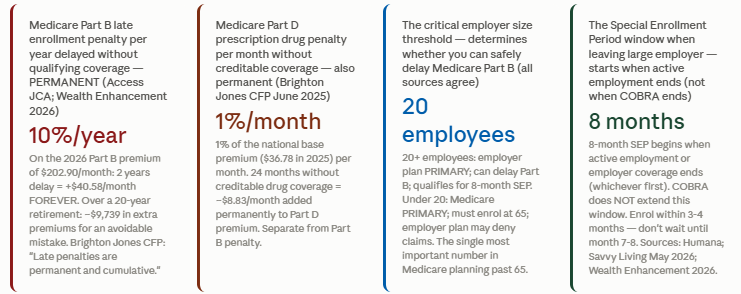
2026 Medicare Part B standard monthly premium: $202.90 (Savvy Living May 2026). Part B late enrollment penalty: 10% of standard premium per full year delayed — PERMANENT. 2-year delay = $40.58/month added FOREVER. Part D penalty: 1% of national base premium per month delayed — also permanent. Part B deductible: $257 (2025, Brighton Jones). Sources cited. Not Medicare or legal advice.
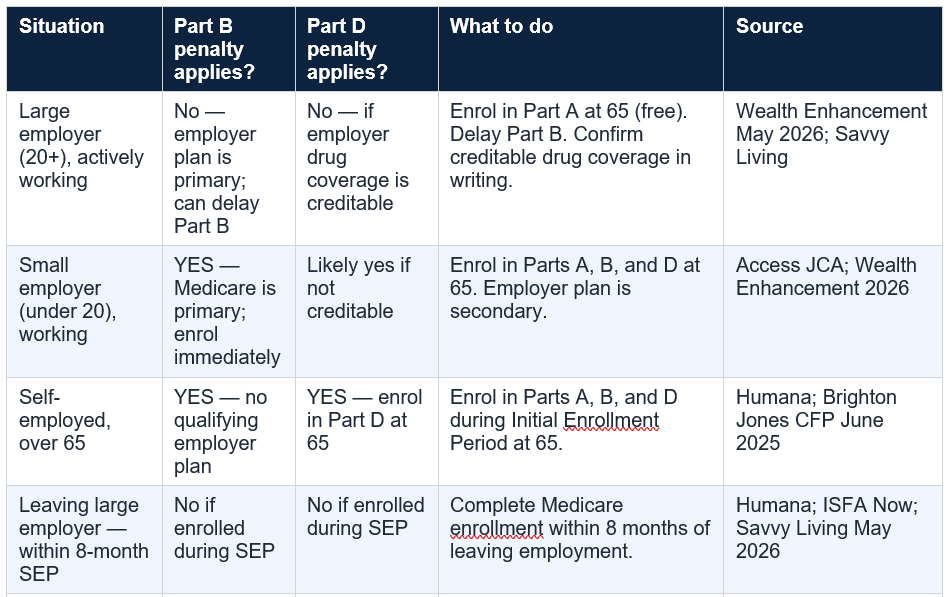
Wealth Enhancement’s May 2026 guide lays this out in binary terms. More than 20 employees: employer coverage remains primary, delay is permitted, SEP is available when you retire. Fewer than 20 employees: you should enrol in Parts A and B at 65. Access JCA’s penalty guide adds the coverage gap risk: if Medicare is the primary insurer and has not been enrolled, the employer plan may deny claims because it is designed to pay only after Medicare pays. The practical consequence of this denial scenario is that a worker at a small employer who delays Medicare enrollment thinking their employer plan covers them can face a period during which neither plan pays claims.
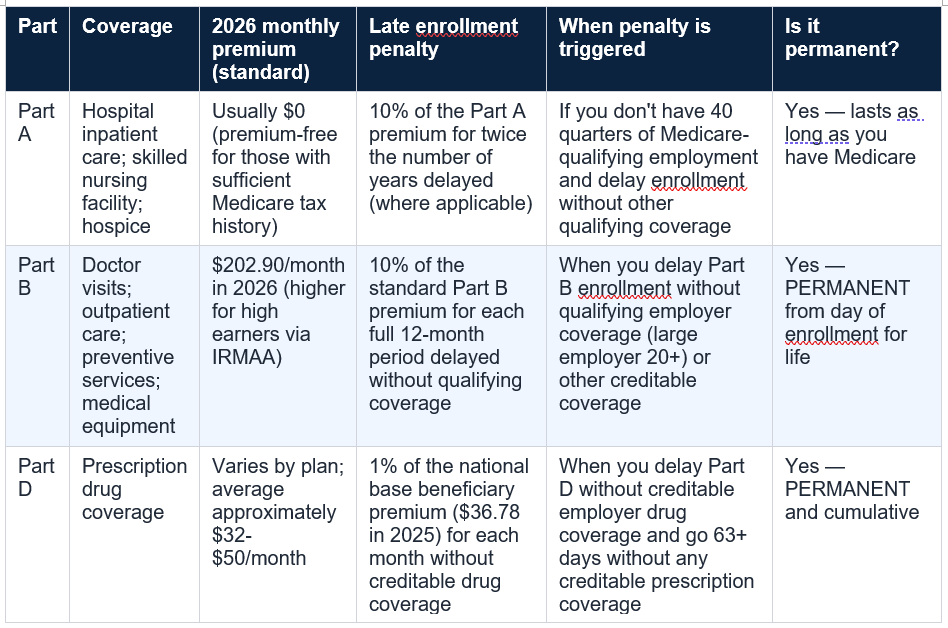
The 20-employee threshold: MORE THAN 20 = employer plan primary; delay Part B is permitted; SEP available at retirement. FEWER THAN 20 = Medicare is primary; must enrol at 65; employer plan may deny claims if Medicare not in place. Source: Wealth Enhancement May 2026; Access JCA; Savvy Living May 2026.
Small employer (fewer than 20 employees): must enroll in Medicare Parts A and B at 65. Employer plan pays secondary. If Medicare is not in place and is primary, employer plan may deny claims. Late Part B penalty: 10% of the standard premium per year delayed — PERMANENT (Access JCA; Wealth Enhancement 2026).
More than 20 employees: employer plan is primary. You can delay Part B without penalty. Get confirmation in writing from your HR/benefits team that your coverage is based on active employment as defined by Medicare (Wealth Enhancement 2026).
Miss the 8-month SEP and you must wait for the General Enrollment Period (January 1 to March 31 each year), with coverage starting July 1. Every full 12-month period without qualifying coverage adds a permanent 10% to your Part B premium (ISFA Now; Wealth Enhancement 2026).
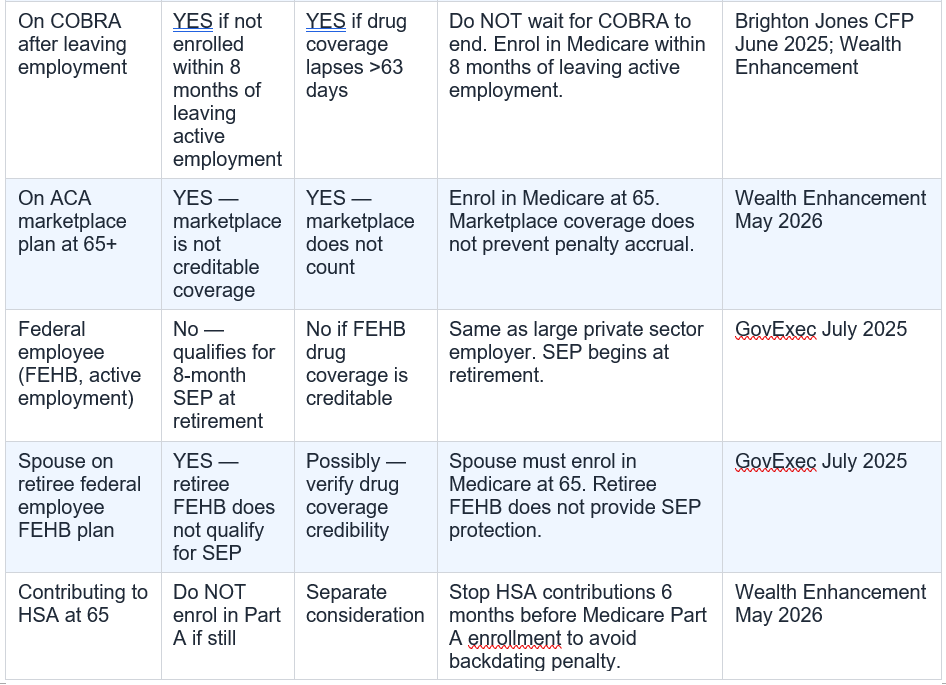
COBRA does NOT count as creditable coverage for delaying Medicare Part B. The 8-month SEP clock runs from the end of ACTIVE EMPLOYMENT — not from the end of COBRA. ACA marketplace plans also do not qualify. Starting COBRA does not pause the penalty (Brighton Jones CFP June 2025; Wealth Enhancement 2026).
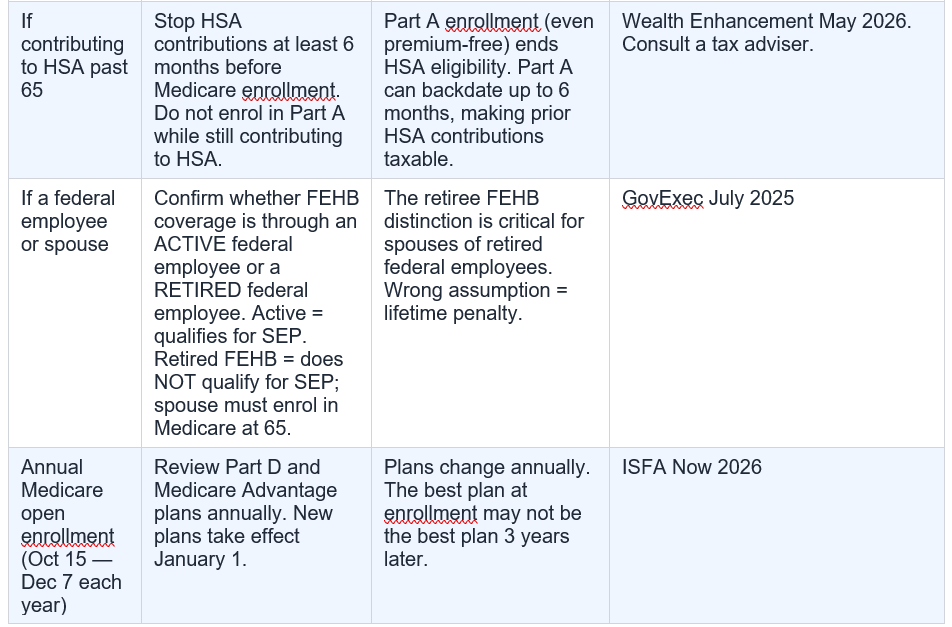
Enrolling in any part of Medicare (including premium-free Part A) makes you ineligible for HSA contributions. Part A enrollment can be backdated up to 6 months — making prior HSA contributions potentially taxable. (Wealth Enhancement May 2026.)
Part D late enrollment penalty: 1% of the national base premium per month without creditable drug coverage — PERMANENT and cumulative. Example: 24 months delay at $36.78 base = approximately $8.83/month additional FOREVER (Brighton Jones CFP June 2025; ISFA Now).
Federal employees: FEHB from a RETIREE's plan does NOT qualify for SEP. A spouse covered under a retired federal employee's FEHB must enrol in Medicare at 65 to avoid the Part B late enrollment penalty (GovExec July 2025).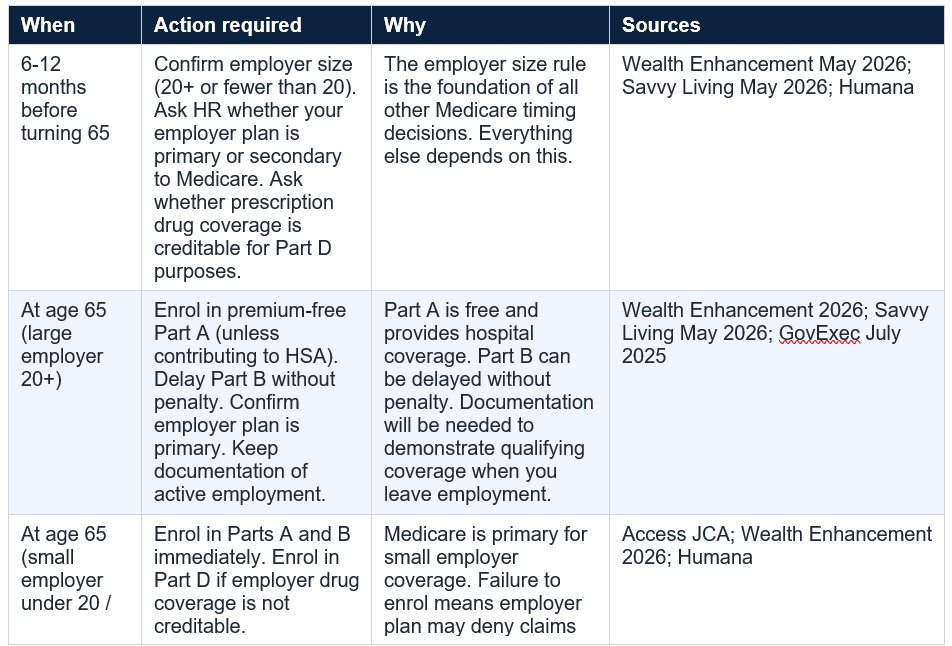
But the rules are also learnable. The 20-employee threshold is clear. The 8-month SEP is generous for those who understand it. The COBRA trap is entirely avoidable once you know it exists. The HSA timing issue has a clean solution: stop contributions six months before Medicare enrollment. The federal employee spousal exception requires one phone call to clarify. Brighton Jones CFP Biss McCarthy’s June 2025 conclusion is the most important sentence in Medicare planning for working Americans: ‘Above all, don’t ignore enrollment deadlines — late penalties for Part B and Part D are permanent and cumulative.’ Knowing the rules and acting on the right timeline is all that separates the penalty-free from the permanently penalised. Not Medicare, legal, or financial advice. Verify all rules at Medicare.gov or by calling 1-800-MEDICARE (1-800-633-4227). Consider consulting a SHIP counsellor for free personalised guidance.
Yes — but only under specific conditions. If you are actively working and covered by a group health plan from an employer with more than 20 employees, you can delay Medicare Part B without penalty. Your employer coverage remains primary, and you will qualify for an 8-month Special Enrollment Period when you retire or your employment-based coverage ends. If your employer has fewer than 20 employees, you cannot safely delay Medicare. Medicare becomes the primary insurer for small employer plans, meaning your employer plan may deny claims if Medicare is not in place. You must enrol in Parts A and B at 65 if your employer has fewer than 20 employees. Self-employed individuals must also enrol at 65. Sources: Wealth Enhancement May 2026; Access JCA; Humana; Savvy Living May 2026. Not Medicare or legal advice. Verify at Medicare.gov.
What is the Medicare Part B late enrollment penalty and how much does it cost?
The Medicare Part B late enrollment penalty is 10% of the standard Part B monthly premium for each full 12-month period you delayed enrollment without qualifying coverage. It is permanent — it does not go away once you eventually enrol. The 2026 standard Part B premium is $202.90 per month (Savvy Living May 2026). A two-year delay without qualifying coverage adds a 20% permanent premium increase: approximately $40.58 per month added to the $202.90 standard premium for as long as you have Medicare. Over a 20-year retirement, a 2-year avoidable delay costs approximately $9,739 in additional premiums. The Part D prescription drug penalty is a separate 1% of the national base beneficiary premium per month without creditable drug coverage — also permanent and cumulative. Sources: Wealth Enhancement May 2026; Brighton Jones CFP June 2025; Access JCA; ISFA Now.
Does COBRA coverage protect me from the Medicare late enrollment penalty?
No. COBRA coverage does not count as creditable coverage for the purpose of delaying Medicare enrollment, and it does not extend the Special Enrollment Period or pause the penalty clock. Brighton Jones CFP Biss McCarthy wrote in June 2025: 'When you stop working and are eligible for COBRA coverage, it's best not to wait until your COBRA coverage ends before enrolling in Medicare. COBRA coverage does not grant you immunity from penalties.' The 8-month Special Enrollment Period begins when active employment or employer-sponsored coverage ends, whichever comes first — not when COBRA ends. If you leave employment in June, take COBRA, and do not enrol in Medicare until 10 months later when COBRA runs out, you have been accruing the Part B late penalty since August (2 months into the SEP). Enrol in Medicare within 8 months of leaving active employment regardless of COBRA status. Sources: Brighton Jones CFP June 2025; Wealth Enhancement May 2026.
Can I still contribute to my HSA if I enrol in Medicare at 65?
No. Enrolling in any part of Medicare — including premium-free Part A — makes you ineligible to contribute to a Health Savings Account. Many workers delay Part A enrollment specifically to continue HSA contributions in their final working years. If this is your strategy, be aware of the backdating trap: when you eventually apply for Medicare Part A, it can be backdated up to 6 months. If you apply in November 2027, Part A may backdate to May 2027, and any HSA contributions made between May and November 2027 become non-qualifying contributions subject to tax. Wealth Enhancement's May 2026 guide recommends stopping HSA contributions at least 6 months before any anticipated Medicare enrollment to avoid this trap. Consult a tax adviser regarding your specific HSA situation. Sources: Wealth Enhancement May 2026.
What is the Special Enrollment Period (SEP) for Medicare?
The Medicare Special Enrollment Period (SEP) is an 8-month window during which people who delayed Medicare enrollment because of qualifying employer coverage can enrol in Part B without penalty. The 8-month SEP begins when active employment ends or employer-sponsored health coverage ends, whichever comes first. Key facts: it is only available to people who were covered by a group health plan from an employer with 20 or more employees during the period of delay. It does not apply to those covered by COBRA, marketplace coverage, retiree coverage, or small employer (under 20 employees) plans. Federal employees with active FEHB coverage qualify for a comparable 8-month SEP at retirement. The SEP is a countdown, not a grace period — aim to enrol in Part B within 3-4 months of leaving employment rather than waiting until month 7 or 8. Sources: Humana; ISFA Now; Wealth Enhancement May 2026; Savvy Living May 2026; GovExec July 2025. Not Medicare advice. Verify at Medicare.gov or 1-800-MEDICARE.
More Americans are working past age 65 than at any point in recent decades. For many, the combination of continued employer health coverage and the wish to delay Medicare creates a sensible financial strategy. For others, the same combination produces a permanent monthly penalty that stays with them for the rest of their Medicare-covered lives. The difference between these two outcomes is not income, not health status, and not how good your employer plan is. It is whether you understand six specific rules and act on them at the right time. The Medicare Part B late enrollment penalty is 10% of the standard premium for each full year you delay without qualifying coverage — and it is permanent. On the 2026 Part B premium of $202.90 per month, a two-year penalty adds approximately $40.58 every single month for as long as you have Medicare. This article covers the six most common Medicare mistakes working people past 65 make, what the rules actually say, and exactly what to do to stay penalty-free. Not Medicare, legal, or financial advice. Always verify rules at Medicare.gov or call 1-800-MEDICARE.
Table of Contents
- Why Medicare Timing Matters More Than Most People Realise
- The Three Medicare Penalties That Can Follow You Forever
- The Employer Size Rule: The Decision That Changes Everything
- Mistake #1: Assuming Your Employer Coverage Automatically Keeps You Penalty-Free
- Mistake #2: Missing the 8-Month Special Enrollment Period Window
- Mistake #3: Thinking COBRA or Marketplace Coverage Covers the Gap
- Mistake #4: Contributing to an HSA After Medicare Enrollment
- Mistake #5: Forgetting Part D Prescription Drug Coverage
- Mistake #6: Not Understanding the Federal Employee FEHB Rules
- The Decision Timeline: What to Do and When
- The Complete Penalty and Safe-Harbour Reference Table
- Conclusion: The Rules Are Learnable. The Penalties Are Permanent.
- Frequently Asked Questions
Why Medicare Timing Matters More Than Most People Realise
The decision of when to enrol in Medicare feels, to many people approaching 65, like a bureaucratic box to tick at the appropriate time. It is considerably more consequential than that. Medicare’s late enrollment penalties are permanent. Unlike most financial mistakes, which can be corrected given time and money, a Medicare late enrollment penalty does not go away when you eventually enrol, does not diminish with time, and does not disappear if you pay it long enough. It is added to your monthly premium for as long as you have Medicare. The penalty for each full year of delayed Part B enrollment without qualifying coverage is 10% of the standard premium — permanently. The 2026 Part B standard premium is $202.90 per month. A two-year delay without qualifying coverage produces a penalty of approximately $40.58 per month added to that premium for life. Over a 20-year retirement, that is approximately $9,739 in additional premiums paid for an avoidable administrative error.More Americans are working past age 65 than ever before, and Wealth Enhancement’s May 2026 guide notes the increased complexity this creates: employer size, HSA contributions, and COBRA and marketplace coverage can all lead to penalties that may last a lifetime. The good news is that the rules are learnable. For the majority of people working past 65 at large employers with good coverage, the path to penalty-free Medicare enrollment is clear and straightforward. For those at small employers, the self-employed, those relying on COBRA, or those navigating federal employment rules, the traps are more specific and more easily avoided once you understand them.
2026 Medicare Part B standard monthly premium: $202.90 (Savvy Living May 2026). Part B late enrollment penalty: 10% of standard premium per full year delayed — PERMANENT. 2-year delay = $40.58/month added FOREVER. Part D penalty: 1% of national base premium per month delayed — also permanent. Part B deductible: $257 (2025, Brighton Jones). Sources cited. Not Medicare or legal advice.
The Three Medicare Penalties That Can Follow You Forever
Medicare has three separate late enrollment penalties, each applying to a different component of Medicare coverage. All three are permanent once triggered, and all three have specific, learnable conditions under which they apply. Understanding them before turning 65 — not after — is what separates the penalty-free from the penalised.
The Employer Size Rule: The Decision That Changes Everything
If you remember only one thing about Medicare when working past 65, make it this: employer size determines everything. The number 20 is the threshold. If your employer has more than 20 employees, your group health plan is the primary payer, Medicare is secondary, and you can delay Part B enrollment without penalty. If your employer has fewer than 20 employees, Medicare is the primary payer, your employer plan is secondary, and you must enrol in Medicare at 65 to avoid both the penalty and the risk of claim denials.Wealth Enhancement’s May 2026 guide lays this out in binary terms. More than 20 employees: employer coverage remains primary, delay is permitted, SEP is available when you retire. Fewer than 20 employees: you should enrol in Parts A and B at 65. Access JCA’s penalty guide adds the coverage gap risk: if Medicare is the primary insurer and has not been enrolled, the employer plan may deny claims because it is designed to pay only after Medicare pays. The practical consequence of this denial scenario is that a worker at a small employer who delays Medicare enrollment thinking their employer plan covers them can face a period during which neither plan pays claims.
The 20-employee threshold: MORE THAN 20 = employer plan primary; delay Part B is permitted; SEP available at retirement. FEWER THAN 20 = Medicare is primary; must enrol at 65; employer plan may deny claims if Medicare not in place. Source: Wealth Enhancement May 2026; Access JCA; Savvy Living May 2026.
Mistake #1: Assuming Your Employer Coverage Automatically Keeps You Penalty-Free
The most expensive Medicare mistake working Americans make after 65 is a confident one: assuming that having employer health coverage automatically means they can delay Medicare without penalty. This is partially true — but the key word is employer size. Wealth Enhancement’s May 2026 guide makes the rule explicit: if you are actively working and covered by a group health plan from an employer with more than 20 employees, you can delay Medicare Part B without penalty. Your employer coverage remains primary, and you’ll qualify for a Special Enrollment Period when you retire. But if your employer has fewer than 20 employees, the calculus reverses completely. Access JCA’s Medicare penalty guide confirms: for small employers, Medicare is the primary insurer. If Medicare is primary and you have not enrolled, your employer plan may legally deny claims, because it is designed to pay second — after Medicare — and if there is no Medicare coverage to pay first, the claim falls through the gap. A worker at a small company who delays Medicare enrollment thinking their employer plan covers them may find that neither plan pays.Small employer (fewer than 20 employees): must enroll in Medicare Parts A and B at 65. Employer plan pays secondary. If Medicare is not in place and is primary, employer plan may deny claims. Late Part B penalty: 10% of the standard premium per year delayed — PERMANENT (Access JCA; Wealth Enhancement 2026).
More than 20 employees: employer plan is primary. You can delay Part B without penalty. Get confirmation in writing from your HR/benefits team that your coverage is based on active employment as defined by Medicare (Wealth Enhancement 2026).
Mistake #2: Missing the 8-Month Special Enrollment Period Window
For workers at large employers (20+ employees) who correctly delay Medicare Part B while working, the next critical deadline arrives when employment ends. The 8-month Special Enrollment Period begins the moment active employment — or employer health coverage — ends, whichever comes first. Humana’s Medicare working guide confirms: once you stop working or lose your health insurance, you have an 8-month Special Enrollment Period to sign up for Medicare. This window is generous compared to many government deadlines, but it is finite, and Wealth Enhancement’s May 2026 guide warns of a specific pattern: by the time someone realises the SEP is running, the late penalty may have already started accruing. If you retire at the end of June, your 8-month SEP begins on July 1. If you do not enroll in Part B by February 28 of the following year, the penalty begins. It is a countdown, not a grace period.Miss the 8-month SEP and you must wait for the General Enrollment Period (January 1 to March 31 each year), with coverage starting July 1. Every full 12-month period without qualifying coverage adds a permanent 10% to your Part B premium (ISFA Now; Wealth Enhancement 2026).
Mistake #3: Thinking COBRA or Marketplace Coverage Covers the Gap
This is perhaps the most counterintuitive — and most frequently cited — Medicare penalty trap. When workers leave employment, many transition to COBRA coverage to maintain their existing health insurance while they figure out Medicare. The logical assumption is that COBRA extends the creditable coverage clock. It does not. Brighton Jones CFP Biss McCarthy, writing in June 2025, is unambiguous: ‘When you stop working and are eligible for COBRA coverage, it’s best not to wait until your COBRA coverage ends before enrolling in Medicare. COBRA coverage does not grant you immunity from penalties.’ Wealth Enhancement’s May 2026 working-past-65 guide names COBRA directly as one of the coverage types that can lead to lifetime penalties. The same applies to Affordable Care Act marketplace coverage. Neither qualifies as creditable coverage for the purpose of delaying Medicare Part B enrollment. If you are 65 or older and relying on a marketplace plan while delaying Medicare, you are accruing the Part B late enrollment penalty with every month that passes.COBRA does NOT count as creditable coverage for delaying Medicare Part B. The 8-month SEP clock runs from the end of ACTIVE EMPLOYMENT — not from the end of COBRA. ACA marketplace plans also do not qualify. Starting COBRA does not pause the penalty (Brighton Jones CFP June 2025; Wealth Enhancement 2026).
Mistake #4: Contributing to an HSA After Medicare Enrollment
Health Savings Accounts (HSAs) are one of the most tax-efficient tools available to working Americans: contributions are pre-tax, growth is tax-free, and qualified withdrawals are tax-free. But HSA eligibility ends the moment you enrol in Medicare — even just Part A. Wealth Enhancement’s May 2026 guide flags this specifically: if you enrol in Medicare (even just Part A), you cannot contribute to an HSA. Many workers who delay Part B because they work for a large employer also delay Part A enrollment for exactly this reason — to continue maximising HSA contributions in the final working years before retirement. If this is your strategy, there is a specific trap to understand: when you eventually apply for Medicare Part A, it can be backdated by up to six months. This means that if you apply for Medicare Part A in November while still working, Part A coverage may be backdated to the previous May. Any HSA contributions made between May and November are now non-qualifying contributions that are subject to tax. Wealth Enhancement specifically advises: do HSA corrections before your tax filing deadline to avoid ongoing penalties.Enrolling in any part of Medicare (including premium-free Part A) makes you ineligible for HSA contributions. Part A enrollment can be backdated up to 6 months — making prior HSA contributions potentially taxable. (Wealth Enhancement May 2026.)
Mistake #5: Forgetting Part D Prescription Drug Coverage
Medicare’s prescription drug coverage — Part D — carries its own separate late enrollment penalty, and it is easy to forget about when navigating the Part A/Part B rules. Brighton Jones CFP Biss McCarthy described the Part D penalty in the June 2025 analysis: 1% of the national base premium ($36.78 in 2025) for each month you delay without creditable drug coverage. That is approximately $0.37 per month of delay, which compounds into a permanent surcharge on your Part D premium for as long as you have Medicare. If an employer plan includes creditable prescription drug coverage, that counts — and you can delay Part D enrollment without penalty. The critical step is confirming with your employer that the drug coverage is creditable. ISFA Now’s Medicare enrollment guide confirms: if you have prescription drug coverage, this can also make you exempt from Part D penalties. But if the employer’s drug coverage is not creditable, you should enrol in Part D during your Initial Enrollment Period to avoid the penalty. The verification step is essential.Part D late enrollment penalty: 1% of the national base premium per month without creditable drug coverage — PERMANENT and cumulative. Example: 24 months delay at $36.78 base = approximately $8.83/month additional FOREVER (Brighton Jones CFP June 2025; ISFA Now).
Mistake #6: Not Understanding the Federal Employee FEHB Rules
Federal employees have their own health coverage through the Federal Employees Health Benefits programme (FEHB), which creates a specific set of Medicare interaction rules that are different enough from the private sector to warrant separate attention. GovExec’s July 2025 guide to Medicare Part B late enrollment penalties covers the FEHB framework: federal employees with FEHB coverage qualify for an 8-month Medicare SEP beginning at retirement, the same structure as large private-sector employers. However, there is a specific spousal trap that has caught federal employee families off guard. If a federal employee’s spouse is covered under a RETIREE’s FEHB plan rather than an active employee’s FEHB plan, that spouse does NOT qualify for a SEP. GovExec is explicit: ‘If you’re retired and your spouse continues working past 65 while remaining on your retiree FEHB coverage, they will not qualify for an SEP. In that case, they would need to enroll in Medicare at age 65 to avoid a late enrollment penalty.’ The distinction between coverage through an active federal employee versus a retired federal employee is the decisive factor.Federal employees: FEHB from a RETIREE's plan does NOT qualify for SEP. A spouse covered under a retired federal employee's FEHB must enrol in Medicare at 65 to avoid the Part B late enrollment penalty (GovExec July 2025).
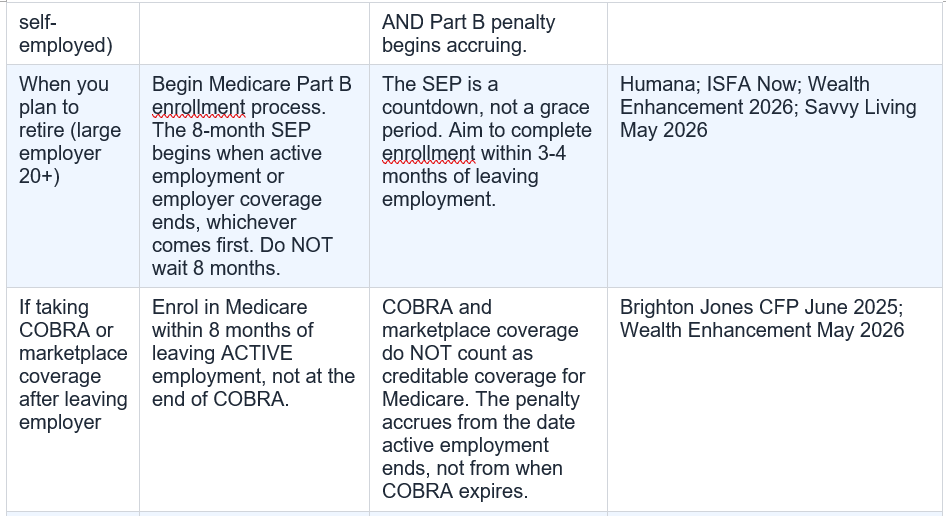
10. The Decision Timeline: What to Do and When
The Complete Penalty and Safe-Harbour Reference Table
Conclusion
Medicare’s late enrollment penalties are among the few financial consequences in American life that are genuinely permanent. They do not go away when you eventually enrol. They do not diminish over time. They compound, month by month, for the rest of your Medicare-covered life. Wealth Enhancement’s May 2026 guide captures the stakes in its subtitle: employer size, HSA contributions, and COBRA and marketplace coverage can all lead to penalties that may last a lifetime.But the rules are also learnable. The 20-employee threshold is clear. The 8-month SEP is generous for those who understand it. The COBRA trap is entirely avoidable once you know it exists. The HSA timing issue has a clean solution: stop contributions six months before Medicare enrollment. The federal employee spousal exception requires one phone call to clarify. Brighton Jones CFP Biss McCarthy’s June 2025 conclusion is the most important sentence in Medicare planning for working Americans: ‘Above all, don’t ignore enrollment deadlines — late penalties for Part B and Part D are permanent and cumulative.’ Knowing the rules and acting on the right timeline is all that separates the penalty-free from the permanently penalised. Not Medicare, legal, or financial advice. Verify all rules at Medicare.gov or by calling 1-800-MEDICARE (1-800-633-4227). Consider consulting a SHIP counsellor for free personalised guidance.
Frequently Asked Questions
Can I delay Medicare if I'm still working past 65?Yes — but only under specific conditions. If you are actively working and covered by a group health plan from an employer with more than 20 employees, you can delay Medicare Part B without penalty. Your employer coverage remains primary, and you will qualify for an 8-month Special Enrollment Period when you retire or your employment-based coverage ends. If your employer has fewer than 20 employees, you cannot safely delay Medicare. Medicare becomes the primary insurer for small employer plans, meaning your employer plan may deny claims if Medicare is not in place. You must enrol in Parts A and B at 65 if your employer has fewer than 20 employees. Self-employed individuals must also enrol at 65. Sources: Wealth Enhancement May 2026; Access JCA; Humana; Savvy Living May 2026. Not Medicare or legal advice. Verify at Medicare.gov.
What is the Medicare Part B late enrollment penalty and how much does it cost?
The Medicare Part B late enrollment penalty is 10% of the standard Part B monthly premium for each full 12-month period you delayed enrollment without qualifying coverage. It is permanent — it does not go away once you eventually enrol. The 2026 standard Part B premium is $202.90 per month (Savvy Living May 2026). A two-year delay without qualifying coverage adds a 20% permanent premium increase: approximately $40.58 per month added to the $202.90 standard premium for as long as you have Medicare. Over a 20-year retirement, a 2-year avoidable delay costs approximately $9,739 in additional premiums. The Part D prescription drug penalty is a separate 1% of the national base beneficiary premium per month without creditable drug coverage — also permanent and cumulative. Sources: Wealth Enhancement May 2026; Brighton Jones CFP June 2025; Access JCA; ISFA Now.
Does COBRA coverage protect me from the Medicare late enrollment penalty?
No. COBRA coverage does not count as creditable coverage for the purpose of delaying Medicare enrollment, and it does not extend the Special Enrollment Period or pause the penalty clock. Brighton Jones CFP Biss McCarthy wrote in June 2025: 'When you stop working and are eligible for COBRA coverage, it's best not to wait until your COBRA coverage ends before enrolling in Medicare. COBRA coverage does not grant you immunity from penalties.' The 8-month Special Enrollment Period begins when active employment or employer-sponsored coverage ends, whichever comes first — not when COBRA ends. If you leave employment in June, take COBRA, and do not enrol in Medicare until 10 months later when COBRA runs out, you have been accruing the Part B late penalty since August (2 months into the SEP). Enrol in Medicare within 8 months of leaving active employment regardless of COBRA status. Sources: Brighton Jones CFP June 2025; Wealth Enhancement May 2026.
Can I still contribute to my HSA if I enrol in Medicare at 65?
No. Enrolling in any part of Medicare — including premium-free Part A — makes you ineligible to contribute to a Health Savings Account. Many workers delay Part A enrollment specifically to continue HSA contributions in their final working years. If this is your strategy, be aware of the backdating trap: when you eventually apply for Medicare Part A, it can be backdated up to 6 months. If you apply in November 2027, Part A may backdate to May 2027, and any HSA contributions made between May and November 2027 become non-qualifying contributions subject to tax. Wealth Enhancement's May 2026 guide recommends stopping HSA contributions at least 6 months before any anticipated Medicare enrollment to avoid this trap. Consult a tax adviser regarding your specific HSA situation. Sources: Wealth Enhancement May 2026.
What is the Special Enrollment Period (SEP) for Medicare?
The Medicare Special Enrollment Period (SEP) is an 8-month window during which people who delayed Medicare enrollment because of qualifying employer coverage can enrol in Part B without penalty. The 8-month SEP begins when active employment ends or employer-sponsored health coverage ends, whichever comes first. Key facts: it is only available to people who were covered by a group health plan from an employer with 20 or more employees during the period of delay. It does not apply to those covered by COBRA, marketplace coverage, retiree coverage, or small employer (under 20 employees) plans. Federal employees with active FEHB coverage qualify for a comparable 8-month SEP at retirement. The SEP is a countdown, not a grace period — aim to enrol in Part B within 3-4 months of leaving employment rather than waiting until month 7 or 8. Sources: Humana; ISFA Now; Wealth Enhancement May 2026; Savvy Living May 2026; GovExec July 2025. Not Medicare advice. Verify at Medicare.gov or 1-800-MEDICARE.
0 Comments
Be the first to share your thoughts on this article.