
Retirement
The Retirement Crisis Nobody Is Talking About: 3 Huge Cliffs

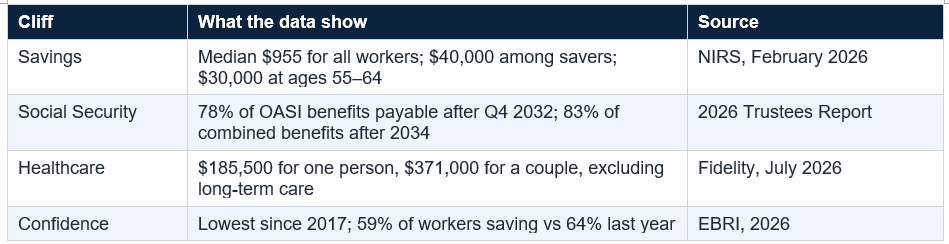
OASI reserves depleted Q4 2032 with 78% of benefits payable; combined OASDI depleted 2034 with 83% payable; Hospital Insurance fund 2033. Reserves fell $160 billion in 2025 to $2.56 trillion; cost has exceeded income since 2021. NIRS (Feb 2026): median retirement savings $955 for all employed Americans 21–64; $40,000 among those with a defined contribution balance; about $30,000 for ages 55–64; 63% offered an employer plan. EBRI 2026: worker retirement confidence lowest since 2017; 59% saving, down from 64%; 58% say debt interferes. Transamerica: median household retirement savings $78,000; median emergency savings $5,000. Fidelity (July 2026): a 65-year-old retiring in 2026 needs about $185,500 for healthcare ($371,000 for a couple), up 7.5%, excluding long-term care; 54% wrongly believe Medicare covers everything. Illustration: a 17% cut on an average benefit of about $2,083 a month is about $354 a month (22% cut: about $458). A 4% withdrawal from a $40,000 balance is $1,600 a year, less than 2026 Medicare Part B premiums ($2,435).
But the numbers are no longer subtle. The typical American worker has saved very little. The program most retirees rely on is scheduled to pay less within about six to eight years unless the law changes. And healthcare in retirement keeps getting costlier. Each fact is known, but they rarely get discussed together. This post puts them side by side and ends with steps that help. It is not meant to frighten you. It is meant to help you plan.
Other surveys show higher figures because they measure different groups. Transamerica reported a median household retirement savings of $78,000 among workers in 2025 and a median emergency savings of just $5,000. Vanguard’s data show an average 401(k) balance of $167,970, but a median of only $44,115. The gap between average and median tells the story: a few large balances pull the average up, while the typical person has much less.
And the trend is not improving. The EBRI Retirement Confidence Survey in 2026 found worker confidence at its lowest level since 2017. The share of workers currently saving fell to 59% from 64% last year, and 58% said debt interferes with their ability to save. Transamerica found that 15% of workers had tapped their retirement accounts.
Here is what thin savings mean in practice. A common rule of thumb says you can withdraw about 4% of a portfolio in the first year of retirement. Applied to $40,000, that is $1,600 a year, about $133 a month. The standard Medicare Part B premium in 2026 is $202.90 a month, or $2,435 a year. So the median saver’s withdrawal would not even cover the Part B premium. That is my illustration, not a rule for any individual, but it shows the scale of the shortfall.
The numbers: NIRS 2026: median retirement savings $955 (all workers 21–64); $40,000 among workers with savings; about $30,000 at ages 55–64. EBRI 2026: confidence lowest since 2017; 59% saving vs 64% a year earlier. A 4% withdrawal from $40,000 is $1,600 a year, less than the $2,435 Medicare Part B premium.
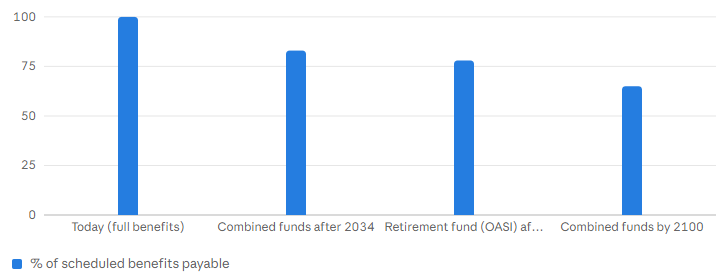
Here is the part that gets lost in the headlines: depletion does not mean the program ends. After the reserves run out, payroll taxes would continue to come in. The report says the combined funds would be able to pay about 83% of scheduled benefits at that point, and the OASI fund alone about 78%. The Penn Wharton Budget Model projects slightly better, with 86% payable at combined depletion, though both sources project further decline over time, with the Trustees at 65% by 2100. The Hospital Insurance fund, which supports Medicare Part A, is projected to be depleted in 2033.
What would that cut look like? This is my own illustration. This year’s 3.6% cost-of-living increase is about $75 a month on average, which implies an average benefit of roughly $2,083 a month before the increase. A 17% reduction would be about $354 a month, or roughly $4,250 a year. A 22% reduction would be about $458 a month, or $5,500 a year. Those are in today’s dollars and for an average benefit. Many retirees have little else to cover the difference.
These are official projections, not certainties. Lawmakers have a wide range of options to close the shortfall, according to the Trustees, and the outcome depends on choices not yet made. The sensible response is to plan for the possibility without assuming the worst.
Crucially, Fidelity’s estimate assumes enrollment in Original Medicare and Part D, and does not include long-term care, most dental services or over-the-counter medications. Medicare is valuable, but it does not cover everything. Fidelity found that 54% of pre-retirees incorrectly believe Medicare will cover all of their healthcare expenses. Spread over 20 to 30 years, $185,500 is roughly $6,200 to $9,300 a year, before long-term care.
A health savings account can help, if you are eligible. Fidelity noted that HSA balances roll over and can be saved for retirement healthcare. But 40% of Americans with HSAs have not invested their balances, which means that money may be sitting in cash rather than growing.
There is also a human reason. Thinking about retirement means thinking about aging, health and money all at once, and it is easier to look away. But that does not change the arithmetic. It only removes the years in which small changes would help most.

For everyone, build a healthcare plan. Learn what Medicare covers and what it does not, and if you are eligible, use an HSA and invest it rather than leaving it in cash. Keep an emergency fund, since Transamerica found the median worker has only $5,000. If you are already retired, review your spending and Medicare options each year and keep your withdrawal rate modest.
The encouraging part is that you can act on all three. Save more, even gradually. Stress-test your plan against a smaller benefit. Learn what Medicare does and does not cover. And revisit your plan each year. None of this requires prediction, only preparation. A qualified adviser can help you apply it to your situation.
No. The 2026 Trustees Report projects that even if the trust funds run out, ongoing payroll tax income would still pay about 83% of scheduled benefits from 2034 for the combined funds, and 78% of retirement benefits from the Old-Age and Survivors trust fund in late 2032. The program would not disappear, but benefits would be cut automatically unless Congress acts.
When could Social Security benefits be cut?
The Trustees project that the retirement trust fund (OASI) reserves are depleted in the fourth quarter of 2032, and that the combined retirement and disability funds are depleted in 2034. Those are projections that depend on economic and demographic assumptions, and lawmakers could change the outcome. Private analysts such as the Penn Wharton Budget Model project dates a few months later.
How much do I need to save for healthcare in retirement?
Fidelity estimates that a 65-year-old retiring in 2026 will spend an average of $185,500 on healthcare and medical expenses over retirement, and about $371,000 for a couple, excluding long-term care. Your own figure depends on your health, location and longevity. An HSA, if you are eligible, can help.
What is the median retirement savings in America?
It depends on the measure. The National Institute on Retirement Security found that the median for all employed Americans aged 21 to 64, including those with nothing saved, was $955, and $40,000 among workers who have a defined contribution balance. Transamerica reported a median household figure of $78,000 for workers in 2025.
What should I do if I am behind?
Start where you are. Capture any employer match, raise your savings rate gradually, pay down high-interest debt and keep an emergency fund. If you are within about ten years of retirement, consider working a bit longer, delaying Social Security and planning for healthcare costs. A qualified adviser can model your specific numbers.
Table of Contents
- The Crisis Without a Headline
- The Short Answer: Three Cliffs at Once
- Cliff One: The Savings Cliff
- Cliff Two: The Social Security Cliff
- Cliff Three: The Healthcare Cliff
- Why the Three Cliffs Compound
- Why Nobody Talks About It
- Stress-Test Your Own Plan
- What to Do, by Stage of Life
- What Not to Do
- Conclusion
- Frequently Asked Questions
Social Security: share of scheduled benefits payable if Congress does not act (%)
% payable by 2026 Trustees Report, intermediate assumptions
Retirement savings: different measures of the 'typical' American ($)
Retirement savings ($) by Different surveys and definitions; not directly comparable
The healthcare cliff: lifetime retiree healthcare costs vs. typical savings ($)
Dollars ($) by Fidelity estimate excludes long-term care
The Crisis Without a Headline
Some crises arrive with sirens. Retirement does not. It arrives as a quiet drift: a balance that never quite grows, a statement you do not open, a benefit estimate you assume will be there. There is no single day when it becomes obvious, which is probably why it gets less attention than markets or prices.But the numbers are no longer subtle. The typical American worker has saved very little. The program most retirees rely on is scheduled to pay less within about six to eight years unless the law changes. And healthcare in retirement keeps getting costlier. Each fact is known, but they rarely get discussed together. This post puts them side by side and ends with steps that help. It is not meant to frighten you. It is meant to help you plan.
The Short Answer: Three Cliffs at Once
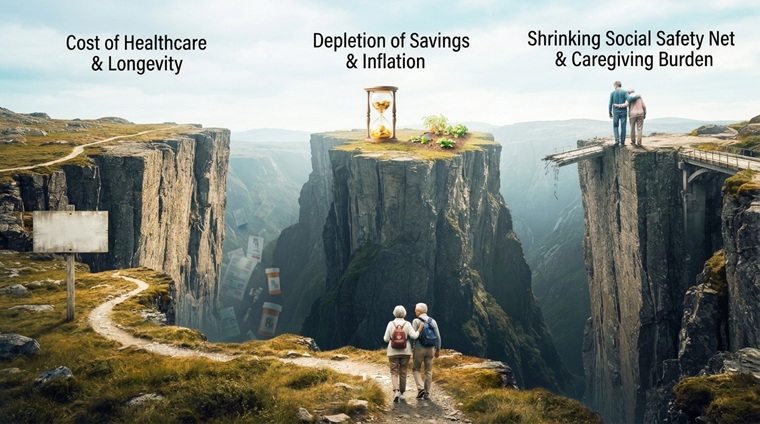
The retirement crisis nobody is talking about is not one problem. It is three arriving at the same time. First, a savings cliff: the typical worker has far too little set aside. Second, a Social Security cliff: the 2026 Trustees Report projects automatic benefit cuts of about 17% to 22% when trust fund reserves run out in 2032 to 2034 unless Congress acts. Third, a healthcare cliff: Fidelity estimates $185,500 for a 65-year-old retiring this year, and that excludes long-term care. Any one is manageable. Together, they squeeze the same household.Cliff One: The Savings Cliff
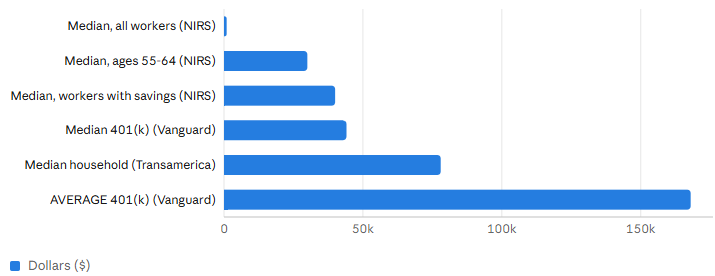
Start with the money people have actually saved. The National Institute on Retirement Security, using Census data, found in February 2026 that the median retirement savings of all employed Americans aged 21 to 64, including those with nothing saved, was just $955. Among workers who do have a defined contribution balance, the median was $40,000. For workers aged 55 to 64, the group closest to retiring, the median was about $30,000. NIRS also found that only 63% of workers are offered a retirement plan at work.Other surveys show higher figures because they measure different groups. Transamerica reported a median household retirement savings of $78,000 among workers in 2025 and a median emergency savings of just $5,000. Vanguard’s data show an average 401(k) balance of $167,970, but a median of only $44,115. The gap between average and median tells the story: a few large balances pull the average up, while the typical person has much less.
And the trend is not improving. The EBRI Retirement Confidence Survey in 2026 found worker confidence at its lowest level since 2017. The share of workers currently saving fell to 59% from 64% last year, and 58% said debt interferes with their ability to save. Transamerica found that 15% of workers had tapped their retirement accounts.
Here is what thin savings mean in practice. A common rule of thumb says you can withdraw about 4% of a portfolio in the first year of retirement. Applied to $40,000, that is $1,600 a year, about $133 a month. The standard Medicare Part B premium in 2026 is $202.90 a month, or $2,435 a year. So the median saver’s withdrawal would not even cover the Part B premium. That is my illustration, not a rule for any individual, but it shows the scale of the shortfall.
The numbers: NIRS 2026: median retirement savings $955 (all workers 21–64); $40,000 among workers with savings; about $30,000 at ages 55–64. EBRI 2026: confidence lowest since 2017; 59% saving vs 64% a year earlier. A 4% withdrawal from $40,000 is $1,600 a year, less than the $2,435 Medicare Part B premium.
Cliff Two: The Social Security Cliff
For most retirees, Social Security is the foundation. The 2026 Trustees Report, released June 9, shows why people are watching it. Social Security’s cost has exceeded its total income since 2021, and the reserves of the combined trust funds fell by $160 billion in 2025 to $2.56 trillion. Total income was $1.45 trillion against expenditures of $1.61 trillion. The Trustees project that the retirement trust fund, OASI, will be depleted in the fourth quarter of 2032, and the combined retirement and disability funds in 2034.Here is the part that gets lost in the headlines: depletion does not mean the program ends. After the reserves run out, payroll taxes would continue to come in. The report says the combined funds would be able to pay about 83% of scheduled benefits at that point, and the OASI fund alone about 78%. The Penn Wharton Budget Model projects slightly better, with 86% payable at combined depletion, though both sources project further decline over time, with the Trustees at 65% by 2100. The Hospital Insurance fund, which supports Medicare Part A, is projected to be depleted in 2033.
What would that cut look like? This is my own illustration. This year’s 3.6% cost-of-living increase is about $75 a month on average, which implies an average benefit of roughly $2,083 a month before the increase. A 17% reduction would be about $354 a month, or roughly $4,250 a year. A 22% reduction would be about $458 a month, or $5,500 a year. Those are in today’s dollars and for an average benefit. Many retirees have little else to cover the difference.
These are official projections, not certainties. Lawmakers have a wide range of options to close the shortfall, according to the Trustees, and the outcome depends on choices not yet made. The sensible response is to plan for the possibility without assuming the worst.
Cliff Three: The Healthcare Cliff
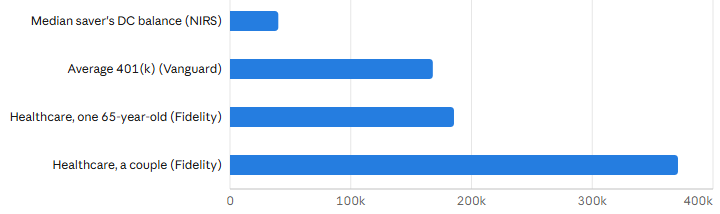
The third cliff is the one people underestimate. Fidelity’s 25th annual Retiree Health Care Cost Estimate, released July 21, found that a 65-year-old retiring in 2026 can expect to spend an average of $185,500 on healthcare and medical expenses throughout retirement. That is up 7.5% from last year, after increases of 5% in 2025 and 4% in 2024. For a couple, the figure is about $371,000. Milliman’s 2026 index puts a healthy couple’s lifetime costs as high as $637,000.Crucially, Fidelity’s estimate assumes enrollment in Original Medicare and Part D, and does not include long-term care, most dental services or over-the-counter medications. Medicare is valuable, but it does not cover everything. Fidelity found that 54% of pre-retirees incorrectly believe Medicare will cover all of their healthcare expenses. Spread over 20 to 30 years, $185,500 is roughly $6,200 to $9,300 a year, before long-term care.
A health savings account can help, if you are eligible. Fidelity noted that HSA balances roll over and can be saved for retirement healthcare. But 40% of Americans with HSAs have not invested their balances, which means that money may be sitting in cash rather than growing.
Why the Three Cliffs Compound
Each cliff is survivable alone. A retiree with a thin balance but a full Social Security check can adapt. A retiree with a healthy balance can absorb a modest benefit cut. The danger lies in the overlap: low savings means less capacity to absorb a Social Security reduction, and rising healthcare costs then take a bigger share of a shrinking income. Inflation, at 3.7% in September, raises costs further.
Why Nobody Talks About It
There are understandable reasons. The timeline is long, and the pain arrives gradually. The topics are complicated, spanning savings, tax law, insurance and benefits. The political stakes make people cautious. And optimism is comforting: Transamerica found that 84% of employers were confident their workers would achieve a secure retirement, while only 69% of workers felt that way.There is also a human reason. Thinking about retirement means thinking about aging, health and money all at once, and it is easier to look away. But that does not change the arithmetic. It only removes the years in which small changes would help most.
Stress-Test Your Own Plan
The best response to uncertainty is to test your plan against it. Take your Social Security estimate from your online account and multiply it by 0.78 and by 0.83. If your plan still works with that smaller number, you are in a stronger position. If it does not, you have identified a gap while there is still time to close it. Then add a healthcare line: at least several thousand dollars a year for premiums and out-of-pocket costs, more if you retire before 65.
9. What to Do, by Stage of Life
If you are in your twenties or thirties, time is your biggest asset. Capture any employer match, since it is an immediate return, and aim to raise your savings rate each year. If you are in your forties or fifties, check your progress honestly, increase contributions as income allows, pay down high-interest debt and use catch-up contributions if you are 50 or older. If you are within ten years of retirement, consider working a little longer, which adds savings, shortens the withdrawal period and can increase your Social Security benefit if you delay claiming.For everyone, build a healthcare plan. Learn what Medicare covers and what it does not, and if you are eligible, use an HSA and invest it rather than leaving it in cash. Keep an emergency fund, since Transamerica found the median worker has only $5,000. If you are already retired, review your spending and Medicare options each year and keep your withdrawal rate modest.
What Not to Do
Do not panic. The program is not disappearing, and projections can change. Do not claim Social Security early solely to beat a possible cut, since claiming early permanently reduces your monthly benefit, and nobody yet knows how any cut would be applied. Do not raid retirement accounts for short-term needs if you can avoid it. Do not assume Medicare covers everything. And do not ignore the problem because it feels distant; the earlier you act, the smaller each adjustment needs to be.Conclusion
The retirement crisis nobody is talking about is not a single event. It is three quiet cliffs: savings that are too thin, a Social Security program projected to pay about 78% to 83% of scheduled benefits from 2032 to 2034 without action, and healthcare costs that have risen again to $185,500 per person. Worker confidence, according to EBRI, is at its lowest since 2017, and for good reason.The encouraging part is that you can act on all three. Save more, even gradually. Stress-test your plan against a smaller benefit. Learn what Medicare does and does not cover. And revisit your plan each year. None of this requires prediction, only preparation. A qualified adviser can help you apply it to your situation.
Frequently Asked Questions
Is Social Security going bankrupt?No. The 2026 Trustees Report projects that even if the trust funds run out, ongoing payroll tax income would still pay about 83% of scheduled benefits from 2034 for the combined funds, and 78% of retirement benefits from the Old-Age and Survivors trust fund in late 2032. The program would not disappear, but benefits would be cut automatically unless Congress acts.
When could Social Security benefits be cut?
The Trustees project that the retirement trust fund (OASI) reserves are depleted in the fourth quarter of 2032, and that the combined retirement and disability funds are depleted in 2034. Those are projections that depend on economic and demographic assumptions, and lawmakers could change the outcome. Private analysts such as the Penn Wharton Budget Model project dates a few months later.
How much do I need to save for healthcare in retirement?
Fidelity estimates that a 65-year-old retiring in 2026 will spend an average of $185,500 on healthcare and medical expenses over retirement, and about $371,000 for a couple, excluding long-term care. Your own figure depends on your health, location and longevity. An HSA, if you are eligible, can help.
What is the median retirement savings in America?
It depends on the measure. The National Institute on Retirement Security found that the median for all employed Americans aged 21 to 64, including those with nothing saved, was $955, and $40,000 among workers who have a defined contribution balance. Transamerica reported a median household figure of $78,000 for workers in 2025.
What should I do if I am behind?
Start where you are. Capture any employer match, raise your savings rate gradually, pay down high-interest debt and keep an emergency fund. If you are within about ten years of retirement, consider working a bit longer, delaying Social Security and planning for healthcare costs. A qualified adviser can model your specific numbers.
0 Comments
Be the first to share your thoughts on this article.