

Retirement
The Best Retirement Account to Have While on Social Security

2027 COLA: 3.6% (announced October 14, 2026), about $75 a month on average, versus 2.8% for 2026. Taxable maximum rises from $184,500 to $192,300. 2026 limits: 401(k) $24,500 (plus $8,000 catch-up at 50+, or $11,250 at ages 60–63); IRA $7,500 (plus $1,100 catch-up at 50+). Roth phase-out: $153,000–$168,000 single, $242,000–$252,000 joint. Social Security tax thresholds (provisional income): $25,000 / $34,000 single; $32,000 / $44,000 joint; frozen since 1983 and 1993. Up to 85% of benefits can be taxable. Estimates of recipients who pay tax range from about 40% to 56%. Example: $30,000 benefit plus $20,000 from a traditional IRA makes $5,350 of benefits taxable; the same $20,000 from a Roth makes $0 taxable. Medicare 2026: standard Part B premium $202.90 a month; IRMAA starts above $109,000 (single) or $218,000 (joint) of income from two years earlier.
That is why the question of which retirement account to hold while collecting benefits is worth a closer look. The answer affects your tax bill, your Medicare premiums and how long your savings last.
But "many people" is doing real work in that sentence. A Roth is not automatically best, and for some retirees it is not available or not worth the cost of getting there. The rest of this post helps you tell which camp you are in.
Two points are often misunderstood. First, 85% does not mean you lose 85% of your benefits to tax. It means up to 85% of the benefit is added to your taxable income, which is then taxed at your normal rate. Second, those thresholds have never been indexed to inflation. They are frozen at 1983 and 1993 levels, which is why more people are caught every year. Estimates of how many recipients pay tax on their benefits vary by source and year, from about 40% to roughly 56%.
The numbers: Provisional income = adjusted gross income (without Social Security) + tax-exempt interest + half of your benefits. Thresholds: $25,000 and $34,000 single; $32,000 and $44,000 joint. Up to 85% of benefits can be taxable.
The second benefit is timing. Traditional accounts eventually force you to take money out. Sources cited here put the starting age for required minimum distributions at 73, and those withdrawals count as ordinary income whether you need the cash or not. Roth IRAs have no required distributions for the original owner. A big traditional balance can therefore push your income up in your seventies and eighties, just when your benefits are largest. A Roth gives you a pool of money you can tap or leave alone without moving the needle on your benefit tax.

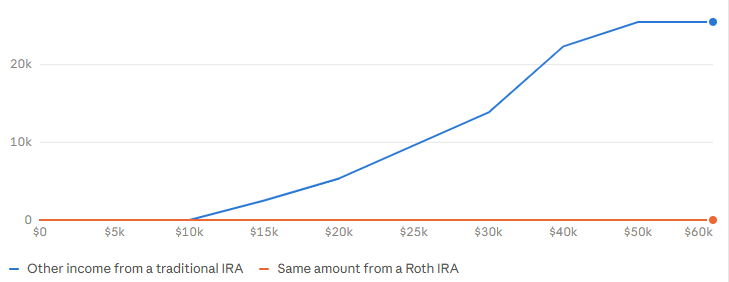
The traditional IRA withdrawal does not just add $20,000 to taxable income. It also drags $5,350 of benefits into the tax base, so the withdrawal effectively raises taxable income by $25,350. The Roth withdrawal adds nothing. You would still pay tax on the traditional money at your normal rate, but the Roth path leaves the benefits alone. My calculation uses the same method as a published guide whose example of $45,000 provisional income produces $13,850 of taxable benefits.
Now add the COLA. A 3.6% raise on a $30,000 benefit is $1,080 more a year, and half of that, $540, is added to provisional income. Since the thresholds do not move, every cost-of-living increase nudges more of your benefit toward taxation. Keeping other income low, which is where Roth money helps, is one of the few levers you control. In the example, other income of $20,000 from a traditional account makes 17.8% of benefits taxable. At $30,000 it is 46.2%, and at about $43,700 it reaches the 85% cap.
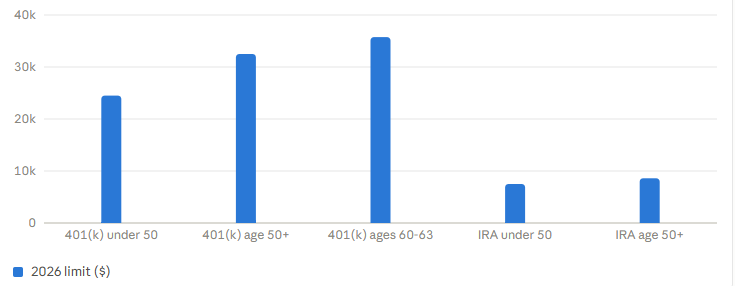
Roth eligibility also phases out with income. For 2026 the range is $153,000 to $168,000 for single filers and $242,000 to $252,000 for married couples filing jointly. If your employer offers a Roth 401(k), the 2026 employee limit is $24,500, with an extra $8,000 catch-up at 50 and older, or $11,250 at ages 60 to 63. If you are not working at all, the main route to a Roth is a conversion, which brings its own trade-offs.
There is also Medicare. Higher-income beneficiaries pay a surcharge called IRMAA, based on income from two years earlier. For 2026 the standard Part B premium is $202.90 a month, and surcharges start once income passes $109,000 for singles or $218,000 for couples. The first tier adds $81.20 a month to Part B and $14.50 to Part D, about $1,148 a year per person. It works like a cliff: cross a line by a dollar and the surcharge applies for the year. A conversion in 2026 can therefore raise your premiums in 2028.
Watch out: Large conversions, one-time IRA withdrawals and big capital gains all count toward IRMAA income. Size conversions deliberately, often in smaller yearly amounts, and ask a tax professional to model both the benefit tax and the Medicare effect.
A few other tools are worth knowing. Qualified charitable distributions let people age 70½ or older send money from an IRA directly to charity, which Kiplinger notes keeps it out of the provisional income calculation. If you are still on a high-deductible health plan and not yet on Medicare, a health savings account may be worth a look, though you generally cannot contribute once you enroll. And a few states tax benefits differently from the federal government, so check your own.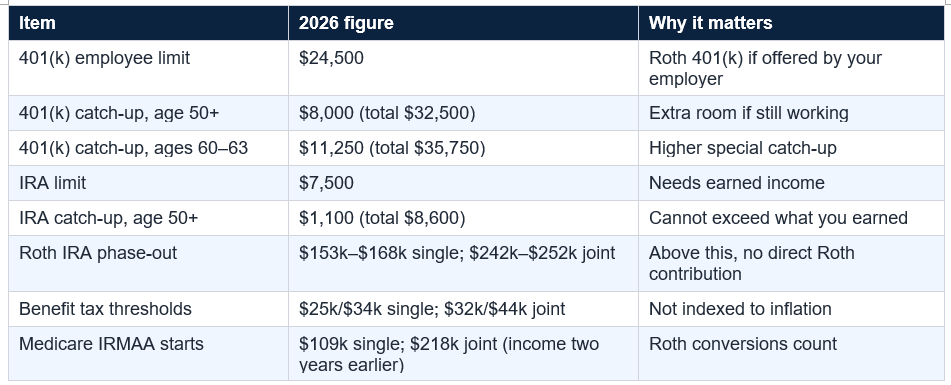
But the full answer depends on your earnings, your bracket, your Medicare exposure and how much time you have. Think of the account as a tool in a bigger plan, and use a qualified tax professional to run your own numbers before you move money. A little planning can protect a surprising share of the benefits you spent a lifetime earning.
Yes, if you have earned income such as wages or self-employment income. Social Security benefits themselves are not earned income. For 2026 the IRA limit is $7,500, plus a $1,100 catch-up at 50 and older, so $8,600, and you cannot contribute more than you earned. Roth contributions also phase out at higher incomes.
Do Roth IRA withdrawals count toward the tax on my Social Security?
Qualified Roth IRA and Roth 401(k) withdrawals are not part of adjusted gross income, so they do not count toward provisional income. Traditional IRA and 401(k) withdrawals do. That difference is the main reason Roth money is attractive for people who collect benefits.
Is a Roth conversion a good idea once I am on Social Security?
It can be, but the converted amount is taxable income in the year you convert. That can make more of your benefits taxable and can push your income over a Medicare IRMAA line two years later. Many planners size conversions carefully, often in smaller yearly amounts. A tax professional can model your numbers.
At what age do required minimum distributions start?
Sources cited here say 73 for traditional accounts. Roth IRAs have no required distributions for the original owner. The age rises to 75 for people born in 1960 or later under current law, so check which applies to you.
Is a Roth always better than a traditional account for retirees?
No. If your income is low enough that your benefits are not taxed and you are in a low bracket, traditional withdrawals or conversions may not cost much, and Roth conversions could create tax you would not otherwise owe. The right answer depends on your income, tax bracket, health costs and plans for heirs.
Taxable Social Security: single filer, $30,000 benefit ($)
Taxable portion of benefits ($) by Other income taken in the year
2026 maximum contributions by account and age ($)
Annual limit ($) by Account
Table of Contents
- A Bigger Check With a Catch
- The Short Answer
- How Your Benefits Actually Get Taxed
- Why Roth Money Plays Nicely With Social Security
- A Worked Example: Same $20,000, Very Different Results
- The Tax Torpedo and the COLA
- Who Can Fund a Roth, and How Much
- Roth Conversions and the Medicare Catch
- When a Roth Is Not the Best Answer
- The 2026 Numbers at a Glance
- A Simple Decision Guide
- Conclusion
- Frequently Asked Questions
A Bigger Check With a Catch
On October 14, the Social Security Administration announced a 3.6% cost-of-living increase for 2027, up from 2.8% this year. For the average recipient that is about $75 more a month, and it reaches more than 70 million people. It is good news. It also hides a catch that rarely makes the headlines: a bigger benefit check sits on top of the other money you live on, and the tax rules that decide how much of that check gets taxed were set decades ago and never adjusted for inflation.That is why the question of which retirement account to hold while collecting benefits is worth a closer look. The answer affects your tax bill, your Medicare premiums and how long your savings last.
The Short Answer
For many people collecting Social Security, the best account to have is a Roth account, a Roth IRA or a Roth 401(k). The reason is not that Roth money grows faster. It is that qualified Roth withdrawals are not counted when the IRS decides how much of your benefits to tax, and Roth IRAs do not require withdrawals at a set age. Traditional accounts do the opposite on both counts.But "many people" is doing real work in that sentence. A Roth is not automatically best, and for some retirees it is not available or not worth the cost of getting there. The rest of this post helps you tell which camp you are in.
How Your Benefits Actually Get Taxed
Social Security is taxed through a measure called provisional income. You take your adjusted gross income without Social Security, add any tax-exempt interest such as municipal bond income, and add half of your Social Security benefits. If the total passes certain thresholds, part of your benefits becomes taxable. For a single filer the first threshold is $25,000 and the second is $34,000. For a married couple filing jointly they are $32,000 and $44,000. Between the two, up to 50% of benefits can be taxable. Above the second, up to 85%.Two points are often misunderstood. First, 85% does not mean you lose 85% of your benefits to tax. It means up to 85% of the benefit is added to your taxable income, which is then taxed at your normal rate. Second, those thresholds have never been indexed to inflation. They are frozen at 1983 and 1993 levels, which is why more people are caught every year. Estimates of how many recipients pay tax on their benefits vary by source and year, from about 40% to roughly 56%.
The numbers: Provisional income = adjusted gross income (without Social Security) + tax-exempt interest + half of your benefits. Thresholds: $25,000 and $34,000 single; $32,000 and $44,000 joint. Up to 85% of benefits can be taxable.
Why Roth Money Plays Nicely With Social Security
Here is the heart of it. Traditional IRA and 401(k) withdrawals are included in your adjusted gross income, so they raise your provisional income. Qualified withdrawals from a Roth IRA or Roth 401(k) are not part of adjusted gross income, so they do not. Kiplinger and several other sources make the same point: tax-free Roth withdrawals stay out of the calculation.The second benefit is timing. Traditional accounts eventually force you to take money out. Sources cited here put the starting age for required minimum distributions at 73, and those withdrawals count as ordinary income whether you need the cash or not. Roth IRAs have no required distributions for the original owner. A big traditional balance can therefore push your income up in your seventies and eighties, just when your benefits are largest. A Roth gives you a pool of money you can tap or leave alone without moving the needle on your benefit tax.
A Worked Example: Same $20,000, Very Different Results
Let me make this concrete with an illustration I calculated using the IRS formula. Imagine a single retiree with a $30,000 annual Social Security benefit who needs $20,000 more to live on. In the first case the $20,000 comes from a traditional IRA. In the second it comes from a Roth IRA.The traditional IRA withdrawal does not just add $20,000 to taxable income. It also drags $5,350 of benefits into the tax base, so the withdrawal effectively raises taxable income by $25,350. The Roth withdrawal adds nothing. You would still pay tax on the traditional money at your normal rate, but the Roth path leaves the benefits alone. My calculation uses the same method as a published guide whose example of $45,000 provisional income produces $13,850 of taxable benefits.
The Tax Torpedo and the COLA
Planners have a name for what happens in the middle of this range: the tax torpedo. In my single-filer example the first $10,000 of other income produces no tax on benefits. Between provisional income of $25,000 and $34,000, each extra dollar of income adds about $1.50 to taxable income. Above $34,000 it adds about $1.85, until 85% of benefits are taxable, which in this example happens when other income reaches roughly $43,700. Past that point the torpedo stops, and the benefits are as taxable as they will get.Now add the COLA. A 3.6% raise on a $30,000 benefit is $1,080 more a year, and half of that, $540, is added to provisional income. Since the thresholds do not move, every cost-of-living increase nudges more of your benefit toward taxation. Keeping other income low, which is where Roth money helps, is one of the few levers you control. In the example, other income of $20,000 from a traditional account makes 17.8% of benefits taxable. At $30,000 it is 46.2%, and at about $43,700 it reaches the 85% cap.
Who Can Fund a Roth, and How Much
Here is the practical catch. You generally need earned income to contribute to an IRA, because Social Security itself does not count. If you are still working part time, or earning self-employment income, you can contribute. Sources note that you can keep contributing to an IRA or 401(k) while receiving benefits if you have earnings. In 2026 the IRA limit is $7,500, plus a $1,100 catch-up at 50 and older, for $8,600, and you cannot contribute more than you earned.Roth eligibility also phases out with income. For 2026 the range is $153,000 to $168,000 for single filers and $242,000 to $252,000 for married couples filing jointly. If your employer offers a Roth 401(k), the 2026 employee limit is $24,500, with an extra $8,000 catch-up at 50 and older, or $11,250 at ages 60 to 63. If you are not working at all, the main route to a Roth is a conversion, which brings its own trade-offs.
Roth Conversions and the Medicare Catch
A conversion moves money from a traditional account to a Roth and makes the converted amount taxable income in that year. Done before benefits start, it can shrink future required distributions and leave more room under the benefit-tax thresholds. Several sources point to the years between retiring and claiming as an ideal window. Once you are collecting, a conversion adds to provisional income that year, so a large one can make more of your benefits taxable.There is also Medicare. Higher-income beneficiaries pay a surcharge called IRMAA, based on income from two years earlier. For 2026 the standard Part B premium is $202.90 a month, and surcharges start once income passes $109,000 for singles or $218,000 for couples. The first tier adds $81.20 a month to Part B and $14.50 to Part D, about $1,148 a year per person. It works like a cliff: cross a line by a dollar and the surcharge applies for the year. A conversion in 2026 can therefore raise your premiums in 2028.
Watch out: Large conversions, one-time IRA withdrawals and big capital gains all count toward IRMAA income. Size conversions deliberately, often in smaller yearly amounts, and ask a tax professional to model both the benefit tax and the Medicare effect.
When a Roth Is Not the Best Answer
A Roth is not the right tool for everyone. If your provisional income sits below the first threshold, your benefits are not taxed at all, and converting could create tax you would not otherwise pay. If you are in a higher tax bracket now than you expect to be later, paying tax up front may cost more than it saves. If you have little time left to benefit from tax-free growth, or you rely on traditional withdrawals to fill low brackets, the math changes.A few other tools are worth knowing. Qualified charitable distributions let people age 70½ or older send money from an IRA directly to charity, which Kiplinger notes keeps it out of the provisional income calculation. If you are still on a high-deductible health plan and not yet on Medicare, a health savings account may be worth a look, though you generally cannot contribute once you enroll. And a few states tax benefits differently from the federal government, so check your own.
The 2026 Numbers at a Glance
A Simple Decision Guide
This is a framework, not a recommendation. If you are still working while collecting benefits, new savings in a Roth IRA or Roth 401(k) deserve serious consideration, up to your earnings and the limits. If you are not working and hold most of your savings in traditional accounts, the question is how to move some toward Roth treatment gradually, without tripping the benefit-tax and IRMAA lines. If most of your savings are already Roth, the question becomes which account to draw from each year. If your income is low enough that your benefits are barely taxed, the best move may be to avoid creating more taxable income than you need.Conclusion
The best retirement account to hold while collecting Social Security is, for many people, a Roth, because its withdrawals stay out of the formula that taxes your benefits and it does not force you to take money out. The same $20,000 can make $5,350 of benefits taxable from a traditional IRA and $0 from a Roth. With the 3.6% COLA arriving and thresholds that never rise, that difference matters more each year.But the full answer depends on your earnings, your bracket, your Medicare exposure and how much time you have. Think of the account as a tool in a bigger plan, and use a qualified tax professional to run your own numbers before you move money. A little planning can protect a surprising share of the benefits you spent a lifetime earning.
13. Frequently Asked Questions
Can I contribute to an IRA while collecting Social Security?Yes, if you have earned income such as wages or self-employment income. Social Security benefits themselves are not earned income. For 2026 the IRA limit is $7,500, plus a $1,100 catch-up at 50 and older, so $8,600, and you cannot contribute more than you earned. Roth contributions also phase out at higher incomes.
Do Roth IRA withdrawals count toward the tax on my Social Security?
Qualified Roth IRA and Roth 401(k) withdrawals are not part of adjusted gross income, so they do not count toward provisional income. Traditional IRA and 401(k) withdrawals do. That difference is the main reason Roth money is attractive for people who collect benefits.
Is a Roth conversion a good idea once I am on Social Security?
It can be, but the converted amount is taxable income in the year you convert. That can make more of your benefits taxable and can push your income over a Medicare IRMAA line two years later. Many planners size conversions carefully, often in smaller yearly amounts. A tax professional can model your numbers.
At what age do required minimum distributions start?
Sources cited here say 73 for traditional accounts. Roth IRAs have no required distributions for the original owner. The age rises to 75 for people born in 1960 or later under current law, so check which applies to you.
Is a Roth always better than a traditional account for retirees?
No. If your income is low enough that your benefits are not taxed and you are in a low bracket, traditional withdrawals or conversions may not cost much, and Roth conversions could create tax you would not otherwise owe. The right answer depends on your income, tax bracket, health costs and plans for heirs.
0 Comments
Be the first to share your thoughts on this article.