

Retirement
Turn a $1 Million Nest Egg Into a Lifetime Income Machine

63% of Americans fear outliving their money more than death (Allianz). The 4% rule gives $40,000/year. Add average Social Security and a couple can reach $88,000/year. Here is how to make the machine run for life.
A million dollars. For a generation of savers, it became the number — the milestone that meant you had made it, the threshold beyond which retirement was supposed to feel safe. The reality, as anyone who has actually crossed it will tell you, is more complicated. Because a million dollars sitting in an account is not an income. It is a pile of capital that needs to be converted into a reliable, durable, inflation-adjusted income stream that will fund your life for twenty, thirty, or forty years — through market crashes, healthcare cost spikes, and a Federal Reserve that keeps changing its mind about interest rates. The good news: there are proven, research-backed strategies for doing exactly this. The question is not whether $1 million can generate a lifetime income. It can. The question is which combination of strategies converts it most effectively for your specific circumstances. This article works through five of the most important: the 4% rule and its current debate, Social Security as the first income layer, the bucket strategy for sequence-of-returns protection, partial annuitisation for a guaranteed floor, and flexible withdrawal for long-term portfolio survival. With the 2026 data behind each.
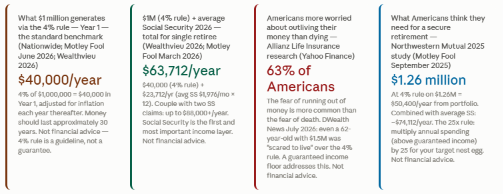
4% rule on $1M = $40,000/year (Year 1) (Nationwide; Motley Fool June 2026; Wealthvieu 2026). 3% = $30,000/year. $40k + average SS ($23,712/year) = $63,712/year single (Wealthvieu 2026). Couple with two SS claims: up to $88,000/year. 63% of Americans more worried about outliving money than dying (Allianz via Yahoo Finance). Americans estimate needing $1.26 million for secure retirement (Northwestern Mutual 2025).
What $1M generates: $1M × 4% = $40,000/year (Year 1). $1M × 3% = $30,000/year (more conservative). $1M × 3.5% = $35,000/year (middle ground).
The 4% rule assumes a 30-year retirement with a balanced stock/bond portfolio. If you retire at 55, you may have a 40-year horizon — for which even 3.5% may carry meaningful risk. If your portfolio is bond-heavy, 4% may be too aggressive.
The 25x rule is the 4% rule in reverse: multiply your annual spending by 25 to find the target nest egg. If you need $60,000/year, you need $1,500,000 before Social Security. If Social Security provides $24,000/year, you need $60,000 - $24,000 = $36,000 from portfolio × 25 = $900,000. The target adjusts down when you layer income sources.
What $1M generates: $40k (4% rule) + $23,712 (avg SS 2026) = $63,712/year (single). $40k + ~$48,000 (couple claiming SS) = ~$88,000/year (couple). Source: Wealthvieu 2026; Motley Fool March 2026.
Social Security is not guaranteed to remain exactly as currently structured. Current projections suggest the Social Security Trust Fund may face funding pressure in the 2030s unless Congress acts. This does not mean SS disappears — it means benefits could be reduced. Not planning around SS at all leaves significant income on the table; assuming it will be unchanged indefinitely is also a risk.
Delay Social Security as long as feasible. Every year you delay past Full Retirement Age (67 for those born after 1960) increases your benefit by 8% per year, up to age 70. This is a guaranteed, inflation-adjusted 8% return on the delay — better than most fixed income alternatives. If health is good and portfolio can sustain early retirement years, delaying SS dramatically improves the income machine's long-term performance.
What $1M generates: Bucket 1 (cash, 1-2 years): ~$40,000-$80,000. Bucket 2 (bonds, 3-10 years): ~$120,000-$400,000. Bucket 3 (equities, long-term growth): remainder. At $1M total: approximate structure = $60k cash + $240k bonds + $700k equities. Not financial advice — specific allocation depends on individual risk tolerance and income needs.
The bucket strategy requires active rebalancing — periodically refilling Bucket 1 from Bucket 2, and Bucket 2 from Bucket 3, as market conditions allow. If not rebalanced, Bucket 1 depletes and the strategy fails. Build a clear rebalancing schedule (annually or when Bucket 1 falls below one year of expenses) before implementing.
The psychological value of Bucket 1 is as important as its mathematical value. Knowing that two years of living expenses are in cash, completely insulated from a stock market crash, eliminates the panic-selling reflex that turns paper losses into permanent ones. The bucket strategy is as much a behavioural tool as a financial one.
What $1M generates: Illustrative partial annuity: $200,000 of a $1M portfolio into a lifetime annuity at 2026 rates for a 65-year-old might generate approximately $12,000-$14,400/year guaranteed for life. Remaining $800,000 at 4% = $32,000/year. Plus SS: total $67,000-$69,400/year with guaranteed floor. Illustrative only.
Not all annuities are appropriate for all retirees. Variable annuities and indexed annuities can be complex, expensive, and carry surrender charges. Simple fixed immediate annuities or deferred income annuities (DIAs) are typically more straightforward. Always get quotes from multiple insurers, understand the surrender terms, and confirm FDIC/state guaranty association coverage. Not financial advice — consult a fee-only fiduciary who does not earn commission from annuity sales.
The 'floor and upside' approach: use 20-30% of the nest egg to purchase a guaranteed lifetime annuity (the floor), covering essential expenses alongside Social Security, while keeping 70-80% in a managed portfolio (the upside). This structure means the retiree can afford to take more growth-oriented risk in the portfolio, knowing essential expenses are covered by the guaranteed floor regardless of market performance.
What $1M generates: Flexible withdrawal example at $1M: floor $28,000/year (2.8% — essential expenses only). Base $40,000/year (4%). Ceiling $48,000/year (4.8% — portfolio up significantly). The floor is covered by SS + minimal portfolio draw. The ceiling is a reward for portfolio growth years. Plus SS at any scenario.
Flexible withdrawal requires the discipline to actually reduce spending when the market falls. For retirees whose essential expenses are fixed (mortgage/rent, healthcare, food), flexibility only applies to discretionary spending. Build the floor to cover essential expenses — ideally from guaranteed income streams (SS, annuity) — so discretionary adjustments do not create hardship.
The Guyton-Klinger guardrails system is a well-researched flexible withdrawal framework: if the withdrawal rate rises above a ceiling (typically 5-6%), take a 10% spending cut. If it falls below a floor (typically 3-4%), take a 10% spending increase. This dynamic adjustment keeps the portfolio from being depleted in bad markets and allows real increases in good ones. Consult a financial planner for the specific parameters appropriate to your situation.
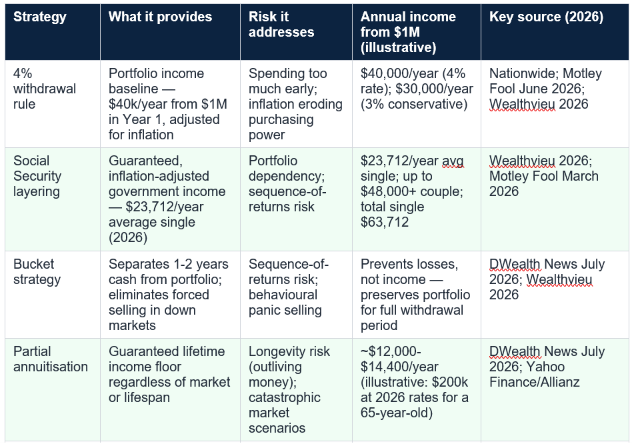
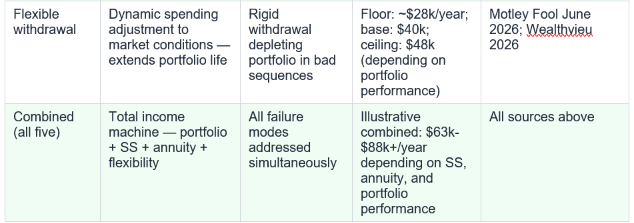
All figures are illustrative and based on 2026 data from sources cited. Individual outcomes depend on age at retirement, portfolio composition, tax situation, actual Social Security benefit, annuity rates, and market performance. Not financial, investment, or retirement advice. Consult a qualified, fee-only fiduciary financial planner for a personalised strategy.
The answer is: for most Americans retiring in their mid-to-late 60s with Social Security income and reasonable expenses, yes. Wealthvieu's 2026 retirement planning guide concludes: '$1 million can absolutely fund a comfortable retirement in 2026 — for most Americans retiring in their mid-to-late 60s with Social Security income and reasonable expenses. The 4% rule generates $40,000/year in portfolio income; combined with Social Security, most couples have $70,000-$90,000/year.' The caveats: if you retire at 55, $1 million may not be enough for a 40-year horizon. If you live in a high-cost city and spend $120,000/year, $1 million is insufficient without a second portfolio or significant other income. The 25x rule means your portfolio target should be approximately 25 times your annual spending above guaranteed income (Social Security, pension).
What is the 4% rule and is it still valid in 2026?
The 4% rule says you can withdraw 4% of your portfolio in Year 1 of retirement, then increase that amount annually for inflation, and the money should last at least 30 years. For $1 million, that is $40,000 in Year 1. Nationwide's guidance confirms it is still the primary benchmark. However, as Motley Fool's 2025 analysis notes, 'the 4% rule is under debate. Some experts say 4% is too aggressive if markets underperform, while others think higher yields on cash and bonds could support that rate.' For longer retirements (40+ years), a 3% or 3.5% withdrawal rate is more conservative. Dave Ramsey controversially claimed $1 million could sustain $80,000/year — a position most financial planners dispute as ignoring sequence-of-returns risk. Not financial advice — consult a fee-only fiduciary planner for your specific situation.
How does Social Security change the calculation?
Social Security is the most important income layer that most retirees have and the most underestimated in simplistic $1 million analyses. Wealthvieu's 2026 guide provides the combined picture: average Social Security benefit in 2026 is approximately $1,976/month ($23,712/year). Combined with the 4% rule on $1 million ($40,000/year), the total for a single retiree is approximately $63,712/year. For a couple claiming two benefits, the combined total can reach $88,000 or more. Every dollar of Social Security income reduces the withdrawal rate your portfolio needs to sustain, directly improving survivability. Delaying Social Security to age 70 (if health and finances permit) increases the monthly benefit by approximately 8% per year over Full Retirement Age — a significant long-term enhancement to the income machine.
What is the bucket strategy and why does it matter?
The bucket strategy divides your retirement portfolio into three segments based on time horizon: Bucket 1 (1-2 years of living expenses in cash), Bucket 2 (bonds covering 3-10 years), and Bucket 3 (equities for long-term growth). The purpose is to protect against sequence-of-returns risk — the danger that a market crash in the early years of retirement forces you to sell equities at low prices to fund living expenses, permanently reducing the portfolio's base. DWealth News' July 2026 guide specifically recommends the bucket strategy as a practical tool to reduce retirement fear. When markets fall, you draw from Bucket 1, allowing Bucket 3 to recover before being touched. The strategy also has a powerful psychological benefit: knowing two years of expenses are in cash removes the panic-selling reflex.
Should I consider buying an annuity with part of my $1 million?
Possibly, depending on your circumstances. DWealth News' July 2026 retirement guidance specifically recommends 'investigating guaranteed income options like partial annuitization if guaranteed monthly cashflow would ease anxiety.' The case for a partial annuity: it provides guaranteed lifetime income regardless of how long you live or what the market does, eliminating the outliving-money fear that Allianz found affects 63% of Americans. The case against: annuities are irreversible, and some carry high fees and commissions. The 'floor and upside' approach — using 20-30% of the nest egg for a guaranteed annuity while keeping 70-80% in a managed portfolio — is often the most balanced structure. Always get independent advice from a fee-only fiduciary who does not earn commission from annuity sales before purchasing one.
A million dollars. For a generation of savers, it became the number — the milestone that meant you had made it, the threshold beyond which retirement was supposed to feel safe. The reality, as anyone who has actually crossed it will tell you, is more complicated. Because a million dollars sitting in an account is not an income. It is a pile of capital that needs to be converted into a reliable, durable, inflation-adjusted income stream that will fund your life for twenty, thirty, or forty years — through market crashes, healthcare cost spikes, and a Federal Reserve that keeps changing its mind about interest rates. The good news: there are proven, research-backed strategies for doing exactly this. The question is not whether $1 million can generate a lifetime income. It can. The question is which combination of strategies converts it most effectively for your specific circumstances. This article works through five of the most important: the 4% rule and its current debate, Social Security as the first income layer, the bucket strategy for sequence-of-returns protection, partial annuitisation for a guaranteed floor, and flexible withdrawal for long-term portfolio survival. With the 2026 data behind each.
Table of Contents
- What a $1 Million Nest Egg Actually Looks Like in 2026
- Strategy 1 The 4% Rule: The Foundation Everyone Debates, Nobody Ignores
- Strategy 2 Social Security as Your First Income Layer
- Strategy 3 The Bucket Strategy: Protection Against the Sequence-of-Returns Devil
- Strategy 4 Annuities: The Guaranteed Floor That Changes the Conversation
- Strategy 5 Flexible Withdrawal: Adjusting the Tap to Market Conditions
- The Combined Income Machine: Layering All Five Strategies
- Conclusion: The Machine Needs a Blueprint, Not Just a Balance
- Frequently Asked Questions
What a $1 Million Nest Egg Actually Looks Like in 2026
Before the strategies, the honest numbers. A million dollars in a retirement account in 2026 is a remarkable achievement — one that most Americans never reach. Motley Fool’s March 2026 analysis notes plainly: ‘Retiring with $1 million is something many people don’t come close to doing.’ But the gap between ‘I have a million dollars’ and ‘I have a reliable income for thirty years’ is where retirement planning earns its reputation for complexity. Allianz Life Insurance research, cited by Yahoo Finance, found that 63% of Americans are more worried about outliving their money than about dying. This fear is not irrational. A million dollars invested at 3% interest generates $30,000 per year in yield. At 4% withdrawal rate, it produces $40,000 in year one. Neither of those figures, on its own, describes a comfortable American retirement. The median household income in the US is approximately $80,000. Wealthvieu’s 2026 retirement guide adds the crucial layer: combined with the average Social Security benefit of approximately $1,976 per month in 2026, the total for a single retiree reaches $63,712 per year. For a couple with two Social Security claims, the combined income can reach $88,000 or above. The Northwestern Mutual study cited by Motley Fool in September 2025 found that Americans project they need $1.26 million, on average, for a secure retirement. At 4% on $1.26 million, that is $50,400 from the portfolio. The five strategies that follow are the tools that convert these starting-point numbers into the most durable version of the income machine your million can build.4% rule on $1M = $40,000/year (Year 1) (Nationwide; Motley Fool June 2026; Wealthvieu 2026). 3% = $30,000/year. $40k + average SS ($23,712/year) = $63,712/year single (Wealthvieu 2026). Couple with two SS claims: up to $88,000/year. 63% of Americans more worried about outliving money than dying (Allianz via Yahoo Finance). Americans estimate needing $1.26 million for secure retirement (Northwestern Mutual 2025).
Strategy 1 The 4% Rule: The Foundation Everyone Debates, Nobody Ignores
The 4% rule originated in research by financial planner William Bengen in 1994, who found that a portfolio split between stocks and bonds could sustain 4% annual withdrawals (adjusted for inflation) for at least 30 years across historical market scenarios. It became the default framework for retirement income planning for a generation. In 2026, it is both the most cited retirement guideline and the most debated. Motley Fool’s June 2026 article on withdrawal strategies from a $1 million portfolio sets out the baseline cleanly: if you use the 4% rule, you can withdraw $40,000 in year one, then adjust annually for inflation. Nationwide’s guidance confirms: ‘If you spend your retirement savings at a rate of 4% the first year and then adjust your withdrawals for inflation every year, your income will probably last three decades.’ For a $1 million nest egg, this produces $40,000 in year one. At a 3% rate — more conservative, recommended for longer retirements — that is $30,000. The Motley Fool’s personal finance coverage from 2025 notes the tension: ‘The 4% rule is under debate. Some experts say 4% is too aggressive if markets underperform, while others think higher yields on cash and bonds could support that rate.’ Dave Ramsey controversially claimed in May 2026 that $1 million could sustainably generate $80,000 annually by staying invested in stocks — dismissing the 4% rule as ‘bogus math.’ This position is challenged by most mainstream financial planners, who note that it ignores sequence-of-returns risk. The honest framing: the 4% rule is a benchmark, not a guarantee. Motley Fool’s June 2026 guidance recommends treating it as a starting point and adjusting based on your portfolio composition, health, and other income sources.What $1M generates: $1M × 4% = $40,000/year (Year 1). $1M × 3% = $30,000/year (more conservative). $1M × 3.5% = $35,000/year (middle ground).
The 4% rule assumes a 30-year retirement with a balanced stock/bond portfolio. If you retire at 55, you may have a 40-year horizon — for which even 3.5% may carry meaningful risk. If your portfolio is bond-heavy, 4% may be too aggressive.
The 25x rule is the 4% rule in reverse: multiply your annual spending by 25 to find the target nest egg. If you need $60,000/year, you need $1,500,000 before Social Security. If Social Security provides $24,000/year, you need $60,000 - $24,000 = $36,000 from portfolio × 25 = $900,000. The target adjusts down when you layer income sources.
Strategy 2 Social Security as Your First Income Layer
The framing of $1 million as the sole source of retirement income misses the most important income stream available to most American retirees: Social Security. Wealthvieu’s 2026 retirement planning guide is specific about the combined picture: the average Social Security benefit in 2026 is approximately $1,976 per month ($23,712 per year). Combined with the $40,000 from the 4% rule on $1 million, the total is approximately $63,712 per year for a single retiree. For a married couple where both spouses claim reasonable Social Security benefits, the total can reach $88,000 or more. The Motley Fool’s March 2026 analysis confirms: ‘The average benefit is $2,075 per month as of January 2026.’ Yahoo Finance’s retirement planning guide notes the limitation: Social Security on average replaces only 40% of pre-retirement income, ‘which is why your personal savings are also important.’ The strategic implication for a $1 million nest egg: every dollar of Social Security income you receive reduces the amount you need to withdraw from the portfolio, directly reducing the portfolio’s depletion rate and improving its survivability. DWealth News’ July 2026 practical retirement planning guide recommends delaying Social Security to 70 where possible to maximise the lifetime monthly benefit — the delay from 62 to 70 can increase the monthly benefit by approximately 76%. For a $1 million retiree who can cover expenses through other means for eight years, the delayed Social Security claim permanently improves the income machine for the rest of their life.What $1M generates: $40k (4% rule) + $23,712 (avg SS 2026) = $63,712/year (single). $40k + ~$48,000 (couple claiming SS) = ~$88,000/year (couple). Source: Wealthvieu 2026; Motley Fool March 2026.
Social Security is not guaranteed to remain exactly as currently structured. Current projections suggest the Social Security Trust Fund may face funding pressure in the 2030s unless Congress acts. This does not mean SS disappears — it means benefits could be reduced. Not planning around SS at all leaves significant income on the table; assuming it will be unchanged indefinitely is also a risk.
Delay Social Security as long as feasible. Every year you delay past Full Retirement Age (67 for those born after 1960) increases your benefit by 8% per year, up to age 70. This is a guaranteed, inflation-adjusted 8% return on the delay — better than most fixed income alternatives. If health is good and portfolio can sustain early retirement years, delaying SS dramatically improves the income machine's long-term performance.
Strategy 3 The Bucket Strategy: Protection Against the Sequence-of-Returns Devil
The single greatest threat to a $1 million retirement income machine is not a low average return. It is a bad return in the first few years of retirement. This is called sequence-of-returns risk: if the portfolio falls 30% in year two of a 30-year retirement, the retiree is forced to sell assets at low prices to fund living expenses, permanently reducing the base that future returns can act on. A 30% loss that happens in year 25 of retirement is far less damaging than the same loss in year two. The bucket strategy, recommended by DWealth News’ July 2026 practical retirement guide as one of the core tools to reduce retirement fear, addresses this risk by partitioning the portfolio across three time horizons. The first bucket holds one to two years of living expenses in cash or short-term instruments — completely insulated from market volatility. When the market falls, the retiree draws from Bucket 1, allowing Buckets 2 and 3 to recover before being touched. Bucket 2 holds intermediate-term assets (typically bonds) covering approximately three to ten years of expenses, replenishing Bucket 1 over time. Bucket 3 holds equities for long-term growth, providing the return that makes a 30-year retirement sustainable. Wealthvieu’s 2026 retirement planning guide confirms that the portfolio composition fundamentally determines the appropriate withdrawal rate: ‘If your portfolio has a much larger concentration in bonds, then a 4% withdrawal rate may be too aggressive.’ The bucket strategy builds the flexibility to ride out the years when the market tests your patience without forcing you to sell at the worst possible time.What $1M generates: Bucket 1 (cash, 1-2 years): ~$40,000-$80,000. Bucket 2 (bonds, 3-10 years): ~$120,000-$400,000. Bucket 3 (equities, long-term growth): remainder. At $1M total: approximate structure = $60k cash + $240k bonds + $700k equities. Not financial advice — specific allocation depends on individual risk tolerance and income needs.
The bucket strategy requires active rebalancing — periodically refilling Bucket 1 from Bucket 2, and Bucket 2 from Bucket 3, as market conditions allow. If not rebalanced, Bucket 1 depletes and the strategy fails. Build a clear rebalancing schedule (annually or when Bucket 1 falls below one year of expenses) before implementing.
The psychological value of Bucket 1 is as important as its mathematical value. Knowing that two years of living expenses are in cash, completely insulated from a stock market crash, eliminates the panic-selling reflex that turns paper losses into permanent ones. The bucket strategy is as much a behavioural tool as a financial one.
Strategy 4 Annuities: The Guaranteed Floor That Changes the Conversation
The fear that most haunts retirees is not poor returns or inflation. It is outliving their money. Allianz Life Insurance research, cited by Yahoo Finance, found that 63% of Americans are more worried about running out of money in retirement than about dying. DWealth News’ July 2026 practical guide for the ‘scared to live over the 4% rule’ retiree specifically recommends investigating ‘guaranteed income options like partial annuitization if guaranteed monthly cashflow would ease anxiety.’ A lifetime income annuity solves the outliving problem structurally: in exchange for a lump sum, the insurance company pays a guaranteed monthly income for life, regardless of how long you live or what the market does. It converts a portion of the nest egg from uncertain investment returns into a defined, predictable income stream. The strategic use of a partial annuity alongside a managed portfolio preserves upside while creating a guaranteed floor. The tradeoff is irreversibility: money placed in a straight lifetime annuity typically cannot be reclaimed. The current annuity rate environment matters significantly. With interest rates at still-elevated levels in 2026, annuity payout rates are more attractive than they were during the low-rate decade of 2010-2021. A rough illustrative figure: at 2026 rates, a $200,000 premium might generate approximately $1,000-$1,200/month ($12,000-$14,400/year) in guaranteed lifetime income for a 65-year-old. This is illustrative only — actual rates depend on age, type of annuity, insurer, and prevailing interest rates. Not financial advice. Always consult a qualified, independent financial adviser before purchasing an annuity.What $1M generates: Illustrative partial annuity: $200,000 of a $1M portfolio into a lifetime annuity at 2026 rates for a 65-year-old might generate approximately $12,000-$14,400/year guaranteed for life. Remaining $800,000 at 4% = $32,000/year. Plus SS: total $67,000-$69,400/year with guaranteed floor. Illustrative only.
Not all annuities are appropriate for all retirees. Variable annuities and indexed annuities can be complex, expensive, and carry surrender charges. Simple fixed immediate annuities or deferred income annuities (DIAs) are typically more straightforward. Always get quotes from multiple insurers, understand the surrender terms, and confirm FDIC/state guaranty association coverage. Not financial advice — consult a fee-only fiduciary who does not earn commission from annuity sales.
The 'floor and upside' approach: use 20-30% of the nest egg to purchase a guaranteed lifetime annuity (the floor), covering essential expenses alongside Social Security, while keeping 70-80% in a managed portfolio (the upside). This structure means the retiree can afford to take more growth-oriented risk in the portfolio, knowing essential expenses are covered by the guaranteed floor regardless of market performance.
Strategy 5 Flexible Withdrawal: Adjusting the Tap to Market Conditions
The 4% rule’s weakness is its inflexibility: it withdraws the same inflation-adjusted amount regardless of what the portfolio is doing. A more adaptive approach adjusts withdrawals in response to market conditions, reducing spending when the portfolio is under stress and allowing higher withdrawals when it has performed well. This is the core of flexible withdrawal strategies, which research consistently shows improve both the survivability of the portfolio and the total lifetime income it provides. Motley Fool’s June 2026 withdrawal guide is specific: ‘It’s also wise to adjust that rate as needed to account for market conditions. While it’s smart to establish a baseline withdrawal rate for your retirement savings, it’s also wise to adjust that rate as needed.’ Wealthvieu’s 2026 guide confirms: ‘Ultimately, the amount it’s safe to withdraw from a $1 million portfolio depends on different factors. One of the most important things to do is not only set a withdrawal rate from the start, but tweak it when the market doesn’t cooperate.’ Practical implementation: establish a floor withdrawal rate (the minimum you need to cover essential expenses), a base rate (4% of original balance), and a ceiling (a higher rate in years when the portfolio has grown significantly above its original value). In a down market year, you draw from Bucket 1 cash rather than reducing the equity portfolio, achieving the same spending flexibility without selling at depressed prices.What $1M generates: Flexible withdrawal example at $1M: floor $28,000/year (2.8% — essential expenses only). Base $40,000/year (4%). Ceiling $48,000/year (4.8% — portfolio up significantly). The floor is covered by SS + minimal portfolio draw. The ceiling is a reward for portfolio growth years. Plus SS at any scenario.
Flexible withdrawal requires the discipline to actually reduce spending when the market falls. For retirees whose essential expenses are fixed (mortgage/rent, healthcare, food), flexibility only applies to discretionary spending. Build the floor to cover essential expenses — ideally from guaranteed income streams (SS, annuity) — so discretionary adjustments do not create hardship.
The Guyton-Klinger guardrails system is a well-researched flexible withdrawal framework: if the withdrawal rate rises above a ceiling (typically 5-6%), take a 10% spending cut. If it falls below a floor (typically 3-4%), take a 10% spending increase. This dynamic adjustment keeps the portfolio from being depleted in bad markets and allows real increases in good ones. Consult a financial planner for the specific parameters appropriate to your situation.
The Combined Income Machine: Layering All Five Strategies
The power of the $1 million income machine is not in any single strategy. It is in the layering. Each strategy addresses a different failure mode. The 4% rule sets the withdrawal discipline. Social Security provides the guaranteed inflation-adjusted base. The bucket strategy protects against sequence-of-returns risk. The annuity creates a guaranteed income floor. Flexible withdrawal extends the portfolio’s lifespan in volatile markets. Together, they build a retirement income structure that is more durable than any single component.All figures are illustrative and based on 2026 data from sources cited. Individual outcomes depend on age at retirement, portfolio composition, tax situation, actual Social Security benefit, annuity rates, and market performance. Not financial, investment, or retirement advice. Consult a qualified, fee-only fiduciary financial planner for a personalised strategy.
Conclusion
The retiree described in DWealth News’ July 2026 article — a 62-year-old with $1.5 million who was ‘scared to live’ over the 4% rule — illustrates the real challenge of retirement income planning. The balance is not the answer. The blueprint is the answer. A million dollars without a distribution strategy is like an engine without an exhaust system. The energy is there. Without the right architecture to channel it, it does not produce what you need. The Motley Fool’s June 2026 guidance summarises the key principle: ‘The more income streams you have, the better.’ Wealthvieu confirms that adjusting the withdrawal rate when markets are uncooperative, combined with multiple income sources, ‘could set the stage for a largely stress-free retirement, at least financially speaking.’ The blueprint for a $1 million lifetime income machine is the combination of these five strategies, weighted to your specific circumstances and reviewed at least annually. Start with the 4% rule as the baseline. Layer Social Security on top of it. Protect the portfolio from sequence risk with the bucket strategy. Consider a partial annuity for the guaranteed floor that removes the outliving-money fear. And give yourself permission to be flexible when the market tests you. This is not financial, investment, or retirement advice. Always consult a qualified, regulated financial adviser or fee-only fiduciary planner for personalised guidance.Frequently Asked Questions
Is $1 million actually enough to retire on in 2026?The answer is: for most Americans retiring in their mid-to-late 60s with Social Security income and reasonable expenses, yes. Wealthvieu's 2026 retirement planning guide concludes: '$1 million can absolutely fund a comfortable retirement in 2026 — for most Americans retiring in their mid-to-late 60s with Social Security income and reasonable expenses. The 4% rule generates $40,000/year in portfolio income; combined with Social Security, most couples have $70,000-$90,000/year.' The caveats: if you retire at 55, $1 million may not be enough for a 40-year horizon. If you live in a high-cost city and spend $120,000/year, $1 million is insufficient without a second portfolio or significant other income. The 25x rule means your portfolio target should be approximately 25 times your annual spending above guaranteed income (Social Security, pension).
What is the 4% rule and is it still valid in 2026?
The 4% rule says you can withdraw 4% of your portfolio in Year 1 of retirement, then increase that amount annually for inflation, and the money should last at least 30 years. For $1 million, that is $40,000 in Year 1. Nationwide's guidance confirms it is still the primary benchmark. However, as Motley Fool's 2025 analysis notes, 'the 4% rule is under debate. Some experts say 4% is too aggressive if markets underperform, while others think higher yields on cash and bonds could support that rate.' For longer retirements (40+ years), a 3% or 3.5% withdrawal rate is more conservative. Dave Ramsey controversially claimed $1 million could sustain $80,000/year — a position most financial planners dispute as ignoring sequence-of-returns risk. Not financial advice — consult a fee-only fiduciary planner for your specific situation.
How does Social Security change the calculation?
Social Security is the most important income layer that most retirees have and the most underestimated in simplistic $1 million analyses. Wealthvieu's 2026 guide provides the combined picture: average Social Security benefit in 2026 is approximately $1,976/month ($23,712/year). Combined with the 4% rule on $1 million ($40,000/year), the total for a single retiree is approximately $63,712/year. For a couple claiming two benefits, the combined total can reach $88,000 or more. Every dollar of Social Security income reduces the withdrawal rate your portfolio needs to sustain, directly improving survivability. Delaying Social Security to age 70 (if health and finances permit) increases the monthly benefit by approximately 8% per year over Full Retirement Age — a significant long-term enhancement to the income machine.
What is the bucket strategy and why does it matter?
The bucket strategy divides your retirement portfolio into three segments based on time horizon: Bucket 1 (1-2 years of living expenses in cash), Bucket 2 (bonds covering 3-10 years), and Bucket 3 (equities for long-term growth). The purpose is to protect against sequence-of-returns risk — the danger that a market crash in the early years of retirement forces you to sell equities at low prices to fund living expenses, permanently reducing the portfolio's base. DWealth News' July 2026 guide specifically recommends the bucket strategy as a practical tool to reduce retirement fear. When markets fall, you draw from Bucket 1, allowing Bucket 3 to recover before being touched. The strategy also has a powerful psychological benefit: knowing two years of expenses are in cash removes the panic-selling reflex.
Should I consider buying an annuity with part of my $1 million?
Possibly, depending on your circumstances. DWealth News' July 2026 retirement guidance specifically recommends 'investigating guaranteed income options like partial annuitization if guaranteed monthly cashflow would ease anxiety.' The case for a partial annuity: it provides guaranteed lifetime income regardless of how long you live or what the market does, eliminating the outliving-money fear that Allianz found affects 63% of Americans. The case against: annuities are irreversible, and some carry high fees and commissions. The 'floor and upside' approach — using 20-30% of the nest egg for a guaranteed annuity while keeping 70-80% in a managed portfolio — is often the most balanced structure. Always get independent advice from a fee-only fiduciary who does not earn commission from annuity sales before purchasing one.
0 Comments
Be the first to share your thoughts on this article.